


Matthew 21:12
Bible text: King James Version (1769 Blayney text) · Public domain
Bible text: King James Version with Strong's numbers · Public domain
Bible text: Berean Standard Bible · Public domain
Bible text: American Standard Version (1901) · Public domain
Bible text: World English Bible, Messianic edition · Public domain
Bible text: Geneva Bible (1599) · Public domain
Bible text: Young's Literal Translation · Public domain
- ΚαὶKaiAndG2532CONJConjunction
- εἰσῆλθενeisēlthenenteredG1525V-2AAI-3SVerb 2nd Aorist Active Indicative 3rd Singular
- ὁho<the>G3588T-NSMDefinite article Nominative Singular Masculine
- ἸησοῦςIēsousJesusG2424N-NSM-PNoun Nominative Singular Masculine Individual
- εἰςeisintoG1519PREPPreposition
- τὸtotheG3588T-ASNDefinite article Accusative Singular Neuter
- ἱερὸνhi'erontempleG2411N-ASNNoun Accusative Singular Neuter
- τοῦtou<the>G3588T-GSMDefinite article Genitive Singular Masculine
- θεοῦtheouof GodG2316N-GSM-TNoun Genitive Singular Masculine Title
- καὶkaiandG2532CONJConjunction
- ἐξέβαλενexebalencast outG1544V-2AAI-3SVerb 2nd Aorist Active Indicative 3rd Singular
- πάνταςpantasallG3956A-APMAdjective Accusative Plural Masculine
- τοὺςtousthoseG3588T-APMDefinite article Accusative Plural Masculine
- πωλοῦνταςpōlountassellingG4453V-PAP-APMVerb Present Active Participle Accusative Plural Masculine
- καὶkaiandG2532CONJConjunction
- ἀγοράζονταςagorazontasbuyingG59V-PAP-APMVerb Present Active Participle Accusative Plural Masculine
- ἐνeninG1722PREPPreposition
- τῷtōtheG3588T-DSNDefinite article Dative Singular Neuter
- ἱερῷhi'erōtempleG2411N-DSNNoun Dative Singular Neuter
- καὶkaiandG2532CONJConjunction
- τὰςtastheG3588T-APFDefinite article Accusative Plural Feminine
- τραπέζαςtrapezastablesG5132N-APFNoun Accusative Plural Feminine
- τῶνtōnof theG3588T-GPMDefinite article Genitive Plural Masculine
- κολλυβιστῶνkollubistōnmoney changersG2855N-GPMNoun Genitive Plural Masculine
- κατέστρεψενkatestrepsenHe overturnedG2690V-AAI-3SVerb Aorist Active Indicative 3rd Singular
- καὶkaiandG2532CONJConjunction
- τὰςtastheG3588T-APFDefinite article Accusative Plural Feminine
- καθέδραςkathedrasseatsG2515N-APFNoun Accusative Plural Feminine
- τῶνtōnof thoseG3588T-GPMDefinite article Genitive Plural Masculine
- πωλούντωνpōlountōnsellingG4453V-PAP-GPMVerb Present Active Participle Genitive Plural Masculine
- τὰςtastheG3588T-APFDefinite article Accusative Plural Feminine
- περιστεράςperisterasdovesG4058N-APFNoun Accusative Plural Feminine
English is a literal word-by-word gloss of the Greek, not the KJV's wording. Why?
This is the original text the KJV's translators worked from — each Greek word with its own literal English meaning in this verse, prepared by scholars at Tyndale House, Cambridge. The KJV translates whole sentences, not word by word, so its wording differs: one Greek word can become several English words, and the KJV may choose “charity” where the gloss reads “love”. Both are faithful — they answer different questions. For the KJV's own rendering, switch to the KJV text.
Details
See on the biblical-era maps
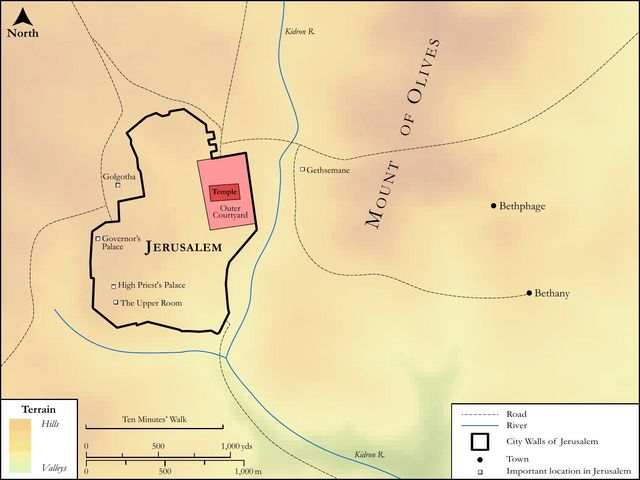
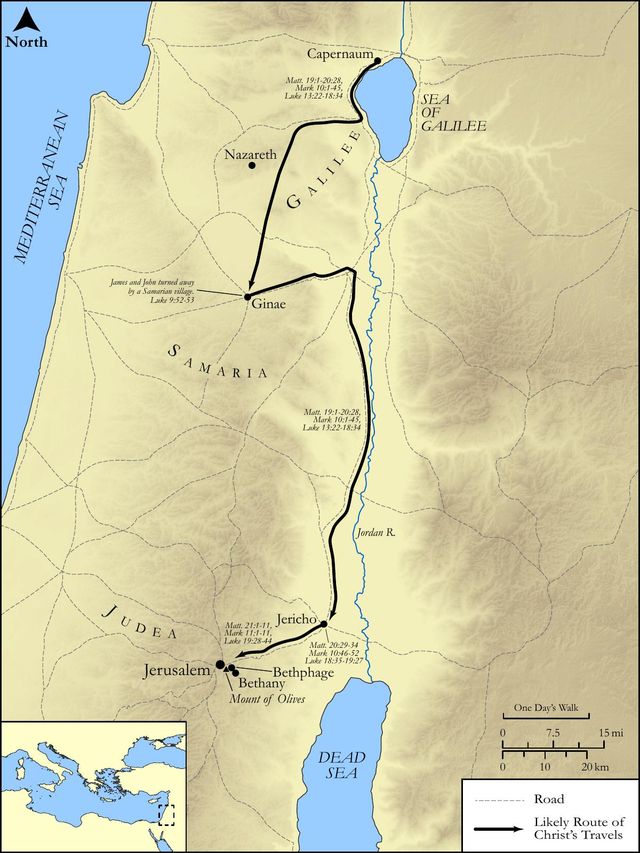
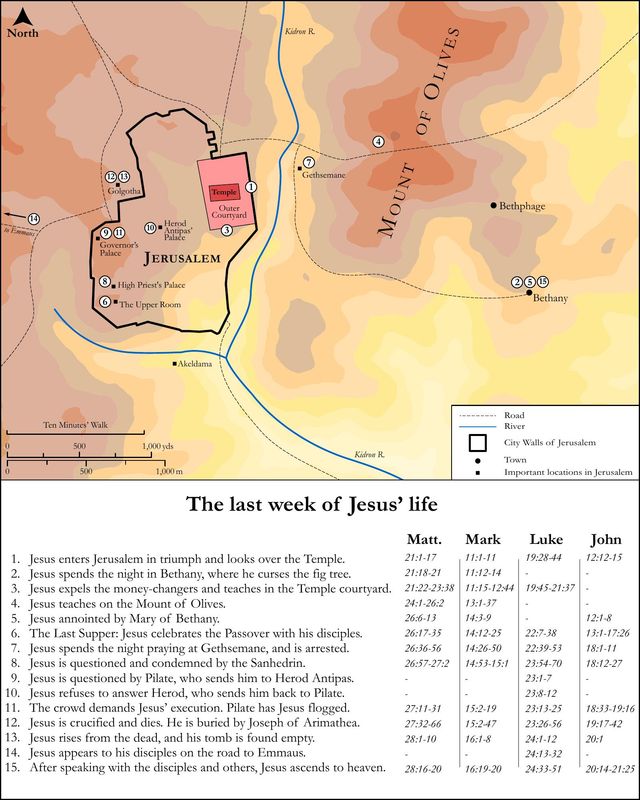
Study this verse
Historical interpretation
Six Centuries of Reception
11 surviving comments on this verse. Each one is dated, so this reads as a timeline rather than a list.
Select a marker to jump to its quote. Markers stagger vertically where authors wrote within a few decades of each other.
For in that they ought neither to sell nor to buy, but to give their time to prayer, being assembled in a house of prayer, whence it follows, And he saith unto them, It is written, My house shall be called a house of prayer. (Is. 56:7.)
Mystically; The Temple of God is the Church of Christ, wherein are many, who live not, as they ought, spiritually, but after the flesh; and that house of prayer which is built of living stones they make by their actions to be a den of thieves. But if we must express more closely the three kinds of men cast out of the Temple, we may say thus. Whosoever among a Christian people spend their time in nothing else but buying and selling, continuing but little in prayers or in other right actions, these are the buyers and sellers in the Temple of God. Deacons who do not lay out well the funds of their Churches, but grow rich out of the poor man's portion, these are the money-changers whose tables Christ overturns. But that the deacons preside over the tables of Church money, we learn from the Act of the Apostles (Acts 6:2.) Bishops who commit Churches to those they ought not, are they that sell the doves, that is, the grace of the Holy Spirit, whose seats Christ overturns.
Or, in His second coming He shall cast forth and overturn those whom He shall find unworthy in God's temple.
But see the baseness of the Jews. He had wrought so many miracles, and never were they thus amazed at Him; but when they saw a multitude running together, then they marvel. "For all the city was moved, saying, Who is this? But the multitudes said, This is Jesus the prophet of Nazareth of Galilee." And when they thought they were saying something great, even then were their thoughts earthly, and low, and dragging on the ground.
This John likewise saith, but he in the beginning of his Gospel, this at the end. Whence it is probable this was done twice, and at different seasons.
And it is evident both from the times, and from their reply. For there He came at the very passover, but here much before. And there the Jews say, "What sign showest thou us?" but here they hold their peace, although reproved, because He was now marvelled at amongst all men.
And this is a heavier charge against the Jews, that when He had done this not once only, but a second time, they continued in their trafficking, and said that He was an adversary of God, when they ought even from hence to have learnt His honor for His Father and His own might. For indeed He also wrought miracles, and they saw His words agreeing with His works.
But not even so were they persuaded, but "were sore displeased," and this while they heard the prophet crying aloud, and the children in a manner beyond their age proclaiming Him. Wherefore also He Himself sets up Isaiah against them as an accuser, saying, "My house shall be called a house of prayer."
(Hom. lxvii.) Which aggravates the fault of the Jews, who after He had done the same thing twice, yet persisted in their hardness.
But not even thus were the Chief Priests convinced, but at His miracles and the shouts of the children they had indignation.
This was at once a type of the Gentiles, and no small comfort to the Apostles; for that they might not be perplexed, contriving how having no education for the purpose they should preach the Gospel, these children going before them did away that fear; for He who made these to sing His praises, shall give speech to those. This miracle also shows that Christ was the Framer of nature; seeing the children spoke things full of meaning, and agreeing with the Prophets, whereas the men uttered things meaningless, and full of frenzy.
(Verse 12, 13.) And Jesus entered the temple of God and drove out all those who were buying and selling in the temple, and overturned the tables of the money changers and the seats of those selling doves. And He said to them, 'It is written: My house shall be called a house of prayer, but you are making it a den of robbers.' Then Jesus entered the temple area accompanied by the crowd of believers (who had spread their garments so that the colt could walk on them without being harmed). He expelled all those who were selling and buying in the temple, overturned the tables of the money changers, and scattered the seats of those selling doves. And he said to them, quoting from the holy scriptures (Isaiah 56) and (Jeremiah 7), that his Father's house should be a house of prayer and not a den of robbers or a house of merchandise, as it is written in another Gospel (John 2). First of all, it must be known that according to the commands of the most august Law, in the whole world, in the temple of the Lord, and from almost all the regions of the Jews, countless offerings were being sacrificed, especially on festive days, of bulls, rams, and goats; so that the poor would not be without offering, those who offered would present young doves and turtles; it often happened that those who had come from afar did not have victims. Therefore, the priests devised a way to take prey from the people, and they sold all the animals they needed for sacrifices, so that they would sell to those who did not have them, and they themselves would receive them again when bought. He dispersed this band of people who were frequently coming due to their lack of resources, those who were in need of expenses, and not only did they not have offerings, but they didn't even have birds and cheap gifts to buy. So they appointed moneylenders who would lend money under collateral. But because there was a law, as commanded in Leviticus 25 and Deuteronomy 23, that no interest should be received, and borrowed money could not bring any benefit, as it had no gain, and sometimes it could even result in loss, they invented another technique, that they would make 'Collybistas' instead of moneylenders, which the Latin language does not express the exact meaning of the word. Among them, what we call trinkets or cheap gifts are called collybadicuntur. For example, roasted chickpeas, dried grapes, and various types of fruits. Therefore, because the moneylenders, called Collybistae, could not charge interest, they would accept various goods instead of interest, so that they could demand what was not allowed in currency, but could be purchased with these items, as if Ezekiel himself did not preach this, saying: 'You shall not take interest and profits.' (Ezek. XXII, 12). The Lord, seeing such a trade or robbery in his Father's house, was stirred with zeal (as it is written in the 68th Psalm, verse 10: The zeal of thy house hath eaten me up), and he made for himself a whip out of cords, and drove out such a great multitude of people from the temple, saying: It is written: My house shall be called a house of prayer; but you have made it a den of thieves. For he is a thief, and he turns the temple of God into a cave of thieves, who seeks profits from religion, and whose worship is not so much the worship of God as it is an opportunity for business. According to the story, Jesus enters the temple of the Father daily, and drives out all, both bishops and priests and deacons, as well as lay people, and the entire crowd from His Church, and He has only one crime, that of buying and selling. For it is written: Freely you have received, freely give. He also overturns the tables of the money changers. Note, because of the greed of the priests, the altars of God are called the tables of money changers. And he overturned the seats of those who were selling doves, who were selling the grace of the Holy Spirit, and they do everything to devour the subject peoples, of whom it is said (as is said): They devour my people like bread (Ps. 13:4). According to simple understanding, doves were not in seats but in cages, unless perhaps the caretakers of the doves were sitting in seats. But that is completely absurd, because in seats, the dignity of teachers is more clearly indicated, which is reduced to nothing when it is mixed with profits. Concerning the churches, let each one understand concerning themselves. For the Apostle says: You are the temple of God, and the Holy Spirit dwells in you (I Cor. VI, 15, and II Cor. III, 16). Let there be no dealing in the house of our hearts, no buying and selling, no desire for gifts, lest Jesus enters angry and stern, and does not cleanse His temple except by using a whip, so as to make a house of prayer out of a den of thieves and a house of commerce.
When Jesus entered with the multitudes, the whole city of Jerusalem was moved, wondering at the crowds, and not knowing the power.
While others were in doubt or enquiring, the worthless multitude confessed Him; But the people said, This is Jesus the Prophet from Nazareth in Galilee. (Ps. 24:8.) They begin with the lesser that they may come to the greater. They hail Him as that Prophet whom Moses had said should come like to himself, (Deut. 15:18.) which is rightly written in Greek with the testimony of the article, (ὁ προφήτες.) From Nazareth of Galilee, for there He had been brought up, that the flower of the field might be nourished with the flower of all excellencies.
And he cast out all them that sold and bought. It should be known that in obedience to the Law, in the Temple of the Lord venerated throughout the whole world, and resorted to by Jews out of every quarter, innumerable victims were sacrificed, especially on festival days, bulls, rams, goats; the poor offering young pigeons and turtle-doves, that they might not omit all sacrifice. But it would happen that those who came from a distance would have no victim. The Priests therefore contrived a plan for making a gain out of the people, selling to such as had no victim the animals which they had need of for sacrifice, and themselves receiving them back again as soon as sold. But this fraudulent practice was often defeated by the poverty of the visitors, who lacking means had neither victims, nor whence to purchase them. They therefore appointed bankers who might lend to them under a bond. But because the Law forbade usury, and money lent without interest was profitless, besides sometimes a loss of the principal, they bethought themselves of another scheme; instead of bankers they appointed 'collybistæa,' a word for which the Latin has no equivalent. Sweetmeats and other trifling presents they called 'collyba,' such, for example, as parched pulse, raisins, and apples of divers sorts. As then they could not take usury, they accepted, the value in kind, taking things that ore bought with money, as if this was not what Ezekiel preached of, saying, Ye shall not receive usury nor increase. (Ezek. 18:17.) This kind of traffic, or cheating rather, the Lord seeing in His Father's house, and moved thereat with spiritual zeal, cast out of the Temple this great multitude of men.
For he is indeed a thief, and turns the temple of God into a den of thieves, who makes a gain of his religion. Among all the miracles wrought by our Lord, this seems to me the most wonderful, that one man, and He at that time mean to such a degree that He was afterwards crucified, and while the Scribes and Pharisees were exasperated against Him seeing their gains thus cut off, was able by the blows of one scourge to cast out so great a multitude. Surely a flame and starry ray darted from his eyes, and the majesty of the Godhead was radiant in his countenance.
But, according to the plain sense; the doves were not in seats, but in cages; unless indeed the sellers of the doves were sitting in seats, but that were absurd, for the seat denotes the dignity of the teacher, which is brought down to nothing when it is mixed with covetousness. Mark also, that through the avarice of the Priests, the altars of God are called tables of money-changers. What we have spoken of Churches let each man understand of himself, for the Apostle says, Ye are the temple of God (2 Cor. 6:16.) Let there not be therefore in the abode of your breast the spirit of bargaining, nor the desire of gifts, lest Jesus, entering in anger and sternness, should purify His temple not without scourging, that from a den of thieves He should make it a house of prayers.
For had He not overthrown the tables of the money-changers and the seats of them that sold doves, the blind and the lame would not have deserved that their wonted sight and power of motion should be restored to them in the temple.
For, not daring to lay hands on Him, the Priests defame his works, and the testimony of the children who cried, Hosanna to the Son of David, blessed is he that cometh in the name of the Lord, as though this might be said to none but to the Son of God only. Let then Bishops and all holy men take heed how they suffer these things to be said to them, if this is charged as a fault in Him who is truly Lord to whom this was said, because the faith of the believers was not yet confirmed.
But the answer of Christ was cautions. He spake not what the Scribes would fain have heard, The children do well that they bear witness to me; nor on the other hand, They do what is wrong, they are but children, you ought to be indulgent to their tender years. But He brings a quotation from the eighth Psalm, that though the Lord were silent, the testimony of Scripture might defend the words of the children (Ps. 8:2) as it follows, But Jesus said unto them, Yea, have ye never read, &c.
Those prophesying spoke of Christ who was to come; these speak in praise of the coming of Christ already fulfilled.
With good reason were they moved at sight of a thing so to be wondered at. Man was praised as God, but it was the God that was praised in the man. But, I suppose, that neither they who praised knew what they praised, but the Spirit that suddenly inspired them poured forth the words of truth.
And Jesus entered into the temple of God. This was the part of a good Son to haste to His Father's house, and do Him honour; so you then becoming an imitator of Christ as soon as you enter into any city, first run to the Church. Further, it was the part of a good physician, that having entered to heal the sick city, he should first apply himself to the source of the sickness; for as every thing good cometh out of the temple, so also doth every evil. For when the priesthood is sound, the whole Church flourishes, but if it is corrupt, faith is impaired; and as when you see a tree whose leaves are pale-coloured you know that it is diseased at its root, so when you see an undisciplined people conclude without hesitation that their priesthood is unsound.
For this reason also He overturns the tables of the money-changers, to signify that in the temple of God ought to be no coin save spiritual, such as bears the image of God, not an earthly image. He overturns the seats of those that sold doves, saying by that deed, What make in My temple so many doves for sale, since that one Dove descended of free gift upon the temple of My Body? What the multitude had proclaimed by their shouts, the Lord shows in deeds; whence it follows, And the blind and the lame came to him in the temple, and he healed them.
For as a pillar a little out of the perpendicular, if more weight be laid upon it, is driven to lean still more to one side; so also the heart of man when once turned aside, is only stirred the more with jealousy by seeing or hearing deeds of some righteous man. In this way the Priests were stirred up against Christ, and said, Hearest thou what these say?
As though He had said, Be it so, it is My fault that these cry thus. But is it My fault that so many thousand years before the Prophet foretold that so it should be? But babes and sucklings cannot know or praise any one. Therefore they are called babes, not in age, but in guilelessness of heart; sucklings, because they cried out being moved by their joy at the wonderful things they beheld, as by the sweetness of milk. Miraculous works are called milk, because the beholding of miracles is no toil, but rather excites wonder, and gently invites to the faith. Bread is the doctrine of perfect righteousness, which none can receive but they who have their senses exercised about spiritual things.
That they are healed in the Temple signifies, that men cannot be healed but in the Church, to which is given the power of binding and loosing.
Having described this, what the Lord did is added: because, entering the temple, he began to cast out those selling and buying in it, saying to them: It is written that my house is a house of prayer, but you have made it a den of thieves. For he who foretold the evils to come and immediately entered the temple to cast out from it those selling and buying, clearly made known that the ruin of the people came chiefly from the fault of the priests. Indeed, in describing the destruction but striking at those selling and buying in the temple, he showed by the very effect of his work whence the root of perdition sprang. Moreover, as we have learned from another evangelist as witness, doves were being sold in the temple. And what is received through doves except the gift of the Holy Spirit? But he expels the sellers and buyers from the temple, because he condemns either those who grant the imposition of hands for a gift, or those who strive to buy the gift of the Spirit.
Just as the temple of God is in the city, so also is the life of religious persons among the faithful people. And often some take up the habit of religion, and when they receive a place in the sacred orders, they turn the office of holy religion into a commerce of earthly business. Those selling in the temple are they who bestow for a reward what rightly belongs to certain persons. For to sell justice is to maintain it in exchange for receiving a reward. Those buying in the temple are they who, while refusing to render to their neighbor what is just, and while disdaining to do what is rightly owed, give a reward to patrons and buy sin.
But why do we speak of these things, when we still see many burdened by more atrocious deeds? For I speak to you priests with grief, because we have learned that some of you perform ordinations for payments, selling spiritual grace and accumulating temporal gains from the iniquities of others along with the harm of sin. Why then does the voice of the Lord commanding not return to your memory, saying: Freely you have received, freely give? Why do you not recall before the eyes of your mind that our Redeemer, entering the temple, overturned the seats of those selling doves and poured out the money of the money-changers? For who are those in the temple of God today who sell doves, if not those who in the Church receive payment for the imposition of hands? Through which imposition, namely, the Holy Spirit is given from heaven. Therefore the dove is sold, because the imposition of hands, through which the Holy Spirit is received, is offered for a price. But our Redeemer overturned the seats of those selling doves, because he destroys the priesthood of such merchants. For hence it is that the sacred canons condemn the simonian heresy, and command that those be deprived of the priesthood who seek payment for bestowing ordinations. Therefore the seat of those selling doves is overturned when those who sell spiritual grace are deprived of the priesthood, either before human eyes or before the eyes of God.
And indeed there are many other evils of those in authority which now escape human eyes. And often they present themselves to people as holy pastors, yet in their hidden deeds they are not ashamed to appear shameful before the eyes of the internal Judge. It will come, it will surely come, that day, nor is it far off, in which the Pastor of pastors will appear, and will bring forth into public the deeds of each one, and he who now avenges the faults of subjects through those in authority, will then raging condemn the evils of those in authority through himself. Whence also entering into the temple, he made as it were a whip from cords by himself, and casting out the wicked merchants from the house of God, he overturned the seats of those selling doves, because he strikes the faults of subjects through pastors, but he strikes the vices of pastors through himself. Behold, now what is done secretly can be denied to people. That Judge will certainly come, from whom no one can hide himself by keeping silent, whom no one can deceive by denying.
But it is to be noted, that this entry of His into Jerusalem was five days before the passover. For John relates, that six days before the Passover He came to Bethany, and on the morrow sitting on the ass entered Jerusalem. (John 12:1.) In this observe the correspondence between the Old and New Testaments, not only in things but in seasons. For on the tenth day of the first month, the lamb that was to be sacrificed for the passover was to be taken into the house, (Exod. 12:3.) because on the same day of the same month, that is, five days before the passover, the Lord was to enter the city in which He was to suffer.
Continue studying Matthew 21:12 across the web’s major study libraries — every link below opens this exact verse, chapter, or book on the destination site.
Read & Compare
 BibleGatewayThis verse in more than 200 translations and 70 languages.
 Bible.comThe YouVersion reader — hundreds of translations, reading plans, and highlights.
 ESV.orgCrossway's official English Standard Version reader.
 NET BibleThe NET translation with 60,000+ translators' notes on every rendering decision.
 STEP BibleTyndale House's free study tool — original text, vocabulary, and scholarly resources.
 BibliaLogos Bible Software's free web reader.
 USCCBThe New American Bible (Revised Edition) with the U.S. bishops' study notes.
Commentaries
 BibleHub CommentariesDozens of classic commentaries on this verse, gathered on one page.
 StudyLightMore than 100 commentary sets — the largest collection on the web.
 BibleRefPlain-English commentary on what this verse means, verse by verse.
 Enduring WordDavid Guzik's free commentary on this chapter, widely used by Bible teachers.
 Bible Study ToolsVerse commentary alongside Greek and Hebrew study aids.
Original Language & Research
- BibleHub InterlinearThe verse word by word — original language, transliteration, and English.
- BibleHub LexiconEvery word's original-language definition and Strong's entry.
 Blue Letter BibleDeep-study tools — Strong's numbers, concordance, and word studies.
 CNTR CollationThe earliest Greek manuscripts of this verse, collated letter by letter.
Sermons, Hymns & Audio


TrulyRandomVerse is not affiliated with these sites and doesn’t control their content. They’re linked because they’re genuinely useful.
Summary
Matthew 21:12 powerfully depicts Jesus' decisive action upon entering the Jerusalem temple, where He confronts and purges the commercial activities that had defiled its sacred space. This event, often termed the "cleansing of the temple," serves as a profound demonstration of Jesus' divine authority, His unwavering zeal for the purity of God's worship, and His prophetic judgment against spiritual corruption and exploitation, setting the stage for His final confrontation with the religious establishment.
Context
ShowHideLiterary Context
This dramatic incident immediately follows Jesus' triumphal entry into Jerusalem (Matthew 21:1-11), where He is hailed as King and Messiah by the crowds. His arrival at the temple and subsequent actions are not merely an outburst but a deliberate, authoritative act of purification, fulfilling prophetic expectations. It directly precedes His teaching and parables within the temple courts (Matthew 21:23-22:46) and sets the stage for the escalating conflict with the chief priests and elders, who challenge His authority (Matthew 21:23). The cleansing thus serves as a pivotal moment, transitioning from public acclamation to direct confrontation with religious hypocrisy.
Historical & Cultural Context
The "temple of God" mentioned here refers specifically to the hieron, the entire temple complex, not just the inner sanctuary (naos). The outer court, known as the Court of the Gentiles, was designated as a place for non-Jews to pray and worship. However, by Jesus' time, it had been transformed into a bustling marketplace. Pilgrims traveling from afar needed to purchase animals for sacrifice and exchange foreign currency for the specific Tyrian shekkel required for the temple tax. While these services were necessary, they had become corrupted by exorbitant prices, dishonest practices, and exploitative exchange rates, turning a sacred space into a commercial hub that effectively hindered sincere worship, particularly for Gentiles.
Key Themes
ShowHideMatthew 21:12 contributes significantly to several overarching themes within the Gospel. It underscores the Purity of Worship, emphasizing God's demand for unadulterated reverence and prayer, a theme explicitly articulated in Matthew 21:13. The act also powerfully asserts Jesus' Divine Authority as He takes direct control over the temple, demonstrating His unique relationship with God and His messianic prerogative. Furthermore, it highlights Zeal for God's House, echoing the prophetic passion described in Psalm 69:9, which is explicitly referenced in the parallel account in John 2:17. Finally, Jesus' actions serve as a Judgment on Corruption, symbolizing God's condemnation of religious practices that prioritize profit over piety and obstruct genuine communion with Him.
Exposition and Analysis
ShowHideKey Word Analysis
ShowHideAs defined by G2411, hieron refers to the entire sacred precincts of the Temple, encompassing the outer courts where commercial activity was taking place, as opposed to the inner sanctuary (naos). This distinction is crucial, as Jesus' cleansing targeted the area intended for all nations to pray, which had been desecrated by worldly commerce. His action was a purification of the entire sacred space.
G1544 defines ekbállō as "to eject (literally or figuratively)." This verb conveys a forceful, decisive, and authoritative expulsion. Jesus didn't merely ask or protest; He actively drove out those who defiled the temple, demonstrating His power and resolve to remove what was an affront to God's holiness.
G2690 describes katastréphō as "to turn upside down, i.e. upset." This word vividly portrays the physical overturning of tables and seats, signifying a complete disruption and reversal of the established, corrupt order. It was a public, undeniable act of dismantling the exploitative system that had taken root in God's house.
Verse Breakdown
ShowHide"And Jesus went into the temple of God"
This phrase establishes the setting and the protagonist's intentional movement. Jesus' entry is not casual but purposeful, immediately following His triumphal entry into Jerusalem. The "temple of God" emphasizes the sacred nature of the place and the divine ownership that Jesus, as God's Son, is about to assert.
"and cast out all them that sold and bought in the temple"
This describes Jesus' primary action: the forceful expulsion of all engaged in commercial transactions within the temple precincts. The phrase "all them that sold and bought" highlights the comprehensive nature of His cleansing, targeting the entire system of commerce that had invaded the sacred space.
"and overthrew the tables of the moneychangers"
This specifies one of the key targets of Jesus' wrath. Moneychangers facilitated the exchange of common currency for the specific Tyrian shekels required for temple taxes, often at exploitative rates. Overthrowing their tables symbolized the disruption and condemnation of their dishonest practices and the commercialization of worship.
"and the seats of them that sold doves"
This identifies the second specific target. Doves were the prescribed sacrifice for the poor (Leviticus 12:8), making their sale a necessary service. However, the vendors likely exploited the vulnerable, charging exorbitant prices. Overturning their seats underscored Jesus' indignation at the exploitation of the poor and the profanation of worship by greed.
Literary Devices
ShowHideMatthew 21:12 employs several powerful Literary Devices. The entire scene functions as a Prophetic Act, where Jesus' physical actions serve as a visible, tangible message, echoing Old Testament prophecies of a Messiah who would purify the temple (e.g., Malachi 3:1-3). There is clear Symbolism present: the temple itself symbolizes God's dwelling place and the purity required for worship, while the moneychangers' tables and dove sellers' seats symbolize the corruption and exploitation that had infiltrated religious practices. The forceful verbs "cast out" and "overthrew" create a sense of Dramatic Action and Urgency, conveying Jesus' intense zeal and authority. Furthermore, the passage presents a stark Contrast between the intended purpose of the temple as a "house of prayer" and its current state as a "den of thieves," a contrast explicitly drawn in the subsequent verse (Matthew 21:13). This contrast highlights the profound spiritual decay Jesus confronts.
Theological and Thematic Connections
ShowHideThe cleansing of the temple in Matthew 21:12 is a pivotal theological statement, asserting Jesus' divine authority and His unwavering commitment to the sanctity of true worship. It reveals God's intolerance for corruption, exploitation, and the commercialization of spiritual practices, particularly within spaces designated for communion with Him. This act underscores the principle that worship must be pure, sincere, and accessible to all, free from human-imposed barriers or greed. It also serves as a powerful demonstration of Jesus' messianic identity, fulfilling ancient prophecies of a Lord who would suddenly come to His temple to purify it, establishing His rightful dominion over God's house and its practices.
Reflection and Application
ShowHideThe cleansing of the temple in Matthew 21:12 offers profound lessons for believers today. Just as Jesus purified the physical temple, He calls us to examine and purify the "temple" of our own lives, recognizing that our bodies are temples of the Holy Spirit (1 Corinthians 6:19). This means actively casting out anything that defiles our hearts, distracts us from genuine worship, or exploits others—whether it be greed, self-serving ambition, or spiritual apathy. It challenges us to ensure that our personal and corporate worship is truly focused on God, free from commercialism, hypocrisy, or anything that hinders others from encountering Him. Jesus' zeal reminds us to cultivate a holy indignation against injustice and corruption, especially when it masquerades as piety. His authority over the temple also reminds us of His ultimate authority over our lives and the Church, urging us to submit to His will and uphold His standards of holiness.
Questions for Reflection
ShowHideFAQ
ShowHideWhy was Jesus so angry and violent in the temple?
ShowHideJesus' actions were not an uncontrolled outburst of anger but a righteous indignation rooted in His divine authority and zeal for God's holiness. The temple, intended as a "house of prayer for all nations" (Isaiah 56:7), had become a place of exploitation and commercialism, particularly the Court of the Gentiles, which was meant for non-Jewish worshippers. The activities of the moneychangers and sellers, while ostensibly providing a service, were marred by greed and dishonesty, effectively turning the temple into a "den of robbers" (Jeremiah 7:11). Jesus' forceful cleansing was a prophetic act of judgment against this corruption, demonstrating His messianic role as the one who purifies God's dwelling place and restores true worship. It was a demonstration of His authority and passion for His Father's house, as the disciples recalled, "Zeal for your house will consume me" (John 2:17).
Christ-Centered Fulfillment
ShowHideThe cleansing of the temple in Matthew 21:12 finds its profound Christ-centered fulfillment in Jesus Himself, who is the ultimate Temple and the perfect embodiment of God's presence among humanity. While He purifies the physical structure, His greater work is to establish a new order of worship, not bound by buildings, but centered on His person and His redemptive work. Jesus declares, "Destroy this temple, and in three days I will raise it up," speaking of the temple of His body (John 2:19-21). Through His sacrificial death and resurrection, Jesus provides the ultimate cleansing, not of a physical space, but of the human heart, making it a dwelling place for the Holy Spirit (1 Corinthians 6:19-20). He is the Lamb of God who takes away the sin of the world (John 1:29), offering a once-for-all purification that surpasses all temple sacrifices (Hebrews 9:11-14). Thus, Jesus' temple cleansing is a powerful foreshadowing of His greater work as King and High Priest, establishing a new covenant where access to God is through Him alone, making every believer a participant in a spiritual temple built on Christ, the cornerstone (Ephesians 2:19-22).