


Daniel 10:3
- לֶחֶםLe·chemfood ofH3899N-mscNoun Singular Masculine Construct
- חֲמֻדוֹתcha·mu·Dotdesirableness<es>H2532N-fpNoun Plural Feminine Absolute
- לֹאlo'notH3808NegParticle Negative
- אָכַלְתִּי'a·Khal·tiI ateH398V-Qal-Perf-1csVerb Qal Perfect 1st Singular common gender
- וּבָשָׂרu·va·Sarand meatH1320Conj-w ¦ N-msNoun Singular Masculine Absoluteוּandבָשָׂרmeat
- וָיַיִןva·Ya·yinand wineH3196Conj-w ¦ N-msNoun Singular Masculine Absoluteוָandיַיִןwine
- לֹאlo'notH3808NegParticle Negative
- בָאva'it cameH935V-Qal-Perf-3msVerb Qal Perfect 3rd Singular Masculine
- אֶל'elintoH413PrepPreposition
- פִּיpimy mouthH6310N-msc ¦ 1csNoun Singular Masculine Constructפִּmouthיmy
- וְסוֹךְve·Sokhand indeed <anoint>H5480Conj-w ¦ V-Qal-InfVerb Qal Infinitive Constructוְandסוֹךְindeed <anoint>
- לֹאlo'notH3808NegParticle Negative
- סָכְתִּיSa·khe·tiI anointed myselfH5480V-Qal-Perf-1csVerb Qal Perfect 1st Singular common gender
- עַד'aduntilH5704PrepPreposition
- מְלֹאתme·Lotwere completedH4390V-Qal-InfVerb Qal Infinitive Construct
- שְׁלֹשֶׁתshe·Lo·shetthreeH7969Adj-cscAdjective Numerical Singular common gender Construct
- שָׁבֻעִיםsha·vu·'ImsevensH7620N-mpNoun Plural Masculine Absolute
- יָמִיםya·MimdaysH3117N-mpNoun Plural Masculine Absolute
English is a literal word-by-word gloss of the Hebrew, not the KJV's wording. Why?
This is the original text the KJV's translators worked from — each Hebrew word with its own literal English meaning in this verse, prepared by scholars at Tyndale House, Cambridge. The KJV translates whole sentences, not word by word, so its wording differs: one Hebrew word can become several English words, and the KJV may choose “the LORD” where the gloss reads “Yahweh”. Both are faithful — they answer different questions. For the KJV's own rendering, switch to the KJV text.
Details
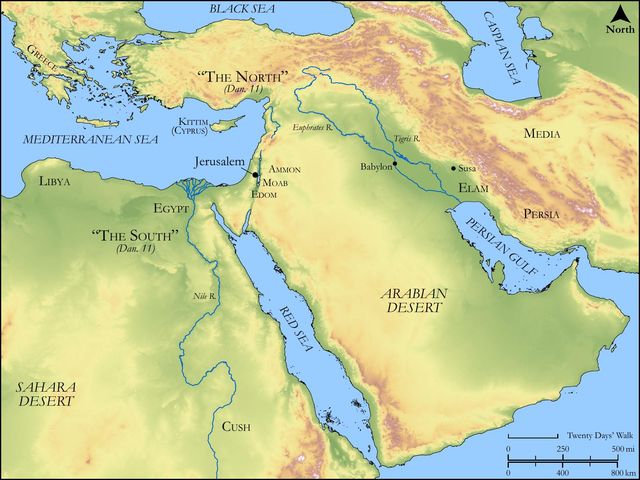
See on the biblical-era map
Study this verse
Public-domain commentary
Matthew Henry
From his Commentary on the Whole Bible. Henry comments on passages, not single verses — this entry covers Daniel 10:1–9. His two-level outline is real structure in the source text, so it is rendered as structure.
This vision is dated in the third year of Cyrus, that is, of his reign after the conquest of Babylon, his third year since Daniel became acquainted with him and a subject to him. Here is,
I.A general idea of this prophecy (Dan 10:1):
The thing was true; every word of God is so; it was true that Daniel had such a vision, and that such and such things were said. This he solemnly attests upon the word of a prophet. Et hoc paratus est verificare - He was prepared to verify it; and, if it was a word spoken from heaven, no doubt it is stedfast and may be depended upon. But the time appointed was long, as long as to the end of the reign of Antiochus, which was 300 years, a long time indeed when it is looked upon as to come. Nay, and because it is usual with the prophets to glance at things spiritual and eternal, there is that in this prophecy which looks in type as far forward as to the end of the world and the resurrection of the dead; and then he might well say, The time appointed was long. It was, however, made as plain to him as if it had been a history rather than a prophecy; he understood the thing; so distinctly was it delivered to him, and received by him, that he could say he had understanding of the vision. It did not so much operate upon his fancy as upon his understanding.
II.An account of Daniel's mortification of himself before he had this vision, not in expectation of it, nor, when he prayed that solemn prayer ch. 9, does it appear that he had any expectation of the vision in answer to it, but purely from a principle of devotion and pious sympathy with the afflicted people of God. He was mourning full three weeks (Dan 10:2), for his own sins and the sins of his people, and their sorrows. Some think that the particular occasion of his mourning was slothfulness and indifference of many of the Jews, who, though they had liberty to return to their own land, continued still in the land of their captivity, not knowing how to value the privileges offered them; and perhaps it troubled him the more because those that did so justified themselves by the example of Daniel, though they had not that reason to stay behind which he had. Others think that it was because he heard of the obstruction given to the building of the temple by the enemies of the Jews, who hired counsellors against them, to frustrate their purpose (Ezr 4:4, Ezr 4:5), all the days of Cyrus, and gained their point from his son Cambyses, or Artaxerxes, who governed while Cyrus was absent in the Scythian war. Note, Good men cannot but mourn to see how slowly the work of God goes on in the world and what opposition it meets with, how weak its friends are and how active its enemies. During the days of Daniel's mourning he ate no pleasant bread; he could not live without meat, but he ate little, and very sparingly, and mortified himself in the quality as well as the quantity of what he ate, which may truly be reckoned fasting, and a token of humiliation and sorrow. He did not eat the pleasant bread he used to eat, but that which was course and unpalatable, which he would not be tempted to eat any more of than was just necessary to support nature. As ornaments, so delicacies, are very disagreeable to a day of humiliation. Daniel ate no flesh, drank no wine, nor anointed himself, for those three week's time, Dan 10:3. Though he was now a very old man, and might plead that the decay of his nature required what was nourishing, though he was a very great man, and might plead that, being used to dainty meats, he could not do without them, it would prejudice his health if he were, yet, when it was both to testify and to assist his devotion, he could thus deny himself; let this be noted to the shame of many young people in the common ranks of life who cannot persuade themselves thus to deny themselves.
III.A description of that glorious person whom Daniel saw in vision, which, it is generally agreed, could be no other that Christ himself, the eternal Word. He was by the side of the river Hiddekel (Dan 10:4), probably walking there, not for diversion, but devotion and contemplation, as Isaac walked in the field, to meditate; and, being a person of distinction, he had his servants attending him at some distance. There he looked up, and saw one man Christ Jesus. It must be he, for he appears in the same resemblance wherein he appeared to St. John in the isle of Patmos, Rev 1:13-15. His dress was priestly, for he is the high priest of our profession, clothed in linen, as the high priest himself was on the day of atonement, that great day; his loins were girded (in St. John's vision his paps were girded) with a golden girdle of the finest gold, that of Uphaz, for every thing about Christ is the best in its kind. The girding of the loins denotes his ready and diligent application to his work, as his Father's servant, in the business of our redemption. His shape was amiable, his body like the beryl, a precious stone of a sky-colour. His countenance was awful, and enough to strike a terror on the beholders, for his face was as the appearance of lightning, which dazzles the eyes, both brightens and threatens. His eyes were bright and sparkling, as lamps of fire. His arms and feet shone like polished brass, Dan 10:6. His voice was loud, and strong, and very piercing, like the voice of a multitude. The vox Dei - voice of God can overpower the vox populi - voice of the people. Thus glorious did Christ appear, and it should engage us,
1.To think highly and honourably of him. Now consider how great this man is, and in all things let him have the pre-eminence.
2.To admire his condescension for us and our salvation. Over all this splendour he drew a veil when he took upon him the form of a servant, and emptied himself.
IV.The wonderful influence that this appearance had upon Daniel and his attendants, and the terror that it struck upon him and them.
1.His attendants saw not the vision; it was not fit that they should be honoured with the sight of it. There is a divine revelation vouchsafed to all, from converse with which none are excluded who do not exclude themselves; but such a vision must be peculiar to Daniel, who was a favourite. Paul's companions were aware of the light, but saw no man, Act 9:7; Act 22:9. Note, It is the honour of those who are beloved of God that, what is hidden from others, is known to them. Christ manifests himself to them, but not to the world, Joh 14:22. But, though they saw not the vision, they were seized with an unaccountable trembling; either from the voice they heard, or from some strange concussion or vibration of the air they felt, so it was that a great quaking fell upon them, so that they fled to hide themselves, probably among the willows that grew by the river's side. Note, Many have a spirit of bondage to fear who never receive a spirit of adoption, to whom Christ has been, and will be, never otherwise than a terror. Now the fright that Daniel's attendants were in is a confirmation of the truth of the vision; it could not be Daniel's fancy, or the product of a heated imagination of his own, or it had a real, powerful, and strange effect upon those about him.
2.He himself saw it, and saw it alone, but he was not able to bear the sight of it. It not only dazzled his eyes, but overwhelmed his spirit, so that there remained no strength in him, Dan 10:8. He said, as Moses himself, I exceedingly fear and quake. His spirits were all so employed, either in an intense speculation of the glory of this vision or in the fortifying of his heart against the terror of it, that his body was left in a manner lifeless and spiritless. He had no vigour in him, and was but one remove from a dead carcase; he looked as pale as death, his colour was gone, his comeliness in him was turned into corruption, and he retained no strength. Note, the greatest and best of men cannot bear the immediate discoveries of the divine glory; no man can see it and live; it is next to death to see a glimpse of it, as Daniel here; but glorified saints see Christ as he is and can bear the sight. But, though Daniel was thus dispirited with the vision of Christ, yet he heard the voice of his words and knew what he said. Note, We must take heed lest our reverence of God's glory, by which we should be awakened to hear his voice both in his word and in his providence, should degenerate into such a dread of him as will disable or indispose us to hear it. It should seem that when the vision of Christ terrified Daniel the voice of his words soon pacified and composed him, silenced his fear, and laid him to sleep in a holy security and serenity of mind: When I heard the voice of his words I fell into a slumber, a sweet slumber, on my face, and my face towards the ground. When he saw the vision he threw himself prostrate, into a posture of the most humble adoration, and dropped asleep, not as careless of what he heard and saw, but charmed with it. Note, How dreadful soever Christ may appear to those who are under convictions of sin, and in terror by reason of it, there is enough in his word to quiet their spirits and make them easy, if they will but attend to it and apply it.
Historical interpretation
Two Centuries of Reception
4 surviving comments on this verse. Each one is dated, so this reads as a timeline rather than a list.
Select a marker to jump to its quote. Markers stagger vertically where authors wrote within a few decades of each other.
This abstinence Daniel used in order to please God by humiliation, and not for the purpose of producing a sensibility and wisdom for his soul previous to receiving communication by dreams and visions, as if it were not rather to effect such action in an ecstatic state. This “sobriety” … will have nothing to do with exciting ecstasy but will rather serve to recommend its being wrought by God.
The prophet teaches us that fasting is a great virtue and so too is affliction with prayer. Through these things sometimes a person is deemed worthy even of visions.
Verses 2, 3. "In those days I, Daniel, mourned for the days of three weeks; I ate no desirable bread, and neither flesh or wine entered into my mouth; neither was I anointed with ointment until the days of three weeks were accomplished." By this example we are taught to abstain from the pleasanter types of food (I think that the term "desirable bread" is that inclusive) during a period of fasting, and that we neither eat flesh nor drink wine, and especially that we desire no anointing with ointments. This custom is maintained among the Persians and Indians even to this day, that they use ointment as a substitute for baths. Also, Daniel afflicted his soul for three consecutive weeks, so that his intercession might not appear cursory or casual. By inference, indeed, we ought to make the observation that a person in mourning who bemourns the absence of one betrothed partakes of no desirable bread though it comes down from heaven itself; neither does he touch solid food, which is to be understood in the sense of meat, nor does he drink any wine, which gladdens the heart of man, or make his face cheerful with oil (as we read in the Psalms: "That he may make the face cheerful with oil" Psalm 104:15). By means of such a fast as this the betrothed girl sheds tears which will be convincing, when her fiance has been taken from her. Daniel also did well to supplicate the Lord with boldness, inasmuch as in the first year of Cyrus's reign the captivity of the Jews had already been somewhat relaxed in its severity.
Daniel paid no attention to his body in these days either by anointing the outside or [by taking] food within. Quite well and usefully he has added the descriptor desirable not to meat but to bread. For bread is the most necessary food of all; the wealthy enjoy meat, but the poor as well as the rich enjoy bread. Therefore, he called it “the desirable bread,” on the grounds that is a most common food and most desired of all food.
Continue studying Daniel 10:3 across the web’s major study libraries — every link below opens this exact verse, chapter, or book on the destination site.
Read & Compare
 BibleGatewayThis verse in more than 200 translations and 70 languages.
 Bible.comThe YouVersion reader — hundreds of translations, reading plans, and highlights.
 ESV.orgCrossway's official English Standard Version reader.
 NET BibleThe NET translation with 60,000+ translators' notes on every rendering decision.
 STEP BibleTyndale House's free study tool — original text, vocabulary, and scholarly resources.
 BibliaLogos Bible Software's free web reader.
 USCCBThe New American Bible (Revised Edition) with the U.S. bishops' study notes.
Commentaries
 BibleHub CommentariesDozens of classic commentaries on this verse, gathered on one page.
 StudyLightMore than 100 commentary sets — the largest collection on the web.
 BibleRefPlain-English commentary on what this verse means, verse by verse.
 Enduring WordDavid Guzik's free commentary on this chapter, widely used by Bible teachers.
 Bible Study ToolsVerse commentary alongside Greek and Hebrew study aids.
Original Language & Research
- BibleHub InterlinearThe verse word by word — original language, transliteration, and English.
- BibleHub LexiconEvery word's original-language definition and Strong's entry.
 Blue Letter BibleDeep-study tools — Strong's numbers, concordance, and word studies.
 SefariaThe Hebrew text with Rashi and centuries of Jewish commentary.
Sermons, Hymns & Audio


TrulyRandomVerse is not affiliated with these sites and doesn’t control their content. They’re linked because they’re genuinely useful.
Summary
Daniel 10:3 vividly portrays the prophet Daniel's profound spiritual discipline during a three-week period of intense mourning and intercession. He intentionally abstained from rich foods ("pleasant bread," "flesh," "wine") and personal grooming ("anoint myself"), signifying deep humility and focused devotion as he earnestly sought divine understanding regarding a weighty prophetic vision concerning the future of his people.
Context
ShowHideLiterary Context
This verse is situated at the very beginning of Daniel's final and most extensive vision, spanning chapters 10-12. Daniel 10:1 introduces the vision as a "great conflict" revealed to Daniel in the third year of Cyrus, King of Persia. Daniel 10:2 immediately precedes our verse, stating that Daniel "was mourning three full weeks." This sets the stage for Daniel's physical and spiritual posture, explaining the rigorous self-denial described in Daniel 10:3. The subsequent verses (Daniel 10:4ff) detail the appearance of a glorious angelic being, who then explains the profound prophecy that unfolds in the remainder of the book. Daniel's fasting and mourning are presented as a direct preparation and prerequisite for receiving such a weighty and detailed divine revelation, underscoring the spiritual intensity required for such an encounter.
Historical & Cultural Context
Daniel's vision occurs in the third year of Cyrus's reign, placing it around 536 BC. This was a pivotal time for the Jewish exiles; though Cyrus had issued a decree allowing them to return to Jerusalem (as recorded in Ezra 1:1-4), the reality on the ground was challenging. The rebuilding of the temple had begun but faced significant opposition (see Ezra 4), and the political landscape was fraught with uncertainty. Daniel, likely in his late 80s or early 90s, would have been deeply burdened by the precarious state of his people and the unfolding geopolitical events. Culturally, abstaining from rich foods and anointing oneself was a widely recognized symbol of mourning, humility, and earnest supplication in the ancient Near East, reflecting a complete focus on spiritual matters over physical comfort or social appearance.
Key Themes
ShowHideDaniel 10:3 contributes significantly to several overarching themes within the book of Daniel and biblical theology. Firstly, it highlights the theme of Spiritual Discipline and Intercession, demonstrating Daniel's unwavering commitment to seeking God through prayer and fasting, even in old age. His actions exemplify a deep, personal piety that transcends mere ritual. Secondly, the verse underscores the theme of Divine Revelation and Preparation, illustrating that profound spiritual insights and encounters with God often follow periods of intense seeking and self-humiliation. The angel's words in Daniel 10:12 confirm that Daniel's prayer was heard from the very first day of his fast, emphasizing God's responsiveness to earnest seeking. Finally, Daniel's mourning connects to the broader theme of God's Sovereignty Amidst Human Conflict, as the subsequent vision reveals the spiritual battles influencing earthly kingdoms and the ultimate triumph of God's plan, providing comfort and understanding to Daniel in the face of the "great conflict" mentioned in Daniel 10:1.
Exposition and Analysis
ShowHideKey Word Analysis
ShowHideMeaning "delight; desire, goodly, pleasant, precious." This word indicates that Daniel was not merely abstaining from food, but specifically from desirable, luxurious, or rich foods. It implies a deliberate choice to deny himself comforts and delicacies, focusing his physical and spiritual energy on his petition to God. This was a fast of quality, not necessarily quantity, though the overall practice was one of significant self-denial.
Meaning "flesh (from its freshness); by extension, body, person." In this context, it refers to meat, a common and often prized component of meals, especially for those of Daniel's status. Abstaining from meat, along with wine and pleasant bread, underscores the comprehensive nature of his dietary restrictions, moving beyond basic sustenance to a more austere regimen.
Meaning "to smear over (with oil), i.e. anoint." Anointing with oil was a daily practice for hygiene, moisturizing the skin, and often a sign of joy, comfort, or prosperity (e.g., Psalm 23:5). Daniel's refusal to anoint himself signifies a state of deep mourning, humility, and complete detachment from personal comfort and appearance, aligning with the traditional biblical signs of distress or penitence (e.g., 2 Samuel 14:2).
Verse Breakdown
ShowHide"I ate no pleasant bread"
Daniel deliberately refrained from consuming desirable or luxurious foods. This was not a complete fast from all food, but a specific denial of rich, palatable, or comforting sustenance, indicating a focused spiritual discipline rather than starvation.
"neither came flesh nor wine in my mouth"
This clause further specifies the nature of Daniel's dietary restrictions. He abstained from meat and wine, which were common elements of a normal, comfortable diet. This reinforces the idea of a disciplined, austere diet chosen for spiritual purposes, emphasizing self-denial over indulgence.
"neither did I anoint myself at all, till three whole weeks were fulfilled"
Daniel also abstained from the cultural practice of anointing himself with oil. This act, typically associated with personal hygiene, comfort, and well-being, was foregone for the entire duration of his mourning period. The "three whole weeks" (21 days) highlights the sustained and consistent nature of his spiritual discipline, emphasizing the depth of his commitment and the intensity of his seeking God.
Literary Devices
ShowHideThe verse employs several literary devices to convey Daniel's profound spiritual state. Emphasis is achieved through the repeated use of negation ("no pleasant bread," "neither came flesh nor wine," "neither did I anoint myself"), underscoring the comprehensive nature of his self-denial. This creates a powerful image of complete devotion. Symbolism is also prominent; "pleasant bread," "flesh," and "wine" symbolize worldly comforts and normal daily pleasures, while the act of anointing symbolizes well-being and joy. Daniel's abstinence from these elements symbolizes his deep mourning, humility, and singular focus on God. The specific duration, "three whole weeks," adds a sense of verisimilitude and highlights the sustained, disciplined effort Daniel exerted, rather than a fleeting moment of piety. This detailed description serves to impress upon the reader the gravity of Daniel's spiritual pursuit and the depth of his intercession.
Theological and Thematic Connections
ShowHideDaniel's rigorous self-denial in Daniel 10:3 is a powerful testament to the biblical principle that spiritual breakthrough often accompanies earnest, disciplined seeking of God. His actions demonstrate a profound understanding that some spiritual insights or battles require a level of personal sacrifice and focused attention that transcends ordinary prayer. This period of fasting and mourning was not about earning God's favor, but about aligning Daniel's heart and mind with God's will, humbling himself to receive divine revelation concerning the intense spiritual conflict affecting his people and the future. It underscores God's attentiveness to the fervent prayers of His saints and the spiritual preparation necessary to grasp the magnitude of His plans.
Reflection and Application
ShowHideDaniel's example in this verse offers a timeless blueprint for believers seeking deeper communion with God and clearer understanding of His purposes, especially in times of personal or collective distress. His deliberate choice to set aside comfort and pleasure for the sake of spiritual focus teaches us the value of intentional self-denial, not as a legalistic requirement, but as a means to cultivate greater sensitivity to the Holy Spirit's leading. In a world saturated with distractions and immediate gratification, Daniel's twenty-one-day commitment challenges us to consider what we might willingly lay aside to create space for God to speak and work more profoundly in our lives. It reminds us that true spiritual growth often involves humble surrender and a willingness to prioritize heavenly realities over earthly comforts, positioning us to receive divine insight and participate in God's unfolding plan.
Questions for Reflection
ShowHideFAQ
ShowHideWhat is "Daniel's Fast" and is it commanded for Christians today?
ShowHide"Daniel's Fast," inspired by Daniel 10:3 and Daniel 1:8-16, refers to a period of partial fasting where one abstains from rich foods, meat, and wine, often focusing on vegetables, fruits, and water. While Daniel's specific dietary choices and duration are descriptive of his personal spiritual discipline, they are not prescriptive commands for all Christians today. The Bible encourages fasting (e.g., Matthew 6:16-18), but the form and frequency are left to individual conviction and the leading of the Holy Spirit. Daniel's example serves as an inspiration for intentional self-denial and focused prayer, emphasizing the spiritual principles of humility, seeking God's will, and preparing for divine encounter, rather than a rigid dietary rule.
Why did Daniel abstain from anointing himself?
ShowHideIn ancient cultures, anointing oneself with oil was a common daily practice for hygiene, skin care, and as a symbol of joy, comfort, and well-being. To refrain from anointing oneself was a widely recognized sign of mourning, distress, or deep humility before God. It indicated a deliberate neglect of personal comfort and appearance, signifying a complete focus on spiritual sorrow and earnest supplication. Daniel's refusal to anoint himself, along with his dietary restrictions, underscored the depth of his spiritual anguish and his commitment to humbling himself before God during this intense period of intercession and seeking revelation. This practice is seen in other biblical contexts as well, such as 2 Samuel 14:2.
Christ-Centered Fulfillment
ShowHideWhile Daniel's fast is a powerful example of human devotion, its ultimate significance points beyond itself to the perfect self-denial and spiritual preparation of Jesus Christ. Daniel's temporary abstinence from earthly comforts foreshadows Christ's profound and complete detachment from worldly allurements for the sake of God's will and humanity's redemption. Jesus Himself underwent a forty-day fast in the wilderness (as recounted in Matthew 4:1-11), not to receive revelation for Himself, but to perfectly fulfill all righteousness and prepare for His public ministry, ultimately triumphing over temptation where Adam and Israel failed. Daniel's intercessory prayer and self-humiliation for his people's future find their ultimate fulfillment in Christ, who is the perfect Intercessor, continually pleading for His people before the Father (as seen in Romans 8:34 and Hebrews 7:25). Daniel sought understanding of a "great conflict" (Daniel 10:1), but Christ entered and won the ultimate spiritual conflict on the cross, securing victory over sin and death (as described in Colossians 2:15). Thus, Daniel's spiritual discipline serves as a shadow, pointing to the One who perfectly embodied complete obedience and self-sacrifice to reveal God's ultimate plan of salvation.