


Ezra 4:4
Bible text: King James Version (1769 Blayney text) · Public domain
Bible text: Berean Standard Bible · Public domain
Bible text: American Standard Version (1901) · Public domain
Bible text: World English Bible, Messianic edition · Public domain
Bible text: Geneva Bible (1599) · Public domain
Bible text: Young's Literal Translation · Public domain
- וַיְהִיvay·Hiand it wasH1961Conj-w ¦ V-Qal-ConsecImperf-3msVerb Qal Consecutive Imperfect 3rd Singular Masculineוַandיְהִיit was
- עַם'am[the] people ofH5971N-mscNoun Singular Masculine Construct
- הָאָרֶץha·'A·retzthe landH776Art ¦ N-fsNoun Singular Feminine Absoluteהָtheאָרֶץland
- מְרַפִּיםme·ra·Pim[were] making slackH7503V-Piel-Prtcpl-mpVerb Piel Participle Plural Masculine Absolute
- יְדֵיye·Dei[the] hands ofH3027N-cdcNoun Dual common gender Construct
- עַם'am[the] people ofH5971N-mscNoun Singular Masculine Construct
- יְהוּדָהye·hu·DahJudahH3063N-properNoun Proper Location
- וּמְבַהֲלִיםu·me·va·la·himand [were] terrifyingH926Conj-w ¦ V-Piel-Prtcpl-mpVerb Piel Participle Plural Masculine Absoluteוּandמְבַהֲלִים[were] terrifying
- אוֹתָם'o·Tam<obj.> themH853DirObjM ¦ 3mpParticle Object Indicatorאוֹתָ<obj.>םthem
- לִבְנוֹתliv·Notto buildH1129Prep-l ¦ V-Qal-InfVerb Qal Infinitive Constructלִtoבְנוֹתbuild
English is a literal word-by-word gloss of the Hebrew, not the KJV's wording. Why?
This is the original text the KJV's translators worked from — each Hebrew word with its own literal English meaning in this verse, prepared by scholars at Tyndale House, Cambridge. The KJV translates whole sentences, not word by word, so its wording differs: one Hebrew word can become several English words, and the KJV may choose “the LORD” where the gloss reads “Yahweh”. Both are faithful — they answer different questions. For the KJV's own rendering, switch to the KJV text.
Details
See on the biblical-era map
Study this verse
Public-domain commentary
Matthew Henry
From his Commentary on the Whole Bible. Henry comments on passages, not single verses — this entry covers Ezra 4:1–5. His three-level outline is real structure in the source text, so it is rendered as structure.
We have here an instance of the old enmity that was put between the seed of the woman and the seed of the serpent. God's temple cannot be built, but Satan will rage, and the gates of hell will fight against it. The gospel kingdom was, in like manner, to be set up with much struggling and contention. In this respect the glory of the latter house was greater than the glory of the former, and it was more a figure of the temple of Christ's church, in that Solomon built his temple when there was no adversary nor evil occurrent, (Kg1 5:4); but this second temple was built notwithstanding great opposition, in the removing and conquering of which, and the bringing of the work to perfection at last in spite of it, the wisdom, power, and goodness of God were much glorified, and the church was encouraged to trust in him.
I.The undertakers are here called the children of the captivity (Ezr 4:1), which makes them look very little.
They had newly come out of captivity, were born in captivity, had still the marks of their captivity upon them; though they were not now captives, they were under the control of those whose captives they had lately been. Israel was God's son, his first-born; but by their iniquity the people sold and enslaved themselves, and so became children of the captivity. But, it should seem, the thought of their being so quickened them to this work, for it was by their neglect of the temple that they lost their freedom.
II.The opposers of the undertaking are here said to be the adversaries of Judah and Benjamin, not the Chaldeans or Persians (they gave them no disturbance - "let them build and welcome"), but the relics of the ten tribes, and the foreigners that had joined themselves to them, and patched up that mongrel religion we had an account of, Kg2 17:33. They feared the Lord, and served their own gods too. They are called the people of the land, Ezr 4:4. The worst enemies Judah and Benjamin had were those that said they were Jews and were not, Rev 3:9.
III.The opposition they gave had in it much of the subtlety of the old serpent.
When they heard that the temple was in building they were immediately aware that it would be a fatal blow to their superstition, and set themselves to oppose it. They had not power to do it forcibly, but they tried all the ways they could to do it effectually.
1.They offered their service to build with the Israelites only that thereby they might get an opportunity to retard the work, while they pretended to further it. Now,
(1.)Their offer was plausible enough, and looked kind: "We will build with you, will help you to contrive, and will contribute towards the expense; for we seek your God as you do," Ezr 4:2. This was false, for, though they sought the same God, they did not seek him only, nor seek him in the way he appointed, and therefore did not seek him as they did. Herein they designed, if it were possible, to hinder the building of it, at least to hinder their comfortable enjoyment of it; as good almost not have it as not have it to themselves, for the pure worship of the true God and him only. Thus are the kisses of an enemy deceitful; his words are smoother than butter when war is in his heart. But,
(2.)The refusal of their proffered service was very just, Ezr 4:3. The chief of the fathers of Israel were soon aware that they meant them no kindness, whatever they pretended, but really designed to do them a mischief, and therefore (though they had need enough of help if it had been such as they could confide in) told them plainly, "You have nothing to do with us, have no part nor lot in this matter, are not true-born Israelites nor faithful worshippers of God; you worship you know not what, Joh 4:22. You are none of those with whom we dare hold communion, and therefore we ourselves will build it." They plead not to them the law of their God, which forbade them to mingle with strangers (though that especially they had an eye to), but that which they would take more notice of, the king's commission, which was directed to them only: "The king of Persia has commanded us to build this house, and we shall distrust and affront him if we call in foreign aid." Note, In doing good there is need of the wisdom of the serpent, as well as the innocency of the dove, and we have need, as it follows there, to beware of men, Mat 10:16, Mat 10:17. We should carefully consider with whom we are associated and on whose hand we lean. While we trust God with a pious confidence we must trust men with a prudent jealousy and caution.
2.When this plot failed they did what they could to divert them from the work and discourage them in it. They weakened their hands by telling them it was in vain to attempt it, calling them foolish builders, who began what they were not able to finish, and by their insinuations troubled them, and made them drive heavily in the work. All were not alike zealous in it. Those that were cool and indifferent were by these artifices drawn off from the work, which wanted their help, Ezr 4:4. And because what they themselves said the Jews would suspect to be ill meant, and not be influenced by, they, underhand, hired counsellors against them, who, pretending to advise them for the best, should dissuade them from proceeding, and so frustrate their purpose (Ezr 4:5), or dissuade the men of Tyre and Sidon from furnishing them with the timber they had bargained for (Ezr 3:7); or whatever business they had at the Persian court, to solicit for any particular grants or favours, pursuant to the general edict for their liberty, there were those that were hired and lay ready to appear of counsel against them. Wonder not at the restlessness of the church's enemies in their attempts against the building of God's temple. He whom they serve, and whose work they are doing, is unwearied in walking to and fro through the earth to do mischief. And let those who discourage a good work, and weaken the hands of those that are employed in it, see whose pattern they follow.
Historical interpretation
Historical reception
1 surviving comment on this verse from the historical church.
Thus, it happened that the people of the land hindered them. He rightly calls those who disrupted the workers of the truth and tried to hinder the work of the Church the people of the land. But the people of Judah, that is, those confessing and glorifying Him who with a whole heart sought to build for the Lord God, sought to convert all minds and mouths they could to doing His will, to seeking His glory. How often have heretics not only in individual cities but also in entire provinces, either by perverse teaching or by hostile violence, impeded the doctrine of true confession, let us not know. For instance, let us remain silent about the teacher of the nations, who, bound for two years in Caesarea due to the persecution by the Jews (Acts 23), had his tongue restrained from the duty of building the house of God. Behold, through the snares of subsequent heretics, blessed Athanasius was exiled from his homeland for many years, Ambrose was besieged in his city, Hilary was relegated to exile, Eusebius suffered martyrdom; many bishops in Africa, having had their tongues cut out, were ejected from their province, others were tormented or killed by various punishments, the house of God, which they had built, was handed over to be profaned by the people of the land, that is, by men seeking their own interests, not those of Jesus Christ; until, at the divinely appointed time, there should again be a supply of wise architects to rebuild that house after the captivity; that is, until the Catholic Fathers were given the ability to restore the Church after the heresies had been discovered and overcome.
Continue studying Ezra 4:4 across the web’s major study libraries — every link below opens this exact verse, chapter, or book on the destination site.
Read & Compare
 BibleGatewayThis verse in more than 200 translations and 70 languages.
 Bible.comThe YouVersion reader — hundreds of translations, reading plans, and highlights.
 ESV.orgCrossway's official English Standard Version reader.
 NET BibleThe NET translation with 60,000+ translators' notes on every rendering decision.
 STEP BibleTyndale House's free study tool — original text, vocabulary, and scholarly resources.
 BibliaLogos Bible Software's free web reader.
 USCCBThe New American Bible (Revised Edition) with the U.S. bishops' study notes.
Commentaries
 BibleHub CommentariesDozens of classic commentaries on this verse, gathered on one page.
 StudyLightMore than 100 commentary sets — the largest collection on the web.
 BibleRefPlain-English commentary on what this verse means, verse by verse.
 Enduring WordDavid Guzik's free commentary on this chapter, widely used by Bible teachers.
 Bible Study ToolsVerse commentary alongside Greek and Hebrew study aids.
Original Language & Research
- BibleHub InterlinearThe verse word by word — original language, transliteration, and English.
- BibleHub LexiconEvery word's original-language definition and Strong's entry.
 Blue Letter BibleDeep-study tools — Strong's numbers, concordance, and word studies.
 SefariaThe Hebrew text with Rashi and centuries of Jewish commentary.
Sermons, Hymns & Audio


TrulyRandomVerse is not affiliated with these sites and doesn’t control their content. They’re linked because they’re genuinely useful.
Summary
Ezra 4:4 vividly portrays the immediate and aggressive opposition encountered by the Jewish exiles who had returned to Jerusalem with the divine mandate to rebuild the Temple. Following their principled refusal of an alliance with the local inhabitants, these "people of the land" launched a concerted campaign designed to demoralize the builders, "weakening their hands" through various forms of harassment and intimidation, thereby actively obstructing the sacred work of reconstruction.
Context
ShowHideLiterary Context
Ezra 4:4 immediately follows the pivotal moment in Ezra 4:1-3 where the "adversaries of Judah and Benjamin" (the "people of the land") offered to help rebuild the Temple. Zerubbabel, Jeshua, and the other heads of families firmly rejected this offer, asserting that the rebuilding was a task specifically for those who had returned under King Cyrus's decree. This refusal, rooted in a desire to maintain the purity of their worship and heritage, directly provoked the hostile actions described in Ezra 4:4. The verse then sets the stage for the prolonged opposition detailed in the subsequent verses of Ezra 4, which chronicles years of legal and political maneuvering, ultimately leading to a cessation of the building work until the time of Darius I.
Historical & Cultural Context
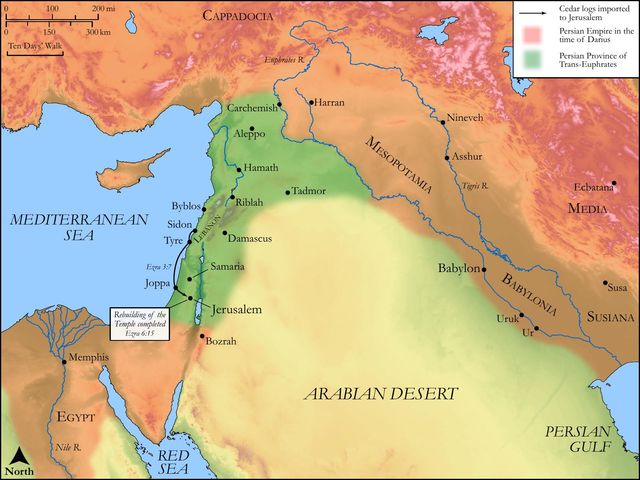
The "people of the land" (עַם הָאָרֶץ, ʿam hāʾāreṣ) in this context refers to the mixed population that had settled in Samaria and the surrounding regions after the Assyrian deportations and subsequent repopulation policies (2 Kings 17:24-41). These individuals practiced a syncretistic religion, blending elements of Israelite worship with their own pagan deities. Their offer to help was likely motivated by a desire to gain influence over the returning exiles or to integrate their religious practices into the Temple worship, which the Jewish leaders rightly perceived as a threat to their monotheistic faith and covenant identity. The returned exiles, having just endured seventy years of Babylonian captivity due to idolatry, were acutely sensitive to any potential compromise with foreign religious practices. The Persian Empire, under whose authority the Jews returned, generally allowed conquered peoples a degree of religious autonomy, but local political rivalries and economic interests often fueled such conflicts.
Key Themes
ShowHideEzra 4:4 powerfully introduces several enduring themes crucial to the book of Ezra and the broader biblical narrative. Firstly, it underscores the theme of Opposition to God's Work, demonstrating that divine initiatives often encounter fierce resistance from worldly forces. The rebuilding of the Temple was not merely a construction project but a spiritual restoration, an act of obedience to God's command, and thus became a target for spiritual antagonism (Nehemiah 4:7-8). Secondly, the verse highlights Discouragement as a Tactic, revealing how adversaries seek to undermine faith and effort not just through direct confrontation but through psychological warfare designed to "weaken the hands" and make the task seem insurmountable. This tactic aims to erode resolve and halt progress. Thirdly, it implicitly introduces the theme of Divine Sovereignty and Perseverance, setting the stage for how God's people must respond to such adversity, relying on His strength to complete His purposes despite formidable obstacles, a truth echoed in the steadfastness encouraged in Philippians 1:28.
Exposition and Analysis
ShowHideKey Word Analysis
ShowHideThis primitive root (H7503) means "to slacken" or "to become feeble." In this context, it carries a strong sense of causing someone to lose heart, to be discouraged, or to abandon effort. When applied to "hands," it vividly describes the psychological and emotional impact of the opposition, making the builders feel incapable or unwilling to continue their work. It implies a systematic effort to sap their energy and resolve.
This primitive word (H3027) refers to the hand, often indicating power, means, or ability. As part of the idiom "weakened the hands," it symbolizes the capacity for work, effort, and resolve. The weakening of the hands signifies a deliberate attempt to undermine the will and ability of the Jewish builders to continue the construction, rendering them helpless or hopeless.
This primitive root (H926) means "to tremble inwardly," "to be alarmed or agitated," or "to hasten anxiously." It suggests a more active, aggressive form of interference than mere discouragement. It implies actions that created anxiety, fear, and disruption, making the building process exceedingly difficult and stressful. This could include legal threats, economic pressure, or even physical intimidation, all designed to create a hostile environment that would force the Jews to cease their work.
Verse Breakdown
ShowHide"Then the people of the land"
This phrase identifies the antagonists as the local inhabitants, a mixed population of non-Jews and partially assimilated Israelites residing in the region, particularly Samaria. Their collective action indicates a unified and organized effort against the returning exiles.
"weakened the hands of the people of Judah"
This powerful idiomatic expression describes the primary method of opposition. It refers to a deliberate attempt to demoralize, discourage, and debilitate the Jewish builders. The "hands" symbolize their capacity for work, effort, and resolve. To "weaken the hands" means to undermine their will and ability to continue the construction, making them feel helpless or hopeless.
"and troubled them in building"
This clause specifies the effect of the weakening and the arena of the harassment. The "troubling" indicates active harassment, intimidation, and disruption. This was not passive resistance but an aggressive campaign to create obstacles and distress specifically aimed at halting the rebuilding of the Temple. The phrase highlights that the opposition was direct and targeted at their sacred mission.
Literary Devices
ShowHideThe verse employs several potent literary devices to convey the nature of the opposition. The most prominent is the Idiom "weakened the hands" (רָפָה יָדַיִם, rāphâ yādayim). This phrase functions as a vivid Metaphor for psychological and emotional discouragement, where the physical act of "slackening hands" represents a loss of resolve and energy for work. It effectively communicates the internal impact of external pressures. Furthermore, the juxtaposition of the Jewish people's divinely appointed task of "building" with the adversaries' active "troubling" creates a strong sense of Antithesis, highlighting the conflict between God's purposes and human opposition. The concise and direct language of the verse contributes to its impactful portrayal of immediate and intense conflict.
Theological and Thematic Connections
ShowHideEzra 4:4 serves as a foundational text for understanding the reality of spiritual opposition in the pursuit of God's will. It underscores that whenever God's people embark on a significant work for His kingdom, they should anticipate resistance. This opposition is not merely coincidental; it is often a deliberate strategy by forces hostile to God, aimed at discouraging believers and thwarting divine purposes. The "weakening of hands" and "troubling" tactics are timeless, manifesting in various forms—criticism, legal challenges, social ostracization, or even internal doubt—all designed to make God's work seem too difficult or not worth the effort. The verse implicitly calls for spiritual discernment to recognize the source and nature of such opposition, and for steadfastness in the face of adversity, knowing that God's ultimate plan will prevail.
Reflection and Application
ShowHideEzra 4:4 offers a profound and sobering lesson for believers in every age: commitment to God's purposes inevitably invites opposition. Just as the returning exiles faced external pressures designed to halt their sacred work, so too will those who seek to live faithfully and advance God's kingdom encounter resistance. This "weakening of hands" can manifest as subtle discouragement, overwhelming obstacles, or direct attacks on one's faith and efforts. The "troubling" can come through criticism, legal battles, financial strain, or spiritual warfare, all aimed at making us lose heart and abandon our divine calling. Recognizing these tactics is crucial for perseverance. We are called not to be surprised by opposition, but to be prepared, understanding that our struggle is not merely against flesh and blood but against spiritual forces (Ephesians 6:12). Our strength to overcome discouragement and continue building comes not from our own might, but from our unwavering reliance on God's power and His promise to complete what He has begun.
Questions for Reflection
ShowHideFAQ
ShowHideWho were "the people of the land" mentioned in Ezra 4:4, and why were they opposed to the rebuilding of the Temple?
ShowHide"The people of the land" (עַם הָאָרֶץ, ʿam hāʾāreṣ) refers to the mixed population living in the region of Samaria and surrounding areas. These were descendants of various foreign peoples whom the Assyrians had resettled in the land after deporting the Israelites, along with some remaining Israelites who had intermarried. They practiced a syncretistic religion, blending elements of Israelite worship with their own pagan deities (as described in 2 Kings 17:24-41). Their opposition stemmed from several factors: the Jewish leaders' refusal to allow them to participate in the Temple rebuilding, which they saw as an insult and a rejection of their claim to the land; a desire to maintain their own influence and control in the region; and likely a spiritual antagonism towards the pure worship of Yahweh that the returning exiles sought to re-establish. Their actions were designed to prevent the re-establishment of a strong, independent Jewish community and its central place of worship.
What does the phrase "weakened the hands" truly imply about the opposition's tactics?
ShowHideThe idiom "weakened the hands" (Hebrew: rāphâ yādayim) is a powerful metaphor indicating a deliberate effort to cause discouragement, to make someone lose heart, or to sap their resolve and energy for a task. It implies psychological warfare more than just physical obstruction. The adversaries likely used various tactics such as spreading rumors, making false accusations, threatening legal action, imposing financial burdens, or engaging in intimidation, all designed to make the Jewish builders feel overwhelmed, hopeless, and incapable of completing the Temple. It was an attempt to break their spirit and make them abandon the work themselves, rather than having to physically stop them. This tactic is often employed by adversaries to undermine God's people, as seen in Nehemiah 6:9 where Nehemiah prays, "Now therefore, O God, strengthen my hands."
Christ-Centered Fulfillment
ShowHideEzra 4:4, depicting the intense opposition to the rebuilding of God's physical Temple, powerfully foreshadows the spiritual opposition faced by Christ and His Church in building God's spiritual Temple. Just as the "people of the land" sought to "weaken the hands" and "trouble" the Jewish exiles, so too does the adversary of our souls constantly seek to discourage and hinder believers from advancing God's kingdom. Jesus Himself faced relentless opposition from religious leaders and worldly powers, culminating in His crucifixion, yet His ultimate victory on the cross disarmed all hostile principalities and powers (Colossians 2:15). The Church, as the body of Christ and the new Temple where God's Spirit dwells (1 Corinthians 3:16), continues this divine mission and likewise experiences spiritual warfare. However, the ultimate fulfillment in Christ means that no opposition, no matter how intense or discouraging, can ultimately thwart God's eternal purposes. Christ, the Chief Cornerstone (Ephesians 2:20), ensures that the gates of Hades will not prevail against His Church (Matthew 16:18), empowering His followers to persevere and complete the work He has given them, for "I can do all things through Christ who strengthens me" (Philippians 4:13).