


Isaiah 41:5
- רָאוּra·'Uthey have seenH7200V-Qal-Perf-3cpVerb Qal Perfect 3rd Plural common gender
- אִיִּים'i·YimislandsH339N-mpNoun Plural Masculine Absolute
- וְיִירָאוּve·yi·Ra·'uso they may be afraidH3372Conj-w ¦ V-Qal-ConjImperf-3mpVerb Qal Conjunction+Imperfect 3rd Plural Masculineוְsoיִירָאוּthey may be afraid
- קְצוֹתke·Tzot[the] ends ofH7098N-fpcNoun Plural Feminine Construct
- הָאָרֶץha·'A·retzthe earthH776Art ¦ N-fsNoun Singular Feminine Absoluteהָtheאָרֶץearth
- יֶחֱרָדוּye·che·Ra·duthey trembleH2729V-Qal-Imperf-3mpVerb Qal Imperfect 3rd Plural Masculine
- קָרְבוּka·re·Vuthey have drawn nearH7126V-Qal-Perf-3cpVerb Qal Perfect 3rd Plural common gender
- וַיֶּאֱתָיוּןvai·ye·'e·ta·Yunand they have come !H857Conj-w ¦ V-Qal-ConsecImperf-3mp ¦ SfxVerb Qal Consecutive Imperfect 3rd Plural Masculineוַandיֶּאֱתָיוּthey have comeן!
English is a literal word-by-word gloss of the Hebrew, not the KJV's wording. Why?
This is the original text the KJV's translators worked from — each Hebrew word with its own literal English meaning in this verse, prepared by scholars at Tyndale House, Cambridge. The KJV translates whole sentences, not word by word, so its wording differs: one Hebrew word can become several English words, and the KJV may choose “the LORD” where the gloss reads “Yahweh”. Both are faithful — they answer different questions. For the KJV's own rendering, switch to the KJV text.
Details
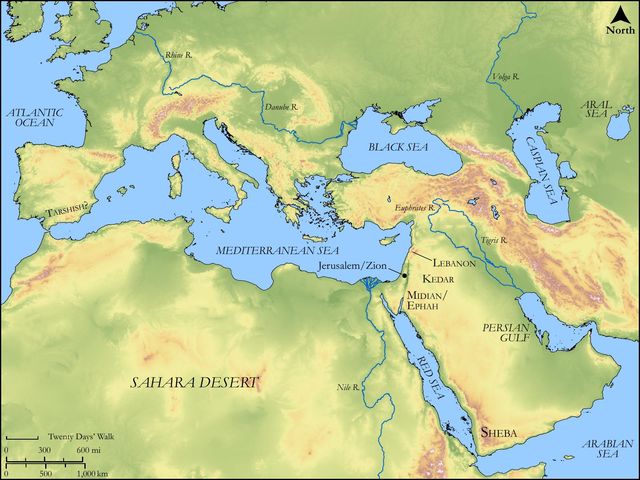
See on the biblical-era map
Study this verse
Public-domain commentary
Matthew Henry
From his Commentary on the Whole Bible. Henry comments on passages, not single verses — this entry covers Isaiah 41:1–9. His four-level outline is real structure in the source text, so it is rendered as structure.
That particular instance of God's care for his people Israel in raising up Cyrus to be their deliverer is here insisted upon as a great proof both of his sovereignty above all idols and of his power to protect his people. Here is,
I.A general challenge to the worshippers and admirers of idols to make good their pretensions, in competition with God and opposition to him, Isa 41:1. Is is renewed (Isa 41:21): Produce your cause. The court is set, summonses are sent to the islands that lay most remote, but not out of God's jurisdiction, for he is the Creator and possessor of the ends of the earth, to make their appearance and give their attendance. Silence (as usual) is proclaimed while the cause is in trying: "Keep silence before me, and judge nothing before the time"; while the cause is in trying between the kingdom of God and the kingdom of Satan it becomes all people silently to expect the issue, not to object against God's proceedings, but to be confident that he will carry the day. The defenders of idolatry are called to say what they can in defence of it: "Let them renew their strength, in opposition to God, and see whether it be equal to the strength which those renew that wait upon him (Isa 40:31); let them try their utmost efforts, whether by force of arms or force of argument. Let them come near; they shall not complain that God's dread makes them afraid (Job 13:21), so that they cannot say what they have to say, in vindication and honour of their idols; no, let them speak freely: Let us come near together to judgment." Note.
1.The cause of God and his kingdom is not afraid of a fair trial; if the case be but fairly stated, it will be surely carried in favour of religion.
2.The enemies of God's church and his holy religion may safely be challenged to say and do their worst for the support of their unrighteous cause. He that sits in heaven laughs at them, and the daughter of Zion despises them; for great is the truth and will prevail.
II.He particularly challenges the idols to do that for their worshippers, and against his, which he had done and would do for his worshippers, and against theirs. Different senses are given of Isa 41:2, concerning the righteous man raised up from the east; and, since we cannot determine which is the true, we will make use of each as good.
1.That which is to be proved is,
(1.)That the Lord is God alone, the first and with the last (Isa 41:4), that he is infinite, eternal, and unchangeable, that he governed the world from the beginning, and will to the end of time. He has reigned of old, and will reign for ever; the counsels of his kingdom were from eternity, and the continuance of it will be to eternity.
(2.)That Israel is his servant (Isa 41:8), whom he owns, and protects, and employs, and in whom he is and will be glorified. As there is a God in heaven, so there is a church on earth that is his particular care. Elijah prays (Kg1 18:36), Let it be known that thou art God, and that I am thy servant. Now,
2.To prove this he shows,
(1.)That it was he who called Abraham, the father of this despised nation, out of an idolatrous country, and by many instances of his favour made his name great, Gen 12:2. He is the righteous man whom God raised up from the east. Of him the Chaldee paraphrast expressly understands it: Who brought Abraham publicly from the east? To maintain the honour of the people of Israel, it was very proper to show what a figure this great ancestor of theirs made in his day; and Isa 41:8 seems to be the explication of it, where God calls Israel the seed of Abraham my friend; and (Isa 41:4) he calls the generations (namely, the generations of Israel) from the beginning. Also, to put contempt upon idolatry, and particularly the Chaldean idolatry, it was proper to show how Abraham was called from serving other gods (Jos 24:2, Jos 24:3, etc.), so that an early testimony was borne against that idolatry which boasted so much of its antiquity. Also, to encourage the captives in Babylon to hope that God would find a way for their return to their own land, it was proper to remind them how at first he brought their father Abraham out of the same country into this land, to give it to him for an inheritance, Gen 15:7. Now observe what is here said concerning him.
[1.]That he was a righteous man, or righteousness, a man of righteousness, that believed God, and it was counted to him for righteousness; and so he became the father of all those who by faith in Christ are made the righteousness of God through him, Rom 4:3, Rom 4:11; Co2 5:21. He was a great example of righteousness in his day, and taught his household to do judgment and justice, Gen 18:19.
[2.]That God raised him up from the east, from Ur first and afterwards from Haran, which lay east from Canaan. God would not let him settle in either of those places, but did by him as the eagle by her young, when she stirs up her nest: he raised him out of iniquity and made him pious, out of obscurity and made him famous.
[3.]He called him to his foot, to follow him with an implicit faith; for he went out, not knowing whither he went, but whom he followed, Heb 11:8. Those whom God effectually calls he calls to his foot, to be subject to him, to attend him, and follow the Lamb whithersoever he goes; and we must all either come to his foot or be made his footstool.
[4.]He gave nations before him, the nations of Canaan, which he promised to make him master of, and thus far gave him an interest in that the Hittites acknowledged him a mighty prince among them, Gen 23:6. He made him rule over those kings whom he conquered for the rescue of his brother Lot, Gen. 14. And when God gave them as dust to his sword, and as driven stubble to his bow (that is, made them an easy prey to his catechised servants), he then pursued them, and passed safely, or in peace, under the divine protection, though it was in a way he was altogether unacquainted with; and so considerable was this victory that Melchizedec himself appeared to celebrate it. Now who did this but the great Jehovah? Can any of the gods of the heathen do so?
(2.)That it is he who will, ere long, raise up Cyrus from the east. It is spoken of according to the language of prophecy as a thing past, because as sure to be done in its season as if it were already done. God will raise him up in righteousness (so it may be read, Isa 45:13), will call him to his foot, make what use of him he pleases, and make him victorious over the nations that oppose his coming to the crown, and give him success in all his wars; and he shall be a type of Christ, who is righteousness itself, the Lord our righteousness, whom God will, in the fulness of time, raise up and make victorious over the powers of darkness; so that he shall spoil them and make a show of them openly.
III.He exposes the folly of idolaters, who, notwithstanding the convincing proofs which the God of Israel had given of his being God alone, obstinately persisted in their idolatry, nay, were so much the more hardened in it (Isa 41:5): The isles of the Gentiles saw this, not only what God did for Abraham himself, but what he did for his seed, for his sake, how he brought them out of Egypt, and made them rule over kings, and they feared, Exo 15:14-16. They were afraid, and, according to the summons (Isa 41:1), they drew near, and came; they could not avoid taking notice of what God did for Abraham and his seed; but, instead of helping to reason one another out of their sottish idolatries, they helped to confirm one another in them, Isa 41:6, Isa 41:7.
1.They looked upon it as a dangerous design upon their religion, which they were jealous for the honour of, and were resolved, right or wrong, to adhere to, and therefore were alarmed to appear vigorously for the support of it, as the Ephesians for their Diana. When God, by his wonderful appearances on the behalf of his people, went about to wrest their idols from them, they held them so much the faster, and said one to another, "Be of good courage; let us unanimously agree to keep up the reputation of our gods. Though Dagon fall before the ark, he shall be set up again in his place." One tradesman encourages another to come into a confederacy for the keeping up of the noble craft of god-making. Thus men's convictions often exasperate their corruptions, and they are made worse both by the word and the works of God, which should make them better.
2.They looked upon it as a dangerous design upon themselves. They thought themselves in danger from the growing greatness both of Abraham that was a convert from idolatry, and of the people of Israel that were separatists from it; and therefore they not only had recourse to their old gods for protection, but made new ones, Deu 32:17. So the carpenter, having done his part to the timberwork, encouraged the goldsmith to do his part in gilding or overlaying it; and, when it came into the goldsmith's hand, he that smooths with the hammer that polishes it, or beats it thin, quickened him that smote the anvil, bade him be expeditious, and told him it was ready for the soldering, which perhaps was the last operation about it, and then it is fastened with nails, and you have a god of it presently. Do sinners thus animate and quicken one another in the ways of sin? And shall not the servants of the living God both stir up one another to, and strengthen one another in, his service? Some read all this ironically, and by way of permission: Let them help every one his neighbour; let the carpenter encourage the goldsmith; but all in vain; idols shall fall for all this.
IV.He encourages his own people to trust in him (Isa 41:8, Isa 41:9):
"But thou, Israel, art my servant. They know me not, but thou knowest me, and knowest better than to join with such ignorant besotted people as these" (for it is intended for a warning to the people of God not to walk in the way of the heathen); "they put themselves under the protection of these impotent deities, but thou art under my protection. Those that make them are like unto them, and so is every one that trusts in them; but thou, O Israel! art the servant of a better Master." Observe what is suggested here for the encouragement of God's people when they are threatened and insulted over. 1. They are God's servants, and he will not see them abused, especially for what they do in his service: Thou art my servant (Isa 41:8), and (Isa 41:9) "I have said unto thee, Thou art my servant; and I will not go back from my word." 2. He has chosen them to be a peculiar people to himself. They were not forced upon him, but of his own good-will he set them apart. 3. They were the seed of Abraham his friend. It was the honour of Abraham that he was called the friend of God (Jam 2:23), whom God covenanted and conversed with as a friend, and the man of his counsel; and this honour have all the saints, Joh 15:15. And for the father's sake the people of Israel were beloved. God was pleased to look upon them as the posterity of an old friend of his, and therefore to be kind to them; for the covenant of friendship was made with Abraham and his seed. 4. He had sometimes, when they had been scattered among the heathen, fetched them from the ends of the earth and taken them out of the hands of the chief ones thereof, and therefore he would not now abandon them. Abraham their father was fetched from a place at a great distance, and they in his loins; and those who had been thus far-fetched and dear-bought he could not easily part with. 5. He had not yet cast them away, though they had often provoked him, and therefore he would not now abandon them. What God has done for his people, and what he has further engaged to do, should encourage them to trust in him at all times.
Historical interpretation
Historical reception
1 surviving comment on this verse from the historical church.
(Chapter 41, verses 1 and following.) Let the islands be silent before me, and let the nations change their strength: let them come near, and then let them speak: let us come together to judgment. Who raised up the Just One from the East, and called him to follow him? He will give nations before him, and he will rule over kings: he will make them like the dust with his sword, and like stubble driven by the wind to his bow. He will pursue them, and he will pass in peace, a path will not appear under his feet. Who has accomplished and done this, calling forth the generations from the beginning? I, the Lord, am the first and the last; I am He. The islands have seen and feared; the ends of the earth tremble; they have drawn near and come. Each one helps his neighbor and says to his brother, 'Be strong!' The blacksmith takes a tool and works with it in the coals; he fashions it with hammers and works it with his strong arm. He also gets hungry and his strength fails; he drinks no water and grows faint. LXX: Come near to me, you islands; let the leaders approach together and declare judgment. Who has stirred up one from the east, calling him in righteousness to his service? He hands nations over to him and subdues kings before him. He makes them like dust with his sword, like windblown chaff with his bow. He pursues them and moves on unscathed, by a path his feet have not traveled before. Who has done this and carried it through, calling forth the generations from the beginning? I, the Lord—with the first of them and with the last—I am he.\ He will call her who has been called from the beginning of generations. I am the first God, and I am present in the things that are to come. The nations have seen and feared: the ends of the earth have stood in awe and approached: they have come together, each judging their neighbor to help and support their brother: and they will say: the skilled craftsman and blacksmith have prevailed, striking the hammer together, producing: sometimes indeed they say, ‘it is good to strengthen’. They have strengthened it, they have set it in nails: and it will not be moved. People, that is, the islands, which are buffeted by the false and bitter waves of this age, are commanded to listen and to close their mouths, and to know that which was said to Israel: Listen, Israel, and be silent; and to change their strength, lest they cannot hear the word of God because of their former weakness, so that they may approach the Lord first, and that they may not be satisfied with their own salvation; but that which they have learned, they may teach to others, and may argue with the Lord whether God has kept justice for all. But he interrogates them and challenges them to respond, in order to teach them through the questioning what they are ignorant of: Who raised up the just one from the East, or justice? For it is not only the God of the Jews, but also of the Gentiles, who called Christ the Lord and Savior, who became for us wisdom from God, righteousness and sanctification, and redemption (1 Cor. 1). In which, according to the same Apostle, God's righteousness is revealed (ibid). But he called him, so that he might follow him in all things and do the works of the Father; and he fulfilled that saying: O God, I desired to do your will (Ps. 39:9). In his presence, kings and nations will submit their necks, and the opposing powers, like stubble and dust, will be subjected to his sword and arrows. He will pursue them, namely the kings and princes of each nation, and he will pass by in peace, calling all to peace so that they may be reconciled to God. His path will not be visible, that is, he will not feel the labor of the journey or any weakness or fatigue of human nature; but he will drink from the stream on the way, and therefore he will lift up his head. Who, he says, has worked and made these? Who raised up the righteous, or righteousness? Who delivered nations and kings to him? Who subjected all things to his sword and bow? Certainly he, who from the beginning of the world predicted these things, who is the creator of all. And because he had said, in response to the questioner's emotion: Who raised up the righteous from the East, etc., while all were silent, he answered himself: I am the Lord, I am the first and the last. He Himself is the one who speaks in the Apocalypse of John: I am the Alpha and Omega, the beginning and the end (Rev. I, 8; and XXII, 13). The islands, that is, the nations or the Churches gathered from the nations, have seen and feared the Lord, for the fear of the Lord is the beginning of wisdom (Prov. IX, 10). All the ends of the earth trembled at the words of the Apostles, approaching and likewise coming to the Gospel of Christ. And when they saw themselves to be saved, they completed the work that they had heard before: let them approach, and then let them speak; that they may assist their neighbors, and that they may wish to strengthen their brothers in the Lord, and may say to them: Depart from idols, despise ancient images of demons, which were created by human hands, which were produced by a hammer striking, which were bound with glue, which were fastened with nails, so that they would not be moved; and when they stood, they could not walk. Some report that we, interpreted as the ones above all others, through the calling of the Gentiles and the preaching of the Gospel and the condemnation of idols, led Cyrus, the king of the Persians, to rise up against the Babylonians from the East, and made him submit to his command, prostrating many nations before him and subjecting everything to his sword and bow. And they relate other things that follow concerning his person, namely that their idols, which were made with human skill and skillfully crafted by the bronze smith, were of no avail to the Babylonians. Some Hebrews believe that Abraham was called righteous from the East, that is, from the Chaldeans, because he alone was found to be righteous. He followed God, leaving his homeland to a land that he did not know, and he delivered kings into his hand who had come against Sodom and Gomorrah. He made them like stubble and dust before his sword and bow. He pursued them, returned in peace, and did not feel the effects of the long journey, and all this was not by his own strength but by the mercy of the Lord, who knew these things from the beginning. They saw, he said, the islands, that is, the nations in the surrounding area, and they were terrified by his power: and the ends of the earth. Indeed, he was the son of Noah, who had escaped the Flood with his father and brothers in the final time of the earth; and he had been preserved until that time: they want him to be understood as Melchizedek, and to have come to meet Abraham returning from battle, and to have received him, and blessed him, and strengthened him with the blessings of God: and to be the skillful craftsman who had fashioned for Abraham, and with the hammer of his art had brought forth better things: and to have said to him, It is good that you are united and joined to him in the fear of the Lord. And he strengthened him, or established him on the key of the commandments of the Lord, so that he would not be moved, but would remain in fear of Him.
Continue studying Isaiah 41:5 across the web’s major study libraries — every link below opens this exact verse, chapter, or book on the destination site.
Read & Compare
 BibleGatewayThis verse in more than 200 translations and 70 languages.
 Bible.comThe YouVersion reader — hundreds of translations, reading plans, and highlights.
 ESV.orgCrossway's official English Standard Version reader.
 NET BibleThe NET translation with 60,000+ translators' notes on every rendering decision.
 STEP BibleTyndale House's free study tool — original text, vocabulary, and scholarly resources.
 BibliaLogos Bible Software's free web reader.
 USCCBThe New American Bible (Revised Edition) with the U.S. bishops' study notes.
Commentaries
 BibleHub CommentariesDozens of classic commentaries on this verse, gathered on one page.
 StudyLightMore than 100 commentary sets — the largest collection on the web.
 BibleRefPlain-English commentary on what this verse means, verse by verse.
 Enduring WordDavid Guzik's free commentary on this chapter, widely used by Bible teachers.
 Bible Study ToolsVerse commentary alongside Greek and Hebrew study aids.
Original Language & Research
- BibleHub InterlinearThe verse word by word — original language, transliteration, and English.
- BibleHub LexiconEvery word's original-language definition and Strong's entry.
 Blue Letter BibleDeep-study tools — Strong's numbers, concordance, and word studies.
 SefariaThe Hebrew text with Rashi and centuries of Jewish commentary.
Sermons, Hymns & Audio


TrulyRandomVerse is not affiliated with these sites and doesn’t control their content. They’re linked because they’re genuinely useful.
Summary
Isaiah 41:5 vividly portrays the profound and widespread reaction of distant nations and the farthest reaches of the earth to God's decisive and sovereign interventions in history. This verse captures the overwhelming fear and compelled convergence that results from the undeniable manifestation of divine power, setting the stage for the subsequent futile attempts by these nations to reinforce their powerless idols when confronted with the living God.
Context
ShowHideLiterary Context
This verse is intricately woven into the fabric of Isaiah's "Servant Songs" and disputation speeches, particularly within chapters 40-48. In this section, God systematically contrasts His unique omnipotence and absolute sovereignty with the utter impotence and futility of the idols worshipped by the Gentile nations. The verses immediately preceding Isaiah 41:2-4 describe God raising up a righteous conqueror from the east (often understood as Cyrus, though unnamed), who swiftly and successfully subdues nations. The "it" that the "isles" and "ends of the earth" witness and fear in verse 5 directly refers to this divinely orchestrated, sweeping conquest or the powerful agent God employs. This immediate global reaction of fear and drawing near then serves as a dramatic prelude to the nations' desperate and foolish turn to their idols in Isaiah 41:6-7, sharply highlighting their spiritual blindness and the stark contrast between human efforts and divine power.
Historical & Cultural Context
Isaiah's prophecies were delivered during a period of immense geopolitical upheaval for Judah, marked by the rising dominance of the Assyrian and, later, the Babylonian empires. The terms "the isles" (Hebrew: ʼîy) and "the ends of the earth" (Hebrew: qâtsâh_ _ʼerets) referred to the distant coastlands, maritime regions, and remote Gentile nations known to the ancient Near Eastern world. These phrases collectively represent the entirety of the known inhabited world beyond Israel, emphasizing the universal scope of God's actions. The cultural landscape was dominated by widespread polytheism and idolatry, where nations placed their trust in their national deities for security, prosperity, and military success. God's direct challenge to these idols and His demonstration of power through a chosen instrument would have been a direct assault on the prevailing worldview, compelling a profound reaction from those who relied on their own strength and the supposed power of their gods. The imagery of the verse evokes a global stage upon which God's actions are universally observable and undeniably impactful.
Key Themes
ShowHideIsaiah 41:5 significantly contributes to several profound themes pervasive throughout the book of Isaiah. Firstly, it powerfully underscores God's Unchallengeable Sovereignty, asserting that His divine plan unfolds on a global scale, compelling even distant nations to acknowledge His hand, whether in fearful recognition or reluctant submission. This is a recurring motif, emphasizing that God is the ultimate ruler over all human history and political events, as seen in passages like Isaiah 44:6-8. Secondly, the verse highlights the Global Impact of Divine Action, demonstrating that no place or people is beyond the scope of God's power and influence, foreshadowing the universal reach of His salvation and the ultimate establishment of His kingdom. Thirdly, it vividly illustrates the Futility of Idolatry by showing the nations' initial fear and drawing near, which then devolves into a panicked, futile attempt to reinforce their powerless idols, a theme powerfully developed throughout chapters 40-48, such as in Isaiah 46:1-2. The nations' response of "feared" and "drew near, and came" suggests a complex mixture of dread, curiosity, and an attempt to understand or perhaps counter the overwhelming force they perceive from the one true God.
Exposition and Analysis
ShowHideKey Word Analysis
ShowHideFrom a root meaning "to be desirable," this term properly denotes a habitable spot, dry land, a coast, or an island. In prophetic literature, "isles" (or "coastlands") often refers to distant maritime regions or Gentile nations far from Israel. Its use here emphasizes the universal scope of God's actions, extending beyond the immediate geographical context of Judah to encompass the entire known world.
A primitive root meaning "to fear," "to revere," or "to frighten." In this context, it conveys a deep sense of dread, awe, or terror. The nations' fear is not necessarily reverential worship but a profound apprehension and shaking inspired by the undeniable display of God's overwhelming power and the swiftness of His chosen instrument. It signifies a response of being "affrighted" or "dreadful."
A primitive root meaning "to approach" or "to bring near" for various purposes. Here, it signifies a physical or conceptual movement towards the source of the perceived power. This "drawing near" suggests a compelled attention, an investigation, or even a hesitant confrontation, indicating that the nations could not ignore what they witnessed but were compelled to engage with it, even if in opposition or out of sheer curiosity.
Verse Breakdown
ShowHide"The isles saw [it],"
This opening clause establishes the global audience for God's mighty acts. "The isles," representing distant Gentile nations and maritime regions, are depicted as direct witnesses to the unfolding of God's sovereign plan, specifically the rise of the conqueror mentioned in preceding verses. The act of "seeing" implies a clear, undeniable perception and recognition of divine intervention.
"and feared;"
The immediate and profound reaction of these distant nations to what they saw was fear. This fear is not necessarily a turning to God in repentance or worship, but rather a recognition of overwhelming power that evokes dread, apprehension, and a shaking of their established order and reliance on their own gods.
"the ends of the earth were afraid,"
This phrase serves as a powerful parallel to "the isles," reinforcing the universal scope of the reaction. "The ends of the earth" emphasizes the remoteness and totality of the global response, indicating that no corner of the world was untouched by the impact of God's actions. The repetition of "feared" (using a different Hebrew word, chârad, which means to shudder with terror) intensifies the description of their dread and discomfiture.
"drew near,"
Following their initial fear, the nations are depicted as "drawing near." This suggests a compelled approach, a movement towards the source of the power they witnessed. It could imply an attempt to understand, to observe more closely, or even to form a united front against this perceived threat, rather than an act of submission or worship.
"and came."
This final verb reinforces and completes the action of "drew near," painting a picture of a decisive and unified movement. The nations did not merely observe from afar but actively converged, indicating a significant and collective response to the divine display, setting the stage for their subsequent actions of reinforcing their idols.
Literary Devices
ShowHideIsaiah 41:5 employs several potent literary devices to convey its profound message of God's universal sovereignty. Personification is strikingly evident as "the isles" and "the ends of the earth" are attributed human actions: "saw," "feared," "drew near," and "came." This imbues inanimate geographical regions with a sense of agency, making the global reaction more vivid and impactful, as if the very land itself is responding to God. The use of Merism through the pairing of "the isles" and "the ends of the earth" effectively conveys the totality and universality of the response, encompassing the entire known world from its furthest coasts to its most remote interior. This rhetorical device emphasizes that God's power is not localized or confined but has a truly global reach and impact. Furthermore, the verse exhibits strong Parallelism in its structure, with the two main clauses ("The isles saw [it], and feared;" and "the ends of the earth were afraid, drew near, and came") mirroring each other in their description of the nations' perception and reaction. This poetic technique enhances the verse's rhythm, reinforces the comprehensive nature of the global response, and underscores the undeniable reality of God's sovereign acts.
Theological and Thematic Connections
ShowHideIsaiah 41:5 profoundly underscores God's absolute sovereignty over all nations and history, demonstrating that His actions compel a universal response, even from those who oppose Him. The fear and drawing near of the nations highlight the undeniable power of the one true God in stark contrast to the impotence of their idols. This verse sets the stage for the subsequent divine challenge to idolatry, emphasizing that God alone is worthy of recognition and trust, as His power is manifest across the entire earth. It foreshadows a future where all nations will ultimately acknowledge God's reign, whether in fear or in worship, and serves as a powerful reminder that no human endeavor or earthly power can stand against the divine will.
Reflection and Application
ShowHideIsaiah 41:5 serves as a profound theological anchor, reminding us that God is not a distant, passive deity but an active, sovereign force shaping the course of human history. The nations' compelled response of fear and drawing near to God's undeniable power invites us to consider our own posture before Him. In a world often characterized by human pride, self-reliance, and the worship of created things, this verse calls us to a posture of reverent awe and humble submission. Just as the "isles" and "ends of the earth" could not ignore God's manifest power, neither can we. Our response should not be one of panicked idolatry or futile resistance, but rather a trusting embrace of His sovereign will and a recognition of His ultimate authority over all things, both personal and global. It challenges us to discern God's hand in current events and to respond with faith rather than fear, knowing that He is working all things according to His purposes, ultimately for His glory and the good of His people.
Questions for Reflection
ShowHideFAQ
ShowHideWhat is the "it" that the nations saw in Isaiah 41:5?
ShowHideThe "it" refers to the powerful, divinely orchestrated events described in the immediately preceding verses of Isaiah 41:2-4. God declares that He is raising up a righteous individual from the east (often understood as Cyrus, though unnamed here) who will conquer nations with unprecedented speed and success. The "it" is the undeniable display of God's power and the unfolding of His divine plan through this chosen instrument, which compels a global reaction of fear and convergence.
Why did the nations "fear" and "were afraid" in response to God's actions?
ShowHideThe nations' fear was a natural response to the overwhelming and unexpected display of divine power that disrupted their established order and challenged their reliance on their own gods. It was not necessarily a fear leading to repentance or worship, but rather a profound dread, a shuddering terror, and an apprehension of a force far greater than any they had encountered. This fear is contrasted with the subsequent verses (Isaiah 41:6-7) where their fear drives them to futilely reinforce their idols, rather than turning to the true God in humility and submission.
What does "drew near, and came" imply about the nations' response?
ShowHideThe phrases "drew near, and came" indicate a compelled and unified movement by the nations towards the source of the power they witnessed. It suggests that they could not ignore what was happening but were forced to engage with it, whether to observe, understand, or perhaps even to conspire against the perceived threat. This active convergence highlights the undeniable impact of God's actions, which demanded a direct response from the global community, even if that response was ultimately one of opposition and spiritual blindness rather than worship.
Christ-Centered Fulfillment
ShowHideIsaiah 41:5, with its depiction of the nations' compelled recognition of God's power, finds its ultimate and glorious fulfillment in the person and work of Jesus Christ. While the immediate context speaks of a temporal conqueror, the prophetic trajectory points to the universal reign of the Messiah. Just as the "isles" and "ends of the earth" were shaken by God's ancient displays of power, so too will every nation, tribe, people, and language ultimately acknowledge the sovereign authority of Christ. Matthew 28:18 declares that "All authority in heaven and on earth has been given to me," echoing the global scope of power foreshadowed in Isaiah. The fear of the nations in Isaiah 41:5 foreshadows the day when "every knee should bow, in heaven and on earth and under the earth, and every tongue acknowledge that Jesus Christ is Lord, to the glory of God the Father" (Philippians 2:10-11). While the nations "drew near, and came" in fearful recognition in Isaiah, in Christ, the invitation is to draw near in faith and worship, as the gospel is proclaimed to the "ends of the earth" (Acts 1:8). Ultimately, the universal acknowledgment of God's power in Isaiah 41:5 culminates in the global worship of the Lamb, where a "great multitude that no one could count, from every nation, tribe, people and language, standing before the throne and before the Lamb" (Revelation 7:9-10) will offer praise, fulfilling the prophetic vision of God's universal dominion through His Son.