


Acts 9:42
Bible text: King James Version (1769 Blayney text) · Public domain
Bible text: Berean Standard Bible · Public domain
Bible text: American Standard Version (1901) · Public domain
Bible text: World English Bible, Messianic edition · Public domain
Bible text: Geneva Bible (1599) · Public domain
Bible text: Young's Literal Translation · Public domain
- γνωστὸνgnōstonKnownG1110A-NSNAdjective Nominative Singular Neuter
- δὲdethenG1161CONJConjunction
- ἐγένετοegenetoit becameG1096V-2ADI-3SVerb 2nd Aorist Middle Deponent Indicative 3rd Singular
- καθ᾽kath᾽throughoutG2596PREPPreposition
- ὅληςholēsallG3650A-GSFAdjective Genitive Singular Feminine
- τῆςtēs<the>G3588T-GSFDefinite article Genitive Singular Feminine
- ἸόππηςIoppēsof JoppaG2445N-GSF-LNoun Genitive Singular Feminine Location
- καὶkaiandG2532CONJConjunction
- ἐπίστευσανepisteusanbelievedG4100V-AAI-3PVerb Aorist Active Indicative 3rd Plural
- πολλοὶpolloimanyG4183A-NPMAdjective Nominative Plural Masculine
- ἐπὶepionG1909PREPPreposition
- τὸνtontheG3588T-ASMDefinite article Accusative Singular Masculine
- κύριονkurionLordG2962N-ASM-TNoun Accusative Singular Masculine Title
English is a literal word-by-word gloss of the Greek, not the KJV's wording. Why?
This is the original text the KJV's translators worked from — each Greek word with its own literal English meaning in this verse, prepared by scholars at Tyndale House, Cambridge. The KJV translates whole sentences, not word by word, so its wording differs: one Greek word can become several English words, and the KJV may choose “charity” where the gloss reads “love”. Both are faithful — they answer different questions. For the KJV's own rendering, switch to the KJV text.
Details
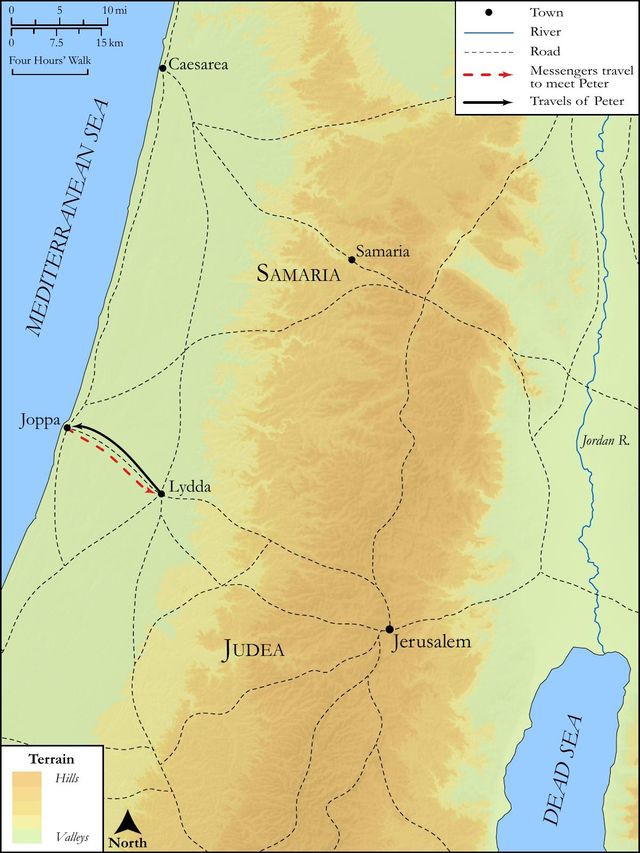
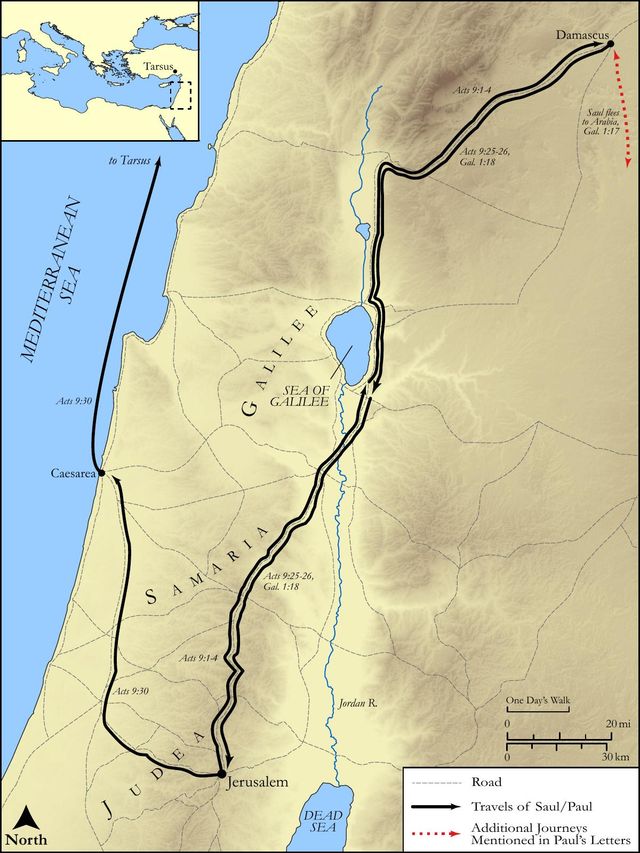
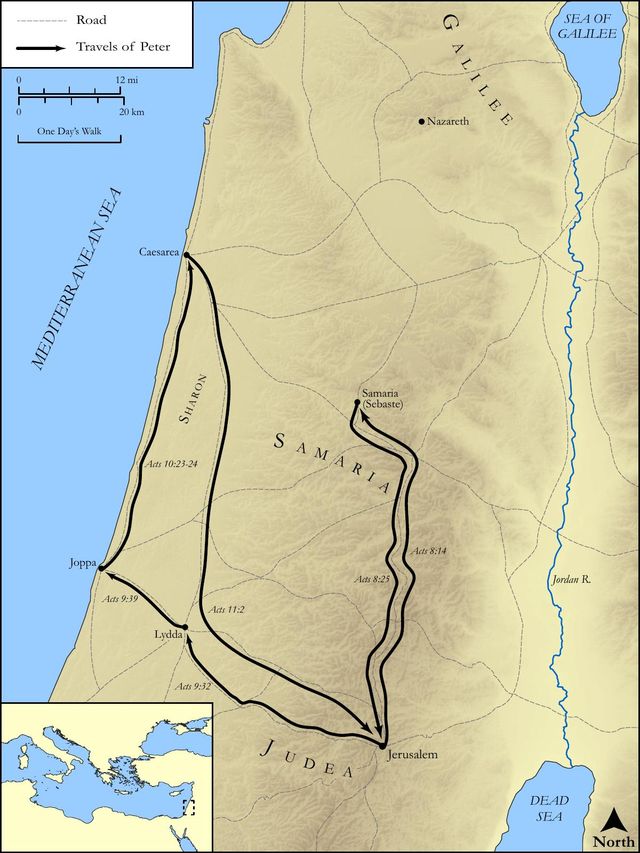
See on the biblical-era maps
Study this verse
Public-domain commentary
Matthew Henry
From his Commentary on the Whole Bible. Henry comments on passages, not single verses — this entry covers Acts 9:36–43. His three-level outline is real structure in the source text, so it is rendered as structure.
Here we have another miracle wrought by Peter, for the confirming of the gospel, and which exceeded the former - the raising of Tabitha to life when she had been for some time dead. Here is,
I.The life, and death, and character of Tabitha, on whom this miracle was wrought, Act 9:36, Act 9:37.
1.She lived at Joppa, a sea-port town in the tribe of Dan, where Jonah took shipping to go to Tarshish, now called Japho.
2.Her name was Tabitha, a Hebrew name, the Greek for which is Dorcas, both signifying a doe, or hind, or deer, a pleasant creature. Naphtali is compared to a hind let loose, giving goodly words; and the wife to the kind and tender husband is as the loving hind, and as the pleasant roe, Pro 5:19.
3.She was a disciple, one that had embraced the faith of Christ and was baptized; and not only so, but was eminent above many for works of charity. She showed her faith by her works, her good works, which she was full of, that is, in which she abounded. Her head was full of cares and contrivances which way she should do good. She devised liberal things, Isa 32:8. Her hands were full of good employment; she made a business of doing good, was never idle, having learned to maintain good works (Tit 3:8), to keep up a constant course and method of them. She was full of good works, as a tree that is full of fruit. Many are full of good words, who are empty and barren in good works; but Tabitha was a great doer, no great talker: Non magna loquimur, sed vivimus - We do not talk great things, but we live them. Among other good works, she was remarkable for her alms - deeds, which she did, not only her works of piety, which are good works and the fruits of faith, but works of charity and beneficence, flowing from love to her neighbour and a holy contempt of this world. Observe, She is commended not only for the alms which she gave, but for the alms - deeds which she did. Those that have not estates wherewith to give in charity may yet be able to do in charity, working with their hands, or walking with their feet, for the benefit of the poor. And those who will not do a charitable deed, whatever they may pretend, if they were rich would not bestow a charitable gift. She was full of alms - deeds, hōn epoiei - which she made; there is an emphasis upon her doing them, because what her hand found to do of this kind she did with all her might, and persevered in. They were alms - deeds, not which she purposed and designed and said she would do, but which she did; not which she began to do, but which she did, which she went through with, which she performed the doing of, Co2 8:11; Co2 9:7. This is the life and character of a certain disciple,; and should be of all the disciples of Christ; for, if we thus bear much fruit, then are we his disciples indeed, Joh 15:8.
4.She was removed in the midst of her usefulness (Act 9:37): In those days she fell sick, and died. It is promised to those who consider the poor, not that they shall never be sick, but that the Lord will strengthen them upon the bed of languishing, at least with strength in their souls, and so will make all their bed in their sickness, will make it easy, Psa 41:1, Psa 41:3. They cannot hope that they shall never die (merciful men are taken away, and merciful women too, witness Tabitha), but they may hope that they shall find mercy of the Lord in that day, Ti2 1:18.
5.Her friends and those about her did not presently bury her, as usual, because they were in hopes Peter would come and raise her to life again; but they washed the dead body, according to the custom, which, it is said, was with warm water, which, if there were any life remaining in the body, would recover it; so that this was done to show that she was really and truly dead. They tried all the usual methods to bring her to life, and could not. Conclamatum est - the last cry was uttered. They laid her out in her grave-clothes in an upper chamber, which Dr. Lightfoot thinks was probably the public meeting-room for the believers of that town; and they laid the body there, that Peter, if he would come, might raise her to life the more solemnly in that place.
II.The request which her Christian friends sent to Peter to come to them with all speed, not to attend the funeral, but, if it might be, to prevent it, Act 9:38. Lydda, where Peter now was, was nigh to Joppa, and the disciples at Joppa had heard that Peter was there, and that he had raised Eneas from a bed of languishing; and therefore they sent him two men, to make the message the more solemn and respectful, desiring him that he would not delay to come to them; not telling him the occasion, lest he should modestly decline coming upon so great an errand as to raise the dead: if they can but get him to them, they will leave it to him. Their friend was dead, and it was too late to send for a physician, but not too late to send for Peter. Post mortem medicus - a physician after death, is an absurdity, but not Post mortem apostolus - an apostle after death.
III.The posture in which he found the survivors, when he came to them (Act 9:30):
Peter arose and went with them. Though they did not tell him what they wanted him for, yet he was willing to go along with them, believing it was upon some good account or other that he was sent for. Let not faithful ministers grudge to be at every body's beck, as far as they have ability, when the great apostle made himself the servant of all, Co1 9:19. He found the corpse laid in the upper chamber, and attended by widows, probably such as were in the communion of the church, poor widows; there they were,
1.Commending the deceased - a good work, when there was that in them which was truly commendable, and worthy of imitation, and when it is done modestly and soberly, and without flattery of the survivors or any sinister intention, but purely for the glory of God and the exciting of others to that which is virtuous and praiseworthy. The commendation of Tabitha was like her own virtues, not in word, but in deed. Here were no encomiums of her in orations, nor poems inscribed to her memory; but the widows showed the coats and garments which she made for them, and bestowed upon them while she was with them. It was the comfort of Job, while he lived, that the loins of the poor blessed him, because they were warmed with the fleece of his sheep, Job 31:20. And here it was the credit of Tabitha, when she was dead, that the backs of the widows praised her for the garments which she made them. And those are certainly best praised whose own works praise them in the gates, whether the words of others do or no. It is much more honourable to clothe a company of decrepit widows with needful clothing for night and day, who will pray for their benefactors when they do not see them, than to clothe a company of lazy footmen with rich liveries, who perhaps behind their backs will curse those that clothe them (Ecc 7:21); and it is what all that are wise and good will take a greater pleasure in, for goodness is true greatness, and will pass better in the account shortly. Observe,
(1.)Into what channel Tabitha turned much of her charity. Doubtless there were other instances of her alms - deeds which she did, but this was now produced; she did, as it should seem with her own hands, make coats and garments for poor widows, who perhaps with their own labour could make a shift to get their bread, but could not earn enough to buy clothes. And this is an excellent piece of charity, If thou seest the naked, that thou cover him (Isa 58:7), and not think it enough to say, Be ye warmed, Jam 2:15, Jam 2:16.
(2.)What a grateful sense the poor had of her kindness: They showed the coats, not ashamed to own that they were indebted to her for the clothes on their backs. Those are horribly ungrateful indeed who have kindness shown them and will not make at least an acknowledgment of it, by showing the kindness that is done them, as these widows here did. Those who receive alms are not obliged so industriously to conceal it, as those are who give alms. When the poor reflect upon the rich as uncharitable and unmerciful, they ought to reflect upon themselves, and consider whether they are not unthankful and ungrateful. Their showing the coats and garments which Dorcas made tended to the praise not only of her charity, but of her industry, according to the character of the virtuous woman, that she lays her hands to the spindle, or at least to the needle, and then stretches out her hand to the poor, and reaches forth her hands to the needy, of what she has worked; and, when God and the poor have thus had their due, she makes herself coverings of tapestry and her own clothing is silk and purple, Pro 31:19-22.
2.They were here lamenting the loss of her: The widows stood by Peter, weeping. When the merciful are taken away, it should be laid to heart, especially by those to whom they have been in a particular manner merciful. They need not weep for her; she is taken from the evil to come, she rests from her labours and her works follow her, besides those she leaves behind her: but they weep for themselves and for their children, who will soon find the want of such a good woman, that has not left her fellow. Observe, They take notice of what good Dorcas did while she was with them, but now she is gone from them, and this is their grief. Those that are charitable will find that the poor they have always with them; but it is well if those that are poor find that they have always the charitable with them. We must make a good use of the lights that yet a little while are with us, because they will not be always with us, will not be long with us: and when they are gone we shall think what they did when they were with us. It should seem, the widows wept before Peter, as an inducement to him, if he could do any thing, to have compassion on them and help them, and restore one to them that used to have compassion on them. When charitable people are dead, there is no praying them to life again; but, when they are sick, this piece of gratitude is owing to them, to pray for their recovery, that, if it be the will of God, those may be spared to live who can ill be spared to die.
IV.The manner in which she was raised to life.
1.Privately: She was laid in the upper room where they used to have their public meetings, and, it should seem, there was great crowding about the dead body, in expectation of what would be done; but Peter put them all forth, all the weeping widows, all but some few relations of the family, or perhaps the heads of the church, to join with him in prayer; as Christ did, Mat 9:25. Thus Peter declined every thing that looked like vainglory and ostentation; they came to see, but he did not come to be seen. He put them all forth, that he might with the more freedom pour out his soul before God in prayer upon this occasion, and not be disturbed with their noisy and clamorous lamentations.
2.By prayer. In his healing Eneas there was an implied prayer, but in this greater work he addressed himself to God by solemn prayer, as Christ when he raised Lazarus; but Christ's prayer was with the authority of a Son, who quickens whom he will; Peter's with the submission of a servant, who is under direction, and therefore he knelt down and prayed.
3.By the word, a quickening word, a word which is spirit and life: He turned to the body, which intimates that when he prayed he turned from it; lest the sight of it should discourage his faith, he looked another way, to teach us, like Abraham, against hope, to believe in hope, and overlook the difficulties that lie in the way, not considering the body as now dead, lest we should stagger at the promise, Rom 4:19, Rom 4:20. But, when he had prayed, he turned to the body, and spoke in his Master's name, according to his example: "Tabitha, arise; return to life again." Power went along with this word, and she came to life, opened her eyes which death had closed. Thus, in the raising of dead souls to spiritual life, the first sign of life is the opening of the eyes of the mind, Act 26:18. When she saw Peter, she sat up, to show that she was really and truly alive; and (Act 9:41) he gave her his hand and lifted her up, not as if she laboured under any remaining weakness, but thus he would as it were welcome her to life again, and give her the right hand of fellowship among the living, from whom she had been cut off. And, lastly, he called the saints and widows, who were all in sorrow for her death, and presented her alive to them, to their great comfort, particularly of the widows, who laid her death much to heart (Act 9:41); to them he presented her, as Elijah (Kg1 17:23), and Elisha (Kg2 4:36), and Christ (Luk 7:15), presented the dead sons alive to their mothers. The greatest joy and satisfaction are expressed by life from the dead.
V.The good effect of this miracle.
1.Many were by it convinced of the truth of the gospel, that is was from heaven, and not of men, and believed in the Lord, Act 9:42. The thing was known throughout all Joppa; it would be in every body's mouth quickly, and, it being a town of seafaring men, the notice of it would be the sooner carried thence to other countries, and though some never minded it many were wrought upon by it. This was the design of miracles, to confirm a divine revelation.
2.Peter was hereby induced to continue some time in this city, Act 9:43. Finding that a door of opportunity was opened for him there, he tarried there many days, till he was sent thence, and sent for thence upon business to another place. He tarried not in the house of Tabitha, though she was rich, lest he should seem to seek his own glory; but he took up his lodgings with one Simon a tanner, an ordinary tradesman, which is an instance of his condescension and humility: and hereby he has taught us not to mind high things, but to condescend to those of low estate, Rom 12:16. And, though Peter might seem to be buried in obscurity here in the house of a poor tanner by the sea-side, yet hence God fetched him to a noble piece of service, which is recorded in the next chapter; for those that humble themselves shall be exalted.
Historical interpretation
Historical reception
1 surviving comment on this verse from the historical church.
"And it was known throughout all Joppa; and many believed in the Lord." Mark the gain, mark the fruit, that it was not for display.
Continue studying Acts 9:42 across the web’s major study libraries — every link below opens this exact verse, chapter, or book on the destination site.
Read & Compare
 BibleGatewayThis verse in more than 200 translations and 70 languages.
 Bible.comThe YouVersion reader — hundreds of translations, reading plans, and highlights.
 ESV.orgCrossway's official English Standard Version reader.
 NET BibleThe NET translation with 60,000+ translators' notes on every rendering decision.
 STEP BibleTyndale House's free study tool — original text, vocabulary, and scholarly resources.
 BibliaLogos Bible Software's free web reader.
 USCCBThe New American Bible (Revised Edition) with the U.S. bishops' study notes.
Commentaries
 BibleHub CommentariesDozens of classic commentaries on this verse, gathered on one page.
 StudyLightMore than 100 commentary sets — the largest collection on the web.
 BibleRefPlain-English commentary on what this verse means, verse by verse.
 Enduring WordDavid Guzik's free commentary on this chapter, widely used by Bible teachers.
 Bible Study ToolsVerse commentary alongside Greek and Hebrew study aids.
Original Language & Research
- BibleHub InterlinearThe verse word by word — original language, transliteration, and English.
- BibleHub LexiconEvery word's original-language definition and Strong's entry.
 Blue Letter BibleDeep-study tools — Strong's numbers, concordance, and word studies.
 CNTR CollationThe earliest Greek manuscripts of this verse, collated letter by letter.
Sermons, Hymns & Audio


TrulyRandomVerse is not affiliated with these sites and doesn’t control their content. They’re linked because they’re genuinely useful.
Summary
Acts 9:42 presents the profound and far-reaching impact of the miraculous resurrection of Tabitha (Dorcas) by the Apostle Peter in the ancient city of Joppa. This verse encapsulates the immediate, widespread knowledge of the divine intervention and the subsequent spiritual awakening, as a significant number of people responded to God's power by placing their faith in the Lord. It serves as a powerful testament to the evangelistic fruit borne from God's manifest presence and miraculous works in the early church.
Context
ShowHideLiterary Context
Acts 9:42 immediately follows Peter's healing ministry in Lydda, where Aeneas, a paralyzed man, was healed, leading to the conversion of many in that region (Acts 9:32-35). News then reached Peter in Lydda that Dorcas (Tabitha), a beloved disciple renowned for her acts of charity in Joppa, had died. Invited by the grieving believers, Peter traveled to Joppa, where he found her prepared for burial. After sending everyone out, Peter knelt and prayed, then commanded Dorcas to "Tabitha, arise!" (Acts 9:40). Her subsequent resurrection was not a private affair but became widely known, setting the stage for the mass conversion described in verse 42. This miracle, like the healing of Aeneas, serves as a divine validation of Peter's apostolic authority and the power of the Holy Spirit at work through the early church.
Historical & Cultural Context
Joppa (modern Jaffa) was a significant ancient port city on the Mediterranean coast, strategically important for trade and travel. Its diverse population would have included Jews and Gentiles, making it a fertile ground for the expansion of the Gospel beyond Jerusalem's initial Jewish focus. In the first century, miraculous signs and wonders were often understood as divine endorsements, validating the message and the messenger. The resurrection of a prominent and beloved figure like Dorcas would have been an extraordinary event, capturing the attention and imagination of the entire city. Such an event would have been discussed widely, contributing to a climate where spiritual claims were often assessed by tangible demonstrations of power, aligning with the cultural expectations of divine intervention.
Key Themes
ShowHideThis verse powerfully illustrates several key themes central to the book of Acts. Firstly, it underscores the Divine Power and Authority of God, working through His apostles. The resurrection of Dorcas is a clear demonstration of God's life-giving power, validating Peter's ministry and the message of the Gospel. Secondly, it highlights the Spread of the Gospel beyond Jerusalem, showing how God uses extraordinary signs to draw people to Himself and extend His kingdom. The news of the miracle becoming "known throughout all Joppa" directly facilitated the widespread belief, demonstrating the evangelistic efficacy of divine intervention. Finally, the verse emphasizes Faith and Conversion, as "many believed in the Lord." This belief was not merely intellectual assent but a transformative commitment of trust and allegiance to Jesus Christ, leading to genuine conversion and an expansion of the early Christian community, echoing the growth seen after Pentecost in Acts 2.
Exposition and Analysis
ShowHideKey Word Analysis
ShowHideFrom ginōskō, meaning "to know" or "to become acquainted with." Here, it signifies that the event of Tabitha's resurrection was not a secret but became "well-known" or "notable" throughout the entire city. This widespread knowledge was crucial for the subsequent mass conversion, indicating that the miracle served as a public testimony to God's power.
From pistis (faith), this verb means "to have faith (in, upon, or with respect to, a person or thing)," implying "to credit" or "to entrust." In this context, it denotes a profound, transformative trust and reliance upon Jesus Christ. It's not just intellectual acknowledgment but a commitment of one's spiritual well-being, indicating genuine conversion and allegiance.
Meaning "supreme in authority" or "controller," and by implication, "Master." In the New Testament, Kyrios is frequently used as a respectful title for God and, significantly, for Jesus Christ, acknowledging His divine authority, sovereignty, and rightful claim over one's life. The phrase "believed in the Lord" therefore signifies belief in Jesus Christ as the divine sovereign.
Verse Breakdown
ShowHide"And it was known throughout all Joppa"
This clause emphasizes the public nature and widespread dissemination of the news regarding Tabitha's resurrection. The miracle was not confined to a small group of disciples but became common knowledge across the entire city. This immediate and extensive awareness created a fertile ground for the Gospel message, demonstrating how God uses visible acts of power to draw attention to His work and open hearts to His truth.
"and many believed in the Lord."
This clause describes the direct spiritual outcome of the widely known miracle. The "many" indicates a significant number of people, not just a few, who responded to the evidence of God's power by placing their faith in Jesus Christ. Their belief signifies a turning point, a commitment of trust and allegiance to Christ as their divine Master and Savior, leading to their conversion and incorporation into the burgeoning Christian community.
Literary Devices
ShowHideThe verse primarily employs Cause and Effect as a literary device. The resurrection of Tabitha (the cause) directly leads to the widespread knowledge of the event and, consequently, to many believing in the Lord (the effect). This highlights the direct correlation between divine power manifested through miracles and the expansion of the early church. Furthermore, there is an element of Narrative Progression, as this verse marks a significant advancement in the spread of the Gospel geographically and numerically, moving the narrative forward from individual healings to widespread community conversion. The phrase "throughout all Joppa" also contains a degree of Hyperbole, emphasizing the pervasive nature of the news, suggesting that virtually everyone in the city was aware of the event, rather than a literal, exhaustive knowledge by every single inhabitant.
Theological and Thematic Connections
ShowHideActs 9:42 powerfully illustrates the divine strategy for the early church's growth: God's manifest power through signs and wonders often served as a catalyst for evangelism, validating the message and drawing people to faith. The resurrection of Tabitha was not merely a compassionate act but a public demonstration of life-giving power that pointed beyond Peter to the God who raises the dead. This event underscores that genuine faith is a response to divine revelation, whether through miracles, the preached Word, or transformed lives. The widespread belief in Joppa demonstrates the Holy Spirit's work in preparing hearts and enabling them to respond to the truth, confirming that God's desire is for all to come to Him.
Reflection and Application
ShowHideActs 9:42 offers profound lessons for contemporary believers. While miraculous resurrections are extraordinary and rare, the underlying principle remains: God actively works to draw people to Himself, and He often uses powerful testimonies, transformed lives, and the clear proclamation of the Gospel to reveal His truth. The response in Joppa reminds us of the importance of being open to God's work in unexpected ways and places. For us today, it encourages us to be faithful witnesses to the good news of Jesus, trusting that God will use our witness, in conjunction with His Spirit, to bring others to saving faith. Just as the news of Tabitha's resurrection spread throughout Joppa, our lives and words, empowered by God, can have a ripple effect, leading others to encounter the transforming power of the Lord. It calls us to pray for spiritual breakthroughs and to be ready to share the reason for the hope that is within us, knowing that God desires "many" to believe.
Questions for Reflection
ShowHideFAQ
ShowHideWhat was the significance of Joppa in the early church's expansion?
ShowHideJoppa was a crucial port city on the Mediterranean coast, making it a gateway for the Gospel to spread beyond the Jewish heartland of Jerusalem and Judea. Its diverse population, including both Jews and Gentiles, represented a broader mission field. The significant number of conversions in Joppa, sparked by Peter's ministry and the miracle of Tabitha's resurrection, demonstrated the Gospel's power to transcend cultural and ethnic boundaries, laying groundwork for future missionary endeavors, including Peter's subsequent vision and ministry to Cornelius in Acts 10.
What does "many believed in the Lord" imply about the nature of their faith?
ShowHideThe phrase "many believed in the Lord" signifies more than mere intellectual assent or acknowledgment of a historical event. The Greek word pisteúō (to believe) in this context implies a profound, transformative trust and reliance on Jesus Christ as the divine Kyrios (Lord). It suggests a turning from former ways and a commitment of one's life and allegiance to Him. This belief was a genuine conversion, leading to a new relationship with God and integration into the community of believers, indicative of saving faith that brings spiritual transformation and eternal life.
Christ-Centered Fulfillment
ShowHideActs 9:42, though describing an event performed by Peter, ultimately points to the resurrected Christ as the source of all life and salvation. The power demonstrated in raising Tabitha from the dead is a continuation of the very power that raised Jesus from His own tomb (Romans 8:11). Peter, filled with the Holy Spirit, acted as an instrument through whom Christ's life-giving authority was extended. The resulting widespread belief in Joppa underscores the core purpose of all miracles in the New Testament: to authenticate the message of the Gospel and lead people to faith in Jesus Christ, the true Lord of life. Just as Jesus performed signs to reveal His glory and draw people to Himself (John 2:11), the apostles' miracles served to confirm that the resurrected Jesus was indeed the promised Messiah and Savior. Thus, the events in Joppa are not merely historical anecdotes but powerful illustrations of Christ's ongoing redemptive work through His Spirit and His church, drawing "many" to Himself for salvation and new life (John 12:32).