


Acts 9:35
Bible text: King James Version (1769 Blayney text) · Public domain
Bible text: Berean Standard Bible · Public domain
Bible text: American Standard Version (1901) · Public domain
Bible text: World English Bible, Messianic edition · Public domain
Bible text: Geneva Bible (1599) · Public domain
Bible text: Young's Literal Translation · Public domain
- καὶkaiAndG2532CONJConjunction
- εἶδανeidansawG1492V-2AAI-3PVerb 2nd Aorist Active Indicative 3rd Plural
- αὐτὸνautonhimG846P-ASMPersonal pronoun Accusative Singular Masculine
- πάντεςpantesallG3956A-NPMAdjective Nominative Plural Masculine
- οἱhoithoseG3588T-NPMDefinite article Nominative Plural Masculine
- κατοικοῦντεςkatoikountesinhabitingG2730V-PAP-NPMVerb Present Active Participle Nominative Plural Masculine
- ΛύδδαLuddaLyddaG3069N-ASF-LNoun Accusative Singular Feminine Location
- καὶkaiandG2532CONJConjunction
- τὸνton<the>G3588T-ASMDefinite article Accusative Singular Masculine
- ΣαρῶναSarōnaSharonG4565N-ASM-LNoun Accusative Singular Masculine Location
- οἵτινεςoitineswhoG3748R-NPMRelative pronoun Nominative Plural Masculine
- ἐπέστρεψανepestrepsanturnedG1994V-2AAI-3PVerb 2nd Aorist Active Indicative 3rd Plural
- ἐπὶepitoG1909PREPPreposition
- τὸνtontheG3588T-ASMDefinite article Accusative Singular Masculine
- κύριονkurionLordG2962N-ASM-TNoun Accusative Singular Masculine Title
English is a literal word-by-word gloss of the Greek, not the KJV's wording. Why?
This is the original text the KJV's translators worked from — each Greek word with its own literal English meaning in this verse, prepared by scholars at Tyndale House, Cambridge. The KJV translates whole sentences, not word by word, so its wording differs: one Greek word can become several English words, and the KJV may choose “charity” where the gloss reads “love”. Both are faithful — they answer different questions. For the KJV's own rendering, switch to the KJV text.
Details
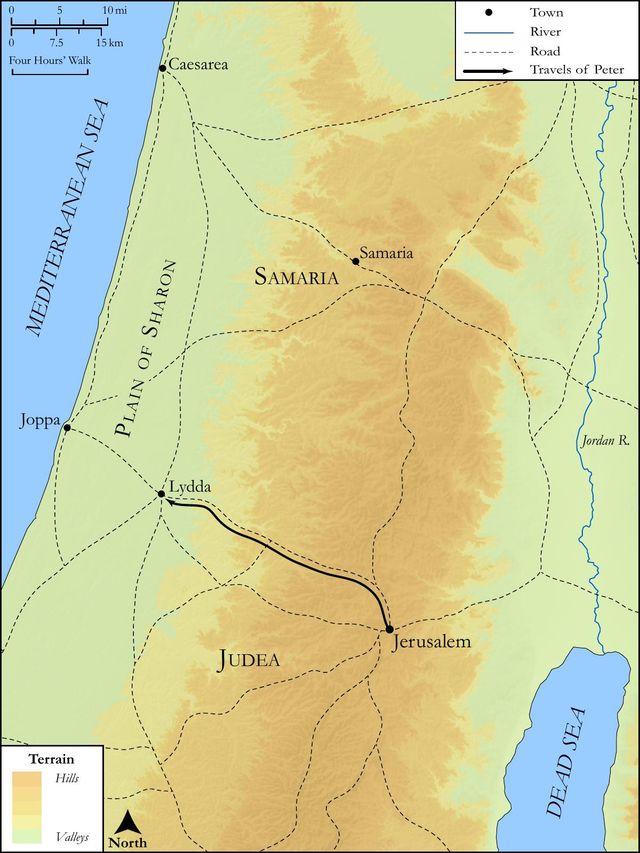
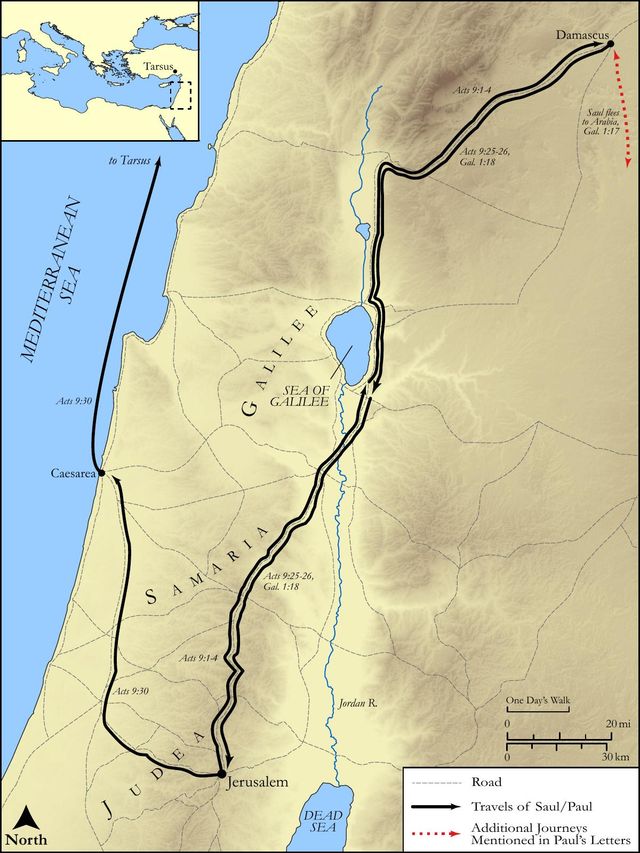
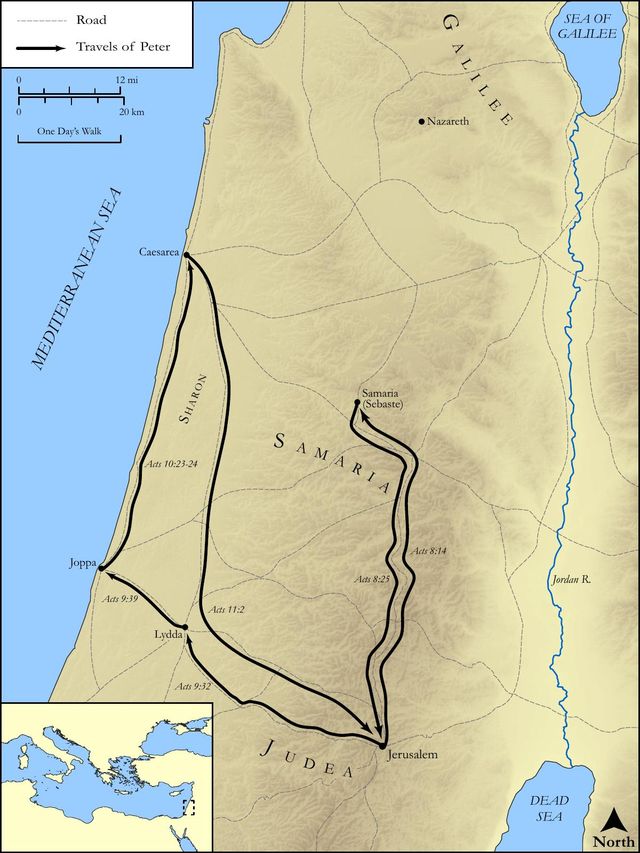
See on the biblical-era maps
Study this verse
Public-domain commentary
Matthew Henry
From his Commentary on the Whole Bible. Henry comments on passages, not single verses — this entry covers Acts 9:32–35. His three-level outline is real structure in the source text, so it is rendered as structure.
Here we have, I. The visit Peter made to the churches that were newly planted by the dispersed preachers, Act 9:32. 1. He passed through all quarters. As an apostle, he was not to be the resident pastor of any one church, but the itinerant visitor of many churches, to confirm the doctrine of inferior preachers, to confer the Holy Ghost on those that believed, and to ordain ministers. He passed dia pantōn - among them all, who pertained to the churches of Judea, Galilee, and Samaria, mentioned in the foregoing chapter. He was, like his Master, always upon the remove, and went about doing good; but still his head-quarters were at Jerusalem, for there we shall find him imprisoned, Act 12:2. He came to the saints at Lydda. This seems to be the same with Lod, a city in the tribe of Benjamin, mentioned Ch1 8:12; Ezr 2:33. The Christians are called saints, not only some particular eminent ones, as saint Peter and saint Paul, but every sincere professor of the faith of Christ. These are the saints on the earth, Psa 16:3.
II.The cure Peter wrought on Eneas, a man that had been bedridden eight years, Act 9:33.
1.His case was very deplorable: He was sick of the palsy, a dumb palsy, perhaps a dead palsy. The disease was extreme, for he kept his bed; it was inveterate, for he kept his bed eight years; and we may suppose that both he himself and all about him despaired of relief for him, and concluded upon no other than that he must still keep his bed till he removed to his grave. Christ chose such patients as this, whose disease was incurable in a course of nature, to show how desperate the case of fallen mankind was when he undertook their cure. When we were without strength, as this poor man, he sent his word to heal us.
2.His cure was very admirable, Act 9:34.
(1.)Peter interested Christ in his case, and engaged him for his relief: Eneas, Jesus Christ maketh thee whole. Peter does not pretend to do it himself by any power of his own, but declares it to be Christ's act and deed, directs him to look up to Christ for help, and assures him of an immediate cure - not, "He will make thee," but, "He does make thee, whole;" and a perfect cure - not, "He makes thee easy," but "He makes thee whole." He does not express himself by way of prayer to Christ that he would make him whole, but as one having authority from Christ, and that knew his mind, he declares him made whole.
(2.)He ordered him to bestir himself, to exert himself: "Arise and make thy bed, that all may see thou art thoroughly cured." Let none say that because it is Christ that by the power of his grace works all our works in us therefore we have no work, no duty, to do; for, though Jesus Christ makes thee whole, yet thou must arise and make use of the power he gives thee: "Arise, and make thy bed, to be to thee no longer a bed of sickness, but a bed of rest." (3.) Power went along with this word: he arose immediately, and no doubt very willingly made his own bed.
III.The good influence this had upon many (Act 9:35):
All that dwelt at Lydda and Saron saw him, and turned to the Lord. We can scarcely think that every individual person in those countries took cognizance of the miracle, and was wrought upon by it; but many, the generality of the people in the town of Lydda and in the country of Saron, or Sharon, a fruitful plain or valley, of which it was foretold, Sharon shall be a fold of flocks, Isa 65:10.
1.They all made enquiry into the truth of the miracle, did not overlook it, but saw him that was healed, and saw that it was a miraculous cure that was wrought upon him by the power of Christ, in his name, and with a design to confirm and ratify that doctrine of Christ which was now preached to the world.
2.They all submitted to the convincing proof and evidence there was in this of the divine origin of the Christian doctrine, and turned to the Lord, to the Lord Jesus. They turned from Judaism to Christianity; they embraced the doctrine of Christ, and submitted to his ordinances, and turned themselves over to him to be ruled and taught and saved by him.
Historical interpretation
Historical reception
1 surviving comment on this verse from the historical church.
"And having seen him," it says, "all that dwelt in Lydda, and Saron, turned unto the Lord." Observe everywhere the signs taking place. But let us so believe them, as if we were now beholding them.
Continue studying Acts 9:35 across the web’s major study libraries — every link below opens this exact verse, chapter, or book on the destination site.
Read & Compare
 BibleGatewayThis verse in more than 200 translations and 70 languages.
 Bible.comThe YouVersion reader — hundreds of translations, reading plans, and highlights.
 ESV.orgCrossway's official English Standard Version reader.
 NET BibleThe NET translation with 60,000+ translators' notes on every rendering decision.
 STEP BibleTyndale House's free study tool — original text, vocabulary, and scholarly resources.
 BibliaLogos Bible Software's free web reader.
 USCCBThe New American Bible (Revised Edition) with the U.S. bishops' study notes.
Commentaries
 BibleHub CommentariesDozens of classic commentaries on this verse, gathered on one page.
 StudyLightMore than 100 commentary sets — the largest collection on the web.
 BibleRefPlain-English commentary on what this verse means, verse by verse.
 Enduring WordDavid Guzik's free commentary on this chapter, widely used by Bible teachers.
 Bible Study ToolsVerse commentary alongside Greek and Hebrew study aids.
Original Language & Research
- BibleHub InterlinearThe verse word by word — original language, transliteration, and English.
- BibleHub LexiconEvery word's original-language definition and Strong's entry.
 Blue Letter BibleDeep-study tools — Strong's numbers, concordance, and word studies.
 CNTR CollationThe earliest Greek manuscripts of this verse, collated letter by letter.
Sermons, Hymns & Audio


TrulyRandomVerse is not affiliated with these sites and doesn’t control their content. They’re linked because they’re genuinely useful.
Summary
Acts 9:35 powerfully illustrates the transformative impact of God's miraculous intervention through Peter's ministry. Following the healing of Aeneas, a paralytic in Lydda, the verse records a widespread spiritual awakening as the inhabitants of both Lydda and the surrounding region of Saron witnessed the miracle and responded by turning decisively to the Lord, signifying a significant expansion of the early Christian community.
Context
ShowHideLiterary Context
This verse immediately follows the dramatic healing of Aeneas in Lydda, a man who had been paralyzed and bedridden for eight years (Acts 9:33-34). Peter, having traveled from Jerusalem through various regions, arrived in Lydda as part of his broader apostolic ministry to strengthen and expand the nascent church. The healing of Aeneas was a public and undeniable miracle, serving as a powerful sign and authenticating the divine authority behind Peter's message. The phrase "saw him" refers to the healed Aeneas, who was now able to walk, serving as a living, visible testament to God's power. This event is part of a series of miracles performed by the apostles that consistently lead to widespread belief and the growth of the church, a pattern evident throughout the book of Acts.
Historical & Cultural Context
Lydda (modern Lod) was a significant town located in the fertile plain of Sharon (Saron), a coastal region stretching north from Joppa. It was primarily Jewish, but like many towns in the Roman province of Judea, it would have had a mixed population, including Gentiles. The plain of Sharon was known for its agricultural richness and its strategic location on trade routes, making it a hub of activity. In this cultural setting, public miracles were often seen as divine endorsements, validating the claims of a prophet or a new religious movement. The widespread response described in the verse indicates a significant shift in religious allegiance, moving from traditional Jewish practices or pagan beliefs to faith in Jesus as the Messiah and Lord. The communal nature of the response ("all that dwelt") highlights the interconnectedness of the communities of that day, where a public event could quickly influence an entire region.
Key Themes
ShowHideActs 9:35 contributes significantly to several key themes in the book of Acts. Firstly, it underscores the theme of Divine Power and Authentication, where God's power is visibly demonstrated through signs and wonders, confirming the apostles' message and authority. The healing of Aeneas was not merely an act of compassion but a compelling witness to the truth of the Gospel, aligning with the promise of power given to the disciples to be witnesses in Jerusalem, Judea, Samaria, and to the ends of the earth. Secondly, the verse highlights Widespread Conversion and Church Growth. The immediate and sweeping response, "all that dwelt at Lydda and Saron... turned to the Lord," signifies a significant movement of faith, illustrating the rapid expansion of Christianity beyond Jerusalem. This demonstrates the transformative power of God's work, where a single miracle can catalyze mass conversion. Finally, it exemplifies Evangelism through Signs and Wonders, a recurring pattern in Acts where miraculous events accompany the preaching of the Word, authenticating the apostles' message and leading many to believe, echoing the early church's reliance on God's supernatural intervention to validate their claims and draw people to faith, as seen in the early days of the church in Jerusalem.
Exposition and Analysis
ShowHideKey Word Analysis
ShowHideThis verb signifies to "house permanently" or "reside." It implies a settled population, not just transient visitors. The use of this word emphasizes that the impact of Aeneas's healing was felt by the established residents of Lydda and the surrounding region of Saron, indicating a deep and lasting effect on the community.
While literally meaning "to see," in this context, eídō implies more than mere physical observation. It suggests a perception that leads to understanding, recognition, and even conviction. The people "saw" Aeneas healed, but this seeing led them to comprehend the divine power at work, moving beyond simple sight to a spiritual apprehension of truth.
This is a crucial term for spiritual conversion, meaning "to revert," "to convert," or "to turn about." It denotes a decisive change of direction, a radical reorientation of one's life. It signifies a turning away from former ways (whether sin, idolatry, or a lack of faith) and a turning towards God, implying repentance and a new commitment to Jesus Christ as Lord.
Derived from a root implying "supremacy," kýrios refers to one who is "supreme in authority," a "controller," or "Master." In the New Testament, it is frequently used to refer to God and, significantly, to Jesus Christ. When the people "turned to the Lord," they were acknowledging Jesus as their sovereign Master and God, committing their allegiance to Him.
Verse Breakdown
ShowHide"And all that dwelt at Lydda and Saron saw him"
This clause highlights the widespread and public nature of the miracle's impact. "All that dwelt" suggests a comprehensive, though perhaps hyperbolic, response from the residents of these two significant regions. Their "seeing" of the healed Aeneas was the catalyst, providing undeniable evidence of divine power and serving as a powerful, visible testimony to the truth of the Gospel message Peter proclaimed.
"and turned to the Lord"
This second clause describes the profound spiritual outcome of their observation. The act of "turning to the Lord" signifies a genuine spiritual conversion. It implies a decisive change in allegiance, a repentance from previous ways of life or beliefs, and a new commitment to Jesus Christ as their Master and God. This turning was not merely intellectual assent but a transformative reorientation of their lives towards Him.
Literary Devices
ShowHideThe verse employs several literary devices to convey its powerful message. Hyperbole is evident in the phrase "all that dwelt at Lydda and Saron," which, while perhaps not literally every single person, emphasizes the widespread and overwhelming nature of the response, underscoring the profound impact of the miracle. Synecdoche is also present, where "Lydda and Saron" stand for the inhabitants of those regions, focusing the reader's attention on the geographical scope of the conversions. The narrative structure itself demonstrates Cause and Effect, where the miraculous healing (cause) directly leads to widespread conversion (effect), highlighting the instrumental role of divine signs in early Christian evangelism. Furthermore, the succinctness of the statement, particularly "turned to the Lord," serves as a powerful Summary Statement, encapsulating a profound spiritual transformation in a few impactful words, leaving the reader to grasp the magnitude of the event.
Theological and Thematic Connections
ShowHideActs 9:35 vividly illustrates God's sovereign power to draw people to Himself through miraculous signs, authenticating His messengers and validating the Gospel message. The collective turning to the Lord by an entire region underscores the communal aspect of faith and the ripple effect of God's work. It demonstrates that God is not limited by human resistance or geographical boundaries, and His power can effect widespread spiritual revival. This event serves as a powerful reminder that God uses both the proclamation of the Word and tangible demonstrations of His power to expand His kingdom, leading people to a decisive and transformative commitment to Christ.
Reflection and Application
ShowHideActs 9:35 offers profound encouragement and challenge for believers today. It reminds us that God's power is still at work, capable of transforming lives and communities. While miraculous healings like Aeneas's may not be commonplace in every context, the principle remains: God uses visible manifestations of His grace to draw people to Himself. Our own transformed lives, our testimonies of God's faithfulness, and acts of love and service can serve as compelling witnesses that point others to Christ. This verse encourages us to be bold in sharing the Good News, trusting that God will work through ordinary people and circumstances to bring about extraordinary conversions. It challenges us to pray for and expect God's powerful intervention in our spheres of influence, recognizing that true conversion involves a decisive "turning to the Lord"—a radical reorientation of one's life, priorities, and allegiance towards Him. It calls us to live lives that clearly demonstrate the reality of Christ, so that others, seeing the fruit of His work in us, might also be drawn to turn to Him.
Questions for Reflection
ShowHideFAQ
ShowHideWho is "him" that Lydda and Saron saw?
ShowHideThe "him" refers to Aeneas, the paralytic man whom Peter had just miraculously healed in Lydda (Acts 9:33-34). Before the healing, Aeneas had been bedridden for eight years. His sudden and complete recovery was a public and undeniable miracle, serving as tangible proof of God's power working through Peter. The sight of Aeneas, now able to walk, was the catalyst for the widespread conversion described in Acts 9:35.
What does "turned to the Lord" imply in this context?
ShowHide"Turned to the Lord" (Greek: epistréphō epi ton kýrion) signifies a profound spiritual conversion. It means more than just acknowledging a miracle or intellectually assenting to a new teaching. It implies a decisive change of direction, a reorientation of one's life. This turning involves repentance from former ways (whether sin, idolatry, or a lack of faith) and a new, active commitment and allegiance to Jesus Christ as their supreme Master and God. It reflects a genuine embrace of the Christian faith, leading to a transformed life, much like the call to repent and turn to God found elsewhere in Acts.
Christ-Centered Fulfillment
ShowHideWhile Acts 9:35 describes an event in the early church's expansion, it powerfully exemplifies the ongoing fulfillment of Christ's mission through His Spirit-empowered followers. The widespread turning to the Lord in Lydda and Saron is a direct result of the power Christ promised His disciples before His ascension, enabling them to be His witnesses "to the end of the earth" (Acts 1:8). Peter's healing of Aeneas, performed "in the name of Jesus Christ" (Acts 9:34), demonstrates that the miraculous works of the apostles were not their own, but a continuation of Christ's ministry on earth, showcasing His living power and authority. The "turning to the Lord" signifies people being delivered from the domain of darkness and transferred into the kingdom of Christ (Colossians 1:13-14), fulfilling the Great Commission given by Christ to make disciples of all nations (Matthew 28:18-20). Thus, this verse is a vivid illustration of Christ's ongoing reign and His active work through His church, drawing people from spiritual blindness to saving faith in Him, just as He declared, "I am the light of the world. Whoever follows me will not walk in darkness, but will have the light of life" (John 8:12).