


Acts 9:38
- ἐγγὺςengusNearG1451PREPPreposition
- δὲdenowG1161CONJConjunction
- οὔσηςousēsbeingG1510V-PAP-GSFVerb Present Active Participle Genitive Singular Feminine
- ΛύδδαςLuddasLyddaG3069N-GSF-LNoun Genitive Singular Feminine Location
- τῇtēa<the>G3588T-DSFDefinite article Dative Singular Feminine
- ἸόππῃIoppēto JoppaG2445N-DSF-LNoun Dative Singular Feminine Location
- οἱhoitheG3588T-NPMDefinite article Nominative Plural Masculine
- μαθηταὶmathētaidisciplesG3101N-NPMNoun Nominative Plural Masculine
- ἀκούσαντεςakousanteshaving heardG191V-AAP-NPMVerb Aorist Active Participle Nominative Plural Masculine
- ὅτιhotithatG3754CONJConjunction
- ΠέτροςPetrosPeterG4074N-NSM-PNoun Nominative Singular Masculine Individual
- ἐστὶνestinisG1510V-PAI-3SVerb Present Active Indicative 3rd Singular
- ἐνeninG1722PREPPreposition
- αὐτῇautēaitG846P-DSFPersonal pronoun Dative Singular Feminine
- ἀπέστειλανapesteilansentG649V-AAI-3PVerb Aorist Active Indicative 3rd Plural
- δύοduotwoG1417A-NUIAdjective
- ἄνδραςandrasmenG435N-APMNoun Accusative Plural Masculine
- πρὸςprostoG4314PREPPreposition
- αὐτὸνautonhimG846P-ASMPersonal pronoun Accusative Singular Masculine
- παρακαλοῦντες·parakalountesimploringG3870V-PAP-NPMVerb Present Active Participle Nominative Plural Masculine
- μὴmēNotG3361PRT-NNegative Particle Negative
- ὀκνήσῃςoknēsēsyou may delayG3635V-AAS-2SVerb Aorist Active Subjunctive 2nd Singular
- διελθεῖνdieltheincomingG1330V-2AANVerb 2nd Aorist Active Infinitive
- ἕωςhe'ōstoG2193PREPPreposition
- ἡμῶνhēmōnusG3165P-1GPPersonal pronoun Genitive 1st Plural
English is a literal word-by-word gloss of the Greek, not the KJV's wording. Why?
This is the original text the KJV's translators worked from — each Greek word with its own literal English meaning in this verse, prepared by scholars at Tyndale House, Cambridge. The KJV translates whole sentences, not word by word, so its wording differs: one Greek word can become several English words, and the KJV may choose “charity” where the gloss reads “love”. Both are faithful — they answer different questions. For the KJV's own rendering, switch to the KJV text.
Details
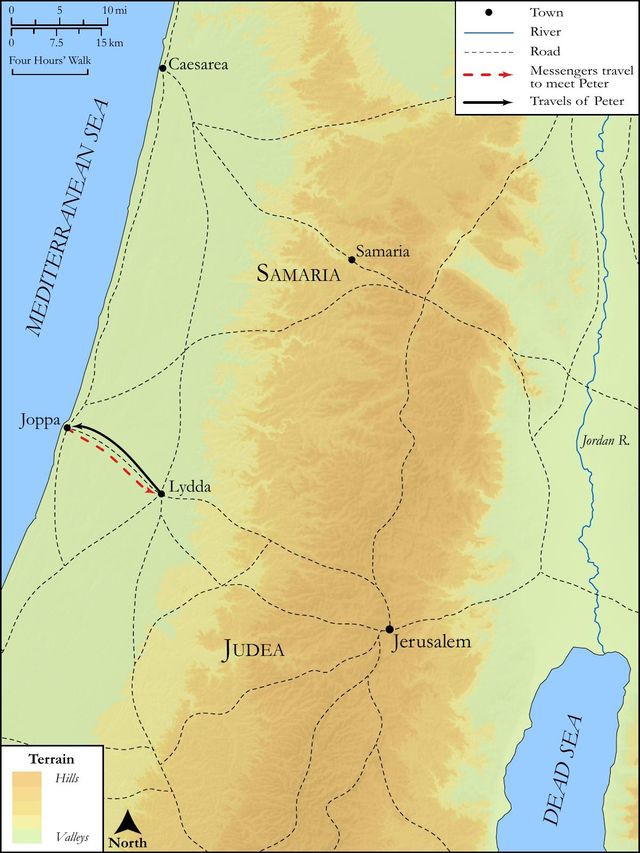
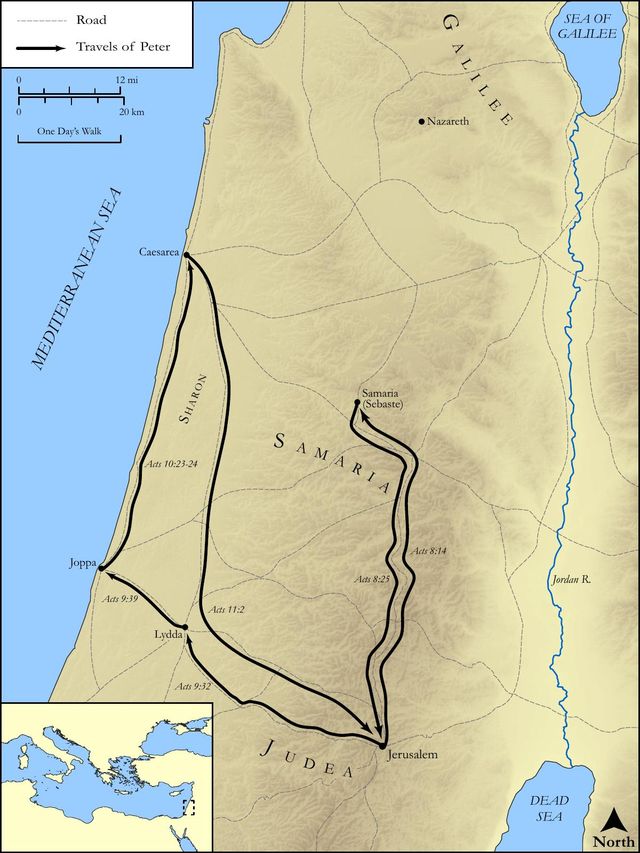
See on the biblical-era map
Study this verse
Public-domain commentary
Matthew Henry
From his Commentary on the Whole Bible. Henry comments on passages, not single verses — this entry covers Acts 9:36–43. His three-level outline is real structure in the source text, so it is rendered as structure.
Here we have another miracle wrought by Peter, for the confirming of the gospel, and which exceeded the former - the raising of Tabitha to life when she had been for some time dead. Here is,
I.The life, and death, and character of Tabitha, on whom this miracle was wrought, Act 9:36, Act 9:37.
1.She lived at Joppa, a sea-port town in the tribe of Dan, where Jonah took shipping to go to Tarshish, now called Japho.
2.Her name was Tabitha, a Hebrew name, the Greek for which is Dorcas, both signifying a doe, or hind, or deer, a pleasant creature. Naphtali is compared to a hind let loose, giving goodly words; and the wife to the kind and tender husband is as the loving hind, and as the pleasant roe, Pro 5:19.
3.She was a disciple, one that had embraced the faith of Christ and was baptized; and not only so, but was eminent above many for works of charity. She showed her faith by her works, her good works, which she was full of, that is, in which she abounded. Her head was full of cares and contrivances which way she should do good. She devised liberal things, Isa 32:8. Her hands were full of good employment; she made a business of doing good, was never idle, having learned to maintain good works (Tit 3:8), to keep up a constant course and method of them. She was full of good works, as a tree that is full of fruit. Many are full of good words, who are empty and barren in good works; but Tabitha was a great doer, no great talker: Non magna loquimur, sed vivimus - We do not talk great things, but we live them. Among other good works, she was remarkable for her alms - deeds, which she did, not only her works of piety, which are good works and the fruits of faith, but works of charity and beneficence, flowing from love to her neighbour and a holy contempt of this world. Observe, She is commended not only for the alms which she gave, but for the alms - deeds which she did. Those that have not estates wherewith to give in charity may yet be able to do in charity, working with their hands, or walking with their feet, for the benefit of the poor. And those who will not do a charitable deed, whatever they may pretend, if they were rich would not bestow a charitable gift. She was full of alms - deeds, hōn epoiei - which she made; there is an emphasis upon her doing them, because what her hand found to do of this kind she did with all her might, and persevered in. They were alms - deeds, not which she purposed and designed and said she would do, but which she did; not which she began to do, but which she did, which she went through with, which she performed the doing of, Co2 8:11; Co2 9:7. This is the life and character of a certain disciple,; and should be of all the disciples of Christ; for, if we thus bear much fruit, then are we his disciples indeed, Joh 15:8.
4.She was removed in the midst of her usefulness (Act 9:37): In those days she fell sick, and died. It is promised to those who consider the poor, not that they shall never be sick, but that the Lord will strengthen them upon the bed of languishing, at least with strength in their souls, and so will make all their bed in their sickness, will make it easy, Psa 41:1, Psa 41:3. They cannot hope that they shall never die (merciful men are taken away, and merciful women too, witness Tabitha), but they may hope that they shall find mercy of the Lord in that day, Ti2 1:18.
5.Her friends and those about her did not presently bury her, as usual, because they were in hopes Peter would come and raise her to life again; but they washed the dead body, according to the custom, which, it is said, was with warm water, which, if there were any life remaining in the body, would recover it; so that this was done to show that she was really and truly dead. They tried all the usual methods to bring her to life, and could not. Conclamatum est - the last cry was uttered. They laid her out in her grave-clothes in an upper chamber, which Dr. Lightfoot thinks was probably the public meeting-room for the believers of that town; and they laid the body there, that Peter, if he would come, might raise her to life the more solemnly in that place.
II.The request which her Christian friends sent to Peter to come to them with all speed, not to attend the funeral, but, if it might be, to prevent it, Act 9:38. Lydda, where Peter now was, was nigh to Joppa, and the disciples at Joppa had heard that Peter was there, and that he had raised Eneas from a bed of languishing; and therefore they sent him two men, to make the message the more solemn and respectful, desiring him that he would not delay to come to them; not telling him the occasion, lest he should modestly decline coming upon so great an errand as to raise the dead: if they can but get him to them, they will leave it to him. Their friend was dead, and it was too late to send for a physician, but not too late to send for Peter. Post mortem medicus - a physician after death, is an absurdity, but not Post mortem apostolus - an apostle after death.
III.The posture in which he found the survivors, when he came to them (Act 9:30):
Peter arose and went with them. Though they did not tell him what they wanted him for, yet he was willing to go along with them, believing it was upon some good account or other that he was sent for. Let not faithful ministers grudge to be at every body's beck, as far as they have ability, when the great apostle made himself the servant of all, Co1 9:19. He found the corpse laid in the upper chamber, and attended by widows, probably such as were in the communion of the church, poor widows; there they were,
1.Commending the deceased - a good work, when there was that in them which was truly commendable, and worthy of imitation, and when it is done modestly and soberly, and without flattery of the survivors or any sinister intention, but purely for the glory of God and the exciting of others to that which is virtuous and praiseworthy. The commendation of Tabitha was like her own virtues, not in word, but in deed. Here were no encomiums of her in orations, nor poems inscribed to her memory; but the widows showed the coats and garments which she made for them, and bestowed upon them while she was with them. It was the comfort of Job, while he lived, that the loins of the poor blessed him, because they were warmed with the fleece of his sheep, Job 31:20. And here it was the credit of Tabitha, when she was dead, that the backs of the widows praised her for the garments which she made them. And those are certainly best praised whose own works praise them in the gates, whether the words of others do or no. It is much more honourable to clothe a company of decrepit widows with needful clothing for night and day, who will pray for their benefactors when they do not see them, than to clothe a company of lazy footmen with rich liveries, who perhaps behind their backs will curse those that clothe them (Ecc 7:21); and it is what all that are wise and good will take a greater pleasure in, for goodness is true greatness, and will pass better in the account shortly. Observe,
(1.)Into what channel Tabitha turned much of her charity. Doubtless there were other instances of her alms - deeds which she did, but this was now produced; she did, as it should seem with her own hands, make coats and garments for poor widows, who perhaps with their own labour could make a shift to get their bread, but could not earn enough to buy clothes. And this is an excellent piece of charity, If thou seest the naked, that thou cover him (Isa 58:7), and not think it enough to say, Be ye warmed, Jam 2:15, Jam 2:16.
(2.)What a grateful sense the poor had of her kindness: They showed the coats, not ashamed to own that they were indebted to her for the clothes on their backs. Those are horribly ungrateful indeed who have kindness shown them and will not make at least an acknowledgment of it, by showing the kindness that is done them, as these widows here did. Those who receive alms are not obliged so industriously to conceal it, as those are who give alms. When the poor reflect upon the rich as uncharitable and unmerciful, they ought to reflect upon themselves, and consider whether they are not unthankful and ungrateful. Their showing the coats and garments which Dorcas made tended to the praise not only of her charity, but of her industry, according to the character of the virtuous woman, that she lays her hands to the spindle, or at least to the needle, and then stretches out her hand to the poor, and reaches forth her hands to the needy, of what she has worked; and, when God and the poor have thus had their due, she makes herself coverings of tapestry and her own clothing is silk and purple, Pro 31:19-22.
2.They were here lamenting the loss of her: The widows stood by Peter, weeping. When the merciful are taken away, it should be laid to heart, especially by those to whom they have been in a particular manner merciful. They need not weep for her; she is taken from the evil to come, she rests from her labours and her works follow her, besides those she leaves behind her: but they weep for themselves and for their children, who will soon find the want of such a good woman, that has not left her fellow. Observe, They take notice of what good Dorcas did while she was with them, but now she is gone from them, and this is their grief. Those that are charitable will find that the poor they have always with them; but it is well if those that are poor find that they have always the charitable with them. We must make a good use of the lights that yet a little while are with us, because they will not be always with us, will not be long with us: and when they are gone we shall think what they did when they were with us. It should seem, the widows wept before Peter, as an inducement to him, if he could do any thing, to have compassion on them and help them, and restore one to them that used to have compassion on them. When charitable people are dead, there is no praying them to life again; but, when they are sick, this piece of gratitude is owing to them, to pray for their recovery, that, if it be the will of God, those may be spared to live who can ill be spared to die.
IV.The manner in which she was raised to life.
1.Privately: She was laid in the upper room where they used to have their public meetings, and, it should seem, there was great crowding about the dead body, in expectation of what would be done; but Peter put them all forth, all the weeping widows, all but some few relations of the family, or perhaps the heads of the church, to join with him in prayer; as Christ did, Mat 9:25. Thus Peter declined every thing that looked like vainglory and ostentation; they came to see, but he did not come to be seen. He put them all forth, that he might with the more freedom pour out his soul before God in prayer upon this occasion, and not be disturbed with their noisy and clamorous lamentations.
2.By prayer. In his healing Eneas there was an implied prayer, but in this greater work he addressed himself to God by solemn prayer, as Christ when he raised Lazarus; but Christ's prayer was with the authority of a Son, who quickens whom he will; Peter's with the submission of a servant, who is under direction, and therefore he knelt down and prayed.
3.By the word, a quickening word, a word which is spirit and life: He turned to the body, which intimates that when he prayed he turned from it; lest the sight of it should discourage his faith, he looked another way, to teach us, like Abraham, against hope, to believe in hope, and overlook the difficulties that lie in the way, not considering the body as now dead, lest we should stagger at the promise, Rom 4:19, Rom 4:20. But, when he had prayed, he turned to the body, and spoke in his Master's name, according to his example: "Tabitha, arise; return to life again." Power went along with this word, and she came to life, opened her eyes which death had closed. Thus, in the raising of dead souls to spiritual life, the first sign of life is the opening of the eyes of the mind, Act 26:18. When she saw Peter, she sat up, to show that she was really and truly alive; and (Act 9:41) he gave her his hand and lifted her up, not as if she laboured under any remaining weakness, but thus he would as it were welcome her to life again, and give her the right hand of fellowship among the living, from whom she had been cut off. And, lastly, he called the saints and widows, who were all in sorrow for her death, and presented her alive to them, to their great comfort, particularly of the widows, who laid her death much to heart (Act 9:41); to them he presented her, as Elijah (Kg1 17:23), and Elisha (Kg2 4:36), and Christ (Luk 7:15), presented the dead sons alive to their mothers. The greatest joy and satisfaction are expressed by life from the dead.
V.The good effect of this miracle.
1.Many were by it convinced of the truth of the gospel, that is was from heaven, and not of men, and believed in the Lord, Act 9:42. The thing was known throughout all Joppa; it would be in every body's mouth quickly, and, it being a town of seafaring men, the notice of it would be the sooner carried thence to other countries, and though some never minded it many were wrought upon by it. This was the design of miracles, to confirm a divine revelation.
2.Peter was hereby induced to continue some time in this city, Act 9:43. Finding that a door of opportunity was opened for him there, he tarried there many days, till he was sent thence, and sent for thence upon business to another place. He tarried not in the house of Tabitha, though she was rich, lest he should seem to seek his own glory; but he took up his lodgings with one Simon a tanner, an ordinary tradesman, which is an instance of his condescension and humility: and hereby he has taught us not to mind high things, but to condescend to those of low estate, Rom 12:16. And, though Peter might seem to be buried in obscurity here in the house of a poor tanner by the sea-side, yet hence God fetched him to a noble piece of service, which is recorded in the next chapter; for those that humble themselves shall be exalted.
Historical interpretation
Historical reception
2 surviving comments on this verse. Each one is dated, so this reads as a timeline rather than a list.
"Now there was at Joppa a certain disciple named Tabitha, which by interpretation is called Dorcas: this woman was full of good works and alms-deeds which she did." Observe everywhere the signs taking place. But let us so believe them, as if we were now beholding them. It is not simply said, that Tabitha died, but that she died, having been in a state of weakness. And yet they did not call Peter until she died; then "they sent and told him not to delay to come unto them."
"Not to delay to come unto them:" for she was a disciple. And Peter arose, and went with them. And when he was come, they led him into the upper chamber. They do not beseech, but leave it to him to give her life.
Continue studying Acts 9:38 across the web’s major study libraries — every link below opens this exact verse, chapter, or book on the destination site.
Read & Compare
 BibleGatewayThis verse in more than 200 translations and 70 languages.
 Bible.comThe YouVersion reader — hundreds of translations, reading plans, and highlights.
 ESV.orgCrossway's official English Standard Version reader.
 NET BibleThe NET translation with 60,000+ translators' notes on every rendering decision.
 STEP BibleTyndale House's free study tool — original text, vocabulary, and scholarly resources.
 BibliaLogos Bible Software's free web reader.
 USCCBThe New American Bible (Revised Edition) with the U.S. bishops' study notes.
Commentaries
 BibleHub CommentariesDozens of classic commentaries on this verse, gathered on one page.
 StudyLightMore than 100 commentary sets — the largest collection on the web.
 BibleRefPlain-English commentary on what this verse means, verse by verse.
 Enduring WordDavid Guzik's free commentary on this chapter, widely used by Bible teachers.
 Bible Study ToolsVerse commentary alongside Greek and Hebrew study aids.
Original Language & Research
- BibleHub InterlinearThe verse word by word — original language, transliteration, and English.
- BibleHub LexiconEvery word's original-language definition and Strong's entry.
 Blue Letter BibleDeep-study tools — Strong's numbers, concordance, and word studies.
 CNTR CollationThe earliest Greek manuscripts of this verse, collated letter by letter.
Sermons, Hymns & Audio


TrulyRandomVerse is not affiliated with these sites and doesn’t control their content. They’re linked because they’re genuinely useful.
Summary
Acts 9:38 describes the urgent plea of the disciples in Joppa to the Apostle Peter, who was ministering in nearby Lydda. Having learned of Peter's presence and miraculous ministry, they dispatched two men to implore him to come without delay, setting the immediate narrative stage for the miraculous raising of Dorcas (Tabitha) from the dead, a pivotal event demonstrating God's power through His chosen apostles and strengthening the burgeoning Christian community.
Context
ShowHideLiterary Context
This verse serves as a crucial transition point in the narrative of Acts 9. Immediately preceding it, Peter had been in Lydda, where he miraculously healed Aeneas, a paralytic, leading to widespread conversion in the region of Sharon (Acts 9:32-35). The news of Peter's powerful ministry had clearly spread. Following Acts 9:38, the narrative swiftly moves to the dire situation in Joppa: the death of a beloved disciple named Dorcas (Tabitha) and the subsequent, even more profound, miracle of Peter raising her from the dead (Acts 9:39-42). Thus, Acts 9:38 acts as the narrative bridge, explaining why Peter traveled to Joppa and how he became involved in the events that would further demonstrate God's power and expand the early church.
Historical & Cultural Context
Lydda (modern Lod) and Joppa (modern Jaffa) were significant towns in ancient Judea, located relatively close to each other—approximately 10-12 miles apart. Joppa, as a major port city on the Mediterranean coast, was a hub of trade and diverse populations, making it fertile ground for the spread of the Gospel. The rapid communication between these two communities, facilitated by the disciples sending two men, highlights the interconnectedness of the early Christian network. In Jewish culture, sending two or more individuals was customary for important delegations or to establish credible witness, underscoring the gravity and urgency of their request. The practice of washing and laying out the dead in an upper room, as seen with Dorcas, was also a common burial custom of the time.
Key Themes
ShowHideActs 9:38 contributes to several overarching themes in the book of Acts. Firstly, it underscores the Urgency and Need within the early Christian communities, demonstrating their reliance on God's power working through His apostles in times of crisis. The disciples' plea for Peter "not to delay" conveys a profound sense of desperation and faith in his ability to intervene. Secondly, the verse illustrates the Interconnectedness and Mutual Support of the burgeoning church. News traveled quickly, and believers actively sought help and solidarity across geographical distances, reflecting the communal nature of the early church as described throughout Acts. Finally, it subtly reinforces the Apostolic Influence and Authority that God had vested in leaders like Peter. His reputation for performing miracles, like the healing of Aeneas in Acts 9:34, meant his presence was highly sought after, solidifying the apostles' crucial role in guiding and empowering the early believers.
Exposition and Analysis
ShowHideKey Word Analysis
ShowHideThis word signifies proximity, both literally and figuratively. In Acts 9:38, it literally indicates the short distance between Lydda and Joppa. The fact that Lydda "was nigh" to Joppa highlights a providential arrangement, placing Peter within reach of a desperate situation. It implies that God had positioned His servant strategically for the miraculous intervention that was about to occur.
Derived from apó (from) and stéllō (to send), this verb means "to send out, properly on a mission." The use of apostéllō here suggests more than a casual invitation; it implies a deliberate, official delegation by the disciples in Joppa. They were not merely asking Peter to visit, but commissioning messengers with an urgent mission, underscoring the gravity of the situation and their earnest desire for his immediate presence and intervention.
This term means "to hesitate" or "to be slow" or "loath." The disciples' plea, "that he would not delay," is a strong expression of their fervent desire for Peter's immediate action. It conveys a sense of profound urgency and desperation, indicating that the situation in Joppa was critical and required Peter's prompt arrival without any hesitation or postponement. Their faith was such that they believed Peter's swift presence could alter their dire circumstances.
Verse Breakdown
ShowHide"And forasmuch as Lydda was nigh to Joppa"
This opening clause establishes the geographical context, indicating the close proximity of the two towns. This detail is crucial, as it explains the feasibility of the disciples' request and subtly hints at divine providence in placing Peter so near to where he was desperately needed.
"and the disciples had heard that Peter was there"
This phrase reveals the rapid spread of information within the early Christian communities. Peter's reputation, likely bolstered by the recent miracle of healing Aeneas in Lydda (Acts 9:32-35), had preceded him. The disciples in Joppa were aware of his presence and the power accompanying his ministry, prompting their appeal.
"they sent unto him two men"
This action signifies a deliberate and formal delegation. Sending "two men" was a common practice in Jewish culture for important missions or to establish credible testimony. It underscores the seriousness and urgency of their request, indicating that the matter was of utmost importance and required official representation.
"desiring [him] that he would not delay to come to them"
This final clause encapsulates the fervent plea of the Joppa disciples. The phrase "desiring him" (Greek: parakaléō) implies earnest entreaty, comfort, or exhortation, while "not delay" (Greek: mḗ oknéō) emphasizes their desperate need for immediate action. They were not merely inviting Peter but imploring him to come swiftly, believing his presence was critical to their crisis.
Literary Devices
ShowHideLuke, the author of Acts, masterfully employs several literary devices in Acts 9:38 to advance the narrative and convey its theological significance. One prominent device is Narrative Progression, where the verse functions as a critical bridge, seamlessly connecting Peter's ministry in Lydda to the impending miracle in Joppa. It builds anticipation for the next significant event. The language also creates a strong sense of Urgency, conveyed through the disciples' immediate action of sending messengers and their specific plea "that he would not delay." This urgency highlights the dire circumstances they faced. Furthermore, the verse employs Foreshadowing, subtly hinting at the profound nature of the crisis in Joppa without explicitly stating it, thereby preparing the reader for the dramatic events that follow concerning Dorcas. Finally, there is an underlying theme of Interconnectedness within the early church, as the rapid communication and mutual reliance between the communities of Lydda and Joppa are clearly demonstrated.
Theological and Thematic Connections
ShowHideActs 9:38 powerfully illustrates God's responsive nature to the cries of His people and the vital role of community in times of crisis. The disciples' urgent appeal to Peter, born out of faith and desperation, underscores the principle that God often works through His chosen vessels in response to the earnest prayers and proactive steps of His children. This passage affirms the power of intercession and the importance of seeking spiritual help from those gifted by God. It also highlights the divine orchestration of events, as Peter was providentially "nigh to Joppa," demonstrating God's perfect timing and care for His church. The immediate and decisive action of the disciples reflects a deep trust in God's ability to intervene through His apostles, setting the stage for a demonstration of resurrection power that would further confirm the Gospel message.
Reflection and Application
ShowHideActs 9:38 provides profound lessons for believers today, emphasizing the importance of active faith, community reliance, and discerning God's timing. When faced with overwhelming challenges or crises, like the disciples in Joppa, we are called not to despair but to act decisively, seeking God's intervention through prayer and by reaching out for spiritual support within the body of Christ. Just as the disciples knew where to find Peter and earnestly sought his help, we should cultivate relationships with mature believers and spiritual leaders, recognizing that God often works through His people to bring comfort, counsel, and miraculous breakthroughs. This verse also reminds us of God's sovereign hand in positioning His resources and servants strategically. We are encouraged to trust in His perfect timing, even when circumstances seem dire, and to be attentive to His leading, ready to respond when He calls us to be His instruments of help and healing in the lives of others. Our proactive faith, combined with reliance on God's power and the support of the Christian community, is a powerful force for navigating life's challenges.
Questions for Reflection
ShowHideFAQ
ShowHideWhy did the disciples in Joppa send two men to Peter, rather than just one?
ShowHideSending two men was a common and significant practice in ancient Jewish culture, serving several important purposes. Firstly, it added credibility and weight to the message, as the testimony of two witnesses was considered more reliable and legally binding (Deuteronomy 19:15). Secondly, it underscored the extreme urgency and gravity of the situation; a single messenger might imply a less critical matter. Thirdly, it provided mutual support and protection for the messengers on their journey. In this context, it conveyed the profound desperation and earnestness of the disciples' plea to Peter, emphasizing that the matter was of life-and-death importance.
What was the significance of Peter being "nigh to Joppa" in Lydda?
ShowHideThe proximity of Lydda to Joppa (only about 10-12 miles) is a detail that highlights divine providence. Peter had just performed a significant miracle in Lydda, healing Aeneas (Acts 9:32-35), which had led to many conversions. God had strategically positioned His apostle close by, ready to respond to the next great need in Joppa. This demonstrates God's perfect timing and His active involvement in orchestrating events to further His kingdom and manifest His power, ensuring that His servants are in the right place at the right time for His purposes.
What does the phrase "desiring him that he would not delay" imply about the disciples' faith?
ShowHideThis urgent plea reveals a profound level of faith and expectation on the part of the disciples in Joppa. They were not merely inviting Peter for a visit; they were imploring him to come immediately because they believed his presence, empowered by God, could bring about a miraculous intervention. Their request for him "not to delay" suggests they anticipated an immediate and powerful act of God through Peter, possibly even a resurrection, given the context of Dorcas's death (though not explicitly stated in this verse). It signifies their conviction that Peter possessed a unique spiritual authority and connection to God's power that could address their desperate situation.
Christ-Centered Fulfillment
ShowHideWhile Acts 9:38 focuses on Peter's immediate response to a desperate plea, it ultimately points to Christ as the ultimate source of life, healing, and resurrection power. Peter's ability to heal Aeneas and later raise Dorcas from the dead was not inherent to him but flowed directly from the authority and power of Jesus Christ, who had commissioned His apostles to continue His work (Matthew 10:1). Just as the disciples in Joppa urgently sought Peter, the world's deepest need is for the immediate and transformative presence of Jesus. Christ Himself is the "resurrection and the life" (John 11:25), the One who conquered death and offers eternal life to all who believe. Peter, in his compassion and miraculous intervention, perfectly mirrors the compassion and power of the Lord Jesus, who "went about doing good, and healing all that were oppressed of the devil" (Acts 10:38). Thus, this verse, while highlighting apostolic ministry, ultimately directs our gaze to the Lamb of God, who takes away the sin of the world and continually acts to bring life and hope to His people through His Spirit and His church.