


Acts 9:32
- ἘγένετοEgenetoIt came to pass thatG1096V-2ADI-3SVerb 2nd Aorist Middle Deponent Indicative 3rd Singular
- δὲdenowG1161CONJConjunction
- ΠέτρονPetronPeterG4074N-ASM-PNoun Accusative Singular Masculine Individual
- διερχόμενονdierchomenonpassingG1330V-PNP-ASMVerb Present Middle Or Passive Deponent Participle Accusative Singular Masculine
- διὰdiathroughG1223PREPPreposition
- πάντωνpantōnall [quarters]G3956A-GPNAdjective Genitive Plural Neuter
- κατελθεῖνkateltheindescendingG2718V-2AANVerb 2nd Aorist Active Infinitive
- καὶkaialsoG2532CONJConjunction
- πρὸςprostoG4314PREPPreposition
- τοὺςtoustheG3588T-APMDefinite article Accusative Plural Masculine
- ἁγίουςhagioussaintsG40A-APMAdjective Accusative Plural Masculine
- τοὺςtousthoseG3588T-APMDefinite article Accusative Plural Masculine
- κατοικοῦνταςkatoikountasinhabitingG2730V-PAP-APMVerb Present Active Participle Accusative Plural Masculine
- ΛύδδαLuddaLyddaG3069N-ASF-LNoun Accusative Singular Feminine Location
English is a literal word-by-word gloss of the Greek, not the KJV's wording. Why?
This is the original text the KJV's translators worked from — each Greek word with its own literal English meaning in this verse, prepared by scholars at Tyndale House, Cambridge. The KJV translates whole sentences, not word by word, so its wording differs: one Greek word can become several English words, and the KJV may choose “charity” where the gloss reads “love”. Both are faithful — they answer different questions. For the KJV's own rendering, switch to the KJV text.
Details
See on the biblical-era map
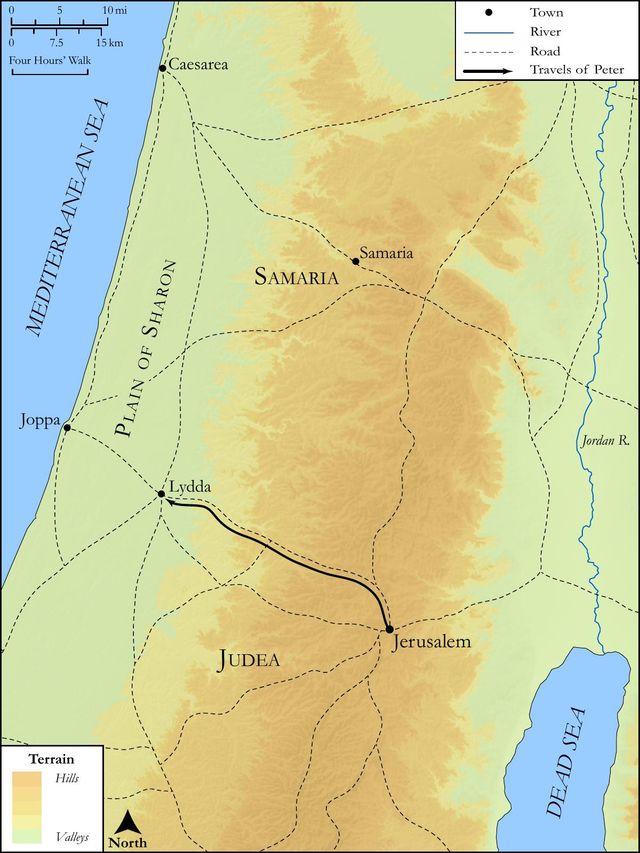
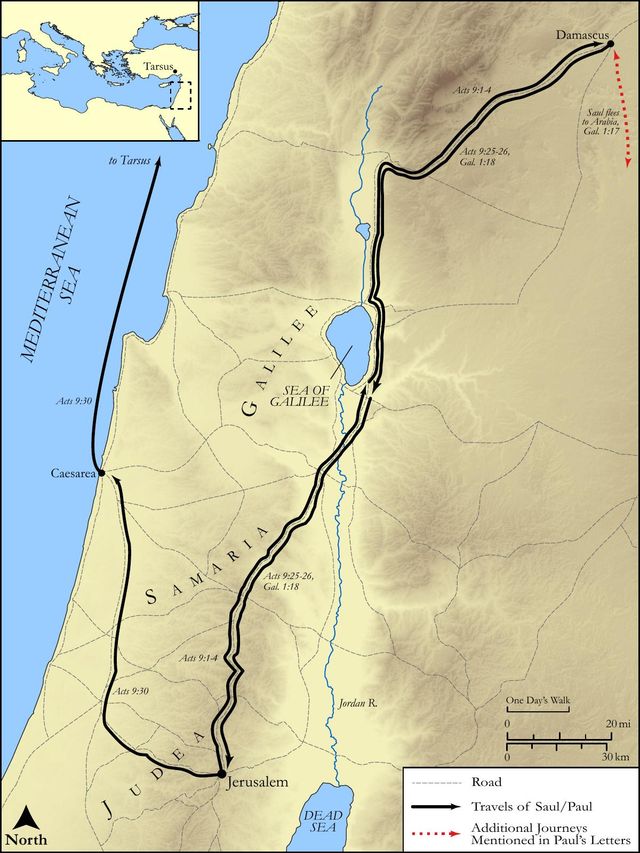
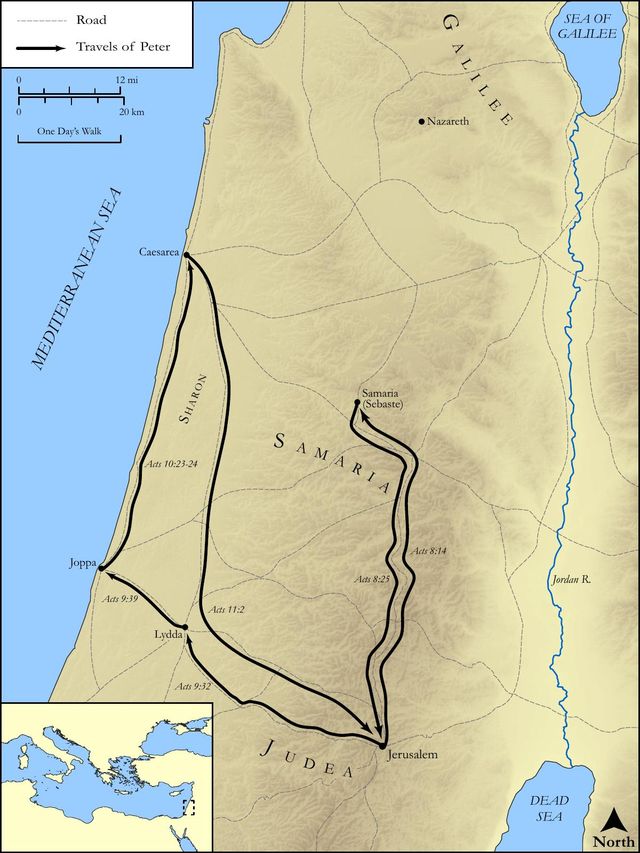
Study this verse
Public-domain commentary
Matthew Henry
From his Commentary on the Whole Bible. Henry comments on passages, not single verses — this entry covers Acts 9:32–35. His three-level outline is real structure in the source text, so it is rendered as structure.
Here we have, I. The visit Peter made to the churches that were newly planted by the dispersed preachers, Act 9:32. 1. He passed through all quarters. As an apostle, he was not to be the resident pastor of any one church, but the itinerant visitor of many churches, to confirm the doctrine of inferior preachers, to confer the Holy Ghost on those that believed, and to ordain ministers. He passed dia pantōn - among them all, who pertained to the churches of Judea, Galilee, and Samaria, mentioned in the foregoing chapter. He was, like his Master, always upon the remove, and went about doing good; but still his head-quarters were at Jerusalem, for there we shall find him imprisoned, Act 12:2. He came to the saints at Lydda. This seems to be the same with Lod, a city in the tribe of Benjamin, mentioned Ch1 8:12; Ezr 2:33. The Christians are called saints, not only some particular eminent ones, as saint Peter and saint Paul, but every sincere professor of the faith of Christ. These are the saints on the earth, Psa 16:3.
II.The cure Peter wrought on Eneas, a man that had been bedridden eight years, Act 9:33.
1.His case was very deplorable: He was sick of the palsy, a dumb palsy, perhaps a dead palsy. The disease was extreme, for he kept his bed; it was inveterate, for he kept his bed eight years; and we may suppose that both he himself and all about him despaired of relief for him, and concluded upon no other than that he must still keep his bed till he removed to his grave. Christ chose such patients as this, whose disease was incurable in a course of nature, to show how desperate the case of fallen mankind was when he undertook their cure. When we were without strength, as this poor man, he sent his word to heal us.
2.His cure was very admirable, Act 9:34.
(1.)Peter interested Christ in his case, and engaged him for his relief: Eneas, Jesus Christ maketh thee whole. Peter does not pretend to do it himself by any power of his own, but declares it to be Christ's act and deed, directs him to look up to Christ for help, and assures him of an immediate cure - not, "He will make thee," but, "He does make thee, whole;" and a perfect cure - not, "He makes thee easy," but "He makes thee whole." He does not express himself by way of prayer to Christ that he would make him whole, but as one having authority from Christ, and that knew his mind, he declares him made whole.
(2.)He ordered him to bestir himself, to exert himself: "Arise and make thy bed, that all may see thou art thoroughly cured." Let none say that because it is Christ that by the power of his grace works all our works in us therefore we have no work, no duty, to do; for, though Jesus Christ makes thee whole, yet thou must arise and make use of the power he gives thee: "Arise, and make thy bed, to be to thee no longer a bed of sickness, but a bed of rest." (3.) Power went along with this word: he arose immediately, and no doubt very willingly made his own bed.
III.The good influence this had upon many (Act 9:35):
All that dwelt at Lydda and Saron saw him, and turned to the Lord. We can scarcely think that every individual person in those countries took cognizance of the miracle, and was wrought upon by it; but many, the generality of the people in the town of Lydda and in the country of Saron, or Sharon, a fruitful plain or valley, of which it was foretold, Sharon shall be a fold of flocks, Isa 65:10.
1.They all made enquiry into the truth of the miracle, did not overlook it, but saw him that was healed, and saw that it was a miraculous cure that was wrought upon him by the power of Christ, in his name, and with a design to confirm and ratify that doctrine of Christ which was now preached to the world.
2.They all submitted to the convincing proof and evidence there was in this of the divine origin of the Christian doctrine, and turned to the Lord, to the Lord Jesus. They turned from Judaism to Christianity; they embraced the doctrine of Christ, and submitted to his ordinances, and turned themselves over to him to be ruled and taught and saved by him.
Historical interpretation
Two Centuries of Reception
2 surviving comments on this verse. Each one is dated, so this reads as a timeline rather than a list.
Select a marker to jump to its quote. Markers stagger vertically where authors wrote within a few decades of each other.
"And it came to pass, as Peter passed throughout all quarters, he came down also to the saints which dwelt at Lydda." Like the commander of an army, he went about, inspecting the ranks, what part was compact, what in good order, what needed his presence. See how on all occasions he goes about, foremost. When an Apostle was to be chosen, he was the foremost: when the Jews were to be told, that these were "not drunken," when the lame man was to be healed, when harangues to be made, he is before the rest: when the rulers were to be spoken to, he was the man; when Ananias, he: when healings were wrought by the shadow, still it was he. And look: where there was danger, he was the man, and where good management was needed; but where all is calm, there they act all in common, and he demands no greater honor than the others. When need was to work miracles, he starts forward, and here again he is the man to labor and toil.
"And it came to pass that Peter, as he passed through, visiting all, came to the saints who dwelt at Lydda," etc. When Peter came to Lydda, he found there a man named Aeneas who, being ill of the palsy, had kept his bed for eight years. Peter said to him: "The Lord Jesus Christ healeth thee", and he was immediately cured. When they saw this miracle, all the people - all who dwelt at Lydda and Saron - converted to God. Then Dorcas, a woman devoted to almsdeeds and holy works who lived in Joppe, was deprived of life. Peter was sent for so that he should come there and show the wonderful works of God. A crowd of poor people, whom Dorcas had been supplying with clothes, were begging Peter that the mother of the poor be given back to them. Then Peter knelt down and prayed, saying: "Arise, in the name of Jesus Christ;" and he presented her alive to the people, after having summoned them. A large number of people believed in the power of the Lord as a result of this event; whereupon it came to pass that Peter stayed many days with one Simon, a tanner.
Continue studying Acts 9:32 across the web’s major study libraries — every link below opens this exact verse, chapter, or book on the destination site.
Read & Compare
 BibleGatewayThis verse in more than 200 translations and 70 languages.
 Bible.comThe YouVersion reader — hundreds of translations, reading plans, and highlights.
 ESV.orgCrossway's official English Standard Version reader.
 NET BibleThe NET translation with 60,000+ translators' notes on every rendering decision.
 STEP BibleTyndale House's free study tool — original text, vocabulary, and scholarly resources.
 BibliaLogos Bible Software's free web reader.
 USCCBThe New American Bible (Revised Edition) with the U.S. bishops' study notes.
Commentaries
 BibleHub CommentariesDozens of classic commentaries on this verse, gathered on one page.
 StudyLightMore than 100 commentary sets — the largest collection on the web.
 BibleRefPlain-English commentary on what this verse means, verse by verse.
 Enduring WordDavid Guzik's free commentary on this chapter, widely used by Bible teachers.
 Bible Study ToolsVerse commentary alongside Greek and Hebrew study aids.
Original Language & Research
- BibleHub InterlinearThe verse word by word — original language, transliteration, and English.
- BibleHub LexiconEvery word's original-language definition and Strong's entry.
 Blue Letter BibleDeep-study tools — Strong's numbers, concordance, and word studies.
 CNTR CollationThe earliest Greek manuscripts of this verse, collated letter by letter.
Sermons, Hymns & Audio


TrulyRandomVerse is not affiliated with these sites and doesn’t control their content. They’re linked because they’re genuinely useful.
Summary
Acts 9:32 serves as a pivotal transitional verse, shifting the narrative focus from Saul's conversion and initial ministry back to the apostle Peter. It describes Peter's extensive travels throughout various regions of Judea, signifying his active apostolic oversight and the continued expansion of the early church. Specifically, the verse highlights his arrival in Lydda, a town on the coastal plain, where he visited existing communities of believers, setting the stage for significant miracles that would further confirm the Gospel message and strengthen the nascent Christian movement.
Context
ShowHideLiterary Context
This verse immediately follows a period of peace for the church, described in Acts 9:31, which notes the church's growth and edification "throughout all Judea and Galilee and Samaria." After the dramatic account of Saul's conversion and his initial, albeit controversial, preaching in Damascus and Jerusalem (see Acts 9:1-30), Luke shifts attention to Peter. This transition underscores the parallel and complementary ministries of the apostles in spreading the Gospel. Peter's journey to Lydda and subsequently Joppa (beginning in Acts 9:36) initiates a new series of miraculous events that demonstrate God's continued power through the apostles, reinforcing the divine authority behind the burgeoning Christian movement before Luke returns to Saul's story in Acts 11:25.
Historical & Cultural Context
Lydda (modern Lod) was an ancient and strategically important town located on the coastal plain of Sharon, about 25 miles northwest of Jerusalem and 11 miles southeast of Joppa. It lay on a major trade route connecting Egypt with Syria and Mesopotamia, making it a significant hub for travel and commerce. In the first century, Lydda had a substantial Jewish population and was known as a center for rabbinic learning. The presence of "saints" (believers) in such a town indicates the successful penetration of the Gospel beyond Jerusalem and into established Jewish communities in the wider region. Peter's journey "throughout all quarters" reflects the common practice of apostles and evangelists traveling to strengthen existing communities and establish new ones, often leveraging these established routes.
Key Themes
ShowHideActs 9:32 contributes to several overarching themes in the book of Acts. Firstly, it exemplifies Apostolic Oversight and Leadership, showing Peter's active role in nurturing and consolidating the growing church beyond its Jerusalem origins, fulfilling the Great Commission's mandate to make disciples. Secondly, it highlights the Geographical Expansion of the Gospel, moving the narrative further into Judea's coastal regions, demonstrating the church's organic spread as prophesied in Acts 1:8. The presence of established communities of "saints" in Lydda underscores the theme of the Formation of Christian Communities, emphasizing that the early church was not merely a collection of scattered individuals but organized groups of believers, united by their faith in Christ and requiring pastoral care.
Exposition and Analysis
ShowHideKey Word Analysis
ShowHideThis verb, G1096, signifies "to cause to be" or "to become," often translated as "happened" or "occurred." Its use here emphasizes the unfolding of events as part of God's sovereign plan. It's not a mere coincidence but a divinely orchestrated progression in the narrative of the early church's expansion and the apostles' ministry.
Derived from G1330, this word literally means "to traverse" or "to go through." It denotes Peter's extensive and purposeful journey, not just a casual visit. The addition of "all quarters" (G3956, pâs, meaning "all" or "the whole") further emphasizes the comprehensive nature of his itinerant ministry, covering a wide geographical area to minister to scattered believers.
Meaning "sacred," "holy," or "set apart." In the New Testament, particularly in the Pauline epistles and here in Acts, this term is commonly used to refer to all believers in Christ, not just a select few of exceptional piety. It signifies their new identity in Christ—consecrated by God, distinct from the world, and dedicated to His purposes. The presence of "saints" in Lydda indicates the establishment of a recognized community of believers.
Verse Breakdown
ShowHide"¶ And it came to pass, as Peter passed throughout all [quarters],"
This opening clause sets the scene for Peter's extensive missionary journey. The phrase "it came to pass" (G1096, gínomai) signals a new development in the narrative. Peter, as a leading apostle, undertakes a deliberate and comprehensive tour ("passed throughout all quarters," G1330 diérchomai and G3956 pâs), demonstrating his commitment to pastoral oversight and the strengthening of the burgeoning Christian communities beyond Jerusalem. This highlights the active, itinerant nature of early apostolic ministry.
"he came down also to the saints which dwelt at Lydda."
This part specifies Peter's destination and the purpose of his visit. "Came down" (G2718, katérchomai) implies a descent, possibly from Jerusalem (which is at a higher elevation) or from a more northerly point in Galilee. The key revelation is his arrival "to the saints" (G40, hágios), indicating that established communities of believers already existed in Lydda. This confirms the widespread dissemination of the Gospel, as these "saints" were those "set apart" by God through faith in Jesus Christ, forming a distinct Christian community. Their "dwelling" (G2730, katoikéō) at Lydda implies a settled, permanent presence of the church in that town.
Literary Devices
ShowHideLuke employs several literary devices in this concise verse. The use of Transition is paramount, as the verse smoothly shifts the narrative focus from Saul to Peter, signaling a new phase of apostolic activity. The phrase "it came to pass" acts as a common Narrative Marker in biblical literature, indicating the initiation of a new event or sequence of events. The specific mention of "Lydda" provides Geographical Precision, grounding the spiritual narrative in real-world locations and demonstrating the tangible spread of the Gospel. Furthermore, the term "saints" serves as a significant Theological Identifier, defining the identity of the early Christian community not by ethnicity or social status, but by their spiritual consecration to God.
Theological and Thematic Connections
ShowHideActs 9:32 underscores the essential nature of apostolic ministry in the early church's growth and consolidation. Peter's journey exemplifies the pastoral heart of the apostles, who actively sought to nurture, teach, and confirm believers in various regions. This itinerant ministry was crucial for establishing the foundational doctrines and practices of the church, ensuring unity and spiritual health among scattered communities. The verse also highlights the organic and geographical expansion of the Gospel, demonstrating that the divine commission to spread the good news was being fulfilled, not just through evangelism, but through the systematic building up of local bodies of believers. It sets the stage for God's power to be displayed through miracles, further validating the apostles' message and drawing more people to faith.
Reflection and Application
ShowHideActs 9:32, though brief, offers profound insights into the nature of early Christian ministry and community, providing valuable lessons for believers today. Peter's deliberate journey to "the saints which dwelt at Lydda" reminds us that the Christian faith is not meant to be lived in isolation but in community. It emphasizes the importance of spiritual leaders actively engaging with and caring for their congregations, providing guidance, encouragement, and teaching. For every believer, it highlights our identity as "saints"—those set apart by God for His purposes, called to live holy lives within a community of faith. This verse also serves as a powerful reminder of the ongoing mission to spread the Gospel and establish vibrant Christian communities in every "quarter" of the world, whether through direct evangelism, discipleship, or supporting those on the front lines of ministry. Our faith is both deeply personal and inherently communal, requiring both individual devotion and collective participation in God's redemptive work.
Questions for Reflection
ShowHideFAQ
ShowHideWhy did Peter travel to Lydda, and what was its significance?
ShowHidePeter traveled to Lydda as part of his broader apostolic ministry, which involved visiting and strengthening the nascent Christian communities that had formed throughout Judea and beyond. Lydda was a strategically important town on a major trade route, with an existing Jewish population. The presence of "saints" (believers) there indicated that the Gospel had already taken root. Peter's visit was not only to provide pastoral oversight but also to perform miraculous works, as seen in the healing of Aeneas in Acts 9:33-35, which further confirmed the power of the Gospel and led many more to turn to the Lord. His presence validated the local church and extended the reach of apostolic authority.
Christ-Centered Fulfillment
ShowHideWhile Acts 9:32 focuses on Peter's ministry, it implicitly points to Christ as the ultimate source and purpose of all apostolic activity. Peter's journey to Lydda, his care for the "saints," and the subsequent miracles (like the healing of Aeneas in Acts 9:33-34) are not merely human endeavors but manifestations of the resurrected Christ's ongoing work through His Spirit. Just as Jesus "went about all the cities and villages, teaching in their synagogues, and preaching the gospel of the kingdom, and healing every sickness and every disease among the people" (Matthew 9:35), so too did His apostles continue this ministry, empowered by Him. The "saints" in Lydda are those who have been set apart by Christ's atoning sacrifice (Hebrews 10:10), and Peter's visit served to nourish and confirm their identity in the one who is the Head of the Church (Ephesians 1:22-23). Thus, Peter's actions in Acts 9:32 are a direct continuation of Christ's mission to gather, shepherd, and empower His people, extending His kingdom through the faithful witness of His chosen vessels.