


Acts 9:33
Bible text: King James Version (1769 Blayney text) · Public domain
Bible text: Berean Standard Bible · Public domain
Bible text: American Standard Version (1901) · Public domain
Bible text: World English Bible, Messianic edition · Public domain
Bible text: Geneva Bible (1599) · Public domain
Bible text: Young's Literal Translation · Public domain
- εὗρενheurenHe foundG2147V-2AAI-3SVerb 2nd Aorist Active Indicative 3rd Singular
- δὲdethenG1161CONJConjunction
- ἐκεῖekeithereG1563ADVAdverb
- ἄνθρωπόνanthrōpona manG444N-ASMNoun Accusative Singular Masculine
- τιναtinacertainG5100X-ASMIndefinite pronoun Accusative Singular Masculine
- ὀνόματιonomatinamedG3686N-DSNNoun Dative Singular Neuter
- ΑἰνέανAineanAeneasG132N-ASM-PNoun Accusative Singular Masculine Individual
- ἐξexforG1537PREPPreposition
- ἐτῶνetōnyearsG2094N-GPNNoun Genitive Plural Neuter
- ὀκτὼoktōeightG3638A-NUIAdjective
- κατακείμενονkatakeimenonlyingG2621V-PNP-ASMVerb Present Middle Or Passive Deponent Participle Accusative Singular Masculine
- ἐπὶepionG1909PREPPreposition
- κραβάττουkrabattoua bedG2895N-GSMNoun Genitive Singular Masculine
- ὃςhoswhoG3739R-NSMRelative pronoun Nominative Singular Masculine
- ἦνēnwasG1510V-IAI-3SVerb Imperfect Active Indicative 3rd Singular
- παραλελυμένοςparalelumenosparalyzedG3886V-RPP-NSMVerb Perfect Passive Participle Nominative Singular Masculine
English is a literal word-by-word gloss of the Greek, not the KJV's wording. Why?
This is the original text the KJV's translators worked from — each Greek word with its own literal English meaning in this verse, prepared by scholars at Tyndale House, Cambridge. The KJV translates whole sentences, not word by word, so its wording differs: one Greek word can become several English words, and the KJV may choose “charity” where the gloss reads “love”. Both are faithful — they answer different questions. For the KJV's own rendering, switch to the KJV text.
Details
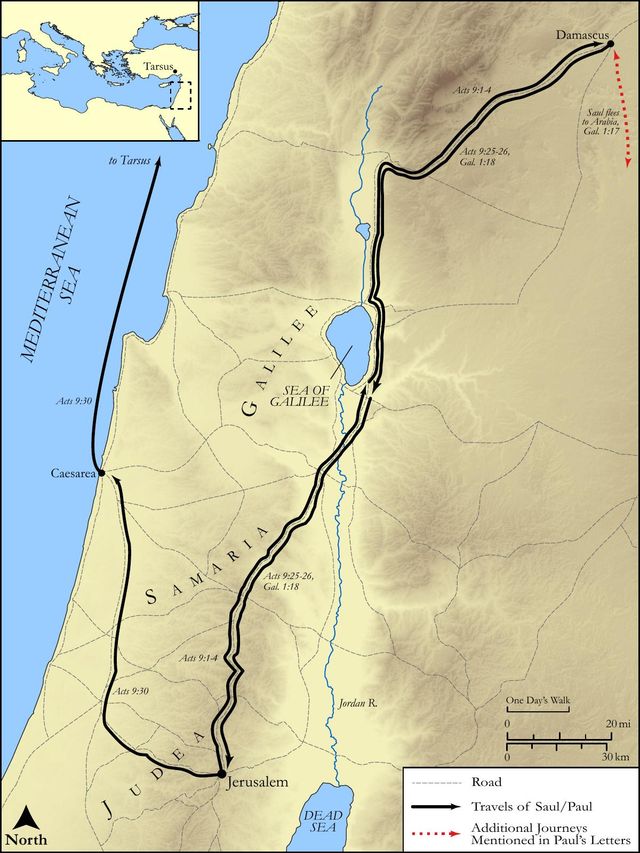
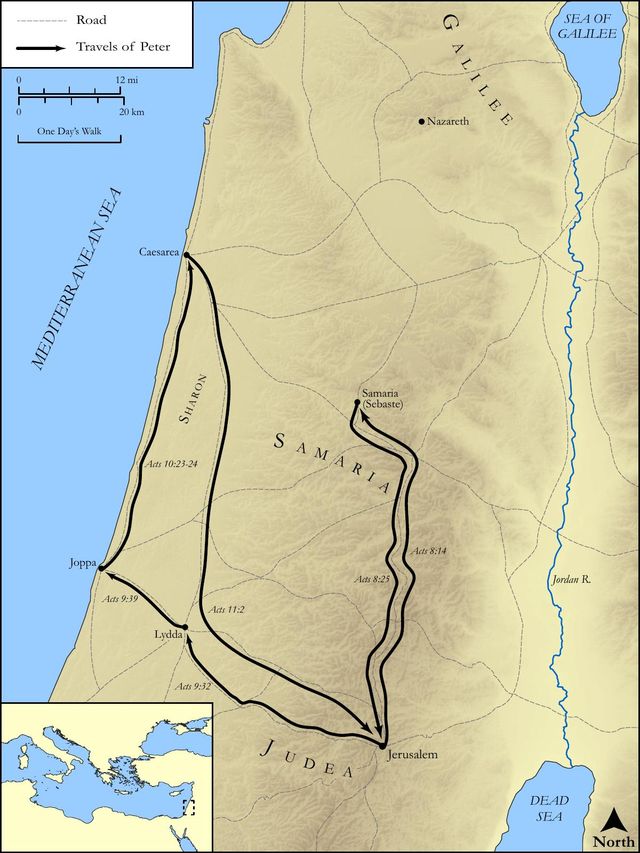
See on the biblical-era maps

Study this verse
Public-domain commentary
Matthew Henry
From his Commentary on the Whole Bible. Henry comments on passages, not single verses — this entry covers Acts 9:32–35. His three-level outline is real structure in the source text, so it is rendered as structure.
Here we have, I. The visit Peter made to the churches that were newly planted by the dispersed preachers, Act 9:32. 1. He passed through all quarters. As an apostle, he was not to be the resident pastor of any one church, but the itinerant visitor of many churches, to confirm the doctrine of inferior preachers, to confer the Holy Ghost on those that believed, and to ordain ministers. He passed dia pantōn - among them all, who pertained to the churches of Judea, Galilee, and Samaria, mentioned in the foregoing chapter. He was, like his Master, always upon the remove, and went about doing good; but still his head-quarters were at Jerusalem, for there we shall find him imprisoned, Act 12:2. He came to the saints at Lydda. This seems to be the same with Lod, a city in the tribe of Benjamin, mentioned Ch1 8:12; Ezr 2:33. The Christians are called saints, not only some particular eminent ones, as saint Peter and saint Paul, but every sincere professor of the faith of Christ. These are the saints on the earth, Psa 16:3.
II.The cure Peter wrought on Eneas, a man that had been bedridden eight years, Act 9:33.
1.His case was very deplorable: He was sick of the palsy, a dumb palsy, perhaps a dead palsy. The disease was extreme, for he kept his bed; it was inveterate, for he kept his bed eight years; and we may suppose that both he himself and all about him despaired of relief for him, and concluded upon no other than that he must still keep his bed till he removed to his grave. Christ chose such patients as this, whose disease was incurable in a course of nature, to show how desperate the case of fallen mankind was when he undertook their cure. When we were without strength, as this poor man, he sent his word to heal us.
2.His cure was very admirable, Act 9:34.
(1.)Peter interested Christ in his case, and engaged him for his relief: Eneas, Jesus Christ maketh thee whole. Peter does not pretend to do it himself by any power of his own, but declares it to be Christ's act and deed, directs him to look up to Christ for help, and assures him of an immediate cure - not, "He will make thee," but, "He does make thee, whole;" and a perfect cure - not, "He makes thee easy," but "He makes thee whole." He does not express himself by way of prayer to Christ that he would make him whole, but as one having authority from Christ, and that knew his mind, he declares him made whole.
(2.)He ordered him to bestir himself, to exert himself: "Arise and make thy bed, that all may see thou art thoroughly cured." Let none say that because it is Christ that by the power of his grace works all our works in us therefore we have no work, no duty, to do; for, though Jesus Christ makes thee whole, yet thou must arise and make use of the power he gives thee: "Arise, and make thy bed, to be to thee no longer a bed of sickness, but a bed of rest." (3.) Power went along with this word: he arose immediately, and no doubt very willingly made his own bed.
III.The good influence this had upon many (Act 9:35):
All that dwelt at Lydda and Saron saw him, and turned to the Lord. We can scarcely think that every individual person in those countries took cognizance of the miracle, and was wrought upon by it; but many, the generality of the people in the town of Lydda and in the country of Saron, or Sharon, a fruitful plain or valley, of which it was foretold, Sharon shall be a fold of flocks, Isa 65:10.
1.They all made enquiry into the truth of the miracle, did not overlook it, but saw him that was healed, and saw that it was a miraculous cure that was wrought upon him by the power of Christ, in his name, and with a design to confirm and ratify that doctrine of Christ which was now preached to the world.
2.They all submitted to the convincing proof and evidence there was in this of the divine origin of the Christian doctrine, and turned to the Lord, to the Lord Jesus. They turned from Judaism to Christianity; they embraced the doctrine of Christ, and submitted to his ordinances, and turned themselves over to him to be ruled and taught and saved by him.
Historical interpretation
Three Centuries of Reception
4 surviving comments on this verse. Each one is dated, so this reads as a timeline rather than a list.
Select a marker to jump to its quote. Markers stagger vertically where authors wrote within a few decades of each other.
"And there he found a certain man named Aeneas, which had kept his bed eight years, and was sick of the palsy. And Peter said unto him, Aeneas, Jesus Christ maketh thee whole: arise, and make thy bed. And he arose immediately." And why did he not wait for the man's faith, and ask if he wished to be healed? In the first place, the miracle served for exhortation to many: hear then how great the gain.
"Arise, and make thy bed:" he does well to give a proof of the miracle: for they not only released men of their diseases, but in giving the health they gave the strength also. Moreover, at that time they had given no proofs of their power, so that the man could not reasonably have been required to show his faith, as neither in the case of the lame man did they demand it. As therefore Christ in the beginning of His miracles did not demand faith, so neither did these. For in Jerusalem indeed, as was but reasonable, the faith of the parties was first shown; "they brought out their sick into the streets, but as Peter passed by, his shadow at least might fall upon some of them"; for many miracles had been wrought there; but here this is the first that occurs. For of the miracles, some were wrought for the purpose of drawing others to faith; some for the comfort of them that believed.
"And Peter said unto him, Eneas," etc. But before discourse, before exhortations, he says to the lame man himself, "Jesus Christ maketh thee whole." This word he believed in any wise, and was made whole. Observe how unassuming he is: for he said not, "In the Name," but rather as a sign he narrates the miracle itself, and speaks as its Evangelist.
He found there a certain man named Aeneas, who had been bedridden for eight years. This Aeneas signifies the human race, languishing previously in the pleasure of infirmities, but healed by the work and word of the apostles. For since the world itself is raised up by four directions, and the course of the age is varied by four yearly seasons, anyone who embraces present and fleeting joys is laid out powerless on a bed, counting, as it were, the twice four years in number. Indeed, the bed itself is sloth, where the sick and weak mind rests, that is, in the pleasure of the body and all worldly delight.
Continue studying Acts 9:33 across the web’s major study libraries — every link below opens this exact verse, chapter, or book on the destination site.
Read & Compare
 BibleGatewayThis verse in more than 200 translations and 70 languages.
 Bible.comThe YouVersion reader — hundreds of translations, reading plans, and highlights.
 ESV.orgCrossway's official English Standard Version reader.
 NET BibleThe NET translation with 60,000+ translators' notes on every rendering decision.
 STEP BibleTyndale House's free study tool — original text, vocabulary, and scholarly resources.
 BibliaLogos Bible Software's free web reader.
 USCCBThe New American Bible (Revised Edition) with the U.S. bishops' study notes.
Commentaries
 BibleHub CommentariesDozens of classic commentaries on this verse, gathered on one page.
 StudyLightMore than 100 commentary sets — the largest collection on the web.
 BibleRefPlain-English commentary on what this verse means, verse by verse.
 Enduring WordDavid Guzik's free commentary on this chapter, widely used by Bible teachers.
 Bible Study ToolsVerse commentary alongside Greek and Hebrew study aids.
Original Language & Research
- BibleHub InterlinearThe verse word by word — original language, transliteration, and English.
- BibleHub LexiconEvery word's original-language definition and Strong's entry.
 Blue Letter BibleDeep-study tools — Strong's numbers, concordance, and word studies.
 CNTR CollationThe earliest Greek manuscripts of this verse, collated letter by letter.
Sermons, Hymns & Audio


TrulyRandomVerse is not affiliated with these sites and doesn’t control their content. They’re linked because they’re genuinely useful.
Summary
Acts 9:33 introduces Aeneas, a man in Lydda who had been bedridden for eight years due to paralysis, setting the stage for a powerful demonstration of divine healing through the Apostle Peter. This verse highlights the severe and prolonged nature of Aeneas's suffering, underscoring the human impossibility of his recovery and preparing the reader for a miraculous intervention that would validate the apostolic ministry and the truth of the Gospel.
Context
ShowHideLiterary Context
Acts 9:33 is situated within a broader narrative detailing the expansion of the early church and the ministry of its key apostles following the dramatic conversion of Saul (who would become Paul) in Acts 9:1-19. After Saul's conversion and initial ministry, Peter embarks on an extensive tour to visit and minister to the scattered communities of believers. His journey takes him from Jerusalem, through Judea, Samaria, and eventually to the coastal plain. The events in Lydda (Acts 9:32-35) and Joppa (Acts 9:36-43) showcase Peter's apostolic authority and the working of God's power through him, serving as pivotal moments that precede the groundbreaking conversion of Cornelius, a Gentile, in Acts 10. This particular verse, therefore, acts as the introduction to a significant healing miracle, paralleling Jesus's own healing ministry and affirming the continuity of divine power in the nascent church.
Historical & Cultural Context
Lydda (modern Lod) was a prominent town on the fertile Sharon plain, strategically located on the main road between Jerusalem and the Mediterranean coast. It was a significant Jewish center, indicating the spread of the Gospel beyond Jerusalem to Jewish communities in the wider region. In that day, chronic illnesses like paralysis ("palsy") were often seen as incurable, leaving sufferers dependent on family or charity. Medical understanding was rudimentary, and such conditions frequently led to social isolation and despair. The "eight years" of Aeneas's affliction emphasizes the long-term, debilitating nature of his condition, making his healing all the more astonishing and counter-cultural. The presence of Christian "saints" (believers) in Lydda indicates the early church's rapid growth and geographical reach, even before the widespread Gentile conversions.
Key Themes
ShowHideThis verse, as an introduction to Peter's miracle, contributes to several major themes found throughout the book of Acts. Firstly, it powerfully illustrates the Divine Power and Authority at work through the apostles. Peter is not merely a compassionate visitor but an instrument through whom God's healing power is manifested, echoing the miracles performed by Jesus himself. Secondly, it highlights the Compassion and Holistic Ministry of the early church. Peter's journey to visit the saints and his encounter with Aeneas demonstrate the church's commitment to caring for the suffering, reflecting the ministry of Christ who "went about doing good and healing all who were oppressed by the devil" as described in Acts 10:38. Finally, the healing of Aeneas serves as a powerful Validation of the Gospel Message. Such undeniable signs and wonders provided compelling evidence of God's endorsement of the apostles' preaching, leading many to faith, as explicitly stated in Acts 9:35.
Exposition and Analysis
ShowHideKey Word Analysis
ShowHideThis verb (G2147) means "to find" literally or figuratively, "to get, obtain, perceive, see." In this context, it implies Peter's discovery of Aeneas, suggesting a providential encounter rather than a random one. It signifies that Peter, in his ministry travels, encountered this specific individual in need, setting the stage for God's intervention.
This compound verb (G2621) from katá ("down") and keîmai ("to lie") means "to lie down," and by implication, "to be sick" or "to recline at a meal." Here, it unequivocally denotes being bedridden due to illness. The phrase "kept his bed" emphasizes the continuous and involuntary nature of Aeneas's confinement to his bed, highlighting the severity and duration of his condition.
This verb (G3886) means "to loosen beside," and in its perfect passive participle form, "paralyzed" or "enfeebled." It describes Aeneas's specific affliction as paralysis, a condition that rendered him unable to move or care for himself. The KJV's "sick of the palsy" accurately conveys the debilitating nature of this neurological condition, which was incurable in that era.
Verse Breakdown
ShowHide"And there he found a certain man named Aeneas"
This clause introduces the setting and the individual. "There" (Lydda, as per the preceding verse) indicates Peter's location. The discovery of Aeneas is presented as a direct encounter, emphasizing Peter's active ministry among the believers. Aeneas is identified by name, giving a personal touch to the narrative and highlighting that this was a specific, known individual within the community.
"which had kept his bed eight years"
This detail is crucial for understanding the gravity of Aeneas's condition. The "eight years" signifies a chronic, long-term, and seemingly hopeless affliction. It underscores that this was not a temporary ailment but a deep-seated, debilitating paralysis that had incapacitated him for a significant portion of his life, making his impending healing all the more remarkable.
"and was sick of the palsy"
This final clause specifies the nature of Aeneas's illness. "Palsy" (paralysis) indicates a severe neurological condition that rendered him immobile. This clarifies why he was bedridden for so long, emphasizing the physical impossibility of his recovery through natural means and setting the stage for a supernatural intervention.
Literary Devices
ShowHideThe verse employs Realism by providing specific, tangible details about Aeneas's condition ("kept his bed eight years," "sick of the palsy"), which grounds the narrative in a relatable human experience of suffering. This detailed description creates a sense of Pathos, evoking sympathy for Aeneas and highlighting the severity of his plight, thereby amplifying the impact of the miracle that follows. The mention of his long-term suffering also serves as Foreshadowing, building anticipation for a powerful divine intervention that will defy human limitations. The contrast between Aeneas's chronic illness and Peter's arrival implicitly sets up a dramatic tension that will be resolved by the demonstration of God's healing power.
Theological and Thematic Connections
ShowHideActs 9:33, while seemingly a simple descriptive verse, profoundly connects to the broader biblical narrative of God's active involvement in human suffering and His power to restore. It echoes the compassionate ministry of Jesus, who frequently healed the paralyzed and infirm, demonstrating His divine authority over sickness and sin. This verse also affirms the continuity of God's power through His chosen instruments, showing that the miraculous signs accompanying the Gospel message were not limited to Jesus's earthly ministry but continued through His apostles, validating their message and mission. The healing of Aeneas, therefore, is not merely an isolated event but a testament to God's enduring desire to bring wholeness—physical and spiritual—to humanity, and His readiness to use His servants to accomplish His purposes.
Reflection and Application
ShowHideActs 9:33 serves as a powerful reminder that God sees and cares for those in their deepest suffering, even when their affliction has been long-standing and seemingly hopeless. Aeneas's eight years of paralysis represent the chronic, debilitating struggles many face—whether physical, emotional, spiritual, or relational. This verse encourages us to recognize that no condition is beyond God's reach or too entrenched for His transformative power. It calls believers to cultivate a heart of compassion, actively seeking out and ministering to those who are suffering, just as Peter did. Furthermore, it instills hope, reminding us that God can use ordinary individuals, empowered by His Spirit, to bring about extraordinary change and healing in the lives of others, thereby demonstrating His love and validating His truth to a watching world.
Questions for Reflection
ShowHideFAQ
ShowHideWhat does "sick of the palsy" mean in modern terms?
ShowHide"Sick of the palsy" refers to a condition of paralysis or severe neurological impairment, often resulting from a stroke, spinal cord injury, or other debilitating disease that affects motor function. In Aeneas's case, it meant he was completely incapacitated and confined to his bed, unable to move or care for himself for eight years. This condition would be diagnosed today as a severe form of paralysis.
Why is the detail "eight years" significant?
ShowHideThe detail "eight years" is highly significant because it emphasizes the chronic, long-term, and seemingly incurable nature of Aeneas's condition. It highlights that this was not a temporary illness but a profound, debilitating affliction that had lasted for a substantial period of his life. This duration underscores the human impossibility of his recovery, thereby magnifying the miraculous nature of the healing performed by Peter and demonstrating the extraordinary power of God at work, as seen in the immediate and complete healing described in Acts 9:34.
Christ-Centered Fulfillment
ShowHideThe healing of Aeneas in Acts 9:33-34, though performed by Peter, is a profound Christ-centered fulfillment. Peter's authority and power to heal did not originate from himself but flowed directly from Jesus Christ, the risen Lord. Peter explicitly states, "Aeneas, Jesus Christ heals you!" in Acts 9:34, making it clear that Christ is the true source of all healing and restoration. This miracle mirrors the many instances of Jesus healing paralytics during His earthly ministry, such as the man let down through the roof in Mark 2:1-12, demonstrating that Christ's power continues to operate through His body, the church, even after His ascension. Aeneas's physical healing points to the greater spiritual healing that Christ offers to all humanity—freedom from the paralysis of sin and spiritual death, bringing new life and the ability to "rise and walk" in faith and obedience, as promised in passages like Ephesians 2:1-5. Thus, this account serves as a powerful testament to the ongoing, life-transforming power of Jesus Christ, who is "the same yesterday and today and forever" (Hebrews 13:8).