


Acts 27:10
- λέγωνlegōnsayingG3004V-PAP-NSMVerb Present Active Participle Nominative Singular Masculine
- αὐτοῖς·autoisto themG846P-DPMPersonal pronoun Dative Plural Masculine
- ἄνδρεςandresMenG435N-VPMNoun Vocative Plural Masculine
- θεωρῶtheōrōI understandG2334V-PAI-1SVerb Present Active Indicative 1st Singular
- ὅτιhotithatG3754CONJConjunction
- μετὰmetawithG3326PREPPreposition
- ὕβρεωςhubreōsdisasterG5196N-GSFNoun Genitive Singular Feminine
- καὶkaiandG2532CONJConjunction
- πολλῆςpollēsmuchG4183A-GSFAdjective Genitive Singular Feminine
- ζημίαςzēmiaslossG2209N-GSFNoun Genitive Singular Feminine
- οὐounotG3756PRT-NNegative Particle Negative
- μόνονmonononlyG3441A-ASNAdjective Accusative Singular Neuter
- τοῦtouof theG3588T-GSNDefinite article Genitive Singular Neuter
- φορτίουphortiouburdenG5413N-GSNNoun Genitive Singular Neuter
- καὶkaiandG2532CONJConjunction
- τοῦtouof theG3588T-GSNDefinite article Genitive Singular Neuter
- πλοίουploioushipG4143N-GSNNoun Genitive Singular Neuter
- ἀλλὰallabutG235CONJConjunction
- καὶkaialsoG2532CONJConjunction
- τῶνtōntheG3588T-GPFDefinite article Genitive Plural Feminine
- ψυχῶνpsuchōnlivesG5590N-GPFNoun Genitive Plural Feminine
- ἡμῶνhēmōnof usG3165P-1GPPersonal pronoun Genitive 1st Plural
- μέλλεινmelleinensuingG3195V-PANVerb Present Active Infinitive
- ἔσεσθαιesesthaito beG1510V-FDNVerb Future Middle Deponent Infinitive
- τὸνtontheG3588T-ASMDefinite article Accusative Singular Masculine
- πλοῦνplounvoyageG4144N-ASMNoun Accusative Singular Masculine
English is a literal word-by-word gloss of the Greek, not the KJV's wording. Why?
This is the original text the KJV's translators worked from — each Greek word with its own literal English meaning in this verse, prepared by scholars at Tyndale House, Cambridge. The KJV translates whole sentences, not word by word, so its wording differs: one Greek word can become several English words, and the KJV may choose “charity” where the gloss reads “love”. Both are faithful — they answer different questions. For the KJV's own rendering, switch to the KJV text.
Details
See on the biblical-era map
Study this verse
Public-domain commentary
Matthew Henry
From his Commentary on the Whole Bible. Henry comments on passages, not single verses — this entry covers Acts 27:1–11. His three-level outline is real structure in the source text, so it is rendered as structure.
It does not appear how long it was after Paul's conference with Agrippa that he was sent away for Rome, pursuant to his appeal to Caesar; but it is likely they took the first convenience they could hear of to do it; in the mean time Paul is in the midst of his friends at Caesarea - they comforts to him, and he a blessing to them. But here we are told,
I.How Paul was shipped off for Italy:
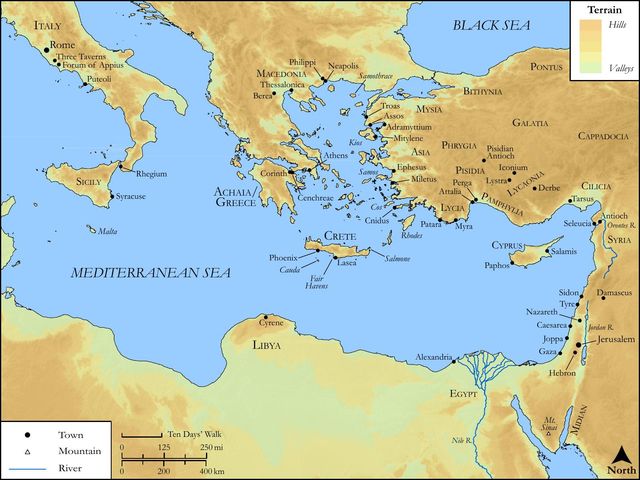
a long voyage, but there is no remedy. He has appealed to Caesar, and to Caesar he must go: It was determined that we should sail into Italy, for to Rome they must go by sea; it would have been a vast way about to go by land. Hence, when the Roman conquest of the Jewish nation is foretold, it is said (Num 24:24), Ships shall come from Chittim, that is, Italy, and shall afflict Eber, that is, the Hebrews. It was determined by the counsel of God, before it was determined by the counsel of Festus, that Paul should go to Rome; for, whatever man intended, God had work for him to do there. Now here we are told,
1.Whose custody he was committed to - to one named Julius, a centurion of Augustus's band, as Cornelius was of the Italian band, or legion, Act 10:1. He had soldiers under him, who were a guard upon Paul, that he might not make his escape, and likewise to protect him, that he might have no mischief done him.
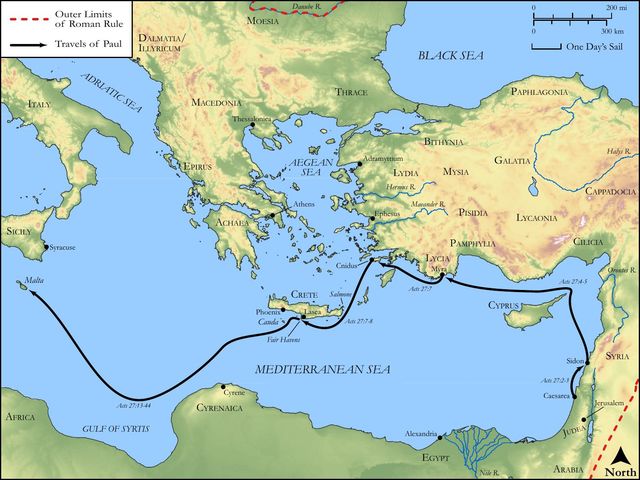
2.What bottom he embarked in: they went on board a ship of Adramyttium (Act 27:2), a sea-port of Africa, whence this ship brought African goods, and, as it should seem, made a coasting voyage for Syria, where those goods came to a good market.
3.What company he had in this voyage, there were some prisoners who were committed to the custody of the same centurion, and who probably had appealed to Caesar too, or were upon some other account removed to Rome, to be tried there, or to be examined as witnesses against some prisoners there; perhaps some notorious offenders, like Barabbas, who were therefore ordered to be brought before the emperor himself. Paul was linked with these, as Christ with the thieves that were crucified with him, and was obliged to take his lot with them in this voyage; and we find in this chapter (Act 27:42) that for their sakes he had like to have been killed, but for his sake they were preserved. Note, It is no new thing for the innocent to be numbered among the transgressors. But he had also some of his friends with him, Luke particularly, the penman of this book, for he puts himself in all along, We sailed into Italy, and, We launched, v. 2. Aristarchus a Thessalonian is particularly named, as being now in his company. Dr. Lightfoot thinks that Trophimus the Ephesian went off with him, but that he left him sick at Miletum (Ti2 4:20), when he passed by those coasts of Asia mentioned here (v. 2), and that there likewise he left Timothy. It was a comfort to Paul to have the society of some of his friends in this tedious voyage, with whom he might converse freely, though he had so much loose profane company about him. Those that go long voyages at sea are commonly necessitated to sojourn, as it were, in Mesech and Kedar, and have need of wisdom, that they may do good to the bad company they are in, may make them better, or at lest be made never the worse by them.
II.What course they steered, and what places they touched at, which are particularly recorded for the confirming of the truth of the history to those who lived at that time, and could by their own knowledge tell of their being at such and such a place.
1.They touched at Sidon, not far off from where they went on board; thither they came the next day. And that which is observable here is, that Julius the centurion was extraordinarily civil to Paul. It is probable that he knew his case, and was one of the chief captains, or principal men, that heard him plead his own cause before Agrippa (Act 25:23), and was convinced of his innocency, and the injury done him; and therefore, though Paul was committed to him as a prisoner, he treated him as a friend, as a scholar, as a gentleman, and as a man that had an interest in heaven: He gave him liberty, while the business of the ship detained it at Sidon, to go among his friends there, to refresh himself; and it would be a great refreshment to him. Julius herein gives an example to those in power to be respectful to those whom they find worthy of their respect, and in using their power to make a difference. A Joseph, a Paul, are not to be used as common prisoners. God herein encourages those that suffer for him to trust in him; for he can put it into the hearts of those to befriend them from whom they least expect it - can cause them to be pitied, nay, can cause them to be prized and valued, even in the eyes of those that carry them captive, Psa 106:46. And it is likewise an instance of Paul's fidelity. He did not go about to make his escape, which he might have easily done; but, being out upon his parole of honour, he faithfully returns to his imprisonment. If the centurion is so civil as to take his word, he is so just and honest as to keep his word.
2.They thence sailed under Cyprus, Act 27:4. If the wind had been fair, they had gone forward by direct sailing, and had left Cyprus on the right hand; but, the wind not favouring them, they were driven to oblique sailing with a side wind, and so compassed the island, in a manner, and left it on the left hand. Sailors must do as they can, when they cannot do as they would, and make the best of their wind, whatever point it is in; so must we all in our passage over the ocean of this world. When the winds are contrary yet we must be getting forward as well as we can.
3.At a port called Myra they changed their ship; that which they were in, it is probable, having business no further, they went on board a vessel of Alexandria bound for Italy, Act 27:5, Act 27:6. Alexandria was now the chief city of Egypt, and great trading there was between that city and Italy; from Alexandria they carried corn to Rome, and the East-India goods and Persian which they imported at the Red Sea they exported again to all parts of the Mediterranean, and especially to Italy. And it was a particular favour shown to the Alexandrian ships in the ports of Italy that they were not obliged to strike sail, as other ships were, when they came into port.
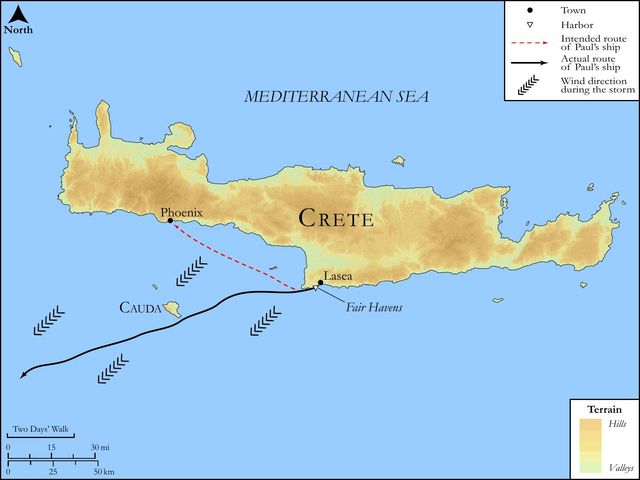
4.With much ado they made The Fair Havens, a port of the island of Crete, Act 27:7, Act 27:8. They sailed slowly many days, being becalmed, or having the wind against them. It was a great while before they made the point of Cnidus, a port of Caria, and were forced to sail under Crete, as before under Cyprus; much difficulty they met with in passing by Salmone, a promontory on the eastern shore of the island of Crete. Though the voyage hitherto was not tempestuous, yet it was very tedious. They many that are not driven backward in their affairs by cross providences, yet sail slowly, and do not get forward by favourable providences. And many good Christians make this complaint in the concerns of their souls, that they do not rid ground in their way of heaven, but have much ado to keep their ground; they move with many stops and pauses, and lie a great while wind-bound. Observe, The place they came to was called The Fair Havens. Travellers say that it is known to this day by the same name, and that it answers the name from the pleasantness of its situation and prospect. And yet,
(1.)It was not the harbour they were bound for; it was a fair haven, but it was not their haven. Whatever agreeable circumstances we may be in in this world, we must remember we are not at home, and therefore we must arise and depart; for, though it be a fair haven, it is not the desired haven, Psa 107:30.
(2.)It was not a commodious haven to winter in, so it is said, Act 27:12. It had a fine prospect, but it lay exposed to the weather. Note, Every fair haven is not a safe haven; nay, there may be most danger where there is most pleasure.
III.What advice Paul gave them with reference to that part of their voyage they had before them - it was to be content to winter where they were, and not to think of stirring till a better season of the year.
1.It was now a bad time for sailing; they had lost a deal of time while they were struggling with contrary winds. Sailing was now dangerous, because the fast was already past, that is, the famous yearly fast of the Jews, the day of atonement, which was on the tenth day of the seventh month, a day to afflict the soul with fasting; it was about the 20th of our September. That yearly fast was very religiously observed; but (which is strange) we never have any mention made in all the scripture history of the observance of it, unless it be meant here, where it serves only to describe the season of the year. Michaelmas is reckoned by mariners as a bad time of the year to be at sea as any other; they complain of their Michaelmas-blasts; it was that time now with these distressed voyagers. The harvest was past, the summer was ended; they had not only lost time, but lost the opportunity.
2.Paul put them in mind of it, and gave them notice of their danger (Act 27:10): "I perceive" (either by notice from God, or by observing their wilful resolution to prosecute the voyage notwithstanding the peril of the season) "that this voyage will be with hurt and damage; you that have effects on board are likely to lose them, and it will be a miracle of mercy if our lives be given us for a prey." There were some good men in the ship, and many more bad men: but in things of this nature all things come alike to all, and there is one event to the righteous and to the wicked. If both be in the same ship, they both are in the same danger.
3.They would not be advised by Paul in this matter, Act 27:11. They thought him impertinent in interposing in an affair of this nature, who did not understand navigation; and the centurion to whom it was referred to determine it, though himself a passenger, yet, being a man in authority, takes upon him to overrule, though he had not been oftener at sea perhaps than Paul, nor was better acquainted with these seas, for Paul had planted the gospel in Crete (Tit 1:5), and knew the several parts of the island well enough. But the centurion gave more regard to the opinion of the master and owner of the ship than to Paul's; for every man is to be credited in his own profession ordinarily: but such a man as Paul, who was so intimate with Heaven, was rather to be regarded in seafaring matters than the most celebrated sailors. Note, Those know not what dangers they run themselves into who will be governed more by human prudence than by divine revelation. The centurion was very civil to Paul (Act 27:3), and yet would not be governed by his advice. Note, Many will show respect to good ministers that will not take their advice, Eze 33:31.
Historical interpretation
Historical reception
2 surviving comments on this verse. Each one is dated, so this reads as a timeline rather than a list.
And observe how unassuming the expression is. That he may not seem to prophesy, but to speak as of conjecture, "I perceive," says he. For they would not have received it, had he said this at the outset. In fact he does prophesy on this former occasion, as he does afterward, and says there, "The God whom I serve," leading them on. Then how comes it that it was not "with loss" of any "of their lives?" It would have been so, but that God brought them safe through it. For as far as depended on the nature of the thing, they had perished, but God prevented it.
See [Paul's] modesty: in order that he may not appear to prophesy but to speak as if from supposition, he says "I see." They would have not received his words if he had pronounced them at once. In the first place he prophesies and says, "God, whom I worship," thus leading them. How would have it happened without a loss of lives? There surely would be such a loss if God did not save them.
Continue studying Acts 27:10 across the web’s major study libraries — every link below opens this exact verse, chapter, or book on the destination site.
Read & Compare
 BibleGatewayThis verse in more than 200 translations and 70 languages.
 Bible.comThe YouVersion reader — hundreds of translations, reading plans, and highlights.
 ESV.orgCrossway's official English Standard Version reader.
 NET BibleThe NET translation with 60,000+ translators' notes on every rendering decision.
 STEP BibleTyndale House's free study tool — original text, vocabulary, and scholarly resources.
 BibliaLogos Bible Software's free web reader.
 USCCBThe New American Bible (Revised Edition) with the U.S. bishops' study notes.
Commentaries
 BibleHub CommentariesDozens of classic commentaries on this verse, gathered on one page.
 StudyLightMore than 100 commentary sets — the largest collection on the web.
 BibleRefPlain-English commentary on what this verse means, verse by verse.
 Enduring WordDavid Guzik's free commentary on this chapter, widely used by Bible teachers.
 Bible Study ToolsVerse commentary alongside Greek and Hebrew study aids.
Original Language & Research
- BibleHub InterlinearThe verse word by word — original language, transliteration, and English.
- BibleHub LexiconEvery word's original-language definition and Strong's entry.
 Blue Letter BibleDeep-study tools — Strong's numbers, concordance, and word studies.
 CNTR CollationThe earliest Greek manuscripts of this verse, collated letter by letter.
Sermons, Hymns & Audio


TrulyRandomVerse is not affiliated with these sites and doesn’t control their content. They’re linked because they’re genuinely useful.
Summary
In Acts 27:10, the Apostle Paul, a prisoner en route to Rome, issues a stark and prophetic warning to the ship's crew and centurion. Despite being a captive, Paul, guided by divine insight, foresees that continuing their perilous voyage will result in significant "hurt and much damage," not only to the ship's cargo and the vessel itself but, most gravely, to the lives of all on board. This declaration underscores Paul's spiritual discernment and compassionate concern for others, even as it sets the stage for the dramatic events of the impending shipwreck.
Context
ShowHideLiterary Context
Acts 27:10 is situated at a critical juncture in Paul's journey to Rome, following his appeals to Caesar. The preceding verses (Acts 27:1-9) describe the challenging conditions of their sea voyage, particularly the onset of the dangerous sailing season, marked by treacherous winds and the approaching Fast (Day of Atonement). Luke explicitly notes in Acts 27:9 that "sailing was now dangerous." Paul's warning in verse 10 directly precedes the fateful decision by the centurion and shipmaster to disregard his counsel and push on, leading inevitably to the shipwreck detailed in the subsequent narrative. This verse functions as a pivotal moment, highlighting Paul's prophetic foresight and establishing the dramatic tension for the events that follow, culminating in the miraculous preservation of life.
Historical & Cultural Context
The Mediterranean Sea was notoriously perilous for sailing during the late autumn and winter months, generally from mid-September to mid-March. The period after the Fast (Yom Kippur, which usually falls in September or early October) was considered particularly hazardous due to strong northerly and easterly winds. Ancient ships were not designed for heavy seas, lacking modern navigational tools and robust construction. Shipowners and masters often prioritized reaching a more convenient winter harbor over safety, sometimes underestimating the risks. Paul's journey was under Roman authority, with a centurion in charge, meaning his advice, though potentially divinely inspired, carried less weight than that of experienced sailors or military commanders in a practical maritime decision. The concept of "lading" (cargo) and "ship" represented significant financial investment, making their potential loss a severe economic concern, secondary only to the loss of "lives."
Key Themes
ShowHidePaul's warning in Acts 27:10 contributes to several overarching themes in Acts and the broader biblical narrative. Firstly, it emphasizes Divine Foresight and Warning, showcasing God's ability to reveal future dangers through His servants, even when human wisdom fails. Paul's "perception" is more than mere observation; it carries the weight of spiritual insight. Secondly, it highlights the Consequences of Disregarding Counsel, as the centurion and shipmaster's decision to ignore Paul's warning directly leads to the predicted disaster (Acts 27:11-20). This underscores a recurring biblical theme that neglecting divinely-given wisdom often results in severe repercussions. Finally, it foreshadows the theme of Divine Preservation amidst Peril, setting up the dramatic contrast between the predicted "hurt and much damage" to the vessel and cargo, and the miraculous preservation of all lives, as later affirmed by Paul in Acts 27:22-24 and fulfilled in Acts 27:44.
Exposition and Analysis
ShowHideKey Word Analysis
ShowHideThis verb means "to be a spectator of, i.e. discern." While it can refer to physical sight or observation, in this context, coupled with Paul's prophetic role, it strongly implies a deeper, spiritual discernment or insight into future events. Paul is not merely guessing; he is apprehending a truth revealed to him, allowing him to "see" the impending disaster with an understanding beyond natural human foresight.
This term, often translated as "insolence" or "outrage" in other contexts (referring to arrogant behavior), here denotes "insolence (as over-bearing), i.e. insult, injury." In a maritime context, it specifically refers to violent damage, injury, or loss, particularly of a physical or material nature. It speaks to the destructive force of the impending storm, implying a severe and aggressive impact.
This word signifies "detriment" or "loss." It is a broader term than hýbris, often referring to financial or material loss, but also encompassing any form of disadvantage or suffering. Coupled with "hurt" (hýbris), it amplifies the severity of Paul's warning, indicating not just physical injury or violent impact, but also the comprehensive and costly detriment that will befall the voyage, encompassing both property and lives.
Verse Breakdown
ShowHide"And said unto them, Sirs,"
Paul addresses the centurion, the shipmaster, and the owner, likely the key decision-makers on board. His address, "Sirs" (Greek: andres, G435, meaning "men" or "gentlemen"), is respectful yet authoritative, indicating the gravity of his message and his earnest desire to be heard by those in charge.
"I perceive that this voyage will be with hurt and much damage,"
This is the core of Paul's warning. His "perception" (theōréō) is not a casual observation but a divinely-imparted insight. He declares that the continuation of their "voyage" (plóos) will inevitably lead to "hurt" (hýbris, violent injury) and "much damage" (polýs G4183, zēmía G2209, extensive loss). This phrase establishes the certainty and severity of the impending disaster.
"not only of the lading and ship,"
Paul specifies the material losses. The "lading" (phórtos, G5414) refers to the cargo, which was likely valuable, and the "ship" (ploîon, G4143) itself represented a significant investment. This part of the warning speaks to the economic and physical destruction of their assets.
"but also of our lives."
This final clause elevates the warning to its most critical level. Paul emphasizes that the impending disaster will not merely be a financial or material setback, but will directly imperil the "lives" (psychḗ, G5590, soul/life) of everyone on board. This highlights Paul's profound concern for human life, transcending the value of property, and sets the stage for the miraculous preservation that will follow.
Literary Devices
ShowHideLuke employs several literary devices in this verse to underscore the significance of Paul's warning. Foreshadowing is prominent, as Paul's precise prediction of "hurt and much damage" to the "lading and ship" and "our lives" directly anticipates the shipwreck and the subsequent events of the chapter. The phrase "not only... but also" serves as a form of climax or escalation, building from the loss of material possessions to the ultimate, most precious loss: human life, thereby intensifying the dramatic tension. There is also a subtle irony at play, as the experienced sailors and centurion, who should be experts in maritime safety, dismiss the warning of a prisoner, only to find his "perception" to be tragically accurate. This highlights a contrast between worldly wisdom and divine revelation.
Theological and Thematic Connections
ShowHidePaul's warning in Acts 27:10 serves as a powerful theological statement about God's sovereign knowledge and His willingness to communicate truth, even through unexpected channels. It underscores the biblical principle that genuine wisdom often comes from discerning God's will rather than relying solely on human experience or expediency. The refusal to heed Paul's divinely-inspired counsel leads directly to the predicted disaster, illustrating the consequences of human self-reliance and the rejection of prophetic warnings. Yet, even in the midst of impending destruction, Paul's concern for "our lives" foreshadows God's ultimate plan of preservation, demonstrating His mercy and faithfulness even when His warnings are initially ignored. This narrative thread reinforces the theme of God's providential care over His people and His purposes, even through trials.
Reflection and Application
ShowHideActs 27:10 offers profound lessons for contemporary believers regarding the nature of wisdom, the importance of discernment, and the consequences of our choices. In a world that often prioritizes convenience, material gain, or conventional wisdom, Paul's warning reminds us that true foresight often comes from a spiritual source. We are challenged to cultivate a posture of humility and openness to divine guidance, whether it comes through the "still small voice" of the Holy Spirit, the counsel of trusted spiritual mentors, or the clear teachings of Scripture. Do we, like the centurion and shipmaster, sometimes dismiss warnings that seem inconvenient or counter-intuitive to our plans, only to face greater "hurt and much damage"? This verse calls us to examine our priorities: do we value material possessions and comfort over spiritual wisdom and the safety of ourselves and others? By heeding wise counsel, especially that which aligns with God's revealed will, we can often avoid unnecessary peril and experience His preservation in our own "voyages" through life.
Questions for Reflection
ShowHideFAQ
ShowHideWas Paul's warning in Acts 27:10 a prophecy, or just a good guess based on experience?
ShowHideWhile Paul had extensive experience with sea travel and shipwrecks (as noted in 2 Corinthians 11:25), his warning in Acts 27:10 appears to be more than just an educated guess; it carries the weight of a prophetic utterance. The Greek word theōréō (G2334) for "perceive" can imply a deeper, spiritual discernment rather than mere observation. The precision of his prediction, encompassing not only the loss of the ship and cargo but also the threat to "our lives," suggests a divine revelation. This is further supported by the subsequent events of the chapter, where Paul later receives an angelic assurance confirming the preservation of all lives (Acts 27:23-24), indicating that his initial warning was indeed divinely inspired.
Christ-Centered Fulfillment
ShowHideActs 27:10, with Paul's prophetic warning of impending "hurt and much damage" to both property and lives, finds its ultimate Christ-centered fulfillment in several profound ways. Just as Paul, the faithful servant, perceived and declared the coming danger, so Jesus Christ, the ultimate Prophet and Revealer of God's truth, continually warned humanity of the profound spiritual "damage" and "loss" inherent in sin and separation from God. His warnings, such as those concerning the narrow gate (Matthew 7:13-14) or the cost of discipleship (Luke 14:25-33), were not mere human observations but divine insights into the true state of the human soul and the eternal consequences of unheeded counsel. Furthermore, while Paul predicted material loss and a threat to physical lives, Christ's mission was to address the ultimate "damage" to our spiritual lives, offering Himself as the "Lamb of God who takes away the sin of the world" (John 1:29). He suffered the ultimate "hurt and much damage" on the cross, not for His own transgression, but to prevent the eternal "loss" of our souls, thereby becoming the preserver of our spiritual lives. His resurrection is the ultimate demonstration of God's power to deliver from the gravest peril, fulfilling the promise of life even when all hope seems lost, just as all lives were miraculously preserved on Paul's voyage.