


Acts 27:20
- μήτεmēteNeitherG3383CONJ-NConjunction Negative
- δὲdenowG1161CONJConjunction
- ἡλίουhēliousunG2246N-GSMNoun Genitive Singular Masculine
- μήτεmētenorG3383CONJ-NConjunction Negative
- ἄστρωνastrōnstarsG798N-GPNNoun Genitive Plural Neuter
- ἐπιφαινόντωνepiphainontōnappearingG2014V-PAP-GPNVerb Present Active Participle Genitive Plural Neuter
- ἐπὶepiforG1909PREPPreposition
- πλείοναςpleionasmanyG4119A-APF-CAdjective Accusative Plural Feminine Comparative
- ἡμέραςhēmerasdaysG2250N-APFNoun Accusative Plural Feminine
- χειμῶνόςcheimōnostempestG5494N-GSMNoun Genitive Singular Masculine
- τεteandG5037CONJConjunction
- οὐκouknoG3756PRT-NNegative Particle Negative
- ὀλίγουoligousmallG3641A-GSMAdjective Genitive Singular Masculine
- ἐπικειμένουepikeimenouafflicted [us]G1945V-PNP-GSMVerb Present Middle Or Passive Deponent Participle Genitive Singular Masculine
- λοιπὸνloiponfrom then onG3063A-ASNAdjective Accusative Singular Neuter
- περιῃρεῖτοperiēreitowas abandonedG4014V-IPI-3SVerb Imperfect Passive Indicative 3rd Singular
- ἐλπὶςelpishopeG1680N-NSFNoun Nominative Singular Feminine
- πᾶσαpasaallG3956A-NSFAdjective Nominative Singular Feminine
- τοῦtouofG3588T-GSNDefinite article Genitive Singular Neuter
- σῴζεσθαιsōzesthaibeing savedG4982V-PPNVerb Present Passive Infinitive
- ἡμᾶςhēmasusG3165P-1APPersonal pronoun Accusative 1st Plural
English is a literal word-by-word gloss of the Greek, not the KJV's wording. Why?
This is the original text the KJV's translators worked from — each Greek word with its own literal English meaning in this verse, prepared by scholars at Tyndale House, Cambridge. The KJV translates whole sentences, not word by word, so its wording differs: one Greek word can become several English words, and the KJV may choose “charity” where the gloss reads “love”. Both are faithful — they answer different questions. For the KJV's own rendering, switch to the KJV text.
Details
See on the biblical-era map
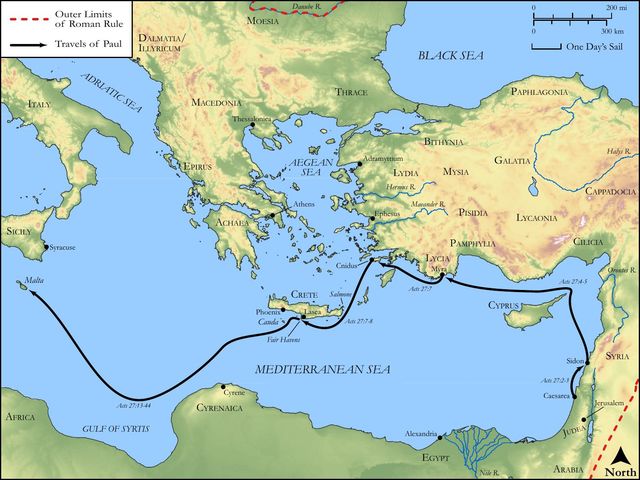
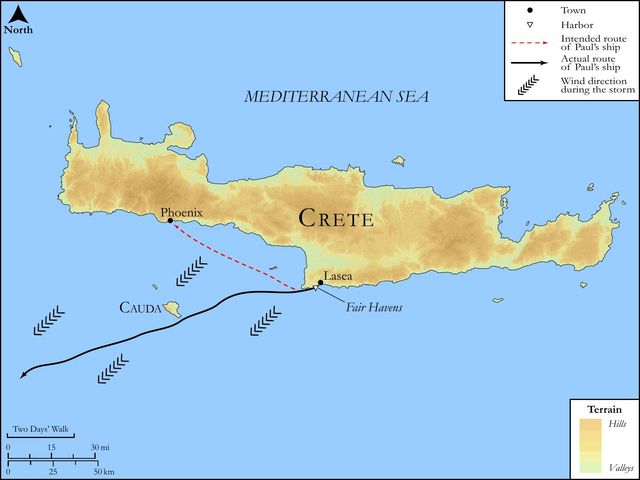
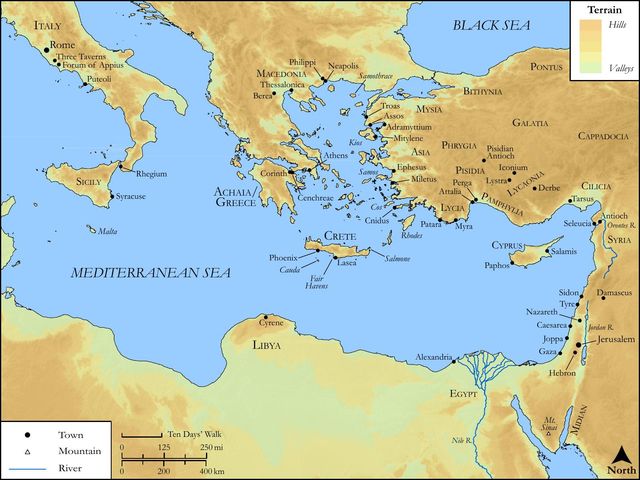
Study this verse
Public-domain commentary
Matthew Henry
From his Commentary on the Whole Bible. Henry comments on passages, not single verses — this entry covers Acts 27:12–20. His three-level outline is real structure in the source text, so it is rendered as structure.
In these verses we have,
I.The ship putting to sea again, and pursuing her voyage at first with a promising gale. Observe,
1.What induced them to leave the fair havens: it was because they thought the harbour not commodious to winter in; it was pleasant enough in summer but in the winter they lay bleak. Or perhaps it was upon some other account incommodious; provisions perhaps were scarce and dear there; and they ran upon a mischief to avoid an inconvenience, as we often do. Some of the ship's crew, or of the council that was called to advise in this matter, were for staying there, rather than venturing to sea now that the weather was so uncertain: it is better to be safe in an incommodious harbour than to be lost in a tempestuous sea. But they were outvoted when it was put to the question, and the greater part advised to depart thence also; yet they aimed not to go far, but only to another port of the same island, here called Phenice, and some think it was so called because the Phenicians frequented it much, the merchants of Tyre and Sidon. It is here described to lie towards the south-west and north-west. Probably the haven was between the two promontories or juttings-out of land into the sea, one of which pointed to the north-west and the other to the south-west, by which it was guarded against the east winds. Thus hath the wisdom of the Creator provided for the relief and safety of those who go down to the sea in ships, and do business in great waters. In vain had nature provided for us the waters to sail on, if it had not likewise provided for us natural harbours to take shelter in.
2.What encouragement they had at first to pursue their voyage. They set out with a fair wind (Act 27:13), the south wind blew softly, upon which they should gain their point, and so they sailed close by the coast of Crete and were not afraid of running upon the rocks or quicksands, because the wind blew so gently. Those who put to sea with ever so fair a gale know not what storms they may yet meet with, and therefore must not be secure, nor take it for granted that they have obtained their purpose, when so many accidents may happen to cross their purpose. Let not him that girdeth on the harness boast as though he had put it off.
II.The ship in a storm presently, a dreadful storm.
They looked at second causes, and took their measures from the favourable hints they gave, and imagined that because the south wind now blew softly it would always blow so; in confidence of this, they ventured to sea, but were soon made sensible of their folly in giving more credit to a smiling wind than to the word of God in Paul's mouth, by which they had fair warning given them of a storm. Observe,
1.What their danger and distress was, (1.). There arose against them a tempestuous wind, which was not only contrary to them, and directly in their teeth, so that they could not get forward, but a violent wind, which raised the waves, like that which was sent forth in pursuit of Jonah, though Paul was following God, and going on in his duty, and not as Jonah running away from God and his duty. This wind the sailors called Euroclydon, a north-east wind, which upon those seas perhaps was observed to be in a particular manner troublesome and dangerous. It was a sort of whirlwind, for the ship is said to be caught by it, Act 27:15. It was God that commanded this wind to rise, designing to bring glory to himself, and reputation to Paul, out of it; stormy winds being brought out of his treasuries (Psa 135:7), they fulfil his word, Psa 148:8. (2.) The ship was exceedingly tossed (Act 27:18); it was kicked like a football from wave to wave; its passengers (as it is elegantly described, Psa 107:26, Psa 107:27) mount up to the heavens, go down again to the depths, reel to and fro, stagger like a drunken man, and are at their wits' end. The ship could not possibly bear up into the wind, could not make her way in opposition to the wind; and therefore they folded up their sails, which in such a storm would endanger them rather than to them any service, and so let the ship drive, Not whither it would, but whither it was impelled by the impetuous waves - non quo voluit, sed quo rapit impetus undae. Ovid. Trist. It is probable that they were very near the heaven of Phenice when this tempest arose, and thought they should presently be in a quiet haven, and were pleasing themselves with the thought of it, and wintering there, and lo, of a sudden, they are in this distress. Let us therefore always rejoice with trembling, and never expect a perfect security, nor a perpetual security, till we come to heaven. (3.) They saw neither sun nor stars for many days. This made the tempest the more terrible, that they were all in the dark; and the use of the loadstone for the direction of sailors not being then found out (so that they had no guide at all, when they could see neither sun nor stars) made the case the more hazardous. Thus melancholy sometimes is the condition of the people of God upon a spiritual account. They walk in darkness and have no light. Neither sun nor stars appear; they cannot dwell, nay, they cannot fasten, upon any thing comfortable or encouraging; thus it may be with them, and yet light is sown for them. (4.) They had abundance of winter-weather: No small tempest - cheimōn ouk oligos, cold rain, and snow, and all the rigours of that season of the year, so that they were ready to perish for cold; and all this continued many days. See what hardships those often undergo who are much at sea, besides the hazards of life they run; and yet to get gain there are still those who make nothing of all this; and it is an instance of divine Providence that it disposes some to this employment, notwithstanding the difficulties that attend it, for the keeping up of commerce among the nations, and the isles of the Gentiles particularly; and Zebulun can as heartily rejoice in his going out as Issachar in his tents. Perhaps Christ therefore chose ministers from among seafaring men, because they had been used to endure hardness.
2.What means they used for their own relief: they betook themselves to all the poor shifts (for I can call them no better) that sailors in distress have recourse to.
(1.)When they could not make head against the wind, they let the ship run adrift, finding it was to no purpose to ply either the oar or the sail. When it is fruitless to struggle, it is wisdom to yield.
(2.)They nevertheless did what they could to avoid the present danger; there was a little island called Clauda, and when they were near that, though they could not pursue their voyage, they took care to prevent their shipwreck, and therefore so ordered their matters that they did not run against the island, but quietly ran under it, Act 27:16.
(3.)When they were afraid they should scarcely save the ship, they were busy to save the boat, which they did with much ado. They had much work to come by the boat (Act 27:16), but at last they took it up, Act 27:17. This might be of use in any exigence, and therefore they made hard shift to get it into the ship to them.
(4.)They used means which were proper enough in those times, when the art of navigation was far short of the perfection it is now come to; they undergirded the ship, Act 27:17. They bound the ship under the bottom of it with strong cables, to keep it from bulging in the extremity of the tempest.
(5.)For fear of falling into the quicksands they struck sail, and then let the ship go as it would. It is strange how a ship will live at sea (so they express it), even in very stormy weather, if it have but sea-room; and, when the sailors cannot make the shore, it is their interest to keep as far off it as they can.
(6.)The next day they lightened the ship of its cargo, threw the goods and the merchandises overboard (as Jonah's mariners did, Jon 1:5), being willing rather to be poor without them than to perish with them. Skin for skin, and all that a man has, will he give for his life. See what the wealth of this world is; how much soever it is courted as a blessing, the time may come when it will be a burden, not only too heavy to be carried safe of itself, but heavy enough to sink him that has it. Riches are often kept by the owners thereof to their hurt (Ecc 5:13); and parted with to their good. But see the folly of the children of this world, they can be thus prodigal of their goods when it is for the saving of their lives, and yet how sparing of them in works of piety and charity, and in suffering for Christ, though they are told by eternal Truth itself that those shall be recompensed more than a thousand fold in the resurrection of the just. Those went upon a principle of faith who took joyfully the spoiling of their goods, knowing in themselves that they had in heaven a better and a more enduring substance, Heb 10:34. Any man will rather make shipwreck of his goods than of his life; but many will rather make shipwreck of faith and a good conscience than of their goods.
(7.)The third day they cast out the tacklings of the ship - the utensils of it, Armamenta (so some render it), as if it were a ship of force. With us it is common to heave the guns over-board in the extremity of a storm; but what heavy artillery they had then which it was necessary to lighten the ship of I do not know; and I question whether it was not then a vulgar error among seamen thus to throw every thing into the sea, even that which would be of great use in a storm, and no great weight.
3.The despair which at last they were brought to (Act 27:20): All hope that we should be saved was then taken away. The storm continued, and they saw no symptoms of its abatement; we have known very blustering weather to continue for some weeks. The means they had used were ineffectual, so that they were at their wits' end; and such was the consternation that this melancholy prospect put them into that they had no heart either to eat or drink. They had provision enough on board (Act 27:38), but such bondage were they under, through fear of death, that they could not admit the supports of life. Why did not Paul, by the power of Christ, and in his name, lay this storm? Why did he not say to the winds and waves, Peace, be still, as his Master had done? Surely it was because the apostles wrought miracles for the confirmation of their doctrine, not for the serving of a turn for themselves or their friends.
Historical interpretation
Historical reception
1 surviving comment on this verse from the historical church.
Then, severe the storm, deep the darkness: and that they may not forget, the vessel also goes to pieces, and the corn is flung out and all beside, that they may not have it in their power after this to be shameless. For this is why the vessel goes to pieces, and their souls are tightly braced. Moreover, both the storm and the darkness contributed not a little to his obtaining the hearing he did.
Continue studying Acts 27:20 across the web’s major study libraries — every link below opens this exact verse, chapter, or book on the destination site.
Read & Compare
 BibleGatewayThis verse in more than 200 translations and 70 languages.
 Bible.comThe YouVersion reader — hundreds of translations, reading plans, and highlights.
 ESV.orgCrossway's official English Standard Version reader.
 NET BibleThe NET translation with 60,000+ translators' notes on every rendering decision.
 STEP BibleTyndale House's free study tool — original text, vocabulary, and scholarly resources.
 BibliaLogos Bible Software's free web reader.
 USCCBThe New American Bible (Revised Edition) with the U.S. bishops' study notes.
Commentaries
 BibleHub CommentariesDozens of classic commentaries on this verse, gathered on one page.
 StudyLightMore than 100 commentary sets — the largest collection on the web.
 BibleRefPlain-English commentary on what this verse means, verse by verse.
 Enduring WordDavid Guzik's free commentary on this chapter, widely used by Bible teachers.
 Bible Study ToolsVerse commentary alongside Greek and Hebrew study aids.
Original Language & Research
- BibleHub InterlinearThe verse word by word — original language, transliteration, and English.
- BibleHub LexiconEvery word's original-language definition and Strong's entry.
 Blue Letter BibleDeep-study tools — Strong's numbers, concordance, and word studies.
 CNTR CollationThe earliest Greek manuscripts of this verse, collated letter by letter.
Sermons, Hymns & Audio


TrulyRandomVerse is not affiliated with these sites and doesn’t control their content. They’re linked because they’re genuinely useful.
Summary
Acts 27:20 vividly captures a moment of profound despair during Paul's perilous sea voyage to Rome, depicting the complete loss of hope among the crew and passengers. After many days without any celestial navigation, enduring a relentless and severe tempest, all expectation of survival or rescue was utterly extinguished, leaving them at the mercy of the elements.
Context
ShowHideLiterary Context
This verse is situated within Luke's detailed account of Paul's journey as a prisoner to Rome, beginning in Acts 27:1. The narrative meticulously describes the ship's departure, the initial challenges, and the fateful decision to sail past Fair Havens despite Paul's warning (Acts 27:9-10). The "no small tempest" mentioned in this verse is the dreaded Euroclydon, a violent northeasterly wind described earlier in Acts 27:14. Verse 20 marks the absolute nadir of the crew's morale, immediately preceding Paul's divine assurance of safety and his subsequent leadership in the crisis (Acts 27:21-26). It serves as the dark backdrop against which God's faithfulness and Paul's prophetic gift shine most brightly.
Historical & Cultural Context
Ancient sea travel was inherently dangerous, especially outside the calmer summer months. The Mediterranean Sea was notorious for sudden, violent storms. Ships of this era, though robust, were vulnerable to prolonged gales. Navigation relied heavily on observing the sun during the day and stars at night to determine direction and position. The absence of "sun nor stars in many days" meant the sailors were completely disoriented, unable to chart a course or even know their general location. This was not merely an inconvenience but a terrifying reality that rendered their maritime skills useless. The "tempest" (Euroclydon) was a specific, well-known type of cyclonic storm in the Mediterranean, characterized by its ferocity and unpredictability, making survival unlikely for any vessel caught in its grip for an extended period.
Key Themes
ShowHideActs 27 as a whole explores several profound themes, to which verse 20 contributes significantly. One major theme is Divine Sovereignty amidst Human Helplessness. Despite the sailors' expertise and the ship's capabilities, they were utterly at the mercy of the elements, highlighting human vulnerability against the forces of nature. The verse underscores Profound Despair, showing how prolonged suffering and the loss of all natural indicators for survival can completely erode human resilience and hope. This deep despair then sets the stage for the contrasting theme of God's Faithfulness and Deliverance, particularly through His chosen instrument, Paul. The narrative demonstrates that even when "all hope that we should be saved was then taken away," God's purposes for Paul and those with him would prevail, as foreshadowed by the angel's message in Acts 27:23-24.
Exposition and Analysis
ShowHideKey Word Analysis
ShowHideFrom a primary word meaning "to anticipate, usually with pleasure"; expectation (abstractly or concretely) or confidence. In this context, elpís refers to the complete absence of any positive expectation or confidence in their survival. It signifies not just diminishing hope, but its utter eradication, leaving behind only dread.
From epí (upon) and phaínō (to shine); to shine upon, i.e., become (literally) visible or (figuratively) known. The sun and stars, which normally "shine upon" the earth and "appear" to guide, were conspicuously absent, symbolizing the loss of any guiding light or clear path forward.
From perí (around) and hairéomai (to take); to remove all around, i.e., unveil, cast off (anchor); figuratively, to expiate. Here, it conveys a complete and comprehensive removal of hope, as if it was stripped away from every side, leaving no vestige behind.
Verse Breakdown
ShowHide"And when neither sun nor stars in many days appeared"
This clause emphasizes the prolonged and absolute lack of celestial navigation. For days on end, the sky remained overcast, preventing any sight of the sun by day or the stars by night. This condition was critical for ancient mariners, as it meant they were completely lost, unable to determine direction, position, or the passage of time accurately. The "many days" suggests an extended period of relentless, disorienting darkness and storm.
"and no small tempest lay on [us]"
This phrase describes the continuous, overwhelming force of the storm. The Greek idiom "no small" (οὐ μικρὸς) is a litotes, meaning "a very great" or "extraordinary" tempest. The word "tempest" (cheimṓn) refers to a violent storm, often accompanied by pouring rain, signifying the extreme severity and duration of the gale. The phrase "lay on us" (epíkeimai) vividly portrays the oppressive, relentless pressure and burden of the storm, pressing down upon the ship and its occupants without respite.
"all hope that we should be saved was then taken away"
This climactic statement encapsulates the psychological and emotional state of everyone on board. The combination of prolonged disorientation, the unrelenting, severe storm, and the sheer exhaustion from the ordeal led to a complete abandonment of any expectation of survival. "All hope" (pâs elpís) signifies that no one, regardless of their experience or resilience, held onto any belief that they would be delivered from their perilous situation. The phrase "taken away" (periairéō) underscores the absolute and comprehensive nature of this loss of hope.
Literary Devices
ShowHideLuke employs several literary devices to convey the utter desperation of the situation. The use of litotes in "no small tempest" (οὐ μικρὸς χεῖμων) serves to emphasize the extraordinary magnitude and severity of the storm, rather than merely stating it was large. This indirect affirmation heightens the dramatic effect. Symbolism is evident in the absence of "sun nor stars," which are not just navigational aids but also ancient symbols of guidance, light, and order. Their disappearance symbolizes the complete loss of direction, clarity, and any sense of control or future. The relentless "tempest" itself acts as a powerful metaphor for overwhelming, uncontrollable forces that strip away human agency and instill profound fear. The cumulative effect of these descriptions evokes a strong sense of pathos, drawing the reader into the emotional experience of the beleaguered travelers and emphasizing their complete and utter despair.
Theological and Thematic Connections
ShowHideActs 27:20 serves as a stark reminder of human vulnerability and the limits of human ingenuity when confronted with overwhelming natural forces. The complete loss of hope described here is a common human experience, whether in physical peril or spiritual distress. Theologically, this verse highlights the concept of divine timing and intervention, as it sets the stage for God's miraculous deliverance through Paul. It underscores that true hope is not rooted in favorable circumstances or human capability, but in the steadfast character and promises of God, who often reveals His power most clearly when all human hope has vanished. This deep despair becomes the canvas upon which God paints His faithfulness.
Reflection and Application
ShowHideActs 27:20 offers a profoundly relatable image for anyone who has experienced a season where "all hope... was taken away." Whether facing a relentless personal crisis, a health struggle with no apparent end, or a period of intense uncertainty and disorientation, this verse acknowledges the raw reality of human despair. It reminds us that there are moments in life when all our usual guides (like the sun and stars) disappear, and the "tempest" seems unending, pressing down on us with no relief. In such times, our natural resilience breaks, and we can feel utterly lost and without a way forward. However, the narrative context of this verse implicitly points to a greater truth: even in our lowest moments, when we are stripped of all natural indicators of a way forward, God's presence and sovereign plan can still be at work. Our hope is not ultimately in our circumstances, but in the God who can speak peace to any storm, whether physical or spiritual, and who often uses our deepest despair to magnify His deliverance.
Questions for Reflection
ShowHideFAQ
ShowHideWhat was the "tempest" mentioned in Acts 27:20?
ShowHideThe "tempest" (Greek: cheimṓn) refers to the violent and unrelenting storm that struck Paul's ship. Earlier in Acts 27:14, this specific storm is named the Euroclydon, a fierce northeasterly wind common in the Mediterranean. The phrase "no small tempest" is a literary device called litotes, emphasizing that it was an extraordinarily severe and dangerous storm, not merely a minor squall. Its prolonged duration and intensity, combined with the lack of celestial navigation, led to the utter despair of everyone on board.
Christ-Centered Fulfillment
ShowHideActs 27:20, with its depiction of absolute despair and the loss of all hope in the face of an overwhelming storm, powerfully foreshadows the ultimate hope found in Christ. Just as the travelers on the ship were without any natural means of salvation, humanity, adrift in the storm of sin and death, is utterly helpless without divine intervention. The "taken away" hope of the sailors mirrors the spiritual hopelessness of a world separated from God, where there is no "sun nor stars" to guide them to eternal life (Ephesians 2:12). Christ, however, is the "bright and morning star" (Revelation 22:16) and the "light of the world" (John 8:12), who appears in our darkest storms. He is the one who calms the raging seas, both literally, as seen in Mark 4:39, and figuratively, bringing peace to our troubled souls. The deliverance from the shipwreck, though physical, points to the spiritual salvation offered through Jesus, who is our true "hope" (Colossians 1:27) and the anchor for our souls, firm and secure (Hebrews 6:19). In Him, even when "all hope" seems lost, a new and living hope springs forth, guaranteed by His resurrection (1 Peter 1:3).