


Acts 27:1
- ὩςHōsWhenG5613PRTParticle or Disjunctive
- δὲdenowG1161CONJConjunction
- ἐκρίθηekrithēwas determinedG2919V-API-3SVerb Aorist Passive Indicative 3rd Singular
- τοῦtou<the>G3588T-GSNDefinite article Genitive Singular Neuter
- ἀποπλεῖνapopleinsailingG636V-PANVerb Present Active Infinitive
- ἡμᾶςhēmasourG3165P-1APPersonal pronoun Accusative 1st Plural
- εἰςeistoG1519PREPPreposition
- τὴνtēn<the>G3588T-ASFDefinite article Accusative Singular Feminine
- ἸταλίανItalianItalyG2482N-ASF-LNoun Accusative Singular Feminine Location
- παρεδίδουνparedidounthey were deliveringG3860V-IAI-3PVerb Imperfect Active Indicative 3rd Plural
- τόνton<the>G3588T-ASMDefinite article Accusative Singular Masculine
- τεtebothG5037CONJConjunction
- ΠαῦλονPaulonPaulG3972N-ASM-PNoun Accusative Singular Masculine Individual
- καίkaiandG2532CONJConjunction
- τιναςtinascertainG5100X-APMIndefinite pronoun Accusative Plural Masculine
- ἑτέρουςheterousotherG2087A-APMAdjective Accusative Plural Masculine
- δεσμώταςdesmōtasprisonersG1202N-APMNoun Accusative Plural Masculine
- ἑκατοντάρχῃhekatontarchēto a centurionG1543N-DSMNoun Dative Singular Masculine
- ὀνόματιonomatinamedG3686N-DSNNoun Dative Singular Neuter
- ἸουλίῳIouliōJuliusG2457N-DSM-PNoun Dative Singular Masculine Individual
- σπείρηςspeirēsof the cohortG4686N-GSFNoun Genitive Singular Feminine
- ΣεβαστῆςSebastēsof AugustusG4575A-GSF-PAdjective Genitive Singular Feminine Individual
English is a literal word-by-word gloss of the Greek, not the KJV's wording. Why?
This is the original text the KJV's translators worked from — each Greek word with its own literal English meaning in this verse, prepared by scholars at Tyndale House, Cambridge. The KJV translates whole sentences, not word by word, so its wording differs: one Greek word can become several English words, and the KJV may choose “charity” where the gloss reads “love”. Both are faithful — they answer different questions. For the KJV's own rendering, switch to the KJV text.
Details
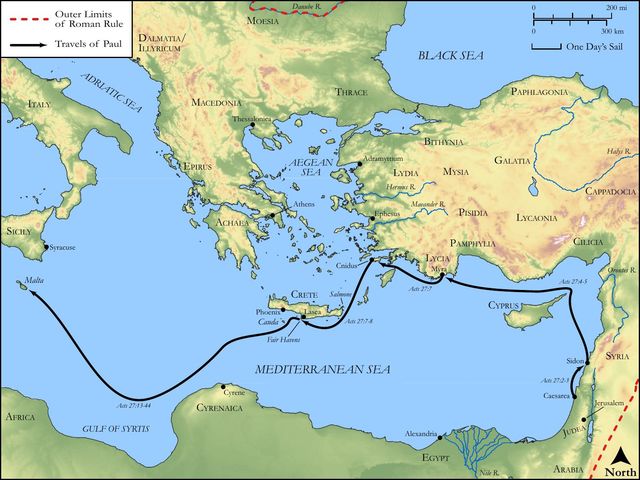
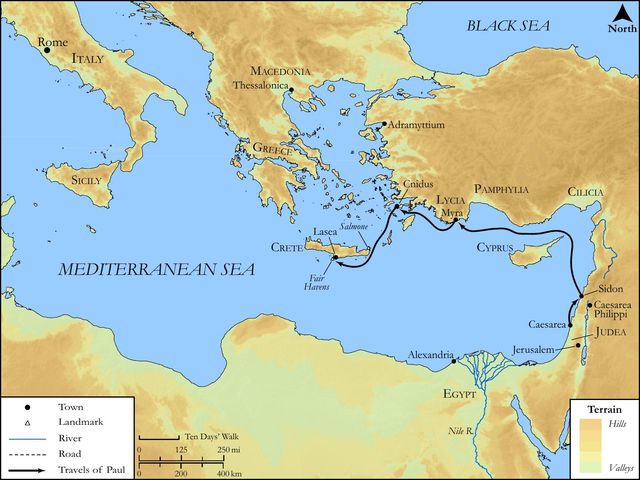
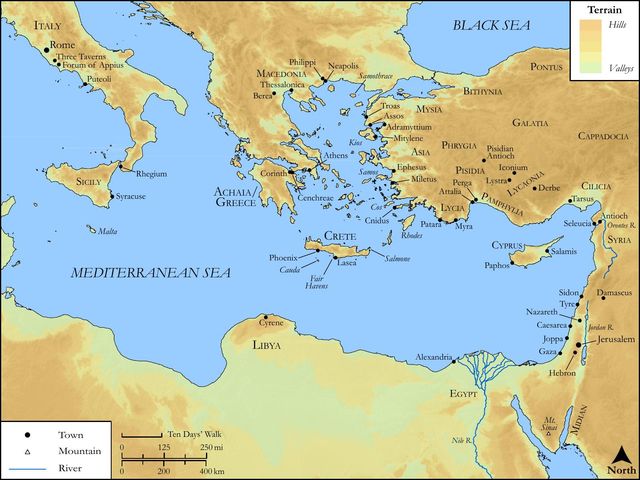
See on the biblical-era map
Study this verse
Public-domain commentary
Matthew Henry
From his Commentary on the Whole Bible. Henry comments on passages, not single verses — this entry covers Acts 27:1–11. His three-level outline is real structure in the source text, so it is rendered as structure.
It does not appear how long it was after Paul's conference with Agrippa that he was sent away for Rome, pursuant to his appeal to Caesar; but it is likely they took the first convenience they could hear of to do it; in the mean time Paul is in the midst of his friends at Caesarea - they comforts to him, and he a blessing to them. But here we are told,
I.How Paul was shipped off for Italy:
a long voyage, but there is no remedy. He has appealed to Caesar, and to Caesar he must go: It was determined that we should sail into Italy, for to Rome they must go by sea; it would have been a vast way about to go by land. Hence, when the Roman conquest of the Jewish nation is foretold, it is said (Num 24:24), Ships shall come from Chittim, that is, Italy, and shall afflict Eber, that is, the Hebrews. It was determined by the counsel of God, before it was determined by the counsel of Festus, that Paul should go to Rome; for, whatever man intended, God had work for him to do there. Now here we are told,
1.Whose custody he was committed to - to one named Julius, a centurion of Augustus's band, as Cornelius was of the Italian band, or legion, Act 10:1. He had soldiers under him, who were a guard upon Paul, that he might not make his escape, and likewise to protect him, that he might have no mischief done him.
2.What bottom he embarked in: they went on board a ship of Adramyttium (Act 27:2), a sea-port of Africa, whence this ship brought African goods, and, as it should seem, made a coasting voyage for Syria, where those goods came to a good market.
3.What company he had in this voyage, there were some prisoners who were committed to the custody of the same centurion, and who probably had appealed to Caesar too, or were upon some other account removed to Rome, to be tried there, or to be examined as witnesses against some prisoners there; perhaps some notorious offenders, like Barabbas, who were therefore ordered to be brought before the emperor himself. Paul was linked with these, as Christ with the thieves that were crucified with him, and was obliged to take his lot with them in this voyage; and we find in this chapter (Act 27:42) that for their sakes he had like to have been killed, but for his sake they were preserved. Note, It is no new thing for the innocent to be numbered among the transgressors. But he had also some of his friends with him, Luke particularly, the penman of this book, for he puts himself in all along, We sailed into Italy, and, We launched, v. 2. Aristarchus a Thessalonian is particularly named, as being now in his company. Dr. Lightfoot thinks that Trophimus the Ephesian went off with him, but that he left him sick at Miletum (Ti2 4:20), when he passed by those coasts of Asia mentioned here (v. 2), and that there likewise he left Timothy. It was a comfort to Paul to have the society of some of his friends in this tedious voyage, with whom he might converse freely, though he had so much loose profane company about him. Those that go long voyages at sea are commonly necessitated to sojourn, as it were, in Mesech and Kedar, and have need of wisdom, that they may do good to the bad company they are in, may make them better, or at lest be made never the worse by them.
II.What course they steered, and what places they touched at, which are particularly recorded for the confirming of the truth of the history to those who lived at that time, and could by their own knowledge tell of their being at such and such a place.
1.They touched at Sidon, not far off from where they went on board; thither they came the next day. And that which is observable here is, that Julius the centurion was extraordinarily civil to Paul. It is probable that he knew his case, and was one of the chief captains, or principal men, that heard him plead his own cause before Agrippa (Act 25:23), and was convinced of his innocency, and the injury done him; and therefore, though Paul was committed to him as a prisoner, he treated him as a friend, as a scholar, as a gentleman, and as a man that had an interest in heaven: He gave him liberty, while the business of the ship detained it at Sidon, to go among his friends there, to refresh himself; and it would be a great refreshment to him. Julius herein gives an example to those in power to be respectful to those whom they find worthy of their respect, and in using their power to make a difference. A Joseph, a Paul, are not to be used as common prisoners. God herein encourages those that suffer for him to trust in him; for he can put it into the hearts of those to befriend them from whom they least expect it - can cause them to be pitied, nay, can cause them to be prized and valued, even in the eyes of those that carry them captive, Psa 106:46. And it is likewise an instance of Paul's fidelity. He did not go about to make his escape, which he might have easily done; but, being out upon his parole of honour, he faithfully returns to his imprisonment. If the centurion is so civil as to take his word, he is so just and honest as to keep his word.
2.They thence sailed under Cyprus, Act 27:4. If the wind had been fair, they had gone forward by direct sailing, and had left Cyprus on the right hand; but, the wind not favouring them, they were driven to oblique sailing with a side wind, and so compassed the island, in a manner, and left it on the left hand. Sailors must do as they can, when they cannot do as they would, and make the best of their wind, whatever point it is in; so must we all in our passage over the ocean of this world. When the winds are contrary yet we must be getting forward as well as we can.
3.At a port called Myra they changed their ship; that which they were in, it is probable, having business no further, they went on board a vessel of Alexandria bound for Italy, Act 27:5, Act 27:6. Alexandria was now the chief city of Egypt, and great trading there was between that city and Italy; from Alexandria they carried corn to Rome, and the East-India goods and Persian which they imported at the Red Sea they exported again to all parts of the Mediterranean, and especially to Italy. And it was a particular favour shown to the Alexandrian ships in the ports of Italy that they were not obliged to strike sail, as other ships were, when they came into port.
4.With much ado they made The Fair Havens, a port of the island of Crete, Act 27:7, Act 27:8. They sailed slowly many days, being becalmed, or having the wind against them. It was a great while before they made the point of Cnidus, a port of Caria, and were forced to sail under Crete, as before under Cyprus; much difficulty they met with in passing by Salmone, a promontory on the eastern shore of the island of Crete. Though the voyage hitherto was not tempestuous, yet it was very tedious. They many that are not driven backward in their affairs by cross providences, yet sail slowly, and do not get forward by favourable providences. And many good Christians make this complaint in the concerns of their souls, that they do not rid ground in their way of heaven, but have much ado to keep their ground; they move with many stops and pauses, and lie a great while wind-bound. Observe, The place they came to was called The Fair Havens. Travellers say that it is known to this day by the same name, and that it answers the name from the pleasantness of its situation and prospect. And yet,
(1.)It was not the harbour they were bound for; it was a fair haven, but it was not their haven. Whatever agreeable circumstances we may be in in this world, we must remember we are not at home, and therefore we must arise and depart; for, though it be a fair haven, it is not the desired haven, Psa 107:30.
(2.)It was not a commodious haven to winter in, so it is said, Act 27:12. It had a fine prospect, but it lay exposed to the weather. Note, Every fair haven is not a safe haven; nay, there may be most danger where there is most pleasure.
III.What advice Paul gave them with reference to that part of their voyage they had before them - it was to be content to winter where they were, and not to think of stirring till a better season of the year.
1.It was now a bad time for sailing; they had lost a deal of time while they were struggling with contrary winds. Sailing was now dangerous, because the fast was already past, that is, the famous yearly fast of the Jews, the day of atonement, which was on the tenth day of the seventh month, a day to afflict the soul with fasting; it was about the 20th of our September. That yearly fast was very religiously observed; but (which is strange) we never have any mention made in all the scripture history of the observance of it, unless it be meant here, where it serves only to describe the season of the year. Michaelmas is reckoned by mariners as a bad time of the year to be at sea as any other; they complain of their Michaelmas-blasts; it was that time now with these distressed voyagers. The harvest was past, the summer was ended; they had not only lost time, but lost the opportunity.
2.Paul put them in mind of it, and gave them notice of their danger (Act 27:10): "I perceive" (either by notice from God, or by observing their wilful resolution to prosecute the voyage notwithstanding the peril of the season) "that this voyage will be with hurt and damage; you that have effects on board are likely to lose them, and it will be a miracle of mercy if our lives be given us for a prey." There were some good men in the ship, and many more bad men: but in things of this nature all things come alike to all, and there is one event to the righteous and to the wicked. If both be in the same ship, they both are in the same danger.
3.They would not be advised by Paul in this matter, Act 27:11. They thought him impertinent in interposing in an affair of this nature, who did not understand navigation; and the centurion to whom it was referred to determine it, though himself a passenger, yet, being a man in authority, takes upon him to overrule, though he had not been oftener at sea perhaps than Paul, nor was better acquainted with these seas, for Paul had planted the gospel in Crete (Tit 1:5), and knew the several parts of the island well enough. But the centurion gave more regard to the opinion of the master and owner of the ship than to Paul's; for every man is to be credited in his own profession ordinarily: but such a man as Paul, who was so intimate with Heaven, was rather to be regarded in seafaring matters than the most celebrated sailors. Note, Those know not what dangers they run themselves into who will be governed more by human prudence than by divine revelation. The centurion was very civil to Paul (Act 27:3), and yet would not be governed by his advice. Note, Many will show respect to good ministers that will not take their advice, Eze 33:31.
Historical interpretation
Four Centuries of Reception
3 surviving comments on this verse. Each one is dated, so this reads as a timeline rather than a list.
Select a marker to jump to its quote. Markers stagger vertically where authors wrote within a few decades of each other.
But after Paul, in consequence of his appeal to Caesar, had been sent to Rome by Festus, the Jews, being frustrated in their hope of entrapping him by the snares that they had laid for him, turned against James, the brother of the Lord, to whom the episcopal seat at Jerusalem had been entrusted by the apostles. The following daring measures were undertaken by them against him. Leading him into their midst they demanded of him that he should renounce faith in Christ in the presence of all the people. But, contrary to the opinion of all, with a clear voice and with greater boldness than they had anticipated, [James] spoke out before the whole multitude and confessed that our Savior and Lord Jesus is the Son of God. But they were unable to bear longer the testimony of the man who, on account of the excellence of ascetic virtue and of piety that he exhibited in his life, was esteemed by all as the most just of people, and consequently they killed him. Opportunity for this deed of violence was furnished by the prevailing anarchy, which was caused by the fact that Festus had died just at this time in Judea and that the province was thus without a governor and head. The manner of James’ death has been already indicated by the above-quoted words of Clement, who records that he was thrown from the pinnacle of the temple and was beaten to death with a club.
See how far Aristarchus also accompanies Paul. To good and useful purpose is Aristarchus present, as he would take back the report of all to Macedonia.
When it was decided that he should sail to Italy, Paul, along with the rest of the prisoners, was handed over to a centurion. More accurately read in Greek: "When it was decided that we should sail to Italy, they handed over Paul and some other prisoners to a centurion."
Continue studying Acts 27:1 across the web’s major study libraries — every link below opens this exact verse, chapter, or book on the destination site.
Read & Compare
 BibleGatewayThis verse in more than 200 translations and 70 languages.
 Bible.comThe YouVersion reader — hundreds of translations, reading plans, and highlights.
 ESV.orgCrossway's official English Standard Version reader.
 NET BibleThe NET translation with 60,000+ translators' notes on every rendering decision.
 STEP BibleTyndale House's free study tool — original text, vocabulary, and scholarly resources.
 BibliaLogos Bible Software's free web reader.
 USCCBThe New American Bible (Revised Edition) with the U.S. bishops' study notes.
Commentaries
 BibleHub CommentariesDozens of classic commentaries on this verse, gathered on one page.
 StudyLightMore than 100 commentary sets — the largest collection on the web.
 BibleRefPlain-English commentary on what this verse means, verse by verse.
 Enduring WordDavid Guzik's free commentary on this chapter, widely used by Bible teachers.
 Bible Study ToolsVerse commentary alongside Greek and Hebrew study aids.
Original Language & Research
- BibleHub InterlinearThe verse word by word — original language, transliteration, and English.
- BibleHub LexiconEvery word's original-language definition and Strong's entry.
 Blue Letter BibleDeep-study tools — Strong's numbers, concordance, and word studies.
 CNTR CollationThe earliest Greek manuscripts of this verse, collated letter by letter.
Sermons, Hymns & Audio


TrulyRandomVerse is not affiliated with these sites and doesn’t control their content. They’re linked because they’re genuinely useful.
Summary
Acts 27:1 initiates the climactic sea voyage of the Apostle Paul towards Rome, fulfilling his appeal to Caesar and God's prophetic word concerning his ministry in the imperial capital. This verse concisely sets the stage for a perilous yet divinely guided journey, introducing the Roman centurion Julius, who would play a significant role in Paul's welfare, and underscoring the Roman legal and military framework through which God's sovereign plan for the spread of the Gospel would unfold.
Context
ShowHideLiterary Context
This verse transitions the narrative from Paul's prolonged imprisonment and various hearings in Caesarea, spanning over two years under governors Felix and Festus (Acts 24:27), to the final, divinely ordained leg of his journey to Rome. Having asserted his Roman citizenship and appealed to Caesar in Acts 25:11, Paul's fate is now determined by the imperial legal system. The immediate preceding chapters (Acts 25 and Acts 26) detail his defense before Festus, King Agrippa, and Bernice, where Paul eloquently proclaims the Gospel, even to those in power, setting the stage for his ultimate destination. This verse marks the literal departure, leading into a detailed account of the arduous sea journey, shipwreck, and eventual arrival in Rome, demonstrating Luke's meticulous historical reporting.
Historical & Cultural Context
Paul's transportation to Rome as a prisoner was a standard procedure for Roman citizens who exercised their right of appeal to the emperor. Such journeys were often long, arduous, and fraught with danger, especially outside the optimal sailing season (typically May to September). The Roman Empire maintained an extensive network of sea routes for trade, military movements, and administrative purposes, but these were vulnerable to storms, piracy, and navigational challenges. The mention of "Augustus' band" (Greek: speira Sebastē) refers to a prestigious imperial cohort, likely a detachment of the Praetorian Guard or an elite unit directly associated with the emperor's household. This detail signifies that Paul was placed under the custody of a highly reputable and possibly influential officer, highlighting the Roman state's structured approach to judicial transport and, perhaps, the perceived importance of Paul's case.
Key Themes
ShowHideActs 27:1 contributes significantly to several overarching themes within the book of Acts. Firstly, it powerfully illustrates Divine Sovereignty and Providence, demonstrating how God orchestrates events, even through human legal systems and challenging circumstances, to fulfill His purposes. Paul's journey to Rome was not merely a consequence of his appeal but a direct fulfillment of God's earlier promise: "Be of good cheer, Paul: for as thou hast testified of me in Jerusalem, so must thou bear witness also at Rome" (Acts 23:11). Secondly, the verse underscores the Unstoppable Advance of the Gospel, as Paul, though a prisoner, continues his mission, now heading to the very heart of the Roman Empire. His imprisonment, rather than hindering, becomes a means for the Gospel to penetrate new spheres, echoing the broader narrative of Acts where the Word of God cannot be bound (Acts 28:30-31). Finally, it highlights the Interaction between the Church and Roman Authority, portraying the Roman legal and military apparatus as a framework within which the early Christian mission operated, sometimes as an obstacle, but often, as seen with Julius, as an unexpected facilitator.
Exposition and Analysis
ShowHideKey Word Analysis
ShowHideMeaning "to distinguish, i.e. decide (mentally or judicially); by implication, to try, condemn, punish." In this context, it signifies a judicial decision or decree. It implies that Paul's appeal to Caesar had been processed, and the formal judgment was to send him to Rome for imperial trial. This word emphasizes the official, legal nature of the journey.
Meaning "(passively) a captive." This term clearly identifies Paul's status, along with others, as one under arrest and detention. Despite his innocence and divine mission, he is legally categorized as a captive, highlighting the real-world constraints and indignities he faced, yet through which God's plan would unfold.
Meaning "the captain of one hundred men." This title denotes a highly experienced and respected Roman military officer. Centurions were the backbone of the Roman army, known for their discipline, leadership, and often, their pragmatic integrity. Julius's role as a centurion underscores the official military escort and the level of authority under which Paul was placed, setting the stage for his subsequent interactions with Paul.
Verse Breakdown
ShowHide"And when it was determined that we should sail into Italy"
This clause establishes the official decision and the destination. The "we" is significant, indicating Luke, the author of Acts, was accompanying Paul, confirming his presence and eyewitness account of the journey. The determination was a judicial one, following Paul's appeal to Caesar, signifying the Roman legal system's role in his fate. Italy, specifically Rome, was the ultimate destination for his imperial trial.
"they delivered Paul and certain other prisoners"
This phrase details the act of transfer. "They" refers to the Roman authorities in Caesarea, who were responsible for executing the judicial decree. Paul is explicitly named, emphasizing his central role, but he is not alone; he is part of a group of "other prisoners," indicating a standard transport of multiple individuals for trial or punishment in Rome. This highlights his shared experience with common criminals, despite his unique calling.
"unto [one] named Julius, a centurion of Augustus' band"
This introduces the specific Roman officer entrusted with the prisoners. Julius, a centurion, held a position of considerable authority and responsibility. The designation "of Augustus' band" (Greek: speira Sebastē) points to a prestigious imperial cohort, likely a unit with direct ties to the emperor's household or a special imperial detachment. This detail suggests Julius was a trusted and high-ranking officer, which would prove beneficial for Paul during the arduous journey, as implied by Julius's subsequent kindness (Acts 27:3).
Literary Devices
ShowHideLuke's narrative in Acts 27:1 employs several literary devices. Foreshadowing is evident in the introduction of Julius, a centurion of "Augustus' band." This detail subtly hints at the relatively favorable treatment Paul would receive from this officer throughout the journey, contrasting with the typical harshness expected for a prisoner. The very act of "sailing into Italy" also serves as Foreshadowing for the fulfillment of God's promise that Paul would bear witness in Rome (Acts 23:11). There is also a degree of Irony present: Paul, a prisoner, is being transported by the very empire he seeks to evangelize, and his imprisonment ultimately facilitates the spread of the Gospel to the imperial capital, demonstrating that God's plans are not thwarted but often advanced through human opposition. The precise naming of Julius and "Augustus' band" also lends Historical Verisimilitude to the account, grounding the spiritual narrative in concrete, verifiable historical details.
Theological and Thematic Connections
ShowHideActs 27:1 serves as a powerful testament to the unwavering sovereignty of God, who utilizes even the constraints of human legal systems and the perils of travel to advance His redemptive purposes. Paul's journey to Rome, though initiated by his appeal as a prisoner, was fundamentally a divine appointment, a strategic move to bring the Gospel to the heart of the Roman Empire. This demonstrates that God's mission is not dependent on human freedom or comfort but can flourish even in adversity, transforming what appears to be a setback into a providential opportunity for witness. The meticulous details of Roman authority and military structure highlight how God works through established human institutions, even those seemingly opposed to His kingdom, to achieve His will.
Reflection and Application
ShowHideActs 27:1 offers profound encouragement for believers navigating their own challenging circumstances. Just as Paul's journey to Rome was not a detour but a direct route to God's intended destination, so too can our unexpected trials, limitations, or forced changes in direction be part of a larger, divine design. This verse calls us to cultivate a deep trust in God's providence, recognizing that His purposes are often accomplished not around our difficulties, but through them. It challenges us to see beyond our immediate discomfort or perceived setbacks, to discern the hand of God at work, opening doors for witness and ministry in ways we might not have anticipated. Our "imprisonments" – whether literal, relational, or circumstantial – can become platforms for God's glory and the advancement of His kingdom, if we remain faithful and open to His leading.
Questions for Reflection
ShowHideFAQ
ShowHideWhy was Paul being sent to Italy as a prisoner?
ShowHidePaul was a Roman citizen, and after being held in custody for two years in Caesarea and facing various accusations from Jewish leaders, he exercised his right to appeal his case directly to the Roman Emperor (Caesar) in Acts 25:11. This appeal meant his case would be heard in Rome, the imperial capital, necessitating his transport there under Roman guard.
Who was Julius, and what was "Augustus' band"?
ShowHideJulius was a Roman centurion, an officer typically in command of around 100 soldiers, known for their discipline and leadership. "Augustus' band" (Greek: speira Sebastē) likely refers to a prestigious imperial cohort. This could have been a unit of the Praetorian Guard or a special detachment associated with the emperor's personal security or household. This designation suggests Julius was a reputable and perhaps influential officer, which proved advantageous for Paul during the journey, as Julius showed him considerable kindness (Acts 27:3).
Christ-Centered Fulfillment
ShowHideActs 27:1, while detailing Paul's journey as a prisoner, profoundly resonates with the Christ-centered narrative of the Gospel. Paul's forced journey to Rome, undertaken not for his own will but in fulfillment of a divine mandate, mirrors the ultimate journey of Christ. Jesus, too, was "delivered" into the hands of authorities, journeying towards Jerusalem not as a free man but as one destined for a cross, fulfilling the Father's will (Luke 9:51). Like Paul, Christ's path involved suffering and apparent limitation, yet it was precisely through His "imprisonment" and ultimate sacrifice that the greatest liberation for humanity was achieved (Philippians 2:8). Paul's journey to Rome, the center of worldly power, to bear witness to Christ, foreshadows the global spread of the Gospel, initiated by the Lamb of God who was "delivered up for our trespasses and raised for our justification" (Romans 4:25). Thus, Paul's experience is a powerful echo of the suffering servant, Jesus, whose path of humility and obedience ultimately led to the triumph of God's kingdom.