


Acts 27:6
- κἀκεῖkakeiAnd thereG1563CONJ + G1563=ADV
- εὑρὼνheurōnhaving foundG2147V-2AAP-NSMVerb 2nd Aorist Active Participle Nominative Singular Masculine
- ὁhotheG3588T-NSMDefinite article Nominative Singular Masculine
- ἑκατοντάρχηςhekatontarchēscenturionG1543N-NSMNoun Nominative Singular Masculine
- πλοῖονploiona shipG4143N-ASNNoun Accusative Singular Neuter
- ἈλεξανδρῖνονAlexandrinonof AlexandriaG222A-ASN-LGAdjective Accusative Singular Neuter Location Gentilic
- πλέονpleonsailingG4126V-PAP-ASNVerb Present Active Participle Accusative Singular Neuter
- εἰςeistoG1519PREPPreposition
- τὴνtēn<the>G3588T-ASFDefinite article Accusative Singular Feminine
- ἸταλίανItalianItalyG2482N-ASF-LNoun Accusative Singular Feminine Location
- ἐνεβίβασενenebibasenhe placedG1688V-AAI-3SVerb Aorist Active Indicative 3rd Singular
- ἡμᾶςhēmasusG3165P-1APPersonal pronoun Accusative 1st Plural
- εἰςeisintoG1519PREPPreposition
- αὐτόautoitG846P-ASNPersonal pronoun Accusative Singular Neuter
English is a literal word-by-word gloss of the Greek, not the KJV's wording. Why?
This is the original text the KJV's translators worked from — each Greek word with its own literal English meaning in this verse, prepared by scholars at Tyndale House, Cambridge. The KJV translates whole sentences, not word by word, so its wording differs: one Greek word can become several English words, and the KJV may choose “charity” where the gloss reads “love”. Both are faithful — they answer different questions. For the KJV's own rendering, switch to the KJV text.
Details
See on the biblical-era map
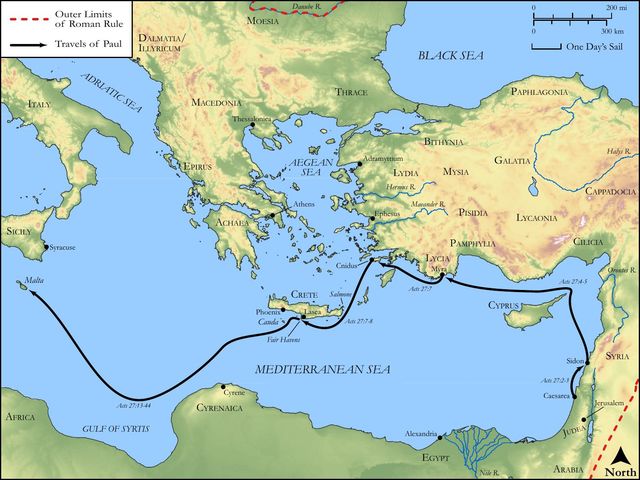
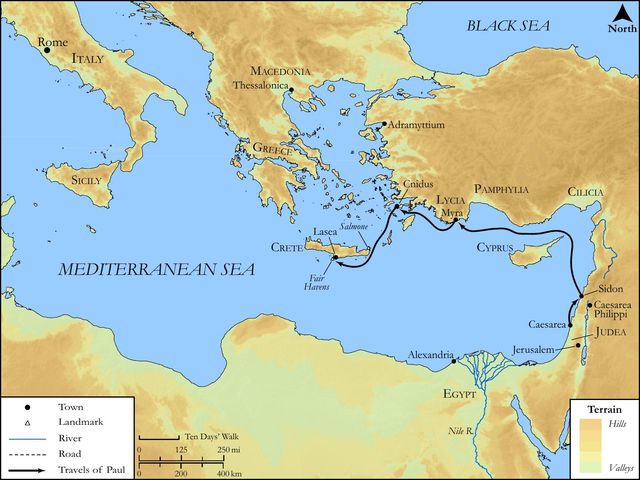
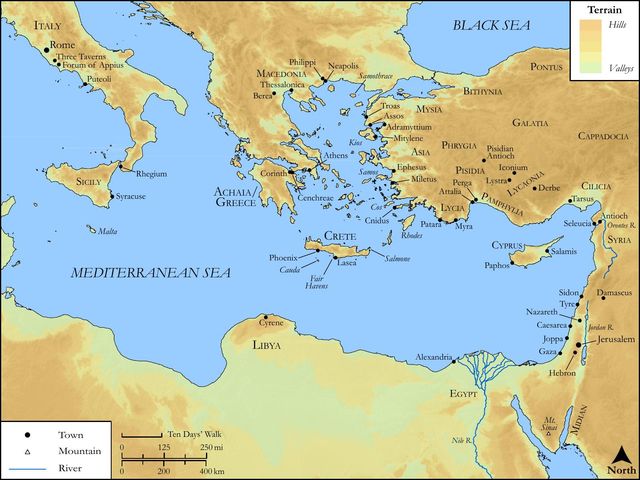
Study this verse
Public-domain commentary
Matthew Henry
From his Commentary on the Whole Bible. Henry comments on passages, not single verses — this entry covers Acts 27:1–11. His three-level outline is real structure in the source text, so it is rendered as structure.
It does not appear how long it was after Paul's conference with Agrippa that he was sent away for Rome, pursuant to his appeal to Caesar; but it is likely they took the first convenience they could hear of to do it; in the mean time Paul is in the midst of his friends at Caesarea - they comforts to him, and he a blessing to them. But here we are told,
I.How Paul was shipped off for Italy:
a long voyage, but there is no remedy. He has appealed to Caesar, and to Caesar he must go: It was determined that we should sail into Italy, for to Rome they must go by sea; it would have been a vast way about to go by land. Hence, when the Roman conquest of the Jewish nation is foretold, it is said (Num 24:24), Ships shall come from Chittim, that is, Italy, and shall afflict Eber, that is, the Hebrews. It was determined by the counsel of God, before it was determined by the counsel of Festus, that Paul should go to Rome; for, whatever man intended, God had work for him to do there. Now here we are told,
1.Whose custody he was committed to - to one named Julius, a centurion of Augustus's band, as Cornelius was of the Italian band, or legion, Act 10:1. He had soldiers under him, who were a guard upon Paul, that he might not make his escape, and likewise to protect him, that he might have no mischief done him.
2.What bottom he embarked in: they went on board a ship of Adramyttium (Act 27:2), a sea-port of Africa, whence this ship brought African goods, and, as it should seem, made a coasting voyage for Syria, where those goods came to a good market.
3.What company he had in this voyage, there were some prisoners who were committed to the custody of the same centurion, and who probably had appealed to Caesar too, or were upon some other account removed to Rome, to be tried there, or to be examined as witnesses against some prisoners there; perhaps some notorious offenders, like Barabbas, who were therefore ordered to be brought before the emperor himself. Paul was linked with these, as Christ with the thieves that were crucified with him, and was obliged to take his lot with them in this voyage; and we find in this chapter (Act 27:42) that for their sakes he had like to have been killed, but for his sake they were preserved. Note, It is no new thing for the innocent to be numbered among the transgressors. But he had also some of his friends with him, Luke particularly, the penman of this book, for he puts himself in all along, We sailed into Italy, and, We launched, v. 2. Aristarchus a Thessalonian is particularly named, as being now in his company. Dr. Lightfoot thinks that Trophimus the Ephesian went off with him, but that he left him sick at Miletum (Ti2 4:20), when he passed by those coasts of Asia mentioned here (v. 2), and that there likewise he left Timothy. It was a comfort to Paul to have the society of some of his friends in this tedious voyage, with whom he might converse freely, though he had so much loose profane company about him. Those that go long voyages at sea are commonly necessitated to sojourn, as it were, in Mesech and Kedar, and have need of wisdom, that they may do good to the bad company they are in, may make them better, or at lest be made never the worse by them.
II.What course they steered, and what places they touched at, which are particularly recorded for the confirming of the truth of the history to those who lived at that time, and could by their own knowledge tell of their being at such and such a place.
1.They touched at Sidon, not far off from where they went on board; thither they came the next day. And that which is observable here is, that Julius the centurion was extraordinarily civil to Paul. It is probable that he knew his case, and was one of the chief captains, or principal men, that heard him plead his own cause before Agrippa (Act 25:23), and was convinced of his innocency, and the injury done him; and therefore, though Paul was committed to him as a prisoner, he treated him as a friend, as a scholar, as a gentleman, and as a man that had an interest in heaven: He gave him liberty, while the business of the ship detained it at Sidon, to go among his friends there, to refresh himself; and it would be a great refreshment to him. Julius herein gives an example to those in power to be respectful to those whom they find worthy of their respect, and in using their power to make a difference. A Joseph, a Paul, are not to be used as common prisoners. God herein encourages those that suffer for him to trust in him; for he can put it into the hearts of those to befriend them from whom they least expect it - can cause them to be pitied, nay, can cause them to be prized and valued, even in the eyes of those that carry them captive, Psa 106:46. And it is likewise an instance of Paul's fidelity. He did not go about to make his escape, which he might have easily done; but, being out upon his parole of honour, he faithfully returns to his imprisonment. If the centurion is so civil as to take his word, he is so just and honest as to keep his word.
2.They thence sailed under Cyprus, Act 27:4. If the wind had been fair, they had gone forward by direct sailing, and had left Cyprus on the right hand; but, the wind not favouring them, they were driven to oblique sailing with a side wind, and so compassed the island, in a manner, and left it on the left hand. Sailors must do as they can, when they cannot do as they would, and make the best of their wind, whatever point it is in; so must we all in our passage over the ocean of this world. When the winds are contrary yet we must be getting forward as well as we can.
3.At a port called Myra they changed their ship; that which they were in, it is probable, having business no further, they went on board a vessel of Alexandria bound for Italy, Act 27:5, Act 27:6. Alexandria was now the chief city of Egypt, and great trading there was between that city and Italy; from Alexandria they carried corn to Rome, and the East-India goods and Persian which they imported at the Red Sea they exported again to all parts of the Mediterranean, and especially to Italy. And it was a particular favour shown to the Alexandrian ships in the ports of Italy that they were not obliged to strike sail, as other ships were, when they came into port.
4.With much ado they made The Fair Havens, a port of the island of Crete, Act 27:7, Act 27:8. They sailed slowly many days, being becalmed, or having the wind against them. It was a great while before they made the point of Cnidus, a port of Caria, and were forced to sail under Crete, as before under Cyprus; much difficulty they met with in passing by Salmone, a promontory on the eastern shore of the island of Crete. Though the voyage hitherto was not tempestuous, yet it was very tedious. They many that are not driven backward in their affairs by cross providences, yet sail slowly, and do not get forward by favourable providences. And many good Christians make this complaint in the concerns of their souls, that they do not rid ground in their way of heaven, but have much ado to keep their ground; they move with many stops and pauses, and lie a great while wind-bound. Observe, The place they came to was called The Fair Havens. Travellers say that it is known to this day by the same name, and that it answers the name from the pleasantness of its situation and prospect. And yet,
(1.)It was not the harbour they were bound for; it was a fair haven, but it was not their haven. Whatever agreeable circumstances we may be in in this world, we must remember we are not at home, and therefore we must arise and depart; for, though it be a fair haven, it is not the desired haven, Psa 107:30.
(2.)It was not a commodious haven to winter in, so it is said, Act 27:12. It had a fine prospect, but it lay exposed to the weather. Note, Every fair haven is not a safe haven; nay, there may be most danger where there is most pleasure.
III.What advice Paul gave them with reference to that part of their voyage they had before them - it was to be content to winter where they were, and not to think of stirring till a better season of the year.
1.It was now a bad time for sailing; they had lost a deal of time while they were struggling with contrary winds. Sailing was now dangerous, because the fast was already past, that is, the famous yearly fast of the Jews, the day of atonement, which was on the tenth day of the seventh month, a day to afflict the soul with fasting; it was about the 20th of our September. That yearly fast was very religiously observed; but (which is strange) we never have any mention made in all the scripture history of the observance of it, unless it be meant here, where it serves only to describe the season of the year. Michaelmas is reckoned by mariners as a bad time of the year to be at sea as any other; they complain of their Michaelmas-blasts; it was that time now with these distressed voyagers. The harvest was past, the summer was ended; they had not only lost time, but lost the opportunity.
2.Paul put them in mind of it, and gave them notice of their danger (Act 27:10): "I perceive" (either by notice from God, or by observing their wilful resolution to prosecute the voyage notwithstanding the peril of the season) "that this voyage will be with hurt and damage; you that have effects on board are likely to lose them, and it will be a miracle of mercy if our lives be given us for a prey." There were some good men in the ship, and many more bad men: but in things of this nature all things come alike to all, and there is one event to the righteous and to the wicked. If both be in the same ship, they both are in the same danger.
3.They would not be advised by Paul in this matter, Act 27:11. They thought him impertinent in interposing in an affair of this nature, who did not understand navigation; and the centurion to whom it was referred to determine it, though himself a passenger, yet, being a man in authority, takes upon him to overrule, though he had not been oftener at sea perhaps than Paul, nor was better acquainted with these seas, for Paul had planted the gospel in Crete (Tit 1:5), and knew the several parts of the island well enough. But the centurion gave more regard to the opinion of the master and owner of the ship than to Paul's; for every man is to be credited in his own profession ordinarily: but such a man as Paul, who was so intimate with Heaven, was rather to be regarded in seafaring matters than the most celebrated sailors. Note, Those know not what dangers they run themselves into who will be governed more by human prudence than by divine revelation. The centurion was very civil to Paul (Act 27:3), and yet would not be governed by his advice. Note, Many will show respect to good ministers that will not take their advice, Eze 33:31.
Historical interpretation
Historical reception
1 surviving comment on this verse from the historical church.
"A ship of Alexandria," it says. It is likely that both those in the former ship would bear to Asia the report of what had befallen Paul, and that these would do the same in Lycia. See how God does not innovate or change the order of nature, but suffers them to sail into the unfavorable winds. But even so the miracle is wrought. That they may sail safely, He did not let them go out in the open sea, but they always sailed near the land.
Continue studying Acts 27:6 across the web’s major study libraries — every link below opens this exact verse, chapter, or book on the destination site.
Read & Compare
 BibleGatewayThis verse in more than 200 translations and 70 languages.
 Bible.comThe YouVersion reader — hundreds of translations, reading plans, and highlights.
 ESV.orgCrossway's official English Standard Version reader.
 NET BibleThe NET translation with 60,000+ translators' notes on every rendering decision.
 STEP BibleTyndale House's free study tool — original text, vocabulary, and scholarly resources.
 BibliaLogos Bible Software's free web reader.
 USCCBThe New American Bible (Revised Edition) with the U.S. bishops' study notes.
Commentaries
 BibleHub CommentariesDozens of classic commentaries on this verse, gathered on one page.
 StudyLightMore than 100 commentary sets — the largest collection on the web.
 BibleRefPlain-English commentary on what this verse means, verse by verse.
 Enduring WordDavid Guzik's free commentary on this chapter, widely used by Bible teachers.
 Bible Study ToolsVerse commentary alongside Greek and Hebrew study aids.
Original Language & Research
- BibleHub InterlinearThe verse word by word — original language, transliteration, and English.
- BibleHub LexiconEvery word's original-language definition and Strong's entry.
 Blue Letter BibleDeep-study tools — Strong's numbers, concordance, and word studies.
 CNTR CollationThe earliest Greek manuscripts of this verse, collated letter by letter.
Sermons, Hymns & Audio


TrulyRandomVerse is not affiliated with these sites and doesn’t control their content. They’re linked because they’re genuinely useful.
Summary
Acts 27:6 marks a pivotal logistical moment in Paul's arduous journey as a prisoner to Rome. Upon arriving at Myra, a port city in Lycia, the Roman centurion Julius efficiently located a large Alexandrian grain ship bound for Italy, facilitating the next crucial leg of their voyage and underscoring the divine orchestration at play even in the seemingly mundane details of Paul's transit.
Context
ShowHideLiterary Context
This verse is embedded within Luke's meticulously detailed account of Paul's sea voyage to Rome, which begins in Acts 27:1. Having sailed from Caesarea and then transferred to another ship at Adramyttium, the group, including Paul, Luke (the author), and Aristarchus, arrived at Myra in Acts 27:5. Myra served as a critical transit point where the centurion, responsible for Paul's safe delivery to Caesar, needed to secure a larger, more direct vessel capable of making the long journey across the Mediterranean to Italy. This verse highlights the practical and logistical challenges of ancient sea travel and Luke's precision in recording the journey's progression.
Historical & Cultural Context
Myra was a significant port city in Lycia, a Roman province in Asia Minor, serving as a hub for maritime trade. Alexandria, Egypt, was renowned as the "breadbasket" of the Roman Empire, supplying vast quantities of grain to feed its populace. Consequently, Alexandrian ships were typically large, sturdy vessels designed for long-distance voyages across the Mediterranean, making them ideal for the journey to Italy. The ease with which the centurion "found" such a ship in Myra speaks to the highly developed and efficient Roman maritime network, which facilitated not only trade but also the movement of officials, soldiers, and prisoners across the empire. This detail grounds the narrative in the historical realities of first-century Roman logistics.
Key Themes
ShowHideThe verse subtly contributes to several overarching themes within Acts and the broader biblical narrative. Firstly, it underscores Divine Orchestration and Providence, demonstrating that despite Paul being a prisoner, his journey to Rome was part of God's sovereign plan for him to bear witness in the imperial capital. Even the seemingly ordinary act of finding a ship fits into this divine purpose, showing God's hand in the practical details. Secondly, it highlights Roman Efficiency and the vastness of their empire's infrastructure, which, ironically, served God's purposes in spreading the Gospel. Lastly, it exemplifies God's Faithfulness in the Mundane, reminding us that God's active involvement in human affairs extends beyond miraculous interventions to the everyday logistical arrangements of life, guiding circumstances to fulfill His will.
Exposition and Analysis
ShowHideKey Word Analysis
ShowHideThis term refers to a Roman military officer in command of approximately one hundred soldiers. In this context, the centurion, Julius, was responsible for transporting Paul to Rome. His authority and efficiency are evident in his ability to secure a suitable vessel for the continued journey. The presence of a centurion underscores the official nature of Paul's transfer and the Roman Empire's structured approach to prisoner transport.
This verb implies a successful search or discovery, rather than a mere accidental encounter. The centurion actively sought out and located a ship that met the requirements for their long voyage to Italy. This highlights his diligence and the practical necessity of securing appropriate transport for his charges.
This adjective specifies the origin of the ship, indicating it was from Alexandria, Egypt. As discussed in the context, Alexandrian ships were typically large grain carriers, well-suited for long, arduous voyages across the Mediterranean. This detail provides crucial information about the size, capacity, and likely route of the vessel, setting the stage for the events that follow.
This verb means "to place on" or "to transfer aboard a vessel." It describes the centurion's direct action of boarding Paul and his companions onto the newly found ship. This is a practical, decisive action that moves the narrative forward, signifying the continuation of their journey.
Verse Breakdown
ShowHide"And there the centurion found a ship of Alexandria"
This clause establishes the location (Myra, implied from the previous verse), the agent of the action (the centurion, Julius), and the outcome of his search: the discovery of a specific type of vessel—an Alexandrian ship. The designation "of Alexandria" immediately signals a large cargo ship, likely involved in the vital grain trade between Egypt and Rome, making it suitable for a long voyage.
"sailing into Italy"
This phrase clarifies the ship's intended destination, confirming that it was on the direct route Paul needed to take. It emphasizes the strategic importance of the centurion's choice, as it would carry them directly towards their ultimate goal of reaching Rome, located in Italy.
"and he put us therein"
This final clause describes the decisive action taken by the centurion: he boarded Paul, Luke, and Aristarchus onto the Alexandrian ship. The use of "us" indicates Luke's continued presence with Paul, reinforcing the eyewitness nature of the account. This act signifies the next stage of their journey, placing them firmly on the path to Rome.
Literary Devices
ShowHideLuke's narrative in Acts 27:6 employs several literary devices to enhance its impact. The most prominent is Verisimilitude, as the detailed description of the ship's origin ("of Alexandria") and its destination ("into Italy") grounds the story in historical and geographical reality. This precision lends credibility and authenticity to Luke's account, allowing the reader to visualize the practicalities of ancient sea travel. There is also a subtle use of Foreshadowing; while not explicitly stated, the choice of a large Alexandrian grain ship, known for its capacity and often its resilience, ironically sets the stage for the dramatic shipwreck that will occur later in the chapter. The fact that even such a robust vessel would succumb to the storm subtly heightens the impending danger. Furthermore, the focus on the centurion's active role ("found," "put us therein") highlights Agency and the efficiency of Roman logistical systems, which, despite their secular nature, are shown to be instruments in the divine plan.
Theological and Thematic Connections
ShowHideActs 27:6, though seemingly a simple logistical detail, profoundly illustrates God's meticulous providence and sovereign control over every aspect of His servants' lives, even in the most mundane and challenging circumstances. Paul was a prisoner, seemingly at the mercy of Roman authorities and the whims of the sea, yet God's hand was actively guiding his journey. The centurion's successful search for a suitable ship was not mere chance but part of God's larger plan to bring Paul to Rome to bear witness for Christ. This reminds believers that God is at work not only in the miraculous but also in the ordinary, practical arrangements of life, orchestrating events to fulfill His divine purposes.
Reflection and Application
ShowHideActs 27:6 offers a powerful, albeit quiet, reminder of God's meticulous oversight in our lives, even when we feel a profound lack of control. Like Paul, who was being transported as a prisoner, we often find ourselves in situations where our paths are dictated by external circumstances, or we face transitions that feel beyond our influence. Yet, this verse assures us that God is actively at work, arranging circumstances, opening doors, and "finding the right ship" to move us toward His ultimate purposes. It encourages us to cultivate a deep trust in His providence, recognizing that His hand is guiding our steps even through the ordinary, logistical details and challenges of life. This perspective transforms mundane events into opportunities to witness God's faithfulness, strengthening our assurance that He is always working for our good and His glory, ensuring His will is done.
Questions for Reflection
ShowHideFAQ
ShowHideWhy was an "Alexandrian ship" significant for Paul's journey?
ShowHideAn "Alexandrian ship" was significant because Alexandria, Egypt, was the primary source of grain for the Roman Empire. Consequently, ships from Alexandria were typically large, robust cargo vessels designed for long-distance voyages across the Mediterranean, capable of carrying substantial loads and enduring the often-treacherous seas. For the centurion, finding such a ship meant securing a vessel that was not only on a direct route to Italy but also likely sturdy enough for the challenging autumn sailing conditions, making it an ideal choice for transporting Paul and his companions efficiently towards Rome. This detail underscores the common trade routes and the scale of Roman maritime activity.
Who was "us" that the centurion put into the ship?
ShowHideThe pronoun "us" in Acts 27:6 refers to Paul, the apostle, along with Luke, the author of the book of Acts. Luke's use of the first-person plural indicates his personal presence and eyewitness account of these events, confirming he was traveling with Paul. Additionally, Acts 27:2 mentions Aristarchus, a Macedonian from Thessalonica, as another companion who was with Paul on this journey. Thus, "us" refers to this small group accompanying Paul as he was transported to Rome.
Christ-Centered Fulfillment
ShowHideActs 27:6, while detailing a practical step in Paul's journey, subtly points to the overarching sovereignty of Christ, who orchestrates all things for the fulfillment of God's redemptive plan. Just as the centurion found the precise ship needed to carry Paul toward his destiny in Rome—a destiny to bear witness to Christ before Caesar (Acts 23:11)—so too does Christ, the ultimate Captain and Lord of all creation, guide the trajectory of history and the lives of His people. He is the one who calms the storms (Matthew 8:23-27) and directs the paths of men (Proverbs 16:9), ensuring that His purposes prevail. Paul's journey, fraught with peril yet divinely protected, foreshadows the ultimate journey of the Gospel, which, empowered by Christ's commission (Acts 1:8), would sail to the ends of the earth. Christ, as the "pioneer of their salvation" (Hebrews 2:10), ensures that every logistical detail, every "ship" and every "port," serves His glorious purpose of bringing many sons and daughters to glory, ultimately establishing His eternal kingdom.