


Acts 27:12
- ἈνευθέτουAneuthetouUnsuitableG428A-GSMAdjective Genitive Singular Masculine
- δὲdenowG1161CONJConjunction
- τοῦtoutheG3588T-GSMDefinite article Genitive Singular Masculine
- λιμένοςlimenosharborG3040N-GSMNoun Genitive Singular Masculine
- ὑπάρχοντοςhuparchontosbeingG5225V-PAP-GSMVerb Present Active Participle Genitive Singular Masculine
- πρὸςprostoG4314PREPPreposition
- παραχειμασίανparacheimasianwinter inG3915N-ASFNoun Accusative Singular Feminine
- οἱhoitheG3588T-NPMDefinite article Nominative Plural Masculine
- πλείονεςpleionesmajorityG4119A-NPM-CAdjective Nominative Plural Masculine Comparative
- ἔθεντοethentoreachedG5087V-2AMI-3PVerb 2nd Aorist Middle Indicative 3rd Plural
- βουλὴνboulēna decisionG1012N-ASFNoun Accusative Singular Feminine
- ἀναχθῆναιanachthēnaito set sailG321V-APNVerb Aorist Passive Infinitive
- ἐκεῖθενekeithenfrom thereG1564ADVAdverb
- εἴeiifG1487CONDConjunction
- πωςpōssomehowG4458PRTParticle or Disjunctive
- δύναιντοdunaintothey would be ableG1410V-PNO-3PVerb Present Middle Or Passive Deponent Optative 3rd Plural
- καταντήσαντεςkatantēsanteshaving arrivedG2658V-AAP-NPMVerb Aorist Active Participle Nominative Plural Masculine
- εἰςeisatG1519PREPPreposition
- ΦοίνικαPhoinikaPhoenixG5405N-ASM-LNoun Accusative Singular Masculine Location
- παραχειμάσαιparacheimasaito winter [there] —G3914V-AANVerb Aorist Active Infinitive
- λιμέναlimenaa harborG3040N-ASMNoun Accusative Singular Masculine
- τῆςtēs<the>G3588T-GSFDefinite article Genitive Singular Feminine
- ΚρήτηςKrētēsof CreteG2914N-GSF-LNoun Genitive Singular Feminine Location
- βλέπονταblepontalookingG991V-PAP-ASMVerb Present Active Participle Accusative Singular Masculine
- κατὰkatatowardG2596PREPPreposition
- λίβαliba[the] southwestG3047N-ASMNoun Accusative Singular Masculine
- καὶkaiandG2532CONJConjunction
- κατὰkatatowardG2596PREPPreposition
- χῶρονchōron[the] northwestG5566N-ASMNoun Accusative Singular Masculine
English is a literal word-by-word gloss of the Greek, not the KJV's wording. Why?
This is the original text the KJV's translators worked from — each Greek word with its own literal English meaning in this verse, prepared by scholars at Tyndale House, Cambridge. The KJV translates whole sentences, not word by word, so its wording differs: one Greek word can become several English words, and the KJV may choose “charity” where the gloss reads “love”. Both are faithful — they answer different questions. For the KJV's own rendering, switch to the KJV text.
Details
See on the biblical-era map
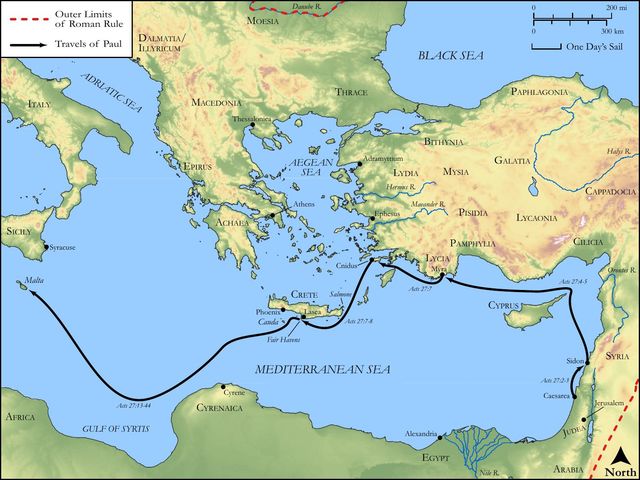
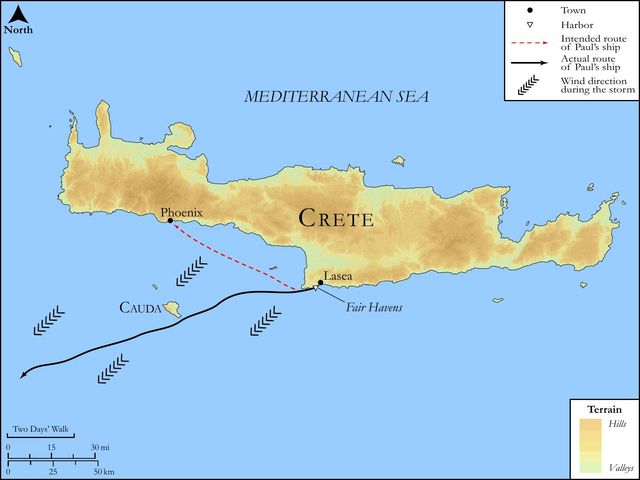
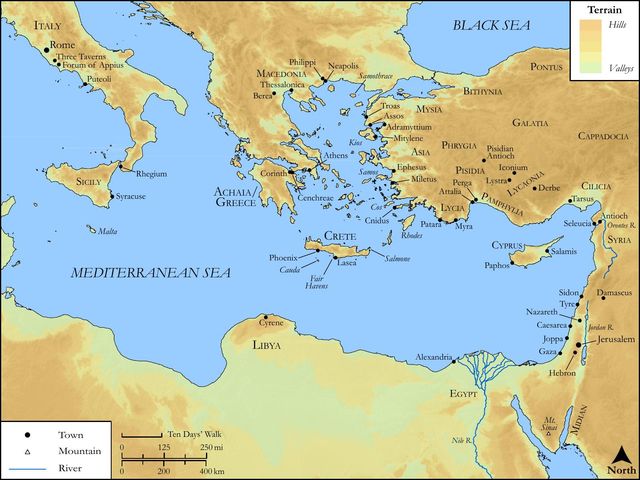
Study this verse
Public-domain commentary
Matthew Henry
From his Commentary on the Whole Bible. Henry comments on passages, not single verses — this entry covers Acts 27:12–20. His three-level outline is real structure in the source text, so it is rendered as structure.
In these verses we have,
I.The ship putting to sea again, and pursuing her voyage at first with a promising gale. Observe,
1.What induced them to leave the fair havens: it was because they thought the harbour not commodious to winter in; it was pleasant enough in summer but in the winter they lay bleak. Or perhaps it was upon some other account incommodious; provisions perhaps were scarce and dear there; and they ran upon a mischief to avoid an inconvenience, as we often do. Some of the ship's crew, or of the council that was called to advise in this matter, were for staying there, rather than venturing to sea now that the weather was so uncertain: it is better to be safe in an incommodious harbour than to be lost in a tempestuous sea. But they were outvoted when it was put to the question, and the greater part advised to depart thence also; yet they aimed not to go far, but only to another port of the same island, here called Phenice, and some think it was so called because the Phenicians frequented it much, the merchants of Tyre and Sidon. It is here described to lie towards the south-west and north-west. Probably the haven was between the two promontories or juttings-out of land into the sea, one of which pointed to the north-west and the other to the south-west, by which it was guarded against the east winds. Thus hath the wisdom of the Creator provided for the relief and safety of those who go down to the sea in ships, and do business in great waters. In vain had nature provided for us the waters to sail on, if it had not likewise provided for us natural harbours to take shelter in.
2.What encouragement they had at first to pursue their voyage. They set out with a fair wind (Act 27:13), the south wind blew softly, upon which they should gain their point, and so they sailed close by the coast of Crete and were not afraid of running upon the rocks or quicksands, because the wind blew so gently. Those who put to sea with ever so fair a gale know not what storms they may yet meet with, and therefore must not be secure, nor take it for granted that they have obtained their purpose, when so many accidents may happen to cross their purpose. Let not him that girdeth on the harness boast as though he had put it off.
II.The ship in a storm presently, a dreadful storm.
They looked at second causes, and took their measures from the favourable hints they gave, and imagined that because the south wind now blew softly it would always blow so; in confidence of this, they ventured to sea, but were soon made sensible of their folly in giving more credit to a smiling wind than to the word of God in Paul's mouth, by which they had fair warning given them of a storm. Observe,
1.What their danger and distress was, (1.). There arose against them a tempestuous wind, which was not only contrary to them, and directly in their teeth, so that they could not get forward, but a violent wind, which raised the waves, like that which was sent forth in pursuit of Jonah, though Paul was following God, and going on in his duty, and not as Jonah running away from God and his duty. This wind the sailors called Euroclydon, a north-east wind, which upon those seas perhaps was observed to be in a particular manner troublesome and dangerous. It was a sort of whirlwind, for the ship is said to be caught by it, Act 27:15. It was God that commanded this wind to rise, designing to bring glory to himself, and reputation to Paul, out of it; stormy winds being brought out of his treasuries (Psa 135:7), they fulfil his word, Psa 148:8. (2.) The ship was exceedingly tossed (Act 27:18); it was kicked like a football from wave to wave; its passengers (as it is elegantly described, Psa 107:26, Psa 107:27) mount up to the heavens, go down again to the depths, reel to and fro, stagger like a drunken man, and are at their wits' end. The ship could not possibly bear up into the wind, could not make her way in opposition to the wind; and therefore they folded up their sails, which in such a storm would endanger them rather than to them any service, and so let the ship drive, Not whither it would, but whither it was impelled by the impetuous waves - non quo voluit, sed quo rapit impetus undae. Ovid. Trist. It is probable that they were very near the heaven of Phenice when this tempest arose, and thought they should presently be in a quiet haven, and were pleasing themselves with the thought of it, and wintering there, and lo, of a sudden, they are in this distress. Let us therefore always rejoice with trembling, and never expect a perfect security, nor a perpetual security, till we come to heaven. (3.) They saw neither sun nor stars for many days. This made the tempest the more terrible, that they were all in the dark; and the use of the loadstone for the direction of sailors not being then found out (so that they had no guide at all, when they could see neither sun nor stars) made the case the more hazardous. Thus melancholy sometimes is the condition of the people of God upon a spiritual account. They walk in darkness and have no light. Neither sun nor stars appear; they cannot dwell, nay, they cannot fasten, upon any thing comfortable or encouraging; thus it may be with them, and yet light is sown for them. (4.) They had abundance of winter-weather: No small tempest - cheimōn ouk oligos, cold rain, and snow, and all the rigours of that season of the year, so that they were ready to perish for cold; and all this continued many days. See what hardships those often undergo who are much at sea, besides the hazards of life they run; and yet to get gain there are still those who make nothing of all this; and it is an instance of divine Providence that it disposes some to this employment, notwithstanding the difficulties that attend it, for the keeping up of commerce among the nations, and the isles of the Gentiles particularly; and Zebulun can as heartily rejoice in his going out as Issachar in his tents. Perhaps Christ therefore chose ministers from among seafaring men, because they had been used to endure hardness.
2.What means they used for their own relief: they betook themselves to all the poor shifts (for I can call them no better) that sailors in distress have recourse to.
(1.)When they could not make head against the wind, they let the ship run adrift, finding it was to no purpose to ply either the oar or the sail. When it is fruitless to struggle, it is wisdom to yield.
(2.)They nevertheless did what they could to avoid the present danger; there was a little island called Clauda, and when they were near that, though they could not pursue their voyage, they took care to prevent their shipwreck, and therefore so ordered their matters that they did not run against the island, but quietly ran under it, Act 27:16.
(3.)When they were afraid they should scarcely save the ship, they were busy to save the boat, which they did with much ado. They had much work to come by the boat (Act 27:16), but at last they took it up, Act 27:17. This might be of use in any exigence, and therefore they made hard shift to get it into the ship to them.
(4.)They used means which were proper enough in those times, when the art of navigation was far short of the perfection it is now come to; they undergirded the ship, Act 27:17. They bound the ship under the bottom of it with strong cables, to keep it from bulging in the extremity of the tempest.
(5.)For fear of falling into the quicksands they struck sail, and then let the ship go as it would. It is strange how a ship will live at sea (so they express it), even in very stormy weather, if it have but sea-room; and, when the sailors cannot make the shore, it is their interest to keep as far off it as they can.
(6.)The next day they lightened the ship of its cargo, threw the goods and the merchandises overboard (as Jonah's mariners did, Jon 1:5), being willing rather to be poor without them than to perish with them. Skin for skin, and all that a man has, will he give for his life. See what the wealth of this world is; how much soever it is courted as a blessing, the time may come when it will be a burden, not only too heavy to be carried safe of itself, but heavy enough to sink him that has it. Riches are often kept by the owners thereof to their hurt (Ecc 5:13); and parted with to their good. But see the folly of the children of this world, they can be thus prodigal of their goods when it is for the saving of their lives, and yet how sparing of them in works of piety and charity, and in suffering for Christ, though they are told by eternal Truth itself that those shall be recompensed more than a thousand fold in the resurrection of the just. Those went upon a principle of faith who took joyfully the spoiling of their goods, knowing in themselves that they had in heaven a better and a more enduring substance, Heb 10:34. Any man will rather make shipwreck of his goods than of his life; but many will rather make shipwreck of faith and a good conscience than of their goods.
(7.)The third day they cast out the tacklings of the ship - the utensils of it, Armamenta (so some render it), as if it were a ship of force. With us it is common to heave the guns over-board in the extremity of a storm; but what heavy artillery they had then which it was necessary to lighten the ship of I do not know; and I question whether it was not then a vulgar error among seamen thus to throw every thing into the sea, even that which would be of great use in a storm, and no great weight.
3.The despair which at last they were brought to (Act 27:20): All hope that we should be saved was then taken away. The storm continued, and they saw no symptoms of its abatement; we have known very blustering weather to continue for some weeks. The means they had used were ineffectual, so that they were at their wits' end; and such was the consternation that this melancholy prospect put them into that they had no heart either to eat or drink. They had provision enough on board (Act 27:38), but such bondage were they under, through fear of death, that they could not admit the supports of life. Why did not Paul, by the power of Christ, and in his name, lay this storm? Why did he not say to the winds and waves, Peace, be still, as his Master had done? Surely it was because the apostles wrought miracles for the confirmation of their doctrine, not for the serving of a turn for themselves or their friends.
Historical interpretation
Four Centuries of Reception
2 surviving comments on this verse. Each one is dated, so this reads as a timeline rather than a list.
Select a marker to jump to its quote. Markers stagger vertically where authors wrote within a few decades of each other.
Since Paul was a prophet, he announced the danger, which would have threatened them on the ship. But he was not able to convince them to spend the winter in Crete, so that it was not fate that dragged them into danger but their will.
If by any means they might reach Phoenix to spend the winter, a port of Crete looking toward the southwest and northwest. The southwest wind, which in Greek is called λίψ, blows between the south and west, inclining; Corus, however, toward the north and west, but more deflected toward the west. It is clear, therefore, that the region of Phoenix had Crete to the west, and so its port of Crete looked in some places to the southwest; and in some places to the northwest, for that reason, whether the southwest wind or the northwest wind blew, they could sail from Crete to Phoenix. But even if the south wind itself, that is, the meridian wind, blew, they could nonetheless navigate to Phoenix with a wavering direction of rudders and with the trimming of sails, if divine judgments did not hinder them. Wherefore it is subsequently added:
Continue studying Acts 27:12 across the web’s major study libraries — every link below opens this exact verse, chapter, or book on the destination site.
Read & Compare
 BibleGatewayThis verse in more than 200 translations and 70 languages.
 Bible.comThe YouVersion reader — hundreds of translations, reading plans, and highlights.
 ESV.orgCrossway's official English Standard Version reader.
 NET BibleThe NET translation with 60,000+ translators' notes on every rendering decision.
 STEP BibleTyndale House's free study tool — original text, vocabulary, and scholarly resources.
 BibliaLogos Bible Software's free web reader.
 USCCBThe New American Bible (Revised Edition) with the U.S. bishops' study notes.
Commentaries
 BibleHub CommentariesDozens of classic commentaries on this verse, gathered on one page.
 StudyLightMore than 100 commentary sets — the largest collection on the web.
 BibleRefPlain-English commentary on what this verse means, verse by verse.
 Enduring WordDavid Guzik's free commentary on this chapter, widely used by Bible teachers.
 Bible Study ToolsVerse commentary alongside Greek and Hebrew study aids.
Original Language & Research
- BibleHub InterlinearThe verse word by word — original language, transliteration, and English.
- BibleHub LexiconEvery word's original-language definition and Strong's entry.
 Blue Letter BibleDeep-study tools — Strong's numbers, concordance, and word studies.
 CNTR CollationThe earliest Greek manuscripts of this verse, collated letter by letter.
Sermons, Hymns & Audio


TrulyRandomVerse is not affiliated with these sites and doesn’t control their content. They’re linked because they’re genuinely useful.
Summary
Acts 27:12 details a pivotal decision made by the ship's company transporting Paul as a prisoner to Rome. Having arrived at Fair Havens, Crete, a harbor deemed unsuitable for wintering, the majority of the crew and passengers, including the ship's owner and the centurion, decided against Paul's earlier warning to press on to Phenice, another Cretan harbor. This choice, driven by the desire for a more "commodious" (convenient) and sheltered port, particularly one described by its orientation to the south-west and north-west winds, inadvertently set the stage for the dramatic shipwreck that followed, highlighting the tension between human prudence and divine counsel.
Context
ShowHideLiterary Context
Acts 27 is a vivid narrative of Paul's perilous sea journey to Rome as a prisoner, following his appeal to Caesar in Acts 25:11. The chapter opens with the commencement of the voyage under the care of a centurion named Julius (Acts 27:1). After encountering initial difficulties and slow progress, they arrive at Fair Havens, a port on the southern coast of Crete (Acts 27:8). Paul, having received a divine premonition, warns them against continuing the voyage, predicting "much damage and great loss" (Acts 27:10). However, his counsel is rejected in favor of the ship's master and owner, and the centurion's assessment, leading to the decision described in Acts 27:12. This verse serves as the immediate precursor to the violent storm, the "Euroclydon," that soon overtakes them (Acts 27:14).
Historical & Cultural Context
Ancient maritime travel was inherently dangerous, especially during the winter months (typically mid-September to mid-March), when the Mediterranean Sea was prone to severe storms and navigation was unreliable due to limited technology. Ships were often laid up for the winter in safe harbors. Fair Havens, while a port, was evidently exposed to certain winds, making it less desirable for a prolonged stay. Phenice (likely modern-day Loutro or Lutro), described as lying "toward the south west and north west," was considered superior because its natural harbor offered better protection from the prevailing and often violent winter winds. This detail underscores the practical concerns of ancient mariners in seeking a secure anchorage. The decision-making process involved the ship's owner (likely a merchant), the master (the navigator), and the centurion (representing Roman authority), reflecting the hierarchy and practical considerations of such a voyage.
Key Themes
ShowHideThis verse contributes significantly to several overarching themes within Acts 27 and the broader book. It highlights the recurring theme of Divine Sovereignty amidst Human Decision-Making, where human choices, even those based on apparent practicality, often diverge from God's revealed will or warnings, yet God's ultimate purposes prevail. The narrative also powerfully illustrates the Challenges and Perils of Missionary Travel, showcasing the real-world dangers faced by early apostles as they spread the gospel. Furthermore, it subtly develops the theme of Paul's Prophetic Insight and Authority, as his disregarded warning proves accurate, affirming his spiritual discernment even in secular matters, a pattern seen elsewhere in Acts, such as his counsel in Acts 22:18. The immediate consequence of this decision sets the stage for God's miraculous preservation of Paul and the ship's company, demonstrating God's Protection of His Servants even through trials, as promised in Acts 27:24.
Exposition and Analysis
ShowHideKey Word Analysis
ShowHideMeaning "not well set," hence "inconvenient" or "unsuitable." This word describes the primary reason for the ship's company's desire to leave Fair Havens. It implies a lack of proper shelter, facilities, or favorable conditions for a prolonged winter stay, making the port undesirable from a practical, maritime perspective.
Meaning "volition," "advice," or "purpose." This term highlights the act of counsel or decision-making. In this context, it refers to the advice given by "the more part" (the majority) of those on board, including the ship's master and owner, to depart from Fair Havens. This advice, rooted in human assessment and experience, stood in direct opposition to Paul's divinely inspired warning.
Meaning "to meet against" or "arrive at." This word expresses the goal or objective of the majority's decision—to reach Phenice. It conveys the intent to achieve a specific destination, perceived as superior, for their wintering needs, underscoring their proactive (though ultimately misguided) pursuit of a better solution.
Verse Breakdown
ShowHide"And because the haven was not commodious to winter in"
This clause establishes the primary motivation for the ship's company's decision. Fair Havens, despite being a port, was deemed unsuitable for the prolonged and dangerous winter season. This unsuitability could refer to its exposure to certain winds, lack of proper anchorage, or insufficient facilities for a large ship and its crew for several months.
"the more part advised to depart thence also, if by any means they might attain to Phenice, and there to winter"
This reveals the collective decision-making process. "The more part" signifies the majority, including the experienced mariners, who overruled Paul's counsel. Their advice was to leave Fair Havens and attempt to reach Phenice, hoping to find a more suitable and safer place to spend the winter. The phrase "if by any means they might attain" suggests an awareness of the inherent risk in attempting to sail further at that time of year, yet they were willing to take it for the perceived benefit.
"which is an haven of Crete, and lieth toward the south west and north west"
This final part describes Phenice, explaining why it was considered a better option. Its geographical orientation, facing both south-west (Greek: lips, G3047) and north-west (Greek: chōros, G5566) winds, implies a naturally sheltered harbor, protected from the most dangerous and common winter storms in the Mediterranean. This detail underscores the practical, human wisdom guiding their decision, contrasting sharply with Paul's spiritual foresight.
Literary Devices
ShowHideThe passage employs Descriptive Language to paint a clear picture of the maritime context and the reasons for the decision. The specific mention of Phenice's orientation ("south west and north west") is a form of Geographical Detail, grounding the narrative in a realistic setting and explaining the practical considerations of ancient sailing. There is also a subtle use of Foreshadowing, as the seemingly logical and prudent decision to seek a "commodious" harbor ultimately leads to the disaster Paul had warned against, setting up the dramatic events of the subsequent verses. This highlights the Irony of human wisdom leading to peril when divine wisdom is disregarded.
Theological and Thematic Connections
ShowHideActs 27:12 serves as a profound illustration of the tension between human wisdom and divine revelation. The majority's decision, based on practical considerations and maritime experience, seemed logical and prudent—seeking a better, more "commodious" haven for winter. Yet, it directly contradicted Paul's divinely inspired warning, which, though seemingly counter-intuitive for a prisoner, proved to be the true wisdom. This episode underscores that God's ways are often higher than human ways, and what appears to be the most sensible path from a worldly perspective may lead to unforeseen peril if it ignores spiritual guidance. It challenges believers to discern and prioritize divine counsel, even when it conflicts with conventional wisdom or immediate comfort, reminding us that true safety and flourishing come from aligning with God's will.
Reflection and Application
ShowHideActs 27:12 presents a timeless lesson on decision-making, both individually and collectively. It challenges us to consider the source and nature of the counsel we receive and to whom we ultimately listen. The ship's company prioritized comfort and perceived safety, relying on experienced human judgment over a prophetic warning. This often mirrors our own lives: we may choose the path that seems most "commodious" or convenient, the one that aligns with popular opinion or expert advice, even when a quiet inner voice, or the clear counsel of Scripture, suggests a different, perhaps more difficult, route. This passage urges us to cultivate spiritual discernment, recognizing that true wisdom often comes from unexpected sources and may require us to step outside our comfort zones or challenge conventional thinking. It reminds us that short-term convenience can lead to long-term hardship, and that trusting God's guidance, even when it seems illogical, is the surest path to safety and the fulfillment of His purposes.
Questions for Reflection
ShowHideFAQ
ShowHideWhy was Fair Havens "not commodious to winter in," and what made Phenice better?
ShowHideFair Havens, while a harbor, was likely deemed "not commodious" (Greek: aneúthetos, meaning unsuitable or inconvenient) for wintering due to its exposure to certain prevailing winds, particularly the strong northerly or easterly gales common in the Mediterranean during winter. These winds could make the harbor unsafe for ships to anchor for an extended period, risking damage or even loss. Phenice, on the other hand, was described as having a more protected orientation, "lieth toward the south west and north west." This geographical detail implies a natural harbor that offered shelter from the most dangerous winter winds, making it a more secure and desirable location for a ship to lay up for several months. The decision to move was a pragmatic one based on the perceived superior protection offered by Phenice, though it ultimately led to disaster as described in Acts 27:13-14.
Christ-Centered Fulfillment
ShowHideWhile Acts 27:12 primarily depicts a practical decision with dire consequences, it subtly points to Christ in its broader narrative of divine sovereignty over human plans and the ultimate preservation of God's purposes. The ship's company, in rejecting Paul's Spirit-inspired warning for what seemed like a more "commodious" human solution, foreshadows humanity's consistent tendency to reject divine wisdom for self-serving or seemingly logical alternatives. Just as Paul, though a prisoner, carried the true wisdom and the promise of God's preservation, so too Christ, in His humility and apparent weakness on the cross, embodied the ultimate divine wisdom that the world rejected (1 Corinthians 1:23-25). The perilous journey and subsequent shipwreck, from which all lives were miraculously saved through Paul's presence and God's intervention (Acts 27:24), serve as a powerful metaphor for humanity's lost condition and God's redemptive plan. Through Christ, the true "haven" and "shelter" for our souls, we find ultimate safety and salvation, rescued from the storms of sin and judgment, not by our own wisdom or efforts, but by His divine grace and power (Hebrews 6:19; Psalm 107:28-30). The narrative ultimately affirms that even when human choices lead to chaos, God's sovereign plan for His people, centered in Christ, will prevail, bringing them safely to their intended destination.