


Acts 27:16
- νησίονnēsionAn IslandG3519N-ASNNoun Accusative Singular Neuter
- δέdethenG1161CONJConjunction
- τιticertainG5100X-ASNIndefinite pronoun Accusative Singular Neuter
- ὑποδραμόντεςhupodramonteshaving run underG5295V-2AAP-NPMVerb 2nd Aorist Active Participle Nominative Plural Masculine
- καλούμενονkaloumenonbeing calledG2564V-PPP-ASNVerb Present Passive Participle Accusative Singular Neuter
- ΚαῦδαKaudaCaudaG2802N-ASN-LNoun Accusative Singular Neuter Location
- ἰσχύσαμενischusamenwe were ableG2480V-AAI-1PVerb Aorist Active Indicative 1st Plural
- μόλιςmoliswith difficultyG3433ADVAdverb
- περικρατεῖςperikrateiscontrolG4031A-NPMAdjective Nominative Plural Masculine
- γενέσθαιgenesthaito gainG1096V-2ADNVerb 2nd Aorist Middle Deponent Infinitive
- τῆςtēsof theG3588T-GSFDefinite article Genitive Singular Feminine
- σκάφηςskaphēslifeboatG4627N-GSFNoun Genitive Singular Feminine
English is a literal word-by-word gloss of the Greek, not the KJV's wording. Why?
This is the original text the KJV's translators worked from — each Greek word with its own literal English meaning in this verse, prepared by scholars at Tyndale House, Cambridge. The KJV translates whole sentences, not word by word, so its wording differs: one Greek word can become several English words, and the KJV may choose “charity” where the gloss reads “love”. Both are faithful — they answer different questions. For the KJV's own rendering, switch to the KJV text.
Details
See on the biblical-era map
Study this verse
Public-domain commentary
Matthew Henry
From his Commentary on the Whole Bible. Henry comments on passages, not single verses — this entry covers Acts 27:12–20. His three-level outline is real structure in the source text, so it is rendered as structure.
In these verses we have,
I.The ship putting to sea again, and pursuing her voyage at first with a promising gale. Observe,
1.What induced them to leave the fair havens: it was because they thought the harbour not commodious to winter in; it was pleasant enough in summer but in the winter they lay bleak. Or perhaps it was upon some other account incommodious; provisions perhaps were scarce and dear there; and they ran upon a mischief to avoid an inconvenience, as we often do. Some of the ship's crew, or of the council that was called to advise in this matter, were for staying there, rather than venturing to sea now that the weather was so uncertain: it is better to be safe in an incommodious harbour than to be lost in a tempestuous sea. But they were outvoted when it was put to the question, and the greater part advised to depart thence also; yet they aimed not to go far, but only to another port of the same island, here called Phenice, and some think it was so called because the Phenicians frequented it much, the merchants of Tyre and Sidon. It is here described to lie towards the south-west and north-west. Probably the haven was between the two promontories or juttings-out of land into the sea, one of which pointed to the north-west and the other to the south-west, by which it was guarded against the east winds. Thus hath the wisdom of the Creator provided for the relief and safety of those who go down to the sea in ships, and do business in great waters. In vain had nature provided for us the waters to sail on, if it had not likewise provided for us natural harbours to take shelter in.
2.What encouragement they had at first to pursue their voyage. They set out with a fair wind (Act 27:13), the south wind blew softly, upon which they should gain their point, and so they sailed close by the coast of Crete and were not afraid of running upon the rocks or quicksands, because the wind blew so gently. Those who put to sea with ever so fair a gale know not what storms they may yet meet with, and therefore must not be secure, nor take it for granted that they have obtained their purpose, when so many accidents may happen to cross their purpose. Let not him that girdeth on the harness boast as though he had put it off.
II.The ship in a storm presently, a dreadful storm.
They looked at second causes, and took their measures from the favourable hints they gave, and imagined that because the south wind now blew softly it would always blow so; in confidence of this, they ventured to sea, but were soon made sensible of their folly in giving more credit to a smiling wind than to the word of God in Paul's mouth, by which they had fair warning given them of a storm. Observe,
1.What their danger and distress was, (1.). There arose against them a tempestuous wind, which was not only contrary to them, and directly in their teeth, so that they could not get forward, but a violent wind, which raised the waves, like that which was sent forth in pursuit of Jonah, though Paul was following God, and going on in his duty, and not as Jonah running away from God and his duty. This wind the sailors called Euroclydon, a north-east wind, which upon those seas perhaps was observed to be in a particular manner troublesome and dangerous. It was a sort of whirlwind, for the ship is said to be caught by it, Act 27:15. It was God that commanded this wind to rise, designing to bring glory to himself, and reputation to Paul, out of it; stormy winds being brought out of his treasuries (Psa 135:7), they fulfil his word, Psa 148:8. (2.) The ship was exceedingly tossed (Act 27:18); it was kicked like a football from wave to wave; its passengers (as it is elegantly described, Psa 107:26, Psa 107:27) mount up to the heavens, go down again to the depths, reel to and fro, stagger like a drunken man, and are at their wits' end. The ship could not possibly bear up into the wind, could not make her way in opposition to the wind; and therefore they folded up their sails, which in such a storm would endanger them rather than to them any service, and so let the ship drive, Not whither it would, but whither it was impelled by the impetuous waves - non quo voluit, sed quo rapit impetus undae. Ovid. Trist. It is probable that they were very near the heaven of Phenice when this tempest arose, and thought they should presently be in a quiet haven, and were pleasing themselves with the thought of it, and wintering there, and lo, of a sudden, they are in this distress. Let us therefore always rejoice with trembling, and never expect a perfect security, nor a perpetual security, till we come to heaven. (3.) They saw neither sun nor stars for many days. This made the tempest the more terrible, that they were all in the dark; and the use of the loadstone for the direction of sailors not being then found out (so that they had no guide at all, when they could see neither sun nor stars) made the case the more hazardous. Thus melancholy sometimes is the condition of the people of God upon a spiritual account. They walk in darkness and have no light. Neither sun nor stars appear; they cannot dwell, nay, they cannot fasten, upon any thing comfortable or encouraging; thus it may be with them, and yet light is sown for them. (4.) They had abundance of winter-weather: No small tempest - cheimōn ouk oligos, cold rain, and snow, and all the rigours of that season of the year, so that they were ready to perish for cold; and all this continued many days. See what hardships those often undergo who are much at sea, besides the hazards of life they run; and yet to get gain there are still those who make nothing of all this; and it is an instance of divine Providence that it disposes some to this employment, notwithstanding the difficulties that attend it, for the keeping up of commerce among the nations, and the isles of the Gentiles particularly; and Zebulun can as heartily rejoice in his going out as Issachar in his tents. Perhaps Christ therefore chose ministers from among seafaring men, because they had been used to endure hardness.
2.What means they used for their own relief: they betook themselves to all the poor shifts (for I can call them no better) that sailors in distress have recourse to.
(1.)When they could not make head against the wind, they let the ship run adrift, finding it was to no purpose to ply either the oar or the sail. When it is fruitless to struggle, it is wisdom to yield.
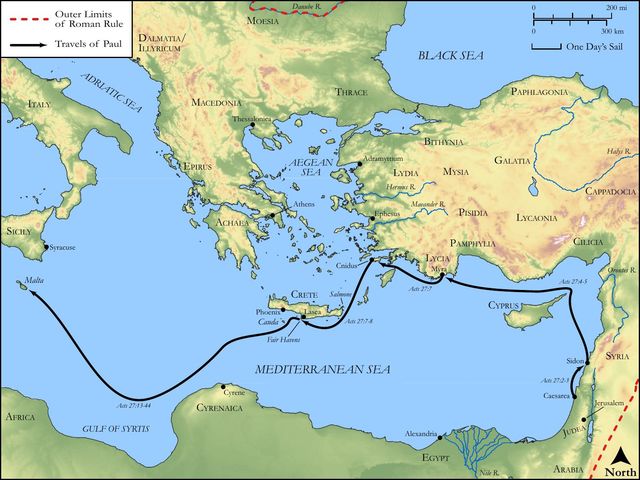
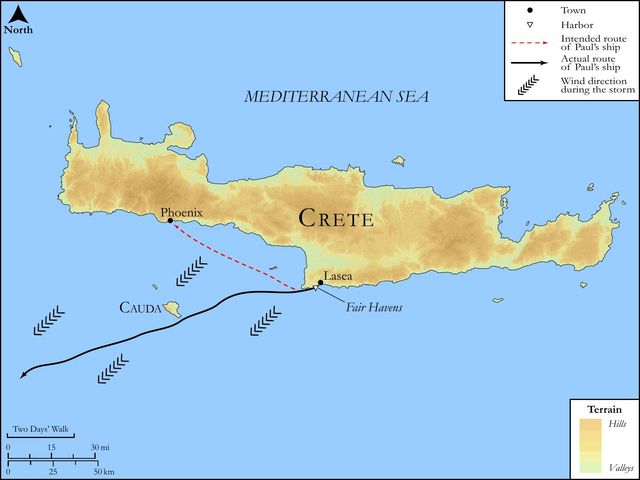
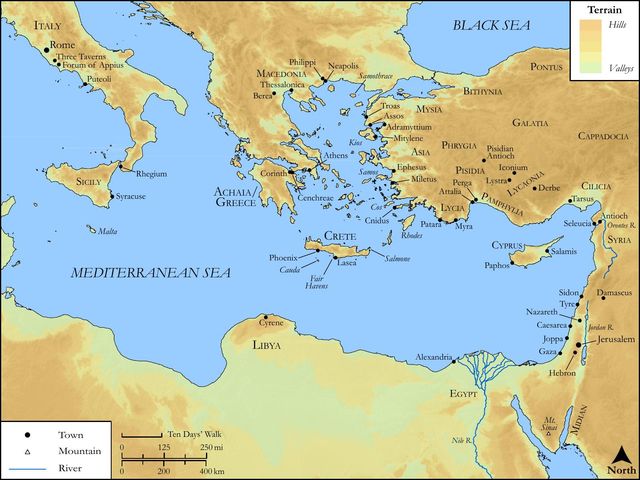
(2.)They nevertheless did what they could to avoid the present danger; there was a little island called Clauda, and when they were near that, though they could not pursue their voyage, they took care to prevent their shipwreck, and therefore so ordered their matters that they did not run against the island, but quietly ran under it, Act 27:16.
(3.)When they were afraid they should scarcely save the ship, they were busy to save the boat, which they did with much ado. They had much work to come by the boat (Act 27:16), but at last they took it up, Act 27:17. This might be of use in any exigence, and therefore they made hard shift to get it into the ship to them.
(4.)They used means which were proper enough in those times, when the art of navigation was far short of the perfection it is now come to; they undergirded the ship, Act 27:17. They bound the ship under the bottom of it with strong cables, to keep it from bulging in the extremity of the tempest.
(5.)For fear of falling into the quicksands they struck sail, and then let the ship go as it would. It is strange how a ship will live at sea (so they express it), even in very stormy weather, if it have but sea-room; and, when the sailors cannot make the shore, it is their interest to keep as far off it as they can.
(6.)The next day they lightened the ship of its cargo, threw the goods and the merchandises overboard (as Jonah's mariners did, Jon 1:5), being willing rather to be poor without them than to perish with them. Skin for skin, and all that a man has, will he give for his life. See what the wealth of this world is; how much soever it is courted as a blessing, the time may come when it will be a burden, not only too heavy to be carried safe of itself, but heavy enough to sink him that has it. Riches are often kept by the owners thereof to their hurt (Ecc 5:13); and parted with to their good. But see the folly of the children of this world, they can be thus prodigal of their goods when it is for the saving of their lives, and yet how sparing of them in works of piety and charity, and in suffering for Christ, though they are told by eternal Truth itself that those shall be recompensed more than a thousand fold in the resurrection of the just. Those went upon a principle of faith who took joyfully the spoiling of their goods, knowing in themselves that they had in heaven a better and a more enduring substance, Heb 10:34. Any man will rather make shipwreck of his goods than of his life; but many will rather make shipwreck of faith and a good conscience than of their goods.
(7.)The third day they cast out the tacklings of the ship - the utensils of it, Armamenta (so some render it), as if it were a ship of force. With us it is common to heave the guns over-board in the extremity of a storm; but what heavy artillery they had then which it was necessary to lighten the ship of I do not know; and I question whether it was not then a vulgar error among seamen thus to throw every thing into the sea, even that which would be of great use in a storm, and no great weight.
3.The despair which at last they were brought to (Act 27:20): All hope that we should be saved was then taken away. The storm continued, and they saw no symptoms of its abatement; we have known very blustering weather to continue for some weeks. The means they had used were ineffectual, so that they were at their wits' end; and such was the consternation that this melancholy prospect put them into that they had no heart either to eat or drink. They had provision enough on board (Act 27:38), but such bondage were they under, through fear of death, that they could not admit the supports of life. Why did not Paul, by the power of Christ, and in his name, lay this storm? Why did he not say to the winds and waves, Peace, be still, as his Master had done? Surely it was because the apostles wrought miracles for the confirmation of their doctrine, not for the serving of a turn for themselves or their friends.
Historical interpretation
Four Centuries of Reception
3 surviving comments on this verse. Each one is dated, so this reads as a timeline rather than a list.
Select a marker to jump to its quote. Markers stagger vertically where authors wrote within a few decades of each other.
It came to pass, after Paul went out of the island Gaudomeleta,
And the south wind blowing softly, they thought they had obtained their purpose, etc., we could scarcely retain the boat. We wrote in the first book, following Isidore, that the boat was a light vessel, woven from wicker and covered with rawhide; but subsequently, upon perusing the writings of others, we found that boats are also called small vessels hollowed out of a single tree, which the Greeks call monoxylas.
We could scarcely obtain the lifeboat. After it was taken, they used auxiliary ropes. The lifeboat or Catascopos is a light boat, made of wicker and covered with rawhide. It is called in Greek from the act of viewing, because sailors or pirates on such a vessel used to observe lands and shores. Thus, when they had launched this lifeboat into the sea to help the larger ship, they could scarcely hold onto it, lest it slip, due to the seething wave.
Continue studying Acts 27:16 across the web’s major study libraries — every link below opens this exact verse, chapter, or book on the destination site.
Read & Compare
 BibleGatewayThis verse in more than 200 translations and 70 languages.
 Bible.comThe YouVersion reader — hundreds of translations, reading plans, and highlights.
 ESV.orgCrossway's official English Standard Version reader.
 NET BibleThe NET translation with 60,000+ translators' notes on every rendering decision.
 STEP BibleTyndale House's free study tool — original text, vocabulary, and scholarly resources.
 BibliaLogos Bible Software's free web reader.
 USCCBThe New American Bible (Revised Edition) with the U.S. bishops' study notes.
Commentaries
 BibleHub CommentariesDozens of classic commentaries on this verse, gathered on one page.
 StudyLightMore than 100 commentary sets — the largest collection on the web.
 BibleRefPlain-English commentary on what this verse means, verse by verse.
 Enduring WordDavid Guzik's free commentary on this chapter, widely used by Bible teachers.
 Bible Study ToolsVerse commentary alongside Greek and Hebrew study aids.
Original Language & Research
- BibleHub InterlinearThe verse word by word — original language, transliteration, and English.
- BibleHub LexiconEvery word's original-language definition and Strong's entry.
 Blue Letter BibleDeep-study tools — Strong's numbers, concordance, and word studies.
 CNTR CollationThe earliest Greek manuscripts of this verse, collated letter by letter.
Sermons, Hymns & Audio


TrulyRandomVerse is not affiliated with these sites and doesn’t control their content. They’re linked because they’re genuinely useful.
Summary
Acts 27:16 vividly recounts a moment of intense struggle for Paul and his fellow travelers aboard a ship caught in a violent tempest. After being relentlessly driven by the severe Euraquilo storm, the crew found a fleeting and partial reprieve by sailing under the lee of the small island of Clauda. This brief shelter offered a desperate window of opportunity, during which they faced immense difficulty and exerted strenuous effort to secure the ship's small lifeboat, a critical task for their ongoing survival amidst the raging elements.
Context
ShowHideLiterary Context
This verse is deeply embedded within the gripping narrative of Paul's perilous sea voyage to Rome, detailed in Acts 27. Immediately preceding this verse, the ship has been caught in a devastating northeasterly storm, described in Acts 27:14 as the "tempestuous wind, Euroclydon" (also known as Euraquilo). The crew's desperate attempts to lighten the ship and use undergirding ropes, mentioned in Acts 27:18-19, underscore the severity of their situation. The brief shelter offered by Clauda in Acts 27:16 is a pivotal moment, allowing them to address the immediate threat posed by the lifeboat before the storm's full fury resumes, leading to the eventual shipwreck described later in the chapter, particularly in Acts 27:39-44.
Historical & Cultural Context
Ancient Mediterranean seafaring was inherently dangerous, especially outside the calmer summer months. Ships were typically wooden, propelled by sails, and highly vulnerable to severe storms like the Euraquilo, a notorious cyclonic wind common in that region. The island of Clauda (modern Gavdos) is a small, rugged island located south of Crete. "Running under" its lee side meant seeking the relative calm on the side of the island opposite the wind, which provided temporary, limited protection from the direct force of the storm. The lifeboat (or skiff) was crucial for disembarking in port or escaping a sinking ship, but towing it in a storm was extremely risky; it could swamp, be dashed against the main vessel, or even drag the ship down, making its retrieval or securing an immediate priority for the experienced mariners.
Key Themes
ShowHideThe passage highlights several significant themes. First, Extreme Peril and Human Effort is evident in the "much work" required to secure the lifeboat, showcasing the immense physical and strategic labor demanded by the life-threatening conditions. Second, Strategic Navigation in Crisis is demonstrated by the crew's skilled decision to seek the lee of Clauda, illustrating their practical seamanship in leveraging any available natural shelter. Finally, and most profoundly, the overarching theme of Divine Sovereignty Amidst Chaos frames the entire narrative. Despite the overwhelming natural forces and the crew's desperate struggle, Paul's journey is divinely ordained, as God had assured him he would bear witness in Rome (as seen in Acts 23:11). This storm, though terrifying, ultimately serves God's larger purpose for Paul's mission, foreshadowing His providential care even in the direst circumstances, a theme echoed in passages like Romans 8:28.
Exposition and Analysis
ShowHideKey Word Analysis
ShowHideThis verb, G5295, from hypó (under) and tréchō (to run), specifically means "to run under" or "to sail past." In this context, it describes the ship's maneuver to gain the shelter of the island's lee side, moving quickly to escape the direct onslaught of the wind and waves. It implies a swift, tactical navigation decision to find temporary refuge.
The word G3433, mólis, is an adverb meaning "with difficulty," "hardly," or "scarcely." Its inclusion here emphasizes the extreme arduousness of the task. It was not merely "work," but work performed under duress, requiring immense effort and strength against overwhelming odds, indicating the severe conditions the crew faced even in the partial shelter of Clauda.
This phrase translates the Greek perikratḗs (G4031) combined with gínomai (G1096). Perikratḗs means "strong all around" or "a master/manager," while gínomai means "to become" or "to come into being." Together, "to become master of" or "to get control of" the boat. This highlights the intense struggle to physically secure the small boat, which was either being towed and was in danger of being swamped or lost, or needed to be hauled aboard. It underscores the critical nature of this task for the ship's overall integrity and the passengers' survival.
Verse Breakdown
ShowHide"And running under a certain island which is called Clauda,"
This clause describes the ship's immediate action after being battered by the storm. The crew, skilled mariners, identified the small island of Clauda (modern Gavdos) as a potential, albeit temporary, refuge. They executed a difficult maneuver to sail into the "lee" of the island, the side sheltered from the direct force of the wind, seeking a momentary respite from the tempest's full fury.
"we had much work"
This phrase conveys the immense difficulty and strenuous effort required for the subsequent action. Even in the partial shelter of Clauda, the sea remained turbulent, and the wind fierce. The "much work" implies a struggle against powerful natural forces, highlighting the physical and mental exhaustion of the crew.
"to come by the boat:"
This final clause specifies the objective of their arduous labor: to secure the ship's small lifeboat (or skiff). This boat, typically towed behind the larger vessel, would have been highly vulnerable in the storm, prone to swamping, being dashed against the ship, or even dragging the ship down. Securing it—either by hauling it aboard or firmly lashing it down—was a critical, life-saving measure to prevent its loss or further damage to the main ship.
Literary Devices
ShowHideThe narrative of Acts 27:16 employs several literary devices to convey the intensity of the situation. The phrase "much work" serves as a form of Understatement, subtly implying the truly Herculean effort required in such a storm, rather than explicitly detailing the physical struggle. This understatement paradoxically emphasizes the severity of the conditions. The entire scene also functions as Foreshadowing, hinting at the greater perils and the eventual shipwreck that will occur, while simultaneously setting the stage for Paul's divine protection and leadership later in the chapter. Furthermore, the "boat" itself can be seen as Symbolism, representing the precariousness of their survival and the vital, yet fragile, elements upon which their lives depended. The desperate struggle to secure it underscores the fight for life against overwhelming natural forces.
Theological and Thematic Connections
ShowHideActs 27:16, though a brief logistical detail, powerfully illustrates the intersection of human effort and divine providence in the face of overwhelming circumstances. It reminds us that while God is sovereign and has a plan, He often calls for human exertion, wisdom, and perseverance. The crew's desperate struggle to secure the lifeboat is a testament to their skill and determination, yet it is ultimately framed within God's larger purpose for Paul's journey to Rome. This passage encourages believers to engage actively and wisely with the "storms" of life, recognizing that our "much work" is not in vain, but part of a larger divine narrative where God's ultimate purposes prevail.
Reflection and Application
ShowHideThe intense struggle to secure the lifeboat in Acts 27:16 offers a profound metaphor for the Christian life. We often find ourselves in "storms"—periods of intense trial, uncertainty, or suffering—where even finding a moment of partial respite ("running under Clauda") still demands immense "work" to secure what is vital. This verse calls us to a posture of active faith: to exert wisdom, perseverance, and diligent effort in protecting the "lifeboats" of our spiritual lives—our faith, our community, our spiritual disciplines, our core convictions—from being swamped or lost amidst the chaos. It reminds us that while we are called to strive, our ultimate hope is not in our own strength or ingenuity, but in the God who is sovereign over all storms, both literal and metaphorical. Even when hope seems dim, our continued diligence in holding fast to what is true and good is part of God's process for our growth and ultimate deliverance.
Questions for Reflection
ShowHideFAQ
ShowHideWhy was securing the lifeboat so important, even in partial shelter?
ShowHideSecuring the lifeboat was critically important because, even in the "partial shelter" offered by the lee of Clauda, the ship was still in a severe storm. A small lifeboat, typically towed behind the main vessel, would be highly vulnerable to the turbulent seas. It could easily be swamped by waves, filled with water, and then either break apart, be lost, or, most dangerously, act as a heavy drag, pulling the main ship down or causing it to capsize. The crew's "much work" to "come by the boat" (i.e., to gain control of it, likely by hauling it aboard or securing it tightly to the deck) was a desperate, immediate measure to prevent a catastrophic loss and ensure the main ship's stability and the passengers' survival. This action, though difficult, was a testament to the mariners' skill and understanding of the immediate threats posed by the tempest, as seen in the broader context of Acts 27.
Christ-Centered Fulfillment
ShowHideActs 27:16, with its depiction of human vulnerability and desperate struggle against overwhelming natural forces, finds profound Christ-centered fulfillment in the person and work of Jesus. While the crew fought to control a small boat, Christ demonstrates ultimate sovereignty over the very elements that threatened Paul's ship. His calming of the storm in Mark 4:35-41 and Matthew 8:23-27 reveals Him as the divine Master of creation, whose word commands the winds and waves. Furthermore, the narrative of Paul's journey, though fraught with peril, is ultimately guided by God's sovereign plan for Paul to bear witness in Rome, echoing the greater journey of salvation. Jesus, as the "pioneer of their salvation" (Hebrews 2:10), navigates humanity through the storms of sin and death, not by securing a physical lifeboat, but by offering Himself as the ultimate rescue, the ark of salvation through His atoning sacrifice. In Him, believers find true and lasting security, a refuge stronger than any island's lee, and a Captain who ensures safe passage to the eternal shore, fulfilling God's purposes for His people.