


2 Chronicles 32:33
- וַיִּשְׁכַּבvai·yish·Kavand he lay downH7901Conj-w ¦ V-Qal-ConsecImperf-3msVerb Qal Consecutive Imperfect 3rd Singular Masculineוַandיִּשְׁכַּבhe lay down
- יְחִזְקִיָּהוּye·chiz·ki·Ya·huHezekiahH2396N-proper-mNoun Proper Masculine
- עִם'imwithH5973PrepPreposition
- אֲבֹתָיו'a·vo·Tavhis ancestorsH1N-fpc ¦ 3msNoun Plural Feminine Constructאֲבֹתָיancestorsוhis
- וַיִּקְבְּרֻהוּvai·yik·be·ru·Huand people buried himH6912Conj-w ¦ V-Qal-ConsecImperf-3mp ¦ 3msVerb Qal Consecutive Imperfect 3rd Plural Masculineוַandיִּקְבְּרֻpeople buriedהוּhim
- בְּמַעֲלֵהbe·ma·'a·Lehat [the] ascent ofH4608Prep-b ¦ N-mscNoun Singular Masculine Constructבְּatמַעֲלֵה[the] ascent of
- קִבְרֵיkiv·Rei[the] graves ofH6913N-mpcNoun Plural Masculine Construct
- בְנֵיve·nei[the] descendants ofH1121N-mpcNoun Plural Masculine Construct
- דָוִידda·VidDavidH1732N-proper-mNoun Proper Masculine
- וְכָבוֹדve·kha·Vodand honorH3519Conj-w ¦ N-msNoun Singular Masculine Absoluteוְandכָבוֹדhonor
- עָשׂוּ'a·suthey didH6213V-Qal-Perf-3cpVerb Qal Perfect 3rd Plural common gender
- לוֹloto himPrep-l ¦ 3msSuffix Personal 3rd Singular Masculineלtoוֹhim
- בְמוֹתוֹve·mo·Toat his deathH4194Prep-b ¦ N-msc ¦ 3msNoun Singular Masculine Constructבְatמוֹתdeathוֹhis
- כָּלkolallH3605N-mscNoun Singular Masculine Construct
- יְהוּדָהye·hu·DahJudahH3063N-properNoun Proper Location
- וְיֹשְׁבֵיve·yo·she·Veiand [the] inhabitants ofH3427Conj-w ¦ V-Qal-Prtcpl-mpVerb Qal Participle Plural Masculine Constructוְandיֹשְׁבֵי[the] inhabitants of
- יְרוּשָׁלִָםye·ru·sha·LimJerusalemH3389N-properNoun Proper Location
- וַיִּמְלֹךְvai·yim·Lokhand he became kingH4427Conj-w ¦ V-Qal-ConsecImperf-3msVerb Qal Consecutive Imperfect 3rd Singular Masculineוַandיִּמְלֹךְhe became king
- מְנַשֶּׁהme·na·ShehManassehH4519N-proper-mNoun Proper Masculine
- בְנוֹve·Nohis sonH1121N-msc ¦ 3msNoun Singular Masculine Constructבְנsonוֹhis
- תַּחְתָּיוtach·Tavin place of himH8478N-mpc ¦ 3msNoun Plural Masculine Constructתַּחְתָּיin place ofוhim
English is a literal word-by-word gloss of the Hebrew, not the KJV's wording. Why?
This is the original text the KJV's translators worked from — each Hebrew word with its own literal English meaning in this verse, prepared by scholars at Tyndale House, Cambridge. The KJV translates whole sentences, not word by word, so its wording differs: one Hebrew word can become several English words, and the KJV may choose “the LORD” where the gloss reads “Yahweh”. Both are faithful — they answer different questions. For the KJV's own rendering, switch to the KJV text.
Details
See on the biblical-era map
Study this verse
Public-domain commentary
Matthew Henry
From his Commentary on the Whole Bible. Henry comments on passages, not single verses — this entry covers 2 Chronicles 32:24–33. His three-level outline is real structure in the source text, so it is rendered as structure.
Here we conclude the story of Hezekiah with an account of three things concerning him: -
I.His sickness and his recovery from it, Ch2 32:24.
The account of his sickness is but briefly mentioned here; we had a large narrative of it, 2 Kings 20. His disease seemed likely to be mortal. In the extremity of it he prayed. God answered him, and gave him a sign that he should recover, the going back of the sun ten degrees.
II.His sin and his repentance for it, which were also more largely related, Kg2 20:12, etc. Yet several things are here observed concerning his sin which we had not there.
1.The occasion of it was the king of Babylon's sending an honourable embassy to him to congratulate him on his recovery. But here it is added that they came to enquire of the wonder that was done in the land (Ch2 32:31), either the destruction of the Assyrian army or the going back of the sun. The Assyrians were their enemies; they came to enquire concerning their fall, that they might triumph in it. The sun was their god; they came to enquire concerning the favour he had shown to Hezekiah, that they might honour him whom their god honoured, Ch2 32:31. These miracles were wrought to alarm and awaken a stupid careless world, and turn them from dumb and lame idols to the living God; and men were startled by them, but not converted till a greater wonder was done in that land, in the appearing of Jesus Christ, Mat 2:1, Mat 2:2.
2.God left him to himself in it, to try him, Ch2 32:31. God, by the power of his almighty grace, could have prevented the sin; but he permitted it for wise and holy ends, that, by this trial and his weakness in it, he might know, that is, it might be known (a usual Hebraism), what was in his heart, that he was not so perfect in grace as he thought he was, but had his follies and infirmities as other men. God left him to himself to be proud of his wealth, to keep him from being proud of his holiness. It is good for us to know ourselves, and our own weakness and sinfulness, that we may not be conceited or self-confident, but may always think meanly of ourselves and live in a dependence upon divine grace. We know not the corruption of our own hearts, nor what we shall do if God leave us to ourselves. Lord, lead us not into temptation.
3.His sin was the his heart was lifted up, Ch2 32:25. He was proud of the honour God had put upon him in so many instances, the honour his neighbours did him in bringing him presents, and now that the king of Babylon should send an embassy to him to caress and court him: this exalted him above measure. When Hezekiah had destroyed other idolatries he began to idolize himself. O what need have great men, and good men, and useful men, to study their own infirmities and follies, and their obligations to free grace, that they may never think highly of themselves, and to beg earnestly of God that he will hide pride from them and always keep them humble!
4.The aggravation of his sin was the he made so bad a return to God for his favours to him, making even those favours the food and fuel of his pride (Ch2 32:25): He rendered not again according to the benefit done unto him. Note, It is justly expected that those who have received mercy from God should study to make some suitable returns for the mercies they have received; and, if they do not, their ingratitude will certainly be charged upon them. Though we cannot render an equivalent, or the payment of a debt, we must render the acknowledgment of a favour. What shall I render that may be so accepted? Psa 116:12.
5.The divine displeasure he was under for this sin; though it was but a heart-sin, and the overt-act seemed not only innocent but civil (the showing of his treasures to a friend), yet wrath came upon him and his kingdom for it, Ch2 32:25. Note, Pride is a sin that God hates as much as any, and particularly in his own people. Those that exalt themselves must expect to be abased, and put under humbling providences. Wrath came on David for his pride in numbering the people.
6.His repentance for this sin: He humbled himself for the pride of his heart. Note,
(1.)Though God may, for wise and holy ends, suffer his people to fall into sin, yet he will not suffer them to lie still in it; they shall not be utterly cast down.
(2.)Heart-sins are to be repented of, though they go no further.
(3.)Self-humiliation is a necessary branch of repentance.
(4.)Pride of heart, by which we have lifted up ourselves, is a sin for which we ought in a special manner to humble ourselves.
(5.)People ought to mourn for the sins of their rulers. The inhabitants of Jerusalem humbled themselves with Hezekiah, because they either knew that they also had been guilty of the same sin, or at least feared that they might share in the punishment. When David, in his pride, numbered the people, they all smarted for his sin.
7.The reprieve granted thereupon. The wrath came not in his days. While he lived the country had peace and truth prevailed; so much does repentance avail to put by, or at least to put off, the tokens of God's anger.
III.Here is the honour done to Hezekiah,
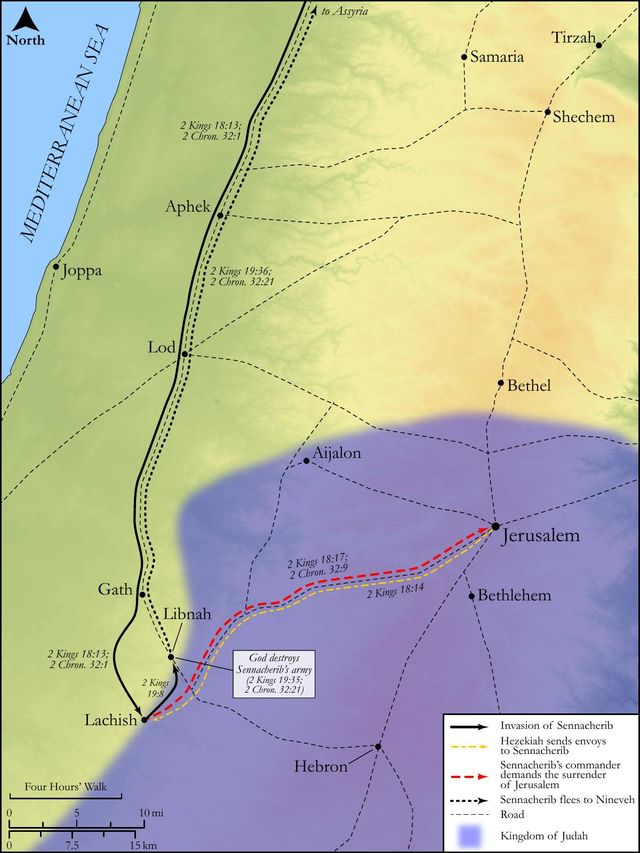
1.By the providence of God while he lived. He had exceeding much riches and honour (Ch2 32:27), replenished his stores, victualled his campus, fortified his city, and did all he wished to do; for God had given him very much substance, Ch2 32:29. Among his great performances, his turning the water-course of Gihon is mentioned (Ch2 32:30), which was done upon occasion of Sennacherib's invasion, Ch2 32:3, Ch2 32:4. The water had come into that which is called the old pool (Isa 22:11) and the upper pool (Isa 7:3); but he gathered the waters into a new place, for the greater convenience of the city, called the lower pool, Isa 22:9. And, in general, he prospered in all his works, for they were good works.
2.By the respect paid to his memory when he was dead.
(1.)The prophet Isaiah wrote his life and reign (Ch2 32:32), his acts and his goodness or piety, or which it is part of the honour to be recorded and remembered, for examples to others.
(2.)The people did him honour at his death (Ch2 32:33), buried him in the chief of the sepulchres, made as great a burning for him as for Asa, or, which is a much greater honour, made great lamentation for him, as for Josiah. See how the honour of serious godliness is manifested in the consciences of men. Though it is to be feared that the generality of the people did not heartily comply with the reforming kings, yet they could not but praise their endeavours for reformation, and the memory of those kings was blessed among them. It is a debt we owe to those who have been eminently useful in their day to do them honour at their death, when they are out of the reach of flattery and we have seen the end of their conversation. The due payment of this debt will be an encouragement to others to do likewise.
Continue studying 2 Chronicles 32:33 across the web’s major study libraries — every link below opens this exact verse, chapter, or book on the destination site.
Read & Compare
 BibleGatewayThis verse in more than 200 translations and 70 languages.
 Bible.comThe YouVersion reader — hundreds of translations, reading plans, and highlights.
 ESV.orgCrossway's official English Standard Version reader.
 NET BibleThe NET translation with 60,000+ translators' notes on every rendering decision.
 STEP BibleTyndale House's free study tool — original text, vocabulary, and scholarly resources.
 BibliaLogos Bible Software's free web reader.
 USCCBThe New American Bible (Revised Edition) with the U.S. bishops' study notes.
Commentaries
 BibleHub CommentariesDozens of classic commentaries on this verse, gathered on one page.
 StudyLightMore than 100 commentary sets — the largest collection on the web.
 BibleRefPlain-English commentary on what this verse means, verse by verse.
 Enduring WordDavid Guzik's free commentary on this chapter, widely used by Bible teachers.
 Bible Study ToolsVerse commentary alongside Greek and Hebrew study aids.
Original Language & Research
- BibleHub InterlinearThe verse word by word — original language, transliteration, and English.
- BibleHub LexiconEvery word's original-language definition and Strong's entry.
 Blue Letter BibleDeep-study tools — Strong's numbers, concordance, and word studies.
 SefariaThe Hebrew text with Rashi and centuries of Jewish commentary.
Sermons, Hymns & Audio


TrulyRandomVerse is not affiliated with these sites and doesn’t control their content. They’re linked because they’re genuinely useful.
Summary
2 Chronicles 32:33 meticulously records the dignified conclusion to King Hezekiah's reign, a monarch celebrated for his unwavering faith, profound spiritual reforms, and God-given deliverance during national crises. The verse details his peaceful passing, his highly esteemed burial in the most prominent section of the Davidic royal tombs, and the widespread honor bestowed upon him by all Judah and the inhabitants of Jerusalem. This moment of commendation, however, is immediately juxtaposed with the succession of his son, Manasseh, a transition that ominously foreshadows a drastic and devastating spiritual decline for the nation, highlighting the fragile nature of inherited spiritual legacy.
Context
ShowHideLiterary Context
This verse serves as the concluding summary of King Hezekiah's extensive narrative within 2 Chronicles, following a detailed account of his remarkable reign. Chapter 32, in particular, highlights his steadfast faith during the formidable Assyrian invasion led by Sennacherib, his miraculous recovery from a life-threatening illness, and his subsequent struggle with pride, culminating in a period of humbling and repentance (2 Chronicles 32:24-26). The Chronicler meticulously portrays Hezekiah as a righteous king, a stark contrast to his unfaithful father, Ahaz, whose ignominious burial is noted in 2 Chronicles 28:27. The immediate mention of Manasseh's succession in the same verse creates a powerful narrative transition, setting the stage for the unparalleled wickedness that would characterize the next chapter of Judah's history, emphasizing the cyclical nature of faithfulness and apostasy in the Davidic line.
Historical & Cultural Context
In ancient Israel, the manner of a king's burial was a significant indicator of his legacy and divine favor. To "sleep with his fathers" was a common euphemism for a peaceful death, implying a natural end to a life and joining one's ancestors in the grave. The phrase "chiefest of the sepulchres of the sons of David" points to a highly distinguished burial site, likely within or adjacent to the royal necropolis in the City of David. This was not a universal privilege; unfaithful kings like Ahaz (2 Chronicles 28:27) or Joash (2 Chronicles 24:25) were denied burial in the royal tombs, signifying divine displeasure and public disdain. The widespread honor shown by "all Judah and the inhabitants of Jerusalem" underscores the profound respect and admiration Hezekiah had garnered, reflecting a collective acknowledgment of his righteous leadership and the blessings it brought to the nation, especially after the Assyrian threat.
Key Themes
ShowHideThis verse encapsulates several pivotal themes central to the Chronicler's theological agenda. Firstly, it underscores the theme of Divine Honor and Blessing, demonstrating that God honors those who honor Him, as articulated in 1 Samuel 2:30. Hezekiah's distinguished burial and the public homage reflect God's favor upon a king who diligently sought Him and initiated widespread spiritual reforms throughout his reign (2 Chronicles 29:3). Secondly, it highlights the Legacy of Righteous Leadership, showcasing how a king's faithfulness can profoundly impact a nation's spiritual and moral trajectory, leaving an enduring positive mark. Finally, the abrupt transition to Manasseh introduces the theme of Generational Responsibility and Spiritual Contrast. Despite Hezekiah's profound spiritual achievements, the immediate succession of a notoriously wicked son illustrates the fragile nature of spiritual gains and the critical need for each generation to actively pursue faithfulness to God, as the piety of one generation does not guarantee the devotion of the next (2 Chronicles 33:1-9).
Exposition and Analysis
ShowHideKey Word Analysis
ShowHideThis primitive root verb (H7901) literally means "to lie down," but is commonly employed as a euphemism for death, particularly for kings and patriarchs. It conveys a sense of peaceful passing and joining one's ancestors, implying a natural and accepted end to a monarch's life and reign, rather than a violent or untimely demise.
Derived from the root meaning "to go up" (H4608), this term denotes an elevation, ascent, or highest place. In this context, it signifies the most prominent, elevated, or honorable section within the royal burial grounds. This detail underscores a burial place of exceptional distinction, setting Hezekiah apart from kings who received less honorable interments due to their unfaithfulness, even if still within the City of David.
From a root meaning "to be heavy" (H3519), this word figuratively denotes weight, splendor, or copiousness, extending to concepts of glory and honor. Here, it indicates that "all Judah and the inhabitants of Jerusalem" showed profound reverence, respect, and possibly engaged in significant public mourning rituals for Hezekiah. This widespread public display of honor underscores the deep recognition of his righteous character and the positive impact of his reign on the nation.
Verse Breakdown
ShowHide"And Hezekiah slept with his fathers"
This clause signifies the peaceful and natural death of King Hezekiah, employing a common biblical idiom for the passing of monarchs. It implies a dignified end to his life, free from violent overthrow or divine judgment in his final moments, a testament to his overall righteous walk with God.
"and they buried him in the chiefest of the sepulchres of the sons of David"
This phrase details the exceptional honor bestowed upon Hezekiah in his burial. Unlike some unfaithful kings who were denied burial in the royal tombs or received less distinguished interments, Hezekiah was interred in the most prominent or distinguished section of the Davidic royal necropolis, signifying a profound level of respect and divine approval for his righteous reign.
"and all Judah and the inhabitants of Jerusalem did him honour at his death"
This clause emphasizes the widespread public mourning and profound respect shown to Hezekiah. The entire nation, particularly the people of Jerusalem, collectively acknowledged and celebrated his life and legacy, a powerful testament to his positive influence and the spiritual revival he spearheaded.
"And Manasseh his son reigned in his stead"
This final clause abruptly shifts the narrative focus to Hezekiah's successor. The immediate mention of Manasseh, without further immediate detail, serves as a stark and ominous transition, foreshadowing the dramatic and devastating spiritual decline that would characterize his reign, contrasting sharply with his father's righteousness and highlighting the fragility of spiritual legacy across generations.
Literary Devices
ShowHideThe verse employs several significant literary devices. The phrase "slept with his fathers" is a classic euphemism for death, softening the stark reality of passing and emphasizing a peaceful, natural end to life. More powerfully, the verse utilizes juxtaposition and contrast. The detailed description of Hezekiah's honorable death and burial is immediately followed by the simple, factual statement of Manasseh's succession. This abrupt transition creates a stark dramatic irony for the reader, who, knowing the subsequent narrative, understands that Manasseh would lead Judah into unprecedented idolatry and wickedness, undoing much of Hezekiah's righteous work. The "chiefest of the sepulchres" serves as symbolism, representing divine approval and public recognition of Hezekiah's exceptional faithfulness and the positive impact of his reign, a stark counterpoint to the less honorable burials of unfaithful kings.
Theological and Thematic Connections
ShowHideThe dignified conclusion to Hezekiah's reign, marked by exceptional honor in burial and widespread public respect, powerfully illustrates the biblical principle that "those who honor me I will honor" (1 Samuel 2:30). Hezekiah's life was characterized by a deep commitment to God, leading to national revival and deliverance, and his death reflected the divine favor he had cultivated. This verse underscores the profound impact of righteous leadership, demonstrating how one individual's faithfulness can profoundly shape the spiritual destiny of a nation. However, the immediate mention of Manasseh's succession serves as a sobering reminder of the fragility of spiritual legacy across generations. While Hezekiah built up Judah's spiritual health, the subsequent reign would see it plummet into deep apostasy, highlighting that spiritual vibrancy is not automatically inherited but requires continuous, personal commitment and a fresh pursuit of God by each successive generation.
Reflection and Application
ShowHideHezekiah's honorable end serves as a profound testament to the enduring impact of a life lived in devotion to God. His legacy reminds us that true honor is not merely about worldly acclaim, but about the respect earned through faithfulness to divine principles and the positive influence we exert on those around us. This passage challenges us to consider the kind of legacy we are building—not just for our immediate families, but for our communities and future generations. The stark contrast between Hezekiah and Manasseh also compels us to recognize the profound responsibility of leadership, whether in the home, church, or workplace, for good or for ill. Ultimately, it is a call to personal accountability: while we can be inspired by the faith of others, spiritual vibrancy is not inherited; each individual must cultivate their own active, living relationship with God, ensuring that the spiritual gains of one generation are not squandered by the next, but rather built upon and expanded for God's glory.
Questions for Reflection
ShowHideFAQ
ShowHideWhy was Hezekiah buried with such honor compared to other kings?
ShowHideHezekiah was buried with exceptional honor because of his exemplary righteousness and unwavering devotion to God throughout his reign. Unlike many other kings of Judah, Hezekiah initiated widespread spiritual reforms, cleansing the temple, restoring proper worship, and leading the nation back to the Lord (2 Chronicles 29). He also demonstrated profound faith during the formidable Assyrian invasion, trusting God for deliverance when Jerusalem was besieged (2 Chronicles 32:7-8). This faithfulness earned him divine favor and the deep respect of his people, resulting in a burial in the "chiefest of the sepulchres," a distinction not afforded to unfaithful kings like his father Ahaz (2 Chronicles 28:27).
What does "slept with his fathers" mean?
ShowHide"Slept with his fathers" is a common biblical euphemism for death, particularly used in the Old Testament when referring to the peaceful passing of kings and patriarchs. It signifies a natural and dignified end to life, rather than a violent overthrow or untimely death. The phrase implies that the deceased has joined their ancestors in the grave, indicating a continuity of lineage and a natural conclusion to their earthly existence. It does not carry any theological implication about the state of the soul after death, but simply describes the physical act of dying and being laid to rest.
How does Manasseh's succession immediately after Hezekiah's death impact the narrative?
ShowHideThe immediate mention of Manasseh's succession creates a stark and poignant contrast that profoundly impacts the narrative. Hezekiah's reign was a period of significant spiritual revival and national blessing, marked by his righteousness and trust in God. However, Manasseh, his son, would become one of Judah's most wicked kings, leading the nation into unprecedented idolatry, child sacrifice, and bloodshed (2 Chronicles 33:1-9). This abrupt transition highlights the fragility of spiritual gains across generations and the critical importance of individual choice and faithfulness. It serves as a sobering reminder that even the most godly leadership cannot guarantee the spiritual trajectory of the next generation, underscoring the constant need for personal commitment to God and the potential for rapid decline if that commitment is absent.
Christ-Centered Fulfillment
ShowHideThe honorable end of King Hezekiah, a righteous "son of David" (Matthew 1:1), foreshadows the ultimate King, Jesus Christ, who perfectly embodies the ideal of righteous leadership. While Hezekiah's reign, though commendable, was temporary and his legacy ultimately followed by the tragic apostasy of his son Manasseh, Jesus' reign is eternal and His spiritual kingdom will never pass away (Luke 1:33). Hezekiah's distinguished burial in the "chiefest of the sepulchres" speaks to the honor bestowed upon a faithful servant, yet it pales in comparison to the ultimate honor and exaltation of Christ, who, after His atoning work, was "highly exalted" by God (Philippians 2:9). Jesus, the true Lamb of God who takes away the sin of the world, "slept with his fathers" in death, but His burial was not an end but a prelude to resurrection and triumph over the grave, swallowing up death in victory (1 Corinthians 15:54). Unlike Manasseh, who brought spiritual decline, Jesus inaugurates an everlasting reign of righteousness, becoming "the Lord Our Righteousness" (Jeremiah 23:6) for all who believe. He is the King of kings and Lord of lords, whose perfect life, atoning death, and glorious resurrection secure an eternal legacy of salvation and spiritual flourishing for His people, a legacy that will never be undone by subsequent generations or human failings.