


John 11:22
- ἀλλὰallaNeverthelessG235CONJConjunction
- καὶkaievenG2532CONJConjunction
- νῦνnunnowG3568ADVAdverb
- οἶδαoidaI knowG1492V-RAI-1SVerb Perfect Active Indicative 1st Singular
- ὅτιhotithatG3754CONJConjunction
- ὅσαhosaas much asG3745K-APNCorrelative pronoun Accusative Plural Neuter
- ἂνanmaybeG302PRTParticle or Disjunctive
- αἰτήσῃaitēsēYou may askG154V-AMS-2SVerb Aorist Middle Subjunctive 2nd Singular
- τὸνton<the>G3588T-ASMDefinite article Accusative Singular Masculine
- θεὸνtheonGodG2316N-ASM-TNoun Accusative Singular Masculine Title
- δώσειdōseiwill giveG1325V-FAI-3SVerb Future Active Indicative 3rd Singular
- σοιsoiYouG4771P-2DSPersonal pronoun Dative 2nd Singular
- ὁho<the>G3588T-NSMDefinite article Nominative Singular Masculine
- θεόςtheosGodG2316N-NSM-TNoun Nominative Singular Masculine Title
English is a literal word-by-word gloss of the Greek, not the KJV's wording. Why?
This is the original text the KJV's translators worked from — each Greek word with its own literal English meaning in this verse, prepared by scholars at Tyndale House, Cambridge. The KJV translates whole sentences, not word by word, so its wording differs: one Greek word can become several English words, and the KJV may choose “charity” where the gloss reads “love”. Both are faithful — they answer different questions. For the KJV's own rendering, switch to the KJV text.
Details
See on the biblical-era map
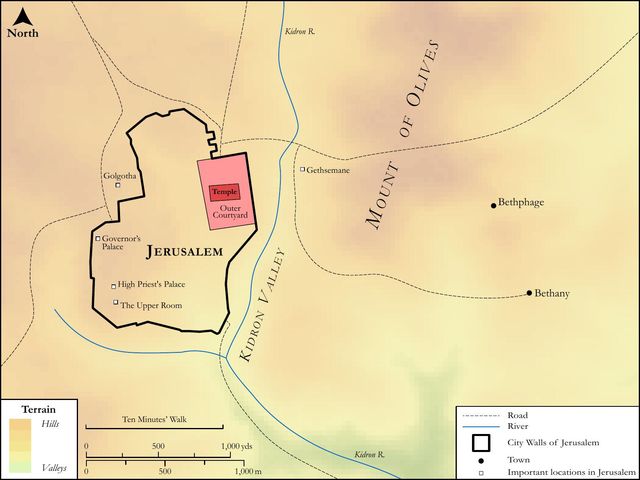
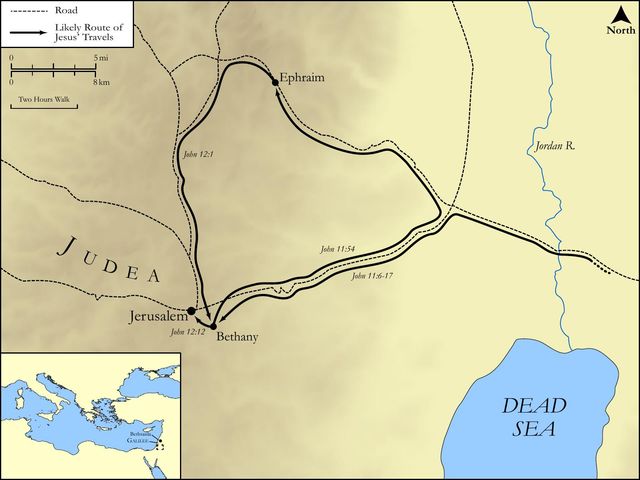
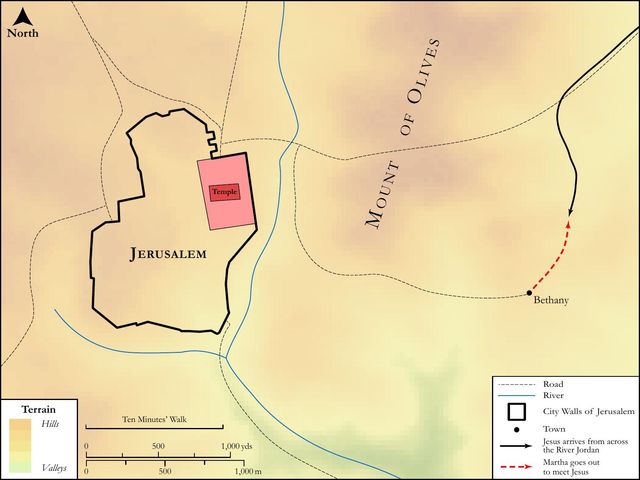
Study this verse
Public-domain commentary
Matthew Henry
From his Commentary on the Whole Bible. Henry comments on passages, not single verses — this entry covers John 11:17–32. His four-level outline is real structure in the source text, so it is rendered as structure.
The matter being determined, that Christ will go to Judea, and his disciples with him, they address themselves to their journey; in this journey some circumstances happened which the other evangelists record, as the healing of the blind man at Jericho, and the conversion of Zaccheus. We must not reckon ourselves out of our way, while we are in the way of doing good; nor be so intent upon one good office as to neglect another.
At length, he comes near to Bethany, which is said to be about fifteen furlongs from Jerusalem, about two measured miles, Joh 11:18. Notice is taken of this, that this miracle was in effect wrought in Jerusalem, and so was put to her score. Christ's miracles in Galilee were more numerous, but those in or near Jerusalem were more illustrious; there he healed one that had been diseased thirty-eight years, another that had been blind from his birth, and raised one that had been dead four days. To Bethany Christ came, and observe,
I.What posture he found his friends there in.
When he had been last with them it is probable that he left them well, in health and joy; but when we part from our friends (though Christ knew) we know not what changes may affect us or them before we meet again.
1.He found his friend Lazarus in the grave, Joh 11:17. When he came near the town, probably by the burying-place belonging to the town, he was told by the neighbours, or some persons whom he met, that Lazarus had been four days buried. Some think that Lazarus died the same day that the messenger came to Jesus with the tidings of his sickness, and so reckon two days for his abode in the same place and two days for his journey. I rather think that Lazarus died at the very instant that Jesus, "Our friend sleepeth, he is now newly fallen asleep;" and that the time between his death and burial (which among the Jews was but short), with the four days of his lying in the grave, was taken up in this journey; for Christ travelled publicly, as appears by his passing through Jericho, and his abode at Zaccheus's house took up some time. Promised salvations, though they always come surely, yet often come slowly.
2.He found his friends that survived in grief. Martha and Mary were almost swallowed up with sorrow for the death of their brother, which is intimated where it is said that many of the Jews came to Martha and Mary to comfort them. Note,
(1.)Ordinarily, where death is there are mourners, especially when those that were agreeable and amiable to their relations, and serviceable to their generation, are taken away. The house where death is called the house of mourning, Ecc 7:2. When man goes to his long home the mourners go about the streets (Ecc 12:5), or rather sit alone, and keep silence. Here was Martha's house, a house where the fear of God was, and on which his blessing rested, yet made a house of mourning. Grace will keep sorrow from the heart (Joh 14:1), not from the house.
(2.)Where there are mourners there ought to be comforters. It is a duty we owe to those that are in sorrow to mourn with them, and to comfort them; and our mourning with them will be some comfort to them. When we are under the present impressions of grief, we are apt to forget those things which would minister comfort to us, and therefore have need of remembrancers. It is a mercy to have remembrancers when we are in sorrow, and our duty to be remembrancers to those who are in sorrow. The Jewish doctors laid great stress upon this, obliging their disciples to make conscience of comforting the mourners after the burial of the dead. They comforted them concerning their brother, that is, by speaking to them of him, not only of the good name he left behind, but of the happy state he was gone to. When godly relations and friends are taken from us, whatever occasion we have to be afflicted concerning ourselves, who are left behind and miss them, we have reason to be comforted concerning those who are gone before us to a happiness where they have no need of us. This visit which the Jews made to Martha and Mary is an evidence that they were persons of distinction, and made a figure; as also that they behaved obligingly to all; so that though they were followers of Christ, yet those who had no respect for him were civil to them. There was also a providence in it, that so many Jews, Jewish ladies it is probable, should come together, just at this time, to comfort the mourners, that they might be unexceptionable witnesses of the miracle, and see what miserable comforters they were, in comparison with Christ. Christ did not usually send for witnesses to his miracles, and yet had none been by but relations this would have been excepted against; therefore God's counsel so ordered it that these should come together accidentally, to bear their testimony to it, that infidelity might stop her mouth.
II.What passed between him and his surviving friends at this interview.
When Christ defers his visits for a time they are thereby made the more acceptable, much the more welcome; so it was here. His departures endear his returns, and his absence teaches us how to value his presence. We have here,
1.The interview between Christ and Martha.
(1.)We are told that she went and met him, Joh 11:20.
[1.]It should seem that Martha was earnestly expecting Christ's arrival, and enquiring for it. Either she had sent out messengers, to bring her tidings of his first approach, or she had often asked, Saw you him whom my soul loveth? so that the first who discovered him ran to her with the welcome news. However it was, she heard of his coming before he arrived. She had waited long, and often asked, Is he come? and could hear no tidings of him; but long-looked-for came at last. At the end the vision will speak, and not lie.
[2.]Martha, when the good news was brought that Jesus was coming, threw all aside, and went and met him, in token of a most affectionate welcome. She waived all ceremony and compliment to the Jews who came to visit her, and hastened to go and meet Jesus. Note, When God by his grace or providence is coming towards us in ways of mercy and comfort, we should go forth by faith, hope, and prayer to meet him. Some suggest that Martha went out of the town to meet Jesus, to let him know that there were several Jews in the house, who were no friends to him, that if he pleased he might keep out of the way of them.
[3.]When Martha went to meet Jesus, Mary sat still in the house. Some think she did not hear the tidings, being in her drawing-room, receiving visits of condolence, while Martha who was busied in the household-affairs had early notice of it. Perhaps Martha would not tell her sister that Christ was coming, being ambitious of the honour of receiving him first. Sancta est prudentia clam fratribus clam parentibus ad Christum esse conferre - Holy prudence conducts us to Christ, while brethren and parents know not what we are doing. - Maldonat. in locum. Others think she did hear that Christ was come, but was so overwhelmed with sorrow that she did not care to stir, choosing rather to indulge her sorrow, and to sit poring upon her affliction, and saying, I do well to mourn. Comparing this story with that in Luk 10:38, etc., we may observe the different tempers of these two sisters, and the temptations and advantages of each. Martha's natural temper was active and busy; she loved to be here and there, and at the end of every thing; and this had been a snare to her when by it she was not only careful and cumbered about many things, but hindered from the exercises of devotion: but now in a day of affliction this active temper did her a kindness, kept the grief from her heart, and made her forward to meet Christ, and so she received comfort from him the sooner. On the other hand, Mary's natural temper was contemplative and reserved. This had been formerly an advantage to her, when it placed her Christ's feet, to hear his word, and enabled her there to attend upon him without those distractions with which Martha was cumbered; but now in the day of affliction that same temper proved a snare to her, made her less able to grapple with her grief, and disposed her to melancholy: But Mary sat still in the house. See here how much it will be our wisdom carefully to watch against the temptations, and improve the advantages, of our natural temper.
(2.)Here is fully related the discourse between Christ and Martha.
[1.]Martha's address to Christ, Joh 11:21, Joh 11:22.
First, She complains of Christ's long absence and delay. She said it, not only with grief for the death of her brother, but with some resentment of the seeming unkindness of the Master: Lord if you hadst been here, my brother had not died. Here is, 1. Some evidence of faith. She believed Christ's power, that, though her brother's sickness was very grievous, yet he could have cured it, and so have prevented his death. She believed his pity, that if he had but seen Lazarus in his extreme illness, and his dear relations all in tears about him, he would have had compassion, and have prevented so sad a breach, for his compassions fail not. But, 2. Here are sad instances of unbelief. Her faith was true, but weak as a bruised reed, for she limits the power of Christ, in saying, If thou hadst been here; whereas she ought to have known that Christ could cure at a distance, and that his gracious operations were not limited to his bodily presence. She reflects likewise upon the wisdom and kindness of Christ, that he did not hasten to them when they sent for him, as if he had not timed his business well, and now might as well have staid away, and not have come at all, as to come too late; and, as for any help now, she can scarcely entertain the thought of it.
Secondly, Yet she corrects and comforts herself with the thoughts of the prevailing interest Christ had in heaven; at least, she blames herself for blaming her Master, and for suggesting that he comes too late: for I know that even now, desperate as the case is, whatsoever thou wilt ask of God, God will give it to thee. Observe, 1. How willing her hope was. Though she had not courage to ask of Jesus that he should raise him to life again, there having been no precedent as yet of any one raised to life that had been so long dead, yet, like a modest petitioner, she humbly recommends the case to the wise and compassionate consideration of the Lord Jesus. When we know not what in particular to ask or expect, let us in general refer ourselves to God, let him do as seemeth him good. Judicii tui est, non praesumptionis meae - I leave it to thy judgment, not to my presumption. - Aug. in locum. When we know not what to pray for, it is our comfort that the great Intercessor knows what to ask for us, and is always heard. 2. How weak her faith was. She should have said, "Lord, thou canst do whatsoever thou wilt;" but she only says, "Thou canst obtain whatsoever thou prayest for." She had forgotten that the Son had life in himself, that he wrought miracles by his own power. Yet both these considerations must be taken in for the encouragement of our faith and hope, and neither excluded: the dominion Christ has on earth and his interest and intercession in heaven. He has in the one hand the golden sceptre, and in the other the golden censer; his power is always predominant, his intercession always prevalent.
[2.]The comfortable word which Christ gave to Martha, in an answer to her pathetic address (Joh 11:23): Jesus saith unto her, Thy brother shall rise again. Martha, in her complaint, looked back, reflecting with regret that Christ was not there, for then, thinks she, my brother had been now alive. We are apt, in such cases, to add to our own trouble, by fancying what might have been. "If such a method had been taken, such a physician employed, my friend had not died;" which is more than we know: but what good does this do? When God's will is done, our business is to submit to him. Christ directs Martha, and us in her, to look forward, and to think what shall be, for that is a certainty, and yields sure comfort: Thy brother shall rise again. First, This was true of Lazarus in a sense peculiar to him: he was now presently to be raised; but Christ speaks of it in general as a thing to be done, not which he himself would do, so humbly did our Lord Jesus speak of what he did. He also expresses it ambiguously, leaving her uncertain at first whether he would raise him presently or not till the last day, that he might try her faith and patience. Secondly, It is applicable to all the saints, and their resurrection at the last day. Note, It is a matter of comfort to us, when we have buried our godly friends and relations, to think that they shall rise again. As the soul at death is not lost, but gone before, so the body is not lost, but laid up. Think you hear Christ saying, "Thy parent, thy child, thy yoke-fellow, shall rise again; these dry bones shall live."
[3.]The faith which Martha mixed with this word, and the unbelief mixed with this faith, Joh 11:24.
First, She accounts it a faithful saying that he shall rise again at the last day. Though the doctrine of the resurrection was to have its full proof from Christ's resurrection, yet, as it was already revealed, she firmly believed it, Act 24:15. 1. That there shall be a last day, with which all the days of time shall be numbered and finished. 2. That there shall be a general resurrection at that day, when the earth and sea shall give up their dead. 3. That there shall be a particular resurrection of each one: "I know that I shall rise again, and this and the other relation that was dear to me." As bone shall return to his bone in that day, so friend to his friend.
Secondly, Yet she seems to think this saying not so well worthy of all acceptation as really it was: "I know he shall rise again at the last day; but what are we the better for that now?" As if the comforts of the resurrection to eternal life were not worth speaking of, or yielded not satisfaction sufficient to balance her affliction. See our weakness and folly, that we suffer present sensible things to make a deeper impression upon us, both of grief and joy, than those things which are the objects of faith. I know that he shall rise again at the last day; and is not this enough? She seems to think it is not. Thus, by our discontent under present crosses, we greatly undervalue our future hopes, and put a slight upon them, as if not worth regarding.
[4.]The further instruction and encouragement which Jesus Christ gave her; for he will not quench the smoking flax nor break the bruised reed. He said to her, I am the resurrection and the life, Joh 11:25, Joh 11:26. Two things Christ possesses her with the belief of, in reference to the present distress; and they are the things which our faith should fasten upon in the like cases.
First, The power of Christ, his sovereign power: I am the resurrection and the life, the fountain of life, and the head and author of the resurrection. Martha believed that at his prayer God would give any thing, but he would have her know that by his word he could work anything. Martha believed a resurrection at the last day; Christ tells her that he had that power lodged in his own hand, that the dead were to hear his voice (Joh 5:25), whence it was easy to infer, He that could raise a world of men that had been dead many ages could doubtless raise one man that had been dead but four days. Note, It is an unspeakable comfort to all good Christians that Jesus Christ is the resurrection and the life, and will be so to them. Resurrection is a return to life; Christ is the author of that return, and of that life to which it is a return. We look for the resurrection of the dead and the life of the world to come, and Christ is both; the author and principle of both, and the ground of our hope of both.
Secondly, The promises of the new covenant, which give us further ground of hope that we shall live. Observe,
a.To whom these promises are made - to those that believe in Jesus Christ, to those that consent to, and confide in, Jesus Christ as the only Mediator of reconciliation and communion between God and man, that receive the record God has given in his word concerning his Son, sincerely comply with it, and answer all the great intentions of it. The condition of the latter promise is thus expressed: Whosoever liveth and believeth in me, which may be understood, either, (a.) Of natural life: Whosoever lives in this world, whether he be Jew or Gentile, wherever he lives, if he believe in Christ, he shall live by him. Yet it limits the time: Whoever during life, while he is here in this state of probation, believes in me, shall be happy in me, but after death it will be too late. Whoever lives and believes, that is, lives by faith (Gal 2:20), has a faith that influences his conversation. Or, (b.) Of spiritual life: He that lives and believes is he that by faith is born again to a heavenly and divine life, to whom to live is Christ - that makes Christ the life of his soul.
b.What the promises are (Joh 11:25): Though he die, yet shall he live, nay, he shall never die, Joh 11:26. Man consists of body and soul, and provision is made for the happiness of both.
(a.)For the body; here is the promise of a blessed resurrection. Though the body be dead because of sin (there is no remedy but it will die), yet it shall live again. All the difficulties that attend the state of the dead are here overlooked, and made nothing of. Though the sentence of death was just, though the effects of death be dismal, though the bands of death be strong, though he be dead and buried, dead and putrefied, though the scattered dust be so mixed with common dust that no art of man can distinguish, much less separate them, put the case as strongly as you will on that side, yet we are sure that he shall live again: the body shall be raised a glorious body.
(b.)For the soul; here is the promise of a blessed immortality. He that liveth and believeth, who, being united to Christ by faith, lives spiritually by virtue of that union, he shall never die. That spiritual life shall never be extinguished, but perfected in eternal life. As the soul, being in its nature spiritual, is therefore immortal; so if by faith it live a spiritual life, consonant to its nature, its felicity shall be immortal too. It shall never die, shall never be otherwise than easy and happy, and there is not any intermission or interruption of its life, as there is of the life of the body. The mortality of the body shall at length be swallowed up of life; but the life of the soul, the believing soul, shall be immediately at death swallowed up of immortality. He shall not die, eis ton aiōna, for ever - Non morietur in aeternum; so Cyprian quotes it. The body shall not be for ever dead in the grave; it dies (like the two witnesses) but for a time, times, and the dividing of time; and when time shall be no more, and all the divisions of it shall be numbered and finished, a spirit of life from God shall enter into it. But this is not all; the souls shall not die that death which is for ever, shall not die eternally, Blessed and holy, that is, blessed and happy, is he that by faith has part in the first resurrection, has part in Christ, who is that resurrection; for on such the second death, which is a death for ever, shall have no power; see Joh 6:40. Christ asks her, "Believest thou this? Canst thou assent to it with application? Canst thou take my word for it?" Note, When we have read or heard the word of Christ, concerning the great things of the other world, we should seriously put it to ourselves, "Do we believe this, this truth in particular, this which is attended with so many difficulties, this which is suited to my case? Does my belief of it realize it to me, and give my soul an assurance of it, so that I can say not only this I believe, but thus I believe it?" Martha was doting upon her brother's being raised in this world; before Christ gave her hopes of this, he directed her thoughts to another life, another world: "No matter for that, but believest thou this that I tell thee concerning the future state?" The crosses and comforts of this present time would not make such an impression upon us as they do if we did but believe the things of eternity as we ought.
[5.]Martha's unfeigned assent yielded to what Christ said, Joh 11:27. We have here Martha's creed, the good confession she witnessed, the same with that for which Peter was commended (Mat 16:16, Mat 16:17), and it is the conclusion of the whole matter.
First, Here is the guide of her faith, and that is the word of Christ; without any alteration, exception, or proviso, she takes it entire as Christ had said it: Yea, Lord, whereby she subscribes to the truth of all and every part of that which Christ had promised, in his own sense: Even so. Faith is an echo to divine revelation, returns the same words, and resolves to abide by them: Yea, Lord, As the word did make it so I believe and take it, said queen Elizabeth.
Secondly, The ground of her faith, and that is the authority of Christ; she believes this because she believes that he who saith it is Christ. She has recourse to the foundation for the support of the superstructure. I believe, pepisteuka, "I have believed that thou art Christ, and therefore I do believe this." Observe here,
a.What she believed and confessed concerning Jesus; three things, all to the same effect: - (a.) That he was the Christ, or Messiah, promised and expected under this name and notion, the anointed one. (b.) That he was the Son of God; so the Messiah was called (Psa 2:7), not by office only, but by nature. (c.) That it was he who should come into the world, the ho erchomenos. That blessing of blessings which the church had for so many ages waited for as future, she embraced as present.
b.What she inferred hence, and what she alleged this for. If she admits this, that Jesus is the Christ, there is no difficulty in believing that he is the resurrection and the life; for if he be the Christ, then, (a.) He is the fountain of light and truth, and we may take all his sayings for faithful and divine, upon his own word. If he be the Christ, he is that prophet whom we are to hear in all things. (b.) He is the fountain of life and blessedness, and we may therefore depend upon his ability as well as upon his veracity. How shall bodies, turned to dust, live again? How shall souls, clogged and clouded as ours are, live for ever? We could not believe this, but that we believe him that undertakes it to be the Son of God, who has life in himself, and has it for us.
2.The interview between Christ and Mary the other sister. And here observe,
(1.)The notice which Martha gave her of Christ's coming (Joh 11:28): When she had so said, as one that needed to say no more, she went her way, easy in her mind, and called Mary her sister.
[1.]Martha, having received instruction and comfort from Christ herself, called her sister to share with her. Time was when Martha would have drawn Mary from Christ, to come and help her in much serving (Luk 10:40); but, to make her amends for this, here she is industrious to draw her to Christ.
[2.]She called her secretly, and whispered it in her ear, because there was company by, Jews, who were no friends to Christ. The saints are called into the fellowship of Jesus Christ by an invitation that is secret and distinguishing, given to them and not to others; they have meat to eat that the world knows not of, joy that a stranger does not intermeddle with.
[3.]She called her by order from Christ; he bade her go call her sister. This call that is effectual, whoever brings it, is sent by Christ. The Master is come, and calleth for thee. First, She calls Christ the Master, didaskalos, a teaching master; by that title he was commonly called and known among them. Mr. George Herbert took pleasure in calling Christ, my Master. Secondly, She triumphs in his arrival: The Master is come. He whom we have long wished and waited for, he is come, he is come; this was the best cordial in the present distress. "Lazarus is gone, and our comfort in him is gone; but the Master is come, who is better than the dearest friend, and has that in him which will abundantly make up all our losses. He is come who is our teacher, who will teach us how to get good by our sorrow (Psa 94:12), who will teach, and so comfort." Thirdly, She invites her sister to go and meet him: "He calls for thee, enquires what is become of thee, and would have thee sent for." Note, When Christ our Master comes, he calls for us. He comes in his word and ordinances, calls us to them, calls us by them, calls us to himself. He calls for thee in particular, for thee by name (Psa 27:8); and, if he call thee, he will cure thee, he will comfort thee.
(2.)The haste which Mary made to Christ upon this notice given her (Joh 11:29): As soon as she heard this good news, that the Master was come, she arose quickly, and came to him. She little thought how near he was to her, for he is often nearer to them that mourn in Zion than they are aware of; but, when she knew how near he was, she started up, and in a transport of joy ran to meet him. The least intimation of Christ's gracious approaches is enough to a lively faith, which stands ready to take the hint, and answer the first call. When Christ was come,
[1.]She did not consult the decorum of her mourning, but, forgetting ceremony, and the common usage in such cases, she ran through the town, to meet Christ. Let no nice punctilios of decency and honour deprive us at any time of opportunities of conversing with Christ.
[2.]She did not consult her neighbours, the Jews that were with her, comforting her; she left them all, to come to him, and did not only not ask their advice, but not so much as ask their leave, or beg their pardon for her rudeness.
(3.)We are told (Joh 11:30) where she found the Master; he was not yet come into Bethany, but was at the town's end, in that place where Martha met him. See here,
[1.]Christ's love to his work. He staid near the place where the grave was, that he might be ready to go to it. He would not go into the town, to refresh himself after the fatigue of his journey, till he had done the work he came to do; nor would he go into the town, lest it should look like ostentation, and a design to levy a crowd to be spectators of the miracle.
[2.]Mary's love to Christ; still she loved much. Though Christ had seemed unkind in his delays, yet she could take nothing amiss from him. Let us go thus to Christ without the camp, Heb 13:13.
(4.)The misconstruction which the Jews that were with Mary made of her going away so hastily (Joh 11:31): They said, She goes to the grave, to weep there. Martha bore up better under this affliction than Mary did, who was a woman of a tender and sorrowful spirit; such was her natural temper. Those that are so have need to watch against melancholy, and ought to be pitied and helped. These comforters found that their formalities did her no service, but that she hardened herself in sorrow: and therefore concluded when she went out, and turned that way, it was to go to the grave and weep there. See,
[1.]What often is the folly and fault of mourners; they contrive how to aggravate their own grief, and to make bad worse. We are apt in such cases to take a strange pleasure in our own pain, and to say, We do well to be passionate in our grief, even unto death; we are apt to fasten upon those things that aggravate the affliction, and what good does this do us, when it is our duty to reconcile ourselves to the will of God in it? Why should mourners go to the grave to weep there, when they sorrow not as those that have no hope? Affliction of itself is grievous; why should we make it more so?
[2.]What is the wisdom and duty of comforters; and that is, to prevent as much as may be, in those who grieve inordinately, the revival of the sorrow, and to divert it. Those Jews that followed Mary were thereby led to Christ, and became the witnesses of one of his most glorious miracles. It is good cleaving to Christ's friends in their sorrows, for thereby we may come to know him better.
(5.)Mary's address to our Lord Jesus (Joh 11:32): She came, attended with her train of comforters, and fell down at his feet, as one overwhelmed with a passionate sorrow, and said with many tears (as appears Joh 11:33), Lord, if thou hadst been here, my brother had not died, as Martha said before, for they had often said it to one another. Now here,
[1.]Her posture is very humble and submissive: She fell down at his feet, which was more than Martha did, who had a greater command of her passions. She fell down not as a sinking mourner, but fell down at his feet as a humble petitioner. This Mary had sat at Christ's feet to hear his word (Luk 10:39), and here we find her there on another errand. Note, Those that in a day of peace place themselves at Christ's feet, to receive instructions from him, may with comfort and confidence in a day of trouble cast themselves at his feet with hope to find favour with him. She fell at his feet, as one submitting to his will in what was done, and referring herself to his good-will in what was now to be done. When we are in affliction we must cast ourselves at Christ's feet in a penitent sorrow and self-abasement for sin, and a patient resignation of ourselves to the divine disposal. Mary's casting herself at Christ's feet was in token of the profound respect and veneration she had for him. Thus subjects were wont to give honour to their kings and princes; but, our Lord Jesus not appearing in secular glory as an earthly prince, those who by this posture of adoration gave honour to him certainly looked upon him as more than man, and intended hereby to give him divine honour. Mary hereby made profession of the Christian faith as truly as Martha did, and in effect said, I believe that thou art the Christ; bowing the knee to Christ, and confessing him with the tongue, are put together as equivalent, Rom 14:11; Phi 2:10, Phi 2:11. This she did in presence of the Jews that attended her, who, though friends to her and her family, yet were bitter enemies to Christ; yet in their sight she fell at Christ's feet, as one that was neither ashamed to own the veneration she had for Christ nor afraid of disobliging her friends and neighbours by it. Let them resent it as they pleased, she falls at his feet; and, if this be to be vile, she will be yet more vile; see Sol 8:1. We serve a Master of whom we have no reason to be ashamed, and whose acceptance of our services is sufficient to balance the reproach of men and all their revilings.
[2.]Her address is very pathetic: Lord, if thou hadst been here, my brother had not died. Christ's delay was designed for the best, and proved so; yet both the sisters very indecently cast the same in his teeth, and in effect charge him with the death of their brother. This repeated challenge he might justly have resented, might have told them he had something else to do than to be at their beck and to attend them; he must come when his business would permit him: but not a word of this; he considered the circumstances of their affliction, and that losers think they may have leave to speak, and therefore overlooked the rudeness of this welcome, and gave us an example of mildness and meekness in such cases. Mary added no more, as Martha did; but it appears, by what follows, that what she fell short in words she made up in tears; she said less than Martha, but wept more; and tears of devout affection have a voice, a loud prevailing voice, in the ears of Christ; no rhetoric like this.
Historical interpretation
Historical reception
5 surviving comments on this verse. Each one is dated, so this reads as a timeline rather than a list.
Select a marker to jump to its quote. Markers stagger vertically where authors wrote within a few decades of each other.
(Hom. lxii. 3) Nor did she know that He wrought His miracles by His own independent power: But I know that even now, whatsoever Thou will ask of God, God will give it Thee. She only thinks Him some very gifted man.
(Tr. xlix. 13) She does not say to Him, Bring my brother to life again; for how could she know that it would be good for him to come to life again; she says, I know that Thou canst do so, if Thou wilt; but what Thou wilt do is for Thy judgment, not for my presumption to determine.
Among all the miracles wrought by our Lord Jesus Christ, the resurrection of Lazarus holds a foremost place in preaching. But if we consider attentively who did it, our duty is to rejoice rather than to wonder. A man was raised up by Him who made man: for He is the only One of the Father, by whom, as you know, all things were made. And if all things were made by Him, what wonder is it that one was raised by Him, when so many are daily brought into the world by His power? It is a greater deed to create men than to raise them again from the dead. Yet He deigned both to create and to raise again; to create all, to resuscitate some.
We have, however, read in the Gospel of three dead persons who were raised to life by the Lord, and, let us hope, to some good purpose. For surely the Lord's deeds are not merely deeds, but signs. And if they are signs, besides their wonderful character, they have some real significance: and to find out this in regard to such deeds is a somewhat harder task than to read or hear of them. We were listening with wonder, as at the sight of some mighty miracle enacted before our eyes, in the reading of the Gospel, how Lazarus was restored to life. If we turn our thoughts to the still more wonderful works of Christ, every one that believeth riseth again: if we all consider, and understand that more horrifying kind of death, every one who sinneth dies. But every man is afraid of the death of the flesh; few, of the death of the soul.
If, then, the Lord in the greatness of His grace and mercy raiseth our souls to life, that we may not die for ever, we may well understand that those three dead persons whom He raised in the body, have some figurative significance of that resurrection of the soul which is effected by faith: He raised up the ruler of the synagogue's daughter, while still lying in the house; He raised up the widow's young son, while being carried outside the gates of the city; and He raised up Lazarus, when four days in the grave. Let each one give heed to his own soul: in sinning he dies: sin is the death of the soul. But sometimes sin is committed only in thought. Thou hast felt delight in what is evil, thou hast assented to its commission; thou hast sinned: that assent has slain thee; but the death is internal, because the evil thought had not yet ripened into action.
"But Mary was she who anointed the Lord with ointment, and wiped His feet with her hair, whose brother Lazarus was sick. Therefore his sisters sent unto Him, saying." We now understand whither it was they sent, namely, where the Lord was; for He was away, as you know, beyond the Jordan. They sent messengers to the Lord to tell Him that their brother was ill. He delayed to heal, that He might be able to raise to life.
"But when Jesus heard that, He said, This sickness is not unto death, but for the glory of God, that the Son of God may be glorified." Such a glorifying of Himself did not add to His dignity, but benefited us. Hence He says, "is not unto death," because even that death itself was not unto death, but rather unto the working of a miracle whereby men might be led to faith in Christ, and so escape the real death. And mark how the Lord, as it were indirectly, called Himself God, for the sake of some who deny that the Son is God. For there are heretics who make such a denial, that the Son of God is God. Let them hearken here: "This sickness" He says. "is not unto death, but for the glory of God." For what glory? For the glory of what God? Hear what follows: "That the Son of God may be glorified."
"Jesus saith unto her, Thy brother shall rise again." This was ambiguous. For He said not, Even now I will raise thy brother; but, "Thy brother shall rise again. Martha saith unto Him, I know that he shall rise again in the resurrection, at the last day." Of that resurrection I am sure, but uncertain about this. "Jesus saith unto her, I am the resurrection." Thou sayest, My brother shall rise again at the last day: true; but by Him, through whom he shall rise then, can he rise even now, for "I," He says, "am the resurrection and the life." Give ear, brethren, give ear to what He says.
"He that believeth in me, though he were dead, yet shall he live: and whosoever liveth and believeth in me shall never die." What meaneth this? "He that believeth in me, though he were dead," just as Lazarus is dead, "yet shall he live;" for He is not the God of the dead, but of the living. Believe then, and though thou wert dead, yet shalt thou live: but if thou believest not, even while thou livest thou art dead.
"When Jesus therefore saw her weeping, and the Jews also weeping, who were with her, He groaned in the spirit, and troubled Himself, and said, Where have ye laid him?" Something there is, did we but know it, that He has suggested to us by groaning in the spirit, and troubling Himself. For who could trouble Him, save He Himself? Therefore, my brethren, first give heed here to the power that did so, and then look for the meaning. Thou art troubled against thy will; Christ was troubled because He willed. Jesus hungered, it is true, but because He willed; Jesus slept, it is true, but because He willed; He was sorrowful, it is true, but because He willed; He died, it is true, but because He willed: in His own power it lay to be thus and thus affected or not.
I have spoken of the power: look now to the meaning. It is a great criminal that is signified by that four days' death and burial. Why is it, then, that Christ troubleth Himself, but to intimate to thee how thou oughtest to be troubled, when weighed down and crushed by so great a mass of iniquity? For here thou hast been looking to thyself, been seeing thine own guilt, been reckoning for thyself: I have done this, and God has spared me; I have committed this, and He hath borne with me; I have heard the gospel, and despised it; I have been baptized, and returned again to the same course: what am I doing? whither am I going? how shall I escape? When thou speakest thus, Christ is already groaning; for thy faith is groaning. In the voice of one who groaneth thus, there comes to light the hope of his rising again.
"Jesus wept. Then said the Jews, Behold how He loved him!" "Loved him," what does that mean? "I came not to call the righteous, but sinners to repentance." "But some of them said, Could not this man, who opened the eyes of the blind, have caused that even this man should not die?" But He, who would do nought to hinder his dying, had something greater in view in raising him from the dead.
"Jesus therefore again groaning in Himself, cometh to the tomb." May His groaning have thee also for its object, if thou wouldst re-enter into life! Every man who lies in that dire moral condition has it said to him, "He cometh to the tomb." "It was a cave, and a stone had been laid upon it." Dead under that stone, guilty under the law. For you know that the law, which was given to the Jews, was inscribed on stone. And all the guilty are under the law: the right-living are in harmony with the law. The law is not laid on a righteous man. What mean then the words, "Take ye away the stone"? Preach grace. For the Apostle Paul calleth himself a minister of the New Testament, not of the letter, but of the spirit; "for the letter," he says, "killeth, but the spirit giveth life."
"Martha, the sister of him that was dead, saith unto Him, Lord, by this time he stinketh: for he hath been dead four days. Jesus saith unto her, Have I not said unto thee, that, if thou believest, thou shalt see the glory of God?" What does He mean by this, "thou shall see the glory of God"? That He can raise to life even one who is putrid and hath been four days dead. "For all have sinned, and come short of the glory of God; and, Where sin abounded, grace also did superabound."
"Then they took away the stone. And Jesus lifted up His eyes, and said, Father, I thank Thee, that Thou hast heard me. And I knew that Thou hearest me always: but because of the people that stand by I said it, that they may believe that Thou hast sent me. And when He had thus spoken, He cried with a loud voice." He groaned, He wept, He cried with a loud voice. With what difficulty does one rise who lies crushed under the heavy burden of a habit of sinning! And yet he does rise: he is quickened by hidden grace within; and after that loud voice he riseth. For what followed? "He cried with a loud voice, Lazarus, come forth. And immediately he that was dead came forth, bound hand and foot with bandages; and his face was bound about with a napkin." Dost thou wonder how he came forth with his feet bound, and wonderest not at this, that after four days' interment he rose from the dead? In both events it was the power of the Lord that operated, and not the strength of the dead.
"Then many of the Jews who had come to Mary, and had seen the things which Jesus did, believed on Him. But some of them went away to the Pharisees, and told them what things Jesus had done." All of the Jews who had come to Mary did not believe, but many of them did.
"Then gathered the chief priests and the Pharisees a council, and said, What do we?" But they did not say, Let us believe. For these abandoned men were more occupied in considering what evil they could do to effect His ruin, than in consulting for their own preservation.
"And one of them, named Caiaphas, being the high priest that same year, said unto them, Ye know nothing at all, nor consider that it is expedient for us that one man should die for the people, and that the whole nation perish not. And this spake he not of himself; but being high priest that year, he prophesied." We are here taught that the Spirit of prophecy used the agency even of wicked men to foretell what was future; which, however, the evangelist attributes to the divine sacramental fact that he was pontiff, which is to say, the high priest.
"Then, from that day forth, they took counsel together for to put Him to death. Jesus therefore walked no more openly among the Jews; but went thence unto a country near to the wilderness, into a city called Ephraim, and there continued with His disciples." Not that there was any failure in His power, by which, had He only wished, He might have continued His intercourse with the Jews, and received no injury at their hands; but in His human weakness He furnished His disciples with an example of living, by which He might make it manifest that it was no sin in His believing ones, who are His members, to withdraw from the presence of their persecutors, and escape the fury of the wicked by concealment, rather than inflame it by showing themselves openly.
And the words: Whatsoever Thou shalt ask of God He will give Thee, are the words of one who is almost afraid to ask plainly what she wishes; nevertheless she stumbles concerning the truth in that she speaks not as to God, but as to one of the saints; His being seen in the flesh causing her to think that whatsoever He should ask as a saint, He would receive from God; not indeed knowing that, being in His Nature God and the Power of the Father, He possesses irresistible might over all things. For if she had known that He was God, she would not have said: If Thou hadst been here; for God is everywhere.
This woman does not believe, but she is trying to believe, while her unbelief is disturbing her belief. “Whatever you ask of God.…” God gives of his own accord; he does not ask of himself. Why, woman, do you delay in making your request when the one to grant it stands before you? Woman, he is the Judge himself whom you desire merely as an advocate. In him there is the power to give, not the need to make any request. “I know,” she says, “that whatever you ask of God, he will give you.” Woman, to believe this means that you do not believe. To know this means that you do not know. The apostle has indicated this, that the moment when a person thinks that he knows something, he does not know it.
Continue studying John 11:22 across the web’s major study libraries — every link below opens this exact verse, chapter, or book on the destination site.
Read & Compare
 BibleGatewayThis verse in more than 200 translations and 70 languages.
 Bible.comThe YouVersion reader — hundreds of translations, reading plans, and highlights.
 ESV.orgCrossway's official English Standard Version reader.
 NET BibleThe NET translation with 60,000+ translators' notes on every rendering decision.
 STEP BibleTyndale House's free study tool — original text, vocabulary, and scholarly resources.
 BibliaLogos Bible Software's free web reader.
 USCCBThe New American Bible (Revised Edition) with the U.S. bishops' study notes.
Commentaries
 BibleHub CommentariesDozens of classic commentaries on this verse, gathered on one page.
 StudyLightMore than 100 commentary sets — the largest collection on the web.
 BibleRefPlain-English commentary on what this verse means, verse by verse.
 Enduring WordDavid Guzik's free commentary on this chapter, widely used by Bible teachers.
 Bible Study ToolsVerse commentary alongside Greek and Hebrew study aids.
Original Language & Research
- BibleHub InterlinearThe verse word by word — original language, transliteration, and English.
- BibleHub LexiconEvery word's original-language definition and Strong's entry.
 Blue Letter BibleDeep-study tools — Strong's numbers, concordance, and word studies.
 CNTR CollationThe earliest Greek manuscripts of this verse, collated letter by letter.
Sermons, Hymns & Audio


TrulyRandomVerse is not affiliated with these sites and doesn’t control their content. They’re linked because they’re genuinely useful.
Summary
John 11:22 captures Martha's profound declaration of faith in Jesus, even in the depths of her grief over Lazarus's death. Despite her initial lament that Jesus's delay led to her brother's demise, she immediately pivots to affirm her unwavering conviction in Jesus's unique and powerful relationship with God. Her statement, "But I know, that even now, whatsoever thou wilt ask of God, God will give it thee," reveals a deep understanding of Jesus's divine authority and His unparalleled access to the Father's will and power, setting the stage for the miraculous demonstration of His identity as the Resurrection and the Life.
Context
ShowHideLiterary Context
This verse is situated within the dramatic narrative of Lazarus's death and resurrection in John 11. Martha's statement immediately follows her heartbroken greeting to Jesus in John 11:21, where she expresses a common human lament: "Lord, if thou hadst been here, my brother had not died." This initial expression of grief and implied reproach highlights the perceived failure of Jesus to arrive in time. However, John 11:22 serves as a crucial transition, demonstrating Martha's remarkable pivot from lament to a profound, unwavering faith in Jesus's ongoing power and divine favor, even in the face of death. Her words anticipate Jesus's subsequent revelation of Himself as "the resurrection and the life" in John 11:25, preparing the reader for the astonishing miracle that is about to unfold.
Historical & Cultural Context
In first-century Jewish culture, death was a profoundly significant event, often accompanied by intense public mourning, typically lasting seven days, with the first three days being particularly critical as it was believed the soul lingered near the body. By the fourth day, as in Lazarus's case, decomposition would have begun, signifying the finality of death and making resurrection seem utterly impossible. The Jewish understanding of resurrection was primarily eschatological, believing in a general resurrection at the end of time, as Martha herself articulates in John 11:24. Martha's statement in John 11:22 is therefore extraordinary because it transcends this common eschatological hope, expressing a belief in Jesus's immediate and present power to influence God, even over death, a concept not widely held for an individual in her time.
Key Themes
ShowHideMartha's declaration in John 11:22 contributes significantly to several key themes within the Gospel of John and the broader biblical narrative. Firstly, it underscores the theme of Faith Amidst Adversity, demonstrating that genuine faith can exist even in the deepest sorrow and when circumstances seem hopeless. Secondly, it highlights Jesus's Divine Authority and Unique Relationship with the Father, reinforcing the Johannine emphasis on Jesus's oneness with God, as seen in passages like John 10:30 and John 14:13-14. Martha's conviction that "whatsoever thou wilt ask of God, God will give it thee" is a testament to this unparalleled connection. Thirdly, the verse subtly introduces the Power of Intercessory Prayer through Christ, foreshadowing the New Testament teaching that believers can approach God confidently through Jesus, our great High Priest (Hebrews 4:16). Finally, it speaks to Divine Sovereignty and Timing, as Martha's faith, though perhaps not fully comprehending the how, trusts in God's ultimate power to act, even when His timing seems delayed from a human perspective.
Exposition and Analysis
ShowHideKey Word Analysis
ShowHideThis verb, often used in the perfect tense, signifies a settled, experiential knowledge rather than a mere intellectual understanding. Martha's declaration "I know" indicates a deep, personal conviction rooted in her past interactions with and observations of Jesus. It's not a hopeful guess but a confident assertion of what she understands about Jesus's relationship with God.
This word refers to a general request, begging, or craving. It implies a direct petition from one person to another, or from a person to God. In Martha's context, it highlights the nature of Jesus's interaction with the Father – a direct and effective request, not a mere suggestion or wish. It underscores the power and authority inherent in Jesus's prayers.
This versatile verb means to bestow, grant, or deliver. Its broad application here emphasizes that God is not merely considering Jesus's request but will actively and certainly grant it. It speaks to the Father's willingness and readiness to respond affirmatively to the Son's petitions, reinforcing the unique bond and shared purpose between them.
Verse Breakdown
ShowHide"But I know,"
This phrase immediately follows Martha's lament in John 11:21, indicating a sharp contrast or pivot. The "but" (Greek, allá') signals a shift from her grief-stricken complaint to a statement of profound, unwavering faith. Her "I know" (Greek, eídō') conveys a deep, settled conviction, not a hopeful wish, but a certainty based on her understanding of Jesus's identity and power.
"that even now,"
The phrase "even now" (Greek, kaí_ _nŷn') is crucial. It signifies that despite the seemingly irreversible situation – Lazarus having been dead for four days and buried – Martha believes Jesus's power is not diminished by time or circumstance. Her faith is not limited to what Jesus could have done, but extends to what He can do in the present, dire moment. This "even now" hints at a belief in immediate, miraculous intervention.
"whatsoever thou wilt ask of God,"
This clause expresses the boundless nature of Martha's faith in Jesus's intercessory power. The word "whatsoever" (Greek, hóti_ hósos _án') implies an unlimited scope, suggesting that there is no request too great or impossible for Jesus to make of God. It highlights her recognition of Jesus's unique and privileged position with the Father, where His requests are always honored.
"God will give it thee."
This final clause articulates Martha's absolute certainty in the Father's affirmative response to Jesus's requests. It underscores the perfect unity and cooperation between Jesus and God the Father. The "it" is supplied in the KJV for clarity, referring to whatever Jesus asks. This statement is a powerful affirmation of Jesus's divine authority and the Father's unwavering commitment to His Son's will.
Literary Devices
ShowHideThe verse employs several significant literary devices. Contrast is immediately evident, as Martha's statement of faith in John 11:22 sharply contrasts with her lament in the preceding verse (John 11:21), highlighting the dynamic interplay between human grief and divine power. The phrase "whatsoever thou wilt ask" can be seen as a form of Hyperbole, emphasizing the boundless nature of Jesus's access to God's power, even though the specific request for Lazarus's resurrection is not yet explicitly stated by Martha. There is also a subtle Foreshadowing in Martha's words, as her belief in Jesus's ability to ask anything of God implicitly anticipates the miraculous resurrection of Lazarus that is about to occur, revealing Jesus's identity as "the resurrection and the life." Finally, the repetition of "God" (Greek, theós') within the short verse emphasizes the divine source of power and the intimate relationship between Jesus and the Father.
Theological and Thematic Connections
ShowHideMartha's declaration in John 11:22 stands as a profound theological statement about Jesus's unique identity and His unparalleled relationship with God the Father. It affirms Jesus's divine authority and His intimate access to the Father's will and power, even in the face of death. This is not merely a belief in Jesus as a powerful prophet, but as one whose petitions to God are inherently granted, signaling His co-equality and unity with the Father. Her faith, though perhaps not yet fully comprehending the "I AM" statement that follows, points directly to Jesus as the mediator of divine power and the ultimate source of life. This verse serves as a crucial bridge, moving the narrative from human despair to the revelation of divine glory through Jesus's action.
Reflection and Application
ShowHideMartha's statement in John 11:22 offers a powerful model for believers navigating their own seasons of grief, doubt, or seemingly insurmountable challenges. Her faith is not naive; it acknowledges the pain ("if you had been here...") but refuses to let that pain define the limits of God's power through Jesus. She demonstrates that even when our circumstances scream "impossible," our conviction in Jesus's unique relationship with the Father should remain steadfast. We are called to cultivate a similar "even now" faith, trusting that Jesus's power is not constrained by our human timelines or the apparent finality of our situations. This verse encourages us to bring our deepest needs and most desperate prayers to Jesus, confident that He has unparalleled access to the Father and that God delights to answer prayers that align with His perfect will, especially those offered through His beloved Son. Our hope is not in our ability to ask, but in Jesus's ability to intercede.
Questions for Reflection
ShowHideFAQ
ShowHideDid Martha expect Jesus to raise Lazarus from the dead when she said this?
ShowHideWhile Martha's statement in John 11:22 expresses an extraordinary level of faith in Jesus's power and His unique access to God, it's not explicitly clear that she was expecting Lazarus's immediate resurrection at that very moment. Her words, "whatsoever thou wilt ask of God, God will give it thee," are broad and encompass any request. When Jesus later speaks of Lazarus rising, Martha initially interprets it in the traditional Jewish sense of a general resurrection at the last day (John 11:24). This suggests that while she believed Jesus could accomplish anything, the specific miracle of raising a four-day-dead man was perhaps beyond her immediate conceptualization, even with her profound faith. Her faith was in Jesus's power to ask, rather than a specific expectation of this particular outcome. Nevertheless, her statement laid the groundwork for Jesus to reveal Himself as "the resurrection and the life" (John 11:25) and perform the miracle.
Christ-Centered Fulfillment
ShowHideMartha's profound declaration in John 11:22, though spoken before the cross and resurrection, finds its ultimate Christ-centered fulfillment in Jesus's role as our Great High Priest and perpetual Intercessor. Her belief that "whatsoever thou wilt ask of God, God will give it thee" foreshadows the New Testament revelation that Jesus, having accomplished our redemption, now sits at the right hand of God, continually interceding for His people (Romans 8:34 and Hebrews 7:25). Martha's faith in Jesus's unique access to the Father is fully realized in the resurrected Christ, who, by virtue of His completed work, has opened the way for believers to approach God's throne of grace with confidence (Hebrews 4:16). Her statement points to the truth that all divine blessings flow through Christ, and that the Father delights to grant the requests of His Son, which now include the prayers of His redeemed people offered in His name (John 14:13-14). Thus, Martha's faith in Jesus's power to ask and receive from God becomes the foundation for our own confidence in prayer, knowing that our requests are presented by the One whom the Father always hears.