


2 Samuel 13:12
Bible text: King James Version (1769 Blayney text) · Public domain
Bible text: Berean Standard Bible · Public domain
Bible text: American Standard Version (1901) · Public domain
Bible text: World English Bible, Messianic edition · Public domain
Bible text: Geneva Bible (1599) · Public domain
Bible text: Young's Literal Translation · Public domain
- וַתֹּאמֶרva·To·merand she saidH559Conj-w ¦ V-Qal-ConsecImperf-3fsVerb Qal Consecutive Imperfect 3rd Singular Feminineוַandתֹּאמֶרshe said
- לוֹloto <the> himPrep-l ¦ 3msSuffix Personal 3rd Singular Masculineלto <the>וֹhim
- אַל'almay [you] notH408NegParticle Negative
- אָחִי'a·Chimy O brotherH251N-msc ¦ 1csNoun Singular Masculine ConstructאָחִO brotherיmy
- אַל'almay notH408NegParticle Negative
- תְּעַנֵּנִיte·'a·Ne·niyou humble meH6031V-Piel-Imperf-2ms ¦ 1csVerb Piel Imperfect 2nd Singular Masculineתְּעַנֵּyou humbleנִיme
- כִּיkiforH3588PrtParticle Conditional
- לֹאlo'notH3808NegParticle Negative
- יֵעָשֶׂהye·'a·Sehit will be doneH6213V-Niphal-Imperf-3msVerb Niphal Imperfect 3rd Singular Masculine
- כֵןkhenthusH3651AdvAdverb
- בְּיִשְׂרָאֵלbe·Yis·ra·'Elin IsraelH3478Prep-b ¦ N-properNoun Proper LocationבְּinיִשְׂרָאֵלIsrael
- אַל'almay notH408NegParticle Negative
- תַּעֲשֵׂהta·'a·Sehyou doH6213V-Qal-Imperf-2msVerb Qal Imperfect 2nd Singular Masculine
- אֶת'et<obj.>H853DirObjMParticle Object Indicator
- הַנְּבָלָהha·ne·va·Lahthe disgraceful follyH5039Art ¦ N-fsNoun Singular Feminine Absoluteהַtheנְּבָלָהdisgraceful folly
- הַזֹּאתha·Zot<the> thisH2063Art ¦ PrtParticle Demonstrativeהַ<the>זֹּאתthis
English is a literal word-by-word gloss of the Hebrew, not the KJV's wording. Why?
This is the original text the KJV's translators worked from — each Hebrew word with its own literal English meaning in this verse, prepared by scholars at Tyndale House, Cambridge. The KJV translates whole sentences, not word by word, so its wording differs: one Hebrew word can become several English words, and the KJV may choose “the LORD” where the gloss reads “Yahweh”. Both are faithful — they answer different questions. For the KJV's own rendering, switch to the KJV text.
Details
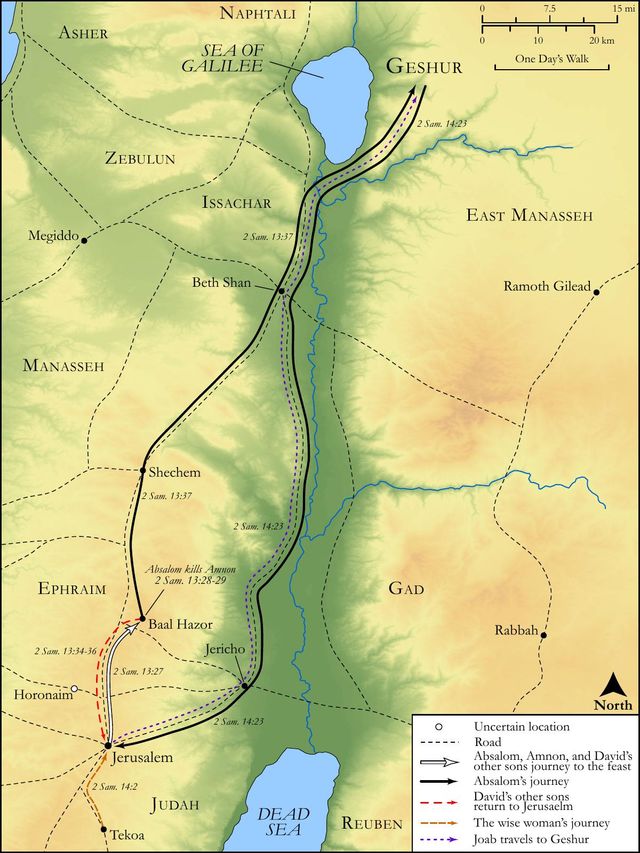
See on the biblical-era maps

Study this verse
Public-domain commentary
Matthew Henry
From his Commentary on the Whole Bible. Henry comments on passages, not single verses — this entry covers 2 Samuel 13:1–20. His four-level outline is real structure in the source text, so it is rendered as structure.
We have here a particular account of the abominable wickedness of Amnon in ravishing his sister, a subject not fit to be enlarged upon nor indeed to be mentioned without blushing, that ever any man should be so vile, especially that a son of David should be so. Amnon's character, we have reason to think, was bad in other things; if he had not forsaken God, he would never have been given up to these vile affections. Godly parents have often been afflicted with wicked children; grace does not run in the blood, but corruption does. We do not find that David's children imitated him in his devotion; but his false steps they trod in, and in those did much worse, and repented not. Parents know not how fatal the consequences may be if in any instance they give their children bad examples. Observe the steps of Amnon's sin.
I.The devil, as an unclean spirit, put it into his heart to lust after his sister Tamar.
Beauty is a snare to many; it was so to her. She was fair, and therefore Amnon coveted her, Sa2 13:1. Those that are peculiarly handsome have no reason, on that account, to be proud, but great reason to stand upon their watch. Amnon's lust was,
1.Unnatural in itself, to lust after his sister, which even natural conscience startles at and cannot think of without horror. Such a spirit of contradiction there is in man's corrupt nature that still it desires forbidden fruit, and the more strongly it is forbidden the more greedily it is desired. Can he entertain the thought of betraying that virtue and honour of which, as a brother, he ought to have been the protector? But what wickedness so vile as not to find admittance into an unsanctified unguarded heart, left to itself?
2.It was very uneasy to him. He was so vexed that he could not gain an opportunity to solicit her chastity (for innocent converse with her was not denied him) that he fell sick, Sa2 13:2. Fleshly lusts are their own punishment, and not only war against the soul, but against the body too, and are the rottenness of the bones. See what a hard master sinners serve, and how heavy his yoke is.
II.The devil, as a subtle serpent, put it into his head how to compass this wicked design.
Amnon had a friend (so he called him, but he was really an enemy to him), a kinsman, that had in him more of David's blood (for he was his nephew) than of David's spirit, for he was a subtle man, cunning to carry on any bad design, especially an intrigue of this nature, Sa2 13:3.
1.He took notice that Amnon looked ill, and, being a subtle man, concluded that he was love-sick (Sa2 13:4), and asks him, "Why art thou, being the king's son, lean from day to day? Why dost thou pine, being the king's eldest son, and heir to the crown. Being the king's son," (1.) "Thou hast the pleasures of the court to divert thee; take those pleasures then, and with them drive away the sorrow, whatever it is." Content and comfort are not always to be found in royal palaces. With much more reason may we ask dejected and disconsolate saints why they, who are the children of the King of kings and heirs of the crown of life, are thus lean from day to day. (2.) "Thou hast the power of a prince to command what thou wantest and wishest for; use that power therefore, and gratify thyself. Pine not away for that which, lawful or unlawful, thou, being the king's son, mayest have. Quicquid libet licet - Your will is law." Thus Jezebel to Ahab in a like case (Kg1 21:7), Dost not thou govern Israel? The abuse of power is the most dangerous temptation of the great.
2.Amnon having the impudence to own his wicked lust, miscalling it love (I love Tamar), Jonadab put him in a way to compass his design, Sa2 13:5. Had he been what he pretended (Amnon's friend), he would have startled at the mention of such horrid wickedness, would have laid before him the evil of it, what an offence it was to God and what a wrong to his own soul to entertain such a vile thought, of what fatal consequence it would be to him to cherish and prosecute it; he would have used his subtlety to divert Amnon from it, by recommending some other person to him, whom he might lawfully marry. But he seems not at all surprised at it, objects not either the unlawfulness or the difficulty, the reproach or so much as his father's displeasure, but puts him in the way to get Tamar to his bed-side, and then he might do as he pleased. Note, The case of those is very miserable whose friends, instead of admonishing and reproving them, flatter them and forward them in their sinful ways, and are their counsellors and contrivers to do wickedly. Amnon is already sick, but goes about; he must take upon him to be so ill (and his thin looks will give colour enough to the pretence) as not to be able to get up, and to have no appetite to any thing but just that which pleases his fancy. Dainty meat is abhorred, Job 33:20. The best dish from the king's table cannot please him; but, if he can eat any thing, it must be from his sister Tamar's fair hand. This is what he is advised to.
3.Amnon followed these directions, and thus got Tamar within his reach: He made himself sick, Sa2 13:6. Thus he lieth in wait secretly, as a lion in his den, to catch the poor, and to draw them into his net, Psa 10:8-10. David was always fond of his children, and concerned if any thing ailed them; he no sooner hears that Amnon is sick than he comes himself to visit him. Let parents learn hence to be tender of their children and compassionate towards them. The sick child commonly the mother comforteth (Isa 66:13), but let not the father be unconcerned. We may suppose that when David came to see his sick son he gave him good counsel to make a right use of his affliction, and prayed with him, which yet did not alter his wicked purpose. At parting, the indulgent father asks, "Is there any thing thou hast a mind to, that I can procure for thee?" "Yes, Sir," says the dissembling son, "my stomach is weak, and I know not of any thing I can eat, unless it be a cake of my sister Tamar's making, and I cannot be satisfied that it is so unless I see her make it, and it will do me the more good if I eat it at her hand." David saw no reason to suspect any mischief intended. God hid his heart from understanding in this matter. He therefore immediately orders Tamar to go and attend her sick brother, Sa2 13:7. He does it very innocently, but afterwards, no doubt, reflected upon it with great regret. Tamar as innocently goes to her brother's chamber, neither dreading any abuse (why should she from a brother, a sick brother?) nor disdaining, in obedience to her father and love to her brother (though but her half-brother), to be his nurse, Sa2 13:8, Sa2 13:9. Though she was a king's daughter, a great beauty (Sa2 13:1), and well dressed (Sa2 13:18), yet she did not think it below her to knead cakes and bake them, nor would she have done this now if she had not been used to it. Good house-wifery is not a thing below the greatest ladies, nor ought they to think it a disparagement to them. The virtuous woman, whose husband sits among the elders, yet works willingly with her hands, Pro 31:13. Modern ages have not been destitute of such instances, nor is it so unfashionable as some would make it. Preparing for the sick should be more the care and delight of the ladies than preparing for the nice, charity more than curiosity.
4.Having got her to him, he contrives to have her alone; for the adulterer (much more so vile an adulterer as this) is in care that no eye see him, Job 24:15. The meat is ready, but he cannot eat while he is looked at by those about him; they must all be turned out, Sa2 13:9. The sick must be humoured, and think they have a privilege to command. Tamar is willing to humour him; her chaste and virtuous soul has not the least thought of that which his polluted breast is full of; and therefore she makes no scruple of being alone with him in the inner chamber, Sa2 13:10. And now the mask is thrown off, the meat is thrown by, and the wicked wretch calls her sister, and yet impudently courts her to come and lie with him, Sa2 13:11. It was a base affront to her virtue to think it possible to persuade her to consent to such wickedness when he knew her behaviour to be always exemplarily modest and virtuous. But it is common for those that live in uncleanness to think others such as themselves, at least tinder to their sparks.
III.The devil, as a strong tempter, deafens his ear to all the reasonings with which she resisted his assaults and would have persuaded him to desist. We may well imagine what a surprise and terror it was to the young lady to be thus attacked, how she blushed and how she trembled; yet, in this great confusion, nothing could be said more pertinently, nor with greater strength of argument, than what she said to him.
1.She calls him brother, reminding him of the nearness of the relation, which made it unlawful for him to marry her, much more to debauch her. It was expressly forbidden (Lev 18:9) under a severe penalty, Lev 20:17. Great care must be taken lest the love that should be among relations degenerate into lust.
2.She entreats him not to force her, which intimates that she would never consent to it in any degree; and what satisfaction could he take in offering violence?
3.She lays before him the great wickedness of it. It is folly; all sin is so, especially uncleanness. It is wickedness of the worst kind. Such abominations ought not to be committed in Israel, among the professing people of God, that have better statutes than the heathen have. We are Israelites; if we do such things, we are more inexcusable than others, and our condemnation will be more intolerable, for we reproach the Lord, and that worthy name by which we are called.
4.She represents to him the shame of it, which perhaps might influence him more than the sin of it: "For my part, whither shall I cause my shame to go? If it should be concealed, yet I shall blush to think of it as long as I live; and, if ever it be known, how shall I be able to look any of my friends in the face? For thy part, thou shalt be as one of the fools in Israel," that is, "Thou wilt be looked upon as an atrocious debauchee, the worst of men; thou wilt lose thy interest in the esteem of all that are wise and good, and so wilt be set aside as unfit to rule, though the first-born; for Israel will never submit to the government of such a fool." Prospect of shame, especially everlasting shame, should deter us from sin.
5.To divert him from his wicked purpose at this time, and (if possible) to get clear of him, she intimates to him that probably the king, rather than he should die for love of her, would dispense with the divine law and let him marry her: not as if she thought he had such a dispensing power, or would pretend to it; but she was confident that, upon notice given to the king by himself of this wicked desire, which he would scarcely have believed from any one else, he would take an effectual course to protect her from him. But all her arts and all her arguments availed not. His proud spirit cannot bear a denial; but her comfort, and honour, and all that was dear to her, must be sacrificed to his brutish and outrageous lust, Sa2 13:14. It is to be feared that Amnon, though young, had long lived a lewd life, which his father either knew not or punished not; for a man could not, of a sudden, arrive at such a pitch of wickedness as this. But is this his love to Tamar? Is this the recompence he gives her for her readiness to attend him in his sickness? Will he deal with his sister as with a harlot? Base villain! God deliver all that are modest and virtuous from such wicked and unreasonable men.
IV.The devil, as a tormentor and betrayer, immediately turns his love of her into hatred (Sa2 13:15):
He hated her with great hatred, greatly, so it is in the margin, and grew as outrageous in his malice as he had been in his lust.
1.He basely turned her out of doors by force; nay, as if he now disdained to touch her with his own hands, he ordered his servant to pull her out and bolt the door after her, Sa2 13:17. Now,
(1.)The innocent injured lady had reason to resent this as a great affront, and in some respects (as she says, Sa2 13:16) worse than the former; for nothing could have been done more barbarous and ill-natured, or more disgraceful to her. Had he taken care to conceal what was done, her honour would have been lost to herself only. Had he gone down on his knees and begged her pardon, it might have been some little reparation. Had he given her time to compose herself after the horrid confusion she was put into, she might have kept her countenance when she went out, and so have kept her counsel. But to dismiss her thus hurried, thus rudely, as if she had done some wicked thing, obliged her, in her own defence, to proclaim the wrong that had been done her.
(2.)We may learn from it both the malignity of sin (unbridled passions are as bad as unbridled appetites) and the mischievous consequences of sin (at last, it bites like a serpent); for here we find,
[1.]That sins, sweet in the commission, afterwards become odious and painful, and the sinner's own conscience makes them so to himself. Amnon hated Tamar because she would not consent to his wickedness, and so take part of the blame upon herself, but to the last resisted it, and reasoned against it, and so threw all the blame upon him. Had he hated the sin, and loathed himself for it, we might have hoped he was penitent. Godly sorrow worketh indignation, Co2 7:11. But to hate the person he had abused showed that his conscience was terrified, but his heart not at all humbled. See what deceitful pleasures those of the flesh are, how soon they pass away, and turn into loathing; see Eze 23:17.
[2.]That sins, secret in the commission, afterwards become open and public, and the sinners themselves often make them so. Their own tongues fall upon them. The Jewish doctors say that, upon the occasion of this wickedness of Amnon, a law was made that a young man and a young woman should never be alone together; for, said they, if the king's daughter be so used, what will become of the children of private men?
2.We must now leave the criminal to the terrors of his own guilty conscience, and enquire what becomes of the poor victim.
(1.)She bitterly lamented the injury she had received, as it was a stain to her honour, though no real blemish to her virtue. She tore her fine clothes in token of her grief, and put ashes upon her head, to deform herself, loathing her own beauty and ornaments, because they had occasioned Amnon's unlawful love; and she went on crying for another's sin, Sa2 13:19.
(2.)She retired to her brother Absalom's house, because he was her own brother, and there she lived in solitude and sorrow, in token of her modesty and detestation of uncleanness. Absalom spoke kindly to her, bade her pass by the injury for the present, designing himself to revenge it, Sa2 13:20. It should seem by Absalom's question (Has Amnon been with thee?) that Amnon was notorious for such lewd practices, so that it was dangerous for a modest woman to be with him; this Absalom might know, and yet Tamar be wholly ignorant of it.
Historical interpretation
Two Centuries of Reception
2 surviving comments on this verse. Each one is dated, so this reads as a timeline rather than a list.
Select a marker to jump to its quote. Markers stagger vertically where authors wrote within a few decades of each other.
As if to show that near relationship is no safeguard, Amnon burned with illicit passion for his sister Tamar.
No man shall rely upon chastity in the past, for none whose hearts are tainted by women can become holier than David or wiser than Solomon. That none may assume that his chastity is safe in the presence of a woman related to him, let him remember how Tamar was corrupted by her brother Amnon when he pretended to be ill. Accordingly, both monks and nuns should live so chastely that they may have a good report, not only before God but also before people, and may leave to those who follow an example of sanctity.
Continue studying 2 Samuel 13:12 across the web’s major study libraries — every link below opens this exact verse, chapter, or book on the destination site.
Read & Compare
 BibleGatewayThis verse in more than 200 translations and 70 languages.
 Bible.comThe YouVersion reader — hundreds of translations, reading plans, and highlights.
 ESV.orgCrossway's official English Standard Version reader.
 NET BibleThe NET translation with 60,000+ translators' notes on every rendering decision.
 STEP BibleTyndale House's free study tool — original text, vocabulary, and scholarly resources.
 BibliaLogos Bible Software's free web reader.
 USCCBThe New American Bible (Revised Edition) with the U.S. bishops' study notes.
Commentaries
 BibleHub CommentariesDozens of classic commentaries on this verse, gathered on one page.
 StudyLightMore than 100 commentary sets — the largest collection on the web.
 BibleRefPlain-English commentary on what this verse means, verse by verse.
 Enduring WordDavid Guzik's free commentary on this chapter, widely used by Bible teachers.
 Bible Study ToolsVerse commentary alongside Greek and Hebrew study aids.
Original Language & Research
- BibleHub InterlinearThe verse word by word — original language, transliteration, and English.
- BibleHub LexiconEvery word's original-language definition and Strong's entry.
 Blue Letter BibleDeep-study tools — Strong's numbers, concordance, and word studies.
 SefariaThe Hebrew text with Rashi and centuries of Jewish commentary.
Sermons, Hymns & Audio


TrulyRandomVerse is not affiliated with these sites and doesn’t control their content. They’re linked because they’re genuinely useful.
Summary
2 Samuel 13:12 captures Tamar's desperate and poignant plea to her half-brother Amnon, imploring him to abandon his wicked intent to sexually assault her. Her words are a powerful appeal to their familial bond, the strict moral and legal standards of Israel, and the profound disgrace such an act would bring upon them and the nation. This verse serves as a tragic pivot point in the narrative, exposing the moral decay within David's royal household and initiating a devastating chain of events that would ripple through the kingdom.
Context
ShowHideLiterary Context
This verse is situated at the harrowing climax of a deeply disturbing narrative within 2 Samuel 13. Amnon, King David's firstborn son, has become consumed by an illicit desire for his half-sister Tamar, who is also the full sister of Absalom. Manipulated by his cunning cousin Jonadab, Amnon feigns illness to create a pretext for Tamar to come to his private chambers and prepare him food. Tamar, unsuspecting of his sinister intentions, innocently complies. Her desperate plea in 2 Samuel 13:12 immediately precedes Amnon's violent act, representing her final, futile attempt to avert the impending horror. The narrative then unfolds the horrific rape, Amnon's immediate and cruel repulsion of Tamar, and Absalom's simmering, vengeful rage, which ultimately culminates in Amnon's murder and Absalom's subsequent rebellion against King David. This entire tragic episode serves as a direct and painful fulfillment of the prophecy delivered by Nathan to David in 2 Samuel 12:10-11, foretelling that "the sword shall never depart from your house" and that calamity would arise from within his own family due to his sin with Bathsheba.
Historical & Cultural Context
Ancient Israelite society, as the law of Moses shows, placed immense significance on family honor, female chastity, and the sanctity of kinship. Incestuous relationships, particularly between siblings or half-siblings, were unequivocally forbidden and considered an abomination under the Mosaic Law, as explicitly detailed in passages such as Leviticus 18:9 and Deuteronomy 27:22. Such acts brought profound shame and defilement not only upon the individuals involved but also upon their entire family lineage and the wider community. A virgin daughter's purity was paramount to her marriageability and the family's social standing. Rape was considered a grave violation, often a capital offense in specific circumstances (e.g., if committed against a betrothed virgin in a city, Deuteronomy 22:23-27). Tamar's status as a princess, a daughter of the king, further magnified the severity of the transgression, transforming it into an act of violence and profound dishonor within the royal family, thereby threatening the moral legitimacy and stability of the kingdom itself.
Key Themes
ShowHideThis verse powerfully contributes to several overarching themes within the book of 2 Samuel and the broader Deuteronomistic History. It starkly illustrates the corrupting influence of unchecked desire and the abuse of power, demonstrating how Amnon's lust, coupled with his royal privilege and entitlement, led to a heinous act of sexual violence. It unequivocally underscores the sanctity of kinship and the abhorrence of sexual immorality within Israel, as Tamar explicitly declares, "no such thing ought to be done in Israel." The theme of divine judgment and the devastating consequences of sin is also profoundly evident, as this event is a direct outworking of Nathan's prophecy against David's house, stemming from David's own grievous sin with Bathsheba and Uriah in 2 Samuel 11. Furthermore, the narrative introduces the poignant theme of injustice and the vulnerability of the innocent, as Tamar, despite her desperate and articulate pleas, is subjected to brutal violence with devastating long-term psychological and social consequences. Her subsequent desolation and public lamentation, vividly portrayed in 2 Samuel 13:19-20, powerfully convey the profound and lasting impact of such trauma.
Exposition and Analysis
ShowHideKey Word Analysis
ShowHideThis term (H251) is a primitive word meaning "a brother (used in the widest sense of literal relationship and metaphorical affinity or resemblance (like father)); another, brother(-ly); kindred, like, other." Tamar's address "my brother" is a poignant appeal to the sacred familial bond and the inherent trust and protection that should exist within such a relationship. It highlights Amnon's profound betrayal of this kinship, making his subsequent act all the more heinous.
This verb (H6031) is a primitive root meaning "to depress literally or figuratively, transitive or intransitive (in various applications, as follows); abase self, afflict(-ion, self), answer (by mistake for עָנָה), chasten self, deal hardly with, defile, exercise, force, gentleness, humble (self), hurt, ravish, sing (by mistake for עָנָה), speak (by mistake for עָנָה), submit self, weaken, [idiom] in any wise." In this context, it specifically refers to sexual violence, the act of violating a woman's body against her will, implying brutal subjugation and degradation. The use of this term unequivocally emphasizes the violent, coercive, and non-consensual nature of Amnon's intent.
This noun (H5039) is the feminine form of נָבָל, meaning "foolishness, i.e. (morally) wickedness; concretely, a crime; by extension, punishment; folly, vile, villany." This is a crucial and loaded term, signifying far more than mere foolishness. It denotes a morally reprehensible, outrageous, and disgraceful act that stands in direct opposition to divine and human law. It implies deep moral depravity, a shameful wickedness that brings public disgrace. This same term is notably used in Genesis 34:7 to describe the rape of Dinah, underscoring the severity and public dishonor associated with such actions. It is a term reserved for acts that are an abomination in Israel, acts that violate the very fabric of covenantal community and moral order.
Verse Breakdown
ShowHide"And she answered him, Nay, my brother, do not force me;"
Tamar's immediate response is a direct, desperate, and unequivocal refusal. Her address, "my brother," is a poignant appeal to the sacred familial bond and the inherent trust and protection that should exist within that relationship. It is a desperate attempt to remind Amnon of his moral obligation and the profound violation of kinship he is contemplating. The phrase "do not force me" is a clear and absolute declaration of non-consent, highlighting the violent and coercive nature of Amnon's intent and her absolute lack of desire for his advances.
"for no such thing ought to be done in Israel:"
This clause elevates Tamar's plea from a personal one to a communal and theological indictment. She appeals to the established moral and legal standards of the nation of Israel, implying that Amnon's intended act is not merely a private sin but a public disgrace and an affront to the covenant community. It is an act that violates the very principles upon which Israel was founded, specifically the laws against incest and sexual violence, and the broader covenantal expectations of righteousness and justice.
"do not thou this folly."
Tamar concludes her impassioned plea by explicitly labeling Amnon's intended act as "folly" (nᵉbâlâh'). This is a powerful and damning indictment, signifying that his action is not merely a mistake or a lapse in judgment, but a deliberate act of profound moral depravity and wickedness that will bring shame and disgrace upon himself, his royal family, and the entire nation. It is a final, desperate warning of the severe moral, social, and spiritual consequences of his sin.
Literary Devices
ShowHideThe verse employs several powerful literary devices to convey the gravity of the situation and Tamar's desperate plight. Pathos is profoundly evident in Tamar's pleading tone and vulnerable position, designed to evoke pity, empathy, and moral conviction in Amnon. Her repeated appeals—"my brother," "do not force me," "no such thing ought to be done in Israel," "do not thou this folly"—create a palpable sense of urgency and highlight her utter helplessness against Amnon's superior strength and determination. The use of the term "folly" (nᵉbâlâh') functions as a potent form of euphemism and understatement, simultaneously masking the full brutality of the act while condemning it as utterly abominable and morally bankrupt within the Israelite covenant. There is also a tragic irony in Tamar's appeal to "what ought to be done in Israel," as the subsequent narrative tragically reveals the profound moral failure of the royal family, including David's own inaction, to uphold these very standards. Her prophetic words also serve as a stark form of foreshadowing, hinting at the catastrophic and far-reaching consequences that will indeed follow this "folly" for David's house and the entire kingdom.
Theological and Thematic Connections
ShowHideTamar's desperate cry in 2 Samuel 13:12 resonates with profound theological implications, underscoring the gravity of sin, particularly sexual violence and the abuse of power, within God's covenant people. It highlights that God's moral law is not arbitrary but reflects His holy character and is designed for the flourishing of humanity and community. When these laws are violated, especially by those in positions of authority, the consequences are devastating, leading to brokenness, injustice, and societal decay. The narrative serves as a stark reminder that even within the chosen lineage, sin's destructive power can wreak havoc, demonstrating the pervasive nature of human depravity and the ultimate need for divine intervention and redemption. It foreshadows the ultimate need for a King who would perfectly uphold righteousness and justice, unlike David's deeply flawed family.
Reflection and Application
ShowHideTamar's plea in 2 Samuel 13:12 remains a powerful and haunting reminder of the devastating impact of sin, especially sexual violence and the abuse of power. It compels us to confront the sanctity of human dignity, the absolute necessity of consent, and the profound responsibility that accompanies any position of authority or influence. For believers, this narrative underscores the unwavering call to uphold God's moral standards in all relationships, recognizing that our actions have far-reaching consequences, not just for ourselves but for our families, communities, and the broader society. It challenges us to actively confront the reality of evil and injustice in the world, to speak out against abuse, and to diligently work towards creating environments where the vulnerable are protected, respected, and empowered. Furthermore, it serves as a sobering reminder that unchecked desires, fueled by selfishness and a disregard for God's holy law, inevitably lead to destruction, sorrow, and deep brokenness, both for the perpetrator and, tragically, for the victim.
Questions for Reflection
ShowHideFAQ
ShowHideWhat does "folly" mean in this context, and why is it significant?
ShowHideIn 2 Samuel 13:12, "folly" translates the Hebrew word nᵉbâlâh'. This term is far stronger than mere foolishness or a simple mistake. It signifies a morally depraved, outrageous, and utterly disgraceful act that is considered an abomination in the eyes of God and the covenant community. It implies a gross violation of fundamental covenantal standards, bringing profound public shame and dishonor upon all involved. Its significance lies in Tamar's use of it to condemn Amnon's intended act as not just a personal offense but a profound transgression against the very moral fabric of Israelite society, echoing its use in other severe biblical contexts like the defilement of Dinah in Genesis 34:7 or the egregious wickedness of the men of Gibeah in Judges 19:23.
Why didn't Tamar's suggestion to "speak unto the king" (2 Samuel 13:13) prevent the rape?
ShowHideTamar's desperate suggestion in 2 Samuel 13:13 – that David might permit their marriage – was likely a desperate, last-ditch effort to appeal to Amnon's reason and avert the imminent rape, rather than a genuine belief that such a union was permissible or probable. Under Mosaic Law, marriage between half-siblings from the same father was explicitly forbidden (Leviticus 18:9). Amnon's lust had completely consumed him, overriding any moral sense, familial obligation, or consideration for the law. He was determined to "force" her, as the text states, indicating that he had no intention of seeking an honorable or lawful path, even if one existed. His immediate response was to overpower her, demonstrating his complete disregard for her words, the law, and her personal dignity.
Christ-Centered Fulfillment
ShowHideThe tragic narrative of Amnon and Tamar, culminating in Tamar's desperate plea in 2 Samuel 13:12, powerfully illustrates the pervasive brokenness of humanity and the devastating consequences of sin, even within the chosen lineage of David. It reveals the profound need for a perfect King, one who would not succumb to lust or abuse of power, and who would perfectly uphold justice and righteousness. While David's house was plagued by internal strife, moral failure, and the bitter fruits of sin, foreshadowing the need for a greater deliverer, Jesus Christ stands as the ultimate fulfillment. He is the true Son of David, yet uniquely without sin (Hebrews 4:15). Where Amnon used his power for selfish gratification and brutal violence, Christ used His divine authority to serve, heal, and ultimately sacrifice Himself for the sake of others (Mark 10:45). The "folly" and moral depravity that marred David's family find their antithesis in Christ's perfect obedience and His establishment of a new covenant where true righteousness, purity, and spiritual restoration are possible through His atoning work (2 Corinthians 5:21). He is the one who brings true justice and healing to the brokenhearted, offering redemption from the very sins that destroyed Amnon and devastated Tamar (Isaiah 61:1). Through Christ, we find the power to overcome the "folly" of sin and live lives of integrity and love, reflecting God's holy character.