


Judges 19:23
Bible text: King James Version (1769 Blayney text) · Public domain
Bible text: King James Version with Strong's numbers · Public domain
Bible text: Berean Standard Bible · Public domain
Bible text: American Standard Version (1901) · Public domain
Bible text: World English Bible, Messianic edition · Public domain
Bible text: Geneva Bible (1599) · Public domain
Bible text: Young's Literal Translation · Public domain
- וַיֵּצֵאvai·ye·Tze'and he went outH3318Conj-w ¦ V-Qal-ConsecImperf-3msVerb Qal Consecutive Imperfect 3rd Singular Masculineוַandיֵּצֵאhe went out
- אֲלֵיהֶם'a·lei·Hemto themH413Prep ¦ 3mpPreposition Definiteאֲלֵיtoהֶםthem
- הָאִישׁha·'Ishthe manH376Art ¦ N-msNoun Singular Masculine Absoluteהָtheאִישׁman
- בַּעַלBa·'al[the] master ofH1167N-mscNoun Singular Masculine Construct
- הַבַּיִתha·Ba·yitthe houseH1004Art ¦ N-msNoun Singular Masculine Absoluteהַtheבַּיִתhouse
- וַיֹּאמֶרvai·Yo·merand he saidH559Conj-w ¦ V-Qal-ConsecImperf-3msVerb Qal Consecutive Imperfect 3rd Singular Masculineוַandיֹּאמֶרhe said
- אֲלֵהֶם'a·le·Hemto themH413Prep ¦ 3mpPreposition Definiteאֲלֵtoהֶםthem
- אַל'almay [you] notH408NegParticle Negative
- אַחַי'a·Chaimy O brothersH251N-mpc ¦ 1csNoun Plural Masculine ConstructאַחַO brothersיmy
- אַל'almay notH408NegParticle Negative
- תָּרֵעוּta·Re·'uyou do evilH7489V-Hiphil-Imperf-2mpVerb Hiphil Imperfect 2nd Plural Masculine
- נָאNa'pleaseH4994PrtParticle Interjection
- אַחֲרֵי'A·cha·reiafterH310Adj-mpcAdjective Numerical Plural Masculine Construct
- אֲשֶׁר'a·SherthatH834RelParticle Relative
- בָּאba'he has comeH935V-Qal-Perf-3msVerb Qal Perfect 3rd Singular Masculine
- הָאִישׁha·'Ishthe manH376Art ¦ N-msNoun Singular Masculine Absoluteהָtheאִישׁman
- הַזֶּהha·Zeh<the> thisH2088Art ¦ PrtParticle Demonstrativeהַ<the>זֶּהthis
- אַל'almay [you] notH413PrepPreposition
- בֵּיתִיbei·Timy houseH1004N-msc ¦ 1csNoun Singular Masculine Constructבֵּיתִhouseיmy
- אַל'almay notH408NegParticle Negative
- תַּעֲשׂוּta·'a·Suyou doH6213V-Qal-Imperf-2mpVerb Qal Imperfect 2nd Plural Masculine
- אֶת'et<obj.>H853DirObjMParticle Object Indicator
- הַנְּבָלָהha·ne·va·Lahthe disgraceful follyH5039Art ¦ N-fsNoun Singular Feminine Absoluteהַtheנְּבָלָהdisgraceful folly
- הַזֹּאתha·Zot<the> thisH2063Art ¦ PrtParticle Demonstrativeהַ<the>זֹּאתthis
English is a literal word-by-word gloss of the Hebrew, not the KJV's wording. Why?
This is the original text the KJV's translators worked from — each Hebrew word with its own literal English meaning in this verse, prepared by scholars at Tyndale House, Cambridge. The KJV translates whole sentences, not word by word, so its wording differs: one Hebrew word can become several English words, and the KJV may choose “the LORD” where the gloss reads “Yahweh”. Both are faithful — they answer different questions. For the KJV's own rendering, switch to the KJV text.
Details
See on the biblical-era maps

Study this verse
Public-domain commentary
Matthew Henry
From his Commentary on the Whole Bible. Henry comments on passages, not single verses — this entry covers Judges 19:22–30. His three-level outline is real structure in the source text, so it is rendered as structure.
Here is, I. The great wickedness of the men of Gibeah. One could not imagine that ever it should enter into the heart of men that had the use of human reason, of Israelites that had the benefit of divine revelation, to be so very wicked. "Lord, what is man!" said David, "what a mean creature is he!" "Lord, what is man," may we say upon the reading of this story, "what a vile creature is he, when he is given up to his own heart's lusts!" The sinners are here called sons of Belial, that is, ungovernable men, men that would endure no yoke, children of the devil (for he is Belial), resembling him, and joining with him in rebellion against God and his government. Sons of Benjamin, of whom Moses had said, The beloved of the Lord shall dwell in safety by him (Deu 33:12), have become such sons of Belial that an honest man cannot lodge in safety among them. The sufferers were a Levite and his wife, and that kind man that gave them entertainment. We are strangers upon earth, and must expect strange usage. It is said they were making their hearts merry when this trouble came upon them, Jdg 19:22. If the mirth was innocent, it teaches us of what uncertain continuance all our creature comforts and enjoyments are; when we are ever so well pleased with our friends, we know not how near our enemies are; nor, if it be well with us this hour, can we be sure it will be so the next. If the mirth was sinful and excessive, let it be a warning to us to keep a strict guard upon ourselves, that we grow not intemperate in the use of lawful things, nor be transported into indecencies by our cheerfulness; for the end of that mirth is heaviness. God can soon change the note of those that are making their hearts merry, and turn their laughter into mourning and their joy into heaviness. Let us see what the wickedness of these Benjamites was.
1.They made a rude and insolent assault, in the night, upon the habitation of an honest man, that not only lived peaceably among them, but kept a good house and was a blessing and ornament to their city. They beset the house round, and, to the great terror of those within, beat as hard as they could at the door, Jdg 19:22. A man's house is his castle, in which he ought to be both safe and quiet, and, where there is law, it is taken under the special protection of it; but there was no king in Israel to keep the peace and secure honest men from the sons of violence.
2.They had a particular spite at the strangers that were within their gates, that only desired a night's lodging among them, contrary to the laws of hospitality, which all civilized nations have accounted sacred, and which the master of the house pleaded with them (Jdg 19:23): Seeing that this man has come into my house. Those are base and abject spirits indeed that will trample upon the helpless, and use a man the worse for his being a stranger, whom they know no ill of.
3.They designed in the most filthy and abominable manner (not to be thought of without horror and detestation) to abuse the Levite, whom perhaps they had observed to be young and comely: Bring him forth that we may know him. We should certainly have concluded they meant only to enquire whence he came, and to know his character, but that the good man of the house, who understood their meaning too well, by his answer lets us know that they designed the gratification of that most unnatural and worse than brutish lust which was expressly forbidden by the law of Moses, and called an abomination, Lev 18:22. Those that are guilty of it are ranked in the New Testament among the worst and vilest of sinners (Ti1 1:10), and such as shall not inherit the kingdom of God, Co1 6:9. Now,
(1.)This was the sin of Sodom, and is thence called Sodomy. The Dead Sea, which was the standing monument of God's vengeance upon Sodom, for its filthiness, was one of the boundaries of Canaan, and lay not many miles off from Gibeah. We may suppose the men of Gibeah had seen it many a time, and yet would not take warning by it, but did worse than Sodom (Eze 16:48), and sinned just after the similitude of their transgression. Who would have expected (says bishop Hall) such extreme abomination to come out of the loins of Jacob? Even the worst pagans were saints to them. What did it avail them that they had the ark of God in Shiloh when they had Sodom in their streets - God's law in their fringes, but the devil in their hearts? Nothing but hell itself can yield a worse creature than a depraved Israelite.
(2.)This was the punishment of their idolatry, that sin to which they were, above all others, most addicted. Because they liked not to retain God in their knowledge, therefore he gave them up to these vile affections, by which they dishonoured themselves as they had by their idolatry dishonoured him and turned his glory into shame, Rom 1:24, Rom 1:28. See and admire, in this instance, the patience of God. Why were not these sons of Belial struck blind, as the Sodomites were? Why were not fire and brimstone rained from heaven upon their city? It was because God would leave it to Israel to punish them by the sword, and would reserve his own punishment of them for the future state, in which those that go after strange flesh shall suffer the vengeance of eternal fire, Jde 1:7.
4.They were deaf to the reproofs and reasoning of the good man of the house, who, being well acquainted (we may suppose) with the story of Lot and the Sodomites, set himself to imitate Lot, Jdg 19:23, Jdg 19:24. Compare Gen 19:6-8. He went out to them as Lot did, spoke civilly to them, called them brethren, begged of them to desist, pleaded the protection of his house which his guests were under, and represented to them the great wickedness of their attempt: "Do not so wickedly, so very wickedly." He calls it folly and a vile thing. But in one thing he conformed too far to Lot's example (as we are apt in imitating good men to follow them even in their false steps), in offering them his daughter to do what they would with. He had not power thus to prostitute his daughter, nor ought he to have done this evil that good might come. But this wicked proposal of his may be in part excused from the great surprise and terror he was in, his concern for his guests, and his having too close a regard to what Lot did in the like case, especially not finding that the angels who were by reproved him for it. And perhaps he hoped that his mentioning this as a more natural gratification of their lust would have sent them back to their common harlots. But they would not hearken to him, Jdg 19:25. Headstrong lusts are like the deaf adder that stoppeth her ear; they sear the conscience and make it insensible.
5.They got the Levite's wife among them, and abused her to death, Jdg 19:25. They slighted the old man's offer of his daughter to their lust, either because she was not handsome or because they knew her to be one of great gravity and modesty: but, when the Levite brought them his concubine, they took her with them by force to the place appointed for their filthiness. Josephus, in his narrative of this story, makes her to be the person they had a design upon when they beset the house, and says nothing of their villainous design upon the Levite himself. They saw her (he says) in the street, when they came into the town, and were smitten with her beauty; and perhaps, though she was reconciled to her husband, her looks did not bespeak her to be one of the most modest. Many bring mischief of this kind upon themselves by their loose carriage and behaviour; a little spark may kindle a great fire. One would think the Levite should have followed them, to see what became of his wife, but it is probable he durst not, lest they should do him a mischief. In the miserable end of this woman, we may see the righteous hand of God punishing her for her former uncleanness, when she played the whore against her husband, Jdg 19:2. Though her father had countenanced her, her husband had forgiven her, and the fault was forgotten now that the quarrel was made up, yet God remembered it against her when he suffered these wicked men thus wretchedly to abuse her; how unrighteous soever they were in their treatment of her, in permitting it the Lord was righteous. Her punishment answered her sin, Culpa libido fuit, poena libido fuit - Lust was her sin, and lust was her punishment. By the law of Moses she was to have been put to death for her adultery. She escaped that punishment from men, yet vengeance pursued her; for, if there was no king in Israel, yet there was a God in Israel, a God that judgeth in the earth. We must not think it enough to make our peace with men, whom by our sins we have wronged, but are concerned, by repentance and faith, to make our peace with God, who sees not as men see, nor makes so light of sin as men often do. The justice of God in this matter does not at all extenuate the horrid wickedness of these men of Gibeah, than which nothing could be more barbarous and inhuman.
II.The notice that was sent of this wickedness to all the tribes of Israel.
The poor abused woman made towards her husband's lodgings as soon as ever the approach of the day-light obliged these sons of Belial to let her go (for these works of darkness hate and dread the light), Jdg 19:25. Down she fell at the door, with her hands on the threshold, begging pardon (as it were) for her former transgression, and in that posture of a penitent, with her mouth in the dust, she expired. There he found her (Jdg 19:26, Jdg 19:27), supposed her asleep, or overcome with shame and confusion for what had happened, but soon perceived she was dead (Jdg 19:28), took up her dead body, which, we may suppose, had all over it marks of the hands, the blows, and other abuses, she had received. On this sad occasion he waived his purpose of going to Shiloh, and went directly home. He that went out in hopes to return rejoicing came in again melancholy and disconsolate, sat down and considered, "Is this an injury fit to be passed by?" He cannot call for fire from heaven to consume the men of Gibeah, as those angels did who were, after the same manner, insulted by the Sodomites. There was no king in Israel, nor (for aught that appears) any sanhedrim, or great council, to appeal to, and demand justice from. Phinehas is high priest, but he attends closely to the business of the sanctuary, and will be no judge or divider. He has therefore no other way left him than to appeal to the people: let the community be judge. Though they had no general stated assembly of all the tribes, yet it is probable that each tribe had a meeting of their chiefs within itself. To each of the tribes, in their respective meetings, he sent by special messengers a remonstrance of the wrong that was done him, in all its aggravating circumstances, and with it a piece of his wife's dead body (Jdg 19:29), both to confirm the truth of the story and to affect them the more with it. He divided it into twelve pieces, according to the bones, so some read it, that is, by the joints, sending one to each tribe, even to Benjamin among the rest, with the hope that some among them would be moved to join in punishing so great a villany, and the more warmly because committed by some of their own tribe. It did indeed look very barbarous thus to mangle a dead body, which, having been so wretchedly dishonoured, ought to have been decently interred; but the Levite designed hereby, not only to represent their barbarous usage of his wife, whom they had better have cut in pieces thus than have used as they did, but also to express his own passionate concern and thereby to excite the like in them. And it had the desired effect. All that saw the pieces of the dead body, and were told how the matter was, expressed the same sentiments upon it.
1.That the men of Gibeah had been guilty of a very heinous piece of wickedness, the like to which had never been known before in Israel, Jdg 19:30. It was a complicated crime, loaded and blackened with all possible aggravations. They were not such fools as to make a mock at this sin, or turn the story off with a jest.
2.That a general assembly of all Israel should be called, to debate what was fit to be done for the punishment of this wickedness, that a stop might be put to this threatening inundation of debauchery, and the wrath of God might not be poured upon the whole nation for it. It is not a common case, and therefore they stir up one another to come together upon the occasion with this: Consider of it, take advice, and speak your minds. We have here the three great rules by which those that sit in council ought to go in every arduous affair.
(1.)Let every man retire into himself, and weigh the matter impartially and fully in his own thoughts, and seriously and calmly consider it, without prejudice on either side, before he speaks upon it.
(2.)Let them freely talk it over, and every man take advice of his friend, know his opinion and his reasons, and weigh them.
(3.)Then let every man speak his mind, and give his vote according to his conscience. In the multitude of such counsellors there is safety.
Historical interpretation
Historical reception
2 surviving comments on this verse. Each one is dated, so this reads as a timeline rather than a list.
And when they were satisfied and the tables were removed, vile men rushed up and surrounded the house. Then the old man offered these wicked men his daughter, a virgin, and the concubine with whom she shared her bed, only that violence might not be inflicted on his guest. But when reason did no good and violence prevailed, the Levite parted from his wife, and they knew her and abused her all that night. Overcome by this cruelty or by grief at her wrong, she fell at the door of their host where her husband had entered, and died, with the last effort of her life guarding the feelings of a good wife so as to preserve for her husband at least her mortal remains.
The old man kept urging them to be glad and kept inviting them to drink more wine so that they would forget their cares, when all of a sudden they were surrounded by young men of Gaba [Gibeah], given to lust, all lacking esteem for moderation. The woman’s beauty had bewitched them and thrown them into utter folly. They were captivated by her beauty and, because of the old man’s age and lack of help, with high hope of getting her, they demanded the woman and kept pounding at the door.The old man, going out, begged them not to defile his guest’s stay with a base crime, contemplating violation of a privilege reverenced even by savage nations of barbarous peoples; they could not insultingly mistreat a fellow tribesman of his, legitimately born, a married man, without causing wrath in their heavenly judge. When he saw that he was making little headway, he added that he had a maiden daughter and he offered her to them, with great sorrow, since he was her parent, but with less damage to the favor he owed his guest. He considered a public crime more tolerable than private disgrace. Driven by a wave of fury and inflamed by the incentive of lust, their desire for the young woman’s beauty increased the more she was denied them. Deprived of all righteousness, they mocked his fair words, considering the old man’s daughter an object of contempt in that she was offered with less feeling of ill will toward the crime.
Then, when pious entreaties availed nothing and the aged hands were hopelessly extended in vain, the woman was seized and all that night was subjected to violence. When day brought an end to the outrage, she went back to the door of their lodging, where she would not ask to see her husband, whom she thought she must now forego, ashamed at her pitiable condition. Yet, to show her love for her husband, she who had lost her chastity lay down at the door of the lodging, and there in pitiable circumstance came an end to her disgrace. The Levite, coming out, found her lying there and thought that she dared not lift her head for shame. He began comforting her, since she had succumbed to such injury not willingly but unwillingly. He bade her rise and go home with him. Then, as no answer came, he called her loudly as though to rouse her from sleep.
Continue studying Judges 19:23 across the web’s major study libraries — every link below opens this exact verse, chapter, or book on the destination site.
Read & Compare
 BibleGatewayThis verse in more than 200 translations and 70 languages.
 Bible.comThe YouVersion reader — hundreds of translations, reading plans, and highlights.
 ESV.orgCrossway's official English Standard Version reader.
 NET BibleThe NET translation with 60,000+ translators' notes on every rendering decision.
 STEP BibleTyndale House's free study tool — original text, vocabulary, and scholarly resources.
 BibliaLogos Bible Software's free web reader.
 USCCBThe New American Bible (Revised Edition) with the U.S. bishops' study notes.
Commentaries
 BibleHub CommentariesDozens of classic commentaries on this verse, gathered on one page.
 StudyLightMore than 100 commentary sets — the largest collection on the web.
 BibleRefPlain-English commentary on what this verse means, verse by verse.
 Enduring WordDavid Guzik's free commentary on this chapter, widely used by Bible teachers.
 Bible Study ToolsVerse commentary alongside Greek and Hebrew study aids.
Original Language & Research
- BibleHub InterlinearThe verse word by word — original language, transliteration, and English.
- BibleHub LexiconEvery word's original-language definition and Strong's entry.
 Blue Letter BibleDeep-study tools — Strong's numbers, concordance, and word studies.
 SefariaThe Hebrew text with Rashi and centuries of Jewish commentary.
Sermons, Hymns & Audio


TrulyRandomVerse is not affiliated with these sites and doesn’t control their content. They’re linked because they’re genuinely useful.
Summary
Judges 19:23 encapsulates a moment of profound moral collapse in ancient Israel, depicting an elderly Ephraimite man, acting as a host in Gibeah, desperately pleading with a depraved Benjamite mob to spare his Levite guest from sexual violence. His impassioned appeal to the fundamental law of hospitality and basic human decency underscores the deep spiritual and ethical decay that characterized the period of the Judges, revealing a society where sacred customs were brutally violated and justice was utterly perverted.
Context
ShowHideLiterary Context
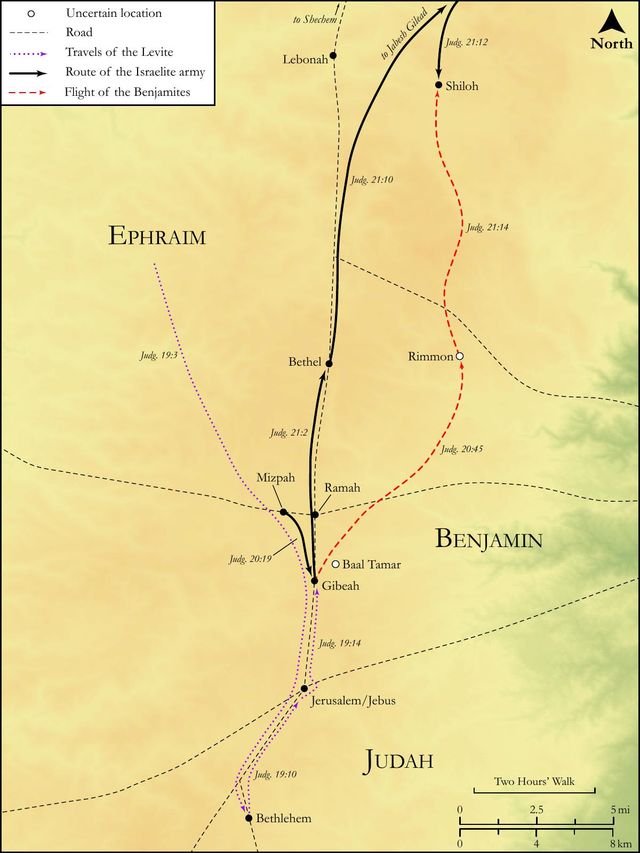
This verse is a critical juncture within the deeply disturbing narrative of Judges 19-21, which recounts an incident so heinous it plunges Israel into civil war. The story begins with a Levite and his concubine traveling through Benjaminite territory. When they arrive in Gibeah, a city notorious for its wickedness, no one offers them lodging until an old Ephraimite man, a sojourner himself, extends hospitality. As night falls, the house is surrounded by a mob of "sons of Belial"—a term denoting extreme depravity—who demand that the Levite be brought out for gang rape. The old man's desperate plea in Judges 19:23 is his immediate response to this demand, an attempt to uphold the sacred custom of guest protection, as Lot had done at Sodom, even at immense personal cost. The events that follow, including the unspeakable act committed against the concubine and the Levite's subsequent dismemberment of her body, escalate the horror and set the stage for the tribal war against Benjamin.
Historical & Cultural Context
The period of the Judges (roughly 1200-1000 BC) was a turbulent era in Israel's history, marked by a cyclical pattern of apostasy, oppression, and deliverance. Without a central monarchy or strong spiritual leadership, "every man did that which was right in his own eyes" (Judges 17:6). Hospitality was not merely a social courtesy but a sacred covenant, a cornerstone of Israelite society, offering protection and refuge to travelers. A host was expected to defend his guests with his life, and violating this custom was an act of profound sacrilege and social anarchy, as seen in the parallel account of Lot in Sodom (Genesis 19:4-8). The events in Gibeah illustrate the complete breakdown of this foundational societal norm, reflecting a pervasive moral and spiritual rot that had permeated even the tribe of Benjamin, which was supposed to be part of God's covenant people.
Key Themes
ShowHideJudges 19:23 powerfully contributes to several overarching themes within the book of Judges and the broader biblical narrative. Firstly, it highlights the Violation of Sacred Hospitality, demonstrating the catastrophic consequences when a society disregards fundamental moral and social laws. The host's desperate plea underscores the gravity of the mob's demand, echoing the egregious sin of Sodom and Gomorrah. Secondly, the passage vividly portrays Moral Degeneration, showcasing the depths of depravity into which Israel had fallen. The actions of the men of Gibeah reveal a complete absence of ethical restraint, leading to violence, sexual perversion, and injustice. This moral decay is a direct result of Israel's spiritual apostasy and their abandonment of God's covenant. Finally, the old man's words, "do not so wickedly; seeing that this man is come into mine house, do not this folly," represent a desperate Plea for Righteousness and a call to basic human decency amidst overwhelming wickedness. His appeal, though ultimately futile in preventing the horror, stands as a stark contrast to the surrounding darkness and emphasizes the urgent need for moral order and divine law in a society that had lost its way, famously summarized by the refrain that "there was no king in Israel" (Judges 17:6 and Judges 21:25).
Exposition and Analysis
ShowHideKey Word Analysis
ShowHideThis word (H7489, רָעַע) is a primitive root meaning to spoil, break to pieces, or figuratively, to make (or be) good for nothing. It encompasses moral evil, harm, disaster, and anything that is displeasing or abhorrent. In this context, the old man uses it to describe the mob's intended actions as profoundly evil and morally reprehensible in the sight of God and man. It's a general condemnation of their proposed sin, emphasizing its inherent wrongness and destructive nature.
The term (H5039, נְבָלָה) is much stronger and more specific than "wickedly." It denotes a "disgraceful act," "outrage," "heinous act," or "senseless wickedness." It signifies not merely a mistake or an error, but a morally reprehensible and senseless act that brings shame, defilement, and public disgrace upon the perpetrator and the community. It is often used in the Old Testament for acts of sexual perversion, gross indecency, or profound spiritual rebellion (e.g., Genesis 34:7; Deuteronomy 22:21). By using "folly," the host highlights the utter depravity and moral senselessness of the mob's demand, emphasizing its egregious nature as an affront to both human decency and divine law.
Verse Breakdown
ShowHide"And the man, the master of the house, went out unto them"
This phrase establishes the host's courageous, albeit desperate, action. Despite the clear danger, the old man, identified by his role as "master of the house" (H1167, baʻal of H1004, bayith), steps outside (H3318, yâtsâ') to confront the menacing mob. This highlights his commitment to the sacred duty of hospitality, even when faced with overwhelming evil. His action is a direct fulfillment of his cultural obligation to protect those under his roof.
"and said unto them, Nay, my brethren, [nay], I pray you, do not [so] wickedly;"
The host's address to the mob as "my brethren" (H251, ʼâch) is deeply ironic and tragic. He appeals to a shared bond of kinship or humanity, hoping to evoke some sense of decency or common morality. The repeated "nay" (H408, ʼal) is a strong prohibition, an urgent plea for them to desist from their intended evil. His use of "wickedly" (H7489, râʻaʻ) condemns their proposed actions as inherently evil and harmful.
"seeing that this man is come into mine house, do not this folly."
This final clause articulates the specific reason for his plea and the nature of their sin. The phrase "seeing that this man (H376, ʼîysh) is come (H935, bôw') into mine house (H1004, bayith)" invokes the inviolable law of hospitality; the guest is now under the host's protection. To harm him would be a direct violation of this sacred trust. The use of "folly" (H5039, nᵉbâlâh) here is a powerful condemnation, labeling their demand not just as wicked but as an utterly senseless, disgraceful, and morally abhorrent act that would bring profound shame and defilement upon them and their community.
Literary Devices
ShowHideJudges 19:23 is rich with literary devices that amplify its chilling message. The most prominent is Irony, particularly in the host's address of the depraved mob as "my brethren." This stark contrast between the expected bond of kinship and the mob's heinous intentions underscores the complete breakdown of societal norms and moral fabric. There is also profound Contrast between the old man's desperate attempt to uphold sacred hospitality and the Benjamites' utter disregard for it, highlighting the chasm between righteousness and rampant wickedness. The narrative employs Foreshadowing by subtly echoing the events of Sodom in Genesis 19, signaling to the reader that a similar level of divine judgment and destruction might be imminent for Gibeah. The host's fervent pleas, with the repeated "nay" and the strong terms "wickedly" and "folly," convey a sense of Hyperbole in his desperation, emphasizing the extreme nature of the mob's demand and the profound moral crisis it represents. The house itself functions as a Symbol of sanctuary and protection, which the mob seeks to desecrate, further illustrating the violation of sacred space and trust.
Theological and Thematic Connections
ShowHideJudges 19:23 serves as a stark theological commentary on the devastating consequences of moral relativism and the abandonment of divine law. It reveals the depths of human depravity when individuals "do what is right in their own eyes" without accountability to God or community. The violation of hospitality, a core tenet of Israel's morality and a reflection of God's own welcoming nature, underscores the profound spiritual sickness that had gripped Israel. This incident is a vivid illustration of how sin, left unchecked, can spiral into unimaginable horrors, leading to societal breakdown, injustice, and violence. The old man's plea, though unsuccessful, stands as a testament to the enduring, though often suppressed, human conscience and the innate understanding of right and wrong, even in the darkest times. The passage implicitly cries out for a just king, a divine standard, and a moral compass that Israel clearly lacked, foreshadowing the need for God's ultimate intervention to restore order and righteousness.
Reflection and Application
ShowHideJudges 19:23 is not merely a historical account of ancient depravity but a timeless warning about the fragility of moral order and the dangers of unchecked sin. It challenges us to confront the reality of human wickedness and the ease with which societies can descend into chaos when divine standards are abandoned. We are called to reflect on the importance of upholding justice, protecting the vulnerable, and extending true hospitality, not just as a social custom but as an act of obedience to God. The story compels us to examine our own hearts and communities: Do we stand against injustice, or do we remain silent? Are we quick to condemn the "folly" of others while overlooking our own moral compromises? The horror of Gibeah underscores the urgent need for clear moral boundaries, accountability, and a deep reverence for God's unchanging standards, reminding us that true freedom is found not in doing "what is right in our own eyes," but in aligning our lives with God's righteous will.
Questions for Reflection
ShowHideFAQ
ShowHideWhy did the old man offer his concubine to the mob instead of the Levite?
ShowHideThe old man's horrific offer of his own virgin daughter and the Levite's concubine in Judges 19:24, while not explicitly in verse 23, is the immediate and chilling follow-up to his plea. This act is not an endorsement of such behavior but a reflection of the extreme moral depravity and desperation of the era, where the sacred law of hospitality was paramount. In Israel, a host was obligated to protect his guests at all costs, even with his own life or the lives of his family members. The old man's offer, though morally repugnant, was a desperate, last-ditch attempt to avert what he perceived as an even greater abomination—the homosexual gang rape of a male guest, which was considered an ultimate violation of social and religious order (Genesis 19:8). This act underscores the utter breakdown of societal norms, the pervasive wickedness, and the tragic choices made in a time when "every man did that which was right in his own eyes" (Judges 17:6). It highlights the profound darkness and moral confusion that characterized Israel without a righteous king or adherence to God's law.
Christ-Centered Fulfillment
ShowHideThe gruesome narrative of Judges 19:23, with its stark depiction of human depravity and societal chaos, powerfully underscores humanity's desperate need for a true and righteous King—a need ultimately fulfilled in Jesus Christ. The "no king in Israel" refrain that punctuates the book of Judges finds its ultimate resolution in the reign of Christ, who brings order to chaos and righteousness to depravity. While the old man's plea for hospitality was tragically ignored, Jesus Christ is the ultimate Host and Protector, who welcomes all who come to Him, offering rest to the weary and burdened (Matthew 11:28). He is the Lamb of God who truly takes away the sin of the world (John 1:29), addressing the root cause of the "wickedness" and "folly" seen in Gibeah. The moral anarchy of Judges 19 points to the absolute necessity of Christ's perfect law of love, which transforms hearts and establishes true justice and peace (Romans 13:10). In Him, the broken covenant of hospitality is restored through His boundless grace, offering refuge and eternal life to all who believe, a stark contrast to the perverted and violated sanctuary of the old man's house.