


Judges 19:25
Bible text: King James Version (1769 Blayney text) · Public domain
Bible text: King James Version with Strong's numbers · Public domain
Bible text: Berean Standard Bible · Public domain
Bible text: American Standard Version (1901) · Public domain
Bible text: World English Bible, Messianic edition · Public domain
Bible text: Geneva Bible (1599) · Public domain
Bible text: Young's Literal Translation · Public domain
- וְלֹאve·lo'and notH3808Conj-w ¦ NegParticle Negativeוְandלֹאnot
- אָבוּ'a·Vuthey were willingH14V-Qal-Perf-3cpVerb Qal Perfect 3rd Plural common gender
- הָאֲנָשִׁיםha·'a·na·Shimthe menH582Art ¦ N-mpNoun Plural Masculine Absoluteהָtheאֲנָשִׁיםmen
- לִשְׁמֹעַlish·Mo·a'to listenH8085Prep-l ¦ V-Qal-InfVerb Qal Infinitive Constructלִtoשְׁמֹעַlisten
- לוֹloto <the> himPrep-l ¦ 3msSuffix Personal 3rd Singular Masculineלto <the>וֹhim
- וַיַּחֲזֵקvai·ya·cha·Zekand he took holdH2388Conj-w ¦ V-Hiphil-ConsecImperf-3msVerb Hiphil Consecutive Imperfect 3rd Singular Masculineוַandיַּחֲזֵקhe took hold
- הָאִישׁha·'Ishthe manH376Art ¦ N-msNoun Singular Masculine Absoluteהָtheאִישׁman
- בְּפִילַגְשׁוֹbe·Fi·lag·Shoon his concubineH6370Prep-b ¦ N-fsc ¦ 3msNoun Singular Feminine Constructבְּonפִילַגְשׁconcubineוֹhis
- וַיֹּצֵאvai·yo·Tze'and he brought [her] outH3318Conj-w ¦ V-Hiphil-ConsecImperf-3msVerb Hiphil Consecutive Imperfect 3rd Singular Masculineוַandיֹּצֵאhe brought [her] out
- אֲלֵיהֶם'a·lei·Hemto themH413Prep ¦ 3mpPreposition Definiteאֲלֵיtoהֶםthem
- הַחוּץha·Chutz<the> outsideH2351Art ¦ N-msNoun Singular Masculine Absoluteהַ<the>חוּץoutside
- וַיֵּדְעוּvai·ye·de·'Uand they knewH3045Conj-w ¦ V-Qal-ConsecImperf-3mpVerb Qal Consecutive Imperfect 3rd Plural Masculineוַandיֵּדְעוּthey knew
- אוֹתָהּ'o·tah<obj.> herH853DirObjM ¦ 3fsParticle Object Indicatorאוֹתָ<obj.>הּher
- וַיִּתְעַלְּלוּvai·yit·'a·le·luand they abusedH5953Conj-w ¦ V-Hithpael-ConsecImperf-3mpVerb Hithpael Consecutive Imperfect 3rd Plural Masculineוַandיִּתְעַלְּלוּthey abused
- בָהּvah<in> <the> herPrep-b ¦ 3fsSuffix Personal 3rd Singular Feminineבָ<in> <the>הּher
- כָּלkolallH3605N-mscNoun Singular Masculine Construct
- הַלַּיְלָהha·Lay·lahthe nightH3915Art ¦ N-msNoun Singular Masculine Absoluteהַtheלַּיְלָהnight
- עַד'aduntilH5704PrepPreposition
- הַבֹּקֶרha·Bo·kerthe morningH1242Art ¦ N-msNoun Singular Masculine Absoluteהַtheבֹּקֶרmorning
- וַיְשַׁלְּחוּהָvay·sha·le·Chu·haand they let go herH7971Conj-w ¦ V-Piel-ConsecImperf-3mp ¦ 3fsVerb Piel Consecutive Imperfect 3rd Plural Masculineוַandיְשַׁלְּחוּthey let goהָher
- כַּעֲלוֹתka·'a·lotjust as came upH5927Prep-k ¦ V-Qal-InfVerb Qal Infinitive Constructכַּjust asעֲלוֹתcame up
- הַשָּׁחַרha·Sha·charthe dawnH7837Art ¦ N-msNoun Singular Masculine Absoluteהַtheשָּׁחַרdawn
English is a literal word-by-word gloss of the Hebrew, not the KJV's wording. Why?
This is the original text the KJV's translators worked from — each Hebrew word with its own literal English meaning in this verse, prepared by scholars at Tyndale House, Cambridge. The KJV translates whole sentences, not word by word, so its wording differs: one Hebrew word can become several English words, and the KJV may choose “the LORD” where the gloss reads “Yahweh”. Both are faithful — they answer different questions. For the KJV's own rendering, switch to the KJV text.
Details
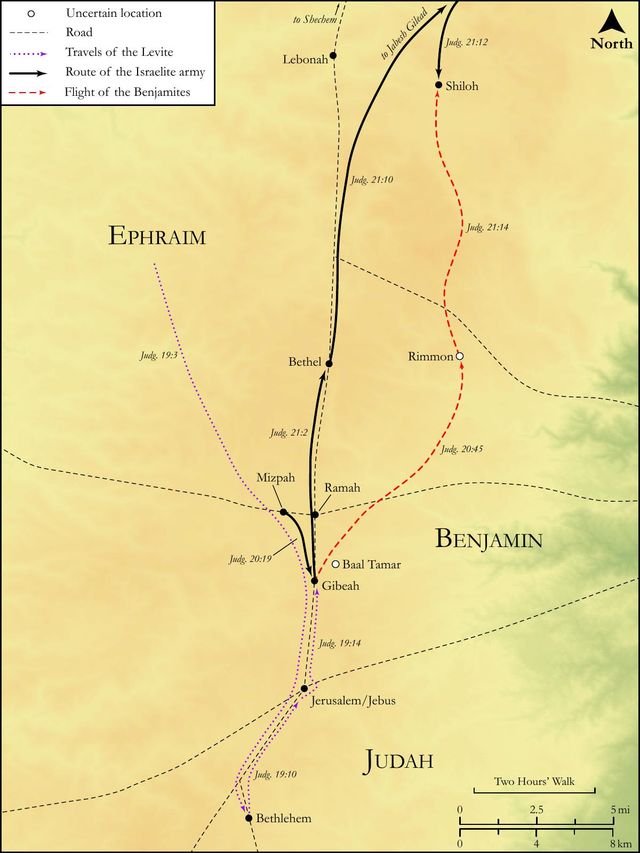
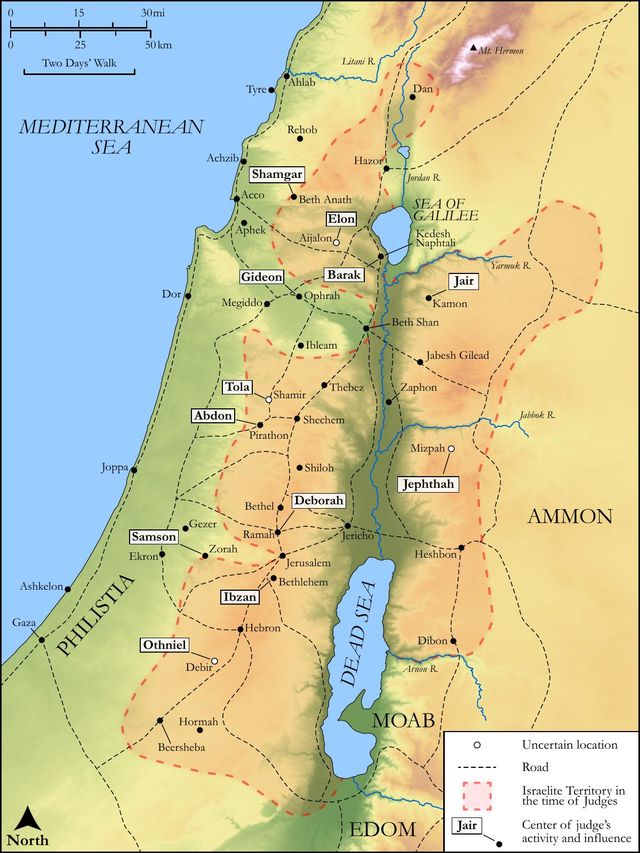
See on the biblical-era maps
Study this verse
Public-domain commentary
Matthew Henry
From his Commentary on the Whole Bible. Henry comments on passages, not single verses — this entry covers Judges 19:22–30. His three-level outline is real structure in the source text, so it is rendered as structure.
Here is, I. The great wickedness of the men of Gibeah. One could not imagine that ever it should enter into the heart of men that had the use of human reason, of Israelites that had the benefit of divine revelation, to be so very wicked. "Lord, what is man!" said David, "what a mean creature is he!" "Lord, what is man," may we say upon the reading of this story, "what a vile creature is he, when he is given up to his own heart's lusts!" The sinners are here called sons of Belial, that is, ungovernable men, men that would endure no yoke, children of the devil (for he is Belial), resembling him, and joining with him in rebellion against God and his government. Sons of Benjamin, of whom Moses had said, The beloved of the Lord shall dwell in safety by him (Deu 33:12), have become such sons of Belial that an honest man cannot lodge in safety among them. The sufferers were a Levite and his wife, and that kind man that gave them entertainment. We are strangers upon earth, and must expect strange usage. It is said they were making their hearts merry when this trouble came upon them, Jdg 19:22. If the mirth was innocent, it teaches us of what uncertain continuance all our creature comforts and enjoyments are; when we are ever so well pleased with our friends, we know not how near our enemies are; nor, if it be well with us this hour, can we be sure it will be so the next. If the mirth was sinful and excessive, let it be a warning to us to keep a strict guard upon ourselves, that we grow not intemperate in the use of lawful things, nor be transported into indecencies by our cheerfulness; for the end of that mirth is heaviness. God can soon change the note of those that are making their hearts merry, and turn their laughter into mourning and their joy into heaviness. Let us see what the wickedness of these Benjamites was.
1.They made a rude and insolent assault, in the night, upon the habitation of an honest man, that not only lived peaceably among them, but kept a good house and was a blessing and ornament to their city. They beset the house round, and, to the great terror of those within, beat as hard as they could at the door, Jdg 19:22. A man's house is his castle, in which he ought to be both safe and quiet, and, where there is law, it is taken under the special protection of it; but there was no king in Israel to keep the peace and secure honest men from the sons of violence.
2.They had a particular spite at the strangers that were within their gates, that only desired a night's lodging among them, contrary to the laws of hospitality, which all civilized nations have accounted sacred, and which the master of the house pleaded with them (Jdg 19:23): Seeing that this man has come into my house. Those are base and abject spirits indeed that will trample upon the helpless, and use a man the worse for his being a stranger, whom they know no ill of.
3.They designed in the most filthy and abominable manner (not to be thought of without horror and detestation) to abuse the Levite, whom perhaps they had observed to be young and comely: Bring him forth that we may know him. We should certainly have concluded they meant only to enquire whence he came, and to know his character, but that the good man of the house, who understood their meaning too well, by his answer lets us know that they designed the gratification of that most unnatural and worse than brutish lust which was expressly forbidden by the law of Moses, and called an abomination, Lev 18:22. Those that are guilty of it are ranked in the New Testament among the worst and vilest of sinners (Ti1 1:10), and such as shall not inherit the kingdom of God, Co1 6:9. Now,
(1.)This was the sin of Sodom, and is thence called Sodomy. The Dead Sea, which was the standing monument of God's vengeance upon Sodom, for its filthiness, was one of the boundaries of Canaan, and lay not many miles off from Gibeah. We may suppose the men of Gibeah had seen it many a time, and yet would not take warning by it, but did worse than Sodom (Eze 16:48), and sinned just after the similitude of their transgression. Who would have expected (says bishop Hall) such extreme abomination to come out of the loins of Jacob? Even the worst pagans were saints to them. What did it avail them that they had the ark of God in Shiloh when they had Sodom in their streets - God's law in their fringes, but the devil in their hearts? Nothing but hell itself can yield a worse creature than a depraved Israelite.
(2.)This was the punishment of their idolatry, that sin to which they were, above all others, most addicted. Because they liked not to retain God in their knowledge, therefore he gave them up to these vile affections, by which they dishonoured themselves as they had by their idolatry dishonoured him and turned his glory into shame, Rom 1:24, Rom 1:28. See and admire, in this instance, the patience of God. Why were not these sons of Belial struck blind, as the Sodomites were? Why were not fire and brimstone rained from heaven upon their city? It was because God would leave it to Israel to punish them by the sword, and would reserve his own punishment of them for the future state, in which those that go after strange flesh shall suffer the vengeance of eternal fire, Jde 1:7.
4.They were deaf to the reproofs and reasoning of the good man of the house, who, being well acquainted (we may suppose) with the story of Lot and the Sodomites, set himself to imitate Lot, Jdg 19:23, Jdg 19:24. Compare Gen 19:6-8. He went out to them as Lot did, spoke civilly to them, called them brethren, begged of them to desist, pleaded the protection of his house which his guests were under, and represented to them the great wickedness of their attempt: "Do not so wickedly, so very wickedly." He calls it folly and a vile thing. But in one thing he conformed too far to Lot's example (as we are apt in imitating good men to follow them even in their false steps), in offering them his daughter to do what they would with. He had not power thus to prostitute his daughter, nor ought he to have done this evil that good might come. But this wicked proposal of his may be in part excused from the great surprise and terror he was in, his concern for his guests, and his having too close a regard to what Lot did in the like case, especially not finding that the angels who were by reproved him for it. And perhaps he hoped that his mentioning this as a more natural gratification of their lust would have sent them back to their common harlots. But they would not hearken to him, Jdg 19:25. Headstrong lusts are like the deaf adder that stoppeth her ear; they sear the conscience and make it insensible.
5.They got the Levite's wife among them, and abused her to death, Jdg 19:25. They slighted the old man's offer of his daughter to their lust, either because she was not handsome or because they knew her to be one of great gravity and modesty: but, when the Levite brought them his concubine, they took her with them by force to the place appointed for their filthiness. Josephus, in his narrative of this story, makes her to be the person they had a design upon when they beset the house, and says nothing of their villainous design upon the Levite himself. They saw her (he says) in the street, when they came into the town, and were smitten with her beauty; and perhaps, though she was reconciled to her husband, her looks did not bespeak her to be one of the most modest. Many bring mischief of this kind upon themselves by their loose carriage and behaviour; a little spark may kindle a great fire. One would think the Levite should have followed them, to see what became of his wife, but it is probable he durst not, lest they should do him a mischief. In the miserable end of this woman, we may see the righteous hand of God punishing her for her former uncleanness, when she played the whore against her husband, Jdg 19:2. Though her father had countenanced her, her husband had forgiven her, and the fault was forgotten now that the quarrel was made up, yet God remembered it against her when he suffered these wicked men thus wretchedly to abuse her; how unrighteous soever they were in their treatment of her, in permitting it the Lord was righteous. Her punishment answered her sin, Culpa libido fuit, poena libido fuit - Lust was her sin, and lust was her punishment. By the law of Moses she was to have been put to death for her adultery. She escaped that punishment from men, yet vengeance pursued her; for, if there was no king in Israel, yet there was a God in Israel, a God that judgeth in the earth. We must not think it enough to make our peace with men, whom by our sins we have wronged, but are concerned, by repentance and faith, to make our peace with God, who sees not as men see, nor makes so light of sin as men often do. The justice of God in this matter does not at all extenuate the horrid wickedness of these men of Gibeah, than which nothing could be more barbarous and inhuman.
II.The notice that was sent of this wickedness to all the tribes of Israel.
The poor abused woman made towards her husband's lodgings as soon as ever the approach of the day-light obliged these sons of Belial to let her go (for these works of darkness hate and dread the light), Jdg 19:25. Down she fell at the door, with her hands on the threshold, begging pardon (as it were) for her former transgression, and in that posture of a penitent, with her mouth in the dust, she expired. There he found her (Jdg 19:26, Jdg 19:27), supposed her asleep, or overcome with shame and confusion for what had happened, but soon perceived she was dead (Jdg 19:28), took up her dead body, which, we may suppose, had all over it marks of the hands, the blows, and other abuses, she had received. On this sad occasion he waived his purpose of going to Shiloh, and went directly home. He that went out in hopes to return rejoicing came in again melancholy and disconsolate, sat down and considered, "Is this an injury fit to be passed by?" He cannot call for fire from heaven to consume the men of Gibeah, as those angels did who were, after the same manner, insulted by the Sodomites. There was no king in Israel, nor (for aught that appears) any sanhedrim, or great council, to appeal to, and demand justice from. Phinehas is high priest, but he attends closely to the business of the sanctuary, and will be no judge or divider. He has therefore no other way left him than to appeal to the people: let the community be judge. Though they had no general stated assembly of all the tribes, yet it is probable that each tribe had a meeting of their chiefs within itself. To each of the tribes, in their respective meetings, he sent by special messengers a remonstrance of the wrong that was done him, in all its aggravating circumstances, and with it a piece of his wife's dead body (Jdg 19:29), both to confirm the truth of the story and to affect them the more with it. He divided it into twelve pieces, according to the bones, so some read it, that is, by the joints, sending one to each tribe, even to Benjamin among the rest, with the hope that some among them would be moved to join in punishing so great a villany, and the more warmly because committed by some of their own tribe. It did indeed look very barbarous thus to mangle a dead body, which, having been so wretchedly dishonoured, ought to have been decently interred; but the Levite designed hereby, not only to represent their barbarous usage of his wife, whom they had better have cut in pieces thus than have used as they did, but also to express his own passionate concern and thereby to excite the like in them. And it had the desired effect. All that saw the pieces of the dead body, and were told how the matter was, expressed the same sentiments upon it.
1.That the men of Gibeah had been guilty of a very heinous piece of wickedness, the like to which had never been known before in Israel, Jdg 19:30. It was a complicated crime, loaded and blackened with all possible aggravations. They were not such fools as to make a mock at this sin, or turn the story off with a jest.
2.That a general assembly of all Israel should be called, to debate what was fit to be done for the punishment of this wickedness, that a stop might be put to this threatening inundation of debauchery, and the wrath of God might not be poured upon the whole nation for it. It is not a common case, and therefore they stir up one another to come together upon the occasion with this: Consider of it, take advice, and speak your minds. We have here the three great rules by which those that sit in council ought to go in every arduous affair.
(1.)Let every man retire into himself, and weigh the matter impartially and fully in his own thoughts, and seriously and calmly consider it, without prejudice on either side, before he speaks upon it.
(2.)Let them freely talk it over, and every man take advice of his friend, know his opinion and his reasons, and weigh them.
(3.)Then let every man speak his mind, and give his vote according to his conscience. In the multitude of such counsellors there is safety.
Historical interpretation
Historical reception
2 surviving comments on this verse. Each one is dated, so this reads as a timeline rather than a list.
And when they were satisfied and the tables were removed, vile men rushed up and surrounded the house. Then the old man offered these wicked men his daughter, a virgin, and the concubine with whom she shared her bed, only that violence might not be inflicted on his guest. But when reason did no good and violence prevailed, the Levite parted from his wife, and they knew her and abused her all that night. Overcome by this cruelty or by grief at her wrong, she fell at the door of their host where her husband had entered, and died, with the last effort of her life guarding the feelings of a good wife so as to preserve for her husband at least her mortal remains.
The old man kept urging them to be glad and kept inviting them to drink more wine so that they would forget their cares, when all of a sudden they were surrounded by young men of Gaba [Gibeah], given to lust, all lacking esteem for moderation. The woman’s beauty had bewitched them and thrown them into utter folly. They were captivated by her beauty and, because of the old man’s age and lack of help, with high hope of getting her, they demanded the woman and kept pounding at the door.The old man, going out, begged them not to defile his guest’s stay with a base crime, contemplating violation of a privilege reverenced even by savage nations of barbarous peoples; they could not insultingly mistreat a fellow tribesman of his, legitimately born, a married man, without causing wrath in their heavenly judge. When he saw that he was making little headway, he added that he had a maiden daughter and he offered her to them, with great sorrow, since he was her parent, but with less damage to the favor he owed his guest. He considered a public crime more tolerable than private disgrace. Driven by a wave of fury and inflamed by the incentive of lust, their desire for the young woman’s beauty increased the more she was denied them. Deprived of all righteousness, they mocked his fair words, considering the old man’s daughter an object of contempt in that she was offered with less feeling of ill will toward the crime.
Then, when pious entreaties availed nothing and the aged hands were hopelessly extended in vain, the woman was seized and all that night was subjected to violence. When day brought an end to the outrage, she went back to the door of their lodging, where she would not ask to see her husband, whom she thought she must now forego, ashamed at her pitiable condition. Yet, to show her love for her husband, she who had lost her chastity lay down at the door of the lodging, and there in pitiable circumstance came an end to her disgrace. The Levite, coming out, found her lying there and thought that she dared not lift her head for shame. He began comforting her, since she had succumbed to such injury not willingly but unwillingly. He bade her rise and go home with him. Then, as no answer came, he called her loudly as though to rouse her from sleep.
Continue studying Judges 19:25 across the web’s major study libraries — every link below opens this exact verse, chapter, or book on the destination site.
Read & Compare
 BibleGatewayThis verse in more than 200 translations and 70 languages.
 Bible.comThe YouVersion reader — hundreds of translations, reading plans, and highlights.
 ESV.orgCrossway's official English Standard Version reader.
 NET BibleThe NET translation with 60,000+ translators' notes on every rendering decision.
 STEP BibleTyndale House's free study tool — original text, vocabulary, and scholarly resources.
 BibliaLogos Bible Software's free web reader.
 USCCBThe New American Bible (Revised Edition) with the U.S. bishops' study notes.
Commentaries
 BibleHub CommentariesDozens of classic commentaries on this verse, gathered on one page.
 StudyLightMore than 100 commentary sets — the largest collection on the web.
 BibleRefPlain-English commentary on what this verse means, verse by verse.
 Enduring WordDavid Guzik's free commentary on this chapter, widely used by Bible teachers.
 Bible Study ToolsVerse commentary alongside Greek and Hebrew study aids.
Original Language & Research
- BibleHub InterlinearThe verse word by word — original language, transliteration, and English.
- BibleHub LexiconEvery word's original-language definition and Strong's entry.
 Blue Letter BibleDeep-study tools — Strong's numbers, concordance, and word studies.
 SefariaThe Hebrew text with Rashi and centuries of Jewish commentary.
Sermons, Hymns & Audio


TrulyRandomVerse is not affiliated with these sites and doesn’t control their content. They’re linked because they’re genuinely useful.
Summary
Judges 19:25 recounts a profoundly disturbing event, detailing the brutal gang rape and abuse of a Levite's concubine by the men of Gibeah. This horrific act, enabled by the Levite's complicity and the host's desperate attempt to uphold a perverted sense of hospitality, stands as a chilling testament to the profound moral decay and societal anarchy that plagued Israel during the period when "there was no king" and every person acted according to their own corrupt desires.
Context
ShowHideLiterary Context
Judges 19:25 serves as the horrific climax of a narrative arc spanning Judges 19-21, functioning as a distinct appendix to the book of Judges. This story immediately follows the Levite's desperate attempt to find lodging in Gibeah and the host's shocking offer of his virgin daughter and the Levite's concubine to a mob of "sons of Belial" (Judges 19:22) who had demanded the Levite for sexual assault. The verse details the brutal outcome of this exchange, directly preceding the concubine's death (Judges 19:26-28) and the Levite's gruesome act of dismembering her body to summon the tribes of Israel for war against Benjamin (Judges 19:29-30, Judges 20). This entire narrative serves as the ultimate illustration of the moral chaos described by the recurring refrain, "In those days there was no king in Israel; everyone did what was right in his own eyes" (Judges 17:6, Judges 21:25).
Historical & Cultural Context
The events of Judges take place during a transitional period in Israel's history, after the conquest of Canaan but before the establishment of the monarchy. This era was marked by decentralized tribal leadership, frequent cycles of apostasy, oppression, and deliverance, and a general decline in adherence to Mosaic law. The sacred custom of hospitality, a cornerstone of Israelite culture, was meant to offer protection to travelers, but in Gibeah, it was perverted into a grotesque violation. The term "sons of Belial" (Judges 19:22) denotes extreme wickedness and lawlessness, indicating individuals utterly devoid of moral restraint or respect for divine or human law. The treatment of the concubine reflects the deeply patriarchal society where women, especially concubines, held a vulnerable and often objectified status, highlighting the horrific consequences when societal and divine laws broke down, leaving the most vulnerable without protection.
Key Themes
ShowHideThis verse powerfully contributes to several overarching themes within the book of Judges and beyond. It vividly portrays the extreme depravity and moral collapse of Israel, demonstrating the depths of human wickedness when divine authority is disregarded and societal norms are abandoned. It underscores the violation of sacred hospitality, a fundamental societal covenant, turning a place of refuge into a scene of unspeakable horror and betrayal. The objectification and violence against women are starkly highlighted, as the concubine is treated as property and subjected to brutal sexual violence, emphasizing the vulnerability and neglect of women in a lawless society. Fundamentally, the incident illustrates the devastating consequences of lawlessness and moral relativism, serving as a direct catalyst for the civil war recounted in Judges 20, thereby reinforcing the book's central argument for the necessity of righteous governance and adherence to God's covenant.
Exposition and Analysis
ShowHideKey Word Analysis
ShowHideWhile often used in the Old Testament to denote intimate, consensual knowledge, including sexual relations (e.g., Genesis 4:1), in this context, the verb yâdaʻ (H3045) is a euphemism for sexual intercourse that is clearly forced and violent. Coupled with the subsequent phrase "abused her," it conveys a brutal act of sexual assault, emphasizing the violation of the woman's personhood and autonomy.
The Hebrew verb ʻâlal (H5953) is a strong term that goes beyond mere sexual contact. It signifies "to effect thoroughly," "to glean," but in a negative sense, "to overdo," "to maltreat," "to be saucy to," "to pain," or "to impose." Its use here underscores the prolonged and brutal nature of the assault, indicating not just rape but also torture, profound degradation, and a complete lack of humanity displayed by the men of Gibeah.
The phrase "until the morning" uses the noun bôqer (H1242), which properly refers to "dawn" or "the break of day." The arrival of morning marks the chilling conclusion of the night's ordeal, implying that the abuse lasted for the entire night until the first light, when the perpetrators, having exhausted their depravity, finally discarded her. This detail emphasizes the sustained torment and the utter indifference of the attackers.
Verse Breakdown
ShowHide"But the men would not hearken to him:"
This clause highlights the mob's unwavering intent and their rejection of the host's initial attempt to protect the Levite. Their refusal underscores their depravity and their single-minded pursuit of sexual violence against the male guest, revealing a shocking disregard for the sacred laws of hospitality and human dignity. It establishes their unyielding wickedness.
"so the man took his concubine, and brought her forth unto them;"
This is a pivotal and horrifying moment of complicity and moral failure. The Levite, whose responsibility it was to protect his concubine, actively hands her over to the mob. This act reveals his moral cowardice and the profound objectification of the woman, treated as a disposable commodity to save his own life and the host's, demonstrating a complete betrayal of his duty.
"and they knew her, and abused her all the night until the morning:"
This is the core of the verse's horror, explicitly describing the prolonged and brutal gang rape and torture. The duration—"all the night until the morning"—emphasizes the sustained torment, the relentless nature of the assault, and the utter lack of mercy shown by the perpetrators, painting a picture of extreme cruelty and dehumanization.
"and when the day began to spring, they let her go."
The chilling conclusion to the ordeal. As dawn breaks, the men, having satisfied their depraved desires, simply discard the concubine. This act of "letting her go" is not a release but an abandonment, leaving her lifeless or near-lifeless body at the doorstep, underscoring their complete indifference to her humanity and fate, and the finality of their monstrous act.
Literary Devices
ShowHideJudges 19:25 employs several powerful literary devices to convey its horrific message and underscore the profound moral decay of the era. The use of Euphemism in "they knew her" for sexual assault is a common biblical convention, which, rather than softening the blow, often makes the underlying brutality more starkly implied by forcing the reader to confront the horrific reality behind the veiled language. The narrative employs Foreshadowing, as the extreme depravity of this act in Gibeah directly sets the stage for the devastating civil war against the tribe of Benjamin in the subsequent chapters, highlighting the inevitable and catastrophic consequences of such moral decay on a national scale. There is a profound Juxtaposition between the sacred ancient custom of hospitality, which should offer protection and refuge to a traveler, and its horrific violation, where guests are subjected to extreme violence and betrayal. The passage also evokes intense Pathos, drawing deep sympathy and horror from the reader for the concubine's unimaginable suffering and the callous indifference of her attackers and the Levite. Finally, the incident serves as a powerful Symbolism of the complete breakdown of order, righteousness, and covenant faithfulness in Israel, echoing the book's recurring theme that "there was no king in Israel," leading to a society where "everyone did what was right in his own eyes."
Theological and Thematic Connections
ShowHideJudges 19:25 stands as a stark and sobering testament to the profound depths of human depravity when unrestrained by divine law, moral authority, or compassionate leadership. Theologically, it reveals the horrific consequences of a society that has abandoned God's covenant and chosen to live by its own corrupt standards, where human life, particularly that of the vulnerable, is utterly devalued and objectified. This passage exposes the reality of sin's destructive power, not just on individuals but on the entire social fabric, leading to chaos, violence, and the breakdown of all order. It implicitly cries out for justice and highlights the desperate need for a righteous King and a renewed commitment to God's commands, demonstrating that a society without God's moral framework inevitably descends into anarchy and barbarism.
Reflection and Application
ShowHideJudges 19:25 is an exceptionally difficult passage, but its inclusion in the biblical canon is not gratuitous; it serves as a powerful and enduring warning. It compels us to confront the reality of human wickedness and the devastating consequences of unchecked sin, moral relativism, and the objectification of others. For believers today, this text underscores the vital importance of upholding God's moral law as the foundation for a just and humane society. It challenges us to actively champion justice, protect the vulnerable, and speak out against all forms of violence and dehumanization, especially against those who are overlooked or exploited. Furthermore, it reminds us that the Bible unflinchingly portrays humanity's desperate need for a Savior and the establishment of God's righteous kingdom, where such atrocities will be no more. We are called to be agents of light and hope in a fallen world, reflecting Christ's compassion and pursuing His justice, ensuring that we do not stand idly by in the face of evil but actively work towards a world that reflects God's righteousness and love.
Questions for Reflection
ShowHideFAQ
ShowHideWhy is such a horrific story included in the Bible?
ShowHideThe Bible is a realistic and honest portrayal of humanity's fallen state, not a sanitized one. The inclusion of this horrific story serves several crucial purposes. First, it vividly illustrates the depths of human depravity and the chaos that ensues when a society abandons God's laws and moral principles, as highlighted by the repeated refrain "there was no king in Israel; everyone did what was right in his own eyes" (Judges 17:6, Judges 21:25). Second, it underscores the desperate need for a righteous king and ultimately, for God's redemptive intervention. Third, it functions as a stark warning against moral relativism and the consequences of unchecked sin, demonstrating the breakdown of societal order and the horrific treatment of the vulnerable when divine authority is rejected. Finally, it sets the stage for the subsequent civil war, explaining the dire state of Israel that necessitated a shift towards monarchy and the establishment of a more centralized, divinely-guided governance.
What is the significance of the phrase "knew her" in this context?
ShowHideThe Hebrew verb yâdaʻ (H3045), meaning "to know," is a common biblical euphemism for sexual intercourse, often used to describe intimate, consensual relations (e.g., Genesis 4:1). However, in the context of Judges 19:25, coupled with the subsequent phrase "and abused her" (ʻâlal, H5953), it unequivocally describes forced, violent sexual assault. The use of euphemism does not diminish the horror of the act; rather, it reflects ancient literary conventions while still conveying the brutal reality of the gang rape and torture. The passage leaves no doubt that the concubine was subjected to extreme sexual violence and dehumanization, highlighting the complete moral collapse of the men involved.
Christ-Centered Fulfillment
ShowHideThe unbridled depravity and moral anarchy depicted in Judges 19:25, where every person did "what was right in his own eyes" (Judges 17:6), vividly underscore humanity's profound and desperate need for a true and righteous King. This dark chapter of Israel's history, characterized by the ultimate betrayal of hospitality and the brutal objectification of a human life, points forward to the coming of Jesus Christ. Unlike the Levite who callously sacrificed his concubine, Christ is the Good Shepherd who lays down His life for His sheep. He did not offer another as a sacrifice; instead, He became the ultimate atonement, the Lamb of God who takes away the sin of the world, enduring unimaginable suffering and violence, not as a victim of human depravity but as a willing sacrifice for it. His coming inaugurates a new kingdom where justice prevails (Isaiah 11:3-5), the vulnerable are protected, and true hospitality is extended through His invitation to all who are weary and burdened. The horror of Gibeah serves as a stark backdrop, highlighting the profound darkness from which Christ rescues humanity, offering redemption, reconciliation, and the promise of a new heaven and new earth where righteousness and peace will kiss each other, and such atrocities will be forever banished by His sovereign rule.