


John 7:13
Bible text: King James Version (1769 Blayney text) · Public domain
Bible text: Berean Standard Bible · Public domain
Bible text: American Standard Version (1901) · Public domain
Bible text: World English Bible, Messianic edition · Public domain
Bible text: Geneva Bible (1599) · Public domain
Bible text: Young's Literal Translation · Public domain
- οὐδεὶςoudeisNo [one]G3762A-NSMAdjective Nominative Singular Masculine
- μέντοιmentoihoweverG3305CONJConjunction
- παρρησίᾳparrēsiapubliclyG3954N-DSFNoun Dative Singular Feminine
- ἐλάλειelaleiwas speakingG2980V-IAI-3SVerb Imperfect Active Indicative 3rd Singular
- περὶperiaboutG4012PREPPreposition
- αὐτοῦautouHimG846P-GSMPersonal pronoun Genitive Singular Masculine
- διὰdiabecause ofG1223PREPPreposition
- τὸνtontheG3588T-ASMDefinite article Accusative Singular Masculine
- φόβονphobonfearG5401N-ASMNoun Accusative Singular Masculine
- τῶνtōnof theG3588T-GPMDefinite article Genitive Plural Masculine
- ἸουδαίωνIoudaiōnJewsG2453N-GPM-PGNoun Genitive Plural Masculine Person Gentilic
English is a literal word-by-word gloss of the Greek, not the KJV's wording. Why?
This is the original text the KJV's translators worked from — each Greek word with its own literal English meaning in this verse, prepared by scholars at Tyndale House, Cambridge. The KJV translates whole sentences, not word by word, so its wording differs: one Greek word can become several English words, and the KJV may choose “charity” where the gloss reads “love”. Both are faithful — they answer different questions. For the KJV's own rendering, switch to the KJV text.
Details
See on the biblical-era maps
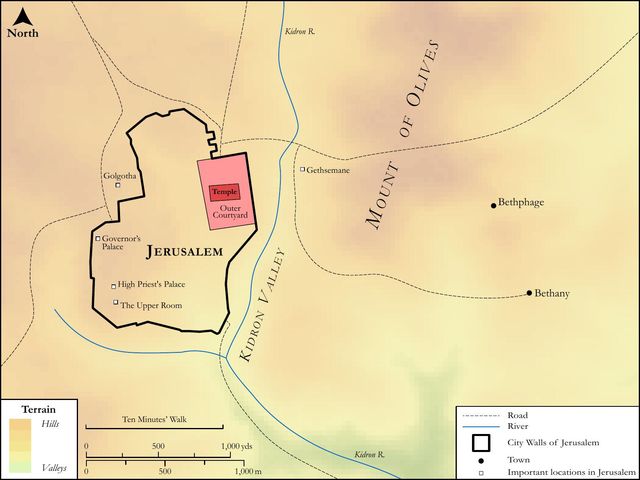
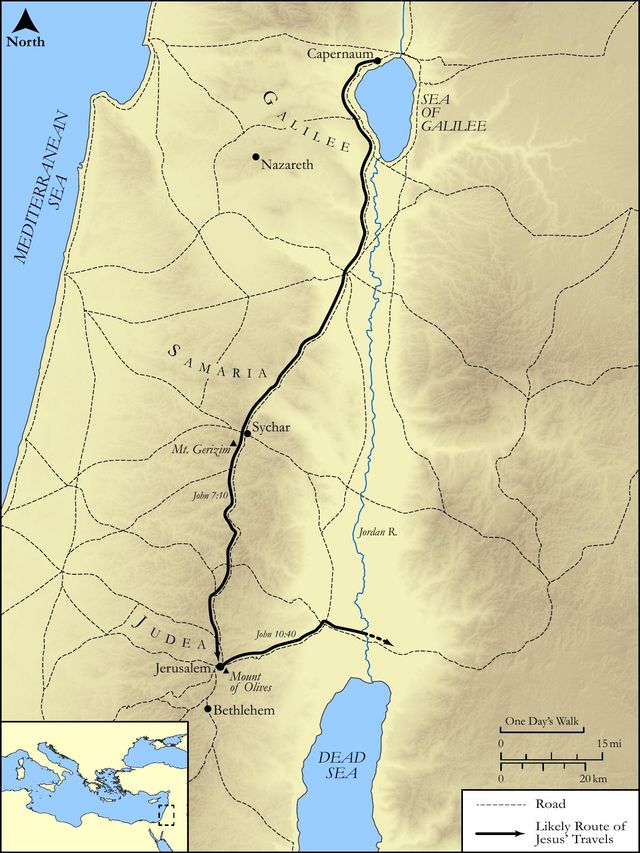
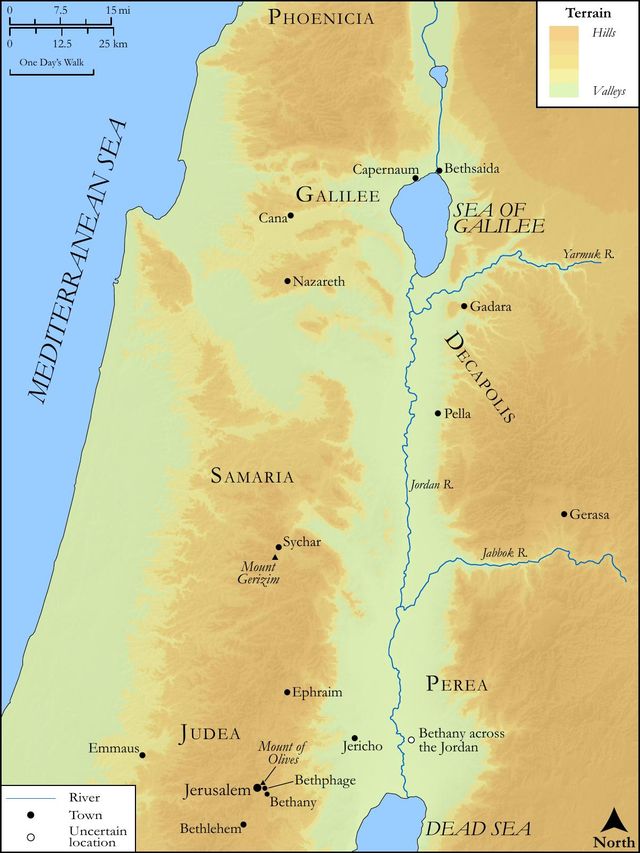
Study this verse
Public-domain commentary
Matthew Henry
From his Commentary on the Whole Bible. Henry comments on passages, not single verses — this entry covers John 7:1–13. His four-level outline is real structure in the source text, so it is rendered as structure.
We have here, I. The reason given why Christ spent more of his time in Galilee than in Judea (Joh 7:1): because the Jews, the people in Judea and Jerusalem, sought to kill him, for curing the impotent man on the sabbath day, Joh 5:16. They thought to be the death of him, either by a popular tumult or by a legal prosecution, in consideration of which he kept at a distance in another part of the country, very much out of the lines of Jerusalem's communication. It is not said, He durst not, but, He would not, walk in Jewry; it was not through fear and cowardice that he declined it, but in prudence, because his hour was not yet come. Note, 1. Gospel light is justly taken away from those that endeavour to extinguish it. Christ will withdraw from those that drive him from them, will hide his face from those that spit in it, and justly shut up his bowels from those who spurn at them. 2. In times of imminent peril it is not only allowable, but advisable, to withdraw and abscond for our own safety and preservation, and to choose the service of those places which are least perilous, Mat 10:23. Then, and not till then, we are called to expose and lay down our lives, when we cannot save them without sin. 3. If the providence of God casts persons of merit into places of obscurity and little note, it must not be thought strange; it was the lot of our Master himself. He who was fit to have sat in the highest of Moses's seats willingly walked in Galilee among the ordinary sort of people. Observe, He did not sit still in Galilee, nor bury himself alive there, but walked; he went about doing good. When we cannot do what and where we would, we must do what and where we can.
II.The approach of the feast of tabernacles (Joh 7:2), one of the three solemnities which called for the personal attendance of all the males at Jerusalem; see the institution of it, Lev 23:34, etc., and the revival of it after a long disuse, Neh 8:14. It was intended to be both a memorial of the tabernacle state of Israel in the wilderness, and a figure of the tabernacle state of God's spiritual Israel in this world. This feast, which was instituted so many hundred years before, was still religiously observed. Note, Divine institutions are never antiquated, nor go out of date, by length of time: nor must wilderness mercies ever be forgotten. But it is called the Jews' feast, because it was now shortly to be abolished, as a mere Jewish thing, and left to them that served the tabernacle.
III.Christ's discourse with his brethren, some of his kindred, whether by his mother or his supposed father is not certain; but they were such as pretended to have an interest in him, and therefore interposed to advise him in his conduct. And observe,
1.Their ambition and vain-glory in urging him to make a more public appearance than he did: "Depart hence," said they, "and go into Judea (Joh 7:3), where thou wilt make a better figure than thou canst here."
(1.)They give two reasons for this advice: [1.] That it would be an encouragement to those in and about Jerusalem who had a respect for him; for, expecting his temporal kingdom, the royal seat of which they concluded must be at Jerusalem, they would have had the disciples there particularly countenanced, and thought the time he spent among his Galilean disciples wasted and thrown away, and his miracles turning to no account unless those at Jerusalem saw them. Or, "That thy disciples, all of them in general, who will be gathered at Jerusalem to keep the feast, may see thy works, and not, as here, a few at one time and a few at another." [2.] That it would be for the advancement of his name and honour: There is no man that does any thing in secret if he himself seeks to be known openly. They took it for granted that Christ sought to make himself known, and therefore thought it absurd for him to conceal his miracles: "If thou do these things, if thou be so well able to gain the applause of the people and the approbation of the rulers by thy miracles, venture abroad, and show thyself to the world. Supported with these credentials, thou canst not fail of acceptance, and therefore it is high time to set up for an interest, and to think of being great."
(2.)One would not think there was any harm in this advice, and yet the evangelist noted it is an evidence of their infidelity: For neither did his brethren believe in him (Joh 7:5), if they had, they would not have said this. Observe,
[1.]It was an honour to be of the kindred of Christ, but no saving honour; they that hear his word and keep it are the kindred he values. Surely grace runs in no blood in the world, when not in that of Christ's family.
[2.]It was a sign that Christ did not aim at any secular interest, for then his kindred would have struck in with him, and he would have secured them first.
[3.]There were those who were akin to Christ according to the flesh who did believe in him (three of the twelve were his brethren), and yet others, as nearly allied to him as they, did not believe in him. Many that have the same external privileges and advantages do not make the same use of them. But,
(3.)What was there amiss in the advice which they gave him? I answer,
[1.]It was a piece of presumption for them to prescribe to Christ, and to teach him what measures to take; it was a sign that they did not believe him able to guide them, when they did not think him sufficient to guide himself.
[2.]They discovered a great carelessness about his safety, when they would have him go to Judea, where they knew the Jews sought to kill him. Those that believed in him, and loved him, dissuaded him from Judea, Joh 11:8.
[3.]Some think they hoped that if his miracles were wrought at Jerusalem the Pharisees and rulers would try them, and discover some cheat in them, which would justify their unbelief. So. Dr. Whitby.
[4.]Perhaps they were weary of his company in Galilee (for are not all these that speak Galileans?) and this was, in effect, a desire that he would depart out of their coasts.
[5.]They causelessly insinuate that he neglected his disciples, and denied them such a sight of his works as was necessary to the support of their faith.
[6.]They tacitly reproach him as mean-spirited, that he durst not enter the lists with the great men, nor trust himself upon the stage of public action, which, if he had any courage and greatness of soul, he would do, and not sneak thus and skulk in a corner; thus Christ's humility, and his humiliation, and the small figure which his religion has usually made in the world, have been often turned to the reproach of both him and it.
[7.]They seem to question the truth of the miracles he wrought, in saying, "If thou do these things, if they will bear the test of a public scrutiny in the courts above, produce them there." [8.] They think Christ altogether such a one as themselves, as subject as they to worldly policy, and as desirous as they to make a fair show in the flesh; whereas he sought not honour from men. [9.] Self was at the bottom of all; they hoped, if he would make himself as great as he might, they, being his kinsmen, should share in his honour, and have respect paid them for his sake. Note, First, Many carnal people go to public ordinances, to worship at the feast, only to show themselves, and all their care is to make a good appearance, to present themselves handsomely to the world. Secondly, Many that seem to seek Christ's honour do really therein seek their own, and make it serve a turn for themselves.
2.The prudence and humility of our Lord Jesus, which appeared in his answer to the advice his brethren gave him, Joh 7:6-8. Though there were so many base insinuations in it, he answered them mildly. Note, Even that which is said without reason should be answered without passion; we should learn of our Master to reply with meekness even to that which is most impertinent and imperious, and, where it is easy to find much amiss, to seem not to see it, and wink at the affront. They expected Christ's company with them to the feast, perhaps hoping he would bear their charges: but here,
(1.)He shows the difference between himself and them, in two things: - [1.] His time was set, so was not theirs: My time is not yet come, but your time is always ready. Understand it of the time of his going up to the feast. It was an indifferent thing to them when they went, for they had nothing of moment to do either where they were, to detain them there, or where they were going, to hasten them thither; but every minute of Christ's time was precious, and had its own particular business allotted to it. He had some work yet to do in Galilee before he left the country: in the harmony of the gospels betwixt this motion made by his kindred and his going up to this feast comes in the story of his sending forth the seventy disciples (Luk 10:1, etc.), which was an affair of very great consequence; his time is not yet, for that must be done first. Those who live useless lives have their time always ready; they can go and come when they please. But those whose time is filled up with duty will often find themselves straitened, and they have not yet time for that which others can do at any time. Those who are made the servants of God, as all men are, and who have made themselves the servants of all, as all useful men have, must not expect not covet to be masters of their own time. The confinement of business is a thousand times better than the liberty of idleness. or, it may be meant of the time of his appearing publicly at Jerusalem; Christ, who knows all men and all things, knew that the best and most proper time for it would be about the middle of the feast. We, who are ignorant and short-sighted, are apt to prescribe to him, and to think he should deliver his people, and so show himself now. The present time is our time, but he is fittest to judge, and, it may be, his time is not yet come; his people are not yet ready for deliverance, nor his enemies ripe for ruin; let us therefore wait with patience for his time, for all he does will be most glorious in its season. [2.] His life was sought, so was not theirs, Joh 7:7. They, in showing themselves to the world, did not expose themselves: "The world cannot hate you, for you are of the world, its children, its servants, and in with its interests; and no doubt the world will love its own;" see Joh 15:19. Unholy souls, whom the holy God cannot love, the world that lies in wickedness cannot hate; but Christ, in showing himself to the world, laid himself open to the greatest danger; for me it hateth. Christ was not only slighted, as inconsiderable in the world (the world knew him not), but hated, as if he had been hurtful to the world; thus ill was he requited for his love to the world: reigning sin is a rooted antipathy and enmity to Christ. But why did the world hate Christ? What evil had he done to it? Had he, like Alexander, under colour of conquering it, laid it waste? "No, but because" (saith he) "I testify of it, that the works of it are evil." Note, First, The works of an evil world are evil works; as the tree is, so are the fruits: it is a dark world, and an apostate world, and its works are works of darkness and rebellion. Secondly, Our Lord Jesus, both by himself and by his ministers, did and will both discover and testify against the evil works of this wicked world. Thirdly, It is a great uneasiness and provocation to the world to be convicted of the evil of its works. It is for the honour of virtue and piety that those who are impious and vicious do not care for hearing of it, for their own consciences make them ashamed of the turpitude there is in sin and afraid of the punishment that follows after sin. Fourthly, Whatever is pretended, the real cause of the world's enmity to the gospel is the testimony it bears against sin and sinners. Christ's witnesses by their doctrine and conversation torment those that dwell on the earth, and therefore are treated so barbarously, Rev 11:10. But it is better to incur the world's hatred, by testifying against its wickedness, than gain its good-will by going down the stream with it.
(2.)He dismisses them, with a design to stay behind for some time in Galilee (Joh 7:8): Go you up to this feast, I go not up yet.
[1.]He allows their going to the feast, though they were carnal and hypocritical in it. Note, Even those who go not to holy ordinances with right affections and sincere intentions must not be hindered nor discouraged from going; who knows but they may be wrought upon there?
[2.]He denies them his company when they went to the feast, because they were carnal and hypocritical. Those who go to ordinances for ostentation, or to serve some secular purpose, go without Christ, and will speed accordingly. How sad is the condition of that man, though he reckon himself akin to Christ, to whom he saith, "Go up to such an ordinance, Go pray, Go hear the word, Go receive the sacrament, but I go not up with thee? Go thou and appear before God, but I will not appear for thee," as Exo 33:1-3. But, if the presence of Christ go not with us, to what purpose should we go up? Go you up, I go not up. When we are going to, or coming fRom. solemn ordinances, it becomes us to be careful what company we have and choose, and to avoid that which is vain and carnal, lest the coal of good affections be quenched by corrupt communication. I go not up yet to this feast; he does not say, I will not go up at all, but not yet. There may be reasons for deferring a particular duty, which yet must not be wholly omitted or laid aside; see Num 9:6-11. The reason he gives is, My time is not yet fully come. Note, Our Lord Jesus is very exact and punctual in knowing and keeping his time, and, as it was the time fixed, so it was the best time.
3.Christ's continuance in Galilee till his full time was come, Joh 7:9. He, saying these things to them (tauta de eipōn) abode still in Galilee; because of this discourse he continued there; for,
(1.)He would not be influenced by those who advised him to seek honour from men, nor go along with those who put him upon making a figure; he would not seem to countenance the temptation.
(2.)He would not depart from his own purpose. He had said, upon a clear foresight and mature deliberation, that he would not go up yet to this feast, and therefore he abode still in Galilee. It becomes the followers of Christ thus to be steady, and not to use lightness.
4.His going up to the feast when his time was come. Observe,
(1.)When he went: When his brethren were gone up. He would not go up with them, lest they should make a noise and disturbance, under pretence of showing him to the world; whereas it agreed both with the prediction and with his spirit not to strive nor cry, nor let his voice be heard in the streets, Isa 42:2. But he went up after them. We may lawfully join in the same religious worship with those with whom we should yet decline an intimate acquaintance and converse; for the blessing of ordinances depends upon the grace of God, and not upon the grace of our fellow-worshippers. His carnal brethren went up first, and then he went. Note, In the external performances of religion it is possible that formal hypocrites may get the start of those that are sincere. Many come first to the temple who are brought thither by vain-glory, and go thence unjustified, as he, Luk 18:11. It is not, Who comes first? that will be the question, but, Who comes fittest? If we bring our hearts with us, it is no matter who gets before us.
(2.)How he went, ōs en kruptō - as if he were hiding himself: not openly, but as it were in secret, rather for fear of giving offence than of receiving injury. He went up to the feast, because it was an opportunity of honouring God and doing good; but he went up as it were in secret, because he would not provoke the government. Note, Provided the work of God be done effectually, it is best done when done with least noise. The kingdom of God need not come with observation, Luk 17:20. We may do the work of God privately, and yet not do it deceitfully.
5.The great expectation that there was of him among the Jews at Jerusalem, Joh 7:11-14. Having formerly come up to the feasts, and signalized himself by the miracles he wrought, he had made himself the subject of much discourse and observation.
(1.)They could not but think of him (Joh 7:11): The Jews sought him at the feast, and said, Where is he?
[1.]The common people longed to see him there, that they might have their curiosity gratified with the sight of his person and miracles. They did not think it worth while to go to him into Galilee, though if they had they would not have lost their labour, but they hoped the feast would bring him to Jerusalem, and then they should see him. If an opportunity of acquaintance with Christ come to their door, they can like it well enough. They sought him at the feast. When we attend upon God in his holy ordinances, we should seek Christ in them, seek him at the gospel feasts. Those who would see Christ at a feast must seek him there. Or,
[2.]Perhaps it was his enemies that were thus waiting an opportunity to seize him, and, if possible, to put an effectual stop to his progress. They said, Where is he? pou esin ekeinos - where is that fellow? Thus scornfully and contemptibly do they speak of him. When they should have welcomed the feast as an opportunity of serving God, they were glad of it as an opportunity of persecuting Christ. Thus Saul hoped to slay David at the new moon, Sa1 20:27. Those who seek opportunity to sin in solemn assemblies for religious worship profane God's ordinances to the last degree, and defy him upon his own ground; it is like striking within the verge of the court.
(2.)The people differed much in their sentiments concerning him (Joh 7:12): There was much murmuring, or muttering rather, among the people concerning him. The enmity of the rulers against Christ, and their enquiries after him, caused him to be so much the more talked of and observed among the people. This ground the gospel of Christ has got by the opposition made to it, that it has been the more enquired into, and, by being every where spoken against, it has come to be every where spoken of, and by this means has been spread the further, and the merits of his cause have been the more searched into. This murmuring was not against Christ, but concerning him; some murmured at the rulers, because they did not countenance and encourage him: others murmured at them, because they did not silence and restrain him. Some murmured that he had so great an interest in Galilee; others, that he had so little interest in Jerusalem. Note, Christ and his religion have been, and will be, the subject of much controversy and debate, Luk 12:51, Luk 12:52. If all would agree to entertain Christ as they ought, there would be perfect peace; but, when some receive the light and others resolve against it, there will be murmuring. The bones in the valley, while they were dead and dry, lay quiet; but when it was said unto them, Live, there was a noise and a shaking, Eze 37:7. But the noise and rencounter of liberty and business are preferable, surely, to the silence and agreement of a prison. Now what were the sentiments of the people concerning him?
[1.]Some said, he is a good man. This was a truth, but it was far short of being the whole truth. He was not only a good man, but more than a man, he was the Son of God. Many who have no ill thoughts of Christ have yet low thoughts of him, and scarcely honour him, even when they speak well of him, because they do not say enough; yet indeed it was his honour, and the reproach of those who persecuted him, that even those who would not believe him to be the Messiah could not but own he was a good man.
[2.]Others said, Nay, but he deceiveth the people; if this had been true, he had been a very bad man. The doctrine he preached was sound, and could not be contested; his miracles were real, and could not be disproved; his conversation was manifestly holy and good; and yet it must be taken for granted, notwithstanding, that there was some undiscovered cheat at the bottom, because it was the interest of the chief priests to oppose him and run him down. Such murmuring as there was among the Jews concerning Christ there is still among us: the Socinians say, He is a good man, and further they say not; the deists will not allow this, but say, He deceived the people. Thus some depreciate him, others abuse him, but great is the truth.
[3.]They were frightened by their superiors from speaking much of him (Joh 7:13): No man spoke openly of him, for fear of the Jews. Either, First, They durst not openly speak well of him. While any one was at liberty to censure and reproach him, none durst vindicate him. Or, Secondly, They durst not speak at all of him openly. Because nothing could justly be said against him, they would not suffer any thing to be said of him. It was a crime to name him. Thus many have aimed to suppress truth, under colour of silencing disputes about it, and would have all talk of religion hushed, in hopes thereby to bury in oblivion religion itself.
Historical interpretation
Historical reception
6 surviving comments on this verse. Each one is dated, so this reads as a timeline rather than a list.
Select a marker to jump to its quote. Markers stagger vertically where authors wrote within a few decades of each other.
"Howbeit no man spake openly of Him for fear of the Jews." Seest thou everywhere the ruling body corrupted, and the ruled sound indeed in judgment, but not having that proper courage which a multitude especially lacketh?
(Hom. xlix. 1) Observe, the corruption is in the rulers: the common people are sound in their judgment, but have not liberty of speech, as is generally their case.
(Tract. xxviii. 12) Howbeit no man spake openly of Him, for fear of the Jews; none, that is, of those who said, He is a good man. They who said, He deceiveth the people, proclaimed their opinion openly enough; while the former only dared whisper theirs.
"Howbeit no man spake openly of Him for fear of the Jews." But who were they that did not speak of Him for fear of the Jews? Undoubtedly they who said, "He is a good man:" not they who said, "He deceiveth the people." As for them who said "He deceiveth the people," their din was heard like the noise of dry leaves. "He deceiveth the people," they sounded more and more loudly: "He is a good man," they whispered more and more constrainedly. But now, brethren, notwithstanding that glory of Christ which is to make us immortal is not yet come, yet now, I say, His Church so increases, He has deigned to spread it abroad through the whole world, that it is now only whispered. "He deceiveth the people;" and more and more loudly it sounds forth, "He is a good man."
There was murmuring among the Jews, and for fear of the Jews, he says that no man could speak openly. The Divine Evangelist then is calling the rulers of the Jews emphatically Jews, not deigning (as seems to me) to call them elders or priests, or the like, kindled with pious jealousy unto grief to themward, whom with reason does God accuse of destroying His spiritual vineyard, saying in the prophets, Many pastors destroyed My vineyard, they defiled My portion, they gave My longed-for portion for an impassable wilderness, it hath become a vanishing of perdition. For how shall we not suppose that the Lord's vineyard hath in truth been destroyed by their abominations, when they showed that even to agree with the good, and only to marvel at that which is worthy of marvel is hazardous? But that this too works a sorer punishment for the rulers of the Jews and the rest of them, what wise man will doubt? Lo, for lo, the whole people fear and tremble before them, yet are not instructed in the law, nor yet taught to live in a fitting manner, although very zealously subjected to their injunctions. For fear is a proof of the very highest subjection. They were compelled then to transgress rather than wisely to look into the purpose of the Law-giver, and (in that they dare not so much as praise what is good) to give by no means a voluntary, but a constrained, judgment of evil against whosoever the others choose, and to condemn as base, Him That is worthy of praise and admiration. Just as a man therefore who has good skill in sea-faring matters, and sits at the ship's helm, and having her at his command dashes her against the rocks, would be himself held guilty of the wreck: or as if one accustomed to drive, were borne along by swiftest ponies, and being able by the checks of the reins to hold their easily-directed flight whithersoever he would, were to dash the wheels against a stone, not to the ponies would he reasonably attach the blame of the misfortune, but rather to himself:----in like manner, I deem, the rulers of the Jews, having the people of the Jews not only honouring them, but even serving them by fear as well, if they manage them contrary to Divine Commands, shall justly themselves incur responsibility for the loss of all. But that themselves were the cause of the perdition of the people, the prophet Jeremiah will testify, saying, For the pastors became brutish,, and sought not out the LORD: therefore the whole flock understood not and were scattered.
If a skilled horseman—who is able to control even the swiftest team of horses with checks of the reins and directs them wherever he likes—if he were to dash the carriage wheels against a stone, the blame would not fall on the horses but on their driver. In a similar manner, I suppose, the rulers of the Jews, who are not only honored by their people but are served and feared by them as well, if they manage their people contrary to the divine commandments, then it is they who will justly bear the responsibility for the loss of all.
Continue studying John 7:13 across the web’s major study libraries — every link below opens this exact verse, chapter, or book on the destination site.
Read & Compare
 BibleGatewayThis verse in more than 200 translations and 70 languages.
 Bible.comThe YouVersion reader — hundreds of translations, reading plans, and highlights.
 ESV.orgCrossway's official English Standard Version reader.
 NET BibleThe NET translation with 60,000+ translators' notes on every rendering decision.
 STEP BibleTyndale House's free study tool — original text, vocabulary, and scholarly resources.
 BibliaLogos Bible Software's free web reader.
 USCCBThe New American Bible (Revised Edition) with the U.S. bishops' study notes.
Commentaries
 BibleHub CommentariesDozens of classic commentaries on this verse, gathered on one page.
 StudyLightMore than 100 commentary sets — the largest collection on the web.
 BibleRefPlain-English commentary on what this verse means, verse by verse.
 Enduring WordDavid Guzik's free commentary on this chapter, widely used by Bible teachers.
 Bible Study ToolsVerse commentary alongside Greek and Hebrew study aids.
Original Language & Research
- BibleHub InterlinearThe verse word by word — original language, transliteration, and English.
- BibleHub LexiconEvery word's original-language definition and Strong's entry.
 Blue Letter BibleDeep-study tools — Strong's numbers, concordance, and word studies.
 CNTR CollationThe earliest Greek manuscripts of this verse, collated letter by letter.
Sermons, Hymns & Audio


TrulyRandomVerse is not affiliated with these sites and doesn’t control their content. They’re linked because they’re genuinely useful.
Summary
John 7:13 reveals the pervasive atmosphere of fear and intimidation surrounding Jesus during the Feast of Tabernacles in Jerusalem. Despite widespread discussion and curiosity about His identity, no one dared to speak openly in His favor due to a palpable apprehension of the influential Jewish religious authorities, highlighting the significant social and religious pressures faced by those who might otherwise have publicly acknowledged Him.
Context
ShowHideLiterary Context
This verse is situated within a narrative of escalating tension and division concerning Jesus' identity and authority in Jerusalem. Jesus had arrived at the Feast of Tabernacles, not openly, but "as it were in secret" John 7:10. Prior to this, there had been significant debate among the crowds, with some asserting He was "a good man" while others contended, "Nay; but he deceiveth the people" John 7:12. Verse 13 serves as the crucial explanation for why these discussions remained largely private or whispered, rather than openly declared. The fear of the powerful religious establishment stifled public discourse and prevented any open endorsement of Jesus, setting the stage for the direct confrontations that follow in the chapter.
Historical & Cultural Context
The Feast of Tabernacles (Sukkot) was one of the three major pilgrimage festivals, drawing large crowds to Jerusalem. This setting amplified the public nature of Jesus' ministry and the scrutiny He faced. The phrase "the Jews" in John's Gospel often refers specifically to the religious leaders and authorities (e.g., Pharisees, Sadducees, chief priests, members of the Sanhedrin) who held significant social, religious, and political power over the populace. These leaders had already demonstrated their hostility towards Jesus, having previously sought to kill Him John 5:18. The fear mentioned in this verse was not merely of physical harm, but more profoundly, of social ostracism, excommunication from the synagogue (which meant social and religious isolation), and economic repercussions, as later evidenced by the threats against those who confessed Jesus as the Christ John 9:22.
Key Themes
ShowHideJohn 7:13 powerfully contributes to several overarching themes in the Gospel of John. Firstly, it underscores the theme of Fear and Intimidation, illustrating how the authority and opposition of the religious establishment paralyzed potential followers and silenced public support for Jesus. This fear prevented open confession, contrasting sharply with the boldness Jesus Himself often displayed. Secondly, it highlights the tension between Hidden Faith and Open Confession. Many may have been intellectually convinced or personally drawn to Jesus, but the social and religious cost of publicly aligning with Him was too high for them. This struggle recurs throughout John's narrative, notably when "many of the chief rulers believed on him; but because of the Pharisees they did not confess him, lest they should be put out of the synagogue" John 12:42. Finally, the verse reinforces the pervasive Hostility of the Authorities towards Jesus, a persistent motif that drives much of the narrative tension in the Gospel and ultimately leads to His crucifixion. Their influence was so profound that it stifled free speech and open inquiry concerning the Messiah.
Exposition and Analysis
ShowHideKey Word Analysis
ShowHideMeaning "not even one (man, woman or thing), i.e. none, nobody, nothing." This emphasizes the absolute absence of public, open support for Jesus. It's a stark statement, indicating a complete lack of individuals willing to speak out, rather than just a few.
Meaning "all out-spokenness, i.e. frankness, bluntness, publicity; by implication, assurance." This word denotes speaking with boldness, without reservation, and in public. The absence of parrhēsía highlights the intense pressure and danger associated with publicly acknowledging Jesus, contrasting with His own willingness to speak openly at times John 7:26.
Meaning "alarm or fright." This is the direct cause stated for the silence. It's not mere apprehension but a deep-seated dread of the consequences of speaking out, encompassing social, religious, and potentially physical repercussions.
Verse Breakdown
ShowHide"Howbeit no man spake openly of him"
This clause establishes the central observation: despite the widespread discussion about Jesus, there was a complete lack of public, unreserved speech in His favor. The term "openly" (Greek: parrhēsía) is crucial, implying not just private conversation but a bold, public declaration or defense. This silence indicates a significant underlying reason, which the second part of the verse immediately provides. The "no man" underscores the universality of this phenomenon within the public sphere at the Feast.
"for fear of the Jews."
This phrase provides the explicit reason for the public silence. "The Jews" in this context refers to the influential religious and political leaders who held authority over the people. Their opposition to Jesus was well-known, and they possessed the power to impose severe social and religious penalties, such as excommunication from the synagogue. This fear was a powerful deterrent, demonstrating the immense social and spiritual cost of discipleship in this hostile environment.
Literary Devices
ShowHideThe verse effectively employs several literary devices. Contrast is prominent, highlighting the disparity between the private murmuring and divided opinions about Jesus John 7:12 and the complete absence of public, open speech in His defense. This contrast underscores the oppressive atmosphere created by the religious authorities. There is also a strong element of Foreshadowing, as this pervasive fear of "the Jews" anticipates the increasing hostility Jesus will face, culminating in His arrest and crucifixion, and also foreshadows the later persecution of His disciples. Finally, the verse uses Irony in that the very people who should have been most open to the Messiah—the religious leaders of Israel—were the primary source of opposition and fear, stifling the truth among their own people.
Theological and Thematic Connections
ShowHideJohn 7:13 powerfully illustrates the spiritual battle between light and darkness, truth and deception, and courage and fear. It reveals the profound impact of human fear, particularly the fear of man, in hindering the open proclamation and reception of divine truth. The silence of the crowds, driven by apprehension of the religious elite, underscores humanity's tendency to prioritize social acceptance and security over allegiance to God's revealed will. Theologically, it highlights the radical nature of true discipleship, which often demands a willingness to defy human pressures and stand boldly for Christ, even when facing significant opposition. This verse also implicitly points to the necessity of divine empowerment for such boldness, as human courage often falters in the face of severe consequences.
Reflection and Application
ShowHideJohn 7:13 serves as a poignant mirror for contemporary believers, challenging us to examine the authenticity and courage of our own faith. In an increasingly polarized world, various "fears of the Jews" can still prevent open confession of Christ—whether it's fear of social ostracism, professional repercussions, intellectual ridicule, or even physical persecution in some contexts. This verse prompts us to consider: Are we willing to speak openly of Jesus, even when it is unpopular or costly? Do we allow the fear of human disapproval to silence our witness or compromise our convictions? The call to discipleship is a call to courageous faith, one that prioritizes allegiance to Christ above all earthly considerations. Just as the early apostles, once timid, were empowered by the Holy Spirit to speak with boldness, so too are believers today called to overcome the fear of man and to be unashamed witnesses for the Gospel, trusting in God's sovereignty and provision.
Questions for Reflection
ShowHideFAQ
ShowHideWho are "the Jews" in this context, and why were people afraid of them?
ShowHideIn the Gospel of John, "the Jews" often refers specifically to the Jewish religious authorities and leaders (such as the Pharisees, Sadducees, and members of the Sanhedrin) rather than the Jewish people in general. These leaders held significant power and influence over Jewish society. People were afraid of them because these authorities had the power to impose severe penalties on those who publicly supported Jesus. These penalties included social ostracism, religious excommunication from the synagogue (which meant being cut off from community life, worship, and social support), and potentially economic ruin. They had already sought to kill Jesus John 5:18 and later formalized a policy to excommunicate anyone who confessed Jesus as the Christ John 9:22. This fear was a powerful deterrent to open confession.
What does it mean that "no man spake openly of him"?
ShowHideThe phrase "spake openly" translates the Greek word parrhēsía (G3954), which means "with boldness," "frankly," "publicly," or "without reservation." It implies speaking freely and confidently in public, without fear of consequence. Therefore, "no man spake openly of him" means that no one was willing to publicly declare their support for Jesus, defend Him, or confess Him as the Messiah in a bold and unreserved manner. While there were private discussions and divided opinions John 7:12, the pervasive fear of the Jewish authorities prevented any public endorsement, demonstrating the intense pressure and danger associated with aligning with Jesus at that time.
Christ-Centered Fulfillment
ShowHideJohn 7:13, with its depiction of human fear stifling open confession, profoundly highlights the unique and unparalleled boldness of Jesus Christ. While "no man spake openly of him for fear of the Jews," Jesus Himself consistently spoke with divine authority and unreserved truth, even in the face of escalating opposition and threats to His life. His ministry was characterized by parrhēsía—speaking openly and fearlessly—as He declared Himself to be the light of the world John 8:12, the Son of God, and the way, the truth, and the life John 14:6. The very fear that silenced others ultimately served to underscore His divine courage and unwavering commitment to His Father's will, even unto death on the cross. His ultimate sacrifice, made not out of fear but out of love for humanity, broke the power of sin and death, and by extension, the fear of man. It is through His finished work that believers are now empowered by the Holy Spirit to overcome such fears and to "speak the word of God with boldness" Acts 4:31, becoming witnesses to the very Christ whom others feared to acknowledge.