


John 4:49
Bible text: King James Version (1769 Blayney text) · Public domain
Bible text: Berean Standard Bible · Public domain
Bible text: American Standard Version (1901) · Public domain
Bible text: World English Bible, Messianic edition · Public domain
Bible text: Geneva Bible (1599) · Public domain
Bible text: Young's Literal Translation · Public domain
- λέγειlegeiSaysG3004V-PAI-3SVerb Present Active Indicative 3rd Singular
- πρὸςprostoG4314PREPPreposition
- αὐτὸνautonHimG846P-ASMPersonal pronoun Accusative Singular Masculine
- ὁhotheG3588T-NSMDefinite article Nominative Singular Masculine
- βασιλικός·basilikosroyal officialG937A-NSMAdjective Nominative Singular Masculine
- κύριεkurieSirG2962N-VSMNoun Vocative Singular Masculine
- κατάβηθιkatabēthido come downG2597V-2AAM-2SVerb 2nd Aorist Active Imperative 2nd Singular
- πρὶνprinbeforeG4250PREPPreposition
- ἀποθανεῖνapothaneinto dieG599V-2AANVerb 2nd Aorist Active Infinitive
- τὸtotheG3588T-ASNDefinite article Accusative Singular Neuter
- παιδίονpaidionchildG3813N-ASNNoun Accusative Singular Neuter
- μουmouof mineG3165P-1GSPersonal pronoun Genitive 1st Singular
English is a literal word-by-word gloss of the Greek, not the KJV's wording. Why?
This is the original text the KJV's translators worked from — each Greek word with its own literal English meaning in this verse, prepared by scholars at Tyndale House, Cambridge. The KJV translates whole sentences, not word by word, so its wording differs: one Greek word can become several English words, and the KJV may choose “charity” where the gloss reads “love”. Both are faithful — they answer different questions. For the KJV's own rendering, switch to the KJV text.
Details
See on the biblical-era maps
Study this verse
Public-domain commentary
Matthew Henry
From his Commentary on the Whole Bible. Henry comments on passages, not single verses — this entry covers John 4:43–54. His four-level outline is real structure in the source text, so it is rendered as structure.
In these verses we have,
I.Christ's coming into Galilee, Joh 4:43.
Though he was as welcome among the Samaritans as he could be any where, and had better success, yet after two days he left them, not so much because they were Samaritans, and he would not confirm those in their prejudices against him who said, He is a Samaritan (Joh 8:48), but because he must preach to other cities, Luk 4:43. He went into Galilee, for there he spent much of his time. Now see here,
1.Whither Christ went; into Galilee, into the country of Galilee, but not to Nazareth, which was strictly his own country. He went among the villages, but declined going to Nazareth, the head city, for a reason here given, which Jesus himself testified, who knew the temper of his countrymen, the hearts of all men, and the experiences of all prophets, and it is this, That a prophet has no honour in his own country. Note,
(1.)Prophets ought to have honour, because God has put honour upon them and we do or may receive benefit by them.
(2.)The honour due to the Lord's prophets has very often been denied them, and contempt put upon them.
(3.)This due honour is more frequently denied them in their own country; see Luk 4:24; Mat 13:57. Not that it is universally true (no rule but has some exceptions), but it holds for the most part. Joseph, when he began to be a prophet, was most hated by his brethren; David was disdained by his brother (Sa1 17:28); Jeremiah was maligned by the men of Anathoth (Jer 11:21), Paul by his countrymen the Jews; and Christ's near kinsmen spoke most slightly of him, Joh 7:5. Men's pride and envy make them scorn to be instructed by those who once were their school-fellows and play-fellows. Desire of novelty, and of that which is far-fetched and dear-bought, and seems to drop out of the sky to them, makes them despise those persons and things which they have been long used to and know the rise of.
(4.)It is a great discouragement to a minister to go among a people who have no value for him or his labours. Christ would not go to Nazareth, because he knew how little respect he should have there.
(5.)It is just with God to deny his gospel to those that despise the ministers of it. They that mock the messengers forfeit the benefit of the message. Mat 21:35, Mat 21:41.
2.What entertainment he met with among the Galileans in the country (Joh 4:45): They received him, bade him welcome, and cheerfully attended on his doctrine. Christ and his gospel are not sent in vain; if they have not honour with some, they shall have with others. Now the reason given why these Galileans were so ready to receive Christ is because they had seen the miracles he did at Jerusalem, Joh 4:45. Observe,
(1.)They went up to Jerusalem at the feast, the feast of the passover. The Galileans lay very remote from Jerusalem, and their way thither lay through the country of the Samaritans, which was troublesome for a Jew to pass through, worse than Baca's valley of old; yet, in obedience to God's command, they went up to the feast, and there they became acquainted with Christ. Note, They that are diligent and constant in attending on public ordinances some time or other meet with more spiritual benefit than they expect.
(2.)At Jerusalem they saw Christ's miracles, which recommended him and his doctrine very much to their faith and affections. The miracles were wrought for the benefit of those at Jerusalem; yet the Galileans who were accidentally there got more advantage by them than they did for whom they were chiefly designed. Thus the word preached to a mixed multitude may perhaps edify occasional hearers more than the constant auditory.
3.What city he went to. When he would go to a city, he chose to go to Cana of Galilee, where he had made the water wine (Joh 4:46); thither he went, to see if there were any good fruits of that miracle remaining; and, if there were, to confirm their faith, and water what he had planted. The evangelist mentions this miracle here to teach us to keep in remembrance what we have seen of the works of Christ.
II.His curing the nobleman's son that was sick of a fever.
This story is not recorded by any other of the evangelists; it comes in Mat 4:23.
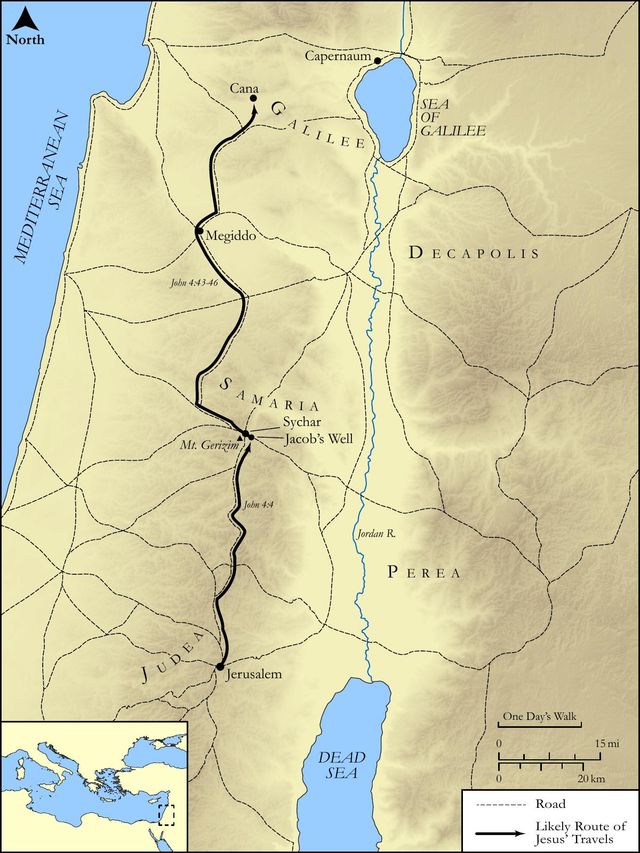
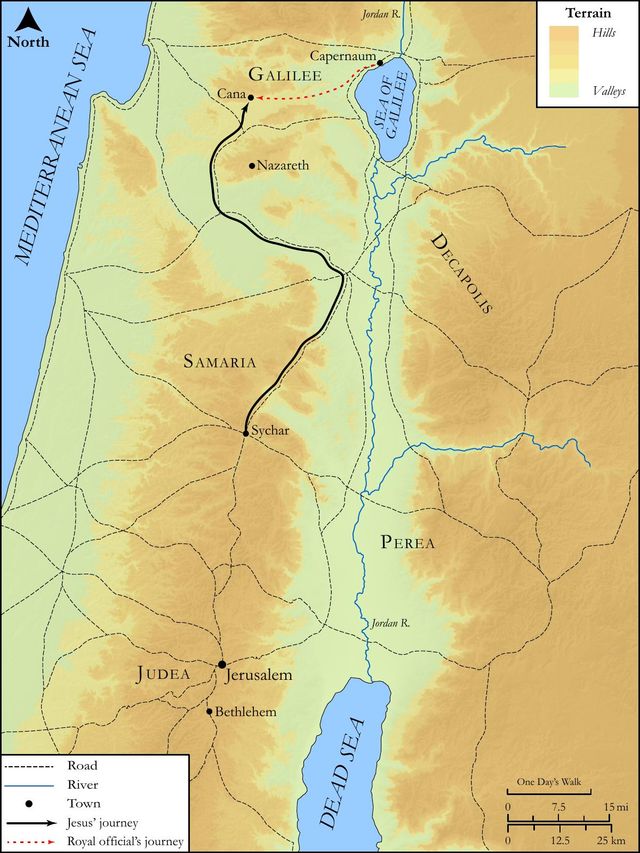
Observe, 1. Who the petitioner was, and who the patient: the petitioner was a nobleman; the patient was his son: There was a certain nobleman. Regulus (so the Latin), a little king; so called, either for the largeness of his estate, or the extent of his power, or the royalties that belonged to his manor. Some understand it as denoting his preferment - he was a courtier in some office about the king; others as denoting his party - he was an Herodian, a royalist, a prerogative-man, one that espoused the interests of the Herods, father and son; perhaps it was Chuza, Herod's steward (Luk 8:3), or Manaen, Herod's foster-brother, Act 13:1. There were saints in Caesar's household. The father a nobleman, and yet the son sick; for dignities and titles of honour will be no security to persons and families from the assaults of sickness and death. It was fifteen miles from Capernaum where this nobleman lived to Cana, where Christ now was; yet this affliction in his family sent him so far to Christ.
2.How the petitioner made his application to the physician. Having heard that Jesus was come out of Judea to Galilee, and finding that he did not come towards Capernaum, but turned off towards the other side of the country, he went to him himself, and besought him to come and heal his son, Joh 4:47. See here,
(1.)His tender affection to his son, that when he was sick he would spare no pains to get help for him.
(2.)His great respect to our Lord Jesus, that he would come himself to wait upon him, when he might have sent a servant; and that he besought him, when, as a man in authority, some would think he might have ordered his attendance. The greatest men, when they come to God, must become beggars, and sue sub forma pauperis - as paupers. As to the errand he came upon, we may observe a mixture in his faith.
[1.]There was sincerity in it; he did believe that Christ could heal his son, though his disease was dangerous. It is probable he had physicians to him, who had given him over; but he believed that Christ could cure him when the case seemed deplorable.
[2.]Yet there was infirmity in his faith; he believed that Christ could heal his son, but, as it should seem, he thought he could not heal him at a distance, and therefore he besought him that he would come down and heal him, expecting, as Naaman did, that he would come and strike his hand over the patient, as if he could not cure him but by a physical contact. Thus we are apt to limit the Holy One of Israel, and to stint him to our forms. The centurion, a Gentile, a soldier, was so strong in faith as to say, Lord, I am not worthy that thou shouldest come under my roof, Mat 8:8. This nobleman, a Jew, must have Christ to come down, though it was a good day's journey, and despairs of a cure unless he come down, as if he must teach Christ how to work. We are encouraged to pray, but we are not allowed to prescribe: Lord, heal me; but, whether with a word or a touch, thy will be done.
3.The gentle rebuke he met with in this address (Joh 4:48): Jesus said to him, "I see how it is; except you see signs and wonders, you will not believe, as the Samaritans did, though they saw no signs and wonders, and therefore I must work miracles among you." Though he was a nobleman, and now in grief about his son, and had shown great respect to Christ in coming so far to him, yet Christ gives him a reproof. Men's dignity in the world shall not exempt them from the rebukes of the word or providence; for Christ reproves not after the hearing of his ears, but with equity, Isa 11:3, Isa 11:4. Observe, Christ first shows him his sin and weakness, to prepare him for mercy, and then grants his request. Those whom Christ intends to honour with his favours he first humbles with his frowns. The Comforter shall first convince. Herod longed to see some miracle (Luk 23:8), and this courtier was of the same mind, and the generality of the people too. Now that which is blamed is,
(1.)That, whereas they had heard by credible and incontestable report of the miracles he had wrought in other places, they would not believe except they saw them with their own eyes, Luk 4:23. They must be honoured, and they must be humoured, or they will not be convinced. Their country must be graced, and their curiosity gratified, with signs and wonders, or else, though the doctrine of Christ be sufficiently proved by miracles wrought elsewhere, they will not believe. Like Thomas, they will yield to no method of conviction but what they shall prescribe.
(2.)That, whereas they had seen divers miracles, the evidence of which they could not gainsay, but which sufficiently proved Christ to be a teacher come from God, and should now have applied themselves to him for instruction in his doctrine, which by its native excellency would have gently led them on, in believing, to a spiritual perfection, instead of this they would go no further in believing than they were driven by signs and wonders. The spiritual power of the word did not affect them, did not attract them, but only the sensible power of miracles, which were for those who believe not, while prophesying was for those that believe, Co1 14:22. Those that admire miracles only, and despise prophesying, rank themselves with unbelievers.
4.His continued importunity in his address (Joh 4:49): Sir, come down ere my child die. Kurie - Lord; so it should be rendered. In this reply of his we have,
(1.)Something that was commendable: he took the reproof patiently; he spoke to Christ respectfully. Though he was one of those that wore soft clothing, yet he could bear reproof. It is none of the privileges of peerage to be above the reproofs of the word of Christ; but it is a sign of a good temper and disposition in men, especially in great men, when they can be told of their faults and not be angry. And, as he did not take the reproof for an affront, so he did not take it for a denial, but still prosecuted his request, and continued to wrestle till he prevailed. Nay, he might argue thus: "If Christ heal my soul, surely he will heal my son; if he cure my unbelief, he will cure his fever." This is the method Christ takes, first to work upon us, and then to work for us; and there is hope if we find him entering upon this method.
(2.)Something that was blameworthy, that was his infirmity; for,
[1.]He seems to take no notice of the reproof Christ gave him, says nothing to it, by way either of confession or of excuse, for he is so wholly taken up with concern about his child that he can mind nothing else. Note, The sorrow of the world is a great prejudice to our profiting by the word of Christ. Inordinate care and grief are thorns that choke the good seed; see Exo 6:9.
[2.]He still discovered the weakness of his faith in the power of Christ. First, He must have Christ to come down, thinking that else he could do the child no kindness. It is hard to persuade ourselves that distance of time and place are no obstructions to the knowledge and power of our Lord Jesus; yet so it is: he sees afar off, for his word, the word of his power, runs very swiftly. Secondly, He believes that Christ could heal a sick child, but not that he could raise a dead child, and therefore, "O come down, ere my child die," as if then it would be too late; whereas Christ has the same power over death that he has over bodily diseases. He forgot that Elijah and Elisha had raised dead children; and is Christ's power inferior to theirs? Observe what haste he is in: Come down, ere my child die; as if there were danger of Christ's slipping his time. He that believeth does not make haste, but refers himself to Christ. "Lord, what and when and how thou pleasest."
5.The answer of peace which Christ gave to his request at last (Joh 4:50): Go thy way, thy son liveth. Christ here gives us an instance,
(1.)Of his power, that he not only could heal, but could heal with so much ease, without the trouble of a visit. Here is nothing said, nothing done, nothing ordered to be done, and yet the cure wrought: Thy son liveth. The healing beams of the Sun of righteousness dispense benign influences from one end of heaven to another, and there is nothing hid from the heat thereof. Though Christ is now in heaven, and his church on earth, he can send from above. This nobleman would have Christ come down and heal his son; Christ will heal his son, and not come down. And thus the cure is the sooner wrought, the nobleman's mistake rectified, and his faith confirmed; so that the thing was better done in Christ's way. When he denies what we ask, he gives what is much more to our advantage; we ask for ease, he gives patience. Observe, His power was exerted by his word. In saying, Thy son lives, he showed that he has life in himself, and power to quicken whom he will. Christ's saying, Thy soul lives, makes it alive.
(2.)Of his pity; he observed the nobleman to be in pain about his son, and his natural affection discovered itself in that word, Ere my child, my dear child, die; and therefore Christ dropped the reproof, and gave him assurance of the recovery of his child; for he knows how a father pities his children.
6.The nobleman's belief of the word of Christ: He believed, and went away. Though Christ did not gratify him so far as to go down with him, he is satisfied with the method Christ took, and reckons he has gained his point. How quickly, how easily, is that which is lacking in our faith perfected by the word and power of Christ. Now he sees no sign or wonder, and yet believes the wonder done.
(1.)Christ said, Thy son liveth, and the man believed him; not only believed the omniscience of Christ, that he knew the child had recovered, but the omnipotence of Christ, that the cure was effected by his word. He left him dying; yet, when Christ said, He lives, like the father of the faithful, against hope he believed in hope, and staggered not through unbelief.
(2.)Christ said, Go thy way; and, as an evidence of the sincerity of his faith, he went his way, and gave neither Christ nor himself any further disturbance. He did not press Christ to come down, did not say, "If he do recover, yet a visit will be acceptable;" no, he seems no further solicitous, but, like Hannah, he goes his way, and his countenance is no more sad. As one entirely satisfied, he made no great haste home; did not hurry home that night, but returned leisurely, as one that was perfectly easy in his own mind.
7.The further confirmation of his faith, by comparing notes with his servants at his return.
(1.)His servants met him with the agreeable news of the child's recovery, Joh 4:51. Probably they met him not far from his own house, and, knowing what their master's cares were, they were willing as soon as they could to make him easy. David's servants were loth to tell him when the child was dead. Christ said, Thy son liveth; and now the servants say the same. Good news will meet those that hope in God's word.
(2.)He enquired what hour the child began to recover (Joh 4:52); not as if he doubted the influence of Christ's word upon the child's recovery, but he was desirous to have his faith confirmed, that he might be able to satisfy any to whom he should mention the miracle; for it was a material circumstance. Note,
[1.]It is good to furnish ourselves with all the corroborating proofs and evidences that may be, to strengthen our faith in the word of Christ, that it may grow up to a full assurance. Show me a token for good.
[2.]The diligent comparison of the works of Christ with his word will be of great use to us for the confirming of our faith. This was the course the nobleman took: He enquired of the servants the hour when he began to amend; and they told him, Yesterday at the seventh hour (at one o'clock in the afternoon, or, as some think this evangelist reckons, at seven o'clock at night) the fever left him; not only he began to amend, but he was perfectly well on a sudden; so the father knew that it was at the same hour when Jesus said to him, Thy son liveth. As the word of God, well-studied, will help us to understand his providences, so the providence of God, well observed, will help us to understand his word; for God is every day fulfilling the scripture. Two things would help to confirm his faith: - First, That the child's recovery was sudden and not gradual. They name the precise time to an hour: Yesterday, not about, but at the seventh hour, the fever left him; not it abated, or began to decrease, but it left him in an instant. The word of Christ did not work like physic, which must have time to operate, and produce the effect, and perhaps cures by expectation only; no, with Christ it was dictum factum - he spoke and it was done; not, He spoke and it was set a doing. Secondly, That it was just at the same time that Christ spoke to him: at that very hour. The synchronisms and coincidents of events add very much to the beauty and harmony of Providence. Observe the time, and the thing itself will be more illustrious, for every thing is beautiful in its time; at the very time when it is promised, as Israel's deliverance (Exo 12:41); at the very time when it is prayed for, as Peter's deliverance, Act 12:12. In men's works, distance of place is the delay of time and the retarding of business; but it is not so in the works of Christ. The pardon, and peace, and comfort, and spiritual healing, which he speaks in heaven, are, if he pleases, at the same time effected and wrought in the souls of believers; and, when these two come to be compared in the great day, Christ will be glorified in his saints, and admired in all them that believe.
8.The happy effect and issue of this. The bringing of the cure to the family brought salvation to it.
(1.)The nobleman himself believed. He had before believed the word of Christ, with reference to this particular occasion; but now he believed in Christ as the Messiah promised, and became one of his disciples. Thus the particular experience of the power and efficacy of one word of Christ may be a happy means to introduce and settle the whole authority of Christ's dominion in the soul. Christ has many ways of gaining the heart, and by the grant of a temporal mercy may make way for better things.
(2.)His whole house believed likewise.
[1.]Because of the interest they all had in the miracle, which preserved the blossom and hopes of the family; this affected them all, and endeared Christ to them, and recommended him to their best thoughts.
[2.]Because of the influence the master of the family had upon them all. A master of a family cannot give faith to those under his charge, nor force them to believe, but he may be instrumental to remove external prejudices, which obstruct the operation of the evidence, and then the work is more than half done. Abraham was famous for this (Gen 18:19), and Joshua, Jos 24:15. This was a nobleman, and probably he had a great household; but, when he comes into Christ's school, he brings them all along with him. What a blessed change was here in this house, occasioned by the sickness of the child! This should reconcile us to afflictions; we know not what good may follow from them. Probably, the conversion of this nobleman and his family at Capernaum might induce Christ to come afterwards, and settle at Capernaum, as his head-quarters in Galilee. When great men receive the gospel, they may be instrumental to bring it to the places where they live.
9.Here is the evangelist's remark upon this cure (Joh 4:54); This is the second miracle, referring to Joh 2:11, where the turning of water into wine is said to be the first; that was soon after his first return out of Judea, this soon after his second. In Judea he had wrought many miracles, Joh 3:2; Joh 4:45. They had the first offer; but, being driven thence, he wrought miracles in Galilee. Somewhere or other Christ will find a welcome. People may, if they please, shut the sun out of their own houses, but they cannot shut it out of the world. This is noted to be the second miracle, 1. To remind us of the first, wrought in the same place some months before. Fresh mercies should revive the remembrance of former mercies, as former mercies should encourage our hopes of further mercies. Christ keeps account of his favours, whether we do or no. 2. To let us know that this cure was before those many cures which the other evangelists mention to be wrought in Galilee, Mat 4:23; Mar 1:34; Luk 4:40. Probably, the patient being a person of quality, the cure was the more talked of and sent him crowds of patients; when this nobleman applied himself to Christ, multitudes followed. What abundance of good may great men do, if they be good men!
Historical interpretation
Nine Centuries of Reception
8 surviving comments on this verse. Each one is dated, so this reads as a timeline rather than a list.
Select a marker to jump to its quote. Markers stagger vertically where authors wrote within a few decades of each other.
(tom. xiii. c. 55) The Galilæans were allowed to keep the feast at Jerusalem, where they had seen Jesus. Thus they were prepared to receive Him, when He came: otherwise they would either have rejected Him; or He, knowing their unprepared state, would not have gone near them.
(tom. xvii. c. 57) Some think that this was an officer of King Herod's; others, that he was one of Cæsar's household, then employed on some commission in Judæa. It is not said that He was a Jew.
His rank appears in the fact of his servants meeting him: And as he was now going down, his servants met him, and told him, saying, Thy son liveth.
(tom. xvii. c. 60) The sentence is ambiguous. Taken one way, it means that Jesus after coming to Galilee, performed two miracles, of which that of healing the nobleman's son was the second: taken another, it means, that of the two miracles which Jesus performed in Galilee, the second was done after coming from Judæa into Galilee. The latter is the true and received meaning. Mystically, the two journeys of Christ into Galilee signify His two advents; (c. 56.). at the first of which He makes us His guest at supper, and gives us wine to drink; at the second, He raises up the nobleman's son who was at the point of death, i. e. the Jewish people, who, after the fulness of the Gentiles, attain themselves to salvation. For, as the great King of Kings is He, whom God hath seated upon His holy hill of Sion, so the lesser king is he, who saw his day, and was glad, i. e. Abrahame. And therefore his sick son is the Jewish people fallen from the true religion, and thrown into a fever in consequence by the fiery darts of the enemy. And we know that the saints of old, even when they had put off the covering of the flesh, made the people the object of their care: for we read in Maccabees, after the death of Jeremiah, This is Jeremias the prophet of the Lord, who prayeth much for the people. (2 Macc. 12) Abraham therefore prays to our Saviour to succour his diseased people. Again, the word of power, Thy son liveth, comes forth from Cana, i. e. the work of the Word, the healing of the nobleman's son, is done in Capernaum, i. e. the land of consolation. The nobleman's son signifies the class of believers who though diseased are yet not altogether destitute of fruits. The words, Except ye see signs and wonders, ye will not believe, are spoken of the Jewish people in general, or perhaps of the nobleman, i. e. Abraham himself, in a certain sense. For as John waited for a sign; on Whom thou shall see the Spirit descending; so too the Saints who died before the coming of Christ in the flesh, expected Him to manifest Himself by signs and wonders. And this nobleman too had servants as well as a son; which servants stand for the lower and weaker class of believers. Nor is it chance that the fever leaves the son at the seventh hour; for seven is the number of rest.
(t. xviii. c. 56) There may be an allusion in the two journeys to the two advents of Christ in the soul, the first supplying a spiritual banquet of wine, the second taking away all remains of weakness and death.
"Except ye see signs and wonders, ye will not believe."
Yet the very coming and beseeching Him was a mark of faith. And besides, after this the Evangelist witnesses to him, declaring that when Jesus said, "Go, thy son liveth," he believed His word, and went. What then is that which He saith here? Either He useth the words as approving of the Samaritans because they believed without signs; or, to touch Capernaum which was thought to be His own city, and of which this person was. Moreover, another man in Luke, who says, "Lord, I believe," said besides, "help Thou mine unbelief." And so if this ruler also believed, yet he believed not entirely or soundly, as is clear from his enquiring "at what hour the fever left him," since he desired to know whether it did so of its own accord, or at the bidding of Christ. When therefore he knew that it was "yesterday at the seventh hour," then "himself believed and his whole house." Seest thou that he believed when his servants, not when Christ spake? Therefore He rebuketh the state of mind with which he had come to Him, and spoken as he did, (thus too He the more drew him on to belief,) because that before the miracle he had not believed strongly. That he came and entreated was nothing wonderful, for parents in their great affection are also wont to resort not only to physicians in whom they have confidence, but also to talk with those in whom they have no confidence, desiring to omit nothing whatever. Indeed, that he came without any strong purpose appears from this, that when Christ was come into Galilee, then he saw Him, whereas if he had firmly believed in Him, he would not, when his child was on the point of death, have hesitated to go into Judaea. Or if he was afraid, this is not to be endured either. Observe how the very words show the weakness of the man; when he ought, after Christ had rebuked his state of mind, to have imagined something great concerning Him, even if he did not so before, listen how he drags along the ground.
(Hom. xxxv. 2) And mark his earthly mind, shown in hurrying Christ along with him; as if our Lord could not raise his son after death. Indeed it is very possible that he may have asked in unbelief. For fathers often are so carried away by their affection, as to consult not only those they depend upon, but even those they do not depend upon at all: not wishing to leave any means untried, which might save their children. But had he had any strong reliance upon Christ, he would have gone to Him in Judæa.
(Hom. xxxv. 2) Or thus; In the centurion there was confirmed faith and true devotion, and therefore our Lord was ready to go. But the nobleman's faith was still imperfect, as he thought our Lord could not heal in the absence of the sick person. But Christ's answer enlightened him. And the man believed the word which Jesus had spoken to him, and went his way. He did not believe, however, wholly or completely.
Feeble indeed unto understanding is the nobleman, for he is a child in his petition for grace, and almost dotes without perceiving it. For by believing that Christ had power not only when present, but that He would surely avail even absent, he would have had a most worthy conception of Him. But now both thinking and acting most foolishly, he asks power befitting God, and does not think He accomplishes all things as God, nor yet that He will be superior to death, although beseeching Him to gain the advantage over him that had all but overcome; for the child was at the point of death.
(Hom. in Evang. xxviii. 1) Remember what He asked for, and you will plainly see that he doubted. He asked Him to come down and see his son: The nobleman saith unto him, Sir, come down, ere my child die. His faith was deficient; in that he thought that our Lord could not save, except He were personally present.
But remember what he asked for, and you will clearly recognize that he wavered in faith. For he asked that the Lord would come down and heal his son. Therefore he was seeking the bodily presence of the Lord, who through the Spirit was absent nowhere. Thus he believed less in him whom he did not think able to give health unless he were present in body. For if he had believed perfectly, he would undoubtedly have known that there is no place where God is not. Therefore to a great extent he was lacking in faith, because he gave honor not to the divine majesty but to bodily presence. Thus he sought health for his son, and yet wavered in faith, because he believed that the one to whom he came was powerful enough to heal, and yet thought him absent from his dying son.
So, we see, faith, like the other virtues, is formed gradually, and has its beginning, growth, and maturity. His faith had its beginning, when he asked for his son's recovery; its growth, when he believed our Lord's words, Thy son liveth; its maturity, after the announcement of the fact by his servants.
The Evangelist reminds us of the miracle in order to express the praise due to the Samaritansd. For the Galileans in receiving Him were influenced as well by the miracle He had wrought with them, as by those they had seen at Jerusalem. The nobleman certainly believed in consequence of the miracle performed at Cana, though he did not yet understand Christ's full greatness; And there was a certain nobleman whose son was sick at Capernaum.
The little king stands for man generally; man not only deriving his soul from the King of the universe, but having Himself dominion over all things. His son, i. e. his mind, labours under a fever of evil passion and desires. He goes to Jesus and entreats Him to come down; i. e. to exercise the condescension of His pity, and pardon his sins, before it is too late. Our Lord answers; Go thy way, i. e. advance in holiness, and then thy son will live; but if thou stop short in thy course, thou wilt destroy the power of understanding and doing right.
Continue studying John 4:49 across the web’s major study libraries — every link below opens this exact verse, chapter, or book on the destination site.
Read & Compare
 BibleGatewayThis verse in more than 200 translations and 70 languages.
 Bible.comThe YouVersion reader — hundreds of translations, reading plans, and highlights.
 ESV.orgCrossway's official English Standard Version reader.
 NET BibleThe NET translation with 60,000+ translators' notes on every rendering decision.
 STEP BibleTyndale House's free study tool — original text, vocabulary, and scholarly resources.
 BibliaLogos Bible Software's free web reader.
 USCCBThe New American Bible (Revised Edition) with the U.S. bishops' study notes.
Commentaries
 BibleHub CommentariesDozens of classic commentaries on this verse, gathered on one page.
 StudyLightMore than 100 commentary sets — the largest collection on the web.
 BibleRefPlain-English commentary on what this verse means, verse by verse.
 Enduring WordDavid Guzik's free commentary on this chapter, widely used by Bible teachers.
 Bible Study ToolsVerse commentary alongside Greek and Hebrew study aids.
Original Language & Research
- BibleHub InterlinearThe verse word by word — original language, transliteration, and English.
- BibleHub LexiconEvery word's original-language definition and Strong's entry.
 Blue Letter BibleDeep-study tools — Strong's numbers, concordance, and word studies.
 CNTR CollationThe earliest Greek manuscripts of this verse, collated letter by letter.
Sermons, Hymns & Audio


TrulyRandomVerse is not affiliated with these sites and doesn’t control their content. They’re linked because they’re genuinely useful.
Summary
John 4:49 captures the desperate plea of a royal official from Capernaum to Jesus in Cana, urgently requesting His intervention to save his dying son. This verse vividly portrays the nobleman's profound parental anguish and his initial, albeit limited, understanding of Jesus' power, believing that the Lord's physical presence was essential for healing. It sets the stage for a pivotal moment in the narrative where Jesus challenges and deepens the nobleman's faith, demonstrating His authority over distance and death.
Context
ShowHideLiterary Context
This verse is situated within the broader narrative of Jesus' return to Galilee following His transformative encounter with the Samaritan woman at Jacob's well in John 4. Having arrived in Cana, the very place where He performed His first miraculous sign of turning water into wine, Jesus is met by a man of significant social standing. The nobleman's urgent appeal immediately follows Jesus' insightful observation in John 4:48: "Except ye see signs and wonders, ye will not believe." This sets up a profound contrast between the nobleman's initial, sign-dependent faith and the deeper, word-based faith Jesus is about to cultivate. The nobleman's plea for Jesus to "come down" underscores his belief that physical proximity was a prerequisite for divine intervention, a common expectation among people seeking healing in that era.
Historical & Cultural Context
The "nobleman" (Greek: basilikos) was likely a royal official in the service of Herod Antipas, the tetrarch of Galilee and Perea, who ruled under Roman authority. This position signifies a person of considerable influence and wealth within the Herodian court, possibly residing in Capernaum, a significant city on the Sea of Galilee. The journey from Capernaum to Cana was approximately 16 miles (about 25 kilometers), a considerable distance to travel in desperate haste, highlighting the severity of his son's condition and the nobleman's profound desperation. Culturally, it was common for people to seek out renowned healers, often believing that the healer's physical presence or touch was necessary for a cure. This cultural expectation informs the nobleman's urgent request for Jesus to "come down," reflecting the prevailing understanding of how divine power operated through human agents.
Key Themes
ShowHideThe nobleman's desperate cry contributes significantly to several key themes within the Gospel of John. Firstly, it highlights the theme of desperate faith and humility, as a man of high status humbles himself before Jesus, begging for a miracle for his dying child. His urgent appeal, "come down ere my child die," underscores the depth of his parental anguish and a nascent, though still limited, faith in Jesus' ability to intervene. Secondly, the passage powerfully conveys the theme of parental love, serving as the driving force behind the nobleman's extraordinary journey and plea. This emotional urgency makes his request profoundly relatable. Finally, the phrase "ere my child die" introduces the theme of the urgency of crisis, setting the stage for Jesus to demonstrate His divine sovereignty over life and death, challenging the nobleman to move beyond a faith based on physical signs to one rooted in the authority of Jesus' word, as seen in John 4:50.
Exposition and Analysis
ShowHideKey Word Analysis
ShowHideMeaning "regal (in relation), i.e. (literally) belonging to (or befitting) the sovereign (as land, dress, or a courtier), or (figuratively) preeminent." This term identifies the man as a "royal official" or "king's man," indicating his high social status and connection to the royal court, likely that of Herod Antipas. His position adds weight to his desperate act of seeking out Jesus, demonstrating that even those of high standing are vulnerable to life's crises and must humble themselves before divine authority.
Meaning "supreme in authority, i.e. (as noun) controller; by implication, Master (as a respectful title)." The nobleman's address of Jesus as "Sir" (or "Lord" in other translations) signifies respect and recognition of Jesus' authority, even if his understanding of that authority is still developing. It is a title of deference, indicating that the nobleman perceives Jesus as someone capable of extraordinary intervention, though he still expects Jesus to conform to his own understanding of how such power operates.
Meaning "to die off (literally or figuratively)." This word emphasizes the critical, life-or-death nature of the situation. The nobleman's plea is driven by the imminent threat of death to his child, highlighting the urgency and the ultimate power Jesus possesses over life itself. The imminence of death ("ere my child die") underscores the desperation and the perceived finality of the situation without Jesus' immediate intervention.
Verse Breakdown
ShowHide"The nobleman saith unto him"
This phrase immediately establishes the interaction between a person of significant worldly authority and Jesus. It highlights the nobleman's initiative and his direct appeal to Jesus, indicating that he has sought Jesus out specifically for this purpose. The journey itself speaks volumes about his desperation and the growing reputation of Jesus as a healer.
"Sir, come down"
This is the core of the nobleman's plea, reflecting both his respect for Jesus ("Sir") and his limited understanding of Jesus' power. The phrase "come down" implies a geographical movement, as Capernaum was at a lower elevation than Cana. More significantly, it reveals his belief that Jesus' physical presence was necessary for the miracle to occur, a common assumption about healers of the time. He expects Jesus to conform to his understanding of how healing works.
"ere my child die"
This clause conveys the profound urgency and the depth of the father's anguish. The imminent threat of death to his son is the driving force behind his desperate journey and plea. It underscores the critical, time-sensitive nature of the situation and sets the dramatic tension for Jesus' response, which will challenge the nobleman's expectations and invite him to a deeper level of faith.
Literary Devices
ShowHideThe verse powerfully employs Pathos, appealing directly to the reader's emotions through the nobleman's desperate plea for his dying child. The urgency of "ere my child die" evokes profound empathy for the father's anguish and fear. There is also an element of Irony present, as the nobleman, a man of high earthly status, must humble himself and beg for help from Jesus, whom he perceives as a mere healer who needs to be physically present. This contrasts with Jesus' true divine power, which transcends physical limitations and human expectations. Furthermore, the Symbolism of the dying child can be seen as representing the desperate human condition in need of divine intervention, mirroring the spiritual death that can only be overcome by the life-giving power of Christ.
Theological and Thematic Connections
ShowHideJohn 4:49 serves as a profound theological statement on the nature of divine authority and the progression of faith. It underscores that God's power is not confined by human expectations, geographical distance, or conventional methods. The nobleman's initial demand for Jesus' physical presence reflects a common human tendency to limit God to our understanding, yet Jesus' response (in the subsequent verse) challenges this, inviting a faith that trusts His word alone. This narrative emphasizes God's compassion for human suffering, particularly the anguish of a parent, and His willingness to meet us in our deepest needs, even while leading us to a more mature and robust faith. It highlights the sovereign power of Christ over life and death, demonstrating that His authority extends beyond all earthly constraints.
Reflection and Application
ShowHideThe nobleman's desperate cry in John 4:49 offers a powerful model for believers today. When faced with overwhelming circumstances, particularly those involving the health and well-being of our loved ones, we are called to bring our urgent needs before God with humility and persistence, just as this father did. His willingness to travel a significant distance and humble himself before Jesus, despite his high social standing, reminds us that true desperation often precedes profound encounters with God's power. This story also illustrates the journey of faith: while the nobleman initially sought a physical intervention, Jesus would lead him to a deeper belief in His word alone, demonstrating that God's power is not limited by physical presence or conventional methods. This progression encourages us to trust God's power even when we cannot fully comprehend His ways or when His response doesn't align with our expectations. Our faith is meant to mature from seeking signs to trusting the Savior's authoritative word.
Questions for Reflection
ShowHideFAQ
ShowHideWho was the nobleman mentioned in this verse?
ShowHideThe "nobleman" (Greek: basilikos) was a royal official, likely in the service of Herod Antipas, the tetrarch of Galilee. This indicates he was a man of high social standing and influence within the Herodian court, possibly residing in Capernaum. His position highlights that even those with worldly power and resources are subject to life's crises and must ultimately seek divine intervention.
Why did the nobleman ask Jesus to "come down"?
ShowHideThe nobleman's request for Jesus to "come down" from Cana to Capernaum (which was at a lower elevation) reflects a common belief at the time that a healer's physical presence was necessary for a miracle to occur. He likely expected Jesus to physically travel to his home and lay hands on his son, as was customary for many healers. This reveals his initial, limited understanding of Jesus' power, believing it was bound by physical proximity, a perception Jesus would challenge in the subsequent verse by healing from a distance, as seen in John 4:50.
What does this story teach us about the nature of faith?
ShowHideThis story teaches us about the progression of faith. The nobleman initially had a "sign-dependent" faith, believing Jesus needed to be physically present to heal. However, Jesus' response in John 4:50 ("Go thy way; thy son liveth") challenges him to trust in Jesus' word alone, without requiring a physical sign or presence. The nobleman's subsequent belief and the healing of his son (as detailed in John 4:51-53) demonstrate a deeper, more mature faith that trusts in Jesus' authority and power, even when unseen or at a distance. It underscores that true faith relies on the word of Christ, not merely on physical phenomena.
Christ-Centered Fulfillment
ShowHideThe nobleman's desperate plea for his dying child in John 4:49 finds its ultimate fulfillment in Christ as the sovereign Lord over all life and death, the compassionate High Priest, and the ultimate source of healing and resurrection. The nobleman's anguish mirrors humanity's desperate need for salvation from the spiritual death caused by sin, a death from which only Christ can deliver. Jesus' response, healing from a distance and by His authoritative word, foreshadows His boundless power that transcends all earthly limitations—physical, temporal, and spiritual. He is not merely a healer who needs to be present, but the very resurrection and the life, capable of speaking life into existence from afar, and ultimately, from the grave. This narrative points to Jesus as the one who hears our desperate cries and, with divine authority, brings life where there is death, offering not just physical healing but eternal life to all who believe in His word, assuring us that neither death nor life, nor anything else in all creation, will be able to separate us from the love of God that is in Christ Jesus our Lord. He is our sympathetic High Priest, who is able to empathize with our weaknesses, having faced the ultimate human experience of death, only to conquer it.