


John 4:43
Bible text: King James Version (1769 Blayney text) · Public domain
Bible text: Berean Standard Bible · Public domain
Bible text: American Standard Version (1901) · Public domain
Bible text: World English Bible, Messianic edition · Public domain
Bible text: Geneva Bible (1599) · Public domain
Bible text: Young's Literal Translation · Public domain
- ΜετὰMetaAfterG3326PREPPreposition
- δὲdethenG1161CONJConjunction
- τὰςtastheG3588T-APFDefinite article Accusative Plural Feminine
- δύοduotwoG1417A-NUIAdjective
- ἡμέραςhēmerasdaysG2250N-APFNoun Accusative Plural Feminine
- ἐξῆλθενexēlthenHe went forthG1831V-2AAI-3SVerb 2nd Aorist Active Indicative 3rd Singular
- ἐκεῖθενekeithenfrom thereG1564ADVAdverb
- καὶkaiandG2532CONJConjunction
- ἀπῆλθενapēlthenwent awayG565V-2AAI-3SVerb 2nd Aorist Active Indicative 3rd Singular
- εἰςeisintoG1519PREPPreposition
- τὴνtēn<the>G3588T-ASFDefinite article Accusative Singular Feminine
- ΓαλιλαίανGalilaianGalileeG1056N-ASF-LNoun Accusative Singular Feminine Location
English is a literal word-by-word gloss of the Greek, not the KJV's wording. Why?
This is the original text the KJV's translators worked from — each Greek word with its own literal English meaning in this verse, prepared by scholars at Tyndale House, Cambridge. The KJV translates whole sentences, not word by word, so its wording differs: one Greek word can become several English words, and the KJV may choose “charity” where the gloss reads “love”. Both are faithful — they answer different questions. For the KJV's own rendering, switch to the KJV text.
Details
See on the biblical-era maps
Study this verse
Public-domain commentary
Matthew Henry
From his Commentary on the Whole Bible. Henry comments on passages, not single verses — this entry covers John 4:43–54. His four-level outline is real structure in the source text, so it is rendered as structure.
In these verses we have,
I.Christ's coming into Galilee, Joh 4:43.
Though he was as welcome among the Samaritans as he could be any where, and had better success, yet after two days he left them, not so much because they were Samaritans, and he would not confirm those in their prejudices against him who said, He is a Samaritan (Joh 8:48), but because he must preach to other cities, Luk 4:43. He went into Galilee, for there he spent much of his time. Now see here,
1.Whither Christ went; into Galilee, into the country of Galilee, but not to Nazareth, which was strictly his own country. He went among the villages, but declined going to Nazareth, the head city, for a reason here given, which Jesus himself testified, who knew the temper of his countrymen, the hearts of all men, and the experiences of all prophets, and it is this, That a prophet has no honour in his own country. Note,
(1.)Prophets ought to have honour, because God has put honour upon them and we do or may receive benefit by them.
(2.)The honour due to the Lord's prophets has very often been denied them, and contempt put upon them.
(3.)This due honour is more frequently denied them in their own country; see Luk 4:24; Mat 13:57. Not that it is universally true (no rule but has some exceptions), but it holds for the most part. Joseph, when he began to be a prophet, was most hated by his brethren; David was disdained by his brother (Sa1 17:28); Jeremiah was maligned by the men of Anathoth (Jer 11:21), Paul by his countrymen the Jews; and Christ's near kinsmen spoke most slightly of him, Joh 7:5. Men's pride and envy make them scorn to be instructed by those who once were their school-fellows and play-fellows. Desire of novelty, and of that which is far-fetched and dear-bought, and seems to drop out of the sky to them, makes them despise those persons and things which they have been long used to and know the rise of.
(4.)It is a great discouragement to a minister to go among a people who have no value for him or his labours. Christ would not go to Nazareth, because he knew how little respect he should have there.
(5.)It is just with God to deny his gospel to those that despise the ministers of it. They that mock the messengers forfeit the benefit of the message. Mat 21:35, Mat 21:41.
2.What entertainment he met with among the Galileans in the country (Joh 4:45): They received him, bade him welcome, and cheerfully attended on his doctrine. Christ and his gospel are not sent in vain; if they have not honour with some, they shall have with others. Now the reason given why these Galileans were so ready to receive Christ is because they had seen the miracles he did at Jerusalem, Joh 4:45. Observe,
(1.)They went up to Jerusalem at the feast, the feast of the passover. The Galileans lay very remote from Jerusalem, and their way thither lay through the country of the Samaritans, which was troublesome for a Jew to pass through, worse than Baca's valley of old; yet, in obedience to God's command, they went up to the feast, and there they became acquainted with Christ. Note, They that are diligent and constant in attending on public ordinances some time or other meet with more spiritual benefit than they expect.
(2.)At Jerusalem they saw Christ's miracles, which recommended him and his doctrine very much to their faith and affections. The miracles were wrought for the benefit of those at Jerusalem; yet the Galileans who were accidentally there got more advantage by them than they did for whom they were chiefly designed. Thus the word preached to a mixed multitude may perhaps edify occasional hearers more than the constant auditory.
3.What city he went to. When he would go to a city, he chose to go to Cana of Galilee, where he had made the water wine (Joh 4:46); thither he went, to see if there were any good fruits of that miracle remaining; and, if there were, to confirm their faith, and water what he had planted. The evangelist mentions this miracle here to teach us to keep in remembrance what we have seen of the works of Christ.
II.His curing the nobleman's son that was sick of a fever.
This story is not recorded by any other of the evangelists; it comes in Mat 4:23.
Observe, 1. Who the petitioner was, and who the patient: the petitioner was a nobleman; the patient was his son: There was a certain nobleman. Regulus (so the Latin), a little king; so called, either for the largeness of his estate, or the extent of his power, or the royalties that belonged to his manor. Some understand it as denoting his preferment - he was a courtier in some office about the king; others as denoting his party - he was an Herodian, a royalist, a prerogative-man, one that espoused the interests of the Herods, father and son; perhaps it was Chuza, Herod's steward (Luk 8:3), or Manaen, Herod's foster-brother, Act 13:1. There were saints in Caesar's household. The father a nobleman, and yet the son sick; for dignities and titles of honour will be no security to persons and families from the assaults of sickness and death. It was fifteen miles from Capernaum where this nobleman lived to Cana, where Christ now was; yet this affliction in his family sent him so far to Christ.
2.How the petitioner made his application to the physician. Having heard that Jesus was come out of Judea to Galilee, and finding that he did not come towards Capernaum, but turned off towards the other side of the country, he went to him himself, and besought him to come and heal his son, Joh 4:47. See here,
(1.)His tender affection to his son, that when he was sick he would spare no pains to get help for him.
(2.)His great respect to our Lord Jesus, that he would come himself to wait upon him, when he might have sent a servant; and that he besought him, when, as a man in authority, some would think he might have ordered his attendance. The greatest men, when they come to God, must become beggars, and sue sub forma pauperis - as paupers. As to the errand he came upon, we may observe a mixture in his faith.
[1.]There was sincerity in it; he did believe that Christ could heal his son, though his disease was dangerous. It is probable he had physicians to him, who had given him over; but he believed that Christ could cure him when the case seemed deplorable.
[2.]Yet there was infirmity in his faith; he believed that Christ could heal his son, but, as it should seem, he thought he could not heal him at a distance, and therefore he besought him that he would come down and heal him, expecting, as Naaman did, that he would come and strike his hand over the patient, as if he could not cure him but by a physical contact. Thus we are apt to limit the Holy One of Israel, and to stint him to our forms. The centurion, a Gentile, a soldier, was so strong in faith as to say, Lord, I am not worthy that thou shouldest come under my roof, Mat 8:8. This nobleman, a Jew, must have Christ to come down, though it was a good day's journey, and despairs of a cure unless he come down, as if he must teach Christ how to work. We are encouraged to pray, but we are not allowed to prescribe: Lord, heal me; but, whether with a word or a touch, thy will be done.
3.The gentle rebuke he met with in this address (Joh 4:48): Jesus said to him, "I see how it is; except you see signs and wonders, you will not believe, as the Samaritans did, though they saw no signs and wonders, and therefore I must work miracles among you." Though he was a nobleman, and now in grief about his son, and had shown great respect to Christ in coming so far to him, yet Christ gives him a reproof. Men's dignity in the world shall not exempt them from the rebukes of the word or providence; for Christ reproves not after the hearing of his ears, but with equity, Isa 11:3, Isa 11:4. Observe, Christ first shows him his sin and weakness, to prepare him for mercy, and then grants his request. Those whom Christ intends to honour with his favours he first humbles with his frowns. The Comforter shall first convince. Herod longed to see some miracle (Luk 23:8), and this courtier was of the same mind, and the generality of the people too. Now that which is blamed is,
(1.)That, whereas they had heard by credible and incontestable report of the miracles he had wrought in other places, they would not believe except they saw them with their own eyes, Luk 4:23. They must be honoured, and they must be humoured, or they will not be convinced. Their country must be graced, and their curiosity gratified, with signs and wonders, or else, though the doctrine of Christ be sufficiently proved by miracles wrought elsewhere, they will not believe. Like Thomas, they will yield to no method of conviction but what they shall prescribe.
(2.)That, whereas they had seen divers miracles, the evidence of which they could not gainsay, but which sufficiently proved Christ to be a teacher come from God, and should now have applied themselves to him for instruction in his doctrine, which by its native excellency would have gently led them on, in believing, to a spiritual perfection, instead of this they would go no further in believing than they were driven by signs and wonders. The spiritual power of the word did not affect them, did not attract them, but only the sensible power of miracles, which were for those who believe not, while prophesying was for those that believe, Co1 14:22. Those that admire miracles only, and despise prophesying, rank themselves with unbelievers.
4.His continued importunity in his address (Joh 4:49): Sir, come down ere my child die. Kurie - Lord; so it should be rendered. In this reply of his we have,
(1.)Something that was commendable: he took the reproof patiently; he spoke to Christ respectfully. Though he was one of those that wore soft clothing, yet he could bear reproof. It is none of the privileges of peerage to be above the reproofs of the word of Christ; but it is a sign of a good temper and disposition in men, especially in great men, when they can be told of their faults and not be angry. And, as he did not take the reproof for an affront, so he did not take it for a denial, but still prosecuted his request, and continued to wrestle till he prevailed. Nay, he might argue thus: "If Christ heal my soul, surely he will heal my son; if he cure my unbelief, he will cure his fever." This is the method Christ takes, first to work upon us, and then to work for us; and there is hope if we find him entering upon this method.
(2.)Something that was blameworthy, that was his infirmity; for,
[1.]He seems to take no notice of the reproof Christ gave him, says nothing to it, by way either of confession or of excuse, for he is so wholly taken up with concern about his child that he can mind nothing else. Note, The sorrow of the world is a great prejudice to our profiting by the word of Christ. Inordinate care and grief are thorns that choke the good seed; see Exo 6:9.
[2.]He still discovered the weakness of his faith in the power of Christ. First, He must have Christ to come down, thinking that else he could do the child no kindness. It is hard to persuade ourselves that distance of time and place are no obstructions to the knowledge and power of our Lord Jesus; yet so it is: he sees afar off, for his word, the word of his power, runs very swiftly. Secondly, He believes that Christ could heal a sick child, but not that he could raise a dead child, and therefore, "O come down, ere my child die," as if then it would be too late; whereas Christ has the same power over death that he has over bodily diseases. He forgot that Elijah and Elisha had raised dead children; and is Christ's power inferior to theirs? Observe what haste he is in: Come down, ere my child die; as if there were danger of Christ's slipping his time. He that believeth does not make haste, but refers himself to Christ. "Lord, what and when and how thou pleasest."
5.The answer of peace which Christ gave to his request at last (Joh 4:50): Go thy way, thy son liveth. Christ here gives us an instance,
(1.)Of his power, that he not only could heal, but could heal with so much ease, without the trouble of a visit. Here is nothing said, nothing done, nothing ordered to be done, and yet the cure wrought: Thy son liveth. The healing beams of the Sun of righteousness dispense benign influences from one end of heaven to another, and there is nothing hid from the heat thereof. Though Christ is now in heaven, and his church on earth, he can send from above. This nobleman would have Christ come down and heal his son; Christ will heal his son, and not come down. And thus the cure is the sooner wrought, the nobleman's mistake rectified, and his faith confirmed; so that the thing was better done in Christ's way. When he denies what we ask, he gives what is much more to our advantage; we ask for ease, he gives patience. Observe, His power was exerted by his word. In saying, Thy son lives, he showed that he has life in himself, and power to quicken whom he will. Christ's saying, Thy soul lives, makes it alive.
(2.)Of his pity; he observed the nobleman to be in pain about his son, and his natural affection discovered itself in that word, Ere my child, my dear child, die; and therefore Christ dropped the reproof, and gave him assurance of the recovery of his child; for he knows how a father pities his children.
6.The nobleman's belief of the word of Christ: He believed, and went away. Though Christ did not gratify him so far as to go down with him, he is satisfied with the method Christ took, and reckons he has gained his point. How quickly, how easily, is that which is lacking in our faith perfected by the word and power of Christ. Now he sees no sign or wonder, and yet believes the wonder done.
(1.)Christ said, Thy son liveth, and the man believed him; not only believed the omniscience of Christ, that he knew the child had recovered, but the omnipotence of Christ, that the cure was effected by his word. He left him dying; yet, when Christ said, He lives, like the father of the faithful, against hope he believed in hope, and staggered not through unbelief.
(2.)Christ said, Go thy way; and, as an evidence of the sincerity of his faith, he went his way, and gave neither Christ nor himself any further disturbance. He did not press Christ to come down, did not say, "If he do recover, yet a visit will be acceptable;" no, he seems no further solicitous, but, like Hannah, he goes his way, and his countenance is no more sad. As one entirely satisfied, he made no great haste home; did not hurry home that night, but returned leisurely, as one that was perfectly easy in his own mind.
7.The further confirmation of his faith, by comparing notes with his servants at his return.
(1.)His servants met him with the agreeable news of the child's recovery, Joh 4:51. Probably they met him not far from his own house, and, knowing what their master's cares were, they were willing as soon as they could to make him easy. David's servants were loth to tell him when the child was dead. Christ said, Thy son liveth; and now the servants say the same. Good news will meet those that hope in God's word.
(2.)He enquired what hour the child began to recover (Joh 4:52); not as if he doubted the influence of Christ's word upon the child's recovery, but he was desirous to have his faith confirmed, that he might be able to satisfy any to whom he should mention the miracle; for it was a material circumstance. Note,
[1.]It is good to furnish ourselves with all the corroborating proofs and evidences that may be, to strengthen our faith in the word of Christ, that it may grow up to a full assurance. Show me a token for good.
[2.]The diligent comparison of the works of Christ with his word will be of great use to us for the confirming of our faith. This was the course the nobleman took: He enquired of the servants the hour when he began to amend; and they told him, Yesterday at the seventh hour (at one o'clock in the afternoon, or, as some think this evangelist reckons, at seven o'clock at night) the fever left him; not only he began to amend, but he was perfectly well on a sudden; so the father knew that it was at the same hour when Jesus said to him, Thy son liveth. As the word of God, well-studied, will help us to understand his providences, so the providence of God, well observed, will help us to understand his word; for God is every day fulfilling the scripture. Two things would help to confirm his faith: - First, That the child's recovery was sudden and not gradual. They name the precise time to an hour: Yesterday, not about, but at the seventh hour, the fever left him; not it abated, or began to decrease, but it left him in an instant. The word of Christ did not work like physic, which must have time to operate, and produce the effect, and perhaps cures by expectation only; no, with Christ it was dictum factum - he spoke and it was done; not, He spoke and it was set a doing. Secondly, That it was just at the same time that Christ spoke to him: at that very hour. The synchronisms and coincidents of events add very much to the beauty and harmony of Providence. Observe the time, and the thing itself will be more illustrious, for every thing is beautiful in its time; at the very time when it is promised, as Israel's deliverance (Exo 12:41); at the very time when it is prayed for, as Peter's deliverance, Act 12:12. In men's works, distance of place is the delay of time and the retarding of business; but it is not so in the works of Christ. The pardon, and peace, and comfort, and spiritual healing, which he speaks in heaven, are, if he pleases, at the same time effected and wrought in the souls of believers; and, when these two come to be compared in the great day, Christ will be glorified in his saints, and admired in all them that believe.
8.The happy effect and issue of this. The bringing of the cure to the family brought salvation to it.
(1.)The nobleman himself believed. He had before believed the word of Christ, with reference to this particular occasion; but now he believed in Christ as the Messiah promised, and became one of his disciples. Thus the particular experience of the power and efficacy of one word of Christ may be a happy means to introduce and settle the whole authority of Christ's dominion in the soul. Christ has many ways of gaining the heart, and by the grant of a temporal mercy may make way for better things.
(2.)His whole house believed likewise.
[1.]Because of the interest they all had in the miracle, which preserved the blossom and hopes of the family; this affected them all, and endeared Christ to them, and recommended him to their best thoughts.
[2.]Because of the influence the master of the family had upon them all. A master of a family cannot give faith to those under his charge, nor force them to believe, but he may be instrumental to remove external prejudices, which obstruct the operation of the evidence, and then the work is more than half done. Abraham was famous for this (Gen 18:19), and Joshua, Jos 24:15. This was a nobleman, and probably he had a great household; but, when he comes into Christ's school, he brings them all along with him. What a blessed change was here in this house, occasioned by the sickness of the child! This should reconcile us to afflictions; we know not what good may follow from them. Probably, the conversion of this nobleman and his family at Capernaum might induce Christ to come afterwards, and settle at Capernaum, as his head-quarters in Galilee. When great men receive the gospel, they may be instrumental to bring it to the places where they live.
9.Here is the evangelist's remark upon this cure (Joh 4:54); This is the second miracle, referring to Joh 2:11, where the turning of water into wine is said to be the first; that was soon after his first return out of Judea, this soon after his second. In Judea he had wrought many miracles, Joh 3:2; Joh 4:45. They had the first offer; but, being driven thence, he wrought miracles in Galilee. Somewhere or other Christ will find a welcome. People may, if they please, shut the sun out of their own houses, but they cannot shut it out of the world. This is noted to be the second miracle, 1. To remind us of the first, wrought in the same place some months before. Fresh mercies should revive the remembrance of former mercies, as former mercies should encourage our hopes of further mercies. Christ keeps account of his favours, whether we do or no. 2. To let us know that this cure was before those many cures which the other evangelists mention to be wrought in Galilee, Mat 4:23; Mar 1:34; Luk 4:40. Probably, the patient being a person of quality, the cure was the more talked of and sent him crowds of patients; when this nobleman applied himself to Christ, multitudes followed. What abundance of good may great men do, if they be good men!
Historical interpretation
Historical reception
4 surviving comments on this verse. Each one is dated, so this reads as a timeline rather than a list.
Select a marker to jump to its quote. Markers stagger vertically where authors wrote within a few decades of each other.
What is it, then, brethren, that the Lord doth show us here? Galilee of Judea was then the Lord's own country, because He was brought up in it. But now that the circumstance portends something - for it is not without cause that "prodigies" are so called, but because they portend or presage something: for the word "prodigy" is so termed as if it were porrodicium, quod porro dicat, what betokens something to come, and portends something future - now all those circumstances portended something, predicted something; let us just now assume the country of our Lord Jesus Christ after the flesh (for He had no country on earth, except after the flesh which He took on earth); let us, I say, assume the Lord's own country to mean the people of the Jews. Lo, in His own country He hath no honor. Observe at this moment the multitudes of the Jews; observe that nation now scattered over the whole world, and plucked up by the roots; observe the broken branches, cut off, scattered, withered, which being broken off, the wild olive has deserved to be grafted in; look at the multitude of the Jews: what do they say to us even now? "He whom you worship and adore was our brother." And we reply, "A prophet hath no honor in his own country."
In short, those Jews saw the Lord as He walked on the earth and worked miracles; they saw Him giving sight to the blind, opening the ears of the deaf, loosing the tongues of the dumb, bracing up the limbs of the paralytics, walking on the sea, commanding the winds and waves, raising the dead: they saw Him working such great signs, and after all that scarcely a few believed. I am speaking to God's people; so many of us have believed, what signs have we seen? It is thus, therefore, that what occurred at that time betokened what is now going on. The Jews were, or rather are, like the Galileans; we, like those Samaritans. We have heard the gospel, have given it our consent, have believed on Christ through the gospel; we have seen no signs, none do we demand.
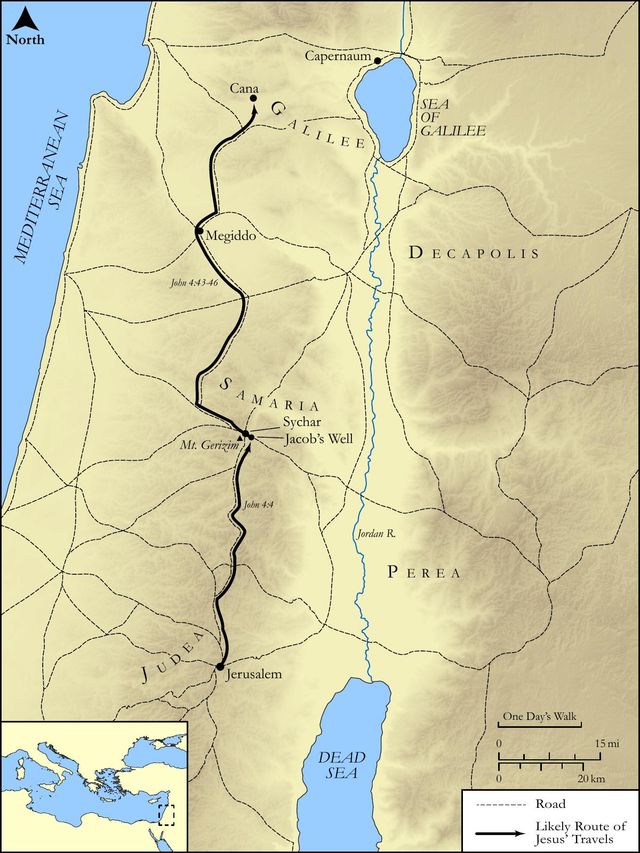
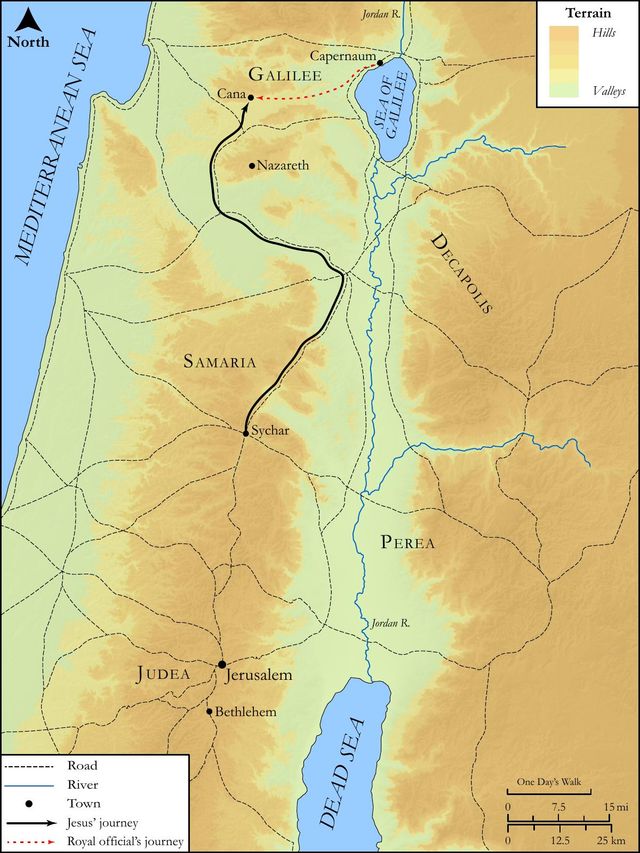
(Tr. xvi) After staying two days in Samaria, He departed into Galilee, where He resided: Now after two days He departed thence, and went into Galilee.
Why then does the Evangelist say immediately, For Jesus Himself testified, that a prophet hath no honour in his own country. For He would seem to have testified more to the truth, had He remained in Samaria, and not gone into Galilee. Not so: He stayed two days in Samaria, and the Samaritans believed on Him: He stayed the same time in Galilee, and the Galileans did not believe on Him, and therefore He said, that a prophet hath no honour in his own country.
Now Jesus, after His stay of two days in Samaria, "departed into Galilee," where He was brought up. And the evangelist, as he goes on, says, "For Jesus Himself testified that a prophet hath no honor in his own country." It was not because He had no honor in Samaria that Jesus departed thence after two days; for Samaria was not His own country, but Galilee. Whilst, therefore, He left Samaria so quickly, and came to Galilee, where He had been brought up, how does He testify that "a prophet hath no honor in his own country"? Rather does it seem that He might have testified that a prophet has no honor in his own country, had He disdained to go into Galilee, and had stayed in Samaria.
Now mark well, beloved, while the Lord suggests and bestows what I may speak, that here is intimated to us no slight mystery. The point that troubles us is, why the evangelist said, "For Jesus Himself testified that a prophet hath no honor in his own country." Urged by this, we go back to the preceding words, to discover the evangelist's intention in saying this; and we find him relating, in the preceding words of the narrative, that after two days Jesus departed from Samaria into Galilee. Was it for this, then, thou saidst, O evangelist, that Jesus testified that a prophet hath no honor in his own country, just because He left Samaria after two days, and made haste to come to Galilee? On the contrary, I should have thought it more likely, that if Jesus had no honor in His own country, He should not have hastened to it, and left Samaria.
Hear then, dearly beloved, what I think in this matter, without prejudice to your own judgment, if you have formed a better. For we have all one Master, and we are fellow-disciples in one school. This, then, is my opinion, and see whether my opinion is not true, or near the truth. In Samaria He spent two days, and the Samaritans believed on Him; many were the days He spent in Galilee, and yet the Galileans did not believe on Him.
He departs from Samaria, having now sown the Word of salvation, and like a husbandman hidden the faith in them that dwell there, not that it might be bound captive in the silence of them that received it, quiet and deep buried, but rather that it might grow in the souls of all, creeping on and advancing ever to the greater, and running to more evident might. But since He passes by Nazareth lying in the midst, wherein it is said that He was also brought up, so that He seemed to be from thence and its citizen, and goes down rather to Galilee; of necessity he offers an explanation of His passing it by, and says that Jesus Himself had testified that a prophet hath no honour in his own country. For it is our nature to think nothing of what we are accustomed to, even though it be great and of price. And the Saviour thought not good to seek honour from them, like a vain-glorious man and a braggart, but knew well that to those who have no thought that one ought to honour one's teacher, neither would the word of the faith be any longer sweet and acceptable. With reason then does He pass by, not thinking it right to expend useless labours upon them who are nothing profited, and thus to lay down grace before them that despise it. For it was not reasonable that they who sinned so deeply should do so unpunished; since it is altogether confessed and undoubted, that they will undergo the severest punishments, who knowingly despise Him and spurn a gift so worthy of marvel.
Continue studying John 4:43 across the web’s major study libraries — every link below opens this exact verse, chapter, or book on the destination site.
Read & Compare
 BibleGatewayThis verse in more than 200 translations and 70 languages.
 Bible.comThe YouVersion reader — hundreds of translations, reading plans, and highlights.
 ESV.orgCrossway's official English Standard Version reader.
 NET BibleThe NET translation with 60,000+ translators' notes on every rendering decision.
 STEP BibleTyndale House's free study tool — original text, vocabulary, and scholarly resources.
 BibliaLogos Bible Software's free web reader.
 USCCBThe New American Bible (Revised Edition) with the U.S. bishops' study notes.
Commentaries
 BibleHub CommentariesDozens of classic commentaries on this verse, gathered on one page.
 StudyLightMore than 100 commentary sets — the largest collection on the web.
 BibleRefPlain-English commentary on what this verse means, verse by verse.
 Enduring WordDavid Guzik's free commentary on this chapter, widely used by Bible teachers.
 Bible Study ToolsVerse commentary alongside Greek and Hebrew study aids.
Original Language & Research
- BibleHub InterlinearThe verse word by word — original language, transliteration, and English.
- BibleHub LexiconEvery word's original-language definition and Strong's entry.
 Blue Letter BibleDeep-study tools — Strong's numbers, concordance, and word studies.
 CNTR CollationThe earliest Greek manuscripts of this verse, collated letter by letter.
Sermons, Hymns & Audio


TrulyRandomVerse is not affiliated with these sites and doesn’t control their content. They’re linked because they’re genuinely useful.
Summary
John 4:43 marks a significant transition in Jesus' early ministry, chronicling His departure from Samaria after a impactful two-day stay and His subsequent journey into Galilee. This verse serves as a crucial geographical and narrative pivot, signaling the conclusion of an unexpected but fruitful outreach to the Samaritans and setting the stage for the next phase of His public teaching, healing, and revelation within His home region, foreshadowing both acceptance and the challenges He would face there.
Context
ShowHideLiterary Context
This verse immediately follows Jesus' profound and transformative ministry in Sychar, a city in Samaria. The preceding narrative (John 4:1-42) details His encounter with the Samaritan woman at Jacob's well, a conversation that breaks numerous social and religious barriers. Her testimony, combined with Jesus' direct teaching, led many Samaritans to believe in Him, declaring Him truly "the Savior of the world" (John 4:42). Jesus' departure "after two days" indicates a divinely appointed duration for His work in this unexpected mission field, having fully accomplished His purpose before moving on. The verse also serves as a direct prelude to His return to Cana and the healing of the nobleman's son, establishing the beginning of His Galilean ministry as recorded by John.
Historical & Cultural Context
The journey from Judea (where Jesus had been) through Samaria to Galilee was geographically logical, but culturally fraught. Jews typically avoided Samaria due to deep-seated ethnic and religious animosity, often taking longer routes around the region. Jesus' deliberate passage through Samaria and His engagement with its inhabitants, particularly the Samaritan woman, was revolutionary. Galilee itself, known as "Galilee of the Gentiles," was a diverse region, less religiously strict than Judea, and often looked down upon by the Jerusalem elite. It was Jesus' home territory, where He had grown up in Nazareth, and where much of His public ministry would unfold, yet it was also a place where a "prophet has no honor in his own country" (John 4:44).
Key Themes
ShowHideJohn 4:43 contributes to several overarching themes in the Gospel. It underscores the itinerant and dynamic nature of Jesus' ministry, demonstrating His constant movement in obedience to His Father's will and divine timing. The specific mention of "two days" highlights the theme of divine intentionality and purpose behind Jesus' every action and location. Furthermore, His return to Galilee, His "own country," sets up the theme of reception and rejection, as the subsequent verses will reveal the mixed responses He received in His homeland compared to the surprising openness He found in Samaria. This movement also emphasizes the universal scope of Jesus' mission, extending beyond Jewish boundaries to embrace all who would believe.
Exposition and Analysis
ShowHideKey Word Analysis
ShowHideThis verb, meaning "to issue forth," "come out," or "go away," emphasizes a deliberate and purposeful movement. It's not a casual stroll but a strategic departure, indicating the completion of one phase of ministry and the initiation of another. The term suggests a decisive exit from the Samaritan context, signifying the fulfillment of His mission there.
Referring to a period of time, specifically "two days," this word highlights the precise, divinely ordained duration of Jesus' stay in Sychar. It underscores that Jesus' movements were not arbitrary but governed by a specific timetable and purpose, ensuring that His work in Samaria was thoroughly accomplished before He transitioned.
Derived from a Hebrew word meaning "circle" or "district," this geographical name refers to the northern region of Palestine. Its mention here signifies a return to Jesus' primary base of operations and the main theater for His public ministry, marking a shift from the unexpected Samaritan outreach to the familiar, yet often challenging, territory of His upbringing.
Verse Breakdown
ShowHide"Now after two days"
This phrase establishes the precise timing of Jesus' departure, emphasizing the brevity yet profound impact of His stay in Samaria. The "two days" were sufficient for the Samaritans to move from hearing the woman's testimony to believing directly in Jesus' words, signifying a complete and effective work in that place.
"he departed thence"
This indicates a physical movement away from Sychar and the region of Samaria. The departure is not a retreat but a strategic relocation, signifying the completion of His work in that specific area and His readiness to move to the next stage of His divine mission.
"and went into Galilee"
This clause specifies Jesus' destination. His return to Galilee, His home region, marks a significant geographical and ministerial shift. It sets the stage for the continuation of His public ministry, particularly the miracles and teachings that would define His early work in the northern part of Israel.
Literary Devices
ShowHideThe verse employs several literary devices. Transition is the most prominent, marking a clear shift in geographical location and ministerial focus from Samaria to Galilee. This transition is underscored by the precise temporal marker of "after two days," highlighting the Divine Timing and intentionality behind Jesus' movements. The narrative employs Conciseness to convey a significant shift in a few words, demonstrating the Gospel writer's focus on the what and where of Jesus' journey rather than the how of the travel itself. Furthermore, this verse functions as a Narrative Progression, propelling the story forward from the surprising Samaritan outreach to the anticipated Galilean ministry, setting the stage for the events of John 4:46-54.
Theological and Thematic Connections
ShowHideJohn 4:43, while seemingly a simple geographical notation, carries profound theological weight. It underscores the purposeful and strategic nature of Jesus' ministry, demonstrating that His movements were not random but guided by divine timing and a comprehensive redemptive plan. His departure from a surprisingly receptive Samaria to His "own country" of Galilee, where He anticipates a prophet has no honor, highlights the theme of divine sovereignty over human reception. This verse also implicitly reinforces Jesus' universal mission, as He moves from ministering to outcasts (Samaritans) to returning to His people, demonstrating that His saving work is for all, regardless of social or ethnic boundaries. It is a testament to His unwavering commitment to fulfilling the Father's will, moving where and when He was called, even when it meant facing familiar skepticism.
Reflection and Application
ShowHideJohn 4:43 offers a powerful model for believers in discerning and embracing God's call in their own lives. Just as Jesus knew when His work in Samaria was complete and when it was time to move to Galilee, we are called to cultivate spiritual discernment regarding seasons of ministry, service, and even personal life. This verse reminds us that faithfulness often involves both deep engagement in one place and courageous transition to another, always in obedience to divine leading. It encourages us to be flexible, adaptable, and responsive to the Holy Spirit's guidance, recognizing that God's purposes unfold through dynamic movement and strategic placement. Our mission, like Jesus', is to complete the work He has given us, whether that means staying and investing deeply or departing to new frontiers for His glory.
Questions for Reflection
ShowHideFAQ
ShowHideWhy did Jesus only stay "two days" in Samaria?
ShowHideThe Gospel of John emphasizes the divine intentionality behind Jesus' actions. His two-day stay was not arbitrary but precisely the time needed to accomplish His purpose in Sychar. During this brief period, He had a profound encounter with the Samaritan woman, which led to her testimony, and then He spent time teaching the Samaritans directly, resulting in many believing in Him not just because of her words, but because they had heard Him themselves. This demonstrates that Jesus' ministry was efficient and effective; He stayed exactly as long as was necessary to establish a nascent faith community before moving on to the next phase of His mission in Galilee.
Christ-Centered Fulfillment
ShowHideJohn 4:43, a seemingly simple geographical transition, subtly points to the broader Christ-centered narrative of redemption. Jesus' departure from Samaria and entry into Galilee foreshadows His ultimate mission to gather all people, both Jew and Gentile, into His kingdom. His willingness to minister in Samaria, a region despised by Jews, prefigures the breaking down of the "dividing wall of hostility" (Ephesians 2:14) through His cross. His return to Galilee, His "own country," where He would face mixed reception, mirrors the broader truth that He "came to his own, and his own people did not receive him" (John 1:11). Yet, it was from this very region that He would call His first disciples (Matthew 4:18-22) and begin to establish the new covenant community. Thus, Jesus' journey in John 4:43 is not merely a physical movement but a living parable of His universal saving work, extending grace to the lowly and calling His chosen ones, ultimately fulfilling the prophetic vision of a light shining in "Galilee of the Gentiles" (Matthew 4:15-16).