


John 20:6
Bible text: King James Version (1769 Blayney text) · Public domain
Bible text: Berean Standard Bible · Public domain
Bible text: American Standard Version (1901) · Public domain
Bible text: World English Bible, Messianic edition · Public domain
Bible text: Geneva Bible (1599) · Public domain
Bible text: Young's Literal Translation · Public domain
- ἜρχεταιErchetaiComesG2064V-PNI-3SVerb Present Middle Or Passive Deponent Indicative 3rd Singular
- οὖνounthenG3767CONJConjunction
- ΣίμωνSimōnSimonG4613N-NSM-PNoun Nominative Singular Masculine Individual
- ΠέτροςPetrosPeterG4074N-NSM-PNoun Nominative Singular Masculine Individual
- ἀκολουθῶνakolouthōnfollowingG190V-PAP-NSMVerb Present Active Participle Nominative Singular Masculine
- αὐτῷautōafter himG846P-DSMPersonal pronoun Dative Singular Masculine
- καὶkaiandG2532CONJConjunction
- εἰσῆλθενeisēlthenhe enteredG1525V-2AAI-3SVerb 2nd Aorist Active Indicative 3rd Singular
- εἰςeisintoG1519PREPPreposition
- τὸtotheG3588T-ASNDefinite article Accusative Singular Neuter
- μνημεῖονmnēmeiontombG3419N-ASNNoun Accusative Singular Neuter
- καὶkaiandG2532CONJConjunction
- θεωρεῖtheōreiseesG2334V-PAI-3SVerb Present Active Indicative 3rd Singular
- τὰtatheG3588T-APNDefinite article Accusative Plural Neuter
- ὀθόνιαothonialinen clothsG3608N-APNNoun Accusative Plural Neuter
- κείμεναkeimenalying [there]G2749V-PNP-APNVerb Present Middle Or Passive Deponent Participle Accusative Plural Neuter
English is a literal word-by-word gloss of the Greek, not the KJV's wording. Why?
This is the original text the KJV's translators worked from — each Greek word with its own literal English meaning in this verse, prepared by scholars at Tyndale House, Cambridge. The KJV translates whole sentences, not word by word, so its wording differs: one Greek word can become several English words, and the KJV may choose “charity” where the gloss reads “love”. Both are faithful — they answer different questions. For the KJV's own rendering, switch to the KJV text.
Details
See on the biblical-era maps
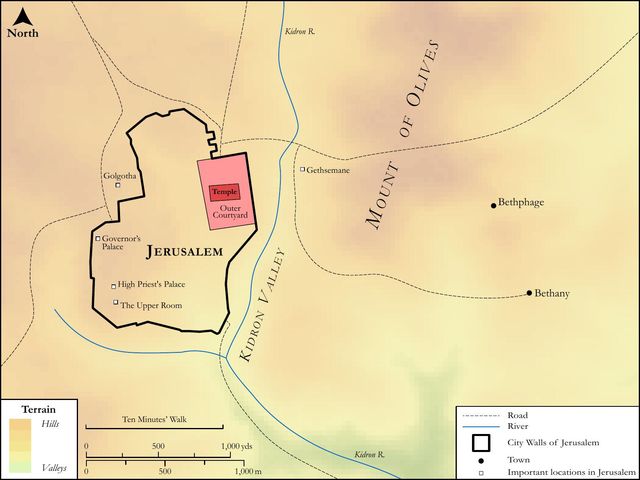
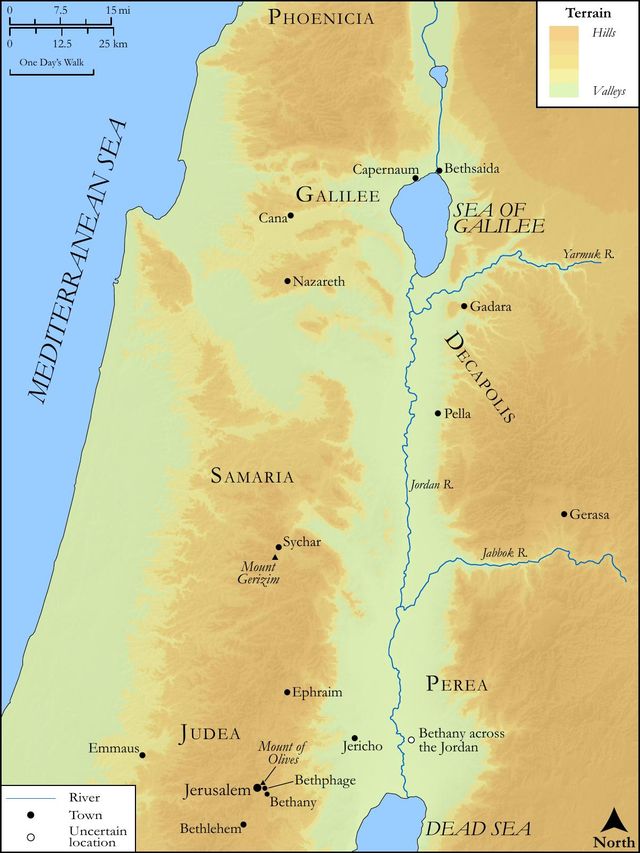
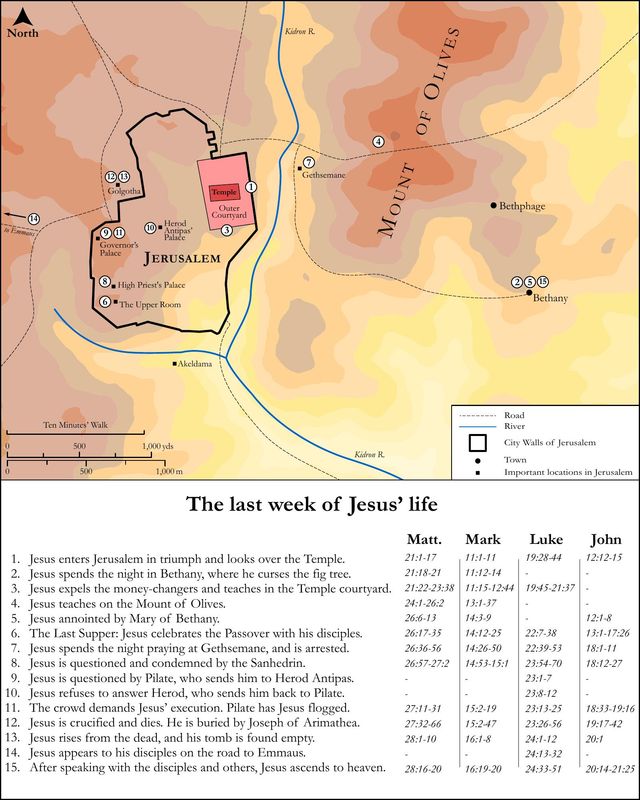
Study this verse
Public-domain commentary
Matthew Henry
From his Commentary on the Whole Bible. Henry comments on passages, not single verses — this entry covers John 20:1–10. His four-level outline is real structure in the source text, so it is rendered as structure.
There was no one thing of which the apostles were more concerned to produce substantial proof than the resurrection of their Master, 1. Because it was that which he himself appealed to as the last and most cogent proof of his being the Messiah. Those that would not believe other signs were referred to this sign of the prophet Jonas. And therefore enemies were most solicitous to stifle the notice of this, because it was put on this issue, and, if he be risen, they are not only murderers, but murderers of the Messiah. 2. Because it was upon this the performance of his undertaking for our redemption and salvation did depend. If he give his life a ransom, and do not resume it, it does not appear that his giving it was accepted as a satisfaction. If he be imprisoned for our debt, and lie by it, we are undone, Co1 15:17. 3. Because he never showed himself alive after his resurrection to all the people, Act 10:40, Act 10:41. We should have said, "Let his ignominious death be private, and his glorious resurrection public." But God's thoughts are not as ours; and he ordered it that his death should be public before the sun, by the same token that the sun blushed and hid his face upon it. But the demonstrations of his resurrection should be reserved as a favour for his particular friends, and by them be published to the world, that those might be blessed who have not seen, and yet have believed. The method of proof is such as gives abundant satisfaction to those who are piously disposed to receive the doctrine and law of Christ, and yet leaves room for those to object who are willingly ignorant and obstinate in their unbelief. And this is a fair trial, suited to the case of those who are probationers.
In these verses we have the first step towards the proof of Christ's resurrection, which is, that the sepulchre was found empty. He is not here, and, if so, they must tell us where he is or we conclude him risen.
I.Mary Magdalene, coming to the sepulchre, finds the stone taken away.
This evangelist does not mention the other women that went with Mary Magdalene, but here only, because she was the most active and forward in this visit to the sepulchre, and in her appeared the most affection; and it was an affection kindled by a good cause, in consideration of the great things Christ had done for her. Much was forgiven her, therefore she loved much. She had shown her affection to him while he lived, attended his doctrine, ministered to him of her substance, Luk 8:2, Luk 8:3. It does not appear that she had any business now at Jerusalem, but to wait upon him for the women were not bound to go up to the feast, and probably she and others followed him the closer, as Elisha did Elijah, now that they knew their Master would shortly be taken from their head, Kg2 2:1-6. The continued instances of her respect to him at and after his death prove the sincerity of her love. Note, Love to Christ, if it be cordial, will be constant. Her love to Christ was strong as death, the death of the cross, for it stood by that; cruel as the grave, for it made a visit to that, and was not deterred by its terrors.
1.She came to the sepulchre, to wash the dead body with her tears, for she went to the grave, to weep there, and to anoint it with the ointment she had prepared. The grave is a house that people do not care for making visits to. They that are free among the dead are separated from the living; and it must be an extraordinary affection to the person which will endear his grave to us. It is especially frightful to the weak and timourous sex. Could she, that had not strength enough to roll away the stone, pretend to such a presence of mind as to enter the grave? The Jews' religion forbade them to meddle any more than needs must with graves and dead bodies. In visiting Christ's sepulchre she exposed herself, and perhaps the disciples, to the suspicion of a design to steal him away; and what real service could she do him by it? But her love answers these, and a thousand such objections. Note,
(1.)We must study to do honour to Christ in those things wherein yet we cannot be profitable to him.
(2.)Love to Christ will take off the terror of death and the grave. If we cannot come to Christ but through that darksome valley, even in that, if we love him, we shall fear no evil.
2.She came as soon as she could, for she came,
(1.)Upon the first day of the week, as soon as ever the sabbath was gone, longing, not to sell corn and to set forth wheat (as Amo 8:5), but to be at the sepulchre. Those that love Christ will take the first opportunity of testifying their respect to him. This was the first Christian sabbath, and she begins it accordingly with enquiries after Christ. She had spent the day before in commemorating the work of creation, and therefore rested; but now she is upon search into the work of redemption, and therefore makes a visit to Christ and him crucified.
(2.)She came early, while it was yet dark; so early did she set out. Note, Those who would seek Christ so as to find him must seek him early; that is,
[1.]Seek him solicitously, with such a care as even breaks the sleep; be up early for fear of missing him.
[2.]Seek him industriously; we must deny ourselves and our own repose in pursuit of Christ.
[3.]Seek him betimes, early in our days, early every day. My voice shalt thou hear in the morning. That day is in a fair way to be well ended that is thus begun. Those that diligently enquire after Christ while it is yet dark shall have such light given them concerning him as shall shine more and more.
3.She found the stone taken away, which she had seen rolled to the door of the sepulchre. Now this was,
(1.)A surprise to her, for she little expected it. Christ crucified is the fountain of life. His grave is one of the wells of salvation; if we come to it in faith; though to a carnal heart it be a spring shut up, we shall find the stone rolled away (as Gen 29:10) and free access to the comforts of it. Surprising comforts are the frequent encouragements of early seekers.
(2.)It was the beginning of a glorious discovery; the Lord was risen, though she did not at first apprehend it so. Note,
[1.]Those that are most constant in their adherence to Christ, and most diligent in their enquiries after him, have commonly the first and sweetest notices of the divine grace. Mary Magdalene, who followed Christ to the last in his humiliation, met him with the first in his exaltation.
[2.]God ordinarily reveals himself and his comforts to us by degrees; to raise our expectations and quicken our enquiries.
II.Finding the stone taken away, she hastens back to Peter and John, who probably lodged together at that end of the town, not far off, and acquaints them with it: "They have taken the Lord out of the sepulchre, envying him the honour of such a decent burying-place, and we know not where they have laid him, nor where to find him, that we may pay him the remainder of our last respects." Observe here,
1.What a notion Mary had of the thing as it now appeared; she found the stone gone, looked into the grave, and saw it empty. Now one would expect that the first thought that offered itself would have been, Surely the Lord is risen; for whenever he had told them that he should be crucified, which she had now lately seen accomplished, he still subjoined in the same breath that the third day he should rise again. Could she feel the great earthquake that happened as she was coming to the sepulchre, or getting ready to come, and now see the grave empty, and yet have no thought of the resurrection enter into her mind? what, no conjecture, no suspicion of it? So it seems by the odd construction she puts upon the removing of the stone, which was very far fetched. Note, When we come to reflect upon our own conduct in a cloudy and dark day, we shall stand amazed at our dulness and forgetfulness, that we could miss of such thoughts as afterwards appear obvious, and how they could be so far out of the way when we had occasion for them. She suggested, They have taken away the Lord; either the chief priests have taken him away, to put him in a worse place, or Joseph and Nicodemus have, upon second thoughts, taken him away, to avoid the ill-will of the Jews. Whatever was her suspicion, it seems it was a great vexation and disturbance to her that the body was gone; whereas, if she had understood it rightly, nothing could be more happy. Note, Weak believers often make that the matter of their complaint which is really just ground of hope, and matter of joy. We cry out that this and the other creature-comfort are taken away, and we know not how to retrieve them, when indeed the removal of our temporal comforts, which we lament, is in order to the resurrection of our spiritual comforts, which we should rejoice in too.
2.What a narrative she made of it to Peter and John. She did not stand poring upon the grief herself, but acquaints her friends with it. Note, The communication of sorrows is one good improvement of the communion of saints. Observe, Peter, though he had denied his Master, had not deserted his Master's friends; by this appears the sincerity of his repentance, that he associated with the disciple whom Jesus loved. And the disciples' keeping up their intimacy with him as formerly, notwithstanding his fall, teaches us to restore those with a spirit of meekness that have been faulty. If God has received them upon their repentance, why should not we?
III.Peter and John go with all speed to the sepulchre, to satisfy themselves of the truth of what was told them, and to see if they could make any further discoveries, Joh 20:3, Joh 20:4. Some think that the other disciples were with Peter and John when the news came; for they told these things to the eleven, Luk 24:9. Others think that Mary Magdalene told her story only to Peter and John, and that the other women told theirs to the other disciples; yet none of them went to the sepulchre but Peter and John, who were two of the first three of Christ's disciples, often distinguished from the rest by special favours. Note, It is well when those that are more honoured than others with the privileges of disciples are more active than others in the duty of disciples, more willing to take pains and run hazards in a good work.
1.See here what use we should make of the experience and observations of others. When Mary told them what she had seen, they would not in this sense take her word, but would go and see with their own eyes. Do others tell us of the comfort and benefit of ordinances? Let us be engaged thereby to make trial of them. Come and see how good it is to draw near to God.
2.See how ready we should be to share with our friends in their cares and fears. Peter and John hastened to the sepulchre, that they might be able to give Mary a satisfactory answer to her jealousies. We should not grudge any pains we take for the succouring and comforting of the weak and timorous followers of Christ.
3.See what haste we should make in a good work, and when we are going on a good errand. Peter and John consulted neither their ease nor their gravity, but ran to the sepulchre, that they might show the strength of their zeal and affection, and might lose no time. If we are in the way of God's commandments, we should run in that way.
4.See what a good thing it is to have good company in a good work. Perhaps neither of these disciples would have ventured to the sepulchre alone, but, being both together, they made no difficulty of it. See Ecc 4:9.
5.See what a laudable emulation it is among disciples to strive which shall excel, which shall exceed, in that which is good. It was no breach of ill manners for John, though the younger, to outrun Peter, and get before him. We must do our best, and neither envy those that can do better, nor despise those that do as they can, though they come behind.
(1.)He that got foremost in this race as the disciple whom Jesus loved in a special manner, and who therefore in a special manner loved Jesus. Note, Sense of Christ's love to us, kindling love in us to him again, will make us to excel in virtue. The love of Christ will constrain us more than any thing to abound in duty.
(2.)He that was cast behind was Peter, who had denied his Master, and was in sorrow and shame for it, and this clogged him as a weight; sense of guilt cramps us, and hinders our enlargement in the service of God. When conscience is offended we lose ground.
IV.Peter and John, having come to the sepulchre, prosecute the enquiry, yet improve little in the discovery.
1.John went no further than Mary Magdalene had done.
(1.)He had the curiosity to look into the sepulchre, and saw it was empty. He stooped down, and looked in. Those that would find the knowledge of Christ must stoop down, and look in, must with a humble heart submit to the authority of divine revelation, and must look wistly.
(2.)Yet he had not courage to go into the sepulchre. The warmest affections are not always accompanied with the boldest resolutions; many are swift to run religion's race that are not stout to fight her battles.
2.Peter, though he came last, went in first, and made a more exact discovery than John had done, Joh 20:6, Joh 20:7. Though John outran him, he did not therefore turn back, nor stand still, but made after him as fast as he could; and, while John was with much caution looking in, he came, and with great courage went into the sepulchre.
(1.)Observe here the boldness of Peter, and how God dispenses his gifts variously. John could out-run Peter, but Peter could out-dare John. It is seldom true of the same persons, what David says poetically of Saul and Jonathan, that they were swifter than eagles, and yet stronger than lions, Sa2 1:23. Some disciples are quick, and they are useful to quicken those that are slow; others are bold, and they are useful to embolden those that are timorous; diversity of gifts, but one Spirit. Peter's venturing into the sepulchre may teach us, [1.] That those who in good earnest seek after Christ must not frighten themselves with bugbears and foolish fancies: "There is a lion in the way, a ghost in the grave." [2.] That good Christians need not be afraid of the grave, since Christ has lain in it; for to them there is nothing in it frightful; it is not the pit of destruction, nor are the worms in it never-dying worms. Let us therefore not indulge, but conquer, the fear we are apt to conceive upon the sight of a dead body, or being alone among the graves; and, since we must be dead and in the grave shortly, let us make death and the grave familiar to us, as our near kindred, Job 17:14. [3.] We must be willing to go through the grave to Christ; that way he went to his glory, and so must we. If we cannot see God's face and live, better die than never see it. See Job 19:25, etc.
(2.)Observe the posture in which he found things in the sepulchre.
[1.]Christ had left his grave-clothes behind him there; what clothes he appeared in to his disciples we are not told, but he never appeared in his grave-clothes, as ghosts are supposed to do; no, he laid them aside, First, Because he arose to die no more; death was to have no more dominion over him, Rom 6:9. Lazarus came out with his grave-clothes on, for he was to use them again; but Christ, rising to an immortal life, came out free from those incumbrances. Secondly, because he was going to be clothed with the robes of glory, therefore he lays aside these rags; in the heavenly paradise there will be no more occasion for clothes than there was in the earthly. The ascending prophet dropped his mantle. Thirdly, When we arise from the death of sin to the life of righteousness, we must leave our grave-clothes behind us, must put off all our corruptions. Fourthly, Christ left those in the grave, as it were, for our use if the grave be a bed to the saints, thus he hath sheeted that bed, and made it ready for them; and the napkin by itself is of use for the mourning survivors to wipe away their tears.
[2.]The grave-clothes were found in very good order, which serves for an evidence that his body was not stolen away while men slept. Robbers of tombs have been known to take away the clothes and leave the body; but none [prior to the practices of modern resurrectionists] ever took away the body and left the clothes, especially when it was fine linen and new, Mar 15:46. Any one would rather choose to carry a dead body in its clothes than naked. Or, if those that were supposed to have stolen it would have left the grave-clothes behind, yet it cannot be supposed they should find leisure to fold up the linen.
(3.)See how Peter's boldness encouraged John; now he took heart and ventured in (Joh 20:8), and he saw and believed; not barely believed what Mary said, that the body was gone (no thanks to him to believe what he saw), but he began to believe that Jesus was risen to life again, though his faith, as yet, was weak and wavering.
[1.]John followed Peter in venturing. It should seem, he durst not have gone into the sepulchre if Peter had not gone in first. Note, It is good to be emboldened in a good work by the boldness of others. The dread of difficulty and danger will be taken off by observing the resolution and courage of others. Perhaps John's quickness had made Peter run faster, and now Peter's boldness makes John venture further, than otherwise either the one or the other would have done; though Peter had lately fallen under the disgrace of being a deserter, and John had been advanced to the honour of a confidant (Christ having committed his mother to him), yet John not only associated with Peter, but thought it no disparagement to follow him.
[2.]Yet, it should seem, John got the start of Peter in believing. Peter saw and wondered (Luk 24:12), but John saw and believed. A mind disposed to contemplation may perhaps sooner receive the evidence of divine truth than a mind disposed to action. But what was the reason that they were so slow of heart to believe? The evangelist tells us (Joh 20:9), as yet they knew not the scripture, that is, they did not consider, and apply, and duly improve, what they knew of the scripture, that he must rise again from the dead. The Old Testament spoke of the resurrection of the Messiah; they believed him to be the Messiah; he himself had often told them that, according to the scriptures of the Old Testament, he should rise again; but they had not presence of mind sufficient by these to explain the present appearances. Observe here, First, How unapt the disciples themselves were, at first, to believe the resurrection of Christ, which confirms the testimony they afterwards gave with so much assurance concerning it; for, by their backwardness to believe it, it appears that they were not credulous concerning it, nor of those simple ones that believe every word. If they had had any design to advance their own interest by it, they would greedily have caught at the first spark of its evidence, would have raised and supported one another's expectations of it, and have prepared the minds of those that followed them to receive the notices of it; but we find, on the contrary, that their hopes were frustrated, it was to them as a strange thing, and one of the furthest things from their thoughts. Peter and John were so shy of believing it at first that nothing less than the most convincing proof the thing was capable of could bring them to testify it afterwards with so much assurance. Hereby it appears that they were not only honest men, who would not deceive others, but cautious men, who would not themselves be imposed upon. Secondly, What was the reason of their slowness to believe; because as yet they knew not the scripture. This seems to be the evangelist's acknowledgment of his own fault among the rest; he does not say, "For as yet Jesus had not appeared to them, had not shown them his hands and his side," but, "As yet he had not opened their understandings to understand the scripture" (Luk 24:44, Luk 24:45), for that is the most sure word of prophecy.
3.Peter and John pursued their enquiry no further, but desisted, hovering between faith and unbelief (Joh 20:10): The disciples went away, not much the wiser, to their own home, pros heautous - to their own friends and companions, the rest of the disciples to their own lodgings, for homes they had none at Jerusalem. They went away,
(1.)For fear of being taken up upon suspicion of a design to steal away the body, or of being charged with it now that it was gone Instead of improving their faith, their care is to secure themselves, to shift for their own safety. In difficult dangerous times it is hard even for good men to go on in their work with the resolution that becomes them.
(2.)Because they were at a loss, and knew not what to do next, nor what to make of what they had seen; and therefore, not having courage to stay at the grave, they resolve to go home, and wait till God shall reveal even this unto them, which is an instance of their weakness as yet.
(3.)It is probable that the rest of the disciples were together; to them they return, to make report of what they had discovered and to consult with them what was to be done; and, probably, now they appointed their meeting in the evening, when Christ came to them. It is observable that before Peter and John came to the sepulchre an angel had appeared there, rolled away the stone, frightened the guard, and comforted the women; as soon as they were gone from the sepulchre, Mary Magdalene here sees two angels in the sepulchre (Joh 20:12), and yet Peter and John come to the sepulchre, and go into it, and see none. What shall we make of this? Where were the angels when Peter and John were at the sepulchre, who appeared there before and after?
[1.]Angels appear and disappear at pleasure, according to the orders and instructions given them. They may be, and are really, where they are not visibly; nay, it should seem, may be visible to one and not to another, at the same time, Num 22:23; Kg2 6:17. How they make themselves visible, then invisible, and then visible again, it is presumption for us to enquire; but that they do so is plain from this story.
[2.]This favour was shown to those who were early and constant in their enquiries after Christ, and was the reward of those that came first and staid last, but denied to those that made a transient visit.
[3.]The apostles were not to receive their instructions from the angels, but from the Spirit of grace. See Heb 2:5.
Historical interpretation
Eight Centuries of Reception
7 surviving comments on this verse. Each one is dated, so this reads as a timeline rather than a list.
Select a marker to jump to its quote. Markers stagger vertically where authors wrote within a few decades of each other.
The cloths lying within seem to me at once to furnish also a proof that the body had not been taken away by people, as Mary supposed. For no one taking away the body would leave the linens, nor would the thief ever have stayed until he had undone the linens and so be caught. And at the same time they establish the resurrection of the body from the dead. For God, who transforms the bodies of our humiliation so as to be conformed to the body of Christ’s glory, changed the body as an organ of the power that dwelt in it, changing it into something more divine. But he left the linen cloths as superfluous and foreign to the nature of the body.
(Hom. lxxxv) The Sabbath being now over, during which it was unlawful to be there, Mary Magdalene could rest no longer, but came very early in the morning, to seek consolation at the grave: The first day of the week cometh Mary Magdalene early, when it was yet dark, unto the sepulchre.
(Hom. lxxxv. 4) Our Lord rose while the stone and seal were still on the sepulchre. But as it was necessary that others should be certified of this, the sepulchre is opened after the resurrection, and so the fact confirmed. This it was which roused Mary. For when she saw the stone taken away, she entered not nor looked in, but ran to the disciples with all the speed of love. But as yet she knew nothing for certain about the resurrection, but thought that His body had been carried off.
(Hom. lxxxv) The Evangelist does not deprive the woman of this praise, nor leaves out from shame, that they had the news first from her. As soon as they hear it, they hasten to the sepulchre.
(Hom. lxxxv) On coming he sees the linen clothes set aside: And he slooping down, and looking in, saw the linen clothes lying. But he makes no further search: yet went he not in. Peter on the other hand, being of a more fervid temper, pursued the search, and examined every thing: Then cometh Simon Peter following him, and went into the sepulchre, and seeth the linen clothes lie, and the napkin, that was about His head, not lying with the linen clothes, but wrapped together in a place by itself. Which circumstances were proof of His resurrection. For had they carried Him away, they would not have stripped Him; nor, if any had stolen Him, would they have taken the trouble to wrap up the napkin, and put it in a place by itself, apart from the linen clothes; but would have taken away the body as it was. John mentioned the myrrh first of all, for this reason, i. e. to show you that He could not have been stolen away. For myrrh would make the linen adhere to the body, and so caused trouble to the thieves, and they would never have been so senseless as to have taken this unnecessary pains about the matter. After Peter however, John entered: Then went in also that other disciple, which came first to the sepulchre, and he saw, and believed.
"The first day of the week" (that is, the Lord's day) "cometh Mary Magdalene, very early in the morning, and seeth the stone taken away from the sepulcher." For He arose while both stone and seals lay over Him; but because it was necessary that others should be fully satisfied, the tomb was opened after the Resurrection, and thus what had come to pass was confirmed. This then was what moved Mary. For being entirely full of loving affection towards her Master, when the Sabbath was past, she could not bear to rest, but came very early in the morning, desiring to find some consolation from the place. But when she saw the place, and the stone taken away, she neither entered in nor stooped down, but ran to the disciples, in the greatness of her longing; for this was what she earnestly desired, she wished very speedily to learn what had become of the body. This was the meaning of her running, and her words declare it. "They have taken away," she saith, "my Lord, and I know not where they have laid Him." Seest thou how she knew not as yet anything clearly concerning the Resurrection, but thought there had been a removal of the body, and tells all simply to the disciples? And the Evangelist hath not deprived the woman of such a praise, nor thought it shame that they should have learnt these things first from her who had passed the night in watching. Thus everywhere doth the truth-loving nature of his disposition shine forth. When then she came and said these things, they hearing them, draw near with great eagerness to the sepulcher, and see the linen clothes lying, which was a sign of the Resurrection. For neither, if any persons had removed the body, would they before doing so have stripped it; nor if any had stolen it, would they have taken the trouble to remove the napkin, and roll it up, and lay it in a place by itself; but how? they would have taken the body as it was. On this account John tells us by anticipation that it was buried with much myrrh, which glues linen to the body not less firmly than lead; in order that when thou hearest that the napkins lay apart, thou mayest not endure those who say that He was stolen. For a thief would not have been so foolish as to spend so much trouble on a superfluous matter. For why should he undo the clothes? and how could he have escaped detection if he had done so? since he would probably have spent much time in so doing, and be found out by delaying and loitering. But why do the clothes lie apart, while the napkin was wrapped together by itself? That thou mayest learn that it was not the action of men in confusion or haste, the placing some in one place, some in another, and the wrapping them together. From this they believed in the Resurrection. On this account Christ afterwards appeared to them, when they were convinced by what they had seen. Observe too here again the absence of boastfulness in the Evangelist, how he witnesses to the exactness of Peter's search. For he himself having gotten before Peter, and having seen the linen clothes, enquired not farther, but withdrew; but that fervent one passing farther in, looked at everything carefully, and saw somewhat more, and then the other too was summoned to the sight. For he entering after Peter, saw the grave-clothes lying, and separate. Now to separate, and to place one thing by itself, and another, after rolling it up, by itself, was the act of some one doing things carefully, and not in a chance way, as if disturbed.
"And he stooping down," he says, "saw the linen clothes lying; yet went he not in. Then cometh Simon Peter following him, and went into the sepulchre, and saw the linen clothes lying, and the napkin, which had been about His head, not lying with the linen clothes, but folded up in one place by itself." Do we suppose these things have no meaning? I can suppose no such thing. But we hasten on to other points, on which we are compelled to linger by the need there is for investigation, or some other kind of obscurity. For in such things as are self-manifest, the inquiry into the meaning even of individual details is, indeed, a subject of holy delight, but only for those who have leisure, which is not the case with us.
(xxii. in Evang.) But Peter and John before the others, for they loved most; Peter therefore went forth, and that other disciple, and came to the sepulchre.
(Hom. xxii. in Evang.) But this account of the Evangelist must not be thought to be without some mystical meaning. By John, the younger of the two, the synagogue; by Peter, the elder, the Gentile Church is represented: for though the synagogue was before the Gentile Church as regards the worship of God, as regards time the Gentile world was before the synagogue. They ran together, because the Gentile world ran side by side with the synagogue from first to last, in respect of purity and community of life, though a purity and community of understanding they had not. The synagogue came first to the sepulchre, but entered not: it knew the commandments of the law, and had heard the prophecies of our Lord's incarnation and death, but would not believe in Him who died. Then cometh Simon Peter, and enteredinto the sepulchre: the Gentile Church both knew Jesus Christ as dead man, and believed in Him as living God. The napkin about our Lord's head is not found with the linen clothes, i. e. God, the Head of Christ, and the incomprehensible mysteries of the Godhead are removed from our poor knowledge; His power transcends the nature of the creature. And it is found not only apart, but also wrapped together; because of the linen wrapped together, neither beginning nor end is seen; and the height of the Divine nature had neither beginning nor end. And it is into one place: for where there is division, God is not; and they merit His grace, who do not occasion scandal by dividing themselves into sects. But as a napkin is what is used in labouring to wipe the sweat of the brow, by the napkin here we may understand the labour of God: which napkin is found apart, because the suffering of our Redeemer is far removed from ours; inasmuch as He suffered innocently, that which we suffer justly; He submitted Himself to death voluntarily, we by necessity. But after Peter entered, John entered too; for at the end of the world even Judaea shall be gathered in to the true faith.
But Simon Peter came following him and entered the tomb, because the Church of the Gentiles, coming after, both recognized the mediator between God and men, the man Jesus Christ, dead in the flesh, and believed him to be the living God.
Or thus: Peter is practical and prompt, John contemplative and intelligent, and learned in divine things. Now the contemplative man is generally beforehand in knowledge and intelligence, but the practical by his fervour and activity gets the advance of the other's perception, and sees first into the divine mystery.
Continue studying John 20:6 across the web’s major study libraries — every link below opens this exact verse, chapter, or book on the destination site.
Read & Compare
 BibleGatewayThis verse in more than 200 translations and 70 languages.
 Bible.comThe YouVersion reader — hundreds of translations, reading plans, and highlights.
 ESV.orgCrossway's official English Standard Version reader.
 NET BibleThe NET translation with 60,000+ translators' notes on every rendering decision.
 STEP BibleTyndale House's free study tool — original text, vocabulary, and scholarly resources.
 BibliaLogos Bible Software's free web reader.
 USCCBThe New American Bible (Revised Edition) with the U.S. bishops' study notes.
Commentaries
 BibleHub CommentariesDozens of classic commentaries on this verse, gathered on one page.
 StudyLightMore than 100 commentary sets — the largest collection on the web.
 BibleRefPlain-English commentary on what this verse means, verse by verse.
 Enduring WordDavid Guzik's free commentary on this chapter, widely used by Bible teachers.
 Bible Study ToolsVerse commentary alongside Greek and Hebrew study aids.
Original Language & Research
- BibleHub InterlinearThe verse word by word — original language, transliteration, and English.
- BibleHub LexiconEvery word's original-language definition and Strong's entry.
 Blue Letter BibleDeep-study tools — Strong's numbers, concordance, and word studies.
 CNTR CollationThe earliest Greek manuscripts of this verse, collated letter by letter.
Sermons, Hymns & Audio


TrulyRandomVerse is not affiliated with these sites and doesn’t control their content. They’re linked because they’re genuinely useful.
Summary
John 20:6 captures the dramatic moment when Simon Peter, having raced to the tomb with the Beloved Disciple, arrives and characteristically enters the sepulchre without hesitation. His immediate observation inside the tomb is of the linen burial cloths, which he finds lying in a state that suggests not a theft or hurried removal, but a miraculous departure of the body, setting the stage for a deeper understanding of the resurrection.
Context
ShowHideLiterary Context
This verse is a crucial part of the resurrection narrative in John's Gospel. It immediately follows Mary Magdalene's distraught report of the empty tomb to Peter and "the other disciple" John 20:1-2. The two disciples then race to the tomb, with the younger disciple arriving first but only stooping to look in John 20:3-5. Peter's arrival and bold entry in John 20:6 directly contrasts with the other disciple's initial hesitation, highlighting Peter's impulsive nature. This observation of the linen clothes then leads directly to the Beloved Disciple's entry and subsequent belief John 20:7-8, forming a progression of eyewitness testimony.
Historical & Cultural Context
Jewish burial customs of the first century involved washing and anointing the body, then wrapping it tightly in strips of linen cloth, often with aromatic spices, before placing it in a tomb. The body would typically be laid on a stone slab or shelf within the sepulchre. The "linen clothes" (Gk. othonia) mentioned here refer to these specific strips or bandages, not a single shroud. The tomb itself would be a cave or rock-cut chamber, often sealed with a large stone. The expectation of the disciples, even after Jesus' predictions, was not of a physical resurrection from the dead in this manner, but rather the traditional Jewish belief in a general resurrection at the end of time. Thus, the empty tomb and the state of the grave clothes presented a profound and unexpected challenge to their understanding.
Key Themes
ShowHideJohn 20:6 significantly contributes to several key themes within the broader narrative. First, it underscores the theme of eyewitness testimony as foundational to belief in the resurrection. Peter's direct observation of the tomb's interior and the grave clothes provides crucial physical evidence. Second, it highlights Peter's unique role and personality within the apostolic band; his characteristic zeal and impulsiveness are on full display, leading him to be the first to fully enter and inspect the empty tomb. Third, the verse emphasizes the empty tomb as a primary piece of evidence for the resurrection, particularly through the specific detail of the undisturbed grave clothes. This detail, further elaborated in John 20:7, serves to refute any notion of a body theft and points towards a supernatural event.
Exposition and Analysis
ShowHideKey Word Analysis
ShowHideFrom εἰς and ἔρχομαι; to enter (literally or figuratively):--X arise, come (in, into), enter in(-to), go in (through). Peter's decisive action of "entering" the tomb signifies his direct, unhesitating investigation, contrasting with John's earlier hesitation. This verb emphasizes the physical act of penetration into the sacred space of the tomb.
From a derivative of θεάομαι (perhaps by addition of ὁράω); to be a spectator of, i.e. discern, (literally, figuratively (experience) or intensively (acknowledge)):--behold, consider, look on, perceive, see. This word implies a careful, discerning observation, not just a casual glance. Peter is actively taking in the scene, processing the details of what he beholds, which will contribute to his eventual understanding.
Middle voice of a primary verb; to lie outstretched (literally or figuratively):--be (appointed, laid up, made, set), lay, lie. This verb describes the state of the linen clothes. They were not scattered, ripped, or unwrapped in disarray, but rather "lying" in a particular, undisturbed manner, as if the body had simply passed through them or dematerialized from within them. This detail is crucial for the subsequent interpretation of the empty tomb.
Verse Breakdown
ShowHide"Then cometh Simon Peter following him,"
This clause establishes the sequence of events, with Peter arriving after the Beloved Disciple, who had outrun him. The phrase "following him" underscores Peter's characteristic role as a leader, even when momentarily behind, and sets up his immediate, decisive action.
"and went into the sepulchre,"
This highlights Peter's bold and direct nature. Unlike the other disciple who only stooped to look in, Peter immediately enters the tomb, driven by an urgent need to verify the situation firsthand. This act signifies his readiness to confront the unknown and seek direct evidence.
"and seeth the linen clothes lie,"
This is the pivotal observation. Peter's discerning gaze (using theōréō) falls upon the burial cloths. The crucial detail is their state: they "lie" (using keîmai), implying an orderly, undisturbed arrangement. This observation is the first piece of concrete, physical evidence that will challenge the disciples' initial assumption of theft and begin to point towards a miraculous event.
Literary Devices
ShowHideThe passage employs Foreshadowing and Subtle Symbolism. Peter's immediate entry and discerning observation of the linen clothes foreshadow the dawning realization of the resurrection, which will fully break upon the Beloved Disciple in the following verses. The Symbolism lies in the state of the linen clothes themselves. Their orderly, undisturbed arrangement, despite the absence of the body, functions as a powerful, silent witness. It's a forensic detail that speaks volumes, subtly but powerfully indicating that the body was not stolen or removed by human hands, which would have left the cloths in disarray. Instead, they lie as if the body simply passed through them, a testament to a supernatural event that defies conventional explanation and points to Christ's glorious transformation.
Theological and Thematic Connections
ShowHideJohn 20:6 serves as a foundational moment in the unfolding narrative of the resurrection, emphasizing the necessity of physical evidence and eyewitness testimony in establishing the truth of Christ's triumph over death. Peter's direct observation of the empty tomb and the undisturbed grave clothes provides tangible proof that begins to shift the disciples' understanding from confusion and despair to dawning conviction. This physical evidence, while not immediately leading to full belief for Peter in this verse, is a critical step in the process of faith, demonstrating that the resurrection is not merely a spiritual concept but a historical event with verifiable signs. It underscores God's provision of concrete, albeit mysterious, indicators to confirm His mighty acts.
Reflection and Application
ShowHideThe scene in John 20:6 invites us to consider our own approach to truth and belief, especially in matters of faith. Peter's urgent pursuit and direct investigation of the empty tomb exemplify a commendable zeal for truth. He doesn't settle for hearsay but enters to see for himself. This challenges us to move beyond superficial understanding or inherited faith, encouraging a deeper, personal engagement with the foundational truths of Christianity. The orderly state of the grave clothes, a subtle yet profound detail, prompts us to look for God's hand in unexpected places and to consider how He provides evidence, even in the midst of mystery. For us today, the historical reality of the resurrection, attested by the empty tomb and the unique state of the grave clothes, remains a cornerstone of our hope. It calls us to examine the evidence, to wrestle with its implications, and to allow its power to transform our lives, moving us from doubt to a robust, evidence-informed faith.
Questions for Reflection
ShowHideFAQ
ShowHideWhy did Peter enter the tomb when the other disciple (John) did not immediately?
ShowHidePeter's immediate entry into the sepulchre, while the Beloved Disciple only stooped and looked in John 20:5, is highly consistent with Peter's character as portrayed throughout the Gospels. He was often impulsive, bold, and quick to act. From walking on water Matthew 14:28-29 to drawing his sword in Gethsemane John 18:10, Peter frequently demonstrated a "ready-fire-aim" approach. In this critical moment, his zeal and perhaps a desperate hope to understand what had happened propelled him to be the first to fully enter and investigate the empty tomb.
What is the significance of the "linen clothes lie" in John 20:6?
ShowHideThe detail that Peter "seeth the linen clothes lie" is profoundly significant as a piece of forensic evidence against the theory that Jesus' body was stolen. If the body had been stolen, the grave clothes would likely have been hastily unwrapped, discarded, or taken with the body. However, the Greek word keîmai (lie) suggests they were not in disarray but were "lying" in an orderly fashion, as if the body had simply passed through or dematerialized from within them. This impression is reinforced by John 20:7, which notes the napkin (head covering) was "wrapped together in a place by itself." This undisturbed, yet empty, state of the grave clothes strongly suggests a supernatural event, not a human act of theft or removal, providing compelling testimony to the reality of the resurrection.
Christ-Centered Fulfillment
ShowHideThe empty tomb, as observed by Peter in John 20:6, stands as the ultimate testament to Christ's victory over death and sin. While the Old Testament foreshadowed a conquering Messiah, it was the resurrection that fully revealed the extent of His triumph. The "linen clothes lie" not as evidence of absence, but as a powerful sign of a new, glorified presence. Christ's emergence from the tomb, leaving behind the grave clothes, symbolizes His complete conquest of the powers of death and the grave Hebrews 2:14-15. He did not merely escape death; He abolished it, rising with a new, immortal body Romans 6:9. This empty tomb is the cornerstone of Christian hope, signifying that just as Christ was raised, so too will believers be raised to new life 1 Corinthians 15:20-22. The undisturbed grave clothes become a silent witness to the divine power that stripped principalities and powers bare, triumphing over them in the cross and resurrection Colossians 2:15. Thus, Peter's observation in John 20:6 is not just about an empty tomb, but about the profound, world-altering reality of a living, reigning Savior.