


Luke 24:12
Bible text: King James Version (1769 Blayney text) · Public domain
Bible text: King James Version with Strong's numbers · Public domain
Bible text: Berean Standard Bible · Public domain
Bible text: American Standard Version (1901) · Public domain
Bible text: World English Bible, Messianic edition · Public domain
Bible text: Geneva Bible (1599) · Public domain
Bible text: Young's Literal Translation · Public domain
- ὉHo<the>G3588T-NSMDefinite article Nominative Singular Masculine
- δὲdeButG1161CONJConjunction
- ΠέτροςPetrosPeterG4074N-NSM-PNoun Nominative Singular Masculine Individual
- ἀναστὰςanastashaving risen upG450V-2AAP-NSMVerb 2nd Aorist Active Participle Nominative Singular Masculine
- ἔδραμενedramenhe ranG5143V-2AAI-3SVerb 2nd Aorist Active Indicative 3rd Singular
- ἐπὶepitoG1909PREPPreposition
- τὸtotheG3588T-ASNDefinite article Accusative Singular Neuter
- μνημεῖονmnēmeiontombG3419N-ASNNoun Accusative Singular Neuter
- καὶkaiandG2532CONJConjunction
- παρακύψαςparakupsashaving stooped downG3879V-AAP-NSMVerb Aorist Active Participle Nominative Singular Masculine
- βλέπειblepeihe seesG991V-PAI-3SVerb Present Active Indicative 3rd Singular
- τὰtatheG3588T-APNDefinite article Accusative Plural Neuter
- ὀθόνιαothonialinen stripsG3608N-APNNoun Accusative Plural Neuter
- κείμεναkeimenalyingG2749V-PNP-APNVerb Present Middle Or Passive Deponent Participle Accusative Plural Neuter
- μόναmonaaloneG3441A-APNAdjective Accusative Plural Neuter
- καὶkaiandG2532CONJConjunction
- ἀπῆλθενapēlthenhe went awayG565V-2AAI-3SVerb 2nd Aorist Active Indicative 3rd Singular
- πρὸςprosinG4314PREPPreposition
- ἑαυτὸνhe'autonhimselfG1438F-3ASMReflexive pronoun Accusative 3rd Singular Masculine
- θαυμάζωνthaumazōnwondering atG2296V-PAP-NSMVerb Present Active Participle Nominative Singular Masculine
- τὸtothatG3588T-ASNDefinite article Accusative Singular Neuter
- γεγονόςgegonoshaving come to passG1096V-2RAP-ASNVerb 2nd Perfect Active Participle Accusative Singular Neuter
English is a literal word-by-word gloss of the Greek, not the KJV's wording. Why?
This is the original text the KJV's translators worked from — each Greek word with its own literal English meaning in this verse, prepared by scholars at Tyndale House, Cambridge. The KJV translates whole sentences, not word by word, so its wording differs: one Greek word can become several English words, and the KJV may choose “charity” where the gloss reads “love”. Both are faithful — they answer different questions. For the KJV's own rendering, switch to the KJV text.
Details
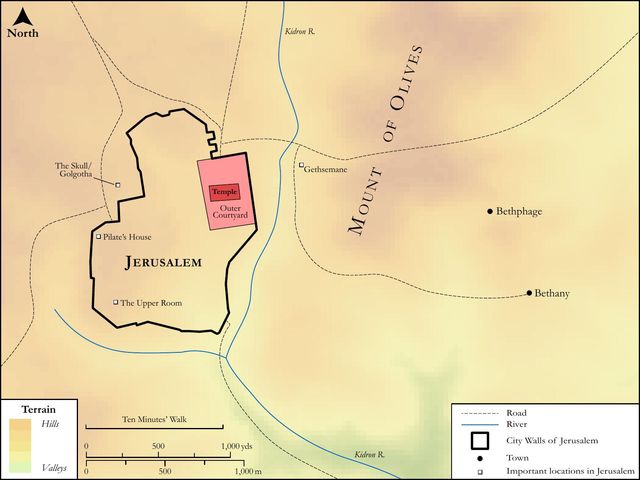
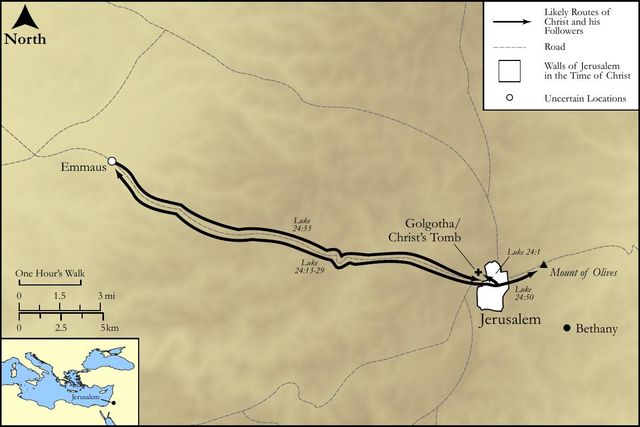
See on the biblical-era maps

Study this verse
Public-domain commentary
Matthew Henry
From his Commentary on the Whole Bible. Henry comments on passages, not single verses — this entry covers Luke 24:1–12. His two-level outline is real structure in the source text, so it is rendered as structure.
The manner of the re-uniting of Christ's soul and body in his resurrection is a mystery, one of the secret things that belong not to us; but the infallible proofs of his resurrection, that he did indeed rise from the dead, and was thereby proved to be the Son of God, are things revealed, which belong to us and to our children. Some of them we have here in these verses, which relate the same story for substance that we had in Matthew and Mark.
I.We have here the affection and respect which the good women that had followed Christ showed to him, after he was dead and buried, Luk 24:1.
As soon as ever they could, after the sabbath was over, they came to the sepulchre, to embalm his body, not to take it out of the linen in which Joseph had wrapped it, but to anoint the head and face, and perhaps the wounded hands and feet, and to scatter sweet spices upon and about the body; as it is usual with us to strew flowers about the dead bodies and graves of our friends, only to show our good-will towards the taking off the deformity of death if we could, and to make them somewhat the less loathsome to those that are about them. The zeal of these good women for Christ did continue. The spices which they had prepared the evening before the sabbath, at a great expense, they did not, upon second thoughts, when they had slept upon it, dispose of otherwise, suggesting, To what purpose is this waste? but they brought them to the sepulchre on the morning after the sabbath, early, very early. It is a rule of charity, Every man, according as he purposes in his heart, so let him give, Co2 9:7. What is prepared for Christ, let it be used for him. Notice is taken of the names of these women, Mary Magdalene, and Joanna, and Mary the mother of James; grave matronly women, it should seem, they were. Notice is also taken of certain others with them, Luk 24:1, and again, Luk 24:10. These, who had not joined in preparing the spices, would yet go along with them to the sepulchre; as if the number of Christ's friends increased when he was dead, Joh 12:24, Joh 12:32. The daughters of Jerusalem, when they saw how inquisitive the souse was after her Beloved, were desirous to seek him with her (Sol 6:1), so were these other women. The zeal of some provokes others.
II.The surprise they were in, when they found the stone rolled away and the grave empty (Luk 24:2, Luk 24:3); they were much perplexed at that (Luk 24:4) which they had much reason to rejoice in, that the stone was rolled away from the sepulchre (by which it appeared that he had a legal discharge, and leave to come out), and that they found not the body of the Lord Jesus, by which it appeared that he had made us of his discharge and was come out. Note, Good Christians often perplex themselves about that with which they should comfort and encourage themselves.
III.The plain account which they had of Christ's resurrection from two angels, who appeared to them in shining garments, not only white, but bright, and casting a lustre about them. They first saw one angel without the sepulchre, who presently went in, and sat with another angel in the sepulchre, one at the head and the other at the feet, where the body of Jesus had lain; so the evangelists may be reconciled. The women, when they saw the angels, were afraid lest they had some ill news for them; but, instead of enquiring of them, they bowed down their faces to the earth, to look for their dear Master in the grave. They would rather find him in his grave-clothes than angels themselves in their shining garments. A dying Jesus has more beauty in the eyes of a believer than angels themselves. These women, like the spouse, when found by the watchman (and angels are called watchers), enter not into any other conversation with them than this, Saw ye him whom my soul loveth? Now here,
1.They upbraid the women with the absurdity of the search they were making: Why seek ye the living among the dead? Luk 24:5. Witness is hereby given to Christ that he is living, of him it is witnessed that he liveth (Heb 7:8), and it is the comfort of all the saints, I know that my Redeemer liveth; for because he lives we shall live also. But a reproof is given to those that look for him among the dead, - that look for him among the dead heroes that the Gentiles worshipped, as if he were but like one of them, - that look for him in an image, or a crucifix, the work of men's hands, or among unwritten tradition and the inventions of men; and indeed all they that expect happiness and satisfaction in the creature, or perfection in this imperfect state, may be said to seek the living among the dead.
2.They assure them that he is risen from the dead (Luk 24:6): "He is not here, but is risen, is risen by his own power; he has quitted his grace, to return no more to it." These angels were competent witnesses, for they had been sent express from heaven with orders for his discharge. And we are sure that their record is true; they durst not tell a lie.
3.They refer them to his own words: Remember what he spoke to you, when he was yet in Galilee. If they had duly believed and observed the prediction of it, they would easily have believed the thing itself when it came to pass; and therefore, that the tidings might not be such a surprise to them and they seemed to be, the angels repeat to them what Christ had often said in their hearing, The Son of man must be delivered into the hands of sinful men, and though it was done by the determinate counsel and foreknowledge of God, yet they that did it were not the less sinful for doing it. He told them that he must be crucified. Surely they could not forget that which they had with so much concern seen fulfilled; and would not this bring to their mind that which always followed, The third day he shall rise again? Observe, These angels from heaven bring not any new gospel, but put them in mind, as the angels of the churches do, of the sayings of Christ, and teach them how to improve and apply them.
IV.Their satisfaction in this account, Luk 24:8.
The women seemed to acquiesce; they remembered his words, when they were thus put in mind of them, and thence concluded that if he was risen it was not more than they had reason to expect; and now they were ashamed of the preparations they had made to embalm on the third day him who had often said that he would on the third day rise again. Note, A seasonable remembrance of the words of Christ will help us to a right understanding of his providence.
V.The report they brought of this to the apostles:
They returned from the sepulchre, and told all these things to the eleven, and to all the rest of Christ's disciples, Luk 24:9. It does not appear that they were together in a body; they were scattered every one to his own, perhaps scarcely two or three of them together in the same lodgings, but one went to some of them and another to others of them, so that in a little time, that morning, they all had notice of it. But we are told (Luk 24:11) how the report was received: Their words seemed to them as idle tales, and they believed them not. They thought it was only the fancy of the women, and imputed it to the power of imagination; for they also had forgotten Christ's words, and wanted to be put in mind of them, not only what he had said to them in Galilee some time ago, but what he had said very lately, in the night wherein he was betrayed: Again a little while, and ye shall see me. I will see you again. One cannot but be amazed at the stupidity of these disciples, - who had themselves so often professed that they believed Christ to be the Son of God and the true Messiah, had been so often told that he must die and rise again, and then enter into his glory, had seen him more than once raise the dead, - that they should be so backward to believe in his raising himself. Surely it would seem the less strange to them, when hereafter this complaint would justly be taken up by them, to remember that there was a time when it might justly have been taken up against them, Who hath believed our report?
VI.The enquiry which Peter made hereupon, Luk 24:12.
It was Mary Magdalene that brought the report to him, as appears, Joh 20:1, Joh 20:2, where this story of his running to the sepulchre is more particularly related.
1.Peter hastened to the sepulchre upon the report, perhaps ashamed of himself, to think that Mary Magdalene should have been there before him; and yet, perhaps, he had not been so ready to go thither now if the women had not told him, among other things, that the watch was fled. Many that are swift-footed enough when there is no danger are but cow-hearted when there is. Peter now ran to the sepulchre, who but the other day ran from his Master.
2.He looked into the sepulchre, and took notice how orderly the linen clothes in which Christ was wrapped were taken off, and folded up, and laid by themselves, but the body gone. He was very particular in making his observations, as if he would rather credit his own eyes than the testimony of the angels.
3.He went away, as he thought, not much the wiser, wondering in himself at that which was come to pass. Had he remembered the words of Christ, even this was enough to satisfy him that he was risen from the dead; but, having forgotten them, he is only amazed with the thing, and knows not what to make of it. There is many a thing puzzling and perplexing to us which would be both plain and profitable if we did but rightly understand the words of Christ, and had them ready to us.
Historical interpretation
Eight Centuries of Reception
9 surviving comments on this verse. Each one is dated, so this reads as a timeline rather than a list.
Select a marker to jump to its quote. Markers stagger vertically where authors wrote within a few decades of each other.
The Instrument of the Word lay dead, but a great stone enclosed the sepulchre, as if death had led Him captive. But three days had not yet elapsed, when life again puts itself forth after a sufficient proof of death, as it follows, And they found the stone rolled away.
The messengers of the health-bearing resurrection and their shining garments stand for tokens of pleasantness and rejoicing. For Moses preparing plagues against the Egyptians, perceived an angel in the flame of fire. But not such were those who appeared to the women at the sepulchre, but calm and joyful as became them to be seen in the kingdom and joy of the Lord. And as at the Passion the sun was darkened, holding forth signs of sorrow and woe to the crucifiers of our Lord, so the angels, heralds of life and resurrection, marked by their white garments the character of the health-bearing feast day.
For he alone believed the women saying that they had seen Angels; and as he was of more ardent feelings than the rest, he anxiously put himself foremost, looking every where for the Lord; as it follows, And stooping down, he beheld the linen clothes laid by themselves.
(Lib. de Inc. Fil. Dei.) He might indeed at once have raised His body from the dead. But some one would have said that He was never dead, or that death plainly had never existed in Him. And perhaps if the resurrection of our Lord had been delayed beyond the third day, the glory of incorruption had been concealed. In order therefore to show His body to be dead, He suffered the interval of one day, and on the third day manifested His body to be without corruption.
If he left his clothes behind in the tomb, it was so that Adam could enter into paradise without clothing, just as he had been before he had sinned. In place of having to leave paradise clothed, he now had to strip himself before entering there [again]. Or [alternatively], he abandoned them to symbolize the mystery of the resurrection of the dead, for just as [the Lord] rose into glory without clothes, so we also [will rise] with our works and not with our clothes.
Now this place has caused great perplexity to many, because while St. Luke says, Very early in the morning, Matthew says that it was in the evening of the sabbath that the women came to the sepulchre. But you may suppose that the Evangelists spoke of different occasions, so as to understand both different parties of women, and different appearances. Because however it was written, that in the evening of the sabbath, as it began to dawn towards the first day of the week, (Matt. 28:1.) our Lord rose, we must so take it, as that neither on the morning of the Lord's day, which is the first after the sabbath, nor on the sabbath, the resurrection should be thought to have taken place. For how are the three days fulfilled? Not then as the day grew towards evening, but in the evening of the night He rose. Lastly, in the Greek it is "late;" (ὀψὶ) but late signifies both the hour at the end of the day, and the slowness of any thing; as we say, "I have been lately told." Late then is also the dead of the night. And thus also the women had the opportunity of coming to the sepulchre when the guards were asleep. And that you may know it was in the night time, some of the women are ignorant of it. They know who watch night and day, they know not who have gone back. According to John, one Mary Magdalene knows not, for the same person could not first know and then afterwards be ignorant. Therefore if there are several Maries, perhaps also there are several Mary Magdalenes, since the former is the name of a person, the second is derived from a place.
But how is it that Mark has mentioned one young man sitting in white garments, and Matthew one, but John and Luke relate that there were seen two angels sitting in white garments.
It is not allowed to women to teach in the church, but they shall ask their husbands at home. (1 Tim. 2:12, 1 Cor. 14:35.) To those then who are at home is the woman sent. But who these women were he explains, adding, It was Mary Magdalene,
(Hom. 90. in Matt.) But the stone was rolled away after the resurrection, on account of the women, that they might believe that the Lord had risen again, seeing indeed the grave without the body. Hence it follows, And they entered in, and found not the body of the Lord Jesus.
(de Con. Ev. lib. iii. c. 24.) Or Matthew by the first part of the night, which is the evening, wished to represent the night itself, at the end of which night they came to the sepulchre, and for this reason, because they had been now preparing since the evening, and it was lawful to bring spices because the sabbath was over.
(de Con. Ev. ut sup.) We may understand that one Angel was seen by the women, as both Mark and Matthew say, so as supposing them to have entered into the sepulchre, that is, into a certain space which was fenced off by a kind of wall in front of the stone sepulchre; and that there they saw an Angel sitting on the right hand, which Mark says, but that afterwards when they looked into the place where our Lord was lying, they saw within two other Angels standing, (as Luke says,) who spoke to encourage their minds, and build up their faith. Hence it follows, And as they were afraid.
Luke is supposed to have mentioned this concerning Peter, recapitulating. For Peter ran to the sepulchre at the same time that John also went, as soon as it had been told to them alone by the women, (especially Mary Magdalene,) that the body was taken away. But the vision of Angels took place afterwards. Luke therefore mentioned Peter only, because to him Mary first told it. It may also strike one, that Luke says that Peter, not entering but stooping down, saw the linen clothes by themselves, and departed wondering, whereas John says, that he himself saw the linen clothes in the same position, and that he entered after Peter. We must understand then that Peter first saw them stooping down, which Luke mentions, John omits, but that he afterwards entered before John came in.
But Peter arose and ran to the tomb, and stooping down, he saw the linen cloths alone, and he went away, wondering to himself what had happened. Luke briefly mentions Peter's run; but how this happened is more fully detailed by John, who also says that the disciple whom Jesus loved ran with Peter, thus implying himself. Therefore, it is asked how Luke says of Peter: "And stooping down, he saw the linen cloths alone" (Luke 24), while John signifies that he himself did this, but that Peter, upon entering the tomb, saw not only the linen cloths but also the napkin that had been on his head. It must be understood that Peter, stooping down, saw what Luke records, which John is silent about; but after entering, to more carefully discern the interior, he entered, yet before John entered.
Devout women not only on the day of preparation, but also when the sabbath was passed, that is, at sun-set, as soon as the liberty of working returned, bought spices that they might come and anoint the body of Jesus, as Mark testifies. (Mark 16:1.) Still as long as night time restrained them, they came not to the sepulchre. And therefore it is said, On the first day of the week, very early in the morning, &c. One of the Sabbath, (una Sabbathi) or the first of the Sabbath, is the first day from the Sabbath; which Christians are wont to call "the Lord's day," because of our Lord's resurrection. But by the women coming to the sepulchre very early in the morning, is manifested their great zeal and fervent love of seeking and finding the Lord.
The holy women, when the Angels stood beside them, are reported not to have fallen to the ground, but to have bowed their faces to the earth; nor do we read that any of the saints, at the time of our Lord's resurrection, worshipped with prostration to the ground either our Lord Himself, or the Angels who appeared to them. Hence has arisen the ecclesiastical custom, either in memory of our Lord's resurrection, or in the hope of our own, of praying on every Lord's day, and through the whole season of Pentecost, not with bended knees, but with our faces bowed to the earth. But not in the sepulchre, which is the place of the dead, was He to be sought, who rose from the dead to life. And therefore it is added, They said to them, that is, the Angels to the women, Why seek ye the living among the dead? He is not here, but is risen. On the third day then, as He Himself foretold to the women, together with the rest of His disciples, He celebrated the triumph of His resurrection. Hence it follows, Remember how he spake unto you when he was yet in Galilee, saying, The Son of man must be delivered into the hands of sinful men, and be crucified, and on the third day rise again, &c. For on the day of the preparation at the ninth hour giving up the ghost, buried in the evening, early on the morning of the first day of the week He rose again.
One day and two nights also He lay in the sepulchre, because He joined the light of His single death to the darkness of our double death.
(who Was also the sister of Lazarus,) and Joanna, (the wife of Chuza, Herod's steward,) and Mary the mother of James, (that is, the mother of James the less, and Joseph.) And it is added generally of the others, and other women that were with them, which told these things to the Apostles.
(ex Amb.) For that the woman might not endure the everlasting reproach of guilt from men, she who had transfused sin into the man, now also transfuses grace.
(ex Greg.) Which was not so much their weakness, as so to speak our strength. For the resurrection itself was demonstrated to those who doubted by many proofs, which while we read and acknowledge we are through their doubts confirmed in the truth.
According to the mystical meaning, by the women coming early in the morning to the sepulchre, we have an example given us, that having cast away the darkness of our vices, we should come to the Body of the Lord. For that sepulchre also bore the figure of the Altar of the Lord, wherein the mysteries of Christ's Body, not in silk or purple cloth, but in pure white linen, like that in which Joseph wrapped it, ought to be consecrated, that as He offered up to death for us the true substance of His earthly nature, so we also in commemoration of Him should place on the Altar the flax, pure from the plant of the earth, and white, and in many ways refined by a kind of crushing to death. But the spices which the women bring, signify the odour of virtue, and the sweetness of prayers by which we ought to approach the Altar. The rolling back of the stone alludes to the unclosing of the Sacraments which were concealed by the veil of the letter of the law which was written on stone, the covering of which being taken away, the dead body of the Lord is not found, but the living body is preached; for although we have known Christ according to the flesh, yet now henceforth know we Him no more. (2 Cor. 5:16.) But as when the Body of our Lord lay in the sepulchre, Angels are said to have stood by, so also at the time of consecration are they to be believed to stand by the mysteries of Christ. Let us then after the example of the devout women, whenever we approach the heavenly mysteries, because of the presence of the Angels, or from reverence to the Sacred Offering, with all humility, bow our faces to the earth, recollecting that we are but dust and ashes.
An angel had rolled it away, as Matthew declares.
Now the miracle of the resurrection is naturally incredible to mankind. Hence it follows, And their words seemed to them as idle tales.
Peter, as soon as he heard this, delays not, but runs to the sepulchre; for fire when applied to matter knows no delay; as it follows, Then arose Peter, and ran to the sepulchre.
But now when he was at the tomb, he first of all obtained that he should marvel at those things which had before been derided by himself or the others; as it is said, And departed, wondering in himself at that which was come to pass; that is, wondering in himself at the way in which it had happened, how the linen clothes had been left behind, since the body was anointed with myrrh; or what opportunity the thief had obtained, that putting away the clothes wrapped up by themselves, he should take away the body with the soldiers standing round.
Continue studying Luke 24:12 across the web’s major study libraries — every link below opens this exact verse, chapter, or book on the destination site.
Read & Compare
 BibleGatewayThis verse in more than 200 translations and 70 languages.
 Bible.comThe YouVersion reader — hundreds of translations, reading plans, and highlights.
 ESV.orgCrossway's official English Standard Version reader.
 NET BibleThe NET translation with 60,000+ translators' notes on every rendering decision.
 STEP BibleTyndale House's free study tool — original text, vocabulary, and scholarly resources.
 BibliaLogos Bible Software's free web reader.
 USCCBThe New American Bible (Revised Edition) with the U.S. bishops' study notes.
Commentaries
 BibleHub CommentariesDozens of classic commentaries on this verse, gathered on one page.
 StudyLightMore than 100 commentary sets — the largest collection on the web.
 BibleRefPlain-English commentary on what this verse means, verse by verse.
 Enduring WordDavid Guzik's free commentary on this chapter, widely used by Bible teachers.
 Bible Study ToolsVerse commentary alongside Greek and Hebrew study aids.
Original Language & Research
- BibleHub InterlinearThe verse word by word — original language, transliteration, and English.
- BibleHub LexiconEvery word's original-language definition and Strong's entry.
 Blue Letter BibleDeep-study tools — Strong's numbers, concordance, and word studies.
 CNTR CollationThe earliest Greek manuscripts of this verse, collated letter by letter.
Sermons, Hymns & Audio


TrulyRandomVerse is not affiliated with these sites and doesn’t control their content. They’re linked because they’re genuinely useful.
Summary
Luke 24:12 captures Peter's immediate, curious, yet initially perplexed response to the women's astonishing report of Jesus' empty tomb. Driven by a desire to verify their incredible claims, Peter rushed to the sepulchre, where he carefully observed the undisturbed linen grave clothes lying by themselves. This sight, while providing compelling evidence of an extraordinary event, left him in a state of profound wonder and bewilderment, as he grappled with the implications of what had transpired.
Context
ShowHideLiterary Context
Luke 24:12 is a pivotal moment within the broader narrative of Jesus' resurrection in Luke's Gospel. It immediately follows the account of the women (Mary Magdalene, Joanna, Mary the mother of James, and others) who went to the tomb early on Sunday morning to anoint Jesus' body, only to find the stone rolled away and the tomb empty (Luke 24:1-3). Two angels then appeared to them, proclaiming that Jesus was not there but had risen, reminding them of His earlier predictions (Luke 24:4-8). Upon returning, the women reported these astonishing events to the eleven apostles and other disciples, but their words were dismissed as "idle tales," and they did not believe them (Luke 24:9-11). Peter's solo expedition to the tomb in verse 12 serves as the first individual response from the male disciples, bridging the initial disbelief with the subsequent encounters with the risen Christ, such as the journey to Emmaus (Luke 24:13-35) and Jesus' appearance to the assembled disciples (Luke 24:36-49).
Historical & Cultural Context
First-century Jewish burial customs involved wrapping the deceased's body tightly in strips of linen cloth, often with aromatic spices and ointments. The body would then be placed in a rock-hewn tomb, typically sealed with a large, heavy stone. The undisturbed state of the "linen clothes laid by themselves" in the empty tomb is a crucial detail. In the event of a grave robbery, the thieves would typically either take the grave clothes with the body (if they were valuable) or leave them in disarray, torn off in haste. The orderly, "laid by themselves" arrangement, along with the absence of the body, strongly suggested that this was not a theft but a miraculous, supernatural event. The disciples, steeped in a worldview that understood death as final, were not expecting a bodily resurrection, despite Jesus' clear prophecies, making the women's report and Peter's subsequent observation profoundly disorienting.
Key Themes
ShowHideThis verse contributes significantly to several key themes within Luke's Gospel and the broader New Testament narrative. Firstly, it highlights the Quest for Verification, even in the face of divine revelation. Despite the apostles' initial disbelief in the women's testimony, Peter's decision to run to the sepulchre demonstrates a spark of curiosity, a desire for tangible evidence, or perhaps a nascent hope that something extraordinary might have indeed occurred. Secondly, the passage underscores the Evidence of the Empty Tomb. Peter's observation of the "linen clothes laid by themselves" serves as a crucial piece of physical evidence for the resurrection. This orderly arrangement, distinct from a chaotic grave robbery, pointed towards a miraculous departure rather than a mere disappearance. Finally, Peter's reaction of "wondering in himself" reveals the theme of Initial Perplexity versus Full Belief. While he witnessed the undeniable evidence of the empty tomb and the undisturbed grave clothes, Peter had not yet grasped the full, miraculous implications of Jesus' resurrection. This state of profound astonishment and bewilderment sets the stage for his later personal encounter with the resurrected Christ (Luke 24:34) and the transformative power of faith that would follow.
Exposition and Analysis
ShowHideKey Word Analysis
ShowHideMeaning "to stand up (literal or figurative, transitive or intransitive)." In this context, it signifies Peter's decisive and immediate action, indicating a sudden movement prompted by the women's report. He didn't merely walk; he "arose" with purpose, suggesting a degree of urgency and determination to investigate.
Meaning "to bend beside, i.e. lean over (so as to peer within)." This word conveys an intentional and careful action. Peter didn't just glance; he bent down and peered intently into the tomb, indicating a thorough examination of the scene. This careful observation is crucial for the veracity of his subsequent report.
Meaning "to wonder; by implication, to admire." This term describes Peter's emotional and intellectual state upon seeing the empty tomb and the grave clothes. It denotes profound astonishment, amazement, and bewilderment. His "wondering" suggests a mind grappling with an unprecedented reality that defied his understanding, rather than an immediate embrace of belief.
Verse Breakdown
ShowHide"Then arose Peter, and ran unto the sepulchre"
This clause highlights Peter's swift and urgent response to the women's incredible, yet initially unbelievable, report. His action demonstrates a mixture of curiosity, a desire for verification, and perhaps a nascent hope that something truly extraordinary had occurred, compelling him to personally investigate the empty tomb.
"and stooping down, he beheld the linen clothes laid by themselves"
This describes Peter's careful observation within the tomb. He didn't just see the empty space; he specifically noted the "linen clothes," which were the burial wrappings, and critically, that they were "laid by themselves" – meaning they were undisturbed and orderly, as if the body had simply passed through or out of them, rather than being unwrapped or stolen. This detail is crucial evidence against the theory of a grave robbery.
"and departed, wondering in himself at that which was come to pass"
This final clause reveals Peter's internal reaction. After witnessing the undeniable evidence of the empty tomb and the orderly grave clothes, he left in a state of deep astonishment and perplexity. He was "wondering" (thaumázō), indicating a profound bewilderment at the unprecedented event, rather than an immediate, full comprehension or belief in Jesus' resurrection. He saw the evidence, but the full miraculous implications had not yet dawned on him.
Literary Devices
ShowHideLuke's brief account in Luke 24:12 employs several literary devices to convey its profound message. Narrative Foreshadowing is evident as Peter's initial perplexity sets the stage for his later, more complete understanding and personal encounter with the risen Christ, which Luke briefly mentions in Luke 24:34. The "linen clothes laid by themselves" serve as powerful Symbolism, representing not a chaotic theft but an orderly, miraculous departure, pointing definitively to resurrection rather than mere disappearance. This detail also functions as Subtle Irony, as the very evidence that should confirm the women's report only deepens Peter's wonder, highlighting the human struggle to comprehend divine miracles. Furthermore, there is a clear Contrast between the women's initial belief (though dismissed by the disciples) and the apostles' initial disbelief, with Peter's action serving as a bridge between these two states, moving from skepticism towards a personal investigation.
Theological and Thematic Connections
ShowHideLuke 24:12, though brief, is profoundly significant as it provides early, tangible evidence for the resurrection of Jesus Christ. Peter's observation of the empty tomb and the undisturbed grave clothes serves as a powerful testament against the notion of a stolen body, pointing instead to a miraculous, supernatural event. This moment underscores that the resurrection is not merely a spiritual concept but a historical reality, grounded in physical evidence. It illustrates the process of coming to faith, which often begins with perplexity and investigation before culminating in full conviction. God often provides compelling evidence to support His truth, inviting us to move beyond skepticism into a deeper understanding of His mighty acts.
Reflection and Application
ShowHidePeter's journey from disbelief to "wondering" in Luke 24:12 offers a relatable paradigm for our own spiritual walks. It reminds us that faith is often a process, not an instantaneous leap. Like Peter, we may encounter moments of doubt or perplexity when faced with God's extraordinary claims or unexpected turns in our lives. Yet, God graciously provides evidence—whether through the reliable testimony of Scripture, the witness of transformed lives, or personal experiences—that invites us to investigate, to "stoop down" and truly behold what He has done. This verse encourages us to be patient with our own doubts and the doubts of others, recognizing that true conviction often grows from initial curiosity and careful consideration of the facts. Ultimately, while evidence is crucial, it is often a personal encounter with the living Christ that transforms wonder into unwavering faith, propelling us from mere observation to profound belief and joyful proclamation.
Questions for Reflection
ShowHideFAQ
ShowHideWhy did Peter run to the tomb if he didn't believe the women's report?
ShowHidePeter's action, despite the apostles' general dismissal of the women's words as "idle tales" (Luke 24:11), likely stemmed from a complex mix of curiosity, a desire for verification, and perhaps a faint glimmer of hope or an urgent need to personally confirm such an extraordinary and potentially world-altering claim. Even if he initially doubted the resurrection, the sheer improbability of the women's story—an empty tomb, angels, and the declaration that Jesus was alive—was too profound to ignore. His running suggests an immediate, visceral response to an unprecedented situation, compelling him to see for himself what had "come to pass."
What is the significance of the "linen clothes laid by themselves"?
ShowHideThe detail that the "linen clothes" were "laid by themselves" is highly significant because it strongly argues against the theory of a grave robbery. In a typical theft, robbers would either take the valuable grave clothes along with the body or leave them in a chaotic, discarded heap. The orderly, undisturbed state of the wrappings, as if the body had simply passed out of them, suggests a supernatural event rather than human intervention. John's Gospel adds a further detail, noting that the "napkin, that was about his head, not lying with the linen clothes, but wrapped together in a place by itself" (John 20:7). This meticulous order points to a deliberate, non-violent, and miraculous departure, providing compelling physical evidence for the resurrection rather than a mere disappearance or theft.
Christ-Centered Fulfillment
ShowHideLuke 24:12, with Peter's bewildered encounter at the empty tomb, serves as a foundational moment pointing to the Christ-centered fulfillment of God's redemptive plan. The empty tomb, evidenced by the undisturbed linen clothes, is not merely a historical curiosity but the ultimate proof of Jesus' victory over sin and death, validating His claims to be the Son of God and the promised Messiah. This event transforms Jesus from a crucified prophet into the resurrected Lord, the "firstfruits of those who are asleep" (1 Corinthians 15:20). Peter's initial perplexity foreshadows the profound transformation that would occur in him and the other disciples as they moved from bewilderment to bold proclamation, empowered by the risen Christ and the outpouring of the Holy Spirit (Acts 2:14-41). The empty tomb is the cornerstone of Christian faith, securing our justification (Romans 4:25), guaranteeing our own future resurrection (1 Corinthians 15:21-23), and empowering believers to walk in "newness of life" even now (Romans 6:4). Thus, Peter's "wondering" at the empty tomb ultimately leads to the glorious truth that Christ is risen, and because He lives, we too shall live!