


Joel 1:5
Bible text: King James Version (1769 Blayney text) · Public domain
Bible text: Berean Standard Bible · Public domain
Bible text: American Standard Version (1901) · Public domain
Bible text: World English Bible, Messianic edition · Public domain
Bible text: Geneva Bible (1599) · Public domain
Bible text: Young's Literal Translation · Public domain
- הָקִיצוּha·Ki·tzuawakeH6974V-Hiphil-Imp-2mpVerb Hiphil Imperative 2nd Plural Masculine
- שִׁכּוֹרִיםshi·ko·RimO drunkardsH7910Adj-mpAdjective Plural Masculine Absolute
- וּבְכוּu·ve·Khuand weepH1058Conj-w ¦ V-Qal-Imp-2mpVerb Qal Imperative 2nd Plural Masculineוּandבְכוּweep
- וְהֵילִלוּve·hei·Li·luand wailH3213Conj-w ¦ V-Hiphil-Imp-2mpVerb Hiphil Imperative 2nd Plural Masculineוְandהֵילִלוּwail
- כָּלkolO allH3605N-mscNoun Singular Masculine Construct
- שֹׁתֵיSho·teidrinkers ofH8354V-Qal-Prtcpl-mpVerb Qal Participle Plural Masculine Construct
- יָיִןYa·yinwineH3196N-msNoun Singular Masculine Absolute
- עַל'alonH5921PrepPreposition
- עָסִיס'a·Sissweet wineH6071N-msNoun Singular Masculine Absolute
- כִּיkiforH3588PrtParticle Conditional
- נִכְרַתnikh·Ratit has been cut offH3772V-Niphal-Perf-3msVerb Niphal Perfect 3rd Singular Masculine
- מִפִּיכֶםmi·pi·Khemfrom your mouthH6310Prep-m ¦ N-msc ¦ 2mpNoun Singular Masculine Constructמִfromפִּיmouthכֶםyour
English is a literal word-by-word gloss of the Hebrew, not the KJV's wording. Why?
This is the original text the KJV's translators worked from — each Hebrew word with its own literal English meaning in this verse, prepared by scholars at Tyndale House, Cambridge. The KJV translates whole sentences, not word by word, so its wording differs: one Hebrew word can become several English words, and the KJV may choose “the LORD” where the gloss reads “Yahweh”. Both are faithful — they answer different questions. For the KJV's own rendering, switch to the KJV text.
Details
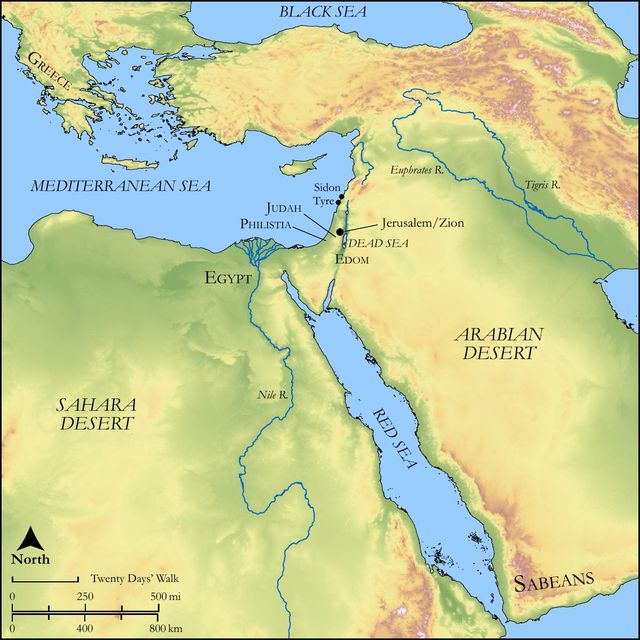
See on the biblical-era map
Study this verse
Public-domain commentary
Matthew Henry
From his Commentary on the Whole Bible. Henry comments on passages, not single verses — this entry covers Joel 1:1–7. His two-level outline is real structure in the source text, so it is rendered as structure.
It is a foolish fancy which some of the Jews have, that this Joel the prophet was the same with that Joel who was the son of Samuel (Sa1 8:2); yet one of their rabbin very gravely undertakes to show why Samuel is here called Pethuel. This Joel was long after that. He here speaks of a sad and sore judgment which was now brought, or to be brought, upon Judah, for their sins. Observe,
I.The greatness of the judgment, expressed here in two things:
- 1. It was such as could not be paralleled in the ages that were past, in history, or in the memory of any living, Joe 1:2. The old men are appealed to, who could remember what had happened long ago; nay, and all the inhabitants of the land are called on to testify, if they could any of them remember the like. Let them go further than any man's memory, and prepare themselves for the search of their fathers (Job 8:8), and they would not find an account of the like in any record. Note, Those that outdo their predecessors in sin may justly expect to fall under greater and sorer judgments than any of their predecessors knew. 2. It was such as would not be forgotten in the ages to come (Joe 1:3): "Tell you your children of it; let them know what dismal tokens of the wrath of God you have been under, that they make take warning, and may learn obedience by the things which you have suffered, for it is designed for warning to them also. Yea, let your children tell their children, and their children another generation; let them tell it not only as a strange thing, which may serve for matter of talk" (as such uncommon accidents are records in our almanacs - It is so long since the plague, and fire - so long since the great frost, and the great wind), "but let them tell it to teach their children to stand in awe of God and of his judgments, and to tremble before him." Note, We ought to transmit to posterity the memorial of God's judgments as well as of his mercies.
II.The judgment itself; it is an invasion of the country of Judea by a great army.
Many interpreters both ancient and modern understand it of armies of men, the forces of the Assyrians, which, under Sennacherib, took all the defenced cities of Judah, and then, no doubt, made havoc of the country and destroyed the products of it: nay, some make the four sorts of animals here names (Joe 1:4) to signify the four monarchies which, in their turns, were oppressive to the people of the Jews, one destroying what had escaped the fury of the other. Many of the Jewish expositors think it is a parabolic expression of the coming of enemies, and their multitude, to lay all waste. So the Chaldee paraphrast mentions these animals (Joe 1:4); but afterwards (Joe 2:25) puts instead of them, Nations, peoples, tongues, languages, potentates, and revenging kingdoms. But it seems much rather to be understood literally of armies of insects coming upon the land and eating up the fruits of it. Locusts were one of the plagues of Egypt. Of them it is said, There never were any like them, nor should be (Exo 10:14), none such as those in Egypt, none such as these in Judah - none like those locusts for bigness, none like these for multitude and the mischief they did. The plague of locusts in Egypt lasted but for a few days; this seems to have continued for four years successively (as some think), because here are four sorts of insects mentioned (Joe 1:4), one destroying what the other left; but others think they came all in one year. We are not told, in the history of the Old Testament, when this happened, but we are sure that no word of God fell to the ground; and, though a devastation by these insects is primarily intended here, yet it is expressed in such a language as is very applicable to the destruction of the country by a foreign enemy invading it, because, if the people were not humbled and reformed by that less judgment which devoured the land, God would send this greater upon them, which would devour the inhabitants; and by the description of that they are bidden to take it for a warning. If this nation of worms do not subdue them, another nation shall come to ruin them. Observe,
1.What these animals are that are sent against them - locusts and caterpillars, palmer-worms and canker-worms, Joe 1:4. We cannot now describe how these differed one from another; they were all little insects, any one of them despicable, and which a man might easily crush with his foot or with his finger; but when they came in vast swarms, or shoals, they were very formidable and ate up all before them. Note, God is Lord of hosts, has all creatures at his command, and, when he pleases, can humble and mortify a proud and rebellious people by the weakest and most contemptible creatures. Man is said to be a worm; and by this it appears that he is less than a worm, for, when God pleases, worms are too hard for him, plunder his country, eat up that for which he laboured, destroy the forage, and cut off the subsistence of a potent nation. The weaker the instrument is that God employs the more is his power magnified.
2.What fury and force they came with. They are here called a nation (Joe 1:6), because they are embodied, and act by consent, and as it were with a common design; for, though the locusts have no king, yet they go forth all of them by bands (Pro 30:27), and it is there mentioned as an instance of their wisdom. It is prudence for those that are weak severally to unite and act jointly. They are strong, for they are without number. The small dust of the balance is light, and easily blown away, but a heap of dust is weighty; so a worm can do little (yet one worm served to destroy Jonah's gourd), but numbers of them can do wonders. They are said to have teeth of a lion, of a great lion, because of the great and terrible execution they do. Note, Locusts become as lions when they come armed with a divine commission. We read of the locusts out of the bottomless pit, that their teeth were as the teeth of lions, Rev 9:8.
3.What mischief they do. They eat up all before them (Joe 1:4); what one leaves the other devours; they destroy not only the grass and corn, but the trees (Joe 1:7): The vine is laid waste. There vermin eat the leaves which should be a shelter to the fruit while it ripens, and so that also perishes and comes to nothing. They eat the very bark of the fig-tree, and so kill it. Thus the fig-tree does not blossom, nor is there fruit in the vine.
III.A call to the drunkards to lament this judgment (Joe 1:5): Awake and weep, all you drinkers of wine. This intimates,
1.That they should suffer very sensibly by this calamity. It should touch them in a tender part; the new wine which they loved so well should be cut off from their mouth. Note, It is just with God to take away those comforts which are abused to luxury and excess, to recover the corn and wine which are prepared for Baal, which are made the food and fuel of a base lust. And to them judgments of that kind are most grievous. The more men place their happiness in the gratification of sense the more pressing temporal afflictions are upon them. The drinkers of water need not to care when the vine was laid waste; they could live as well without it as they had done; it was no trouble to the Nazarites. But the drinkers of wine will weep and howl. The more delights we make necessary to our satisfaction the more we expose ourselves to trouble and disappointment.
2.It intimates that they had been very senseless and stupid under the former tokens of God's displeasure; and therefore they are here called to awake and weep. Those that will not be roused out of their security by the word of God shall be roused by his rod; those that will not be startled by judgments at a distance shall be themselves arrested by them; and when they are going to partake of the forbidden fruit a prohibition of another nature shall come between the cup and the lip, and cut off the wine from their mouth.
Historical interpretation
Historical reception
2 surviving comments on this verse. Each one is dated, so this reads as a timeline rather than a list.
Select a marker to jump to its quote. Markers stagger vertically where authors wrote within a few decades of each other.
(Verse 5.) Wake up, you drunkards, and weep and howl, all you who drink wine in sweetness, because it has perished from your mouth. LXX: Wake up, you who are drunk with your wine, and mourn and lament, all you who drink wine in intoxication, because it has been taken away from your mouth. Like old men and elders, we should listen: nothing intoxicates like disturbance of the mind. There is a sadness that leads to death: this detestable drunkenness is it. Anger is that which does not accomplish the justice of God, and is very close to madness, rendering the mind powerless: to the extent that the lips tremble, the teeth grind, and the face changes color with paleness. And rightly is that praised which Archytas of Tarentum said when he was angry with his steward: 'I would kill you now,' he said, 'if I were not angry.' Why should I mention about joy and pleasure, and especially love, which blinds the eyes of the heart: and it allows the lover to think of nothing else except that which he loves. Is drunkenness to be called freedom of the soul when, because of a cheap prostitute and a shameful part of the body, freedom of the soul inclines towards servile flattery? when it makes its own work the pleasure of another? when it prepares for future wealth through theft, crime, and perjury? and when it seems to everyone that it does not exist: as long as it possesses what it desires. But greed also blinds the mind of one who is never satisfied: and the fear of women, and the desire for sweet vices. Where it is said to them: Be watchful and wake up, you who are drunk, not with wine, as it is contained in the seventy alone, but with every disturbance of vices. Weep, and mourn, and repent, and take on the sorrow that leads to life, and howl, all you who drink wine in sweetness (Prov. III), or in drunkenness. For vices are sweet: because honey distills from the lips of a harlot woman: and therefore it is not offered in sacrifices to God: because the wine, drunkenness, and sweetness which deceived you, has perished or has been taken away from your mouth. For often, indeed, by the providence of God, those who have not known God in prosperous times come to know Him in adversity; and those who have abused wealth are corrected by a shortage of virtues. Let the elders listen to this meaning: let the inhabitants of the earth perceive with their ears the following instructions about that wine, in which there is luxury, and by which those who become intoxicated cannot possess the kingdom of God (Ephesians 5). Let the one who is asleep due to the intoxication of wine awaken and lament that they were drunk, and let them howl; so that afterwards their howling and weeping may turn into laughter, and let them rejoice in not having the material of intoxication, which had made them drunk and insane through its abundance.
What a servile mentality from a crazed brain that knows how to do nothing else but gabble. We must reply to our opponents, “You are drunken men; rouse yourselves from your cups.” Why do you do such violence to the truth? Why have you twisted the sense of the divine teachings so as to have been carried off the royal road?
Continue studying Joel 1:5 across the web’s major study libraries — every link below opens this exact verse, chapter, or book on the destination site.
Read & Compare
 BibleGatewayThis verse in more than 200 translations and 70 languages.
 Bible.comThe YouVersion reader — hundreds of translations, reading plans, and highlights.
 ESV.orgCrossway's official English Standard Version reader.
 NET BibleThe NET translation with 60,000+ translators' notes on every rendering decision.
 STEP BibleTyndale House's free study tool — original text, vocabulary, and scholarly resources.
 BibliaLogos Bible Software's free web reader.
 USCCBThe New American Bible (Revised Edition) with the U.S. bishops' study notes.
Commentaries
 BibleHub CommentariesDozens of classic commentaries on this verse, gathered on one page.
 StudyLightMore than 100 commentary sets — the largest collection on the web.
 BibleRefPlain-English commentary on what this verse means, verse by verse.
 Enduring WordDavid Guzik's free commentary on this chapter, widely used by Bible teachers.
 Bible Study ToolsVerse commentary alongside Greek and Hebrew study aids.
Original Language & Research
- BibleHub InterlinearThe verse word by word — original language, transliteration, and English.
- BibleHub LexiconEvery word's original-language definition and Strong's entry.
 Blue Letter BibleDeep-study tools — Strong's numbers, concordance, and word studies.
 SefariaThe Hebrew text with Rashi and centuries of Jewish commentary.
Sermons, Hymns & Audio


TrulyRandomVerse is not affiliated with these sites and doesn’t control their content. They’re linked because they’re genuinely useful.
Summary
Joel 1:5 delivers a potent prophetic summons to those engrossed in self-indulgence and revelry—the "drunkards" and "drinkers of wine"—commanding them to awaken from their stupor, weep, and howl. This urgent call to lamentation is provoked by the devastating loss of "new wine," a symbol of the land's prosperity and their earthly joy, which has been completely cut off, signifying a profound disruption of their accustomed pleasures and a direct consequence of divine judgment.
Context
ShowHideLiterary Context
Joel 1:5 is situated within the opening chapter of the prophet Joel's book, which vividly describes an unprecedented and catastrophic locust plague, followed by a severe drought, that has utterly devastated the land of Judah. This calamity is presented not merely as a natural disaster but as a direct act of divine judgment, a precursor to the "day of the LORD" (Joel 1:15). The preceding verses (Joel 1:2-4) establish the unparalleled nature of the destruction, urging the elders and inhabitants to consider its magnitude. Verse 5 specifically targets a segment of society—the revelers—highlighting how even their deepest earthly pleasures have been stripped away, thereby compelling a universal call to lamentation that will extend to priests, farmers, and all inhabitants in the verses that follow (Joel 1:8-13).
Historical & Cultural Context
The setting is ancient Judah, an agrarian society heavily dependent on its crops, particularly grain, new wine, and olive oil, for sustenance, economy, and celebration. "New wine" (ʻâçîyç) was a staple agricultural product and a significant source of joy, often associated with festivals and prosperity. Its abundance was seen as a blessing from God, while its absence signified hardship and divine displeasure. The act of "drinking wine" was a common cultural practice, but "drunkards" (shikkôwr) refer to those who indulged excessively, perhaps to the point of spiritual complacency or moral laxity. The call to "weep" and "howl" reflects the practice of public lamentation in Israel, a profound expression of grief and often a prelude to repentance in times of national crisis or mourning. The devastation described would have had immediate and severe economic, social, and spiritual repercussions for all levels of society.
Key Themes
ShowHideThis verse powerfully contributes to several overarching themes in Joel. Firstly, it underscores the theme of Divine Judgment and Consequence, illustrating how God uses natural calamities as instruments of correction, directly impacting even the most entrenched forms of human indulgence. The loss of the "new wine" is a tangible consequence of the plague, demonstrating God's sovereign hand in bringing about hardship to prompt a spiritual reckoning. Secondly, it embodies a profound Call to Spiritual Awakening. The imperative "Awake!" is not merely a literal command to sobriety but a spiritual imperative to shake off complacency, recognize the gravity of the unfolding crisis, and turn from oblivious self-indulgence to urgent repentance and discernment. This resonates with broader biblical calls for spiritual vigilance, such as the admonition to "wake up from your slumber" found in Romans 13:11. Lastly, the verse highlights the Loss of Joy and Sustenance. "New wine" symbolized abundance, prosperity, and joy in ancient Israel. Its absence signifies not only economic devastation but also the cessation of celebration and the deep sorrow that accompanies such loss, emphasizing that true and lasting joy cannot be found in fleeting earthly pleasures.
Exposition and Analysis
ShowHideKey Word Analysis
ShowHideThis primitive root signifies "to awake (literally or figuratively); arise, (be) (a-) wake, watch." In Joel 1:5, it functions as a sharp imperative, commanding a sudden cessation of spiritual lethargy and a forceful recognition of the dire reality. It implies a jolt from a state of unawareness or stupor, urging immediate attention to the unfolding crisis.
Derived from a root meaning "to tread out," this term refers to "must or fresh grape-juice (as just trodden out); juice, new (sweet) wine." Unlike fermented wine (yayin), ʻâçîyç specifically denotes the unfermented, freshly pressed juice, symbolizing the first fruits of the harvest and thus, the very essence of agricultural prosperity, abundance, and the joy associated with a successful yield. Its loss represents a complete disruption of the agricultural cycle and a profound blow to the nation's well-being and celebrations.
This primitive root means "to cut (off, down or asunder); by implication, to destroy or consume; specifically, to covenant." In this context, it powerfully conveys the complete and irreversible cessation or removal of the new wine. It emphasizes the finality of the loss, leaving no hope for its immediate return and underscoring the severity of the judgment that has severed this vital source of sustenance and pleasure from the people's mouths.
Verse Breakdown
ShowHide"Awake, ye drunkards, and weep;"
The prophet issues a direct, urgent, and ironic command to those most steeped in pleasure and oblivious to the crisis. The "drunkards" (shikkôwr) are called to "awake" (qûwts) from their literal and spiritual stupor, not to continue their revelry, but to engage in profound lamentation. The command to "weep" (bâkâh) signifies a deep, sorrowful response, a stark contrast to their previous state of merriment.
"and howl, all ye drinkers of wine,"
This clause reinforces the previous command through parallelism, extending the call to lamentation to "all ye drinkers of wine" (shâthâh), broadening the scope beyond just the habitually intoxicated to anyone whose life revolved around this pleasure. "Howl" (yâlal) suggests a louder, more public, and desperate cry of anguish, indicative of extreme distress and loss.
"because of the new wine;"
This phrase provides the explicit reason for the commanded lamentation. The "new wine" (ʻâçîyç), a symbol of joy, prosperity, and the fruit of the land, is the object of their loss. The reason is concrete and directly impacts their sensory experience and livelihood.
"for it is cut off from your mouth."
This final clause explains the ultimate consequence: the new wine is "cut off" (kârath), implying a complete and devastating cessation of its availability. The phrase "from your mouth" is poignant, highlighting the direct and personal impact of this loss—it is no longer available for consumption, symbolizing the end of their revelry and a profound deprivation.
Literary Devices
ShowHideJoel 1:5 employs several potent Literative Devices to convey its urgent message. The most prominent is the Imperative Mood, seen in the repeated commands "Awake," "weep," and "howl." These direct, forceful verbs create a sense of immediacy and non-negotiable urgency, demanding an abrupt shift from complacency to lamentation. Parallelism is also evident in the structure, particularly between "Awake, ye drunkards, and weep" and "howl, all ye drinkers of wine." This rhetorical technique reinforces the message by repeating it in slightly varied but synonymous phrases, broadening the target audience and intensifying the call to lament. Irony is powerfully present, as those whose lives are characterized by joy and indulgence are now commanded to express the deepest sorrow. Their usual source of pleasure, "new wine," becomes the very reason for their anguish. Finally, Symbolism is central, with "new wine" representing not just a beverage but the broader blessings of agricultural abundance, prosperity, and the associated joy and celebration. Its being "cut off" symbolizes the complete withdrawal of these blessings and the onset of divine judgment.
Theological and Thematic Connections
ShowHideJoel 1:5 serves as a profound theological statement on the nature of divine judgment and the call to repentance. It vividly illustrates that God, in His sovereignty, can withdraw blessings and disrupt human complacency to draw His people back to Himself. The loss of earthly pleasures, even those considered benign, becomes a catalyst for spiritual awakening, forcing individuals to confront their dependence on temporal comforts rather than on the Lord. This verse highlights the biblical principle that true joy and security are not found in material abundance or self-indulgence, but in a right relationship with God and obedience to His commands. The forced lamentation is a necessary step towards humility and a reorientation of priorities, demonstrating that God's discipline, though painful, is ultimately redemptive, aiming to restore His people to a state of spiritual sobriety and dependence.
Reflection and Application
ShowHideJoel 1:5 remains remarkably relevant for believers today, serving as a timeless warning against spiritual apathy and excessive indulgence in worldly pleasures. It challenges us to cultivate a posture of spiritual alertness, recognizing that our ultimate joy and security are not to be found in fleeting earthly comforts or material possessions. When blessings are withdrawn, or hardships arise in our lives, this verse calls us to examine our priorities and dependence, prompting us to ask if we have become "drunk" on the world's offerings, oblivious to God's hand at work or His call to deeper communion. The appropriate response to such divine discipline is not despair or anger, but a genuine lamentation that leads to repentance and a turning back to God. It encourages us to discern the "signs of the times" and to respond with humility and a renewed commitment to spiritual sobriety, understanding that true life and lasting satisfaction are found only in Christ.
Questions for Reflection
ShowHideFAQ
ShowHideWhat is the significance of "new wine" being "cut off" in this verse?
ShowHideThe "new wine" (ʻâçîyç) in Joel 1:5 refers to freshly pressed grape juice, symbolizing the first fruits of the harvest and, by extension, the agricultural prosperity, abundance, and joy associated with a successful yield in ancient Israel. Its being "cut off" (kârath) signifies a complete and devastating cessation of its availability. This is not merely an economic hardship but a profound spiritual blow. It represents God's direct judgment, where He withdraws the very source of the people's earthly pleasure and sustenance. This act forces them to confront their spiritual complacency and dependence on material blessings, compelling them to lament and, ideally, to turn back to the Lord. The loss of "new wine" is a tangible demonstration that their joy and security, which they had placed in earthly things, are fleeting and subject to divine intervention.
Christ-Centered Fulfillment
ShowHideJoel 1:5, with its urgent call to awaken from spiritual stupor and lament the loss of earthly pleasures, finds its ultimate Christ-centered fulfillment in the person and work of Jesus. While the "new wine" in Joel represented temporal joy and sustenance, Christ offers an eternal and superior "new wine" of the Spirit, a joy that is not dependent on earthly circumstances. Jesus Himself speaks of "new wine" requiring "new wineskins" (Matthew 9:17), symbolizing the radical new covenant and spiritual life He brings, which cannot be contained by old, rigid religious forms. The call to "awake" from a drunken stupor foreshadows the New Testament's consistent call to spiritual vigilance and sobriety in Christ (1 Peter 5:8), urging believers to live in awareness of God's kingdom rather than being dulled by worldly pursuits. Ultimately, the "cutting off" of earthly pleasures in Joel points to the truth that true satisfaction and eternal life are not found in the fleeting joys of this world but in the ultimate sacrifice of the Lamb of God who takes away the sin of the world, whose blood is the "new covenant in My blood" (Luke 22:20). He is the true source of joy and sustenance, offering living water and bread from heaven, ensuring that those who feast on Him will never hunger or thirst again (John 6:35).