


Revelation 9:8
- καὶkaiAndG2532CONJConjunction
- εἶχονeichonthey hadG2192V-IAI-3PVerb Imperfect Active Indicative 3rd Plural
- τρίχαςtrichashairG2359N-APFNoun Accusative Plural Feminine
- ὡςhōslikeG5613PRTParticle or Disjunctive
- τρίχαςtrichashairG2359N-APFNoun Accusative Plural Feminine
- γυναικῶνgunaikōnof womenG1135N-GPFNoun Genitive Plural Feminine
- καὶkaiandG2532CONJConjunction
- οἱhoitheG3588T-NPMDefinite article Nominative Plural Masculine
- ὀδόντεςodontesteethG3599N-NPMNoun Nominative Plural Masculine
- αὐτῶνautōnof themG846P-GPFPersonal pronoun Genitive Plural Feminine
- ὡςhōslike [those]G5613PRTParticle or Disjunctive
- λεόντωνleontōnof lionsG3023N-GPMNoun Genitive Plural Masculine
- ἦσανēsanwereG1510V-IAI-3PVerb Imperfect Active Indicative 3rd Plural
English is a literal word-by-word gloss of the Greek, not the KJV's wording. Why?
This is the original text the KJV's translators worked from — each Greek word with its own literal English meaning in this verse, prepared by scholars at Tyndale House, Cambridge. The KJV translates whole sentences, not word by word, so its wording differs: one Greek word can become several English words, and the KJV may choose “charity” where the gloss reads “love”. Both are faithful — they answer different questions. For the KJV's own rendering, switch to the KJV text.
Details
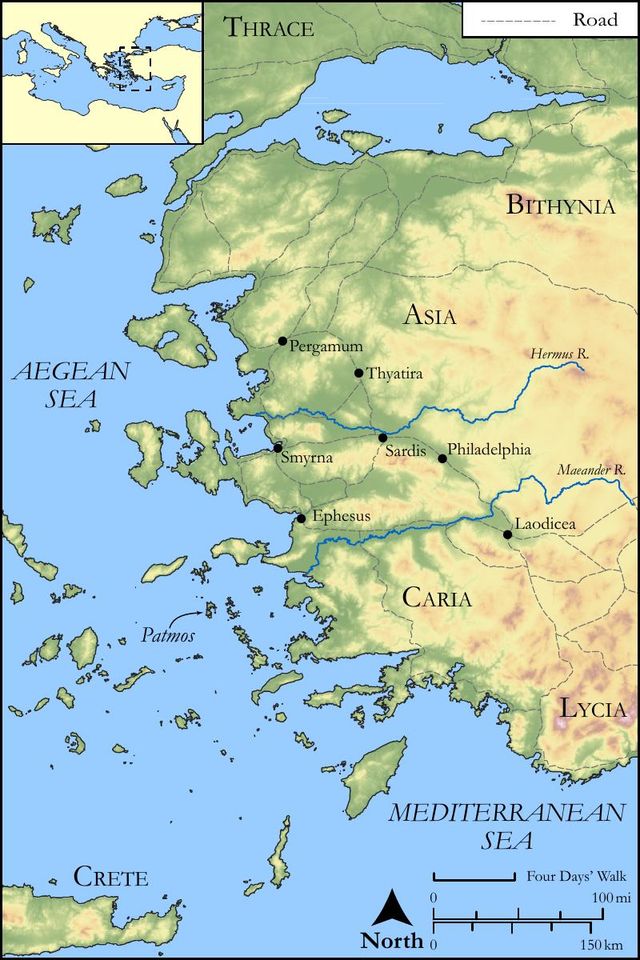
See on the biblical-era map

Study this verse
Public-domain commentary
Matthew Henry
From his Commentary on the Whole Bible. Henry comments on passages, not single verses — this entry covers Revelation 9:1–12.
Upon the sounding of this trumpet, the things to be observed are, 1. A star falling from heaven to the earth. Some think this star represents some eminent bishop in the Christian church, some angel of the church; for, in the same way of speaking by which pastors are called stars, the church is called heaven; but who this is expositors do not agree. Some understand it of Boniface the third bishop of Rome, who assumed the title of universal bishop, by the favour of the emperor Phocas, who, being a usurper and tyrant in the state, allowed Boniface to be so in the church, as the reward of his flattery. 2. To this fallen star was given the key of the bottomless pit. Having now ceased to be a minister of Christ, he becomes the antichrist, the minister of the devil; and by the permission of Christ, who had taken from him the keys of the church, he becomes the devil's turnkey, to let loose the powers of hell against the churches of Christ. 3. Upon the opening of the bottomless pit there arose a great smoke, which darkened the sun and the air. The devils are the powers of darkness; hell is the place of darkness. The devil carries on his designs by blinding the eyes of men, by extinguishing light and knowledge, and promoting ignorance and error. He first deceives men, and then destroys them; wretched souls follow him in the dark, or they durst not follow him. 4. Out of this dark smoke there came a swarm of locusts, one of the plagues of Egypt, the devil's emissaries headed by the antichrist, all the rout and rabble of antichristian orders, to promote superstition, idolatry, error, and cruelty; and these had, by the just permission of God, power to hurt those who had not the mark of God in their foreheads. 5. The hurt they were to do them was not a bodily, but a spiritual hurt. They should not in a military way destroy all by fire and sword; the trees and the grass should be untouched, and those they hurt should not be slain; it should not be a persecution, but a secret poison and infection in their souls, which should rob them of their purity, and afterwards of their peace. Heresy is a poison in the soul, working slowly and secretly, but will be bitterness in the end. 6. They had no power so much as to hurt those who had the seal of God in their foreheads. God's electing, effectual, distinguishing grace will preserve his people from total and final apostasy. 7. The power given to these factors for hell is limited in point of time: five months, a certain season, and but a short season, though how short we cannot tell. Gospel-seasons have their limits, and times of seduction are limited too. 8. Though it would be short, it would be very sharp, insomuch that those who were made to feel the malignity of this poison in their consciences would be weary of their lives, Rev 9:6. A wounded spirit who can bear? 9. These locusts were of a monstrous size and shape, Rev 9:7, Rev 9:8, etc. They were equipped for their work like horses prepared to battle. (1.) They pretended to great authority, and seemed to be assured of victory: They had crowns like gold on their heads; it was not a true, but a counterfeit authority. (2.) They had the show of wisdom and sagacity, the faces of men, though the spirit of devils. (3.) They had all the allurements of seeming beauty, to ensnare and defile the minds of men - hair like women; their way of worship was very gaudy and ornamental. (4.) Though they appeared with the tenderness of women, they had the teeth of lions, were really cruel creatures. (5.) They had the defence and protection of earthly powers - breastplates of iron. (6.) They made a mighty noise in the world; they flew about from one country to another, and the noise of their motion was like that of an army with chariots and horses. (7.) Though at first they soothed and flattered men with a fair appearance, there was a sting in their tails; the cup of their abominations contained that which, though luscious at first, would at length bite like a serpent and sting like an adder. (8.) The king and commander of this hellish squadron is here described, [1.] As an angel; so he was by nature, an angel, once one of the angels of heaven. [2.] The angel of the bottomless pit; an angel still, but a fallen angel, fallen into the bottomless pit, vastly large, and out of which there is no recovery. [3.] In these infernal regions he is a sort of prince and governor, and has the powers of darkness under his rule and command. [4.] His true name is Abaddon, Apollyon - a destroyer, for that is his business, his design, and employment, to which he diligently attends, in which he is very successful, and takes a horrid hellish pleasure; it is about this destroying work that he sends out his emissaries and armies to destroy the souls of men. And now here we have the end of one woe; and where one ends another begins.
Historical interpretation
Six Centuries of Reception
5 surviving comments on this verse. Each one is dated, so this reads as a timeline rather than a list.
Select a marker to jump to its quote. Markers stagger vertically where authors wrote within a few decades of each other.
In the image of the horses he shows the suddenness of persecution that runs around so that it might oppress the innocent and obstruct [their path] to the celestial kingdom.… We recall that it was written that upon the heads of the twenty-four elders, who were a figure of the church, there were crowns of gold. However, these [locusts] do not present a true figure of the church but one only by way of pretense, and so they are not said to have crowns of true gold but crowns similar to gold.… Likewise, they are not perfect human beings but like human beings.… And by the hair he speaks not only of the effeminacy and laxity of women, but he speaks of those from either sex who are given to wantonness and are stained by every baseness.… [By the teeth like lions’ teeth] they daily devour the church.
By the locusts prepared as horses for war he means those who originate evil teachings. For just as locusts which destroy by their mouth, so also these persons tear asunder by their preaching. It is as we read, “fierce wolves not sparing the flock.” Moreover, they are like horses running around aimlessly and so destroy in such a war many whom they lead astray.… And if false doctrine is indicated by the mouth, by the hair of women he aptly describes their effeminate morals and their souls that are open to seduction. And so the apostle says, “These are those who make their way into households and capture weak women, burdened with sins and swayed by various impulses.” By these images he suggests both leaders and those whom they have led astray, so that he shows them to be not only deceitful in their faith but also hateful in their morals. The historical record shows that some of both sexes exhibit [these characteristics]. For women gave their support to many heretics, such as Priscilla and Maximilla to Montanus and Lucilla to Donatus.… It is natural for the teeth of lions not only to mangle but also to give off a natural stench. And since [the heretics] run around like horses to acquire for themselves fleeting fame as preachers, their opinion is rightly regarded as a stench. For in a good sense the apostle said, “We are the good aroma of Christ.” This bad odor, therefore, is derived from their evil doctrine and is by comparison like the odor of a lion’s mouth.
Some have interpreted these words and those which come afterward to indicate that the locusts are angels who administer the divine punishment and who are metaphorically described through each of the various images. These images would then describe either their fearsomeness and the panic they arouse, or their swiftness, or the destruction that comes upon those worthy of condemnation in Gehenna. However, I think that the image of these locusts depicts rather evil demons who are prepared for war against us and who wear upon their heads crowns as of gold in expectation of victory against us. Whenever we submit to these demons and win an evil victory through pleasure, we believe ourselves also to be crowned with such crowns. That their hair is like that of women reveals their love of luxury and their arousal to fornication. The teeth like those of a lion signifies their murderous and poisonous character.
And the shapes of the locusts were like unto horses prepared unto battle: and on their heads were, as it were, crowns like gold. It is right for the heretics to be represented by horses because of their rapidity in running about. They are prepared unto battle against those about whom it is said in Habakkuk, Thou sentest into the sea thy horses, stirring many waters. [Hab. 3:15. acc. to LXX] However, since, by God's favor, they do not win, they are not said to have crowns, but as it were crowns, as if it were said, “They were neither crowns nor of gold, but some kind of invention of falsehood.” And their faces were as the faces of men. And they had women's hair. The faces of the locusts being like human faces mean pretense of reason. As for women's hair, it is the effeminate manners of the heretics. Alternatively, by faces of men, we may understand males; and by women's hair, the sex itself; for heretics have also had women's support. And their teeth were as of lions. The teeth of lions usually bring a natural shame; by them is indicated the stench of the heretics.
After this, the divine evangelist vividly and fearfully describes to us the nature of the worms. In each of the descriptions concerning them, one would marvel at the precision of the account; for he did not say that they had the "teeth of lions", the "tails of scorpions", or the "faces of men", but rather, in each case, he presented a figurative and parabolic representation of what was situated there, not the literal reality. Therefore, either their terrifying and astonishing nature is indicated through these images, or he truly sketched their form.
Continue studying Revelation 9:8 across the web’s major study libraries — every link below opens this exact verse, chapter, or book on the destination site.
Read & Compare
 BibleGatewayThis verse in more than 200 translations and 70 languages.
 Bible.comThe YouVersion reader — hundreds of translations, reading plans, and highlights.
 ESV.orgCrossway's official English Standard Version reader.
 NET BibleThe NET translation with 60,000+ translators' notes on every rendering decision.
 STEP BibleTyndale House's free study tool — original text, vocabulary, and scholarly resources.
 BibliaLogos Bible Software's free web reader.
 USCCBThe New American Bible (Revised Edition) with the U.S. bishops' study notes.
Commentaries
 BibleHub CommentariesDozens of classic commentaries on this verse, gathered on one page.
 StudyLightMore than 100 commentary sets — the largest collection on the web.
 BibleRefPlain-English commentary on what this verse means, verse by verse.
 Enduring WordDavid Guzik's free commentary on this chapter, widely used by Bible teachers.
 Bible Study ToolsVerse commentary alongside Greek and Hebrew study aids.
Original Language & Research
- BibleHub InterlinearThe verse word by word — original language, transliteration, and English.
- BibleHub LexiconEvery word's original-language definition and Strong's entry.
 Blue Letter BibleDeep-study tools — Strong's numbers, concordance, and word studies.
 CNTR CollationThe earliest Greek manuscripts of this verse, collated letter by letter.
Sermons, Hymns & Audio


TrulyRandomVerse is not affiliated with these sites and doesn’t control their content. They’re linked because they’re genuinely useful.
Summary
Revelation 9:8 vividly describes the appearance of the demonic "locusts" released from the bottomless pit, detailing two striking features: their hair resembling that of women and their teeth like those of lions. This verse contributes to the grotesque and terrifying imagery of these supernatural agents of divine judgment, emphasizing their unnatural hybridity, deceptive allure, and ferocious destructive capacity, all operating under God's sovereign permission to torment the unsealed inhabitants of the earth during the tribulation.
Context
ShowHideLiterary Context
Revelation 9:8 is an integral part of the detailed description of the fifth trumpet judgment, which begins in Revelation 9:1 with the opening of the bottomless pit and the release of these unique, demonic entities. The preceding verses establish their origin, their leader (Abaddon/Apollyon), and their specific mission: to torment, not kill, those who do not bear the seal of God on their foreheads for a period of five months, as outlined in Revelation 9:4-5. Verse 8, along with Revelation 9:7 and Revelation 9:9-10, paints a composite picture of these creatures, combining features from horses, men, women, lions, and scorpions, creating a monstrous and unnatural image designed to convey their terrifying nature and the severity of the torment they inflict. This detailed description serves to underscore the supernatural and malevolent character of the judgment.
Historical & Cultural Context
The imagery employed in Revelation draws heavily on Old Testament prophetic traditions and common ancient Near Eastern symbolism, yet it reconfigures them in unique ways. Locust plagues were a well-known and devastating natural disaster in the ancient world, often viewed as a divine judgment (e.g., Exodus 10:1-20). However, the locusts of Revelation 9 are clearly supernatural, not natural. The comparison to "women's hair" might evoke ideas of seductive beauty, long hair as a symbol of glory or power, or even a deceptive appearance. Lions were universally recognized symbols of strength, ferocity, and predatory power, frequently used in biblical texts to depict destructive enemies or powerful rulers (e.g., Proverbs 30:30). The hybrid nature of these creatures, combining human, animal, and insect features, resonates with ancient mythological creatures and apocalyptic visions (e.g., the beasts in Daniel 7), which often depicted composite beings to signify extraordinary power, unnaturalness, or demonic origin.
Key Themes
ShowHideThis verse contributes significantly to several overarching themes within Revelation and biblical prophecy. Firstly, it highlights the theme of Divine Judgment and Wrath, demonstrating God's sovereign use of even terrifying supernatural entities to execute His judgments upon an unrepentant world, as seen throughout Revelation 6-16. Secondly, it underscores the Nature of Spiritual Evil and Demonic Activity, portraying malevolent forces that are both powerful and deceptive, operating under a specific, divinely permitted mandate to inflict torment, as emphasized in Revelation 9:1-11. Thirdly, the grotesque, hybrid imagery reinforces the theme of Unnaturalness and Perversion, depicting creatures that defy natural order, symbolizing the chaos and distortion that characterize the period of tribulation and the influence of evil. Finally, the distinction between those who are sealed by God and those who are not, alluded to in Revelation 9:4, reinforces the theme of Divine Protection Amidst Judgment, assuring believers of God's care even in the midst of overwhelming tribulation.
Exposition and Analysis
ShowHideKey Word Analysis
ShowHideThis word refers to hair, specifically that of the head. In this context, the comparison of the locusts' hair to that of "women" is highly significant. It introduces an element of human-like appearance, but specifically feminine, which can be interpreted as an unsettling or deceptive beauty, a seductive quality, or perhaps even a symbol of effeminacy or weakness that belies their true destructive nature. The repetition of "hair as the hair" emphasizes the direct comparison.
This term simply means "a woman" or "a wife." Here, it specifies the type of hair, adding a layer of symbolic meaning to the locusts' appearance. The "hair of women" could imply an alluring or beautiful facade, contrasting sharply with their monstrous purpose. It might also suggest a deceptive softness or a perversion of natural roles, as these are fierce, tormenting creatures.
A primary word for "lion." The lion is a powerful and universally recognized symbol of strength, ferocity, and predatory behavior. The comparison of the locusts' teeth to those of lions immediately conveys their immense destructive capability and their ability to tear and devour. While their mission is torment, not death, the lion's teeth emphasize the severe, painful, and tearing nature of the affliction they inflict, indicating a predatory and relentless assault.
Verse Breakdown
ShowHide"And they had hair as the hair of women"
This clause introduces a bizarre and unsettling feature of the demonic locusts. The comparison to "women's hair" suggests an element of human-like appearance, but specifically feminine, which could imply a deceptive beauty, an alluring facade, or an unnatural softness that masks their true destructive intent. It contributes to their hybrid, monstrous nature, making them distinct from any natural creature and adding a layer of disquieting perversion to their appearance.
"and their teeth were as [the teeth] of lions"
This second clause immediately contrasts with the first, revealing the true, terrifying nature of these entities. The comparison to "lion's teeth" powerfully conveys their predatory, ferocious, and destructive capability. Lions are symbols of immense strength and the ability to tear and devour. This detail emphasizes the severe, painful, and tearing nature of the torment they are commissioned to inflict upon humanity, highlighting their brutal effectiveness in their destructive mission.
Literary Devices
ShowHideRevelation 9:8 employs several potent literary devices to convey its message. The most prominent is Simile, evident in the direct comparisons "hair as the hair of women" and "teeth were as the teeth of lions." These similes create vivid mental images by likening the unknown and supernatural to familiar earthly forms, making the bizarre more comprehensible while simultaneously highlighting its unnaturalness. Symbolism is also heavily at play: "women's hair" can symbolize deceptive beauty, allure, or even a perversion of natural order, while "lion's teeth" powerfully symbolize predatory ferocity, destructive power, and the capacity for inflicting severe pain. Furthermore, the combination of these disparate features—human (women's hair), animal (lion's teeth), and insect (the broader context of locusts)—creates a form of Chimeric Imagery or Grotesque Imagery. This hybridity underscores the supernatural, unnatural, and terrifying nature of these entities, emphasizing that they are not of this world and represent a perversion of creation, serving as agents of divine wrath.
Theological and Thematic Connections
ShowHideRevelation 9:8, with its disturbing imagery, profoundly connects to the biblical themes of divine judgment, the reality of spiritual warfare, and the nature of unrepentant humanity. The grotesque description of these demonic locusts underscores the severity of God's wrath against a world that rejects Him, revealing that His judgments can take terrifying, supernatural forms. It also serves as a stark reminder of the malevolent power of spiritual evil, which, though formidable, operates strictly under God's sovereign control and within His ordained purposes. The contrast between the deceptive appearance and the destructive capability of these creatures reflects the insidious nature of evil, which often masks its true intent. Ultimately, the passage highlights the critical distinction between those who are sealed by God and those who are not, emphasizing the protective power of faith in Christ amidst escalating global tribulation.
Reflection and Application
ShowHideRevelation 9:8, while depicting a terrifying future judgment, offers profound insights for contemporary believers. The vivid imagery of these supernatural entities reminds us that evil is not merely an abstract concept but a powerful, active force in the world, often operating with deceptive appearances. This should prompt us to cultivate spiritual discernment, recognizing that what may seem alluring or harmless on the surface can harbor destructive intent. Furthermore, the passage underscores God's absolute sovereignty, even over the most malevolent forces. These demonic agents are not unleashed chaotically but operate under divine permission and within specific boundaries, unable to harm those sealed by God. This truth provides immense comfort and assurance, reminding us that no evil, no matter how terrifying, can ultimately thwart God's purposes or overcome those who belong to Him. It calls us to live lives of faithful obedience and spiritual preparedness, trusting in God's protective hand and seeking His seal of righteousness in a world increasingly susceptible to spiritual deception and judgment.
Questions for Reflection
ShowHideFAQ
ShowHideAre the "locusts" in Revelation 9:8 literal insects or symbolic entities?
ShowHideThe "locusts" described in Revelation 9:1-11 are clearly symbolic entities, not literal insects. While they are called "locusts," their description—having human faces, women's hair, lion's teeth, breastplates of iron, and tails like scorpions—goes far beyond any natural creature. They emerge from the "bottomless pit" (Revelation 9:1), are led by a demonic king named Abaddon or Apollyon (Revelation 9:11), and their mission is to torment, not kill, those who do not have the seal of God (Revelation 9:4-5). This composite, supernatural description indicates they are demonic agents of divine judgment, representing a terrifying spiritual force unleashed upon the earth.
Christ-Centered Fulfillment
ShowHideWhile Revelation 9:8 describes agents of divine judgment and torment, its ultimate Christ-centered fulfillment lies in the absolute authority and victory of Jesus Christ over all such demonic powers and the judgment they represent. These terrifying "locusts" are unleashed from the bottomless pit, but only under the sovereign permission of God, whose plan culminates in Christ's triumph. Jesus, as the Son of God, has already disarmed and triumphed over the principalities and powers of darkness through His death and resurrection (Colossians 2:15). He is the one who holds the keys of death and Hades (Revelation 1:18), demonstrating His supreme authority over the very realm from which these creatures emerge. Furthermore, Christ's atoning sacrifice on the cross provides the only escape from the wrath and judgment symbolized by these tormenting entities. Those who are "sealed" by God and protected from their torment (Revelation 9:4) are those who have put their faith in Jesus, the Lamb of God who takes away the sin of the world (John 1:29). Ultimately, the terrifying imagery of Revelation 9:8 serves to magnify Christ as the one who will return in power and glory to execute final judgment, cast all evil into the lake of fire (Revelation 20:10), and establish His eternal kingdom where no evil can ever again torment His redeemed people (Revelation 21:4).