


Joel 1:3
Bible text: King James Version (1769 Blayney text) · Public domain
Bible text: Berean Standard Bible · Public domain
Bible text: American Standard Version (1901) · Public domain
Bible text: World English Bible, Messianic edition · Public domain
Bible text: Geneva Bible (1599) · Public domain
Bible text: Young's Literal Translation · Public domain
- עָלֶיהָ'a·Lei·haon itH5921Prep ¦ 3fsPrepositionעָלֶonיהָit
- לִבְנֵיכֶםliv·nei·Khemto your childrenH1121Prep-l ¦ N-mpc ¦ 2mpNoun Plural Masculine Constructלִtoבְנֵיchildrenכֶםyour
- סַפֵּרוּsa·Pe·rurecountH5608V-Piel-Imp-2mpVerb Piel Imperative 2nd Plural Masculine
- וּבְנֵיכֶםu·ve·nei·Khemand your childrenH1121Conj-w ¦ N-mpc ¦ 2mpNoun Plural Masculine Constructוּandבְנֵיchildrenכֶםyour
- לִבְנֵיהֶםliv·nei·Hemto their childrenH1121Prep-l ¦ N-mpc ¦ 3mpNoun Plural Masculine Constructלִtoבְנֵיchildrenהֶםtheir
- וּבְנֵיהֶםu·ve·nei·Hemand their childrenH1121Conj-w ¦ N-mpc ¦ 3mpNoun Plural Masculine Constructוּandבְנֵיchildrenהֶםtheir
- לְדוֹרle·Dorto a generationH1755Prep-l ¦ N-msNoun Singular Masculine Absoluteלְtoדוֹרa generation
- אַחֵר'a·CheranotherH312Adj-msAdjective Singular Masculine Absolute
English is a literal word-by-word gloss of the Hebrew, not the KJV's wording. Why?
This is the original text the KJV's translators worked from — each Hebrew word with its own literal English meaning in this verse, prepared by scholars at Tyndale House, Cambridge. The KJV translates whole sentences, not word by word, so its wording differs: one Hebrew word can become several English words, and the KJV may choose “the LORD” where the gloss reads “Yahweh”. Both are faithful — they answer different questions. For the KJV's own rendering, switch to the KJV text.
Details
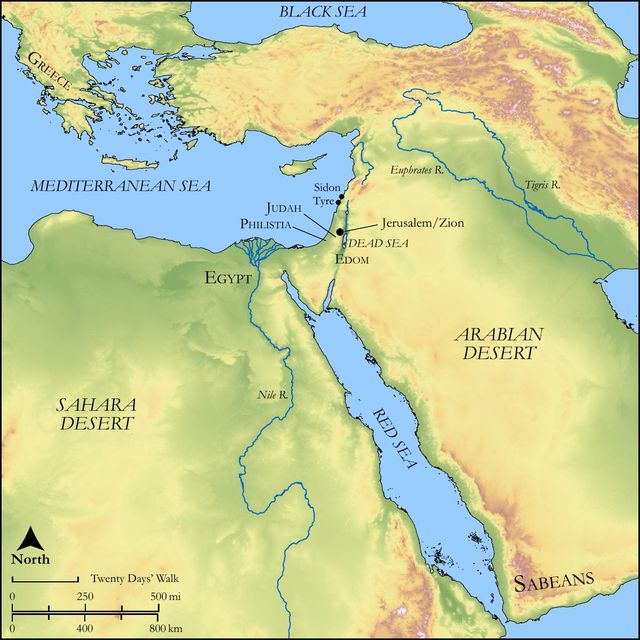
See on the biblical-era map
Study this verse
Public-domain commentary
Matthew Henry
From his Commentary on the Whole Bible. Henry comments on passages, not single verses — this entry covers Joel 1:1–7. His two-level outline is real structure in the source text, so it is rendered as structure.
It is a foolish fancy which some of the Jews have, that this Joel the prophet was the same with that Joel who was the son of Samuel (Sa1 8:2); yet one of their rabbin very gravely undertakes to show why Samuel is here called Pethuel. This Joel was long after that. He here speaks of a sad and sore judgment which was now brought, or to be brought, upon Judah, for their sins. Observe,
I.The greatness of the judgment, expressed here in two things:
- 1. It was such as could not be paralleled in the ages that were past, in history, or in the memory of any living, Joe 1:2. The old men are appealed to, who could remember what had happened long ago; nay, and all the inhabitants of the land are called on to testify, if they could any of them remember the like. Let them go further than any man's memory, and prepare themselves for the search of their fathers (Job 8:8), and they would not find an account of the like in any record. Note, Those that outdo their predecessors in sin may justly expect to fall under greater and sorer judgments than any of their predecessors knew. 2. It was such as would not be forgotten in the ages to come (Joe 1:3): "Tell you your children of it; let them know what dismal tokens of the wrath of God you have been under, that they make take warning, and may learn obedience by the things which you have suffered, for it is designed for warning to them also. Yea, let your children tell their children, and their children another generation; let them tell it not only as a strange thing, which may serve for matter of talk" (as such uncommon accidents are records in our almanacs - It is so long since the plague, and fire - so long since the great frost, and the great wind), "but let them tell it to teach their children to stand in awe of God and of his judgments, and to tremble before him." Note, We ought to transmit to posterity the memorial of God's judgments as well as of his mercies.
II.The judgment itself; it is an invasion of the country of Judea by a great army.
Many interpreters both ancient and modern understand it of armies of men, the forces of the Assyrians, which, under Sennacherib, took all the defenced cities of Judah, and then, no doubt, made havoc of the country and destroyed the products of it: nay, some make the four sorts of animals here names (Joe 1:4) to signify the four monarchies which, in their turns, were oppressive to the people of the Jews, one destroying what had escaped the fury of the other. Many of the Jewish expositors think it is a parabolic expression of the coming of enemies, and their multitude, to lay all waste. So the Chaldee paraphrast mentions these animals (Joe 1:4); but afterwards (Joe 2:25) puts instead of them, Nations, peoples, tongues, languages, potentates, and revenging kingdoms. But it seems much rather to be understood literally of armies of insects coming upon the land and eating up the fruits of it. Locusts were one of the plagues of Egypt. Of them it is said, There never were any like them, nor should be (Exo 10:14), none such as those in Egypt, none such as these in Judah - none like those locusts for bigness, none like these for multitude and the mischief they did. The plague of locusts in Egypt lasted but for a few days; this seems to have continued for four years successively (as some think), because here are four sorts of insects mentioned (Joe 1:4), one destroying what the other left; but others think they came all in one year. We are not told, in the history of the Old Testament, when this happened, but we are sure that no word of God fell to the ground; and, though a devastation by these insects is primarily intended here, yet it is expressed in such a language as is very applicable to the destruction of the country by a foreign enemy invading it, because, if the people were not humbled and reformed by that less judgment which devoured the land, God would send this greater upon them, which would devour the inhabitants; and by the description of that they are bidden to take it for a warning. If this nation of worms do not subdue them, another nation shall come to ruin them. Observe,
1.What these animals are that are sent against them - locusts and caterpillars, palmer-worms and canker-worms, Joe 1:4. We cannot now describe how these differed one from another; they were all little insects, any one of them despicable, and which a man might easily crush with his foot or with his finger; but when they came in vast swarms, or shoals, they were very formidable and ate up all before them. Note, God is Lord of hosts, has all creatures at his command, and, when he pleases, can humble and mortify a proud and rebellious people by the weakest and most contemptible creatures. Man is said to be a worm; and by this it appears that he is less than a worm, for, when God pleases, worms are too hard for him, plunder his country, eat up that for which he laboured, destroy the forage, and cut off the subsistence of a potent nation. The weaker the instrument is that God employs the more is his power magnified.
2.What fury and force they came with. They are here called a nation (Joe 1:6), because they are embodied, and act by consent, and as it were with a common design; for, though the locusts have no king, yet they go forth all of them by bands (Pro 30:27), and it is there mentioned as an instance of their wisdom. It is prudence for those that are weak severally to unite and act jointly. They are strong, for they are without number. The small dust of the balance is light, and easily blown away, but a heap of dust is weighty; so a worm can do little (yet one worm served to destroy Jonah's gourd), but numbers of them can do wonders. They are said to have teeth of a lion, of a great lion, because of the great and terrible execution they do. Note, Locusts become as lions when they come armed with a divine commission. We read of the locusts out of the bottomless pit, that their teeth were as the teeth of lions, Rev 9:8.
3.What mischief they do. They eat up all before them (Joe 1:4); what one leaves the other devours; they destroy not only the grass and corn, but the trees (Joe 1:7): The vine is laid waste. There vermin eat the leaves which should be a shelter to the fruit while it ripens, and so that also perishes and comes to nothing. They eat the very bark of the fig-tree, and so kill it. Thus the fig-tree does not blossom, nor is there fruit in the vine.
III.A call to the drunkards to lament this judgment (Joe 1:5): Awake and weep, all you drinkers of wine. This intimates,
1.That they should suffer very sensibly by this calamity. It should touch them in a tender part; the new wine which they loved so well should be cut off from their mouth. Note, It is just with God to take away those comforts which are abused to luxury and excess, to recover the corn and wine which are prepared for Baal, which are made the food and fuel of a base lust. And to them judgments of that kind are most grievous. The more men place their happiness in the gratification of sense the more pressing temporal afflictions are upon them. The drinkers of water need not to care when the vine was laid waste; they could live as well without it as they had done; it was no trouble to the Nazarites. But the drinkers of wine will weep and howl. The more delights we make necessary to our satisfaction the more we expose ourselves to trouble and disappointment.
2.It intimates that they had been very senseless and stupid under the former tokens of God's displeasure; and therefore they are here called to awake and weep. Those that will not be roused out of their security by the word of God shall be roused by his rod; those that will not be startled by judgments at a distance shall be themselves arrested by them; and when they are going to partake of the forbidden fruit a prohibition of another nature shall come between the cup and the lip, and cut off the wine from their mouth.
Historical interpretation
Historical reception
1 surviving comment on this verse from the historical church.
(Version 2, 3.) Listen to this, elders, and perceive with your ears, all inhabitants of the earth, whether this happened in your days or in the days of your fathers: tell this to your children, and let your children tell their children, and let their children tell the next generation. LXX: Listen to these things, elders, and perceive with your ears, all inhabitants of the earth, whether such things happened in your days or in the days of your fathers: tell this to your children, and let your children tell their children, and let their children tell the next generation. The elderly are ordered to listen, the inhabitants of the earth to perceive with their ears. It is not said to the elderly, 'Listen, everyone'; to the inhabitants of the earth it is added, 'Perceive with your ears, everyone.' For in the holy scriptures, hearing is not that which resonates in the ear, but that which is perceived in the heart, according to what the Lord speaks in the Gospel: 'He who has ears to hear, let him hear' (Matt. 13:9). And what we have translated as 'perceive with your ears' is the same word in Greek and Hebrew, in Greek it is ἐνωτίσασθε, in Hebrew it is Eezinu, which is properly perceived not in the heart, but in the ear. And in order that we may know that hearing is more sacred than that which resonates in the ears, let us learn from the words of Isaiah: 'Hear, O heavens, and give ear, O earth' (Isa. I, 2). The elderly, who are heavenly, hear spiritually; those who dwell on the earth, and are called earthly, hear with their ears. And this should be noted in all the Scriptures where these two words are joined together. We also read this in the case of Lamech, a sinner, who spoke to his wives Ada and Sella: 'Hear my words, O wives of Lamech, give ear to my words, for I have slain a man to my wounding, and a young man to my hurt' (Gen. IV, 23); he knew that what he spoke was obscure, and therefore he called his wives not only to the simple sound of his words, but also to the understanding of his hidden sayings. So if someone is an old man, and an old man chosen in the Lord of mature age, as we read in the following passages according to the Septuagint Interpreters, and he has left behind the infancy of little ones, let him hear what is being said. But whoever still dwells on the earth, and cannot say, “I am a stranger and a pilgrim like all my fathers” (Ps. 39:12), let him perceive with his ears. If it has happened, he says, in your days, or in the days of your fathers. The art of rhetoric, focused on the magnitude of things, captivates the listener: no age, he says, remembers these things, which have not happened in your time, nor in the time of your fathers and ancestors. But recognize the fathers, grandfathers, and great-grandfathers, and the sons of sons, and all the subsequent offspring, according to that Virgilian saying (Aeneid, Book III):
And the children of the children, and those who will be born from them:
And therefore, old men and inhabitants of the earth, tell your sons and posterity; let the old man teach his children the mysteries: let the inhabitant of the earth tell a simple story. Until this day, we who believe in Christ, from whom the veil has been taken away from our eyes together with Moses, and of whom it is said: The wisdom of an aged man is in his gray hairs (Wis. IV, 8), we narrate secret and wonderful things to our children. But the Jews who inhabit the land speak earthly things, and cling to the earth, of whom it is written: He who is of the earth speaks of the earth: He who comes from heaven is above all (John III, 31).
Continue studying Joel 1:3 across the web’s major study libraries — every link below opens this exact verse, chapter, or book on the destination site.
Read & Compare
 BibleGatewayThis verse in more than 200 translations and 70 languages.
 Bible.comThe YouVersion reader — hundreds of translations, reading plans, and highlights.
 ESV.orgCrossway's official English Standard Version reader.
 NET BibleThe NET translation with 60,000+ translators' notes on every rendering decision.
 STEP BibleTyndale House's free study tool — original text, vocabulary, and scholarly resources.
 BibliaLogos Bible Software's free web reader.
 USCCBThe New American Bible (Revised Edition) with the U.S. bishops' study notes.
Commentaries
 BibleHub CommentariesDozens of classic commentaries on this verse, gathered on one page.
 StudyLightMore than 100 commentary sets — the largest collection on the web.
 BibleRefPlain-English commentary on what this verse means, verse by verse.
 Enduring WordDavid Guzik's free commentary on this chapter, widely used by Bible teachers.
 Bible Study ToolsVerse commentary alongside Greek and Hebrew study aids.
Original Language & Research
- BibleHub InterlinearThe verse word by word — original language, transliteration, and English.
- BibleHub LexiconEvery word's original-language definition and Strong's entry.
 Blue Letter BibleDeep-study tools — Strong's numbers, concordance, and word studies.
 SefariaThe Hebrew text with Rashi and centuries of Jewish commentary.
Sermons, Hymns & Audio


TrulyRandomVerse is not affiliated with these sites and doesn’t control their content. They’re linked because they’re genuinely useful.
Summary
Joel 1:3 issues a powerful and urgent command for the intergenerational transmission of the profound lessons learned from the unprecedented locust plague and severe drought that devastated Judah. This verse underscores the critical importance of ensuring that the memory of this divine judgment, and the spiritual implications it carried, endures through successive generations, thereby shaping the spiritual heritage and identity of the people and preparing them for a proper response to God.
Context
ShowHideLiterary Context
The book of Joel opens dramatically with an immediate and catastrophic event: a locust plague of unparalleled destruction, followed by a severe drought. This dual calamity is presented not merely as a natural disaster but as a direct act of divine judgment. Joel, whose name means "the Lord is God," calls for a solemn assembly and a national lament. Before detailing the call to repentance, the prophet emphasizes the profound impact of the current suffering and the imperative to remember it. This verse is part of Joel's initial address, urging the elders and all inhabitants to recognize the uniqueness of the event and its profound spiritual implications. It sets the stage for understanding the depth of the nation's plight and the subsequent call to turn back to the Lord with all their heart.
Historical & Cultural Context
Ancient Israel was an agrarian society, making the devastation wrought by a locust plague and severe drought an existential threat, not just an economic one. Such calamities were often interpreted through a theological lens as divine judgment or a call to repentance, reflecting the covenant relationship between Yahweh and His people. In a culture heavily reliant on oral tradition for the transmission of history, law, and wisdom, the command to "tell your children" was not merely a suggestion but a foundational pedagogical imperative. This ensured that the collective memory of God's dealings, both in blessing and judgment, remained vibrant and shaped the national consciousness, reinforcing their identity as a people uniquely chosen and accountable to God.
Key Themes
ShowHideThe command in Joel 1:3 powerfully underscores the vital importance of Intergenerational Transmission, ensuring that the profound lessons of divine judgment and the need for repentance are passed down through successive generations. This imperative highlights the Power of Memory, stressing the necessity of collective remembrance so that the unique and devastating experience of the plague, as described in Joel 1:2, is internalized and serves as a perpetual reminder of God's Sovereignty and the consequences of disobedience. Ultimately, the verse speaks to the concept of a Spiritual Heritage, where the experiences and understanding of God's dealings with humanity, including His Divine Judgment, are preserved and conveyed, thereby shaping the spiritual health and identity of future generations and implicitly setting the stage for the prophet's later call to national repentance found in Joel 2.
Exposition and Analysis
ShowHideKey Word Analysis
ShowHideThis word means more than just speaking; it implies recounting, numbering, or declaring in detail. It suggests a thorough and precise narration, ensuring that the severity and implications of the event are fully grasped and accurately transmitted.
This term encompasses not only direct offspring but also descendants, youth, and even broader familial or national relationships. Its repeated use emphasizes the direct lineage through which this vital information must flow, from one generation to the next.
This refers to a revolution of time, an age, or a specific group of people living at the same time. The phrase "another generation" (with H312 ʼachêr meaning "other" or "next") stresses the perpetual, unbroken chain of transmission, extending the memory far into the future.
Verse Breakdown
ShowHide"Tell ye your children of it"
This is a direct and urgent command to the current adult generation, particularly the elders addressed in Joel 1:2. The imperative "tell" (Hebrew saphar) implies a detailed, comprehensive recounting of the unprecedented devastation caused by the locust plague and drought, ensuring that the gravity and uniqueness of the event are fully understood by the next lineage.
"and let your children tell their children"
This clause establishes the vital intergenerational chain of transmission. The responsibility is not merely for the present generation to tell their direct offspring, but for those children, in turn, to internalize the message and become active transmitters to their own descendants. This ensures the continuity of memory and spiritual understanding.
"and their children another generation"
This final phrase extends the command indefinitely, emphasizing the perpetual and unbroken nature of this oral tradition. The memory of God's powerful act, whether in judgment or deliverance, is to endure far into the future, shaping the identity and spiritual posture of every successive age.
Literary Devices
ShowHideJoel 1:3 makes powerful use of Repetition to underscore its central message. The repeated phrase "your children... their children... their children" (Hebrew bên) creates a rhythmic, insistent cadence that emphasizes the unbroken, perpetual chain of intergenerational transmission. This anaphoric structure not only highlights the continuity of the command but also the absolute necessity of its fulfillment across time. Furthermore, the Imperative Mood of "Tell ye" (Hebrew saphar) conveys the urgency and non-negotiable nature of the command, presenting it as a divine mandate rather than a mere suggestion. The verse also employs a subtle form of Chain Imagery, where each generation is a link in a continuous line, responsible for passing on the collective memory and spiritual lessons to the next, ensuring that the profound impact of God's dealings is never forgotten.
Theological and Thematic Connections
ShowHideJoel 1:3 resonates deeply with the biblical emphasis on the importance of memory and the transmission of spiritual heritage. Throughout Scripture, God consistently commands His people to remember His mighty acts, His covenant, and His laws, not merely for historical record but for the ongoing formation of their identity and faithfulness. This verse highlights that the lessons learned from divine judgment are not to be confined to one generation's experience but are to become foundational truths passed down, shaping the spiritual consciousness of all who follow. Such intergenerational instruction ensures that the knowledge of God's character, His sovereignty, and His just dealings remains vibrant, preventing spiritual amnesia and fostering a continuous posture of humility and obedience before Him.
Reflection and Application
ShowHideJoel 1:3 issues a timeless and profound challenge to every generation of believers: the imperative to actively participate in the transmission of spiritual truth and experience. In an age often marked by historical amnesia and a disconnect from past spiritual realities, this verse calls us to be diligent stewards of God's story—both His acts of grace and His just judgments. It compels us to consider not only what we believe, but how we are ensuring that those beliefs, and the experiences that shape them, are faithfully conveyed to the next generation. This involves intentional discipleship, sharing personal testimonies of God's work, teaching biblical narratives with depth, and fostering environments where spiritual wisdom can be freely passed down. Our faith is not a private possession but a sacred heritage, meant to be shared and preserved so that the knowledge of God's character and His ways endures.
Questions for Reflection
ShowHideFAQ
ShowHideWhy is intergenerational transmission of faith so critical in the biblical narrative?
ShowHideIntergenerational transmission is foundational because it ensures the continuity of God's covenant relationship with His people and prevents spiritual amnesia. By passing down the stories of God's mighty acts, His laws, and the lessons learned from both obedience and disobedience, each new generation is grounded in the collective history and identity of the faith community. This process, exemplified in Deuteronomy 6, ensures that the knowledge of God's character and His ways remains vibrant, shaping the spiritual posture and moral compass of future generations, and preparing them to respond faithfully to His ongoing work in the world.
What specific "it" is Joel commanding the people to tell their children about in this verse?
ShowHideThe "it" refers to the unprecedented and devastating locust plague and severe drought described in vivid detail throughout Joel 1. This calamity was so severe that Joel 1:2 asks if such a thing has ever happened before. Joel commands the people to recount the memory of this unique and catastrophic event, not merely as a natural disaster, but as a profound act of divine judgment that serves as a powerful lesson for all future generations.
Christ-Centered Fulfillment
ShowHideWhile Joel 1:3 commands the transmission of a specific historical judgment, its underlying principle finds its ultimate and most profound fulfillment in the Christ-centered message of the Gospel. The "it" that future generations must be told is ultimately the story of God's redemptive work culminating in Jesus Christ. Just as the ancient Israelites were to remember God's dealings, so too are believers now called to proclaim the good news of the Lamb of God who takes away the sin of the world. The New Testament church is commissioned to ensure that the story of Christ's life, death, resurrection, and ascension—the ultimate act of God's judgment on sin and His provision of salvation—is passed down "from generation to generation" (Ephesians 3:21). This eternal message, far surpassing any temporal judgment, is the ultimate spiritual heritage to be faithfully conveyed, ensuring that all peoples and all ages hear of the grace and truth that came through Jesus Christ and are called to repentance and faith in Him, the true hope for "another generation" and for all eternity.