


1 Timothy 3:11
- ΓυναῖκαςGunaikasWomenG1135N-APFNoun Accusative Plural Feminine
- ὡσαύτωςhōsautōslikewiseG5615ADVAdverb
- σεμνάςsemnas[must be] dignifiedG4586A-APFAdjective Accusative Plural Feminine
- μὴmēnotG3361PRT-NNegative Particle Negative
- διαβόλουςdiabolousslanderersG1228A-APFAdjective Accusative Plural Feminine
- νηφαλίουςnēphaliousclear-mindedG3524A-APFAdjective Accusative Plural Feminine
- πιστὰςpistasfaithfulG4103A-APFAdjective Accusative Plural Feminine
- ἐνeninG1722PREPPreposition
- πᾶσινpasinall thingsG3956A-DPNAdjective Dative Plural Neuter
English is a literal word-by-word gloss of the Greek, not the KJV's wording. Why?
This is the original text the KJV's translators worked from — each Greek word with its own literal English meaning in this verse, prepared by scholars at Tyndale House, Cambridge. The KJV translates whole sentences, not word by word, so its wording differs: one Greek word can become several English words, and the KJV may choose “charity” where the gloss reads “love”. Both are faithful — they answer different questions. For the KJV's own rendering, switch to the KJV text.
Details
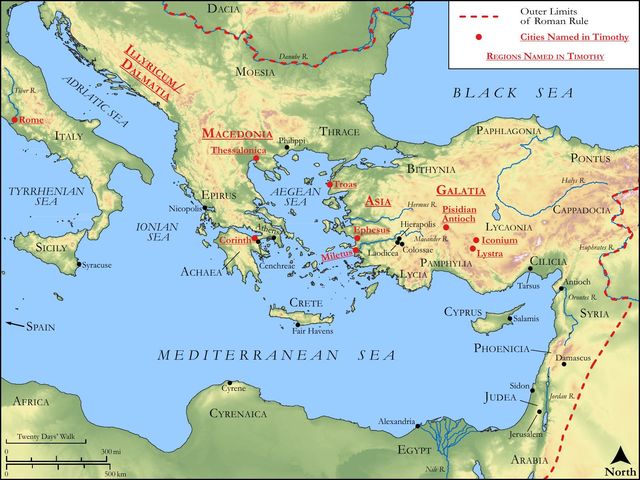
See on the biblical-era map

Study this verse
Public-domain commentary
Matthew Henry
From his Commentary on the Whole Bible. Henry comments on passages, not single verses — this entry covers 1 Timothy 3:8–13.
We have here the character of deacons: these had the care of the temporal concerns of the church, that is, the maintenance of the ministers and provision for the poor: they served tables, while the ministers or bishops gave themselves only to the ministry of the word and prayer, Act 6:2, Act 6:4. Of the institution of this office, with that which gave occasion to it, you have an account in Act 6:1-7. Now it was requisite that deacons should have a good character, because they were assistants to the ministers, appeared and acted publicly, and had a great trust reposed in them. They must be grave. Gravity becomes all Christians, but especially those who are in the office in the church. Not doubled-tongued; that will say one thing to one and another thing to another, according as their interests leads them: a double tongue comes from a double heart; flatterers and slanderers are double-tongued. Not given to much wine; for this is a great disparagement to any man, especially to a Christian, and one in office, unfits men for business, opens the door to many temptations. Not greedy of filthy lucre; this would especially be bad in the deacons, who were entrusted with the church's money, and, if they were covetous and greedy of filthy lucre, would be tempted to embezzle it, and convert that to their own use which was intended for the public service. Holding the mystery of faith in a pure conscience, Ti1 3:9. Note, The mystery of faith is best held in a pure conscience. The practical love of truth is the most powerful preservative from error and delusion. If we keep a pure conscience (take heed of every thing that debauches conscience, and draws us away from God), this will preserve in our souls the mystery of faith. Let these also first be proved, Ti1 3:10. It is not fit that the public trusts should be lodged in the hands of any, till they have been first proved, and found fit for the business they are to be entrusted with; the soundness of their judgments, their zeal for Christ, and the blamelessness of their conversation, must be proved. Their wives likewise must have a good character (Ti1 3:11); they must be of a grave behaviour, not slanderers, tale-bearers, carrying stories to make mischief and sow discord; they must be sober and faithful in all things, not given to any excess, but trusty in all that is committed to them. All who are related to ministers must double their care to walk as becomes the gospel of Christ, lest, if they in any thing walk disorderly, the ministry be blamed. As he said before of the bishops or ministers, so here of the deacons, they must be the husband of one wife, such as had not put away their wives, upon dislike, and married others; they must rule their children and their own houses well; the families of deacons should be examples to other families. And the reason why the deacons must be thus qualified is (Ti1 3:13) because, though the office of a deacon be of an inferior degree, yet it is a step towards the higher degree; and those who had served tables well the church might see cause afterwards to discharge from that service, and prefer to serve in preaching the word and in prayer. Or it may be meant of the good reputation that a man would gain by his fidelity in this office: they will purchase to themselves great boldness in the faith that is in Christ Jesus. Observe, 1. In the primitive church there were but two orders of ministers or officers, bishops and deacons, Phi 1:1. After-ages have invented the rest. The office of the bishop, presbyter, pastor, or minister, was confined to prayer and to the ministry of the word; and the office of the deacon was confined to, or at least principally conversant about, serving tables. Clemens Romanus, in his epistle to the Christian (cap. 42, 44), speaks very fully and plainly to this effect, that the apostles, foreknowing, by our Lord Jesus Christ, that there would arise in the Christian church a controversy about the name episcopacy, appointed the forementioned orders, bishops and deacons. 2. The scripture-deacon's main employment was to serve tables, and not to preach or baptize. It is true, indeed, that Philip did preach and baptize in Samaria (Acts 8), but you read that he was an evangelist (Act 21:8), and he might preach and baptize, and perform any other part of the ministerial office, under that character; but still the design of the deacon's office was to mind the temporal concerns of the church, such as the salaries of the ministers and providing for the poor. 3. Several qualifications were very necessary, even for these inferior officers: The deacons must be grave, etc. 4. Some trial should be made of persons' qualifications before they are admitted into office in the church, or have any trust committed to them: Let these also first be proved. 5. Integrity and uprightness in an inferior office are the way to be preferred to a higher station in the church: They purchase to themselves a good degree. 6. This will also give a man great boldness in the faith, whereas a want of integrity and uprightness will make a man timorous, and ready to tremble at his own shadow. The wicked fleeth when no man pursueth, but the righteous are bold as a lion, Pro 28:1.
Historical interpretation
Six Centuries of Reception
3 surviving comments on this verse. Each one is dated, so this reads as a timeline rather than a list.
Select a marker to jump to its quote. Markers stagger vertically where authors wrote within a few decades of each other.
Paul does not refer here to women deacons, since these are not allowed in the church. It is heretics who have such persons. The reference here is to women in general.
"Even so must the women be grave, not slanderers, sober, faithful in all things."
Some have thought that this is said of women generally, but it is not so, for why should he introduce anything about women to interfere with his subject? He is speaking of those who hold the rank of Deaconesses.
Women likewise must be honorable, not slanderers, but sober-minded, faithful in all things.
Women, not just any women, but deaconesses. For what did Paul wish to mention among the clergy, women of any kind?
not slanderous. What was said above: not to be double-tongued.
but sober-minded. For the female sex is not to be trusted. Therefore, one must be sober and watchful. For as much as they are more susceptible to deceits, so much so do they need sobriety.
faithful in all things. In faith and life.
Continue studying 1 Timothy 3:11 across the web’s major study libraries — every link below opens this exact verse, chapter, or book on the destination site.
Read & Compare
 BibleGatewayThis verse in more than 200 translations and 70 languages.
 Bible.comThe YouVersion reader — hundreds of translations, reading plans, and highlights.
 ESV.orgCrossway's official English Standard Version reader.
 NET BibleThe NET translation with 60,000+ translators' notes on every rendering decision.
 STEP BibleTyndale House's free study tool — original text, vocabulary, and scholarly resources.
 BibliaLogos Bible Software's free web reader.
 USCCBThe New American Bible (Revised Edition) with the U.S. bishops' study notes.
Commentaries
 BibleHub CommentariesDozens of classic commentaries on this verse, gathered on one page.
 StudyLightMore than 100 commentary sets — the largest collection on the web.
 BibleRefPlain-English commentary on what this verse means, verse by verse.
 Enduring WordDavid Guzik's free commentary on this chapter, widely used by Bible teachers.
 Bible Study ToolsVerse commentary alongside Greek and Hebrew study aids.
Original Language & Research
- BibleHub InterlinearThe verse word by word — original language, transliteration, and English.
- BibleHub LexiconEvery word's original-language definition and Strong's entry.
 Blue Letter BibleDeep-study tools — Strong's numbers, concordance, and word studies.
 CNTR CollationThe earliest Greek manuscripts of this verse, collated letter by letter.
Sermons, Hymns & Audio


TrulyRandomVerse is not affiliated with these sites and doesn’t control their content. They’re linked because they’re genuinely useful.
Summary
First Timothy 3:11 provides essential character qualifications for women closely associated with church leadership, specifically complementing the requirements for deacons. It outlines that these women, whether understood as wives of deacons or as female deacons themselves, must embody dignity, integrity of speech, self-control, and unwavering faithfulness. These virtues are presented as crucial for maintaining the church's witness and ensuring the integrity of its ministry, underscoring that the character of all involved in leadership significantly impacts the spiritual health and public perception of the Christian community.
Context
ShowHideLiterary Context
This verse is strategically placed within Paul's comprehensive instructions regarding church leadership. It immediately follows the detailed qualifications for deacons in 1 Timothy 3:8-10, creating a parallel structure that suggests a close relationship between the roles. The preceding verses establish the high moral and spiritual standards for elders (1 Timothy 3:1-7), and the subsequent verses continue to emphasize the profound nature of the church as "the pillar and ground of the truth" (1 Timothy 3:15). The inclusion of this verse highlights that the character of those supporting or serving alongside official leaders is equally vital for the church's reputation and effectiveness, ensuring a consistent standard of godliness across all levels of ministry.
Historical & Cultural Context
In the Greco-Roman world of the first century, the reputation of a household was paramount, and the character of a man's wife significantly reflected on his standing. For the nascent Christian church, which was often viewed with suspicion or misunderstanding, the exemplary conduct of its members, especially those associated with leadership, was crucial for its credibility and evangelistic outreach. While women in Roman society had varying degrees of influence, their public roles were generally more restricted than men's. However, within early Christian communities, women often played significant roles, including hospitality, teaching, and even leadership, as evidenced by figures like Phoebe, a deacon in Cenchreae (Romans 16:1-2). The specific injunctions against slander and for sobriety would have been particularly relevant in a society where gossip and intemperance could easily undermine personal and communal integrity.
Key Themes
ShowHideFirst Timothy 3:11 contributes significantly to several overarching themes in Paul's pastoral epistles. The primary theme is Exemplary Character and Integrity in Ministry, emphasizing that moral uprightness and spiritual maturity are non-negotiable for anyone associated with church leadership. This verse extends the call for blamelessness, previously applied to elders and deacons, to women in a related capacity, underscoring that the church's witness depends on the consistent conduct of all its visible members. Another key theme is the Importance of Speech, particularly the destructive power of slander, which is presented as antithetical to Christian conduct and unity. The instruction to be "not slanderers" directly addresses the potential for harmful speech to undermine the church's mission, echoing broader biblical wisdom on the tongue found in passages like James 3:5-8. Finally, the theme of Faithfulness and Dependability is highlighted, portraying a life of consistent trustworthiness as essential for effective service within the body of Christ, a virtue echoed throughout the New Testament as a mark of genuine discipleship, as seen in the parable of the talents in Matthew 25:21.
Exposition and Analysis
ShowHideKey Word Analysis
ShowHideFrom the base of ginomai (to become), this word primarily means "woman" but often specifically refers to a "wife." In this context, its translation as "wives" (KJV) or "women" (ESV, NIV) leads to scholarly debate. If "wives," it refers to the spouses of deacons, whose character is seen as integral to their husband's ministry. If "women," it could refer to women serving in a distinct diaconal role (deaconesses), indicating that they, too, must meet specific qualifications for their ministry. The broader context of qualifications for church office suggests that either interpretation requires a high standard of character for women involved in public ministry.
This powerful term, derived from diaballō (to throw across, to accuse falsely), means "traducer," "false accuser," or "slanderer." It is the same word used elsewhere in the New Testament to refer to "the Devil" or "Satan" (Matthew 4:1), highlighting the demonic nature and destructive power of malicious gossip and false accusations. The prohibition here emphasizes that such speech is utterly incompatible with Christian character and ministry, as it undermines trust, unity, and truth.
This adjective, from peithō (to persuade, to trust), means "trustworthy" (objectively) or "trustful" (subjectively). In this verse, it denotes reliability, trustworthiness, and consistency in character and conduct. To be "faithful in all things" implies a life lived with integrity, commitment, and steadfastness across all spheres of life, demonstrating a deep and abiding trust in God and a consistent adherence to Christian principles. This quality is foundational for anyone serving in or alongside the church's leadership.
Verse Breakdown
ShowHide"Even so [must their] wives [be] grave"
This phrase introduces the qualifications for women, paralleling the preceding discussion of deacons ("even so" or "likewise"). The term "grave" (Greek, semnós) signifies dignity, respectability, and seriousness of purpose. It implies a demeanor that commands honor and avoids frivolity or lightness, reflecting a mature and responsible approach to life and ministry.
"not slanderers"
This is a crucial negative qualification. As analyzed above, the Greek diábolos points to a strong prohibition against malicious gossip, false accusations, and divisive speech. It underscores the vital importance of guarding the tongue and maintaining integrity in communication, recognizing the destructive potential of unchecked words within the community.
"sober"
The Greek nēpháleos means "sober" not just in terms of abstaining from alcohol, but more broadly as being self-controlled, clear-headed, and circumspect. It implies mental alertness, sound judgment, and temperance in all aspects of life, enabling wise decision-making and a steady character.
"faithful in all things"
This comprehensive positive qualification emphasizes trustworthiness, reliability, and consistency. It means being dependable and true in every area of life—in word, deed, and commitment. This quality is essential for building trust within the church and for demonstrating the steadfastness of Christian character to the world.
Literary Devices
ShowHideThe verse employs Parallelism by mirroring the structure of the qualifications for deacons, suggesting a similar standard of character for women involved in church ministry. It uses Antithesis by explicitly contrasting desired virtues ("grave," "sober," "faithful") with an undesirable vice ("slanderers"), highlighting the stark difference between godly and ungodly conduct. The choice of the word diábolos for "slanderers" is a powerful instance of Figurative Language and Hyperbole, drawing a direct link between malicious gossip and the character of the Devil himself, thereby emphasizing the extreme seriousness of such a sin. The phrase "in all things" serves as an Amplifier, stressing the comprehensive and pervasive nature of the required faithfulness.
Theological and Thematic Connections
ShowHideFirst Timothy 3:11 profoundly reinforces the biblical emphasis on character as the bedrock of Christian life and ministry. It teaches that the integrity of the church, as God's household and the pillar of truth, is inextricably linked to the moral and spiritual health of all its members, particularly those in visible roles. The qualifications for women here, whether wives of deacons or deaconesses, are not merely social expectations but theological imperatives, reflecting the holiness and truthfulness of God Himself. The prohibition against slander highlights the sanctity of truth and the destructive nature of falsehood, aligning with God's character as one who cannot lie (Titus 1:2). The call to be "faithful in all things" echoes the divine attribute of faithfulness and calls believers to embody this attribute in their daily lives, demonstrating the reliability of God's grace and the transformative power of the Gospel.
Reflection and Application
ShowHideFirst Timothy 3:11 serves as a timeless reminder that Christian character is not merely a private affair but has profound public implications, especially for those involved in the church's ministry. For individuals, this verse calls for a deep self-examination of our demeanor, our speech, and our overall trustworthiness. Are we "grave"—displaying a dignified and serious approach to our faith and responsibilities? Do we actively guard our tongues, refraining from gossip, slander, and divisive words, recognizing the spiritual warfare inherent in such speech? Are we "sober," exercising self-control and clear-headedness in all areas of life, not just concerning substances, but in our thoughts, emotions, and decisions? And are we "faithful in all things," consistently demonstrating reliability and integrity in our commitments to God, family, church, and community? This verse challenges every believer to cultivate these virtues, understanding that our personal conduct reflects on the body of Christ and its witness to a watching world. The health and credibility of the church are built upon the consistent godliness of its members, making these qualifications relevant for all who bear the name of Christ.
Questions for Reflection
ShowHideFAQ
ShowHideDoes 1 Timothy 3:11 refer to wives of deacons or to women deacons (deaconesses)?
ShowHideThis is one of the most debated points in the interpretation of 1 Timothy 3:11. The Greek word gunaikas can mean either "women" or "wives." Arguments for "wives of deacons" point to the immediate context following the qualifications for male deacons, suggesting that their wives' character would naturally reflect on their husbands' ministry. Arguments for "women deacons" (deaconesses) note that the qualifications listed are similar in nature and structure to those for male deacons and elders, implying a distinct office. Furthermore, the New Testament does provide evidence of women serving in diaconal roles, such as Phoebe in Romans 16:1. Many scholars believe the qualifications are so specific that they apply to women who hold a recognized ministry position, whether formally called "deaconess" or serving in a similar capacity. Ultimately, regardless of the precise role, the verse emphasizes the essential character traits for women who are significantly involved in church leadership and ministry.
Why is "not slanderers" such a strong prohibition in this verse?
ShowHideThe prohibition against being "slanderers" is particularly strong because the Greek word used, diábolos, is the same term often translated as "devil" or "Satan" (Matthew 4:1). This choice of word highlights the severe and destructive nature of slander. It implies that malicious gossip, false accusation, and divisive speech are not merely minor failings but are demonic in origin and effect. Slander undermines trust, destroys reputations, creates disunity within the church, and ultimately damages the church's witness to the world. By linking slander to the very nature of the adversary, Paul underscores its profound opposition to the truth, love, and unity that should characterize God's people. This strong warning serves as a critical reminder of the power of the tongue and the importance of speaking words that build up rather than tear down, as encouraged in Ephesians 4:29.
Christ-Centered Fulfillment
ShowHideWhile 1 Timothy 3:11 outlines character qualifications for women in ministry, its ultimate fulfillment and deeper meaning are found in Christ. Jesus perfectly embodied every virtue described: He was supremely "grave" and dignified in His mission, always acting with divine authority and purpose (John 18:37). He was never a "slanderer," but rather the very embodiment of truth, exposing lies and falsehoods while speaking grace and truth (John 1:14). Christ was perfectly "sober," demonstrating absolute self-control, clear-headedness, and unwavering focus on His Father's will, even in the face of immense suffering (Luke 22:42). Above all, He was "faithful in all things," completing every aspect of His redemptive work with perfect obedience, even to death on a cross (Philippians 2:8). Believers are called to imitate Christ, and the virtues in 1 Timothy 3:11 are not merely human achievements but are fruits of the Spirit, cultivated in us as we are conformed to the image of the Son (Romans 8:29). Thus, these qualifications point us to the perfect character of our Savior, who empowers us by His Spirit to live lives that reflect His glory and bring honor to His name within the church and to the world.