


2 Timothy 3:3
Bible text: King James Version (1769 Blayney text) · Public domain
Bible text: King James Version with Strong's numbers · Public domain
Bible text: Berean Standard Bible · Public domain
Bible text: American Standard Version (1901) · Public domain
Bible text: World English Bible, Messianic edition · Public domain
Bible text: Geneva Bible (1599) · Public domain
Bible text: Young's Literal Translation · Public domain
- ἄστοργοιastorgoiunlovingG794A-NPMAdjective Nominative Plural Masculine
- ἄσπονδοιaspondoiimplacableG786A-NPMAdjective Nominative Plural Masculine
- διάβολοιdiaboloislanderousG1228A-NPMAdjective Nominative Plural Masculine
- ἀκρατεῖςakrateiswithout self-controlG193A-NPMAdjective Nominative Plural Masculine
- ἀνήμεροιanēmeroisavageG434A-NPMAdjective Nominative Plural Masculine
- ἀφιλάγαθοιaphilagathoiwithout love of goodG865A-NPMAdjective Nominative Plural Masculine
English is a literal word-by-word gloss of the Greek, not the KJV's wording. Why?
This is the original text the KJV's translators worked from — each Greek word with its own literal English meaning in this verse, prepared by scholars at Tyndale House, Cambridge. The KJV translates whole sentences, not word by word, so its wording differs: one Greek word can become several English words, and the KJV may choose “charity” where the gloss reads “love”. Both are faithful — they answer different questions. For the KJV's own rendering, switch to the KJV text.
Details
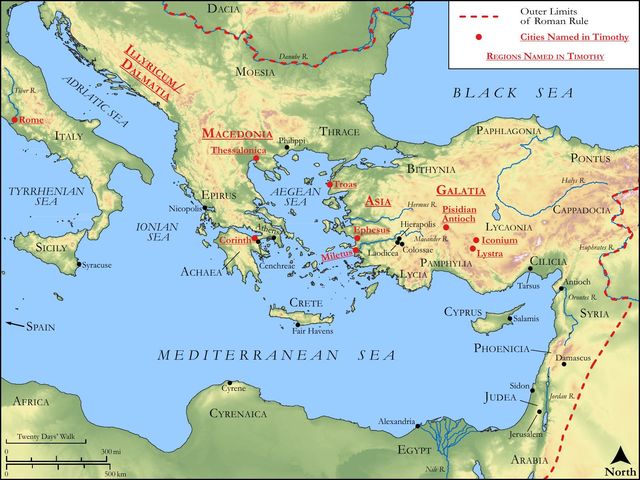
See on the biblical-era maps

Study this verse
Public-domain commentary
Matthew Henry
From his Commentary on the Whole Bible. Henry comments on passages, not single verses — this entry covers 2 Timothy 3:1–9. His three-level outline is real structure in the source text, so it is rendered as structure.
Timothy must not think it strange if there were in the church bad men; for the net of the gospel was to enclose both good fish and bad, Mat 13:47, Mat 13:48. Jesus Christ had foretold (Mt. 24) that there would come seducers, and therefore we must not be offended at it, nor think the worse of religion or the church for it. Even in gold ore there will be dross, and a great deal of chaff among the wheat when it lies on the floor.
I.Timothy must know that in the last days (Ti2 3:1), in gospel times, there would come perilous times.
Though gospel times were times of reformation in many respects, let him know that even in gospel times there would be perilous times; not so much on account of persecution from without as on account of corruptions within. These would be difficult times, wherein it would be difficult for a man to keep a good conscience. He does not say, "Perilous times shall come, for both Jews and Gentiles shall be combined to root out Christianity;" but "perilous times shall come, for such as have the form of godliness (Ti2 3:5) shall be corrupt and wicked, and do a great deal of damage to the church." Two traitors within the garrison may do more hurt to it than two thousand besiegers without. Perilous times shall come, for men shall be wicked. Note,
1.Sin makes the times perilous. When there is a general corruption of manners, and of the tempers of men, this makes the times dangerous to live in; for it is hard to keep our integrity in the midst of general corruption.
2.The coming of perilous times is an evidence of the truth of scripture-predictions; if the event in this respect did not answer to the prophecy, we might be tempted to question the divinity of the Bible.
3.We are all concerned to know this, to believe and consider it, that we may not be surprised when we see the times perilous: This know also.
II.Paul tells Timothy what would be the occasion of making these times perilous, or what shall be the marks and signs whereby these times may be known, Ti2 3:2, etc.
1.Self-love will make the times perilous. Who is there who does not love himself? But this is meant of an irregular sinful self-love. Men love their carnal selves better than their spiritual selves. Men love to gratify their own lusts, and make provision for them, more than to please God and do their duty. Instead of Christian charity, which takes care for the good of others, they will mind themselves only, and prefer their own gratification before the church's edification.
2.Covetousness. Observe, Self-love brings in a long train of sins and mischiefs. When men are lovers of themselves, no good can be expected from them, as all good may be expected from those who love God with all their hearts. When covetousness generally prevails, when every man is for what he can get and for keeping what he has, this makes men dangerous to one another, and obliges every man to stand on his guard against his neighbour.
3.Pride and vain-glory. The times are perilous when men, being proud of themselves, are boasters and blasphemers, boasters before men whom they despise and look upon with scorn, and blasphemers of God and of his name. When men do not fear God they will not regard man, and so vice vers.
4.When children are disobedient to their parents, and break through the obligations which they lie under to them both in duty and gratitude, and frequently in interest, having their dependence upon them and their expectation from them, they make the times perilous; for what wickedness will those stick at who will be abusive to their own parents and rebel against them?
5.Unthankfulness and unholiness make the times perilous, and these two commonly go together. What is the reason that men are unholy and without the fear of God, but that they are unthankful for the mercies of God? Ingratitude and impiety go together; for call a man ungrateful, and you can call him by no worse name. Unthankful, and impure, defiled with fleshly lusts, which is an instance of great ingratitude to that God who has provided so well for the support of the body; we abuse his gifts, if we make them the food and fuel of our lusts.
6.The times are perilous when men will not be held by the bonds either of nature or common honesty, when they are without natural affection, and truce-breakers, Ti2 3:3. There is a natural affection due to all. Wherever there is the human nature, there should be humanity towards those of the same nature, but especially between relations. Times are perilous when children are disobedient to their parents (Ti2 3:2) and when parents are without natural affection to their children, Ti2 3:3. See what a corruption of nature sin is, how it deprives men even of that which nature has implanted in them for the support of their own kind; for the natural affection of parents to their children is that which contributes very much to the keeping up of mankind upon the earth. And those who will not be bound by natural affection, no marvel that they will not be bound by the most solemn leagues and covenants. They are truce-breakers, that make no conscience of the engagements they have laid themselves under.
7.The times are perilous when men are false accusers one of another, diaboloi - devils one to another, having no regard to the good name of others, or to the religious obligations of an oath, but thinking themselves at liberty to say and do what they please, Psa 12:4.
8.When men have no government of themselves and their own appetites: not of their own appetites, for they are incontinent; not of their own passions, for they are fierce; when they have no rule over their own spirits, and therefore are like a city that is broken down, and has no walls; they are soon fired, upon the least provocation.
9.When that which is good and ought to be honoured is generally despised and looked upon with contempt. It is the pride of persecutors that they look with contempt upon good people, though they are more excellent than their neighbours.
10.When men are generally treacherous, wilful, and haughty, the times are perilous (Ti2 3:4) - when men are traitors, heady, high-minded. Our Saviour has foretold that the brother shall betray the brother to death and the father the child (Mat 10:21), and those are the worst sort of traitors: those who delivered up their Bibles to persecutors were called traditores, for they betrayed the trust committed to them. When men are petulant and puffed up, behaving scornfully to all about them, and when this temper generally prevails, then the times are perilous.
11.When men are generally lovers of pleasure more than lovers of God. When there are more epicures than true Christians, then the times are bad indeed. God is to be loved above all. That is a carnal mind, and is full of enmity against him, which prefers any thing before him, especially such a sordid thing as carnal pleasure is.
12.When, notwithstanding all this, they have the form of godliness (Ti2 3:5), are called by the Christian name, baptized into the Christian faith, and make a show of religion; but, how plausible soever their form of godliness is, they deny the power of it. When they take upon them the form which should and would bring along with it the power thereof, they will put asunder what God hath joined together: they will assume the form of godliness, to take away their reproach; but they will not submit to the power of it, to take away their sin. Observe here,
(1.)Men may be very bad and wicked under a profession of religion; they may be lovers of themselves, etc., yet have a form of godliness.
(2.)A form of godliness is a very different thing from the power of it; men may have the one and be wholly destitute of the other; yea, they deny it, at least practically in their lives.
(3.)From such good Christians must withdraw themselves.
III.Here Paul warns Timothy to take heed of certain seducers, not only that he might not be drawn away by them himself, but that he might arm those who were under his charge against their seduction.
1.He shows how industrious they were to make proselytes (Ti2 3:6): they applied themselves to particular persons, visited them in their houses, not daring to appear openly; for those that do evil hate the light, Joh 3:20. They were not forced into houses, as good Christians often were by persecution; but they of choice crept into houses, to insinuate themselves into the affections and good opinion of people, and so to draw them over to their party. And see what sort of people those were that they gained, and made proselytes of; they were such as were weak, silly women; and such as were wicked, laden with sins, and led away with divers lusts. A foolish head and a filthy heart make persons, especially women, an easy prey to seducers.
2.He shows how far they were from coming to the knowledge of the truth, though they pretended to be ever learning, Ti2 3:7. In one sense we must all be ever learning, that is, growing in knowledge, following on to know the Lord, pressing forward; but these were sceptics, giddy and unstable, who were forward to imbibe every new notion, under pretence of advancement in knowledge, but never came to a right understanding of the truth as it is in Jesus.
3.He foretels the certain stop that should be put to their progress (Ti2 3:8, Ti2 3:9), comparing them to the Egyptian magicians who withstood Moses, and who are here named, Jannes and Jambres; though the names are not to be met with in the story of the Old Testament, yet they are found in some old Jewish writers. When Moses came with a divine command to fetch Israel out of Egypt, these magicians opposed him. Thus those heretics resisted the truth and like them were men of corrupt minds, men who had their understandings perverted, biassed and prejudiced against the truth, and reprobate concerning the faith, or very far from being true Christians; but they shall proceed no further, or not much further, as some read it. Observe,
(1.)Seducers seek for corners, and love obscurity; for they are afraid to appear in public, and therefore creep into houses. Further, They attack those who are the least able to defend themselves, silly and wicked women.
(2.)Seducers in all ages are much alike. Their characters are the same - namely, Men of corrupt minds, etc.; their conduct is much the same - they resist the truth, as Jannes and Jambres withstood Moses; and they will be alike in their disappointment.
(3.)Those who resist the truth are guilty of folly, yea, of egregious folly; for magna est veritas, et praevalebit - Great is the truth, and shall prevail.
(4.)Though the spirit of error may be let loose for a time, God has it in a chain. Satan can deceive the nations and the churches no further and no longer than God will permit him: Their folly shall be manifest, it shall appear that they are imposters, and every man shall abandon them.
Historical interpretation
Six Centuries of Reception
4 surviving comments on this verse. Each one is dated, so this reads as a timeline rather than a list.
Select a marker to jump to its quote. Markers stagger vertically where authors wrote within a few decades of each other.
The apostle also showed how much incontinency is to be dreaded by including it among the signs of apostasy, when he said, “In the last days shall come dangerous times. Men shall be lovers of themselves.” Then, after enumerating several forms of iniquity, he adds, “slanderers, incontinent.” Also, for selling his birthright for one portion of food, Esau was charged with incontinency as the greatest of evils. The first disobedience befell men as a consequence of incontinency.
Wherefore henceforward it will be free from blame and reproach, and become clear of such wicked, deceitful, abusive, unmerciful, traitorous persons; of such as are "haters of those that are good, lovers of pleasure"
Immediately he sets down the root and fountain, whence these and all other evils spring, that is, overweeningness. He that is seized with this passion is careless even of his own interests. For when a man overlooks the concerns of his neighbor, and is careless of them, how should he regard his own? For as he that looks to his neighbor's affairs will in them order his own to advantage, so he that looks down upon his neighbor's concerns will neglect his own. For if we are members one of another, the welfare of our neighbor is not his concern only, but that of the whole body, and the injury of our neighbor is not confined to him, but distracts with pains all else as well. If we are a building, whatever part is weakened, it affects the whole, whilst that which is solid gives strength and support to the rest. So also in the Church, if thou hast slighted thy neighbor, thou hast injured thyself. How? In that one of thy own members hath suffered no small hurt. And if he, who does not impart of his possessions, goes into Hell, much more will he be condemned, who sees a neighbor suffering severer evils, and does not stretch out his hand, since in this case the loss is more grievous. "For men shall be lovers of their own selves." He that loves himself may be said not to love himself, but he that loves his brother, loves himself in the truest sense. From self-love springs covetousness. For the wretched niggardly temper of self-love contracts that love which should be widely extended, and diffused on every side. "Covetous." From covetousness springs boastfulness, from boastfulness pride, from pride blasphemy, from blasphemy defiance and disobedience. For he who exalts himself against men, will easily do it against God. Thus sins are produced. Often they ascend from below. He that is pious towards men, is still more pious towards God. He who is meek to his fellow-servants, is more meek to his Master. He that despises his fellow-servants, will end with despising God Himself.
But know this, that in the last days difficult times will come. For men will be lovers of themselves, lovers of money, boastful, proud, blasphemers, disobedient to parents, ungrateful, unholy, without natural affection, uncommitted, devilish, without self-control, brutal, despisers of good, traitors, reckless, snobbish, lovers of pleasure rather than lovers of God.
Even in the days of Moses, there were Jannes and Jambres (Ex. 7; 2 Tim. 3:8), as he says: for this is what the words about the golden and pottery vessels signify. Therefore, these types always exist, but especially in the last times.
difficult times. It is not the times or the days that are to blame, but the wicked people living in them. For we call times good or bad based on what happens in them.
lovers of themselves. This is the root of wickedness, to consider only oneself. And those who are such, neglecting their brothers, first destroy their own.
arrogant. From lovers of themselves are lovers of money. From these offspring are the boastful and the proud, then from these, blasphemers. For evil types cling to each other just as those who are good do. For all good proceeds from love.
disobedient to parents. For arrogance is known to be carried even against nature.
ungrateful. The greedy are also ungrateful. For they give thanks only when they have fulfilled their desire, but it never happens that they themselves are satisfied. But he who is such is also impious. For he who does not have gratitude towards God the Benefactor [εὐεργέτῃ2], how will he show gratitude to others?
without natural affection. Like those who are hostile towards their own.
uncommitted. It shows that they have made no agreement with anyone.
devilish. Like slanderers. For he who is conscious of no good in himself curses and slanders everyone, finding some comfort for himself in this.
without self-control. Namely those who do not control their tongue, stomach, and those things which are under the stomach.
brutal. Some are harsh and cruel.
despisers of good. That is, enemies of all things good.
traitors. One who betrays friendship and companionship.
reckless. That is, rash and having nothing stable.
snobbish. That is, full of arrogance.
lovers of pleasure rather than lovers of God. Exchanging the love of the divine for something shameful. Indeed, the very form of holiness exposes both hypocrites themselves and deceivers.
Continue studying 2 Timothy 3:3 across the web’s major study libraries — every link below opens this exact verse, chapter, or book on the destination site.
Read & Compare
 BibleGatewayThis verse in more than 200 translations and 70 languages.
 Bible.comThe YouVersion reader — hundreds of translations, reading plans, and highlights.
 ESV.orgCrossway's official English Standard Version reader.
 NET BibleThe NET translation with 60,000+ translators' notes on every rendering decision.
 STEP BibleTyndale House's free study tool — original text, vocabulary, and scholarly resources.
 BibliaLogos Bible Software's free web reader.
 USCCBThe New American Bible (Revised Edition) with the U.S. bishops' study notes.
Commentaries
 BibleHub CommentariesDozens of classic commentaries on this verse, gathered on one page.
 StudyLightMore than 100 commentary sets — the largest collection on the web.
 BibleRefPlain-English commentary on what this verse means, verse by verse.
 Enduring WordDavid Guzik's free commentary on this chapter, widely used by Bible teachers.
 Bible Study ToolsVerse commentary alongside Greek and Hebrew study aids.
Original Language & Research
- BibleHub InterlinearThe verse word by word — original language, transliteration, and English.
- BibleHub LexiconEvery word's original-language definition and Strong's entry.
 Blue Letter BibleDeep-study tools — Strong's numbers, concordance, and word studies.
 CNTR CollationThe earliest Greek manuscripts of this verse, collated letter by letter.
Sermons, Hymns & Audio


TrulyRandomVerse is not affiliated with these sites and doesn’t control their content. They’re linked because they’re genuinely useful.
Summary
Second Timothy 3:3 presents a stark portrait of moral and relational decay characteristic of the "last days," as described by the Apostle Paul. This verse enumerates a series of deeply troubling vices, including a profound absence of familial love, an ingrained unreliability in agreements, a propensity for malicious slander, a pervasive lack of self-control, a brutal and untamed disposition, and an active disdain for all that is good and virtuous. It serves as a sobering warning to Timothy and to the church throughout history, highlighting the spiritual and ethical challenges that will define the end times and emphasizing the stark contrast between worldly depravity and godly living.
Context
ShowHideLiterary Context
This verse is an integral part of Paul's urgent warning to Timothy regarding the "perilous times" (χαλεποὶ καιροί, chalepoi kairoi) that will mark the "last days" (2 Timothy 3:1). Paul begins this catalogue of vices in 2 Timothy 3:2, describing individuals as self-lovers, money-lovers, boastful, proud, blasphemers, disobedient to parents, unthankful, and unholy. Verse 3 continues this escalating list of moral degradation, moving from personal vices to those that actively disrupt social and familial bonds. The entire section from 2 Timothy 3:1-5 forms a cohesive unit, painting a comprehensive picture of the spiritual and ethical landscape believers will navigate, culminating in the warning to "turn away from such people" (2 Timothy 3:5).
Historical & Cultural Context
Paul wrote 2 Timothy during his final imprisonment in Rome, likely around 66-67 AD, facing imminent martyrdom. The letter reflects his deep concern for the future of the church and Timothy's leadership in a challenging environment. The vices listed in 2 Timothy 3:1-5 were not entirely new to the Greco-Roman world, which, despite its philosophical advancements, was rife with moral corruption, oppression, and a breakdown of traditional values. Concepts like pietas (duty to family, gods, and state) were foundational but often undermined in practice. The "trucebreakers" (áspondos) would have been particularly shocking in a culture where treaties and oaths, often sealed with libations, were sacrosanct for maintaining social order and trust. The absence of "natural affection" (ástorgos) would strike at the heart of the family unit, a cornerstone of both Roman and Jewish society. Paul's list, therefore, describes an exacerbation of existing human depravity, indicating a profound spiritual decline that would be particularly pronounced in the eschatological era.
Key Themes
ShowHideThe overarching theme of 2 Timothy 3 is the moral and spiritual degeneration that will characterize the "last days." Verse 3 specifically contributes to this by highlighting the breakdown of fundamental human relationships and societal trust. The absence of "natural affection" and the presence of "trucebreakers" speak to a profound erosion of familial bonds and contractual reliability, leading to a fragmented and unreliable society. Furthermore, the descriptions of being "fierce" and "despisers of those that are good" underscore a pervasive rejection of virtue and goodness, demonstrating an active hostility towards righteousness and those who embody it. This reflects a deep-seated spiritual rebellion against God's moral order, contrasting sharply with the call for believers to embody the fruit of the Spirit even amidst such corruption.
Exposition and Analysis
ShowHideKey Word Analysis
ShowHideThis term, derived from the Greek negative particle 'a' (meaning "not") and 'storge' (familial love), denotes a profound lack of the natural, instinctive affection that family members should have for one another. It signifies a hard-heartedness towards kindred, indicating a breakdown in the most basic and foundational human relationships. This is not merely an absence of love, but an active coldness or indifference to those with whom one should share the deepest bonds.
Literally meaning "without a libation," this word refers to those who are unwilling to enter into or keep treaties, covenants, or agreements. Libations (drink offerings) often accompanied the solemnization of treaties in the ancient world, symbolizing the binding nature of the agreement. Thus, "trucebreakers" are those who are faithless, unreliable, and treacherous, demonstrating an utter disregard for oaths and promises, thereby destroying the very fabric of trust necessary for any society.
This is the plural form of the Greek word from which we derive "devil." It describes individuals who are slanderers, malicious gossips, or traducers. Like Satan, who is the "accuser of the brethren" (Revelation 12:10), these individuals actively seek to undermine and destroy others' reputations through lies and calumny, motivated by envy and malice.
Verse Breakdown
ShowHide"Without natural affection"
This phrase describes a chilling absence of storge, the deep, instinctive love that should bind family members together. It points to a profound hardening of the heart, where basic human empathy and care for one's own kin are absent, leading to fractured homes and societal instability.
"trucebreakers"
This refers to individuals who are utterly unreliable and untrustworthy. They disregard oaths, covenants, and agreements, demonstrating a profound lack of integrity. Their word cannot be trusted, making genuine community and cooperation impossible.
"false accusers"
This denotes those who engage in malicious slander and baseless accusations. Like the devil, they seek to destroy reputations and sow discord through lies and calumny, reflecting a spirit of destructive malice rather than truth or justice.
"incontinent"
This describes a lack of self-control, an inability to restrain one's passions, desires, or impulses. It points to an unbridled nature, where individuals are slaves to their appetites and whims, leading to recklessness and moral dissolution.
"fierce"
This term signifies a savage, brutal, or untamed disposition. It indicates a lack of gentleness, humanity, or civility, suggesting a readiness to resort to violence or cruelty without compunction, reflecting an animalistic or wild nature.
"despisers of those that are good"
This phrase identifies those who actively hate, scorn, or are hostile towards virtue, righteousness, and those who embody moral excellence. It's not merely an indifference to good, but an active aversion and opposition to it, preferring wickedness and darkness.
Literary Devices
ShowHidePaul employs several powerful literary devices in this verse to emphasize the profound moral decay he describes. The entire list functions as a catalogue or vices list, a common rhetorical device in ancient literature and Pauline epistles (Romans 1:29-31). This cumulative enumeration builds a stark and overwhelming picture of depravity. Many of the terms are formed with the Greek alpha privative (e.g., ástorgos, áspondos, akratḗs, anḗmeros, aphilágathos), indicating a lack or absence of a positive quality. This repeated use of negation underscores the deficit of virtue and the inversion of godly character. The progression of vices, from the personal ("without natural affection," "incontinent") to the relational ("trucebreakers," "false accusers") and finally to a profound spiritual hostility ("despisers of those that are good"), creates a sense of escalating degeneration and antithesis to the godly character Paul consistently promotes.
Theological and Thematic Connections
ShowHideThe vices listed in 2 Timothy 3:3 are not merely social ills but deep-seated spiritual maladies, reflecting a profound alienation from God and His moral order. The absence of natural affection, the breaking of trust, the malicious slandering, the lack of self-control, the fierce brutality, and the active disdain for goodness all stem from a heart that has rejected divine love and truth. These traits stand in stark opposition to the character of God, who is love, faithfulness, and the source of all goodness. Theologically, this verse underscores the pervasive nature of human depravity when left unchecked by divine grace, illustrating the world's need for redemption and transformation. It highlights the spiritual battle between the kingdom of light and the kingdom of darkness, where the latter manifests in such destructive behaviors.
Reflection and Application
ShowHideIn a world increasingly marked by the very characteristics Paul describes in 2 Timothy 3:3, this verse serves as both a sobering warning and a powerful call to counter-cultural living for believers. We are called not to despair at the moral decline around us, but to recognize it as a sign of the times and to respond with intentionality and spiritual fortitude. This means actively cultivating the opposite virtues: demonstrating genuine, sacrificial love within our families and communities, being people of unwavering integrity and trustworthiness, speaking truth in love rather than engaging in slander, exercising diligent self-control in all areas of life, embodying gentleness and compassion, and passionately loving and pursuing all that is good and righteous. Our lives, transformed by the Gospel, are meant to be a stark contrast to the world's decay, shining as lights in the darkness and offering a tangible witness to the power of Christ to redeem and restore.
Questions for Reflection
ShowHideFAQ
ShowHideAre the characteristics in 2 Timothy 3:3 only for the "last days" or are they always present?
ShowHideWhile Paul specifically links these characteristics to the "last days" or "perilous times" (2 Timothy 3:1), it's important to understand that human sinfulness and depravity have been present throughout history. These vices are manifestations of the fallen human nature described in passages like Romans 3:10-18. What Paul suggests is that in the "last days," these negative traits will become more pervasive, pronounced, and perhaps even normalized, reaching a critical mass that signifies a profound spiritual and moral decline before Christ's return. Therefore, while the seeds of these sins are always present, their widespread and intensified manifestation is a hallmark of the end times.
Christ-Centered Fulfillment
ShowHideThe bleak picture painted in 2 Timothy 3:3, detailing a world devoid of natural affection, trust, and self-control, finds its ultimate counterpoint and fulfillment in the person and work of Jesus Christ. Where humanity is "without natural affection," Christ perfectly embodies divine love, demonstrating ultimate affection by laying down His life for His friends (John 15:13) and even for His enemies (Romans 5:8). As "trucebreakers" shatter trust, Christ is the faithful and true witness (Revelation 3:14), the very embodiment of God's covenant faithfulness, whose promises are "Yes" and "Amen" (2 Corinthians 1:20). Against "false accusers," Christ was Himself falsely accused and slandered (Matthew 26:59-60), yet He responded with truth and grace, ultimately disarming the great accuser, Satan, through His victory on the cross (Colossians 2:15). Where humanity is "incontinent" and "fierce," Christ perfectly exercised self-control and exhibited unparalleled gentleness and humility, even in the face of immense suffering (1 Peter 2:23). Finally, for those who are "despisers of those that are good," Christ is the ultimate Good Shepherd (John 10:11), the source of all goodness and righteousness, who calls His followers to love what is good and to live righteously through the power of the Holy Spirit, transforming hearts of stone into hearts of flesh (Ezekiel 36:26). Thus, Christ not only exposes the depth of human depravity but also offers the divine remedy, empowering believers to live lives that stand in stark, redemptive contrast to the darkness of the "last days."