


1 Timothy 3:12
- διάκονοιdiakonoiDeaconsG1249N-NPMNoun Nominative Plural Masculine
- ἔστωσανestōsanshould beG1510V-PAM-3PVerb Present Active Imperative 3rd Plural
- μιᾶςmiasof oneG1520A-GSFAdjective Genitive Singular Feminine
- γυναικὸςgunaikoswifeG1135N-GSFNoun Genitive Singular Feminine
- ἄνδρεςandreshusbandsG435N-NPMNoun Nominative Plural Masculine
- τέκνωνteknōn[their] childrenG5043N-GPNNoun Genitive Plural Neuter
- καλῶςkalōswellG2573ADVAdverb
- προϊστάμενοιproistamenoimanagingG4291V-PMP-NPMVerb Present Middle Participle Nominative Plural Masculine
- καὶkaiandG2532CONJConjunction
- τῶνtōn<the>G3588T-GPMDefinite article Genitive Plural Masculine
- ἰδίωνidiōn[their] ownG2398A-GPMAdjective Genitive Plural Masculine
- οἴκωνoikōnhouseholdsG3624N-GPMNoun Genitive Plural Masculine
English is a literal word-by-word gloss of the Greek, not the KJV's wording. Why?
This is the original text the KJV's translators worked from — each Greek word with its own literal English meaning in this verse, prepared by scholars at Tyndale House, Cambridge. The KJV translates whole sentences, not word by word, so its wording differs: one Greek word can become several English words, and the KJV may choose “charity” where the gloss reads “love”. Both are faithful — they answer different questions. For the KJV's own rendering, switch to the KJV text.
Details
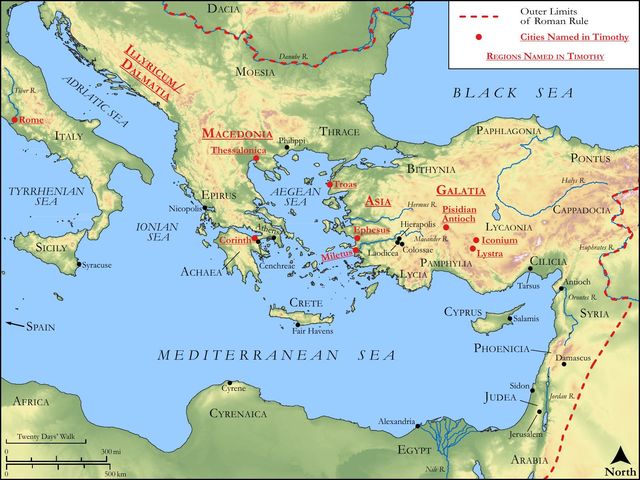
See on the biblical-era map

Study this verse
Public-domain commentary
Matthew Henry
From his Commentary on the Whole Bible. Henry comments on passages, not single verses — this entry covers 1 Timothy 3:8–13.
We have here the character of deacons: these had the care of the temporal concerns of the church, that is, the maintenance of the ministers and provision for the poor: they served tables, while the ministers or bishops gave themselves only to the ministry of the word and prayer, Act 6:2, Act 6:4. Of the institution of this office, with that which gave occasion to it, you have an account in Act 6:1-7. Now it was requisite that deacons should have a good character, because they were assistants to the ministers, appeared and acted publicly, and had a great trust reposed in them. They must be grave. Gravity becomes all Christians, but especially those who are in the office in the church. Not doubled-tongued; that will say one thing to one and another thing to another, according as their interests leads them: a double tongue comes from a double heart; flatterers and slanderers are double-tongued. Not given to much wine; for this is a great disparagement to any man, especially to a Christian, and one in office, unfits men for business, opens the door to many temptations. Not greedy of filthy lucre; this would especially be bad in the deacons, who were entrusted with the church's money, and, if they were covetous and greedy of filthy lucre, would be tempted to embezzle it, and convert that to their own use which was intended for the public service. Holding the mystery of faith in a pure conscience, Ti1 3:9. Note, The mystery of faith is best held in a pure conscience. The practical love of truth is the most powerful preservative from error and delusion. If we keep a pure conscience (take heed of every thing that debauches conscience, and draws us away from God), this will preserve in our souls the mystery of faith. Let these also first be proved, Ti1 3:10. It is not fit that the public trusts should be lodged in the hands of any, till they have been first proved, and found fit for the business they are to be entrusted with; the soundness of their judgments, their zeal for Christ, and the blamelessness of their conversation, must be proved. Their wives likewise must have a good character (Ti1 3:11); they must be of a grave behaviour, not slanderers, tale-bearers, carrying stories to make mischief and sow discord; they must be sober and faithful in all things, not given to any excess, but trusty in all that is committed to them. All who are related to ministers must double their care to walk as becomes the gospel of Christ, lest, if they in any thing walk disorderly, the ministry be blamed. As he said before of the bishops or ministers, so here of the deacons, they must be the husband of one wife, such as had not put away their wives, upon dislike, and married others; they must rule their children and their own houses well; the families of deacons should be examples to other families. And the reason why the deacons must be thus qualified is (Ti1 3:13) because, though the office of a deacon be of an inferior degree, yet it is a step towards the higher degree; and those who had served tables well the church might see cause afterwards to discharge from that service, and prefer to serve in preaching the word and in prayer. Or it may be meant of the good reputation that a man would gain by his fidelity in this office: they will purchase to themselves great boldness in the faith that is in Christ Jesus. Observe, 1. In the primitive church there were but two orders of ministers or officers, bishops and deacons, Phi 1:1. After-ages have invented the rest. The office of the bishop, presbyter, pastor, or minister, was confined to prayer and to the ministry of the word; and the office of the deacon was confined to, or at least principally conversant about, serving tables. Clemens Romanus, in his epistle to the Christian (cap. 42, 44), speaks very fully and plainly to this effect, that the apostles, foreknowing, by our Lord Jesus Christ, that there would arise in the Christian church a controversy about the name episcopacy, appointed the forementioned orders, bishops and deacons. 2. The scripture-deacon's main employment was to serve tables, and not to preach or baptize. It is true, indeed, that Philip did preach and baptize in Samaria (Acts 8), but you read that he was an evangelist (Act 21:8), and he might preach and baptize, and perform any other part of the ministerial office, under that character; but still the design of the deacon's office was to mind the temporal concerns of the church, such as the salaries of the ministers and providing for the poor. 3. Several qualifications were very necessary, even for these inferior officers: The deacons must be grave, etc. 4. Some trial should be made of persons' qualifications before they are admitted into office in the church, or have any trust committed to them: Let these also first be proved. 5. Integrity and uprightness in an inferior office are the way to be preferred to a higher station in the church: They purchase to themselves a good degree. 6. This will also give a man great boldness in the faith, whereas a want of integrity and uprightness will make a man timorous, and ready to tremble at his own shadow. The wicked fleeth when no man pursueth, but the righteous are bold as a lion, Pro 28:1.
Historical interpretation
Six Centuries of Reception
2 surviving comments on this verse. Each one is dated, so this reads as a timeline rather than a list.
Select a marker to jump to its quote. Markers stagger vertically where authors wrote within a few decades of each other.
"Let the Deacons be husbands of one wife."
This must be understood therefore to relate to Deaconesses. For that order is necessary and useful and honorable in the Church. Observe how he requires the same virtue from the Deacons, as from the Bishops, for though they were not of equal rank, they must equally be blameless; equally pure.
"Ruling their children and their own houses well."
Everywhere they are required to rule their children well, that others may not be scandalized by their misconduct.
Let deacons be the husbands of one wife, managing their children and their own households well. For those who serve well gain for themselves a good standing and great confidence in the faith that is in Christ Jesus.
husbands of one wife. You see how the same things are required from deacons as from bishops? These things must also be accepted concerning deaconesses.
managing their children and their own households well. He places this everywhere, wishing to bring the reproof upon them from home.
For those who serve well. Those who have entrusted themselves to the lesser things will quickly come to progress and boldness in Christ.
and great confidence. But who would have confidence in the faith of Christ, except the one who lives with faith and a righteous life?
Continue studying 1 Timothy 3:12 across the web’s major study libraries — every link below opens this exact verse, chapter, or book on the destination site.
Read & Compare
 BibleGatewayThis verse in more than 200 translations and 70 languages.
 Bible.comThe YouVersion reader — hundreds of translations, reading plans, and highlights.
 ESV.orgCrossway's official English Standard Version reader.
 NET BibleThe NET translation with 60,000+ translators' notes on every rendering decision.
 STEP BibleTyndale House's free study tool — original text, vocabulary, and scholarly resources.
 BibliaLogos Bible Software's free web reader.
 USCCBThe New American Bible (Revised Edition) with the U.S. bishops' study notes.
Commentaries
 BibleHub CommentariesDozens of classic commentaries on this verse, gathered on one page.
 StudyLightMore than 100 commentary sets — the largest collection on the web.
 BibleRefPlain-English commentary on what this verse means, verse by verse.
 Enduring WordDavid Guzik's free commentary on this chapter, widely used by Bible teachers.
 Bible Study ToolsVerse commentary alongside Greek and Hebrew study aids.
Original Language & Research
- BibleHub InterlinearThe verse word by word — original language, transliteration, and English.
- BibleHub LexiconEvery word's original-language definition and Strong's entry.
 Blue Letter BibleDeep-study tools — Strong's numbers, concordance, and word studies.
 CNTR CollationThe earliest Greek manuscripts of this verse, collated letter by letter.
Sermons, Hymns & Audio


TrulyRandomVerse is not affiliated with these sites and doesn’t control their content. They’re linked because they’re genuinely useful.
Summary
1 Timothy 3:12 sets forth essential qualifications for deacons within the early church, emphasizing that their personal integrity and domestic stewardship are foundational to their public ministry. This verse underscores the importance of a deacon's marital fidelity, specifically requiring them to be devoted to one spouse, and their proven ability to lead and manage their family and household effectively, thereby demonstrating their fitness for service in the broader household of God.
Context
ShowHideLiterary Context
This verse is an integral part of Paul's comprehensive instructions to Timothy regarding the organization and leadership structure of the church in Ephesus. Following his detailed outline of qualifications for overseers (elders/bishops) in 1 Timothy 3:1-7, Paul shifts his focus to the qualifications for deacons, beginning in 1 Timothy 3:8. Verse 12 specifically elaborates on the domestic requirements for deacons, mirroring the emphasis placed on household management for elders in 1 Timothy 3:4-5. The entire chapter serves to establish a robust and reputable leadership framework, ensuring that those appointed to serve are of impeccable character, both publicly and privately.
Historical & Cultural Context
The early church existed within a Greco-Roman world where polygamy was rare but not unheard of, and divorce was common, especially among the elite. Moreover, sexual immorality and fluid marital norms were prevalent. Against this backdrop, Paul's insistence on "husbands of one wife" was a counter-cultural call for marital fidelity and monogamy, setting a distinct ethical standard for Christian leaders. The concept of "ruling their children and their own houses well" also held significant cultural weight. The Roman paterfamilias (head of the household) held considerable authority and responsibility. Paul adapts this concept, emphasizing not merely authoritarian rule, but a wise, orderly, and caring management that reflects Christian virtues, serving as a public testimony to the transformative power of the Gospel.
Key Themes
ShowHideThis verse contributes significantly to several overarching themes within 1 Timothy and the broader Pauline corpus. It reinforces the theme of Church Order and Structure, providing concrete guidelines for the selection of those who would serve in official capacities, ensuring stability and spiritual health. It highlights the profound connection between Private Piety and Public Ministry, asserting that a leader's character at home directly impacts their credibility and effectiveness in the church. The requirement of being "husbands of one wife" strongly emphasizes Marital Fidelity and Sexual Purity, presenting marriage as a sacred institution and a proving ground for faithfulness. Finally, the ability to "rule their children and their own houses well" underscores the theme of Stewardship and Responsibility, viewing the household as a primary sphere where leadership skills and spiritual maturity are demonstrated before one is entrusted with the "household of God" as mentioned in 1 Timothy 3:15.
Exposition and Analysis
ShowHideKey Word Analysis
ShowHideThis term fundamentally means "an attendant," "a waiter," or "one who runs on errands." In a Christian context, it evolved to signify a "minister" or "servant" who performs specific duties, often involving practical service, administration, or teaching. Here, it refers to an appointed office within the church, distinct from overseers, yet requiring similar moral and spiritual uprightness. The emphasis is on humble service, not hierarchical power.
This word specifically denotes a male person, particularly a "man" or "husband." In the context of "husbands of one wife," it clearly refers to married men. The use of this specific term highlights the male gender of the deacons being addressed and their marital status.
This term refers to a "woman" or, more specifically in this context, a "wife." Coupled with "one" (G3391, mía), it forms the phrase "one wife," emphasizing monogamy and fidelity within the marital bond. This is not merely about marital status but about the quality and exclusivity of the marital relationship.
This verb means "to stand before," "to preside," "to manage," or "to practice." It implies active leadership, diligent oversight, and responsible care. It's not merely about exercising authority but about providing guidance, protection, and provision, ensuring order and well-being within the household. This same word is used for elders in 1 Timothy 5:17.
This word refers to a "dwelling" or "house," but by implication, it also signifies a "family" or "household." When Paul speaks of "ruling their own houses well," he encompasses not just the physical dwelling but the entire family unit—spouse, children, and potentially servants or extended family members living under the same roof. The management of this unit is a test of a deacon's leadership capacity.
This adverb means "well" or "honestly," often with a moral connotation. It suggests doing something in a proper, fitting, and commendable manner. For deacons, managing their households "well" means doing so in a way that is morally upright, orderly, and reflects Christian principles, bringing honor to God and the church.
Verse Breakdown
ShowHide"Let the deacons be the husbands of one wife"
This clause establishes a foundational requirement concerning the marital status and fidelity of deacons. It mandates that a deacon be a man committed to a single spouse, emphasizing monogamy and faithfulness within that relationship. This qualification speaks to a deacon's moral character, self-control, and ability to maintain a stable and godly household, setting him apart from the prevailing cultural norms of the day that might permit marital laxity or multiple partners. It implies not just a current marital status, but a pattern of singular devotion to one's wife.
"ruling their children and their own houses well"
This second clause extends the qualification to the deacon's broader domestic life, encompassing his role as a leader within his family. "Ruling" (Greek: proïstēmi) signifies managing, presiding over, and caring for with diligence and wisdom. This involves not only exercising proper authority over his children but also ensuring the overall order, spiritual health, and financial well-being of his entire household. The adverb "well" (Greek: kalōs) indicates that this management must be done competently, honorably, and in a manner consistent with Christian principles, demonstrating his capacity for leadership and stewardship.
Literary Devices
ShowHideThe verse primarily employs Didacticism, serving as direct instruction for church leadership selection. It also utilizes Metonymy, where the "house" or "household" stands in for the entire sphere of a person's private life and family responsibilities, implying that effective management of this private sphere is a prerequisite for public ministry. There is an element of Exemplarism, as the deacon's domestic life is presented as a model or example for the congregation, demonstrating the practical outworking of Christian principles. The phrase "husbands of one wife" functions as a Synecdoche, where a specific marital status (one wife) represents the broader concept of marital fidelity, sexual purity, and commitment within the Christian walk.
Theological and Thematic Connections
ShowHide1 Timothy 3:12 profoundly connects the private life of a leader to their public ministry, asserting that effective spiritual leadership in the church is rooted in demonstrated faithfulness and order within one's own home. This principle reflects a holistic view of sanctification, where Christian character is not compartmentalized but consistently applied across all spheres of life. The integrity of a deacon's marriage and the orderliness of their household serve as tangible proof of their spiritual maturity and their ability to manage God's household, the church. This verse underscores the biblical emphasis on the family as the primary training ground for leadership and discipleship, a microcosm where the principles of God's kingdom are first lived out and tested.
Reflection and Application
ShowHide1 Timothy 3:12 offers timeless wisdom for all believers, not just those aspiring to church leadership. It challenges us to consider the profound connection between our private lives and our public witness. Our homes are not merely places of residence but spiritual training grounds where our character is forged and tested. How we manage our relationships, raise our children, and steward our resources within our families directly reflects our commitment to Christ and our capacity for greater responsibility. This verse calls us to cultivate integrity and order in our most intimate spheres, recognizing that faithfulness in the small things prepares us for faithfulness in the large. For those in leadership, it's a sobering reminder that authenticity begins at home. For all, it's an encouragement to build strong, Christ-centered families that serve as a powerful testimony to the transforming grace of God in a chaotic world.
Questions for Reflection
ShowHideFAQ
ShowHideDoes "husbands of one wife" mean a deacon cannot be divorced or remarried?
ShowHideThe interpretation of "husbands of one wife" (Greek: mias gynaikos andra) has been a subject of ongoing debate among scholars. The phrase literally translates to "a one-woman man." While some interpretations suggest a strict prohibition against divorce and remarriage, even for biblical reasons, others understand it to mean a man who is faithful to his current wife, not polygamous, and not known for marital infidelity or promiscuity. It emphasizes marital fidelity, sexual purity, and devotion to a single spouse, setting a high standard for moral character. The primary concern is often seen as demonstrating a stable, committed, and exemplary marital life that is above reproach, rather than an absolute ban on anyone who has ever been divorced, especially in cases of biblical grounds for divorce (e.g., adultery, abandonment). The core principle is a deacon's proven faithfulness and integrity in the most intimate of human relationships, which serves as a foundation for trust in their public ministry.
Christ-Centered Fulfillment
ShowHideWhile 1 Timothy 3:12 provides specific qualifications for deacons, its underlying principles find their ultimate fulfillment and perfect embodiment in the person and work of Jesus Christ. Christ, though not a "husband of one wife" in the literal sense, perfectly demonstrated singular devotion and unwavering faithfulness to His "bride," the Church (Ephesians 5:25-27). His commitment to His Father's will and His mission to redeem humanity was absolute, mirroring the singular focus expected of a deacon. Furthermore, Jesus is the supreme example of "ruling" or managing His "house" well. He perfectly ordered His life and ministry, demonstrating impeccable stewardship of His time, resources, and relationships. He perfectly managed His disciples, teaching and guiding them, preparing them to lead the nascent church (John 17:6-19). His entire earthly life was a testament to perfect obedience, selfless service, and impeccable character, embodying the very qualities of integrity, faithfulness, and responsible leadership that Paul requires of deacons. Ultimately, deacons, by faithfully serving and managing their households well, become living illustrations of the ordered, loving, and self-sacrificial leadership that Christ Himself modeled and that He now exercises as the Head of His Church (Colossians 1:18). Their service, rooted in their well-ordered lives, points to the ultimate Servant-King who came not to be served, but to serve (Mark 10:45).