


1 Corinthians 15:40
Bible text: King James Version (1769 Blayney text) · Public domain
Bible text: King James Version with Strong's numbers · Public domain
Bible text: Berean Standard Bible · Public domain
Bible text: American Standard Version (1901) · Public domain
Bible text: World English Bible, Messianic edition · Public domain
Bible text: Geneva Bible (1599) · Public domain
Bible text: Young's Literal Translation · Public domain
- καὶkaiAndG2532CONJConjunction
- σώματαsōmatabodies [there are]G4983N-NPNNoun Nominative Plural Neuter
- ἐπουράνιαepouraniaheavenlyG2032A-NPNAdjective Nominative Plural Neuter
- καὶkaiandG2532CONJConjunction
- σώματαsōmatabodiesG4983N-NPNNoun Nominative Plural Neuter
- ἐπίγεια·epigeiaearthlyG1919A-NPNAdjective Nominative Plural Neuter
- ἀλλ᾽all᾽ButG235CONJConjunction
- ἑτέραheteraoneG2087A-NSFAdjective Nominative Singular Feminine
- μὲνmenindeedG3303PRTParticle or Disjunctive
- ἡhē[is] theG3588T-NSFDefinite article Nominative Singular Feminine
- τῶνtōnof theG3588T-GPNDefinite article Genitive Plural Neuter
- ἐπουρανίωνepouraniōnheavenlyG2032A-GPNAdjective Genitive Plural Neuter
- δόξαdoxagloryG1391N-NSFNoun Nominative Singular Feminine
- ἑτέραheteraanotherG2087A-NSFAdjective Nominative Singular Feminine
- δὲdehoweverG1161CONJConjunction
- ἡhēthatG3588T-NSFDefinite article Nominative Singular Feminine
- τῶνtōnof theG3588T-GPNDefinite article Genitive Plural Neuter
- ἐπιγείωνepigeiōnearthlyG1919A-GPNAdjective Genitive Plural Neuter
English is a literal word-by-word gloss of the Greek, not the KJV's wording. Why?
This is the original text the KJV's translators worked from — each Greek word with its own literal English meaning in this verse, prepared by scholars at Tyndale House, Cambridge. The KJV translates whole sentences, not word by word, so its wording differs: one Greek word can become several English words, and the KJV may choose “charity” where the gloss reads “love”. Both are faithful — they answer different questions. For the KJV's own rendering, switch to the KJV text.
Details
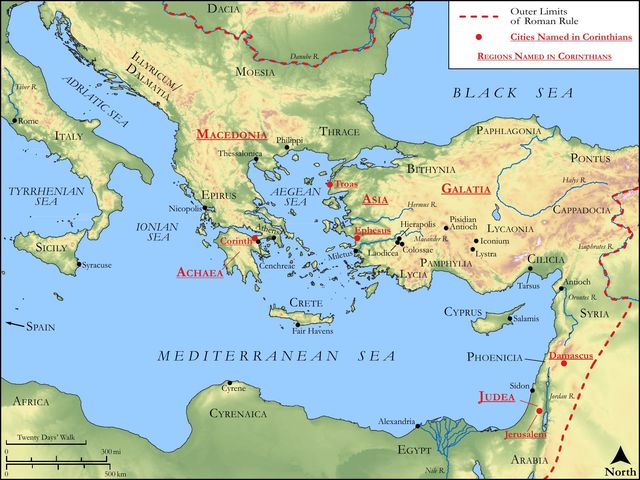
See on the biblical-era maps

Study this verse
Public-domain commentary
Matthew Henry
From his Commentary on the Whole Bible. Henry comments on passages, not single verses — this entry covers 1 Corinthians 15:35–50. His three-level outline is real structure in the source text, so it is rendered as structure.
The apostle comes now to answer a plausible and principal objection against the doctrine of the resurrection of the dead, concerning which observe the proposal of the objection: Some man will say, How are the dead raised up? And with what body do they come? Co1 15:35. The objection is plainly two-fold. How are they raised up? that is, "By what means? How can they be raised? What power is equal to this effect?" It was an opinion that prevailed much among the heathens, and the Sadducees seem to have been in the same sentiment, that it was not within the compass of divine power, mortales aeternitate donare, aut revocare defunctos - to make mortal men immortal, or revive and restore the dead. Such sort of men those seem to have been who among the Corinthians denied the resurrection of the dead, and object here, "How are they raised? How should they be raised? Is it not utterly impossible?" The other part of the objection is about the quality of their bodies, who shall rise: "With what body will they come? Will it be with the same body, with like shape, and form, and stature, and members, and qualities, or various?" The former objection is that of those who opposed the doctrine, the latter the enquiry of curious doubters.
I.To the former the apostle replies by telling them this was to be brought about by divine power, that very power which they had all observed to do something very like it, year after year, in the death and revival of the corn; and therefore it was an argument of great weakness and stupidity to doubt whether the resurrection of the dead might not be effected by the same power: Thou fool! that which thou sowest is not quickened unless it die, Co1 15:36. It must first corrupt, before it will quicken and spring up. It not only sprouts after it is dead, but it must die that it may live. And why should any be so foolish as to imagine that the man once dead cannot be made to live again, by the same power which every year brings the dead grain to life? This is the substance of the apostle's answer to the first question. Note, It is a foolish thing to question the divine power to raise the dead, when we see it every day quickening and reviving things that are dead.
II.But he is longer in replying to the second enquiry.
1.He begins by observing that there is a change made in the grain that is sown: It is not that body which shall be that is sown, but bare grain, of wheat or barley, etc.; but God gives it such a body as he will, and in such way as he will, only so as to distinguish the kinds from each other. Every seed sown has its proper body, is constituted of such materials, and figured in such a manner, as are proper to it, proper to that kind. This is plainly in the divine power, though we no more know how it is done than we know how a dead man is raised to life again. It is certain the grain undergoes a great change, and it is intimated in this passage that so will the dead, when they rise again, and live again, in their bodies, after death.
2.He proceeds hence to observe that there is a great deal of variety among others bodies, as there is among plants: as,
(1.)In bodies of flesh: All flesh is not the same; that of men is of one kind, that of beasts another, another that of fishes, and that of birds another, Co1 15:39. There is a variety in all the kinds, and somewhat peculiar in every kind, to distinguish it from the other.
(2.)In bodies celestial and terrestrial there is also a difference; and what is for the glory of one is not for the other; for the true glory of every being consists in its fitness for its rank and state. Earthly bodies are not adapted to the heavenly regions, nor heavenly bodies fitted to the condition of earthly beings. Nay,
(3.)There is a variety of glory among heavenly bodies themselves: There is one glory of the sun, and another of the moon, and another of the stars; for one star differs from another star in glory, Co1 15:41. All this is to intimate to us that the bodies of the dead, when they rise, will be so far changed, that they will be fitted for the heavenly regions, and that there will be a variety of glories among the bodies of the dead, when they shall be raised, as there is among the sun, and moon, and stars, nay among the stars themselves. All this carries an intimation along with it that it must be as easy to divine power to raise the dead, and recover their mouldered bodies, as out of the same materials to form so many different kinds of flesh and plants, and, for aught we know, celestial bodies as well as terrestrial ones. The sun and stars may, for aught we know, be composed of the same materials as the earth we tread on, though as much refined and changed by the divine skill and power. And can he, out of the same materials, form such various beings, and yet not be able to raise the dead? Having thus prepared the way, he comes,
3.To speak directly to the point: So also, says he, is the resurrection of the dead; so (as the plant growing out of the putrefied grain), so as no longer to be a terrestrial but a celestial body, and varying in glory from the other dead, who are raised, as one star does from another. But he specifies some particulars: as,
(1.)It is sown in corruption, it is raised in incorruption. It is sown. Burying the dead is like sowing them; it is like committing the seed to the earth, that it may spring out of it again. And our bodies, which are sown, are corruptible, liable to putrefy and moulder, and crumble to dust; but, when we rise, they will be out of the power of the grave, and never more be liable to corruption.
(2.)It is sown in dishonour, it is raised in glory. Ours is at present a vile body, Phi 3:21. Nothing is more loathsome than a dead body; it is thrown into the grave as a despised and broken vessel, in which there is no pleasure. But at the resurrection a glory will be put upon it; it will be made like the glorious body of our Saviour; it will be purged from all the dregs of earth, and refined into an ethereal substance, and shine out with a splendour resembling his.
(3.)It is sown in weakness, it is raised in power. It is laid in the earth, a poor helpless thing, wholly in the power of death, deprived of all vital capacities and powers, of life and strength: it is utterly unable to move or stir. But when we arise our bodies will have heavenly life and vigour infused into them; they will be hale, and firm, and durable, and lively, and liable no more to any infirmity, weakness, or decay.
(4.)It is sown a natural, or animal body, sōma psuchikon, a body fitted to the low condition and sensitive pleasures and enjoyments of this life, which are all gross in comparison of the heavenly state and enjoyments. But when we rise it will be quire otherwise; our body will rise spiritual. Not that body would be changed into spirit: this would be a contradiction in our common conceptions; it would be as much as to say, Body changed into what is not body, matter made immaterial. The expression is to be understood comparatively. We shall at the resurrection have bodies purified and refined to the last degree, made light and agile; and, though they are not changed into spirit, yet made fit to be perpetual associates of spirits made perfect. And why should it not be as much in the power of God to raise incorruptible, glorious, lively, spiritual bodies, out of the ruins of those vile, corruptible, lifeless, and animal ones, as first to make matter out of nothing, and then, out of the same mass of matter, produce such variety of beings, both in earth and heaven? To God all things are possible; and this cannot be impossible.
4.He illustrates this by a comparison of the first and second Adam: There is an animal body, says he, and there is a spiritual body; and then goes into the comparison in several instances.
(1.)As we have our natural body, the animal body we have in this world, from the first Adam, we expect our spiritual body from the second. This is implied in the whole comparison.
(2.)This is but consonant to the different characters these two persons bear: The first Adam was made a living soul, such a being as ourselves, and with a power of propagating such beings as himself, and conveying to them a nature and animal body like his own, but none other, nor better. The second Adam is a quickening Spirit; he is the resurrection and the life, Joh 11:25. He hath life in himself, and quickeneth whom he will, Joh 5:20, Joh 5:21. The first man was of the earth, made out of the earth, and was earthy; his body was fitted to the region of his abode: but the second Adam is the Lord from heaven; he who came down from heaven, and giveth life to the world (Joh 6:33); he who came down from heaven and was in heaven at the same time (Joh 3:13); the Lord of heaven and earth. If the first Adam could communicate to us natural and animal bodies, cannot the second Adam make our bodies spiritual ones? If the deputed lord of this lower creation could do the one, cannot the Lord from heaven, the Lord of heaven and earth, do the other?
(3.)We must first have natural bodies from the first Adam before we can have spiritual bodies from the second (Co1 15:49); we must bear the image of the earthy before we can bear the image of the heavenly. Such is the established order of Providence. We must have weak, frail, mortal bodies by descent from the first Adam, before we can have lively, spiritual, and immortal ones by the quickening power of the second. We must die before we can live to die no more.
(4.)Yet if we are Christ's, true believers in him (for this whole discourse relates to the resurrection of the saints), it is as certain that we shall have spiritual bodies as it is now that we have natural or animal ones. By these we are as the first Adam, earthy, we bear his image; by those we shall be as the second Adam, have bodies like his own, heavenly, and so bear him image. And we are as certainly intended to bear the one as we have borne the other. As surely therefore as we have had natural bodies, we shall have spiritual ones. The dead in Christ shall not only rise, but shall rise thus gloriously changed.
5.He sums up this argument by assigning the reason of this change (Co1 15:50): Now this I say that flesh and blood cannot inherit the kingdom of God; nor doth corruption inherit incorruption. The natural body is flesh and blood, consisting of bones, muscles, nerves, veins, arteries, and their several fluids; and, as such, it is of a corruptible frame and form, liable to dissolution, to rot and moulder. But no such thing shall inherit the heavenly regions; for this were for corruption to inherit incorruption, which is little better than a contradiction in terms. The heavenly inheritance is incorruptible, and never fadeth away, Pe1 1:4. How can this be possessed by flesh and blood, which is corruptible and will fade away? It must be changed into ever-during substance, before it can be capable of possessing the heavenly inheritance. The sum is that the bodies of the saints, when they shall rise again, will be greatly changed from what they are now, and much for the better. They are now corruptible, flesh and blood; they will be then incorruptible, glorious, and spiritual bodies, fitted to the celestial world and state, where they are ever afterwards to dwell, and have their eternal inheritance.
Historical interpretation
Seventeen Centuries of Reception
8 surviving comments on this verse. Each one is dated, so this reads as a timeline rather than a list.
Select a marker to jump to its quote. Markers stagger vertically where authors wrote within a few decades of each other.
In like manner, those also who after Him are heavenly, are understood to have this celestial quality predicated of them not from their present nature, but from their future glory; because in a preceding sentence, which originated this distinction respecting difference of dignity, there was shown to be "one glory in celestial bodies, and another in terrestrial ones," -"one glory of the sun, and another glory of the moon, and another glory of the stars: for even one star differeth from another star in glory, " although not in substance.
Even among earthly bodies there are no small differences. Take the human race, for example. Some are Greeks and some are barbarians, and among the barbarians, some are wilder than others. Some have higher laws. Some lower ones, and some follow savage customs which are not laws at all.
That no one should be made sad by death; since in living is labour and peril, in dying peace and the certainty of resurrection. In Genesis: "Then said the Lord to Adam, Because thou hast hearkened to the voice of thy wife, and hast eaten of that tree of which alone I commanded thee that thou shouldest not eat, cursed shall be the ground in all thy works; in sadness and groaning shalt thou eat of it all the days of thy life: thorns and thistles shall it cast forth to thee; and thou shalt eat the herb of the field in the sweat of thy brow. Thou shall eat thy bread until thou return unto the earth from which also thou wast taken; because earth thou art, and to earth thou shall go." Also in the same place: "And Enoch pleased God, and was not found afterwards: because God translated him." And in Isaiah: "All flesh is grass, and all the glory of it as the flower of grass. The grass withered, and the flower hath fallen away; but the word of the Lord abideth for ever." In Ezekiel: "They say, Our bones are become dry, our hope hath perished: we have expired. Therefore prophesy, and say, Thus saith the Lord, Behold, I open your monuments, and I will bring you forth from your monuments, and I will bring you into the land of Israel; and I will put my Spirit upon you, and ye shall live; and I will place you into your land: and ye shall know that I the Lord have spoken, and will do it, saith the Lord." Also in the Wisdom of Solomon: "He was taken away, lest wickedness should change his understanding; for his soul was pleasing to God." Also in the eighty-third Psalm: "How beloved are thy dwellings, Thou Lord of hosts? My soul desires and hastes to the courts of God." And in the Epistle of Paul to the Thessalonians: "But we would not that you should be ignorant, brethren, concerning those who sleep, that ye sorrow not as others which have no hope. For if we believe that Jesus died and rose again, so also them which have fallen asleep in Jesus will God bring with Him." Also in the first Epistle to the Corinthians: "Thou fool, that which thou sowest is not quickened except it have first died." And again: "Star differeth from star in glory: so also the resurrection. The body is sown in corruption, it rises without corruption; it is sown in ignominy, it rises again in glory; it is sown in weakness, it rises again in power; it is sown an animal body, it rises again a spiritual body." And again: "For this corruptible must put on incorruption, and this mortal put on immortality. But when this corruptible shall have put on incorruption, and this mortal shall have put on immortality, then shall come to pass the word that is written, Death is absorbed Into striving. Where, O death, is thy sting? Where, O death, is thy striving? " Also in the Gospel according to John: "Father, I will that those whom Thou hast given me be with me where I shall be, and may see my glory which Thou hast given me before the foundation of the world." Also according to Luke: "Now lettest Thou Thy servant depart in peace, O Lord, according to the word; for mine eyes have seen Thy salvation." Also according to John: "If ye loved me, ye would rejoice because I go to the Father; for the Father is greater than I."
"There are also celestial bodies, and bodies terrestrial; but the glory of the celestial is one, and the glory of the terrestrial is another."
"There is one glory of the sun, and another glory of the moon, and another glory of the stars: for one star differeth from another star in glory."
And what means he by these expressions? Wherefore from the resurrection of the body did he throw himself into the discourse of the stars and the sun? He did not throw himself out, neither did he break off from his purpose; far from it: but he still keeps to it. For whereas he had established the doctrine concerning the resurrection, he intimates in what follows that great will be then the difference of glory, though there be but one resurrection. And for the present he divides the whole into two: into "bodies celestial," and "bodies terrestrial." For that the bodies are raised again, he signified by the corn: but that they are not all in the same glory, he signifies by this. For as the disbelief of the resurrection makes men supine, so again it makes them indolent to think that all are vouchsafed the same reward. Wherefore he corrects both. And the one in the preceding verses he had completed; but this he begins now. And having made two ranks, of the righteous and of sinners, these same two he subdivides again into many parts, signifying that neither righteous nor sinners shall obtain the same; neither righteous men, all of them, alike with other righteous, nor sinners with other sinners.
Now he makes, you see, first, one separation between righteous and sinners, where he says, "bodies celestial, and bodies terrestrial:" by the "terrestrial" intimating the latter, and by the "celestial," the former. Then farther he introduces a difference of sinners from sinners, saying, "All flesh is not the same flesh, but there is one flesh of fishes, another of birds, and another of beasts." And yet all are bodies; but some are in more, and some in lesser vileness. And that in their manner of living too, and in their very constitution.
And having said this, he ascends again to the heaven, saying, "There is one glory of the sun, and another glory of the moon." For as in the earthly bodies there is a difference, so also in the heavenly; and that difference no ordinary one, but reaching even to the uttermost: there being not only a difference between sun and moon, and stars, but also between stars and stars. For what though they be all in the heaven? yet some have a larger, others a less share of glory. What do we learn from hence? That although they be all in God's kingdom, all shall not enjoy the same reward; and though all sinners be in hell, all shall not endure the same punishment.
If God could make the sun, moon and stars, what problem will he have in making new bodies for us?
If any man does not believe that common flesh can be changed into a nature of this sort, he is to be convinced toward faith by gradual steps. If you ask them whether earth can be changed into water, that will not seem to him incredible because there is no great distance between these two elements. Again if you ask whether water can be changed into air, he will agree that that is not absurd because these two elements are close neighbors.
Porphyry says: “You praise the body to me without good reasons. No matter what kind of body it is, you must escape from it if you wish to be happy.” Philosophers say this, but they are wrong. They are raving.… I read your books where you say that the world is animated, that the heavens, the earth, the seas, all the huge bodies which exist, all the immense elements of all times, this whole universal body which consists of all these elements—all this, you say, is a vast living thing and has its own soul. But you claim that it does not have the senses of the body because outside of it there is nothing which can be perceived. Nevertheless you say it has intelligence, and that it leads to God, and that the soul of the world is called Jupiter.… You claim that the same world is eternal, that it will always exist, that it will not have an end. If then the world is eternal and remains without any end, if this world is a living thing and if its soul is always held in the world, then as a matter of fact, must we then flee every kind of body?
The second class of miracles, on this view, foretell what God has not yet done, but will do, universally. He raised one man (the man who was Himself) from the dead because He will one day raise all men from the dead. Perhaps not only men, for there are hints in the New Testament that all creation will eventually be rescued from decay, restored to shape and subserve the splendour of re-made humanity. The Transfiguration and the walking on the water are glimpses of the beauty and the effortless power over all matter which will belong to men when they are really waked by God. Now resurrection certainly involves “reversal” of natural process in the sense that it involves a series of changes moving in the opposite direction to those we see. At death, matter which has been organic, falls back gradually into the inorganic, to be finally scattered and used perhaps in other organisms. Resurrection would be the reverse process. It would not of course mean the restoration to each personality of those very atoms, numerically the same, which had made its first or “natural” body. There would not be enough to go round, for one thing; and for another, the unity of the body even in this life was consistent with a slow but perplexed change of its actual ingredients. But it certainly does mean matter of some kind rushing towards organism as now we see it rushing away. It means, in fact, playing backwards a film we have already seen played forwards. In that sense it is a reversal of Nature. But, of course, it is a further question whether reversal in this sense is necessarily contradiction. Do we know that the film cannot be played backwards?
Well, in one sense, it is precisely the teaching of modern physics that the film never works backwards. For modern physics, as you have heard before, the universe is “running down.” Disorganization and chance is continually increasing. There will come a time, not infinitely remote, when it will be wholly run down or wholly disorganized, and science knows of no possible return from that state. There must have been a time, not infinitely remote, in the past when it was wound up, though science knows of no winding-up process. The point is that for our ancestors the universe was a picture: for modern physics it is a story. If the universe is a picture these things either appear in that picture or not; and if they don’t, since it is an infinite picture, one may suspect that they are contrary to the nature of things. But a story is a different matter; specially if it is an incomplete story. And the story told by modern physics might be told briefly in the words “Humpty Dumpty was falling.” That is, it proclaims itself an incomplete story. There must have been a time before he fell, when he was sitting on the wall; there must be a time after he had reached the ground. It is quite true that science knows of no horses and men who can put him together again once he has reached the ground and broken. But then she also knows of no means by which he could originally have been put on the wall. You wouldn’t expect her to. All science rests on observation: all our observations are taken during Humpty Dumpty’s fall, because we were born after he lost his seat on the wall and shall be extinct long before he reaches the ground. But to assume from observations taken while the clock is running down that the unimaginable winding-up which must have preceded this process cannot occur when the process is over is the merest dogmatism. From the very nature of the case the laws of degradation and disorganization which we find in matter at present, cannot be the ultimate and eternal nature of things. If they were, there would have been nothing to degrade and disorganize. Humpty Dumpty can’t fall off a wall that never existed.
Continue studying 1 Corinthians 15:40 across the web’s major study libraries — every link below opens this exact verse, chapter, or book on the destination site.
Read & Compare
 BibleGatewayThis verse in more than 200 translations and 70 languages.
 Bible.comThe YouVersion reader — hundreds of translations, reading plans, and highlights.
 ESV.orgCrossway's official English Standard Version reader.
 NET BibleThe NET translation with 60,000+ translators' notes on every rendering decision.
 STEP BibleTyndale House's free study tool — original text, vocabulary, and scholarly resources.
 BibliaLogos Bible Software's free web reader.
 USCCBThe New American Bible (Revised Edition) with the U.S. bishops' study notes.
Commentaries
 BibleHub CommentariesDozens of classic commentaries on this verse, gathered on one page.
 StudyLightMore than 100 commentary sets — the largest collection on the web.
 BibleRefPlain-English commentary on what this verse means, verse by verse.
 Enduring WordDavid Guzik's free commentary on this chapter, widely used by Bible teachers.
 Bible Study ToolsVerse commentary alongside Greek and Hebrew study aids.
Original Language & Research
- BibleHub InterlinearThe verse word by word — original language, transliteration, and English.
- BibleHub LexiconEvery word's original-language definition and Strong's entry.
 Blue Letter BibleDeep-study tools — Strong's numbers, concordance, and word studies.
 CNTR CollationThe earliest Greek manuscripts of this verse, collated letter by letter.
Sermons, Hymns & Audio


TrulyRandomVerse is not affiliated with these sites and doesn’t control their content. They’re linked because they’re genuinely useful.
Summary
In the Apostle Paul employs a powerful analogy to elucidate the nature of the resurrected body, a central tenet of Christian eschatology. This verse, nestled within his comprehensive discourse on the resurrection, distinguishes between "celestial bodies" and "bodies terrestrial," asserting that each possesses a unique and distinct "glory" or inherent quality. Paul uses this observable diversity in creation to prepare his audience for the profound qualitative difference between our current perishable bodies and the imperishable, transformed bodies believers will receive at the resurrection, emphasizing that the future body will be perfectly suited for an eternal, heavenly existence.
Context
ShowHideLiterary Context
This verse is an integral part of Paul's extensive and climactic argument in 1 Corinthians chapter 15, which addresses significant doubts and misunderstandings within the Corinthian church regarding the resurrection of the dead. Having firmly established the historical reality and theological necessity of Christ's resurrection as the "firstfruits" of those who have fallen asleep (1 Corinthians 15:20), Paul transitions to answer the practical question posed by some Corinthian believers: "How are the dead raised? And with what kind of body do they come?" (1 Corinthians 15:35). Verses 36-49 constitute a series of analogies drawn from nature—the seed, different kinds of flesh, and celestial bodies—all designed to illustrate that the resurrected body will be continuous with, yet profoundly different from, the earthly body, possessing a new, glorious, and spiritual nature.
Historical & Cultural Context
The Corinthian church, situated in a major city under Rome, was deeply influenced by prevailing philosophical currents. Many Greeks, influenced by Platonic thought, held a dualistic view that often denigrated the physical body as inferior or even evil, while elevating the spirit. This philosophical backdrop made the concept of a bodily resurrection, especially one involving a physical body, difficult for some to accept. Furthermore, the idea of a future bodily resurrection was a distinctively Jewish and Christian belief, often ridiculed by pagans. Paul's detailed explanation, using examples from the natural world, was a pedagogical strategy to bridge this cultural gap, demonstrating that the concept of a transformed body was not illogical but rather consistent with God's creative diversity observed in the heaven and the earth. He was countering both philosophical skepticism and potential misinterpretations of what a resurrected body would entail.
Key Themes
ShowHide1 Corinthians 15:40 contributes significantly to several overarching themes within 1 Corinthians chapter 15. Firstly, it underscores the Diversity in Creation, highlighting God's boundless creative power evident in the varied forms and glories of the natural world, from different kinds of flesh (1 Corinthians 15:39) to celestial bodies. Secondly, the verse serves as a crucial point in Paul's argument for the Transformation of the Resurrected Body, emphasizing that the future body will not be a mere reanimation of the old, but a qualitatively superior, imperishable, and spiritual body (1 Corinthians 15:42-44). Finally, it introduces the concept of Distinct Glories, illustrating that just as the sun, moon, and stars possess different levels of splendor (1 Corinthians 15:41), so too will the resurrected body possess a glory distinct from, and superior to, the earthly body.
Exposition and Analysis
ShowHideKey Word Analysis
ShowHideDerived from "upon" (epi) and "heaven" (ouranos), this term literally means "above the sky" or "heavenly." In this context, it refers to bodies existing in the heavens, such as the sun, moon, and stars, which Paul explicitly mentions in the subsequent verse. It denotes a quality or nature that is heavenly, spiritual, and distinguished by a unique splendor.
Formed from "upon" (epi) and "earth" (gē), this word signifies "earthly" or "on the earth." It describes bodies that belong to the earth, encompassing human, animal, and other forms of life found on land. It conveys a quality or nature that is mortal, perishable, and subject to earthly limitations.
This multifaceted term, stemming from a root meaning "to seem" or "to think," refers to "glory as very apparent." It encompasses dignity, honor, praise, and worship. Here, "glory" signifies the inherent quality, splendor, or intrinsic worth that distinguishes one type of body from another. It is not merely a superficial appearance but the essential nature and radiance of a thing.
This word signifies "other" or "different." Paul uses it to emphasize a qualitative distinction, not just a numerical one. The glory of the celestial is not just a glory, but a different kind of glory from that of the terrestrial, highlighting a fundamental difference in nature and essence.
Verse Breakdown
ShowHide"[There are] also celestial bodies"
Paul begins by pointing to the observable reality of heavenly bodies. This phrase introduces the first category of bodies, those associated with the heavens, characterized by their unique nature, appearance, and function within the heavens. The implicit understanding is that these bodies possess an inherent splendor.
"and bodies terrestrial"
This clause introduces the second category—bodies belonging to the earth. These include not only human bodies but also those of animals, birds, and fish, as mentioned in 1 Corinthians 15:39. This highlights the diversity of physical forms and compositions found on earth.
"but the glory of the celestial [is] one"
Here, Paul introduces the key point of distinction. While both types of bodies exist, their "glory"—their inherent quality, splendor, or radiance—is not the same. The celestial bodies possess a specific, unique kind of glory, distinct from anything found on earth. This "one" signifies a singular, unique quality.
"and the [glory] of the terrestrial [is] another"
This final clause reinforces the qualitative difference. The earthly bodies, too, possess their own distinct "glory," but it is fundamentally "another" kind of glory, different in nature and quality from that of the celestial. This sets the stage for Paul's argument that the resurrected body will be as qualitatively superior to the earthly body as a celestial body is to a terrestrial one.
Literary Devices
ShowHidePaul masterfully employs several literary devices in 1 Corinthians 15:40 to convey his theological point. The primary device is Analogy, where he draws a parallel between the observable diversity in creation (celestial vs. terrestrial bodies) and the future transformation of the human body. This analogy helps the Corinthian audience grasp a complex spiritual truth by relating it to familiar natural phenomena. Closely related is Contrast, as Paul explicitly contrasts the "glory" of celestial bodies with that of terrestrial bodies, highlighting their fundamental differences in nature and splendor. This stark comparison prepares the reader for the subsequent contrast between the perishable earthly body and the imperishable resurrected body. Furthermore, the use of "glory" (doxa) functions as a powerful Metaphor, representing not just outward appearance but the intrinsic quality, inherent worth, and essential nature of a body. By stating that the "glory of the celestial is one, and the glory of the terrestrial is another," Paul uses "glory" metaphorically to signify a qualitative distinction in being and essence, rather than merely a difference in luminosity or physical form.
Theological and Thematic Connections
ShowHide1 Corinthians 15:40 serves as a foundational theological statement regarding the nature of the resurrected body, emphasizing not merely its existence but its transformed quality. It underscores God's sovereignty and wisdom in creation, demonstrating His capacity to create diverse forms of "glory," which then provides a compelling argument for His power to raise believers with bodies perfectly suited for eternal, heavenly existence. This verse assures believers that the resurrection is not a mere reanimation of a decaying corpse but a profound upgrade, a qualitative change from the perishable to the imperishable, from dishonor to glory, from weakness to power, and from a natural body to a spiritual one. It grounds the hope of future glory in the observable patterns of God's creative work, affirming that the future state of believers will be one of profound transformation and inherent splendor, far surpassing the limitations of our current earthly existence.
Reflection and Application
ShowHide1 Corinthians 15:40 offers profound comfort and hope to believers, transforming our perspective on mortality and the future. It assures us that our ultimate destiny is not merely survival beyond death, but a glorious transformation into a body perfectly suited for eternity, free from the decay, weakness, and limitations that characterize our present earthly existence. This promise counters the fear of physical decline and death, replacing it with an eager anticipation of a glorified state. Understanding that God, who orchestrates such diverse and distinct glories in creation, is capable of fashioning our resurrected bodies, deepens our trust in His power and wisdom. It encourages us to live with an eternal perspective, valuing spiritual realities above transient earthly concerns, and to fix our hope on the magnificent future that awaits us in Christ, where we will bear the image of the heavenly man.
Questions for Reflection
ShowHideFAQ
ShowHideWhat is the "glory" Paul refers to in this verse?
ShowHideThe "glory" (Greek: dóxa) in 1 Corinthians 15:40 refers to the inherent quality, splendor, or intrinsic worth that distinguishes one type of body from another. It's not merely about outward shine or luminosity, but the essential nature, characteristics, and dignity of a thing. Paul uses the observable differences in the "glory" of the sun, moon, and stars (1 Corinthians 15:41) to illustrate that the resurrected body will possess a distinct and superior "glory" compared to our current earthly bodies, perfectly suited for an eternal, heavenly existence.
Does this verse imply that our resurrected bodies will literally look like stars or other celestial objects?
ShowHideNo, Paul is using an analogy to illustrate a principle, not to describe the literal appearance of resurrected bodies. The point of the comparison between celestial and terrestrial bodies is to demonstrate that different kinds of bodies can exist, each with its own unique and distinct "glory" or nature. Just as a star has a different glory than a human body, so too will our resurrected bodies have a different, more glorious nature than our current mortal bodies. The emphasis is on the qualitative difference and transformation, not a literal resemblance to astronomical objects. The resurrected body will be "spiritual" and "imperishable" (1 Corinthians 15:42-44), suited for eternity.
How does this verse relate to the overall message of 1 Corinthians 15?
ShowHide1 Corinthians 15:40 is a crucial piece in Paul's comprehensive argument for the resurrection of the dead in 1 Corinthians chapter 15. After establishing the certainty of Christ's resurrection as the "firstfruits" (1 Corinthians 15:20), Paul addresses the practical question of how the dead are raised and with what kind of body (1 Corinthians 15:35). This verse, along with other natural analogies (like the seed in 1 Corinthians 15:37), helps to explain that the resurrected body will be continuous with the earthly body but profoundly transformed and glorious, perfectly suited for eternal life with God. It moves the discussion from the fact of resurrection to the nature of the resurrected body.
Christ-Centered Fulfillment
ShowHide1 Corinthians 15:40, while an analogy drawn from creation, finds its ultimate Christ-centered fulfillment in the resurrection of Jesus Christ Himself. Christ's glorified body serves as the prototype and guarantee for the resurrection of believers. Just as Paul highlights a distinct "glory" for celestial bodies compared to terrestrial ones, so too does Christ's resurrected body possess a glory fundamentally different from His pre-resurrection, mortal body, yet it was undeniably physical (Luke 24:39, John 20:27). He is the "firstfruits" of those who sleep (1 Corinthians 15:20), meaning His resurrection sets the pattern and initiates the harvest of all who are in Him. Our future resurrected bodies, though distinct from our current earthly forms, will be "conformed to His glorious body" (Philippians 3:21), bearing the image of the "heavenly man" (1 Corinthians 15:49). Thus, the diverse glories Paul describes in creation point forward to the ultimate glory revealed in Christ's resurrection, which promises a similar, though derivative, transformation for all who believe, ensuring our eternal dwelling with Him in perfect, glorified bodies.