


Mark 7:6
Bible text: King James Version (1769 Blayney text) · Public domain
Bible text: King James Version with Strong's numbers · Public domain
Bible text: Berean Standard Bible · Public domain
Bible text: American Standard Version (1901) · Public domain
Bible text: World English Bible, Messianic edition · Public domain
Bible text: Geneva Bible (1599) · Public domain
Bible text: Young's Literal Translation · Public domain
- ὉHo<the>G3588T-NSMDefinite article Nominative Singular Masculine
- δὲdeAndG1161CONJConjunction
- ἀποκριθεὶςapokritheisansweringG611V-AOP-NSMVerb Aorist Passive Deponent Participle Nominative Singular Masculine
- εἶπενeipenHe saidG2036V-2AAI-3SVerb 2nd Aorist Active Indicative 3rd Singular
- αὐτοῖςautoisto themG846P-DPMPersonal pronoun Dative Plural Masculine
- ὅτι·hotithatG3754CONJConjunction
- καλῶςkalōsRightlyG2573ADVAdverb
- ἐπροφήτευσενeprophēteusenprophesiedG4395V-AAI-3SVerb Aorist Active Indicative 3rd Singular
- ἨσαΐαςĒsaiasIsaiahG2268N-NSM-PNoun Nominative Singular Masculine Individual
- περὶpericoncerningG4012PREPPreposition
- ὑμῶνhumōnyouG4771P-2GPPersonal pronoun Genitive 2nd Plural
- τῶνtōn<the>G3588T-GPMDefinite article Genitive Plural Masculine
- ὑποκριτῶνhupokritōnhypocritesG5273N-GPMNoun Genitive Plural Masculine
- ὡςhōsasG5613PRTParticle or Disjunctive
- γέγραπταιgegraptaiit has been writtenG1125V-RPI-3SVerb Perfect Passive Indicative 3rd Singular
- οὗτοςhoutosThisG3778D-NSMDemonstrative pronoun Nominative Singular Masculine
- ὁho<the>G3588T-NSMDefinite article Nominative Singular Masculine
- λαὸςlaospeopleG2992N-NSMNoun Nominative Singular Masculine
- τοῖςtoiswith theG3588T-DPNDefinite article Dative Plural Neuter
- χείλεσίνcheilesinlipsG5491N-DPNNoun Dative Plural Neuter
- μεmeMeG3165P-1ASPersonal pronoun Accusative 1st Singular
- τιμᾷtimahonorsG5091V-PAI-3SVerb Present Active Indicative 3rd Singular
- ἡhē<the>G3588T-NSFDefinite article Nominative Singular Feminine
- δὲdebutG1161CONJConjunction
- καρδίαkardiathe heartG2588N-NSFNoun Nominative Singular Feminine
- αὐτῶνautōnof themG846P-GPMPersonal pronoun Genitive Plural Masculine
- πόρρωporrōfar awayG4206ADV-CAdverb Comparative
- ἀπέχειapecheiis keptG568V-PAI-3SVerb Present Active Indicative 3rd Singular
- ἀπ᾽ap᾽fromG575PREPPreposition
- ἐμοῦemouMeG1473S-1SGSNPossessive pronoun Genitive 1st Person Singular Neuter
English is a literal word-by-word gloss of the Greek, not the KJV's wording. Why?
This is the original text the KJV's translators worked from — each Greek word with its own literal English meaning in this verse, prepared by scholars at Tyndale House, Cambridge. The KJV translates whole sentences, not word by word, so its wording differs: one Greek word can become several English words, and the KJV may choose “charity” where the gloss reads “love”. Both are faithful — they answer different questions. For the KJV's own rendering, switch to the KJV text.
Details
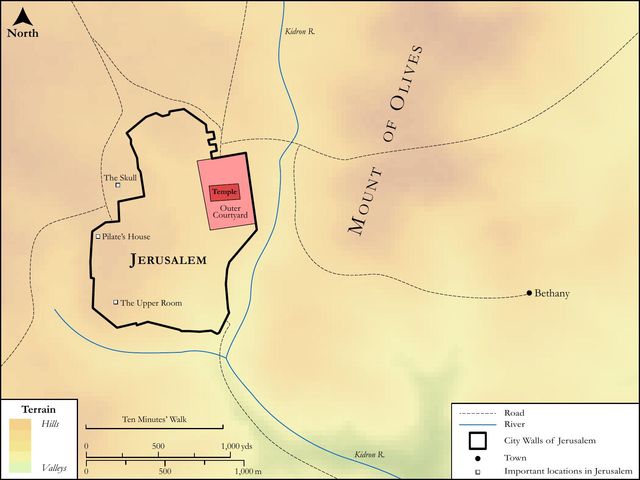
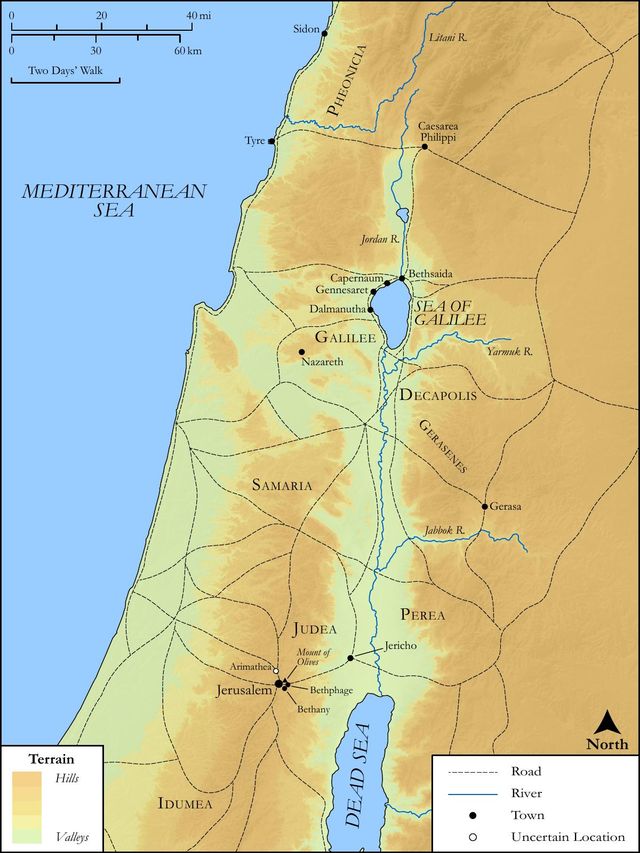
See on the biblical-era maps
Study this verse
Public-domain commentary
Matthew Henry
From his Commentary on the Whole Bible. Henry comments on passages, not single verses — this entry covers Mark 7:1–23. His three-level outline is real structure in the source text, so it is rendered as structure.
One great design of Christ's coming, was, to set aside the ceremonial law which God made, and to put an end to it; to make way for which he begins with the ceremonial law which men had made, and added to the law of God's making, and discharges his disciples from the obligation of that; which here he doth fully, upon occasion of the offence which the Pharisees took at them for the violation of it. These Pharisees and scribes with whom he had this argument, are said to come from Jerusalem down to Galilee - fourscore or a hundred miles, to pick quarrels with our Saviour there, where they supposed him to have the greatest interest and reputation. Had they come so far to be taught by him, their zeal had been commendable; but to come so far to oppose him, and to check the progress of his gospel, was great wickedness. It should seem that the scribes and Pharisees at Jerusalem pretended not only to a pre-eminence above, but to an authority over, the country clergy, and therefore kept up their visitations and sent inquisitors among them, as they did to John when he appeared, Joh 1:19.
Now in this passage we may observe,
I.What the tradition of the elders was:
by it all were enjoined to wash their hands before meat; a cleanly custom, and no harm in it; and yet as such to be over-nice in it discovers too great a care about the body, which is of the earth; but they placed religion in it, and would not leave it indifferent, as it was in its own nature; people were at their liberty to do it or not to do it; but they interposed their authority, and commanded all to do it upon pain of excommunication; this they kept up as a tradition of the elders. The Papists pretend to a zeal for the authority and antiquity of the church and its canons, and talk much of councils and fathers, when really it is nothing but a zeal for their own wealth, interest, and dominion, that governs them; and so it was with the Pharisees.
We have here an account of the practice of the Pharisees and all the Jews, Mar 7:3, Mar 7:4. 1. They washed their hands oft; they washed them, pugmē; the critics find a great deal of work about that word, some making it to denote the frequency of their washing (so we render it); others think it signifies the pains they took in washing their hands; they washed with great care, they washed their hands to their wrists (so some); they lifted up their hands when they were wet, that the water might run to their elbows. 2. They particularly washed before they ate bread; that is, before they sat down to a solemn meal; for that was the rule; they must be sure to wash before they ate the bread on which they begged a blessing. "Whosoever eats the bread over which they recite the benediction, Blessed be he that produceth bread, must wash his hands before and after," or else he was thought to be defiled. 3. They took special care, when they came in from the markets, to wash their hands; from the judgment-halls, so some; it signifies any place of concourse where there were people of all sorts, and, it might be supposed, some heathen or Jews under a ceremonial pollution, by coming near to whom they thought themselves polluted; saying, Stand by thyself, come not near me, I am holier than thou, Isa 65:5. They say, The rule of the rabbies was - That, if they washed their hands well in the morning, the first thing they did, it would serve for all day, provided they kept alone; but, if they went into company, they must not, at their return, either eat or pray till they had washed their hands; thus the elders gained a reputation among the people for sanctity, and thus they exercised and kept up an authority over their consciences. 4. They added to this the washing of cups, and pots, and brazen vessels, which they suspected had been made use of by heathens, or persons polluted; nay, and the very tables on which they ate their meat. There were many cases in which, by the law of Moses, washings were appointed; but they added to them, and enforced the observation of their own impositions as much as of God's institutions.
II.What the practice of Christ's disciples was; they knew what the law was, and the common usage; but they understood themselves so well that they would not be bound up by it: they ate bread with defiled, that is, with unwashen, hands, Mar 7:2. Eating with unwashen hands they called eating with defiled hands; thus men keep up their superstitious vanities by putting every thing into an ill name that contradicts them. The disciples knew (it is probable) that the Pharisees had their eye upon them, and yet they would not humour them by a compliance with their traditions, but took their liberty as at other times, and ate bread with unwashen hands; and herein their righteousness, however it might seem to come short, did really exceed, that of the scribes and Pharisees, Mat 5:20.
III.The offence which the Pharisees took at this; They found fault (Mar 7:2); they censured them as profane, and men of a loose conversation, or rather as men that would not submit to the power of the church, to decree rites and ceremonies, and were therefore rebellious, factious, and schismatical. They brought a complaint against them to their Master, expecting that he should check them, and order them to conform; for they that are fond of their own inventions and impositions, are commonly ready to appeal to Christ, as if he should countenance them, and as if his authority must interpose for the enforcing of them, and the rebuking of those that do not comply with them. They do not ask, Why do not thy disciples do as we do? (Though that was what they meant, coveting to make themselves the standard.) But, Why do not they walk according to the tradition of the elders? Mar 7:5. To which it was easy to answer, that, by receiving the doctrine of Christ, they had more understanding than all their teachers, yea more than the ancients, Psa 119:99, Psa 119:100.
IV.Christ's vindication of them; in which,
1.He argues with the Pharisees concerning the authority by which this ceremony was imposed; and they were the fittest to be discoursed with concerning that, who were the great sticklers for it: but this he did not speak of publicly to the multitude (as appears by his calling the people to him, Mar 7:14) lest he should have seemed to stir them up to faction and discontent at their governors; but addressed it as a reproof to the persons concerned: for the rule is, Suum cuique - Let every one have his own.
(1.)He reproves them for their hypocrisy in pretending to honour God, when really they had no such design in their religious observances (Mar 7:6, Mar 7:7); They honour me with their lips, they pretend it is for the glory of God that they impose those things, to distinguish themselves from the heathen; but really their heart is far from God, and is governed by nothing but ambition and covetousness. They would be thought hereby to appropriate themselves as a holy people to the Lord their God, when really it is the furthest thing in their thought. They rested in the outside of all their religious exercises, and their hearts were not right with God in them, and this was worshipping God in vain; for neither was he pleased with such sham - devotions, nor were they profited by them.
(2.)He reproves them for placing religion in the inventions and injunctions of their elders and rulers; They taught for doctrines the traditions of men. When they should have been pressing upon people the great principles of religion, they were enforcing the canons of their church, and judged of people's being Jews or no, according as they did, or did not, conform to them, without any consideration had, whether they lived in obedience to God's laws or no. It was true, there were divers washings imposed by the law of Moses (Heb 9:10), which were intended to signify that inward purification of the heart from worldly fleshly lusts, which God requires as absolutely necessary to our communion with him; but, instead of providing the substance, they presumptuously added to the ceremony, and were very nice in washing pots and cups; and observe, he adds, Many other such like things ye do, Mar 7:8. Note, Superstition is an endless thing. If one human invention and institution be admitted, though seemingly ever so innocent, as this of washing hands, behold, a troop comes, a door is opened for many other such things.
(3.)He reproves them for laying aside the commandment of God, and overlooking that, not urging that in their preaching, and in their discipline conniving at the violation of that, as if that were no longer of force, Mar 7:8. Note, It is the mischief of impositions, that too often they who are zealous for them, have little zeal for the essential duties of religion, but can contentedly see them laid aside. Nay, they rejected the commandment of God, Mar 7:9. He do fairly disannul and abolish the commandment of God; and even by your traditions make the word of God of no effect, Mar 7:13. God's statutes shall not only lie forgotten, as antiquated obsolete laws, but they shall, in effect, stand repealed, that their traditions may take place. They were entrusted to expound the law, and to enforce it; and, under pretence of using that power, they violated the law, and dissolved the bonds of it; destroying the text with the comment.
This he gives them a particular instance of, and a flagrant one - God commanded children to honour their parents, not only by the law of Moses, but, antecedent to that, by the law of nature; and whoso revileth, or speaketh evil of, father or mother, let him die the death, Mar 7:10. Hence it is easy to infer, that it is the duty of children, if their parents be poor, to relieve them, according to their ability; and if those children are worthy to die, that curse their parents, much more those that starve them. But if a man will but conform himself in all points to the tradition of the elders, they will find him out an expedient by which he may be discharged from this obligation, Mar 7:11. If his parents be in want and he has wherewithal to help them, but has no mind to do it, let him swear by the Corban, that is, by the gold of the temple, and the gift upon the altar, that his parents shall not be profited by him, that he will not relieve them; and, if they ask any thing of him, let him tell them this, and it is enough; as if by the obligation of this wicked vow he had discharged himself from the obligation of God's holy law; thus Dr. Hammond understands it: and it is said to be an ancient canon of the rabbin, That vows take place in things commanded by the law, as well as in things indifferent; so that, if a man make a vow which cannot be ratified without breaking a commandment, the vow must be ratified, and the commandment violated; so Dr. Whitby. Such doctrine as this the Papists teach, discharging children from all obligation to their parents by their monastic vows, and their entrance into religion, as they call it. He concludes, Any many such like things do ye. Where will men stop, when once they have made the word of God give way to their tradition? These eager imposers of such ceremonies, at first only made light of God's commandments in comparison with their traditions, but afterward made void God's commandments, if they stood in competition with them. All this, in effect, Isaiah prophesied of them; what he said of the hypocrites of his own day, was applicable to the scribes and Pharisees, v. 6. Note, When we see, and complain of, the wickedness of the present times, yet we do not enquire wisely of that matter, if we say that all the former days were better than these, Ecc 7:10. The worst of hypocrites and evil doers have had their predecessors.
2.He instructs the people concerning the principles upon which this ceremony was grounded. It was requisite that this part of his discourse should be public, for it related to daily practice, and was designed to rectify a great mistake which the people were led into by their elders; he therefore called the people unto him (Mar 7:14), and bid them hear and understand. Note, It is not enough for the common people to hear, but they must understand what they hear. When Christ would run down the tradition of the Pharisees about washing before meat, he strikes at the opinion which was the root of it. Note, Corrupt customs are best cured by rectifying corrupt notions.
Now that which he goes about to set them right in, is, what the pollution is, which we are in danger of being damaged by, Mar 7:15. (1.) Not by the meat we eat, though it be eaten with unwashen hands; that is but from without, and goes through a man. But, (2.) It is by the breaking out of the corruption that is in our hearts; the mind and conscience are defiled, guilt is contracted, and we become odious in the sight of God by that which comes out of us; our wicked thoughts and affections, words and actions, these defile us, and these only. Our care must therefore be, to wash our heart from wickedness.
3.He gives his disciples, in private, an explication of the instructions he gave the people. They asked him, when they had him by himself, concerning the parable (Mar 7:17); for to them, it seems, it was a parable. Now, in answer to their enquiry, (1.) He reproves their dulness; "Are ye so without understanding also? Are ye dull also, as dull as the people that cannot understand, as dull as the Pharisees that will not? Are ye so dull?" He doth not expect they should understand every thing; "But are ye so weak as not to understand this?" (2.) He explains this truth to them, that they might perceive it, and then they would believe it, for it carried its own evidence along with it. Some truths prove themselves, if they be but rightly explained and apprehended. If we understand the spiritual nature of God and of his law, and what it is that is offensive to him, and disfits us for communion with him, we shall soon perceive, [1.] That that which we eat and drink cannot defile us, so as to call for any religious washing; it goes into the stomach, and passes the several digestions and secretions that nature has appointed, and what there may be in it that is defiling is voided and gone; meats for the belly, and the belly for meats, but God shall destroy both it and them. But, [2.] It is that which comes out from the heart, the corrupt heart, that defiles us. As by the ceremonial law, whatsoever (almost) comes out of a man, defiles him (Lev 15:2; Deu 23:13), so what comes out from the mind of a man is that which defiles him before God, and calls for a religious washing (Mar 7:21); From within, out of the heart of men, which they boast of the goodness of, and think is the best part of them, thence that which defiles proceeds, thence comes all the mischief. As a corrupt fountain sends forth corrupt streams, so doth a corrupt heart send forth corrupt reasonings, corrupt appetites and passions, and all those wicked words and actions which are produced by them. Divers particulars are specified, as in Matthew; we had one there, which is not here, and that is, false witness-bearing; but seven are mentioned here, to be added to those we had there. First, Covetousnesses, for it is plural; pleonexiai - immoderate desires of more of the wealth of the world, and the gratifications of sense, and still more, still crying, Give, give. Hence we read of a heart exercised with covetous practices, Pe2 2:14. Secondly, Wickedness - ponēriai; malice, hatred, and ill-will, a desire to do mischief, and a delight in mischief done. Thirdly, Deceit; which is wickedness covered and disguised, that it may be the more securely and effectually committed. Fourthly, Lasciviousness; that filthiness and foolish talking which the apostle condemns; the eye full of adultery, and all wanton dalliances. Fifthly, The evil eye; the envious eye, and the covetous eye, grudging others the good we give them, or do for them (Pro 23:6), or grieving at the good they do or enjoy. Sixthly, Pride - huperēphania; exalting ourselves in our own conceit above others, and looking down with scorn and contempt upon others. Seventhly, Foolishness - aphrosunē; imprudence, inconsideration; some understand it especially of vainglorious boasting, which St. Paul calls foolishness (Co2 11:1, Co2 11:19), because it is here joined with pride; I rather take it for that rashness in speaking and acting, which is the cause of so much evil. Ill-thinking is put first, as that which is the spring of all our commissions, and unthinking put last, as that which is the spring of all our omissions. Of all these he concludes (Mar 7:23), 1. That they come from within, from the corrupt nature, the carnal mind, the evil treasure in the heart; justly is it said, that the inward part is very wickedness, it must needs be so, when all this comes from within. 2. That they defile the man; they render a man unfit for communion with God, they bring a stain upon the conscience; and, if not mortified and rooted out, will shut men out of the new Jerusalem, into which no unclean thing shall enter.
Historical interpretation
Ten Centuries of Reception
7 surviving comments on this verse. Each one is dated, so this reads as a timeline rather than a list.
Select a marker to jump to its quote. Markers stagger vertically where authors wrote within a few decades of each other.
He beats back the vain words of the Pharisees with His arguments, as men drive back dogs with weapons, by interpreting Moses and Isaiah, that we too by the word of Scripture may conquer the heretics, who oppose us; wherefore it goes on: (Isa. 29:13) Well hath Esaias prophesied of you hypocrites; as it is written, This people honoureth me with their lips, but their heart is far from me.
But Pharisaical tradition, as to tables and vessels, is to be cut off, and cast away. For they often make the commands of God yield to the traditions of men; wherefore it continues, For laying aside the commandments of God, ye hold to the traditions of men, as the washing of pots and cups.
Mystically, again, the disciples eating with unwashed hands signifies the future fellowship of the Gentiles with the Apostles. The cleansing and washing of the Pharisees is barren; but the fellowship of the Apostles, though without washing, has stretched out its branches as far as the sea.
So let us devote ourselves to those at peace in their devotion to God, and not to those who seek peace through hypocrisy. For he says in one place: “This people honors me with their lips, but their heart is far from me.” And again: “They blessed with their mouth, but they cursed in their heart.” And again he says: “They flattered him with their mouths; they lied to him with their tongues. Their heart was not steadfast toward him; they were not true to his covenant.”
And He reproves that people respecting whom it was said, "This people honour Me with their lips; but their heart is far from Me."
(in Matt. 15) Wonderful is the folly of the Pharisees and Scribes; they accuse the Son of God, because He keeps not the traditions and precepts of men. But common is here put for unclean; for the people of the Jews, boasting that they were the portion of God, called those meats common, which all made use of.
(Vict. Ant. e Cat. in Marc.) For since they unjustly accused the disciples not of transgressing the law, but the commands of the elders, He sharply confounds them, calling them hypocrites, as looking with reverence upon what was not worthy of it. He adds, however, the words of Isaiah the prophet, as spoken of them; as though He would say, As those men, of whom it is said, that they honour God with their lips, whilst their heart is far from him, in vain pretend to observe the dictates of piety, whilst they honour the doctrines of men, so ye also neglect your soul, of which ye should take care, and blame those who live justly.
(Vict. Ant. e Cat. in Marc.) Moreover, to convict them of neglecting the reverence due to God, for the sake of the tradition of the elders, which was opposed to the Holy Scriptures, He subjoins, For Moses said, Honour thy father and thy mother; and, Whoso curseth father or mother, let him die the death. (Exod. 21:17.)
(Vict. Ant. e Cat. in Marc.) Notwithstanding the existence of such a divine law, and the1 threats against such as break it, ye lightly transgress the commandment of God, observing the traditions of the Elders. Wherefore there follows, But ye say, If a man shall say to his father or mother, It is Corban, that is to say, a gift, by whatsoever thou mightest be profited by me; understand, he will be freed from the observation of the foregoing command. Wherefore it continues, And ye suffer him no more to do ought for his father or his mother.
(Vict. Ant. e Cat. in Marc.) Or else it may be said, that the Pharisees taught young persons, that if a man offered a gift in expiation of the injury done to his father or mother, he was free from sin, as having given to God the gifts which are owed to a parent; and in saying this, they did not allow parents to be honoured.
(in Marc. 2, 29) The people of the land of Gennesareth, who seemed to be unlearned men, not only come themselves, but also bring their sick to the Lord, that they may but succeed in touching the hem of His garment. But the Pharisees and Scribes, who ought to have been the teachers of the people, run together to the Lord, not to seek for healing, but to move captious questions; wherefore it is said, Then there came together unto him the Pharisees and cerlain of the Scribes, coming from Jerusalem; and when they saw some of his disciples eat bread with common, that is, with unwashen hands, they found fault.
(ubi sup.) For taking the spiritual words of the Prophets in a carnal sense, they observed, by washing the body alone, commandments which concerned the chastening of the heart and deeds, saying Wash you, make you clean; (Isa. 1:16) and again, Be ye clean that bear the vessels of the Lord. (Isa. 52:11) It is therefore a superstitious human tradition, that men who are clean already, should wash oftener because they eat bread, and that they should not eat on leaving the market, without washing. But it is necessary for those who desire to partake of the bread which comes down from heaven, often to cleanse their evil deeds by alms, by tears, and the other fruits of righteousness. It is also necessary for a man to wash thoroughly away the pollutions which he has contracted from the cares of temporal business, by being afterwards intent on good thoughts and works. In vain, however, do the Jews wash their hands, and cleanse themselves after the market, so long as they refuse to be washed in the font of the Saviour; in vain do they observe the washing of their vessels, who neglect to wash away the filthy sins of their bodies and of their hearts. It goes on: Then the Scribes and Pharisees asked him, Why walk not thy disciples after the tradition of the elders, but eat bread with common hands?
(ubi sup.) The sense of the word honour in Scripture is not so much the saluting and paying court to men, as alms-giving, and bestowing gifts; honour, says the Apostle, widows who are widows indeed. (1 Tim. 5:3.)
(ubi sup. v. Hier. in Matt. 15. et Orig. in Matt. Tom. xi. 9) The passage may in a few words have this sense, Every gift which I have to make, will go to do you good; for ye compel children, it is meant, to say to their parents, that gift which I was going to offer to God, I expend on feeding you, and does you good, oh father and mother, speaking this ironically. Thus they would be afraid to accept what had been given into the hands of God, and might prefer a life of poverty to living on consecrated property.
For the disciples of the Lord, who were taught only the practice of virtue, used to eat in a simple way, without washing their hands; but the Pharisees, wishing to find an occasion of blame against them, took it up; they did not indeed blame them as transgressors of the law, but for transgressing the traditions of the elders. Wherefore it goes on: For the Pharisees and all the Jews, except they wash their hands oft, eat not, holding the tradition of the elders.
For the Pharisees, wishing to devour the offerings, instructed sons, when their parents asked for some of their property, to answer them, what thou hast asked of me is corban, that is, a gift, I have already offered it up to the Lord; thus the parents would not require it, as being offered up to the Lord,z (and in that way profitable for their own salvation). Thus they deceived the sons into neglecting their parents, whilst they themselves devoured the offerings; with this therefore the Lord reproaches them, as transgressing the law of God for the sake of gain. Wherefore it goes on, Making the word of God of none effect through your traditions, which ye have delivered: and many such like things do ye; transgressing, that is, the commands of God, that ye may observe the traditions of men.
Continue studying Mark 7:6 across the web’s major study libraries — every link below opens this exact verse, chapter, or book on the destination site.
Read & Compare
 BibleGatewayThis verse in more than 200 translations and 70 languages.
 Bible.comThe YouVersion reader — hundreds of translations, reading plans, and highlights.
 ESV.orgCrossway's official English Standard Version reader.
 NET BibleThe NET translation with 60,000+ translators' notes on every rendering decision.
 STEP BibleTyndale House's free study tool — original text, vocabulary, and scholarly resources.
 BibliaLogos Bible Software's free web reader.
 USCCBThe New American Bible (Revised Edition) with the U.S. bishops' study notes.
Commentaries
 BibleHub CommentariesDozens of classic commentaries on this verse, gathered on one page.
 StudyLightMore than 100 commentary sets — the largest collection on the web.
 BibleRefPlain-English commentary on what this verse means, verse by verse.
 Enduring WordDavid Guzik's free commentary on this chapter, widely used by Bible teachers.
 Bible Study ToolsVerse commentary alongside Greek and Hebrew study aids.
Original Language & Research
- BibleHub InterlinearThe verse word by word — original language, transliteration, and English.
- BibleHub LexiconEvery word's original-language definition and Strong's entry.
 Blue Letter BibleDeep-study tools — Strong's numbers, concordance, and word studies.
 CNTR CollationThe earliest Greek manuscripts of this verse, collated letter by letter.
Sermons, Hymns & Audio


TrulyRandomVerse is not affiliated with these sites and doesn’t control their content. They’re linked because they’re genuinely useful.
Summary
In Mark 7:6, Jesus directly confronts the Pharisees and scribes, exposing their spiritual hypocrisy by quoting the prophet Isaiah. He reveals the profound disconnect between their outward religious devotion—manifested in meticulous adherence to human traditions and ceremonial washings—and the true condition of their hearts, which are far from God. This verse serves as a powerful indictment against external piety that lacks genuine internal transformation and sincere love for God, setting the stage for Jesus' broader teaching on true defilement originating from within.
Context
ShowHideLiterary Context
This verse is Jesus' sharp retort to a challenge from the Pharisees and some scribes who had come from Jerusalem. The preceding verses (Mark 7:1-5) detail their criticism of Jesus' disciples for not observing the traditional ceremonial washing of hands before eating, a practice deeply ingrained in their oral tradition. Jesus' response in Mark 7:6-8 immediately follows this accusation, directly addressing their hypocrisy before He expands on the principle that true defilement comes from within, not from external practices (Mark 7:14-23). The quotation from Isaiah 29:13 is central to His argument, demonstrating that their current spiritual state was a fulfillment of ancient prophecy.
Historical & Cultural Context
The religious landscape of Jesus' day was dominated by groups like the Pharisees and scribes, who were meticulous in their adherence to the Mosaic Law and the vast body of oral traditions that had developed around it. These traditions, often called "the tradition of the elders," were considered by many to be as authoritative as the written Law itself. Ceremonial washings, like those mentioned in Mark 7:3-4, were not commanded in the Old Testament Law but were rabbinic interpretations intended to maintain ritual purity. The Pharisees' concern was with external conformity and ritual cleanliness, believing that such practices made them righteous before God. Jesus' challenge directly strikes at the heart of this legalistic mindset, contrasting outward show with inner reality.
Key Themes
ShowHideMark 7:6 is pivotal in highlighting several key themes within the Gospel of Mark and broader biblical theology. Firstly, it powerfully exposes hypocrisy, revealing the chasm between outward religious performance and the true spiritual condition of the heart. Secondly, it underscores the critical biblical distinction between external ritual and internal reality, emphasizing that God values genuine devotion and a transformed heart over mere lip service or ceremonial adherence. This theme is further developed as Jesus later explains that true defilement comes from within a person, from the heart, not from what goes into the body (Mark 7:15). Finally, the verse introduces the theme of tradition versus divine commandment, setting the stage for Jesus' subsequent argument that the Pharisees had nullified God's word by their human traditions (Mark 7:8-13), particularly exemplified by their reinterpretation of the commandment to honor parents.
Exposition and Analysis
ShowHideKey Word Analysis
ShowHideThis term (G5273) originally referred to an actor on a stage, one who wore a mask and played a role. By extension, it came to mean a dissembler or pretender. Jesus uses it here to describe the Pharisees and scribes as those who outwardly present themselves as righteous and pious, meticulously following religious customs, while their inner character and true motives are contrary to their outward appearance. It perfectly captures the essence of their pretense and the disconnect between their public persona and their private spiritual state.
Derived from timios (G5091), meaning "to prize" or "to fix a valuation upon," this verb signifies to revere or show respect. In this context, it refers to the outward actions and words of worship or respect directed towards God. Jesus acknowledges that the people perform acts that appear to honor God, such as their diligent observance of traditions and their verbal expressions of piety. However, the subsequent clause immediately qualifies this honor as superficial, lacking genuine internal reverence.
In biblical anthropology, the "heart" (G2588) is far more than a physical organ; it is the center of one's entire being—the seat of intellect, emotion, will, and moral character. When Jesus states that their "heart is far from me," He is pointing to a fundamental spiritual alienation. It signifies a lack of genuine love, devotion, and obedience that should originate from the innermost core of a person. This distance of the heart implies a spiritual emptiness and a failure to truly know or serve God despite outward religious activity.
Verse Breakdown
ShowHide"He answered and said unto them, 'Well hath Esaias prophesied of you hypocrites, as it is written..."
Jesus directly confronts the Pharisees and scribes, affirming the prophetic word of Isaiah concerning them. The phrase "Well hath Esaias prophesied" indicates that Isaiah's ancient words precisely describe their current spiritual condition, highlighting the timeless nature of this particular spiritual problem. By calling them "hypocrites," Jesus unmasks their pretense and the insincerity of their religious practices. The phrase "as it is written" introduces the direct quotation from Isaiah, grounding Jesus' accusation in the authority of Scripture.
"...This people honoureth me with [their] lips..."
This clause, part of the Isaiah quotation (Isaiah 29:13), describes the outward manifestation of their piety. They offer verbal praise, participate in rituals, and meticulously observe traditions, all of which outwardly appear to be acts of honor towards God. Their "lips" represent their spoken words, their prayers, their public declarations of faith, and their adherence to ceremonial practices. This part of the prophecy acknowledges their external religious activity.
"...but their heart is far from me."
This is the crucial contrasting clause, revealing the internal reality that nullifies their outward show. Despite their lip service, their "heart"—the core of their being, their affections, their will, their true devotion—is spiritually distant from God. This distance implies a lack of genuine love, obedience, and intimate relationship. It signifies that their religious actions are motivated by human approval, self-righteousness, or tradition, rather than by a sincere desire to please and know God.
Literary Devices
ShowHideMark 7:6 masterfully employs several literary devices to convey its powerful message. The most prominent is Quotation/Allusion, as Jesus directly quotes from Isaiah 29:13. This not only lends prophetic authority to His condemnation but also demonstrates the continuity of God's concern for genuine worship over superficiality across different dispensations. Furthermore, the verse utilizes Contrast, setting up a stark opposition between "lips" and "heart." The "lips" represent outward, visible, and often performative religious actions, while the "heart" signifies the inner, invisible, and true spiritual state. This contrast highlights the fundamental disconnect Jesus is addressing. Finally, the phrase "their heart is far from me" functions as a Metaphor for spiritual alienation. The physical distance implied by "far" is used to describe a profound spiritual separation, indicating a lack of intimacy, devotion, and alignment with God's will.
Theological and Thematic Connections
ShowHideMark 7:6 profoundly impacts our understanding of true worship and the nature of God's relationship with humanity. It asserts that God is not impressed by mere external conformity or ritualistic adherence if the heart is not genuinely devoted to Him. The theological implication is that true piety must originate from an inward transformation and a sincere love for God, rather than from a desire for human approval or a legalistic fulfillment of rules. This verse underscores the biblical emphasis on the heart as the wellspring of life and the true locus of spiritual authenticity. It challenges the notion that religious activity, however diligent, can compensate for a lack of genuine relationship with the Divine.
Cross-references that illuminate this truth include:
Reflection and Application
ShowHideMark 7:6 serves as an enduring mirror for believers, challenging us to examine the authenticity of our own faith and practices. It calls us to move beyond superficial religiosity to cultivate a deep, internal devotion to God. In a world often focused on outward appearances and public displays, this verse reminds us that God sees beyond the surface, valuing the sincerity of our hearts above all else. It prompts us to consider whether our worship, service, and obedience are truly motivated by love for Him, or if they are merely performances driven by tradition, obligation, or the desire for human affirmation. The call is for integrity—for our inner spiritual state to align with our outward expressions of faith.
Questions for Reflection
ShowHideFAQ
ShowHideWhat does Jesus mean by calling the Pharisees "hypocrites" in this context?
ShowHideWhen Jesus calls the Pharisees "hypocrites" (from the Greek hypokritēs), He is using a term that originally referred to an actor who wore a mask and played a role on stage. In this context, He means that the Pharisees were pretending to be righteous and pious, meticulously following external religious rituals and traditions, while their inner spiritual state—their "heart"—was far from God. Their outward actions did not reflect genuine devotion or obedience, but rather a performative piety aimed at human approval or self-righteousness, as highlighted by the quotation from Isaiah 29:13.
Why is the distinction between "lips" and "heart" so significant in this verse?
ShowHideThe distinction between "lips" and "heart" is profoundly significant because it highlights the core difference between superficial religiosity and genuine faith. "Lips" represent outward expressions—words, prayers, rituals, and visible acts of worship. The "heart," in biblical thought, is the center of one's intellect, emotion, and will; it is the seat of true character and motivation. Jesus' point, quoting Isaiah, is that while one can outwardly honor God with words and actions ("lips"), if the inner being ("heart") is distant or disengaged, then that honor is empty and meaningless to God. True worship and obedience must flow from a sincere, transformed heart, not merely from external conformity, as Jesus emphasizes throughout His teaching (e.g., Matthew 6:1-6).
Christ-Centered Fulfillment
ShowHideMark 7:6, with its stark indictment of hypocrisy and emphasis on the heart, finds its ultimate fulfillment and resolution in the person and work of Jesus Christ. The Pharisees' "far heart" represented humanity's universal problem: a spiritual alienation from God due to sin, which no amount of outward religious performance could bridge. Jesus, however, perfectly embodied true heart-devotion to God, living a life of perfect obedience and sincerity, always doing the Father's will (John 8:29). He is the one whose "heart" was never far from God, providing the perfect model of genuine worship. Furthermore, Christ's atoning sacrifice on the cross addresses the very root of the "far heart" problem. By His death and resurrection, He provides the means for humanity's hearts to be drawn near to God, not through ritualistic washings or human traditions, but through faith in Him (Ephesians 2:13). The New Covenant, inaugurated by Christ, promises a new heart and a new spirit, where God's law is written on the heart, enabling true, internal worship and obedience (Jeremiah 31:33 and Hebrews 8:10). Thus, Jesus not only exposes the hypocrisy of a "far heart" but also provides the only way for hearts to be genuinely transformed and brought near to God.