


Acts 20:13
- ἡμεῖςhēmeisWe ourselvesG3165P-1NPPersonal pronoun Nominative 1st Plural
- δὲdehoweverG1161CONJConjunction
- προελθόντεςproelthonteshaving gone aheadG4281V-2AAP-NPMVerb 2nd Aorist Active Participle Nominative Plural Masculine
- ἐπὶepitoG1909PREPPreposition
- τὸtotheG3588T-ASNDefinite article Accusative Singular Neuter
- πλοῖονploionshipG4143N-ASNNoun Accusative Singular Neuter
- ἀνήχθημενanēchthēmensailedG321V-API-1PVerb Aorist Passive Indicative 1st Plural
- ἐπὶepitoG1909PREPPreposition
- τὴνtēn<the>G3588T-ASFDefinite article Accusative Singular Feminine
- ἎσσονAssonAssosG789N-ASF-LNoun Accusative Singular Feminine Location
- ἐκεῖθενekeithenthereG1564ADVAdverb
- μέλλοντεςmellontesbeing aboutG3195V-PAP-NPMVerb Present Active Participle Nominative Plural Masculine
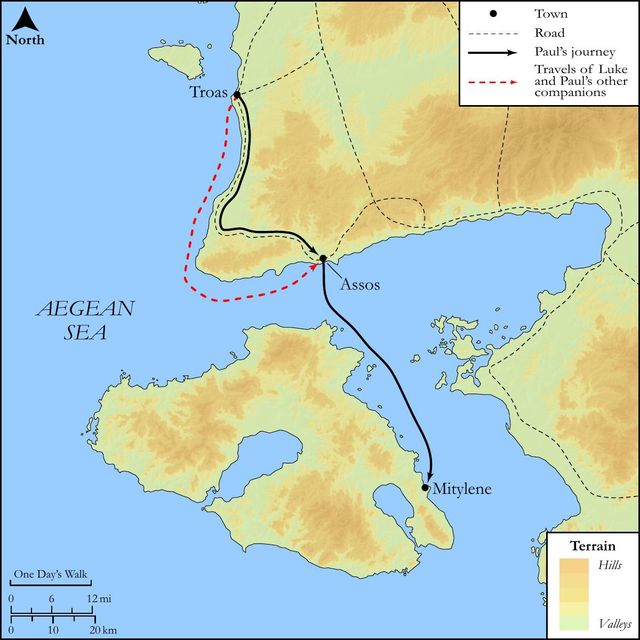
- ἀναλαμβάνεινanalambaneinto take inG353V-PANVerb Present Active Infinitive
- τὸνton<the>G3588T-ASMDefinite article Accusative Singular Masculine
- Παῦλον·PaulonPaulG3972N-ASM-PNoun Accusative Singular Masculine Individual
- οὕτωςhoutōsThusG3779ADVAdverb
- γὰρgarforG1063CONJConjunction
- διατεταγμένοςdiatetagmenoshaving arranged himselfG1299V-RMP-NSMVerb Perfect Middle Participle Nominative Singular Masculine
- ἦνēnhe wasG1510V-IAI-3SVerb Imperfect Active Indicative 3rd Singular
- μέλλωνmellōnreadyingG3195V-PAP-NSMVerb Present Active Participle Nominative Singular Masculine
- αὐτὸςautoshimselfG846P-NSMPersonal pronoun Nominative Singular Masculine
- πεζεύεινpezeueinto go on footG3978V-PANVerb Present Active Infinitive
English is a literal word-by-word gloss of the Greek, not the KJV's wording. Why?
This is the original text the KJV's translators worked from — each Greek word with its own literal English meaning in this verse, prepared by scholars at Tyndale House, Cambridge. The KJV translates whole sentences, not word by word, so its wording differs: one Greek word can become several English words, and the KJV may choose “charity” where the gloss reads “love”. Both are faithful — they answer different questions. For the KJV's own rendering, switch to the KJV text.
Details
See on the biblical-era map
Study this verse
Public-domain commentary
Matthew Henry
From his Commentary on the Whole Bible. Henry comments on passages, not single verses — this entry covers Acts 20:13–16. His two-level outline is real structure in the source text, so it is rendered as structure.
Paul is hastening towards Jerusalem, but strives to do all the good he can by the way, ōs en parodō̂ "as it were by the by." He had called at Troas, and done good there; and now he makes a sort of coasting voyage, the merchants would call it a trading voyage, going from place to place, and no doubt endeavouring to make every place he came to the better for him, as every good man should do.
I.He sent his companions by sea to Assos, but he himself was minded to go afoot, Act 20:13.
He had decreed or determined within himself that whatever importunity should be used with him to the contrary, urging either his ease or his credit, or the conveniency of a ship that offered itself, or the company of his friends, he would foot it to Assos: and, if the land-way which Paul took was the shorter way, yet it is taken notice of by the ancients as a rough way (Homer, Iliad 6, and Eustathius upon him, say, it was enough to kill one to go on foot to Assos. - Lorin. in locum); yet that way Paul would take,
1.That he might call on his friends by the way, and do good among them, either converting sinners or edifying saints; and in both he was serving his great Master, and carrying on his great work. Or,
2.That he might be alone, and might have the greater freedom of converse with God and his own heart in solitude. He loved his companions, and delighted in their company, yet he would show hereby that he did not need it, but could enjoy himself alone. Or,
3.That he might inure himself to hardship, and not seem to indulge his ease. Thus he would by voluntary instances of mortification and self-denial keep under the body, and bring it into subjection, that he might make his sufferings for Christ, when he was called out to them, the more easy, Ti2 2:3. We should use ourselves to deny ourselves.
II.At Assos he went on board with his friends.
There they took him in; for by this time he had enough of his walk, and was willing to betake himself to the other way of travelling; or perhaps he could not go any further by land, but was obliged to go by water. When Christ sent his disciples away by ship, and tarried behind himself, yet he came to them, and they took him in, Mar 6:45, Mar 6:51.
III.He made the best of his way to Jerusalem.
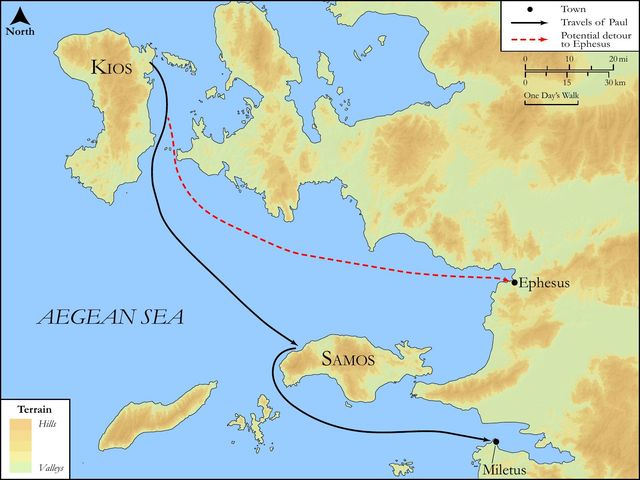
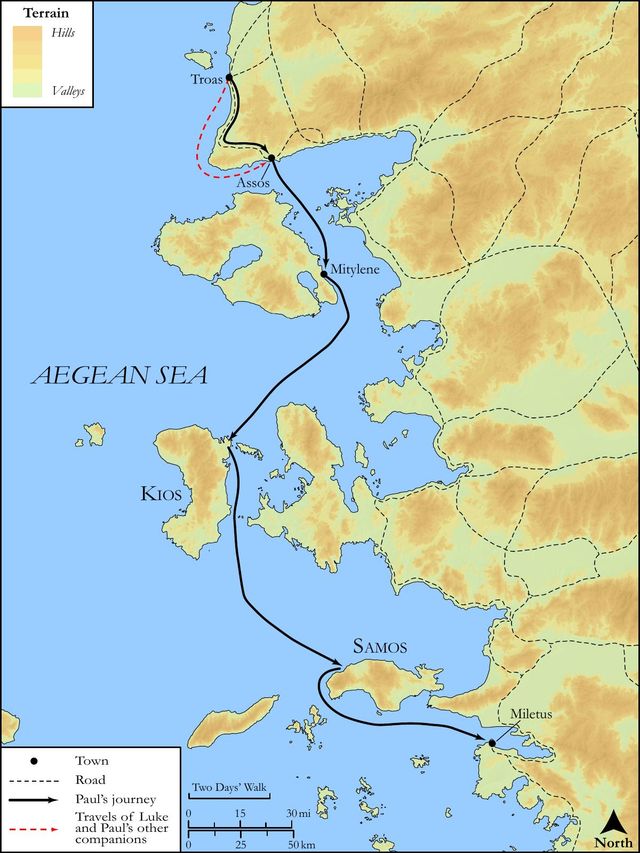
His ship passed by Chios (Act 20:15), touched at Samos (these are places of note among the Greek writers, both poets and historians); they tarried awhile at Trogyllium, the sea-port next to Samos; and the next day they came to Miletus, the sea-port that lay next to Ephesus; for (Act 20:16) he had determined not to go to Ephesus at this time, because he could not go thither without being urged by his friends whose importunity he could not resist, to make some stay with them there; and, because he was resolved not to stay, he would not put himself into a temptation to stay; for he hasted, if it were possible for him, to be at Jerusalem on the day of pentecost. He had been at Jerusalem about four or five years ago (Act 18:21, Act 18:22), and now he was going thither again to pay his continued respects to that church, with which he was careful to keep a good correspondence, that he might not be thought alienated from it by his commission to preach among the Gentiles. He aimed to be there by the feast of pentecost because it was a time of concourse, which would give him an opportunity of propagating the gospel among the Jews and proselytes, who came from all parts to worship at the feast: and the feast of pentecost had been particularly made famous among the Christians by the pouring out of the Spirit. Note, Men of business must fit themselves, and it will contribute to the expediting of it, to set time (with submission to Providence) and strive to keep it, contriving to do that first which we judge to be most needful, and not suffering ourselves to be diverted from it. It is a pleasure to us to be with our friends; it diverts us, nothing more; but we must not by it be diverted from our work. When Paul has a call to Jerusalem, he will not loiter away the time in Asia, though he had more and kinder friends there. This is not the world we are to be together in; we hope to be so in the other world.
Historical interpretation
Two Centuries of Reception
2 surviving comments on this verse. Each one is dated, so this reads as a timeline rather than a list.
Select a marker to jump to its quote. Markers stagger vertically where authors wrote within a few decades of each other.
That this Luke was inseparable from Paul and his fellow laborer in the gospel, he himself clearly evinces, not as a matter of boasting but as bound to do so by the truth itself. For he says that when Barnabas, and John who was called Mark, had parted company from Paul and sailed to Cyprus, “we came to Troas”; and when Paul had beheld in a dream a man of Macedonia, saying, “Come into Macedonia, Paul, and help us,” “immediately,” he says, “we endeavored to go into Macedonia, understanding that the Lord had called us to preach the gospel to them. Therefore, sailing from Troas, we directed our ship’s course towards Samothracia.” And then he carefully indicates all the rest of their journey as far as Philippi, and how they delivered their first address, “for, sitting down,” he says, “we spoke to the women who had assembled,” and certain ones believed, even a great many. Again [Luke] says, “But we sailed from Philippi after the days of unleavened bread and came to Troas, where we stayed for seven days.” And all the remaining details of his course with Paul he recounts, indicating with all diligence both places and cities and number of days, until they went up to Jerusalem; and what happened to Paul there, how he was sent to Rome in bonds; the name of the centurion who took him in charge; and the signs of the ships, and how they made shipwreck; and the island on which they escaped, and how they received kindness there, Paul healing the chief man of that island; and how they sailed from there to Puteoli, and from there arrived at Rome; and for what period they sojourned at Rome. As Luke was present at all these occurrences, he carefully noted them down in writing, so that he cannot be convicted of falsehood or boastfulness, because all these particulars proved both that he was senior to all those who now teach otherwise and that he was not ignorant of the truth.
"And we went before to ship, and sailed unto Thasos, there intending to take in Paul: for so had he appointed, minding himself to go afoot." We often find Paul parting from the disciples. For behold again, he himself goes afoot: giving them the easier way, and himself choosing the more painful. He went afoot, both that he might arrange many matters, and by way of training them to bear a parting from him.
Continue studying Acts 20:13 across the web’s major study libraries — every link below opens this exact verse, chapter, or book on the destination site.
Read & Compare
 BibleGatewayThis verse in more than 200 translations and 70 languages.
 Bible.comThe YouVersion reader — hundreds of translations, reading plans, and highlights.
 ESV.orgCrossway's official English Standard Version reader.
 NET BibleThe NET translation with 60,000+ translators' notes on every rendering decision.
 STEP BibleTyndale House's free study tool — original text, vocabulary, and scholarly resources.
 BibliaLogos Bible Software's free web reader.
 USCCBThe New American Bible (Revised Edition) with the U.S. bishops' study notes.
Commentaries
 BibleHub CommentariesDozens of classic commentaries on this verse, gathered on one page.
 StudyLightMore than 100 commentary sets — the largest collection on the web.
 BibleRefPlain-English commentary on what this verse means, verse by verse.
 Enduring WordDavid Guzik's free commentary on this chapter, widely used by Bible teachers.
 Bible Study ToolsVerse commentary alongside Greek and Hebrew study aids.
Original Language & Research
- BibleHub InterlinearThe verse word by word — original language, transliteration, and English.
- BibleHub LexiconEvery word's original-language definition and Strong's entry.
 Blue Letter BibleDeep-study tools — Strong's numbers, concordance, and word studies.
 CNTR CollationThe earliest Greek manuscripts of this verse, collated letter by letter.
Sermons, Hymns & Audio


TrulyRandomVerse is not affiliated with these sites and doesn’t control their content. They’re linked because they’re genuinely useful.
Summary
Acts 20:13 details a specific logistical arrangement during Paul's return journey to Jerusalem, highlighting a temporary separation from his traveling companions. While his group sailed from Troas to Assos, Paul intentionally chose to travel the distance by foot, demonstrating his personal discipline, strategic planning, and potential desire for solitude or reflection amidst the demanding missionary enterprise. This brief account offers a glimpse into the practicalities of ancient travel and Paul's methodical approach to his ministry.
Context
ShowHideLiterary Context
This verse is embedded within the concluding phase of Paul's third missionary journey, as he meticulously makes his way back to Jerusalem. Having spent a significant period in Troas, marked by a lengthy sermon and the miraculous revival of Eutychus, Paul and his companions are now departing. The narrative immediately preceding this verse describes Paul's extended teaching and the emotional farewells in Troas. The "we" pronoun, consistently used from Acts 20:5 onwards, signals Luke's presence as an eyewitness, lending a personal and reliable dimension to the account. This leg of the journey sets the stage for Paul's poignant farewell address to the Ephesian elders in Miletus, which follows shortly thereafter in Acts 20:17-38.
Historical & Cultural Context
Travel in the ancient world was arduous and time-consuming, relying heavily on sea voyages or overland routes. Troas and Assos were significant port cities on the Aegean coast of Asia Minor. The distance between them by land was considerably shorter than by sea, as the sea route involved navigating around a peninsula. Paul's decision to walk would have been a common practice for many travelers, offering a more direct path and potentially avoiding the vagaries of wind and sea currents that could delay a ship. This period also saw the Roman Empire's established road networks, which facilitated land travel. Paul's choice reflects not only the practicalities of the era but also his personal habits, as he often traveled extensively on foot throughout his missionary journeys, enduring various hardships as described in 2 Corinthians 11:26-27.
Key Themes
ShowHideActs 20:13 contributes to several overarching themes. Firstly, it underscores Paul's Strategic Planning and Leadership. His "appointment" of the meeting place demonstrates his foresight and organizational skills in coordinating the movements of his team. Secondly, it highlights Paul's Personal Discipline and Intentionality. His choice to walk, rather than sail with the others, suggests a deliberate decision, perhaps for solitude, prayer, or simply a preference for the land route. This aligns with Paul's broader commitment to his mission, even in the mundane aspects of travel logistics. Thirdly, the consistent use of the "we" passages, including this verse, reinforces Luke's Eyewitness Testimony and the Credibility of the Narrative. Luke's presence adds a layer of authenticity and detail to the account of Paul's final journey to Jerusalem, a journey Paul knew would be fraught with peril, as he later articulates in Acts 20:22-23.
Exposition and Analysis
ShowHideKey Word Analysis
ShowHideThis verb (G1299) means "to arrange thoroughly, i.e. (specially) institute, prescribe, etc." It signifies Paul's deliberate and authoritative planning. He didn't merely suggest; he "appointed" or "ordered" the rendezvous point, indicating a clear directive and his role as the leader orchestrating their travel logistics. This was a pre-arranged plan, not a spontaneous decision.
Used twice in the verse (G3195), "intending" and "minding," this word conveys the idea of being "about to be, do, or suffer something" or having a strong purpose. It emphasizes Paul's deliberate forethought and resolve regarding his travel method. His decision to walk was not an afterthought but a planned intention, underscoring his purposeful approach to every aspect of his ministry and personal journey.
This verb (G3978) specifically means "to foot a journey, i.e. travel by land." It directly contrasts with the companions' action of sailing. This precise term highlights Paul's physical act of walking, emphasizing the personal and perhaps arduous nature of his chosen path for this segment of the journey.
Verse Breakdown
ShowHide"And we went before to ship, and sailed unto Assos"
This clause describes the action of Paul's companions, including Luke ("we"). They proceeded to the ship and set sail for Assos, indicating a coordinated but separate departure from Troas. This highlights the practical division of labor and the use of maritime travel.
"there intending to take in Paul"
This phrase reveals the purpose of their journey to Assos: it was a pre-arranged meeting point. The companions sailed ahead with the specific intention of picking up Paul at Assos, demonstrating the meticulous planning involved in their travels.
"for so had he appointed"
This explanatory clause provides the reason for the companions' actions. Paul himself had "appointed" or commanded this arrangement. It underscores his leadership and the fact that the group was following his specific instructions for their travel itinerary.
"minding himself to go afoot"
This final clause explains Paul's personal decision and method of travel. While his companions sailed, Paul had deliberately "minded" or purposed to travel the distance between Troas and Assos by walking. This highlights his intentionality and perhaps a desire for a different experience or purpose during this segment of the journey.
Literary Devices
ShowHideThe verse employs several subtle but effective literary devices. The consistent use of the first-person plural pronoun "we" throughout this section of Acts is a prime example of Eyewitness Account, lending authenticity and immediacy to the narrative, as Luke, the author, was present for these events. There is also a clear Contrast established between the mode of travel: the companions sail by ship, while Paul chooses to "go afoot." This juxtaposition draws attention to Paul's unique and deliberate decision. Furthermore, Paul's solitary walk can be seen as a form of Symbolism, potentially representing a period of personal reflection, prayer, or spiritual preparation before the significant challenges and trials he anticipated in Jerusalem. This personal journey foreshadows the more profound and difficult path he was about to embark upon.
Theological and Thematic Connections
ShowHideActs 20:13, though seemingly a mundane detail of travel, subtly underscores the divine orchestration of human plans and the importance of intentionality in ministry. Paul's decision to walk reflects not just logistical efficiency but potentially a spiritual discipline—a time for solitude and communion with God before facing the looming trials in Jerusalem. It reminds us that even in the practicalities of life and ministry, there is room for purposeful choices that align with spiritual needs and God's broader purposes. The meticulous planning involved, with Paul appointing the meeting point, illustrates that God often works through organized, thoughtful human effort, not just spontaneous acts. This verse quietly affirms that even the journey itself can be a part of the spiritual preparation for what lies ahead.
Reflection and Application
ShowHideActs 20:13, while a brief logistical note, offers profound insights for contemporary believers. Paul's intentional choice to walk, rather than sail with his companions, serves as a powerful reminder of the value of purposeful solitude and personal discipline amidst the demands of life and ministry. In our fast-paced, constantly connected world, we often neglect the quiet moments necessary for reflection, prayer, and spiritual recalibration. Paul's "walk" might have been his way of processing the intense ministry in Troas, preparing his heart for the difficult journey to Jerusalem, and seeking divine guidance. This verse challenges us to consider how we integrate intentional periods of quietness and personal spiritual disciplines into our busy schedules. It also highlights the balance between communal effort and individual responsibility. While Paul's companions sailed together, he chose a different, more solitary path for a segment, yet they remained connected by a shared purpose and a planned reunion. Our faith journey often involves both collective action and individual spiritual growth, both requiring deliberate choices and commitment.
Questions for Reflection
ShowHideFAQ
ShowHideWhy did Paul choose to walk from Troas to Assos instead of sailing with his companions?
ShowHideThe Bible does not explicitly state Paul's reasons, but several plausible explanations are often suggested. Geographically, the land route from Troas to Assos was significantly shorter and more direct than the sea route, which required sailing around a peninsula. This might have been a purely practical decision for efficiency. Theologically and spiritually, Paul might have desired a period of solitude for prayer, reflection, or spiritual preparation. He was keenly aware of the trials and imprisonment that awaited him in Jerusalem, and this walk could have served as a time of intense communion with God, processing the past and preparing for the future. It also aligns with Paul's character as a man of great discipline and intentionality, often choosing arduous paths for the sake of the gospel, as seen throughout his missionary journeys.
Christ-Centered Fulfillment
ShowHideActs 20:13, with Paul's intentional and solitary walk, subtly points to the greater, purposeful journey of Jesus Christ. Paul's "appointed" path, chosen with deliberate foresight, echoes the ultimate appointment of the Son of God to come into the world and accomplish redemption. Just as Paul set his face toward Jerusalem, anticipating trials, so too did Jesus resolutely "set His face to go to Jerusalem" (Luke 9:51), knowing full well the suffering and death that awaited Him there. Christ's journey to the cross was the most deliberate and solitary walk in history, a path He trod alone in Gethsemane (Matthew 26:36-46) and on Calvary, even when His closest companions could not fully grasp or share His burden. Paul's physical discipline and intentionality in his mission serve as a faint but true reflection of Christ's perfect obedience and unwavering commitment to fulfill the Father's will, culminating in the ultimate sacrifice for the sins of the world (John 1:29). Every step Paul took was in service of the gospel of Christ, mirroring the very mission of the One who walked among us to bring salvation.