


1 Kings 17:10
- וַיָּקָםvai·Ya·komand he aroseH6965Conj-w ¦ V-Qal-ConsecImperf-3msVerb Qal Consecutive Imperfect 3rd Singular Masculineוַandיָּקָםhe arose
- וַיֵּלֶךְvai·Ye·lekhand he wentH1980Conj-w ¦ V-Qal-ConsecImperf-3msVerb Qal Consecutive Imperfect 3rd Singular Masculineוַandיֵּלֶךְhe went
- צָרְפַתָהtza·re·Fa·tahZarephath towardsH6886N-proper ¦ SfxNoun Proper LocationצָרְפַתָZarephathהtowards
- וַיָּבֹאvai·ya·Vo'and he cameH935Conj-w ¦ V-Qal-ConsecImperf-3msVerb Qal Consecutive Imperfect 3rd Singular Masculineוַandיָּבֹאhe came
- אֶל'eltoH413PrepPreposition
- פֶּתַחPe·tach[the] entrance ofH6607N-mscNoun Singular Masculine Construct
- הָעִירha·'Irthe cityH5892Art ¦ N-fsNoun Singular Feminine Absoluteהָtheעִירcity
- וְהִנֵּהve·hi·nehand there!H2009Conj-w ¦ PrtParticle Interjectionוְandהִנֵּהthere!
- שָׁםshamthereH8033AdvAdverb
- אִשָּׁה'i·Shaha womanH802N-fsNoun Singular Feminine Absolute
- אַלְמָנָה'al·ma·Naha widowH490N-fsNoun Singular Feminine Absolute
- מְקֹשֶׁשֶׁתme·ko·She·shet[was] gatheringH7197V-Piel-Prtcpl-fsVerb Piel Participle Singular Feminine Construct
- עֵצִים'e·Tzimwood<s>H6086N-mpNoun Plural Masculine Absolute
- וַיִּקְרָאvai·yik·Ra'and he called outH7121Conj-w ¦ V-Qal-ConsecImperf-3msVerb Qal Consecutive Imperfect 3rd Singular Masculineוַandיִּקְרָאhe called out
- אֵלֶיהָ'e·Lei·hato herH413Prep ¦ 3fsPrepositionאֵלֶיtoהָher
- וַיֹּאמַרvai·yo·Marand he saidH559Conj-w ¦ V-Qal-ConsecImperf-3msVerb Qal Consecutive Imperfect 3rd Singular Masculineוַandיֹּאמַרhe said
- קְחִיke·chigetH3947V-Qal-Imp-2fsVerb Qal Imperative 2nd Singular Feminine
- נָאna'pleaseH4994PrtParticle Interjection
- לִיlifor mePrep-l ¦ 1csSuffix Personal 1st Singular common genderלִforיme
- מְעַטme·'ata little ofH4592N-mscNoun Singular Masculine Construct
- מַיִםMa·yimwaterH4325N-mpNoun Plural Masculine Absolute
- בַּכְּלִיba·ke·Liin <the> vesselH3627Prep-b ¦ N-msNoun Singular Masculine Absoluteבַּin <the>כְּלִיvessel
- וְאֶשְׁתֶּהve·'esh·Tehso I may drinkH8354Conj-w ¦ V-Qal-ConjImperf-1csVerb Qal Conjunction+Imperfect 1st Singular common genderוְsoאֶשְׁתֶּהI may drink
English is a literal word-by-word gloss of the Hebrew, not the KJV's wording. Why?
This is the original text the KJV's translators worked from — each Hebrew word with its own literal English meaning in this verse, prepared by scholars at Tyndale House, Cambridge. The KJV translates whole sentences, not word by word, so its wording differs: one Hebrew word can become several English words, and the KJV may choose “the LORD” where the gloss reads “Yahweh”. Both are faithful — they answer different questions. For the KJV's own rendering, switch to the KJV text.
Details
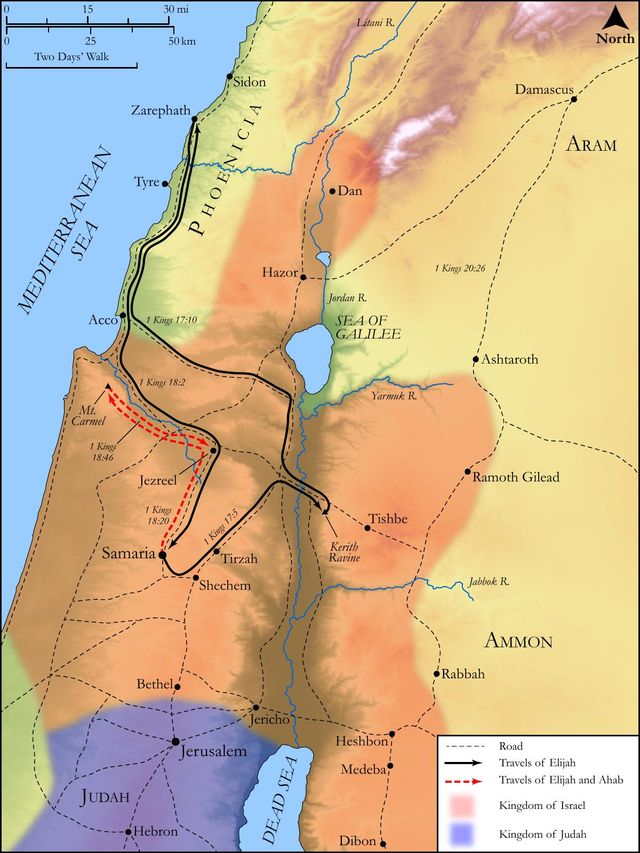
See on the biblical-era map
Study this verse
Public-domain commentary
Matthew Henry
From his Commentary on the Whole Bible. Henry comments on passages, not single verses — this entry covers 1 Kings 17:8–16. His three-level outline is real structure in the source text, so it is rendered as structure.
We have here an account of the further protection Elijah was taken under, and the further provision made for him in his retirement. At destruction and famine he shall laugh that has God for his friend to guard and maintain him. The brook Cherith is dried up, but God's care of his people, and kindness to them, never slacken, never fail, but are still the same, are still continued and drawn out to those that know him, Psa 36:10. When the brook was dried up Jordan was not; why did not God send him thither? Surely because he would show that he has a variety of ways to provide for his people and is not tied to any one. God will now provide for him where he shall have some company and opportunity of usefulness, and not be, as he had been, buried alive. Observe,
I.The place he is sent to, to Zarephath, or Sarepta, a city of Sidon, out of the borders of the land of Israel, Kg1 17:9.
Our Saviour takes notice of this as an early and ancient indication of the favour of God designed for the poor Gentiles, in the fulness of time, Luk 4:25, Luk 4:26. Many widows were in Israel in the days of Elias, and some, it is likely, that would have bidden him welcome to their houses; yet he is sent to honour and bless with his presence a city of Sidon, a Gentile city, and so becomes (says Dr. Lightfoot) the first prophet of the Gentiles. Israel had corrupted themselves with the idolatries of the nations and become worse than they; justly therefore is the casting off of them the riches of the world. Elijah was hated and driven out by his countrymen; therefore, lo, he turns to the Gentiles, as the apostles were afterwards ordered to do, Act 18:6. But why to a city of Sidon? Perhaps because the worship of Baal, which was now the crying sin of Israel, came lately thence with Jezebel, who was a Sidonian (Kg1 16:31); therefore thither he shall go, that thence may be fetched the destroyer of that idolatry, "Even out of Sidon have I called my prophet, my reformer." Jezebel was Elijah's greatest enemy; yet, to show her the impotency of her malice, God will find a hiding-place for him even in her country. Christ never went among the Gentiles except once into the coast of Sidon, Mat 15:21.
II.The person that is appointed to entertain him, not one of the rich merchants or great men, of Sidon, not such a one as Obadiah, that was governor of Ahab's house and fed the prophets; but a poor widow woman, destitute and desolate, is commanded (that is, is made both able and willing) to sustain him. It is God's way, and it is his glory, to make use of the weak and foolish things of the world and put honour upon them. He is, in a special manner, the widows' God, and feeds them, and therefore they must study what they shall render to him.
III.The provision made for him there.
Providence brought the widow woman to meet him very opportunely at the gate of the city (Kg1 17:10), and, by what is here related of what passed between Elijah and her, we find,
1.Her case and character; and it appears,
(1.)That she was very poor and necessitous. She had nothing to live upon but a handful of meal and a little oil, needy at the best, and now, by the general scarcity, reduced to the last extremity. When she has eaten the little she has, for aught she yet sees, she must die for want, she and her son, Kg1 17:12. She had no fuel but the sticks she gathered in the streets, and, having no servant, she must gather them herself (Kg1 17:10), being thus more in a condition to receive alms than give entertainment. To her Elijah was sent, that he might still live upon Providence as much as he did when the ravens fed him. It was in compassion to the low estate of his handmaiden that God sent the prophet to her, not to beg of her, but to board with her, and he would pay well for his table.
(2.)That she was very humble and industrious. He found her gathering sticks, and preparing to bake her own bread, Kg1 17:10, Kg1 17:12. Her mind was brought to her condition, and she complained not of the hardship she was brought to, nor quarrelled with the divine Providence for withholding rain, but accommodated herself to it as well as she could. Such as are of this temper in a day of trouble are best prepared for honour and relief from God.
(3.)That she was very charitable and generous. When this stranger desired her to go and fetch him some water to drink, she readily went, at the first word, Kg1 17:10, Kg1 17:11. She objected not to the present scarcity of it, nor asked him what he would give her for a draught of water (for now it was worth money), nor hinted that he was a stranger, an Israelite, with whom perhaps the Sidonians cared not for having any dealings, any more than the Samaritans, Joh 4:9. She did not excuse herself on account of her weakness through famine, or the urgency of her own affairs, did not tell him she had something else to do than to go on his errands, but left off gathering the sticks for herself to fetch water for him, which perhaps she did the more willingly, being moved with the gravity of his aspect. We should be ready to do any office of kindness even to strangers; if we have not wherewith to give to the distressed, we must be the more ready to work for them. A cup of cold water, though it cost us no more than the labour of fetching, shall in no wise lose its reward.
(4.)That she had a great confidence in the word of God. It was a great trial for her faith and obedience when, having gold the prophet how low her stock of meal and oil was and that she had but just enough for herself and her son, he bade her make a cake for him, and make his first, and then prepare for herself and her son. If we consider, it will appear as great a trial as could be in so small a matter. "Let the children first be served" (might she have said); "charity begins at home. I cannot be expected to give, having but little, and not knowing, when that is gone, where to obtain more." She had much more reason than Nabal to ask, "Shall I take my meat and my oil and give it to one that I know not whence he is?" Elijah, it is true, made mention of the God of Israel (Kg1 17:14), but what was that to a Sidonian? Or if she had a veneration for the name Jehovah, and valued the God of Israel as the true God, yet what assurance had she that this stranger was his prophet or had any warrant to speak in his name? It was easy for a hungry vagrant to impose upon her. But she gets over all these objections, and obeys the precept in dependence upon the promise: She went and did according to the saying of Elijah, Kg1 17:15. O woman! great was thy faith; one has not found the like, no, not in Israel: all things considered, it exceeded that of the widow who, when she had but two mites, cast them into the treasury. She took the prophet's word, that she should not lose by it, but it should be repaid with interest. Those that can venture upon the promise of God will make no difficulty of exposing and emptying themselves in his service, by giving him his dues out of a little and giving him his part first. Those that deal with God must deal upon trust; seek first his kingdom, and then other things shall be added. By the law, the first-fruits were God's, the tithe was taken out first, and the heave-offering of their dough was first offered, Num 15:20, Num 15:21. But surely the increase of this widow's faith, to such a degree as to enable her thus to deny herself and to depend upon the divine promise, was as great a miracle in the kingdom of grace as the increase of her oil was in the kingdom of providence. Happy are those who can thus, against hope, believe and obey in hope.
2.The care God took of her guest: The barrel of meal wasted not, nor did the cruse of oil fail, but still as they took from them more was added to them by the divine power, Kg1 17:16. Never did corn or olive so increase in the growing (says bishop Hall) as these did in the using; but the multiplying of the seed sown (Co2 9:10) in the common course of providence is an instance of the power and goodness of God not to be overlooked because common. The meal and the oil multiplied, not in the hoarding, but in the spending; for there is that scattereth and yet increaseth. When God blesses a little, it will go a great way, even beyond expectation; as, on the contrary, though there be abundance, if he blow upon it, it comes to little, Hag 1:9; Hag 2:16.
(1.)This was a maintenance for the prophet. Still miracles shall be his daily bread. Hitherto he had been fed with bread and flesh, now he was fed with bread and oil, which they used as we do butter. Manna was both, for the taste of it was as the taste of fresh oil, Num 11:8. This Elijah was thankful for, though he had been used to flesh twice a day and now had none at all. Those that cannot live without flesh, once a day at least, because they have been used to it, could not have boarded contentedly with Elijah, no, not to live upon a miracle.
(2.)It was a maintenance for the poor widow and her son, and a recompence to her for entertaining the prophet. There is nothing lost by being kind to God's people and ministers; she that received a prophet had a prophet's reward; she gave him house-room, and he repaid her with food for her household. Christ has promised to those who open their doors to him that he will come in to them, and sup with them, and they with him, Rev 3:20. Like Elijah here, he brings to those who bid him welcome, not only his own entertainment, but theirs too. See how the reward answered the service. She generously made one cake for the prophet, and was repaid with many for herself and her son. When Abraham offers his only son to God he is told he shall be the father of multitudes. What is laid out in piety or charity is let out to the best interest, upon the best securities. One poor meal's meat this poor widow gave the prophet, and, in recompence of it, she and her son did eat many days (Kg1 17:15), above two years, in a time of general scarcity; and to have their food from God's special favour, and to eat it in such good company as Elijah's, made it more than doubly sweet. It is promised to those that trust in God that they shall not be ashamed in the evil time, but in the days of famine they shall be satisfied, Psa 37:19.
Historical interpretation
Historical reception
2 surviving comments on this verse. Each one is dated, so this reads as a timeline rather than a list.
Select a marker to jump to its quote. Markers stagger vertically where authors wrote within a few decades of each other.
When Elijah reached the gate of Zarephath, he met a woman and immediately realized, through the Holy Spirit, that she was the widow about whom God had talked to him. She was there and looked at him. It seems to me that Elijah had asked his Lord whether she was the one, as he was afraid that his severity would be weakened if he began to make inquiries about the widows of Zarephath. And, at the same time, the woman had received the order to feed the prophet through revelation, dream or another means. This is, in fact, what the words of God to Elijah indicate: “I have commanded a widow there to feed you.”When he found her barefoot and dressed in rags in the act of gathering some wood, wasted by starvation and made miserably thin, he had the impression of seeing a burned stick, and he himself was ashamed of asking her for bread so that he first asked her for water. Later he added the request of bread. He knew for sure that a jug of flour would not have been lacking thanks to the promise of his Lord.
Let us further see where blessed Elijah found that widow, dearly beloved. She had gone out to get water and to pick up sticks of wood. Let us now consider what the water and the wood signify. We know that both are very pleasing and necessary for the church, as it is written: “He is like a tree planted near running water.” In the wood is shown the mystery of the cross, in the water the sacrament of baptism. Therefore, she had gone out to gather two sticks of wood, for thus she replied to blessed Elijah when he asked her for food: “As the Lord lives, I have nothing but a handful of meal and a little oil in a cruse; and behold, I am going out to gather two sticks that I may make food for me and my son … and we will eat it and die.” The widow typified the church, as I said above; the widow’s son prefigured the Christian people. Thus, when Elijah came, the widow went out to gather two sticks of wood. Notice, brothers, that she did not say three or four, nor only one stick; but she wanted to gather two sticks. She was gathering two sticks of wood because she received Christ in the type of Elijah; she wanted to pick up those two pieces because she desired to recognize the mystery of the cross. Truly, the cross of our Lord and Savior was prepared from two pieces of wood, and so that widow was gathering two sticks because the church would believe in him who hung on two pieces of wood. For this reason that widow said, “I am gathering two sticks that I may make food for me and my son, and we will eat it and die.” It is true, beloved; no one will merit to believe in Christ crucified unless he dies to this world. For if a person wishes to eat the body of Christ worthily, he must die to the past and live for the future.
Continue studying 1 Kings 17:10 across the web’s major study libraries — every link below opens this exact verse, chapter, or book on the destination site.
Read & Compare
 BibleGatewayThis verse in more than 200 translations and 70 languages.
 Bible.comThe YouVersion reader — hundreds of translations, reading plans, and highlights.
 ESV.orgCrossway's official English Standard Version reader.
 NET BibleThe NET translation with 60,000+ translators' notes on every rendering decision.
 STEP BibleTyndale House's free study tool — original text, vocabulary, and scholarly resources.
 BibliaLogos Bible Software's free web reader.
 USCCBThe New American Bible (Revised Edition) with the U.S. bishops' study notes.
Commentaries
 BibleHub CommentariesDozens of classic commentaries on this verse, gathered on one page.
 StudyLightMore than 100 commentary sets — the largest collection on the web.
 BibleRefPlain-English commentary on what this verse means, verse by verse.
 Enduring WordDavid Guzik's free commentary on this chapter, widely used by Bible teachers.
 Bible Study ToolsVerse commentary alongside Greek and Hebrew study aids.
Original Language & Research
- BibleHub InterlinearThe verse word by word — original language, transliteration, and English.
- BibleHub LexiconEvery word's original-language definition and Strong's entry.
 Blue Letter BibleDeep-study tools — Strong's numbers, concordance, and word studies.
 SefariaThe Hebrew text with Rashi and centuries of Jewish commentary.
Sermons, Hymns & Audio


TrulyRandomVerse is not affiliated with these sites and doesn’t control their content. They’re linked because they’re genuinely useful.
Summary
1 Kings 17:10 vividly portrays the prophet Elijah's arrival in Zarephath, a Sidonian city, in direct obedience to God's command. This pivotal moment, set against the backdrop of a severe famine in Israel, highlights God's meticulous providence as He orchestrates a divine encounter between His prophet and a destitute Gentile widow at the city gate. Elijah's immediate request for water from this vulnerable woman initiates a series of profound miracles, demonstrating God's sovereign care and power to sustain life in the midst of extreme scarcity, even through the most unexpected of vessels.
Context
ShowHideLiterary Context
This verse serves as a crucial transition point in Elijah's ministry, immediately following God's instruction for him to leave the dried-up brook Cherith, where he had been miraculously sustained by ravens (1 Kings 17:7). The divine command in 1 Kings 17:9 explicitly directs Elijah to Zarephath, assuring him that a widow there has been commanded to provide for him. This shift from supernatural provision through animals to provision through a human, particularly a vulnerable Gentile woman, underscores God's diverse and often surprising methods of care. The narrative consistently emphasizes Elijah's unwavering obedience, which is foundational to the unfolding of God's redemptive plan and the demonstration of His power amidst the spiritual darkness of Ahab's reign.
Historical & Cultural Context
The events of 1 Kings 17 unfold during the reign of King Ahab and Queen Jezebel, a period characterized by rampant Baal worship and profound apostasy in Israel. Jezebel, a Phoenician princess from Sidon, aggressively promoted the worship of Baal, making the drought prophesied by Elijah in 1 Kings 17:1 a direct divine judgment against Baal, who was erroneously believed to be the god of rain and fertility. Zarephath's location in Sidonian territory, Jezebel's homeland, adds a layer of profound theological irony, powerfully demonstrating Yahweh's universal sovereignty even over the lands of pagan deities. In ancient Near Eastern society, widows were among the most lowly and vulnerable groups, often lacking social and economic support. God's deliberate choice of a widow as Elijah's provider makes a powerful statement about His compassionate care for the destitute and His ability to work through the seemingly weakest vessels, challenging conventional human wisdom.
Key Themes
ShowHideThe passage powerfully illustrates Divine Provision and Guidance, showcasing God's precise and timely direction for Elijah, leading him not just to a city but to a specific individual, a "widow woman," who would provide for him. This highlights the detailed nature of God's care, even in times of extreme scarcity and hardship, echoing themes of divine sustenance found throughout Scripture, such as in Psalm 37:19. Another prominent theme is Obedience to God's Word, as Elijah's immediate action, "So he arose and went to Zarephath," exemplifies unwavering trust and compliance with the Lord's command, even when the instructions appear unconventional or challenging. Furthermore, the narrative emphasizes God's Use of the Unexpected and Overlooked, as it was highly unusual for a prophet of Israel to seek sustenance from a Gentile widow in a foreign land. This choice underscores God's power to work through the seemingly weak or insignificant, defying human expectations and challenging conventional wisdom about where and how God's power operates, a theme also seen in 1 Corinthians 1:27-29.
Exposition and Analysis
ShowHideKey Word Analysis
ShowHideThis term specifically denotes a woman whose husband has died, leaving her in a state of extreme vulnerability in ancient patriarchal societies. Lacking a male protector and provider, widows were often without social or economic support, making them dependent on charity or divine intervention. God's deliberate choice of an "almânâh" to sustain Elijah highlights His profound compassion for the lowly and His sovereign power to provide through the most unlikely channels, challenging human perceptions of strength and capability.
This primitive root means "to take" in a wide variety of applications, including to accept, bring, carry away, or receive. In Elijah's command to the widow, "Fetch me, I pray thee, a little water," the word implies a direct action of bringing something to him. This seemingly simple request is, in fact, a test of the widow's willingness to give from her scarcity, initiating a relationship of dependence and provision that will reveal God's miraculous power.
This word refers to water, a fundamental necessity for life. In the context of a severe, divinely-imposed drought, water was incredibly scarce and precious. Elijah's request for "a little water" is not merely a polite inquiry but a profound test of the widow's faith and hospitality in a time of extreme deprivation. It sets the stage for the greater miracle of sustained provision, demonstrating God's ability to provide even the most basic necessities in the direst of circumstances.
Verse Breakdown
ShowHide"So he arose and went to Zarephath."
This opening clause emphasizes Elijah's immediate and unwavering obedience to God's command given in the preceding verse. Despite the perilous journey to a foreign, pagan land and the unconventional nature of his destination, Elijah demonstrates complete trust in divine instruction, serving as a model of faith-filled action that is foundational to experiencing God's miraculous provision.
"And when he came to the gate of the city, behold, the widow woman [was] there gathering of sticks:"
The scene at the city gate is divinely orchestrated, highlighting God's meticulous providence. The gate was a public place, a hub of activity, yet God directs Elijah precisely to the designated person. The detail of her "gathering of sticks" immediately communicates her desperate situation, implying she was preparing for a final meager meal, thus setting the stage for the dramatic intervention of God's provision. The word "behold" (Hebrew, hinneh) draws immediate attention to the providential nature of this encounter.
"and he called to her, and said, Fetch me, I pray thee, a little water in a vessel, that I may drink."
Elijah's initial request is simple yet profound, especially in a time of severe drought. Water was a basic necessity, and asking for it first tested the widow's willingness to give from her scarcity. This seemingly small request paves the way for the greater test of faith concerning food and establishes the relationship of dependence and provision that will characterize their interaction, initiating a series of events that would reveal God's miraculous power.
Literary Devices
ShowHideThe passage employs several potent literary devices that enrich its theological significance. Irony is profoundly present, as the prophet of Yahweh, who had called for the drought as a judgment against Baal worship, is now sent to a Gentile city in the heart of Baal's territory—Jezebel's homeland—to be sustained by a pagan widow. This subverts expectations and powerfully underscores Yahweh's universal sovereignty. Foreshadowing is evident in the widow's desperate act of "gathering of sticks," which immediately hints at her extreme poverty and the imminent need for a miraculous intervention, setting the stage for the subsequent miracle of the unfailing jar of flour and oil. The precise timing and location of the encounter, "at the gate of the city," demonstrate Divine Providence, highlighting God's meticulous orchestration of events to bring about His purposes. Furthermore, the stark Contrast between Elijah's divine authority and the widow's extreme vulnerability emphasizes God's power to work through the humble and overlooked, challenging human perceptions of strength and capability and magnifying His glory.
Theological and Thematic Connections
ShowHideThis encounter at the gate of Zarephath is a profound theological statement about God's universal sovereignty, His meticulous providence, and His compassionate care for the vulnerable, extending beyond the conventional boundaries of Israel. It demonstrates that God's power is not limited by human scarcity or geographical borders, but rather thrives in unexpected circumstances, often using the lowly to accomplish His purposes. The narrative underscores the importance of radical obedience in the face of daunting instructions and the profound impact of even small acts of faith and hospitality. It reveals a God who sees the desperate plight of His creation and intervenes supernaturally, not only to sustain His prophet but also to reveal His glory to those who would otherwise be outside the covenant, embodying a principle of grace that transcends ethnic and religious divides.
Reflection and Application
ShowHideThe scene at the gate of Zarephath offers a powerful challenge to our modern understanding of divine provision and the nature of faith. In a world that often values self-reliance, visible resources, and predictable outcomes, Elijah's journey to a destitute widow in a foreign land reminds us that God's economy operates on radically different principles. We are called to cultivate a radical trust in God's specific guidance, even when His instructions seem counter-intuitive, illogical, or lead us to uncomfortable places. Just as Elijah obeyed and found God's supply in the most unexpected of places and through the most unlikely of people, we too must be willing to step out in faith, knowing that God has already made provisions for our needs, often in ways that defy our expectations and challenge our comfort zones. This story also compels us to re-evaluate our preconceptions about who God can use; the humble, the overlooked, and the lowly are often precisely the vessels through whom God chooses to display His greatest power and glory, inviting us to see Christ in the least of these.
Questions for Reflection
ShowHideFAQ
ShowHideWhy did God send Elijah to a Gentile widow in Zarephath, outside of Israel, especially when there were many widows in Israel?
ShowHideGod's decision to send Elijah to Zarephath, a city in Sidonian territory, was multifaceted and deeply significant. Firstly, it powerfully demonstrated God's universal sovereignty, proving that His power was not confined to Israel but extended even to the heart of Baal worship, Jezebel's homeland. This directly challenged the notion that Baal, the god of rain and fertility, had any power over the land. Secondly, it underscored God's prerogative to choose whom He wills, regardless of their ethnic or religious background, highlighting His profound compassion for the vulnerable and His ability to work through the lowly. As Jesus himself later pointed out in Luke 4:25-26, there were indeed many widows in Israel, but God chose this particular Gentile widow, illustrating a principle of divine election and grace that transcends national boundaries and foreshadows the inclusion of Gentiles in God's redemptive plan.
What is the significance of Elijah asking for water first, before food, given the severe famine?
ShowHideElijah's initial request for "a little water in a vessel" is significant for several reasons, especially in a time of severe drought and famine. While food was scarce, water was an immediate and desperate necessity for survival, perhaps even more critical than food in the short term. By asking for water first, Elijah tested the widow's willingness to extend hospitality from her extreme scarcity. It was a seemingly simple request, yet in the context of the drought, it represented a significant act of generosity and self-sacrifice. This initial request also served as a subtle prelude to the greater request for bread, preparing the widow's heart for a more profound act of faith and setting the stage for the miraculous provision of the unfailing jar of flour and oil that would follow. It established a relationship of dependence and initiated the chain of events that would reveal God's miraculous power and faithfulness.
Christ-Centered Fulfillment
ShowHideThe narrative of Elijah's arrival at the gate of Zarephath and his initial request of the destitute widow finds profound Christ-centered fulfillment. Jesus himself referenced this event in Luke 4:25-26, highlighting God's sovereign prerogative to extend grace beyond the confines of Israel, thereby foreshadowing the inclusion of Gentiles into God's family through Christ. The widow's desperate state, gathering sticks for what she believed would be her last meal, powerfully foreshadows humanity's spiritual destitution and utter inability to save itself, awaiting divine intervention. Just as Elijah, sent by God, came to this vulnerable woman with a request that led to miraculous life and sustained provision, so too did Christ, the ultimate Prophet sent from God, come to a world spiritually impoverished and on the brink of eternal death. He made a "request" of humanity—to believe and follow Him—which, when met with faith, leads to an unfailing supply of spiritual life and eternal provision (John 6:35 and John 4:14). The "smelting place" of Zarephath, where faith was refined through testing and miraculous provision, can be seen as a type of the refining work of the cross, where Christ's sacrifice provides ultimate sustenance and transforms those who were once far off into children of God (Ephesians 2:13). The divine initiative in sending Elijah to a specific, vulnerable individual mirrors God's ultimate initiative in sending His Son to seek and save the lost (Luke 19:10), demonstrating that God's provision for humanity in Christ is both universal and deeply personal.