


1 Kings 17:17
Bible text: King James Version (1769 Blayney text) · Public domain
Bible text: King James Version with Strong's numbers · Public domain
Bible text: Berean Standard Bible · Public domain
Bible text: American Standard Version (1901) · Public domain
Bible text: World English Bible, Messianic edition · Public domain
Bible text: Geneva Bible (1599) · Public domain
Bible text: Young's Literal Translation · Public domain
- וַיְהִיvay·Hiand it wasH1961Conj-w ¦ V-Qal-ConsecImperf-3msVerb Qal Consecutive Imperfect 3rd Singular Masculineוַandיְהִיit was
- אַחַר'a·CharafterH310Adj-mscAdjective Numerical Singular Masculine Construct
- הַדְּבָרִיםha·de·va·Rimthe thingsH1697Art ¦ N-mpNoun Plural Masculine Absoluteהַtheדְּבָרִיםthings
- הָאֵלֶּהha·'E·leh<the> theseH428Art ¦ PrtParticle Demonstrativeהָ<the>אֵלֶּהthese
- חָלָהcha·Lahhe became sickH2470V-Qal-Perf-3msVerb Qal Perfect 3rd Singular Masculine
- בֶּןben[the] son ofH1121N-mscNoun Singular Masculine Construct
- הָאִשָּׁהha·'i·Shahthe womanH802Art ¦ N-fsNoun Singular Feminine Absoluteהָtheאִשָּׁהwoman
- בַּעֲלַתba·'a·Lat[the] mistress ofH1172N-fscNoun Singular Feminine Construct
- הַבָּיִתha·Ba·yitthe houseH1004Art ¦ N-msNoun Singular Masculine Absoluteהַtheבָּיִתhouse
- וַיְהִיvay·Hiand it wasH1961Conj-w ¦ V-Qal-ConsecImperf-3msVerb Qal Consecutive Imperfect 3rd Singular Masculineוַandיְהִיit was
- חָלְיוֹchal·Yohis sicknessH2483N-msc ¦ 3msNoun Singular Masculine Constructחָלְיsicknessוֹhis
- חָזָקcha·ZaksevereH2389Adj-msAdjective Singular Masculine Absolute
- מְאֹדme·'OdveryH3966Adj-msAdjective Numerical Singular Masculine Absolute
- עַד'aduntilH5704PrepPreposition
- אֲשֶׁר'a·SherthatH834RelParticle Relative
- לֹאlo'notH3808NegParticle Negative
- נוֹתְרָהnot·rahit was leftH3498V-Niphal-Perf-3fsVerb Niphal Perfect 3rd Singular Feminine
- בּוֹboin himPrep-b ¦ 3msSuffix Personal 3rd Singular Masculineבּinוֹhim
- נְשָׁמָהne·sha·MahbreathH5397N-fsNoun Singular Feminine Absolute
English is a literal word-by-word gloss of the Hebrew, not the KJV's wording. Why?
This is the original text the KJV's translators worked from — each Hebrew word with its own literal English meaning in this verse, prepared by scholars at Tyndale House, Cambridge. The KJV translates whole sentences, not word by word, so its wording differs: one Hebrew word can become several English words, and the KJV may choose “the LORD” where the gloss reads “Yahweh”. Both are faithful — they answer different questions. For the KJV's own rendering, switch to the KJV text.
Details
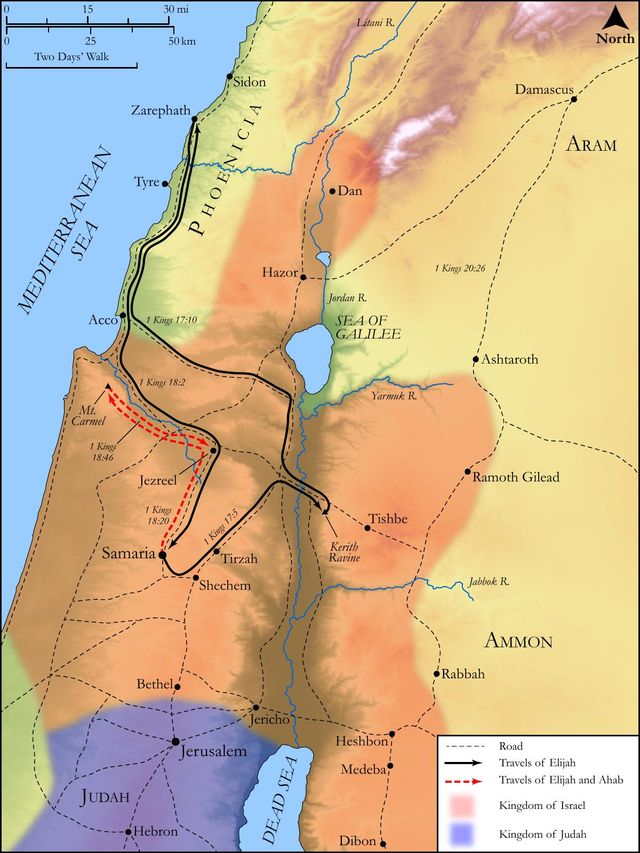
See on the biblical-era maps

Study this verse
Public-domain commentary
Matthew Henry
From his Commentary on the Whole Bible. Henry comments on passages, not single verses — this entry covers 1 Kings 17:17–24. His two-level outline is real structure in the source text, so it is rendered as structure.
We have here a further recompence made to the widow for her kindness to the prophet; as if it were a small thing to be kept alive, her son, when dead, is restored to life, and so restored to her. Observe,
I.The sickness and death of the child.
For aught that appears he was her only son, the comfort of her widowed estate. He was fed miraculously, and yet that did not secure him from sickness and death. Your fathers did eat manna, and are dead, but there is bread of which a man may eat and not die, which was given for the life of the world, Joh 6:49, Joh 6:50. The affliction was to this widow as a thorn in the flesh, lest she should be lifted up above measure with the favours that were done her and the honours that were put upon her.
1.She was nurse to a great prophet, was employed to sustain him, and had strong reason to think the Lord would do her good; yet now she loses her child. Note, We must not think it strange if we meet with very sharp afflictions, even when we are in the way of duty, and of eminent service to God.
2.She was herself nursed by miracle, and kept a good house without charge or care, by a distinguishing blessing from heaven; and in the midst of all this satisfaction she was thus afflicted. Note, When we have the clearest manifestations of God's favour and good-will towards us, even then we must prepare for the rebukes of Providence. Our mountain never stands so strong but it may be moved, and therefore, in this world, we must always rejoice with trembling.
II.Her pathetic complaint to the prophet of this affliction.
It should seem, the child died suddenly, else she would have applied to Elijah, while he was sick, for the cure of him; but being dead, dead in her bosom, she expostulates with the prophet upon it, rather to give vent to her sorrow than in any hope of relief, Kg1 17:18. 1. She expresses herself passionately: What have I to do with thee, O thou man of God? How calmly had she spoken of her own and her child's death when she expected to die for want (Kg1 17:12) - that we may eat, and die! Yet now that her child dies, and not so miserably as by famine, she is extremely disturbed at it. We may speak lightly of an affliction at a distance, but when it toucheth us we are troubled, Job 4:5. Then she spoke deliberately, now in haste; the death of her child was now a surprise to her, and it is hard to keep our spirits composed when troubles come upon us suddenly and unexpectedly, and in the midst of our peace and prosperity. She calls him a man of God, and yet quarrels with him as if he had occasioned the death of her child, and is ready to which she had never seen him, forgetting past mercies and miracles: "What have I done against thee?" (so some understand it), "Wherein have I offended thee, or been wanting in my duty? Show me wherefore thou contendest with me." 2. Yet she expresses herself penitently: "Hast thou come to call my sin to thy remembrance, as the cause of the affliction, and so to call it to my remembrance, as the effect of the affliction?" Perhaps she knew of Elijah's intercession against Israel, and, being conscious to herself of sin, perhaps her former worshipping of Baal the god of the Sidonians, she apprehends he had made intercession against her. Note, (1.) When God removes our comforts from use he remembers our sins against us, perhaps the iniquities of our youth, though long since past, Job 13:26. Our sins are the death of our children. (2.) When God thus remembers our sins against us he designs thereby to make us remember them against ourselves and repent of them.
III.The prophet's address to God upon this occasion.
He gave no answer to her expostulation, but brought it to God, and laid the case before him, not knowing what to say to it himself. He took the dead child from the mother's bosom to his own bed, Kg1 17:19. Probably he had taken a particular kindness to the child, and found the affliction his own more than by sympathy. He retired to his chamber, and, 1. He humbly reasons with God concerning the death of the child, Kg1 17:20. He sees death striking by commission from God: Thou hast brought this evil for is there any evil of this kind in the city, in the family, and the Lord has not done it? He pleads the greatness of the affliction to the poor mother: "It is evil upon the widow; thou art the widow's God, and dost not usually bring evil upon widows; it is affliction added to the afflicted." He pleads his own concern: "It is the widow with whom I sojourn; wilt thou, that art my God, bring evil upon one of the best of my benefactors? I shall be reflected upon, and others will be afraid of entertaining me, if I bring death into the house where I come." 2. He earnestly begs of God to restore the child to life again, Kg1 17:21. We do not read before this of any that were raised to life; yet Elijah, by a divine impulse, prays for the resurrection of this child, which yet will not warrant us to do the like. David expected not, by fasting and prayer, to bring his child back to life (Sa2 12:23), but Elijah had a power to work miracles, which David had not. He stretched himself upon the child, to affect himself with the case and to show how much he was affected with it and how desirous he was of the restoration of the child - he would if he could put life into him by his own breath and warmth; also to give a sign of what God would do by his power, and what he does by his grace, in raising dead souls to a spiritual life; the Holy Ghost comes upon them, overshadows them, and puts life into them. He is very particular in his prayer: I pray thee let this child's soul come into him again, which plainly supposes the existence of the soul in a state of separation from the body, and consequently its immortality, which Grotius thinks God designed by this miracle to give intimation and evidence of, for the encouragement of his suffering people.
IV.The resurrection of the child, and the great satisfaction it gave to the mother:
the child revived, Kg1 17:22. See the power of prayer and the power of him that hears prayer, who kills and makes alive. Elijah brought him to his mother, who, we may suppose, could scarcely believe her own eyes, and therefore Elijah assures her it is her own: "It is thy son that liveth; see it is thy own, and not another," Kg1 17:23. The good woman hereupon cries out, Now I know that thou art a man of God; though she knew it before, by the increase of her meal, yet the death of her child she took so unkindly that she began to question it (a good man surely would not serve her so); but now she was abundantly satisfied that he had both the power and goodness of a man of God, and will never doubt of it again, but give up herself to the direction of his word and the worship of the God of Israel. Thus the death of the child (like that of Lazarus, Joh 11:4) was for the glory of God and the honour of his prophet.
Historical interpretation
Historical reception
1 surviving comment on this verse from the historical church.
Observe carefully the tears of that woman, and see her humility in her grief, because she does not at all blame the judgment of God or rise against the prophet. In the humility of her intellect, she recognizes that that sentence struck her because of her guilt, and she says to the prophet, “You have come to me to bring my sin to remembrance.”
Continue studying 1 Kings 17:17 across the web’s major study libraries — every link below opens this exact verse, chapter, or book on the destination site.
Read & Compare
 BibleGatewayThis verse in more than 200 translations and 70 languages.
 Bible.comThe YouVersion reader — hundreds of translations, reading plans, and highlights.
 ESV.orgCrossway's official English Standard Version reader.
 NET BibleThe NET translation with 60,000+ translators' notes on every rendering decision.
 STEP BibleTyndale House's free study tool — original text, vocabulary, and scholarly resources.
 BibliaLogos Bible Software's free web reader.
 USCCBThe New American Bible (Revised Edition) with the U.S. bishops' study notes.
Commentaries
 BibleHub CommentariesDozens of classic commentaries on this verse, gathered on one page.
 StudyLightMore than 100 commentary sets — the largest collection on the web.
 BibleRefPlain-English commentary on what this verse means, verse by verse.
 Enduring WordDavid Guzik's free commentary on this chapter, widely used by Bible teachers.
 Bible Study ToolsVerse commentary alongside Greek and Hebrew study aids.
Original Language & Research
- BibleHub InterlinearThe verse word by word — original language, transliteration, and English.
- BibleHub LexiconEvery word's original-language definition and Strong's entry.
 Blue Letter BibleDeep-study tools — Strong's numbers, concordance, and word studies.
 SefariaThe Hebrew text with Rashi and centuries of Jewish commentary.
Sermons, Hymns & Audio


TrulyRandomVerse is not affiliated with these sites and doesn’t control their content. They’re linked because they’re genuinely useful.
Summary
Following a period of miraculous provision where the flour and oil in the widow of Zarephath's jar did not fail, a sudden and devastating crisis struck her household: her only son fell gravely ill. The severity of his condition escalated rapidly, culminating in his death, a stark reality conveyed by the unequivocal statement that "there was no breath left in him." This profound tragedy, immediately after a divine blessing, set the stage for an even greater demonstration of God's power and sovereignty over life and death, challenging the faith of the widow and preparing for a pivotal moment in Elijah's prophetic ministry.
Context
ShowHideLiterary Context
This verse marks an abrupt and dramatic shift in the narrative of 1 Kings 17. Immediately preceding this crisis, the prophet Elijah had been miraculously sustained by God, first by ravens (1 Kings 17:2-7), and then by being sent to the widow of Zarephath. Verses 1 Kings 17:8-16 detail the extraordinary provision of God, where the widow's small amount of flour and oil miraculously did not run out, sustaining her, her son, and Elijah during a severe drought. The sudden illness and death of the son in verse 17, therefore, comes as a profound shock, juxtaposing divine blessing with acute suffering and setting the stage for an even more profound display of God's power over life itself. It serves as a narrative pivot, moving from sustenance to resurrection, intensifying the stakes and preparing for a climactic demonstration of Yahweh's unique authority.
Historical & Cultural Context
The events unfold in Zarephath, a town in Sidonian territory, specifically under the rule of King Ethbaal, father of Jezebel, who was a staunch worshiper of Baal. This setting is significant because Elijah, the prophet of Yahweh, is ministering outside the traditional boundaries of Israel, demonstrating God's sovereignty and compassion extending even to Gentiles. The severe drought, prophesied by Elijah in 1 Kings 17:1, was a divine judgment against Baal worship, as Baal was believed to be the god of rain and fertility. In this culture, the death of a male heir was catastrophic for a widow, as it meant the loss of her future support, lineage, and social standing. Her son was her only hope for security and continuation of her family line in a society without provisions for the needy, making his death an absolute and devastating personal tragedy that left her utterly vulnerable.
Key Themes
ShowHideThe sudden death of the widow's son powerfully underscores several key themes within 1 Kings 17 and the broader narrative of the book. Firstly, it highlights Divine Sovereignty Over Life and Death, asserting God's ultimate authority even in the most dire circumstances, contrasting sharply with the impotence of Baal, who could not even bring rain, let alone life. Secondly, it presents a profound Testing of Faith, particularly for the widow who had just witnessed God's miraculous provision; this new crisis forces her to confront deeper questions about God's presence and purpose, echoing the trials faced by figures like Job (Job 1:21). Thirdly, the event serves as a Preparation for God's Glory, as this seemingly tragic turn of events is divinely orchestrated to reveal Yahweh's power through Elijah in a way that will solidify his prophetic authority and demonstrate God's compassion. Finally, it emphasizes the Severity of the Crisis, with the phrase "no breath left in him" leaving no ambiguity about the son's death, thereby amplifying the magnitude of the miracle that is about to unfold and setting a high bar for divine intervention.
Exposition and Analysis
ShowHideKey Word Analysis
ShowHideThis word, H1697, is exceptionally broad in its meaning, encompassing "word," "matter," "thing," "affair," or "deed." In the phrase "after these things," it refers to the preceding events of miraculous sustenance and provision that Elijah and the widow had experienced. Its use here serves as a narrative bridge, linking the period of divine blessing to the sudden onset of crisis, indicating that the death of the son is a new development following the established pattern of God's provision.
Derived from H2389, this term typically means "strong" or "firm," but here, as an adjective describing the sickness, it conveys an intense and severe quality. The illness was not merely a slight indisposition but possessed a powerful, overwhelming force that rapidly incapacitated the boy, leading directly to his demise. It emphasizes the dire and critical nature of his condition, suggesting an unstoppable progression towards death.
This word, H5397, refers to the "breath of life" or "spirit," which in biblical thought is the vital animating principle that distinguishes a living being from a dead one, often associated with the divine act of creation (Genesis 2:7). Its complete absence ("no breath left in him") unequivocally confirms the son's death, distinguishing his state from mere unconsciousness, a coma, or severe illness. This precise phrasing leaves no room for doubt regarding the reality of his death, making the subsequent resurrection a true and profound miracle over the cessation of life itself.
Verse Breakdown
ShowHide"And it came to pass after these things,"
This introductory phrase functions as a temporal and narrative connector, signaling a new, significant development in the story. It explicitly links the current tragic event to the preceding period of miraculous sustenance of the flour and oil, creating a stark and dramatic contrast between divine blessing and sudden, devastating crisis. It sets the stage for a shift in the narrative's focus from provision to a deeper test of faith and a greater display of God's power.
"[that] the son of the woman, the mistress of the house, fell sick;"
This clause precisely identifies the victim of the illness as the widow's only son, immediately highlighting the profound personal tragedy. The designation "the mistress of the house" emphasizes her status as the homeowner and the one providing hospitality to Elijah, making the suffering even more poignant for the prophet and the reader, as it directly impacts his benefactor. The sudden onset of sickness initiates the crisis, marking the beginning of the end for the boy's earthly life.
"and his sickness was so sore, that there was no breath left in him."
This final clause describes the rapid and fatal progression of the illness. The intensity of the sickness, described as "so sore," leaves no doubt about its severity and terminal nature. The ultimate outcome is explicitly stated by the phrase "there was no breath left in him," which is an unambiguous declaration of death. This definitive confirmation of the boy's demise is crucial, establishing the absolute direness of the situation and setting the stage for the miraculous intervention that follows, ensuring that the subsequent act of revival is understood as a true resurrection.
Literary Devices
ShowHideThe verse employs several powerful literary devices to heighten its impact and underscore its theological significance. Juxtaposition is prominently featured, contrasting the recent, ongoing miracle of unfailing provision (1 Kings 17:8-16) with the sudden, devastating reality of death. This stark opposition underscores the unpredictable nature of life, the depth of human vulnerability, and the sovereignty of God over both blessing and suffering. Pathos is powerfully evoked, as the reader is made to feel the profound sorrow and despair of the widow, whose last hope and means of support has been taken from her, intensifying the emotional weight of the narrative. The precise and unambiguous declaration, "there was no breath left in him," functions as Foreshadowing, signaling that a truly monumental divine act will be required to resolve this crisis, hinting at the miracle of resurrection to come. Furthermore, the narrative uses Dramatic Irony, as the reader, aware of Elijah's prophetic power and God's overarching plan, anticipates a divine response, even as the characters within the story are gripped by despair and hopelessness, creating narrative tension.
Theological and Thematic Connections
ShowHideThe death of the widow's son in Zarephath serves as a profound theological statement on God's absolute sovereignty, not only over natural phenomena like drought and provision but ultimately over life and death itself. This tragic event, occurring immediately after a period of divine blessing, challenges the simplistic notion that God's favor always equates to an absence of suffering. Instead, it reveals that God sometimes permits trials, even devastating ones, to deepen faith, reveal His glory in unprecedented ways, and demonstrate His power to transcend human limitations, including death. It underscores that God's purposes are often far grander than immediate comfort, preparing the way for a demonstration of His life-giving power through His chosen prophet, Elijah, and ultimately pointing to the greater resurrection power of Christ.
Reflection and Application
ShowHideThe narrative of the widow's son falling sick and dying, even after experiencing God's miraculous provision, offers a sobering yet profoundly hopeful lesson for believers. It reminds us that God's blessings do not exempt us from the realities of a fallen world, including sickness, loss, and death. Moments of profound crisis, even those that follow periods of divine favor, are not necessarily indicators of God's displeasure or absence. Instead, they can be divinely appointed opportunities for God to reveal a deeper, more powerful dimension of His character and sovereignty than we have yet witnessed. This passage encourages us to cultivate a faith that trusts God not only in the provision of daily bread but also in the face of insurmountable loss, believing that He holds ultimate control over life and death and can bring life even from the grave. It challenges us to look beyond immediate circumstances to discern God's larger, redemptive purposes, knowing that He is capable of intervening in the most desperate situations to display His glory and compassion, drawing us into a deeper, more resilient dependence on Him.
Questions for Reflection
ShowHideFAQ
ShowHideWhy did the son die after God had just provided for the family through a miracle?
ShowHideThe son's death was not a punishment or a sign of God's abandonment, but rather a crucial part of God's divine plan to demonstrate His ultimate power and solidify Elijah's prophetic authority. Having already shown His power over nature (drought) and provision (unfailing flour and oil), God now intended to reveal His sovereignty over life and death itself. This profound tragedy served to deepen the widow's faith, move her to a place of desperate dependence on God through His prophet, and ultimately set the stage for one of the most remarkable miracles in the Old Testament: a resurrection. It also underscored God's compassion and willingness to work miracles even for those outside the covenant people of Israel, as seen in God's directive to Elijah in 1 Kings 17:9.
Does "no breath left in him" definitively mean death, or just severe illness?
ShowHideThe phrase "no breath left in him" unequivocally signifies death. The Hebrew word neshamah (נְשָׁמָה), translated as "breath," refers to the "breath of life" or "spirit," which in biblical thought is the animating principle that distinguishes a living being from a dead one. Its complete absence means the cessation of life, as when God "breathed into his nostrils the breath of life" to make Adam a living being in Genesis 2:7. This clear declaration of death is vital to the narrative, as it establishes the absolute direness of the situation and the magnitude of the miracle that follows. It ensures that the subsequent act of revival is understood as a true resurrection from death, not merely a recovery from a severe illness or a state of unconsciousness.
Christ-Centered Fulfillment
ShowHideThe tragic death of the widow's son in Zarephath, and his subsequent miraculous resurrection through Elijah, serves as a powerful Old Testament foreshadowing of Christ's ultimate victory over death and His role as the giver of life. Elijah, as God's prophet, was an instrument of divine power, bringing life back to a lifeless body. This prefigures Jesus, who is not merely an instrument but the very source of life itself, embodying the divine authority over death. Jesus declared, "I am the resurrection and the life. Whoever believes in me, though he die, yet shall he live" (John 11:25). Just as Elijah restored the widow's son, Jesus compassionately raised the widow of Nain's son (Luke 7:11-17) and Jairus's daughter (Mark 5:35-43), demonstrating His intrinsic authority over death. The temporary restoration of life in the Old Testament points to Christ's eternal life-giving power, not just for physical bodies, but for the spiritual dead, offering new life to all who believe. The "breath of life" that departed the Zarephath boy finds its ultimate and permanent fulfillment in the Spirit of Christ, who gives life to our mortal bodies and promises resurrection to eternal life (Romans 8:11).