


1 Kings 17:14
Bible text: King James Version (1769 Blayney text) · Public domain
Bible text: King James Version with Strong's numbers · Public domain
Bible text: Berean Standard Bible · Public domain
Bible text: American Standard Version (1901) · Public domain
Bible text: World English Bible, Messianic edition · Public domain
Bible text: Geneva Bible (1599) · Public domain
Bible text: Young's Literal Translation · Public domain
- כִּיkiforH3588PrtParticle Conditional
- כֹהkhohthusH3541AdvAdverb
- אָמַר'a·Marhe saysH559V-Qal-Perf-3msVerb Qal Perfect 3rd Singular Masculine
- יְהוָהYah·wehYahwehH3068N-properNoun Proper Title
- אֱלֹהֵי'e·lo·Hei[the] God ofH430N-mpcNoun Plural Masculine Construct
- יִשְׂרָאֵלYis·ra·'ElIsraelH3478N-properNoun Proper Location
- כַּדkad[the] jar ofH3537N-fscNoun Singular Feminine Construct
- הַקֶּמַחha·Ke·mach<the> flourH7058Art ¦ N-msNoun Singular Masculine Absoluteהַ<the>קֶּמַחflour
- לֹאlo'notH3808NegParticle Negative
- תִכְלָהtikh·Lahit will be at an endH3615V-Qal-Imperf-3fsVerb Qal Imperfect 3rd Singular Feminine
- וְצַפַּחַתve·tza·Pa·chatand [the] jug ofH6835Conj-w ¦ N-fscNoun Singular Feminine Constructוְandצַפַּחַת[the] jug of
- הַשֶּׁמֶןha·She·men<the> oilH8081Art ¦ N-msNoun Singular Masculine Absoluteהַ<the>שֶּׁמֶןoil
- לֹאlo'notH3808NegParticle Negative
- תֶחְסָרtech·Sarit will be lackingH2637V-Qal-Imperf-3fsVerb Qal Imperfect 3rd Singular Feminine
- עַד'aduntilH5704PrepPreposition
- יוֹםYom[the] dayH3117N-msNoun Singular Masculine Absolute
- תֵּתti·tengivesH5414V-Qal-InfVerb Qal Infinitive Construct
- יְהוָהha·shemYahwehH3068N-properNoun Proper Title
- גֶּשֶׁםGe·shemrainH1653N-msNoun Singular Masculine Absolute
- עַל'alonH5921PrepPreposition
- פְּנֵיpe·Nei[the] surface ofH6440N-mpcNoun Plural Masculine Construct
- הָאֲדָמָהha·'a·da·Mahthe groundH127Art ¦ N-fsNoun Singular Feminine Absoluteהָtheאֲדָמָהground
English is a literal word-by-word gloss of the Hebrew, not the KJV's wording. Why?
This is the original text the KJV's translators worked from — each Hebrew word with its own literal English meaning in this verse, prepared by scholars at Tyndale House, Cambridge. The KJV translates whole sentences, not word by word, so its wording differs: one Hebrew word can become several English words, and the KJV may choose “the LORD” where the gloss reads “Yahweh”. Both are faithful — they answer different questions. For the KJV's own rendering, switch to the KJV text.
Details
See on the biblical-era maps
Study this verse
Public-domain commentary
Matthew Henry
From his Commentary on the Whole Bible. Henry comments on passages, not single verses — this entry covers 1 Kings 17:8–16. His three-level outline is real structure in the source text, so it is rendered as structure.
We have here an account of the further protection Elijah was taken under, and the further provision made for him in his retirement. At destruction and famine he shall laugh that has God for his friend to guard and maintain him. The brook Cherith is dried up, but God's care of his people, and kindness to them, never slacken, never fail, but are still the same, are still continued and drawn out to those that know him, Psa 36:10. When the brook was dried up Jordan was not; why did not God send him thither? Surely because he would show that he has a variety of ways to provide for his people and is not tied to any one. God will now provide for him where he shall have some company and opportunity of usefulness, and not be, as he had been, buried alive. Observe,
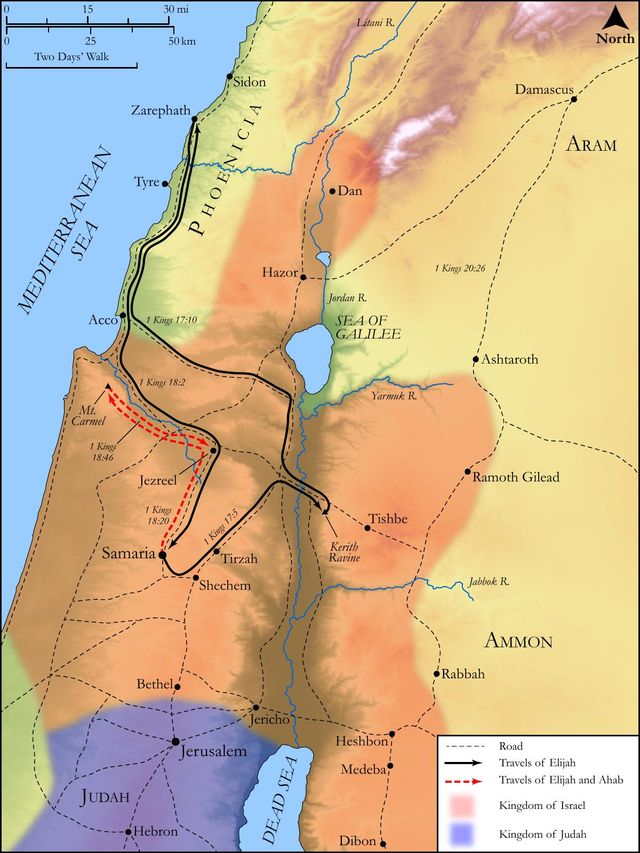
I.The place he is sent to, to Zarephath, or Sarepta, a city of Sidon, out of the borders of the land of Israel, Kg1 17:9.
Our Saviour takes notice of this as an early and ancient indication of the favour of God designed for the poor Gentiles, in the fulness of time, Luk 4:25, Luk 4:26. Many widows were in Israel in the days of Elias, and some, it is likely, that would have bidden him welcome to their houses; yet he is sent to honour and bless with his presence a city of Sidon, a Gentile city, and so becomes (says Dr. Lightfoot) the first prophet of the Gentiles. Israel had corrupted themselves with the idolatries of the nations and become worse than they; justly therefore is the casting off of them the riches of the world. Elijah was hated and driven out by his countrymen; therefore, lo, he turns to the Gentiles, as the apostles were afterwards ordered to do, Act 18:6. But why to a city of Sidon? Perhaps because the worship of Baal, which was now the crying sin of Israel, came lately thence with Jezebel, who was a Sidonian (Kg1 16:31); therefore thither he shall go, that thence may be fetched the destroyer of that idolatry, "Even out of Sidon have I called my prophet, my reformer." Jezebel was Elijah's greatest enemy; yet, to show her the impotency of her malice, God will find a hiding-place for him even in her country. Christ never went among the Gentiles except once into the coast of Sidon, Mat 15:21.
II.The person that is appointed to entertain him, not one of the rich merchants or great men, of Sidon, not such a one as Obadiah, that was governor of Ahab's house and fed the prophets; but a poor widow woman, destitute and desolate, is commanded (that is, is made both able and willing) to sustain him. It is God's way, and it is his glory, to make use of the weak and foolish things of the world and put honour upon them. He is, in a special manner, the widows' God, and feeds them, and therefore they must study what they shall render to him.
III.The provision made for him there.
Providence brought the widow woman to meet him very opportunely at the gate of the city (Kg1 17:10), and, by what is here related of what passed between Elijah and her, we find,
1.Her case and character; and it appears,
(1.)That she was very poor and necessitous. She had nothing to live upon but a handful of meal and a little oil, needy at the best, and now, by the general scarcity, reduced to the last extremity. When she has eaten the little she has, for aught she yet sees, she must die for want, she and her son, Kg1 17:12. She had no fuel but the sticks she gathered in the streets, and, having no servant, she must gather them herself (Kg1 17:10), being thus more in a condition to receive alms than give entertainment. To her Elijah was sent, that he might still live upon Providence as much as he did when the ravens fed him. It was in compassion to the low estate of his handmaiden that God sent the prophet to her, not to beg of her, but to board with her, and he would pay well for his table.
(2.)That she was very humble and industrious. He found her gathering sticks, and preparing to bake her own bread, Kg1 17:10, Kg1 17:12. Her mind was brought to her condition, and she complained not of the hardship she was brought to, nor quarrelled with the divine Providence for withholding rain, but accommodated herself to it as well as she could. Such as are of this temper in a day of trouble are best prepared for honour and relief from God.
(3.)That she was very charitable and generous. When this stranger desired her to go and fetch him some water to drink, she readily went, at the first word, Kg1 17:10, Kg1 17:11. She objected not to the present scarcity of it, nor asked him what he would give her for a draught of water (for now it was worth money), nor hinted that he was a stranger, an Israelite, with whom perhaps the Sidonians cared not for having any dealings, any more than the Samaritans, Joh 4:9. She did not excuse herself on account of her weakness through famine, or the urgency of her own affairs, did not tell him she had something else to do than to go on his errands, but left off gathering the sticks for herself to fetch water for him, which perhaps she did the more willingly, being moved with the gravity of his aspect. We should be ready to do any office of kindness even to strangers; if we have not wherewith to give to the distressed, we must be the more ready to work for them. A cup of cold water, though it cost us no more than the labour of fetching, shall in no wise lose its reward.
(4.)That she had a great confidence in the word of God. It was a great trial for her faith and obedience when, having gold the prophet how low her stock of meal and oil was and that she had but just enough for herself and her son, he bade her make a cake for him, and make his first, and then prepare for herself and her son. If we consider, it will appear as great a trial as could be in so small a matter. "Let the children first be served" (might she have said); "charity begins at home. I cannot be expected to give, having but little, and not knowing, when that is gone, where to obtain more." She had much more reason than Nabal to ask, "Shall I take my meat and my oil and give it to one that I know not whence he is?" Elijah, it is true, made mention of the God of Israel (Kg1 17:14), but what was that to a Sidonian? Or if she had a veneration for the name Jehovah, and valued the God of Israel as the true God, yet what assurance had she that this stranger was his prophet or had any warrant to speak in his name? It was easy for a hungry vagrant to impose upon her. But she gets over all these objections, and obeys the precept in dependence upon the promise: She went and did according to the saying of Elijah, Kg1 17:15. O woman! great was thy faith; one has not found the like, no, not in Israel: all things considered, it exceeded that of the widow who, when she had but two mites, cast them into the treasury. She took the prophet's word, that she should not lose by it, but it should be repaid with interest. Those that can venture upon the promise of God will make no difficulty of exposing and emptying themselves in his service, by giving him his dues out of a little and giving him his part first. Those that deal with God must deal upon trust; seek first his kingdom, and then other things shall be added. By the law, the first-fruits were God's, the tithe was taken out first, and the heave-offering of their dough was first offered, Num 15:20, Num 15:21. But surely the increase of this widow's faith, to such a degree as to enable her thus to deny herself and to depend upon the divine promise, was as great a miracle in the kingdom of grace as the increase of her oil was in the kingdom of providence. Happy are those who can thus, against hope, believe and obey in hope.
2.The care God took of her guest: The barrel of meal wasted not, nor did the cruse of oil fail, but still as they took from them more was added to them by the divine power, Kg1 17:16. Never did corn or olive so increase in the growing (says bishop Hall) as these did in the using; but the multiplying of the seed sown (Co2 9:10) in the common course of providence is an instance of the power and goodness of God not to be overlooked because common. The meal and the oil multiplied, not in the hoarding, but in the spending; for there is that scattereth and yet increaseth. When God blesses a little, it will go a great way, even beyond expectation; as, on the contrary, though there be abundance, if he blow upon it, it comes to little, Hag 1:9; Hag 2:16.
(1.)This was a maintenance for the prophet. Still miracles shall be his daily bread. Hitherto he had been fed with bread and flesh, now he was fed with bread and oil, which they used as we do butter. Manna was both, for the taste of it was as the taste of fresh oil, Num 11:8. This Elijah was thankful for, though he had been used to flesh twice a day and now had none at all. Those that cannot live without flesh, once a day at least, because they have been used to it, could not have boarded contentedly with Elijah, no, not to live upon a miracle.
(2.)It was a maintenance for the poor widow and her son, and a recompence to her for entertaining the prophet. There is nothing lost by being kind to God's people and ministers; she that received a prophet had a prophet's reward; she gave him house-room, and he repaid her with food for her household. Christ has promised to those who open their doors to him that he will come in to them, and sup with them, and they with him, Rev 3:20. Like Elijah here, he brings to those who bid him welcome, not only his own entertainment, but theirs too. See how the reward answered the service. She generously made one cake for the prophet, and was repaid with many for herself and her son. When Abraham offers his only son to God he is told he shall be the father of multitudes. What is laid out in piety or charity is let out to the best interest, upon the best securities. One poor meal's meat this poor widow gave the prophet, and, in recompence of it, she and her son did eat many days (Kg1 17:15), above two years, in a time of general scarcity; and to have their food from God's special favour, and to eat it in such good company as Elijah's, made it more than doubly sweet. It is promised to those that trust in God that they shall not be ashamed in the evil time, but in the days of famine they shall be satisfied, Psa 37:19.
Continue studying 1 Kings 17:14 across the web’s major study libraries — every link below opens this exact verse, chapter, or book on the destination site.
Read & Compare
 BibleGatewayThis verse in more than 200 translations and 70 languages.
 Bible.comThe YouVersion reader — hundreds of translations, reading plans, and highlights.
 ESV.orgCrossway's official English Standard Version reader.
 NET BibleThe NET translation with 60,000+ translators' notes on every rendering decision.
 STEP BibleTyndale House's free study tool — original text, vocabulary, and scholarly resources.
 BibliaLogos Bible Software's free web reader.
 USCCBThe New American Bible (Revised Edition) with the U.S. bishops' study notes.
Commentaries
 BibleHub CommentariesDozens of classic commentaries on this verse, gathered on one page.
 StudyLightMore than 100 commentary sets — the largest collection on the web.
 BibleRefPlain-English commentary on what this verse means, verse by verse.
 Enduring WordDavid Guzik's free commentary on this chapter, widely used by Bible teachers.
 Bible Study ToolsVerse commentary alongside Greek and Hebrew study aids.
Original Language & Research
- BibleHub InterlinearThe verse word by word — original language, transliteration, and English.
- BibleHub LexiconEvery word's original-language definition and Strong's entry.
 Blue Letter BibleDeep-study tools — Strong's numbers, concordance, and word studies.
 SefariaThe Hebrew text with Rashi and centuries of Jewish commentary.
Sermons, Hymns & Audio


TrulyRandomVerse is not affiliated with these sites and doesn’t control their content. They’re linked because they’re genuinely useful.
Summary
1 Kings 17:14 delivers a profound divine guarantee through the prophet Elijah to the destitute widow of Zarephath, promising an unfailing, miraculous supply of meal and oil for her and her household. This authoritative declaration, originating from "the LORD God of Israel," assures continuous sustenance during a severe famine, contingent upon her initial act of faith and obedience, and is precisely limited by God's sovereign timing for the cessation of the drought. It powerfully illustrates God's intimate care, supernatural provision, and unwavering faithfulness to those who trust Him, even in the direst and most hopeless circumstances.
Context
ShowHideLiterary Context
This verse marks a pivotal moment in the unfolding narrative of Elijah's prophetic ministry, set against the backdrop of rampant national apostasy in Israel. The preceding verses establish the context of divine judgment: 1 Kings 17:1 records Elijah's bold declaration of a severe drought, a direct consequence of King Ahab and Queen Jezebel's promotion of Baal worship. God then directs Elijah, first to the Wadi Cherith for miraculous provision by ravens, and subsequently to Zarephath in Sidon. There, Elijah encounters a widow on the brink of starvation, preparing what she believes will be her and her son's final meal. In 1 Kings 17:13, Elijah issues a seemingly impossible command: to bake a small cake for him first, promising divine provision in return. Verse 14 is the direct, authoritative word from Yahweh, validating Elijah's promise and initiating the continuous miracle that follows, thereby demonstrating God's unwavering faithfulness to His word spoken through His chosen messenger.
Historical & Cultural Context
The historical setting is the reign of King Ahab in ancient Israel, a period characterized by state-sponsored idolatry, particularly the worship of Baal, the Canaanite god of rain and fertility. The drought, prophesied by Elijah and lasting three and a half years (James 5:17), was a direct divine challenge to Baal's supposed authority, unequivocally demonstrating Yahweh's supreme control over creation. Zarephath, located in Sidon (modern-day Lebanon), was a Gentile territory, making God's choice to sustain His prophet through a non-Israelite widow particularly significant and indicative of His universal sovereignty. Famine was a catastrophic reality, as in the days of Abraham, of Joseph and of David, leading to widespread suffering and death. The "barrel of meal" and "cruse of oil" were fundamental household staples, representing the most basic means of survival. The widow's desperate situation—preparing her "last handful of flour and a little oil"—vividly portrays the extreme desperation and the cultural reality of subsistence living, where even the smallest reserves were precious and their depletion meant certain death.
Key Themes
ShowHideThis verse powerfully encapsulates several foundational theological themes. Firstly, Divine Provision is central, showcasing God's supernatural ability to sustain life against all natural odds. The continuous, non-depleting supply of meal and oil underscores His meticulous and intimate care for the daily needs of His people, even when all human resources are exhausted. Secondly, Faith and Obedience are inextricably linked to the miraculous intervention. The widow's radical willingness to obey Elijah's counter-intuitive command, giving her last to a stranger, served as the catalyst for God's supernatural intervention, illustrating that genuine faith often necessitates radical trust and action (Hebrews 11:6). Thirdly, God's Sovereignty is profoundly evident, not only in His initiation and control over the famine itself but also in His power to suspend natural laws to fulfill His divine purposes. The provision lasts "until the day that the LORD sendeth rain," emphasizing God's ultimate control over the duration of both the judgment and its eventual end. Finally, Prophetic Authority is powerfully affirmed, as the promise originates directly from "the LORD God of Israel" through Elijah, thereby validating his role as God's authentic messenger and underscoring the absolute reliability of the divine word spoken through him, a theme echoed in Deuteronomy 18:18.
Exposition and Analysis
ShowHideKey Word Analysis
ShowHideThis is the sacred, covenant name of God, often translated as Yahweh or Jehovah. It signifies "the Self-Existent One" or "the Eternal." Its use here emphasizes that the promise is not merely a human assurance but an immutable decree from the sovereign, unchanging God who is the ultimate source of all life and provision. It underscores the absolute reliability and power behind the miraculous supply.
From a primitive root meaning "to end," "to cease," "to be finished," or "to consume." In this context, it powerfully conveys that the meal would not diminish, be used up, or run out. It signifies a continuous, non-depleting supply, ensuring sufficiency day after day. The negative form highlights the supernatural suspension of natural processes of consumption.
A primitive root meaning "to lack," "to diminish," "to be wanting," or "to be abated." This word reinforces the meaning of "waste," emphasizing that the oil would not be insufficient or lacking at any point. Together, "waste" and "fail" promise an uninterrupted, complete, and supernaturally sustained provision, defying the laws of scarcity.
Verse Breakdown
ShowHide"For thus saith the LORD God of Israel,"
This opening phrase serves as a powerful divine fiat, establishing the absolute authority and immutable reliability of the promise that follows. It is not Elijah's personal assurance but the direct, authoritative pronouncement of Yahweh, the covenant God of Israel, whose word is truth and whose power transcends all natural limitations. This divine declaration underscores the certainty and supernatural origin of the miracle.
"The barrel of meal shall not waste, neither shall the cruse of oil fail,"
This is the core of the miraculous guarantee. It promises a continuous, supernatural replenishment of the most basic and essential necessities—flour and oil—which were the staples of life in that culture. The double negative ("shall not waste, neither shall... fail") emphatically stresses the absolute certainty and non-depleting nature of the provision, ensuring that the widow and her son would not experience hunger or lack for the duration of the famine.
"until the day [that] the LORD sendeth rain upon the earth."
This crucial clause defines the precise duration and ultimate termination of the miraculous provision. It highlights God's sovereign control over the famine itself, indicating that the miracle would last exactly as long as the drought, which was also initiated and controlled by God. This demonstrates that the provision was not an end in itself, but a divinely ordained means to sustain life until God's larger plan of ending the judgment and restoring the land was fulfilled.
Literary Devices
ShowHideThe verse employs several potent literary devices to convey its profound message. Divine Fiat is paramount, beginning with "Thus saith the LORD God of Israel," which immediately establishes the absolute authority and certainty of the pronouncement, elevating the promise beyond human capability or natural law. The use of Parallelism in "The barrel of meal shall not waste, neither shall the cruse of oil fail" creates a rhythmic emphasis and reinforces the dual, continuous nature of the provision for both essential staples. Symbolism is also powerfully at play, as the humble "barrel of meal" and "cruse of oil" symbolize not just physical sustenance but God's intimate, daily, and miraculous care for the most vulnerable, demonstrating His ability to provide abundantly from seemingly meager resources. Furthermore, the phrase "until the day that the LORD sendeth rain" functions as a Temporal Boundary, setting a clear, divinely ordained limit to the miracle, thereby underscoring God's ultimate sovereignty over both the famine and its resolution.
Theological and Thematic Connections
ShowHide1 Kings 17:14 stands as a powerful testament to God's character as a faithful, omnipotent, and profoundly compassionate provider. It reveals that God's care extends even to those outside the covenant community of Israel, demonstrating His universal sovereignty and boundless grace. The miracle is not merely about physical sustenance but serves as a profound lesson in building faith and revealing God's glory in desperate circumstances. It teaches that God often uses unconventional means and seemingly impossible situations to display His power, inviting His people to radical trust and complete dependence. This divine provision, contingent on the widow's obedience, illustrates a profound theological principle: God often waits for human faith and action—even a small step of obedience—before unleashing His supernatural power, transforming scarcity into abundance and despair into hope.
Reflection and Application
ShowHideThe divine promise in 1 Kings 17:14 offers profound encouragement and a timeless challenge for believers today. In a world often marked by economic uncertainty, personal anxieties, and a pervasive sense of scarcity, this verse serves as a powerful reminder that our ultimate source of provision is not our income, our savings, or our government, but the unfailing, sovereign hand of the "LORD God of Israel." It calls us to cultivate a radical trust in God's faithfulness, even when circumstances seem bleak and human resources are utterly exhausted. Like the widow, we are invited to step out in courageous obedience, offering our "first fruits" or our "last" in faith, knowing that God's economy operates on principles far beyond human comprehension. This passage also teaches us to live with a daily dependence on God, not hoarding for tomorrow but trusting Him for "daily bread," and to recognize that His provision is always sufficient for the moment, perfectly timed to meet our needs until His larger, redemptive purposes unfold. It encourages us to see every act of giving, especially sacrificial giving, as an opportunity for God to demonstrate His limitless abundance.
Questions for Reflection
ShowHideFAQ
ShowHideWhy did God send Elijah to a Gentile widow in Zarephath, outside of Israel?
ShowHideGod's decision to send Elijah to a Gentile widow in Zarephath, a town in Sidon, was profoundly significant for several reasons. Firstly, it powerfully demonstrated God's universal sovereignty and boundless compassion, showing that His care and redemptive purposes extend beyond the geographical and ethnic boundaries of Israel and His covenant people. While Israel had largely abandoned Him for Baal, God chose to sustain His prophet through a Gentile, highlighting His freedom to work through anyone He chooses. Secondly, it served as a stark and profound indictment of apostate Israel, particularly King Ahab and Queen Jezebel, who were actively promoting Baal worship. God's own people were in rebellion and suffering the consequences, yet a Gentile woman, in her desperate poverty, displayed greater faith and obedience. This act also foreshadows God's future inclusion of the Gentiles into His redemptive plan, a theme later developed and brought to full light in the New Testament (Luke 4:25-26).
Was the widow's obedience truly a "test" of her faith?
ShowHideYes, the encounter was undoubtedly a profound and challenging test of the widow's faith. Elijah's request in 1 Kings 17:13 to "make me thereof a little cake first" was humanly illogical and incredibly demanding. She was preparing her very last meal, fully expecting to die afterward with her son. To give a portion of that to a stranger, a prophet of the God she may not have fully known, required immense trust and a willingness to act against all rational self-preservation. Her obedience, born out of a desperate hope and perhaps a recognition of divine authority in Elijah's words, unlocked the miraculous provision, demonstrating that true faith often requires a radical step into the unknown, trusting God even when it defies logic.
What is the deeper significance of the "barrel of meal" and "cruse of oil" never wasting or failing?
ShowHideThe deeper significance lies in the nature of the provision: it was not a one-time abundance, but a continuous, daily supply of basic necessities. This emphasizes God's intimate and ongoing care for His people's daily needs, teaching them to depend on Him day by day rather than hoarding or worrying about the distant future. It symbolizes God's ability to sustain life in the most humble and miraculous ways, transforming scarcity into sufficiency and demonstrating His power to suspend natural laws. Furthermore, meal and oil were fundamental staples, representing life itself and the very essence of survival in that culture, making their unfailing supply a powerful demonstration of God's life-giving power even in the midst of a death-dealing famine. It teaches a lesson of persistent, daily reliance on God's faithfulness.
Christ-Centered Fulfillment
ShowHideThe miraculous provision in 1 Kings 17:14, where the barrel of meal and cruse of oil never failed, beautifully foreshadows the ultimate and unending spiritual provision found exclusively in Jesus Christ. Just as God supernaturally sustained the widow and her son physically, Jesus offers eternal spiritual sustenance that never diminishes. He declares Himself the "Bread of Life," profoundly stating that "he that cometh to me shall never hunger" (John 6:35), and the "Living Water," promising that those who drink of it "shall never thirst" (John 4:14). His own miraculous feeding of the five thousand (Matthew 14:13-21) and four thousand (Matthew 15:32-39) with meager resources powerfully echoes the multiplication in Zarephath, demonstrating His divine power over creation and His profound compassion for the hungry. Ultimately, the unfailing provision of meal and oil points to Christ's once-for-all sacrifice on the cross, which provides an eternal, inexhaustible supply of grace, forgiveness, and spiritual life for all who believe, ensuring that our spiritual "barrel of meal" and "cruse of oil" will never waste or fail. He is the ultimate fulfillment of God's promise to provide, not just for a season of famine, but for all eternity, satisfying the deepest longings of the human soul.