


1 Kings 17:13
Bible text: King James Version (1769 Blayney text) · Public domain
Bible text: King James Version with Strong's numbers · Public domain
Bible text: Berean Standard Bible · Public domain
Bible text: American Standard Version (1901) · Public domain
Bible text: World English Bible, Messianic edition · Public domain
Bible text: Geneva Bible (1599) · Public domain
Bible text: Young's Literal Translation · Public domain
- וַיֹּאמֶרvai·Yo·merand he saidH559Conj-w ¦ V-Qal-ConsecImperf-3msVerb Qal Consecutive Imperfect 3rd Singular Masculineוַandיֹּאמֶרhe said
- אֵלֶיהָ'e·Lei·hato herH413Prep ¦ 3fsPrepositionאֵלֶיtoהָher
- אֵלִיָּהוּ'e·li·Ya·huElijahH452N-proper-mNoun Proper Masculine
- אַל'almay notH408NegParticle Negative
- תִּירְאִיtir·'Iyou fearH3372V-Qal-Imperf-2fsVerb Qal Imperfect 2nd Singular Feminine
- בֹּאִיBo·'igoH935V-Qal-Imp-2fsVerb Qal Imperative 2nd Singular Feminine
- עֲשִׂי'a·SidoH6213V-Qal-Imp-2fsVerb Qal Imperative 2nd Singular Feminine
- כִדְבָרֵךְkhid·va·Rekhaccording to your wordH1697Prep-k ¦ N-msc ¦ 2fsNoun Singular Masculine Constructכִaccording toדְבָרֵwordךְyour
- אַךְ'akhonlyH389AdvAdverb
- עֲשִׂי'a·simakeH6213V-Qal-Imp-2fsVerb Qal Imperative 2nd Singular Feminine
- לִיlifor mePrep-l ¦ 1csSuffix Personal 1st Singular common genderלִforיme
- מִשָּׁםMi·shomfrom thereH8033Prep-m ¦ AdvAdverbמִfromשָּׁםthere
- עֻגָה'u·Gaha bread cakeH5692N-fsNoun Singular Feminine Absolute
- קְטַנָּהke·ta·NahsmallH6996Adj-fsAdjective Singular Feminine Absolute
- בָרִאשֹׁנָהva·ri·sho·Nahat <the> firstH7223Prep-b ¦ Adj-fsAdjective Numerical Position Singular Feminine Absoluteבָat <the>רִאשֹׁנָהfirst
- וְהוֹצֵאתְve·ho·Tzetand you will bring [it] outH3318Conj-w ¦ V-Hiphil-ConsecPerf-2fsVerb Hiphil Consecutive Perfect 2nd Singular Feminineוְandהוֹצֵאתְyou will bring [it] out
- לִיLito mePrep-l ¦ 1csSuffix Personal 1st Singular common genderלִtoיme
- וְלָךְve·Lakhand for yourselfConj-w ¦ Prep-l ¦ 2fsSuffix Personal 2nd Singular Feminineוְandלָforךְyourself
- וְלִבְנֵךְve·liv·Nekhand for your sonH1121Conj-w ¦ Prep-l ¦ N-msc ¦ 2fsNoun Singular Masculine Constructוְandלִforבְנֵsonךְyour
- תַּעֲשִׂיta·'a·Siyou will prepareH6213V-Qal-Imperf-2fsVerb Qal Imperfect 2nd Singular Feminine
- בָּאַחֲרֹנָהba·'a·cha·ro·Nahat the lastH314Prep-b ¦ Adj-fsAdjective Singular Feminine Absoluteבָּat theאַחֲרֹנָהlast
English is a literal word-by-word gloss of the Hebrew, not the KJV's wording. Why?
This is the original text the KJV's translators worked from — each Hebrew word with its own literal English meaning in this verse, prepared by scholars at Tyndale House, Cambridge. The KJV translates whole sentences, not word by word, so its wording differs: one Hebrew word can become several English words, and the KJV may choose “the LORD” where the gloss reads “Yahweh”. Both are faithful — they answer different questions. For the KJV's own rendering, switch to the KJV text.
Details
See on the biblical-era maps

Study this verse
Public-domain commentary
Matthew Henry
From his Commentary on the Whole Bible. Henry comments on passages, not single verses — this entry covers 1 Kings 17:8–16. His three-level outline is real structure in the source text, so it is rendered as structure.
We have here an account of the further protection Elijah was taken under, and the further provision made for him in his retirement. At destruction and famine he shall laugh that has God for his friend to guard and maintain him. The brook Cherith is dried up, but God's care of his people, and kindness to them, never slacken, never fail, but are still the same, are still continued and drawn out to those that know him, Psa 36:10. When the brook was dried up Jordan was not; why did not God send him thither? Surely because he would show that he has a variety of ways to provide for his people and is not tied to any one. God will now provide for him where he shall have some company and opportunity of usefulness, and not be, as he had been, buried alive. Observe,
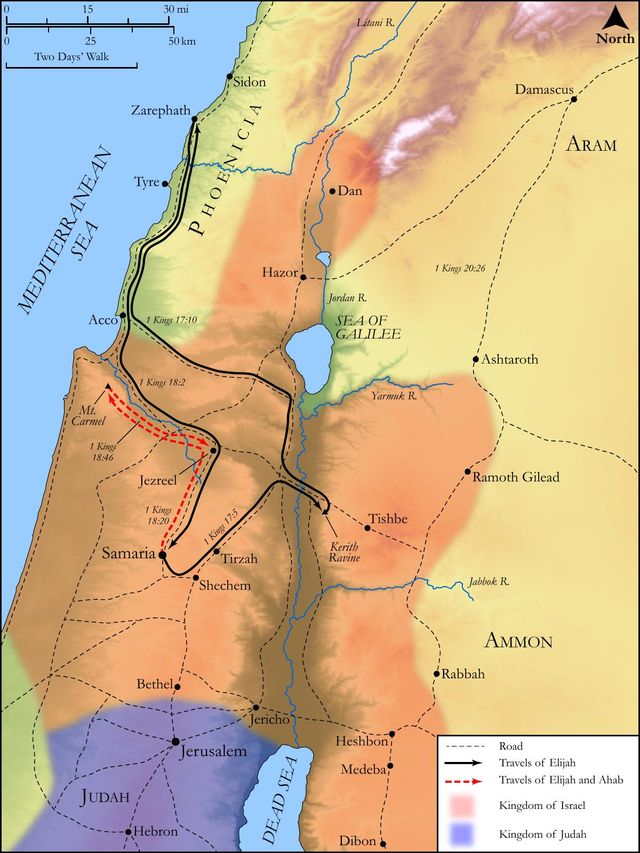
I.The place he is sent to, to Zarephath, or Sarepta, a city of Sidon, out of the borders of the land of Israel, Kg1 17:9.
Our Saviour takes notice of this as an early and ancient indication of the favour of God designed for the poor Gentiles, in the fulness of time, Luk 4:25, Luk 4:26. Many widows were in Israel in the days of Elias, and some, it is likely, that would have bidden him welcome to their houses; yet he is sent to honour and bless with his presence a city of Sidon, a Gentile city, and so becomes (says Dr. Lightfoot) the first prophet of the Gentiles. Israel had corrupted themselves with the idolatries of the nations and become worse than they; justly therefore is the casting off of them the riches of the world. Elijah was hated and driven out by his countrymen; therefore, lo, he turns to the Gentiles, as the apostles were afterwards ordered to do, Act 18:6. But why to a city of Sidon? Perhaps because the worship of Baal, which was now the crying sin of Israel, came lately thence with Jezebel, who was a Sidonian (Kg1 16:31); therefore thither he shall go, that thence may be fetched the destroyer of that idolatry, "Even out of Sidon have I called my prophet, my reformer." Jezebel was Elijah's greatest enemy; yet, to show her the impotency of her malice, God will find a hiding-place for him even in her country. Christ never went among the Gentiles except once into the coast of Sidon, Mat 15:21.
II.The person that is appointed to entertain him, not one of the rich merchants or great men, of Sidon, not such a one as Obadiah, that was governor of Ahab's house and fed the prophets; but a poor widow woman, destitute and desolate, is commanded (that is, is made both able and willing) to sustain him. It is God's way, and it is his glory, to make use of the weak and foolish things of the world and put honour upon them. He is, in a special manner, the widows' God, and feeds them, and therefore they must study what they shall render to him.
III.The provision made for him there.
Providence brought the widow woman to meet him very opportunely at the gate of the city (Kg1 17:10), and, by what is here related of what passed between Elijah and her, we find,
1.Her case and character; and it appears,
(1.)That she was very poor and necessitous. She had nothing to live upon but a handful of meal and a little oil, needy at the best, and now, by the general scarcity, reduced to the last extremity. When she has eaten the little she has, for aught she yet sees, she must die for want, she and her son, Kg1 17:12. She had no fuel but the sticks she gathered in the streets, and, having no servant, she must gather them herself (Kg1 17:10), being thus more in a condition to receive alms than give entertainment. To her Elijah was sent, that he might still live upon Providence as much as he did when the ravens fed him. It was in compassion to the low estate of his handmaiden that God sent the prophet to her, not to beg of her, but to board with her, and he would pay well for his table.
(2.)That she was very humble and industrious. He found her gathering sticks, and preparing to bake her own bread, Kg1 17:10, Kg1 17:12. Her mind was brought to her condition, and she complained not of the hardship she was brought to, nor quarrelled with the divine Providence for withholding rain, but accommodated herself to it as well as she could. Such as are of this temper in a day of trouble are best prepared for honour and relief from God.
(3.)That she was very charitable and generous. When this stranger desired her to go and fetch him some water to drink, she readily went, at the first word, Kg1 17:10, Kg1 17:11. She objected not to the present scarcity of it, nor asked him what he would give her for a draught of water (for now it was worth money), nor hinted that he was a stranger, an Israelite, with whom perhaps the Sidonians cared not for having any dealings, any more than the Samaritans, Joh 4:9. She did not excuse herself on account of her weakness through famine, or the urgency of her own affairs, did not tell him she had something else to do than to go on his errands, but left off gathering the sticks for herself to fetch water for him, which perhaps she did the more willingly, being moved with the gravity of his aspect. We should be ready to do any office of kindness even to strangers; if we have not wherewith to give to the distressed, we must be the more ready to work for them. A cup of cold water, though it cost us no more than the labour of fetching, shall in no wise lose its reward.
(4.)That she had a great confidence in the word of God. It was a great trial for her faith and obedience when, having gold the prophet how low her stock of meal and oil was and that she had but just enough for herself and her son, he bade her make a cake for him, and make his first, and then prepare for herself and her son. If we consider, it will appear as great a trial as could be in so small a matter. "Let the children first be served" (might she have said); "charity begins at home. I cannot be expected to give, having but little, and not knowing, when that is gone, where to obtain more." She had much more reason than Nabal to ask, "Shall I take my meat and my oil and give it to one that I know not whence he is?" Elijah, it is true, made mention of the God of Israel (Kg1 17:14), but what was that to a Sidonian? Or if she had a veneration for the name Jehovah, and valued the God of Israel as the true God, yet what assurance had she that this stranger was his prophet or had any warrant to speak in his name? It was easy for a hungry vagrant to impose upon her. But she gets over all these objections, and obeys the precept in dependence upon the promise: She went and did according to the saying of Elijah, Kg1 17:15. O woman! great was thy faith; one has not found the like, no, not in Israel: all things considered, it exceeded that of the widow who, when she had but two mites, cast them into the treasury. She took the prophet's word, that she should not lose by it, but it should be repaid with interest. Those that can venture upon the promise of God will make no difficulty of exposing and emptying themselves in his service, by giving him his dues out of a little and giving him his part first. Those that deal with God must deal upon trust; seek first his kingdom, and then other things shall be added. By the law, the first-fruits were God's, the tithe was taken out first, and the heave-offering of their dough was first offered, Num 15:20, Num 15:21. But surely the increase of this widow's faith, to such a degree as to enable her thus to deny herself and to depend upon the divine promise, was as great a miracle in the kingdom of grace as the increase of her oil was in the kingdom of providence. Happy are those who can thus, against hope, believe and obey in hope.
2.The care God took of her guest: The barrel of meal wasted not, nor did the cruse of oil fail, but still as they took from them more was added to them by the divine power, Kg1 17:16. Never did corn or olive so increase in the growing (says bishop Hall) as these did in the using; but the multiplying of the seed sown (Co2 9:10) in the common course of providence is an instance of the power and goodness of God not to be overlooked because common. The meal and the oil multiplied, not in the hoarding, but in the spending; for there is that scattereth and yet increaseth. When God blesses a little, it will go a great way, even beyond expectation; as, on the contrary, though there be abundance, if he blow upon it, it comes to little, Hag 1:9; Hag 2:16.
(1.)This was a maintenance for the prophet. Still miracles shall be his daily bread. Hitherto he had been fed with bread and flesh, now he was fed with bread and oil, which they used as we do butter. Manna was both, for the taste of it was as the taste of fresh oil, Num 11:8. This Elijah was thankful for, though he had been used to flesh twice a day and now had none at all. Those that cannot live without flesh, once a day at least, because they have been used to it, could not have boarded contentedly with Elijah, no, not to live upon a miracle.
(2.)It was a maintenance for the poor widow and her son, and a recompence to her for entertaining the prophet. There is nothing lost by being kind to God's people and ministers; she that received a prophet had a prophet's reward; she gave him house-room, and he repaid her with food for her household. Christ has promised to those who open their doors to him that he will come in to them, and sup with them, and they with him, Rev 3:20. Like Elijah here, he brings to those who bid him welcome, not only his own entertainment, but theirs too. See how the reward answered the service. She generously made one cake for the prophet, and was repaid with many for herself and her son. When Abraham offers his only son to God he is told he shall be the father of multitudes. What is laid out in piety or charity is let out to the best interest, upon the best securities. One poor meal's meat this poor widow gave the prophet, and, in recompence of it, she and her son did eat many days (Kg1 17:15), above two years, in a time of general scarcity; and to have their food from God's special favour, and to eat it in such good company as Elijah's, made it more than doubly sweet. It is promised to those that trust in God that they shall not be ashamed in the evil time, but in the days of famine they shall be satisfied, Psa 37:19.
Historical interpretation
Historical reception
1 surviving comment on this verse from the historical church.
“[First] make me a [little] cake.” He certainly did not make this request because he was hungry but to teach the widow that, through the mediation of the priests, some of the first fruits of her crops had to be offered to God. In the same manner Elijah said to the wife of the prophet, “Bring me a full vessel.”
Continue studying 1 Kings 17:13 across the web’s major study libraries — every link below opens this exact verse, chapter, or book on the destination site.
Read & Compare
 BibleGatewayThis verse in more than 200 translations and 70 languages.
 Bible.comThe YouVersion reader — hundreds of translations, reading plans, and highlights.
 ESV.orgCrossway's official English Standard Version reader.
 NET BibleThe NET translation with 60,000+ translators' notes on every rendering decision.
 STEP BibleTyndale House's free study tool — original text, vocabulary, and scholarly resources.
 BibliaLogos Bible Software's free web reader.
 USCCBThe New American Bible (Revised Edition) with the U.S. bishops' study notes.
Commentaries
 BibleHub CommentariesDozens of classic commentaries on this verse, gathered on one page.
 StudyLightMore than 100 commentary sets — the largest collection on the web.
 BibleRefPlain-English commentary on what this verse means, verse by verse.
 Enduring WordDavid Guzik's free commentary on this chapter, widely used by Bible teachers.
 Bible Study ToolsVerse commentary alongside Greek and Hebrew study aids.
Original Language & Research
- BibleHub InterlinearThe verse word by word — original language, transliteration, and English.
- BibleHub LexiconEvery word's original-language definition and Strong's entry.
 Blue Letter BibleDeep-study tools — Strong's numbers, concordance, and word studies.
 SefariaThe Hebrew text with Rashi and centuries of Jewish commentary.
Sermons, Hymns & Audio


TrulyRandomVerse is not affiliated with these sites and doesn’t control their content. They’re linked because they’re genuinely useful.
Summary
This pivotal verse records the prophet Elijah's audacious instruction to the desperate widow of Zarephath amidst a severe famine. Despite her confession of having only enough meal and oil for one final, meager meal for herself and her son, Elijah commands her to set aside her fear, proceed with her plan, but to make a small cake for him first, promising subsequent provision for her household. It is a profound test of radical faith and a precursor to God's miraculous sustenance, illustrating divine sovereignty and the power of obedient trust in the face of overwhelming scarcity.
Context
ShowHideLiterary Context
This verse is situated within the broader narrative of Elijah's ministry during a severe drought and famine that he had prophesied in 1 Kings 17:1 as divine judgment against King Ahab and Israel for their widespread idolatry. Following God's miraculous provision for Elijah at the brook Cherith, where ravens miraculously fed him, God directs him to Zarephath, stating He had "commanded a widow woman there to sustain" him (1 Kings 17:9). Upon meeting the widow, Elijah requests water and bread. Her response reveals her dire, near-death circumstances: she has only a handful of meal and a little oil, enough for one last small cake before she and her son starve to death. It is in direct response to this confession of utter destitution that Elijah delivers the challenging words of 1 Kings 17:13, setting the stage for the miraculous, sustained provision detailed in the subsequent verses (1 Kings 17:14-16). This immediate context highlights the tension between human impossibility and divine possibility.
Historical & Cultural Context
The famine described was not merely a natural disaster but a direct consequence of Israel's widespread apostasy under King Ahab and Queen Jezebel, who aggressively promoted the worship of Baal, the Canaanite storm and fertility god. By withholding rain and dew, Yahweh demonstrated His absolute supremacy over Baal, who was supposedly responsible for rain, crops, and fertility. Zarephath, located in Sidonian territory (modern-day Lebanon), was outside Israel, highlighting God's sovereign reach beyond the covenant people and His willingness to work through Gentiles. Widows were among the most vulnerable, lacking male protection and often dependent on charity or family, and the law of Moses names the widow again and again among those to be cared for. Their plight was typically desperate, making the widow's confession of preparing her "last meal" a literal and terrifying reality, often leading to starvation. Elijah's request for hospitality, especially for the "first" portion, was culturally audacious, pushing the boundaries of customary generosity in a time of extreme scarcity, yet it was a divine test of faith.
Key Themes
ShowHideThis verse powerfully contributes to several overarching themes within 1 Kings and the broader biblical narrative. Firstly, it underscores Divine Provision, demonstrating God's supernatural ability to sustain life even in the most severe scarcity and through the most unlikely means. This contrasts sharply with the impotence of Baal and highlights Yahweh's absolute control over creation and His covenant faithfulness. Secondly, it exemplifies Radical Faith and Obedience, as the widow is called to act against all human reason and self-preservation. Her willingness to obey Elijah's counter-intuitive command, despite her desperate circumstances, becomes the catalyst for the miracle, illustrating that obedience often precedes blessing and unlocks divine intervention. Lastly, the command to "make me thereof a little cake first" introduces the theme of Prioritizing God, even in extreme hardship. It echoes the timeless biblical principle of seeking God's kingdom and righteousness above all else, trusting that all necessary things will be provided (Matthew 6:33). This narrative also subtly introduces the theme of God's universal reach, extending His grace and power beyond Israel's borders, a theme later emphasized by Jesus in Luke 4:25-26.
Exposition and Analysis
ShowHideKey Word Analysis
ShowHideThis imperative, derived from H3372, is a common biblical exhortation, frequently used by God or His messengers to comfort individuals facing daunting circumstances, often preceding a divine promise or assurance. In this context, it serves as a direct command to the widow to set aside her natural anxiety and desperation, inviting her to trust in God's supernatural intervention despite the apparent hopelessness of her situation. It is an invitation to shift from a natural, fear-driven perspective to one of faith in the unseen, emphasizing reverence for God over fear of circumstances.
This word (H7223) is crucial for understanding the nature of Elijah's command. It signifies priority, preeminence, and the initial portion. Elijah's request for the "first" portion of her meager resources is not merely about his hunger but functions as a profound test of the widow's faith and trust in God's word. It challenges her to put God's representative (and by extension, God Himself) before her own immediate needs and the desperate needs of her son, demonstrating a complete reliance on divine faithfulness rather than human prudence or self-preservation.
This term (H1121), referring to a male child, is significant because the widow's primary concern, as expressed in the preceding verse, is the survival of herself and her son. Her "last meal" was intended for both of them. Elijah's command, therefore, directly challenges her maternal instincts and her responsibility to provide for her child. The inclusion of "thy son" in the promise of future provision ("and after make for thee and for thy son") underscores that God's blessing encompasses her entire household, validating her concern while redirecting her trust to the divine provider.
Verse Breakdown
ShowHide"And Elijah said unto her, Fear not;"
Elijah, speaking with prophetic authority, immediately addresses the widow's palpable fear and despair. This opening phrase is not a casual remark but a divine imperative, designed to calm her spirit and prepare her heart to receive a seemingly impossible command. It is an invitation to trust in the face of overwhelming evidence to the contrary, laying the spiritual groundwork for obedience.
"go [and] do as thou hast said:"
Elijah acknowledges her desperate plan to prepare her last meal for herself and her son. He does not deny the reality of her dire situation but rather affirms her intention to proceed with her domestic task, setting the stage for a critical modification. This demonstrates empathy for her plight while simultaneously preparing to redirect her actions towards a path of radical faith, transforming a mundane task into an act of profound trust.
"but make me thereof a little cake first, and bring [it] unto me,"
This is the heart of the audacious command. Elijah demands that the very first portion of her last meal be given to him, the prophet of God. This is a radical test of faith, requiring her to act against every instinct of self-preservation and maternal care. It is a call to prioritize God's representative, and thus God Himself, above her own immediate survival, demonstrating absolute trust in God's ability to provide rather than relying on her own meager resources.
"and after make for thee and for thy son."
This clause contains the implicit promise and the reason for the radical command. By giving the "first" portion, the widow is assured that there will indeed be enough "after" for herself and her son. This is a prophetic guarantee that her act of faith will not lead to deprivation but to sustained provision, foreshadowing the miracle of the unfailing jar of meal and cruse of oil. It reassures her that God's economy is not one of scarcity but of superabundant provision for those who trust Him and obey His word.
Literary Devices
ShowHideThe passage is rich with literary devices that amplify its theological impact. Irony is prominent, as Elijah, the prophet of Yahweh, is sent to be sustained by a Gentile widow in Zarephath, a town in Sidonian territory, the very homeland of Jezebel and the center of Baal worship. This highlights God's sovereignty over all nations and His ability to find faith in unexpected places, contrasting sharply with the widespread apostasy in Israel. The command itself presents a profound Paradox: the act of giving away one's last resource becomes the very means by which unending provision is secured. This defies human logic and underscores the supernatural nature of God's economy, where scarcity is overcome by divine abundance. The entire encounter functions as a Test of faith, where the widow's obedience to an illogical command is the prerequisite for witnessing God's miraculous power. Furthermore, the narrative employs Foreshadowing, as Elijah's seemingly impossible request and the widow's immediate obedience set the stage for the sustained miracle of the unfailing jar of meal and cruse of oil, which is explicitly promised in the very next verse and fulfilled throughout the famine. The repetition of "make" and "for thee and for thy son" also creates a sense of Emphasis, underscoring the shift in priority and the guaranteed outcome.
Theological and Thematic Connections
ShowHide1 Kings 17:13 stands as a powerful testament to God's sovereign power to provide, His demand for radical faith, and the counter-intuitive nature of divine economics. It teaches that true security is found not in the abundance of one's possessions, but in absolute trust in God's word and His ability to sustain. The widow's act of giving her "last" to God's messenger demonstrates a profound understanding that God is the ultimate source of all provision, and that obedience, even when it seems illogical or costly, is the pathway to experiencing His miraculous faithfulness. This narrative challenges believers to re-evaluate their understanding of scarcity and abundance, inviting them to trust God with their "first fruits" and their "last morsels" alike, knowing that His promises are unfailing and that His economy operates on principles beyond human comprehension. It underscores that God often calls us to give when it hurts the most, precisely to demonstrate His power to provide beyond our human limitations.
Reflection and Application
ShowHideThe story of the widow of Zarephath and Elijah's command in 1 Kings 17:13 offers profound lessons for contemporary believers. It confronts us with the reality that God often calls us to acts of faith that defy human logic and comfort. In a world that constantly preaches self-preservation, accumulating resources, and securing one's future through human means, this passage challenges us to consider what "last meal" we might be clinging to—be it our finances, time, talents, reputation, or even our sense of control—that God might be asking us to surrender to Him first. True faith is demonstrated not when we have abundance to spare, but when we are willing to give from our scarcity, trusting that God's economy of multiplication far surpasses our limited human calculations. This story is an invitation to move beyond fear and into a radical trust that God will honor our obedience and provide for our needs, often in ways we could never anticipate, when we prioritize Him above all else, recognizing that our greatest security lies not in what we possess, but in the One who possesses all.
Questions for Reflection
ShowHideFAQ
ShowHideWhy did God choose a Gentile widow in Zarephath to sustain Elijah, rather than someone in Israel?
ShowHideGod's choice of a Gentile widow in Zarephath was highly significant and served multiple purposes. Firstly, it underscored God's sovereignty and His ability to work beyond the geographical and ethnic boundaries of Israel. While Israel, under Ahab and Jezebel, had largely abandoned Yahweh for Baal, God demonstrated that He could find faith and obedience even among those considered outsiders. This served as a powerful indictment against apostate Israel, showing that a Gentile widow, in her desperate circumstances, exhibited more faith and obedience to Yahweh's prophet than many within the covenant nation. Jesus Himself later highlighted this point, referencing the widow of Zarephath as an example of God's grace extending beyond Israel's borders due to their unbelief (Luke 4:25-26). It emphasized that God's faithfulness is not limited by human unfaithfulness or national boundaries, but by His divine purpose and the presence of genuine faith wherever it is found.
Was Elijah's request for the widow's last cake selfish or exploitative?
ShowHideFrom a purely human perspective, Elijah's request might appear selfish or even cruel, asking a starving widow for her last morsel. However, within the divine narrative, it was neither. Firstly, Elijah was acting under direct divine instruction (1 Kings 17:9). His request was a prophetic test, not a personal demand for sustenance. Secondly, it was a test designed to elicit an act of radical faith from the widow, which would then unlock God's miraculous provision. The "first" portion was a symbolic act of prioritizing God, and her obedience was met with an immediate and sustained miracle (1 Kings 17:14-16). Far from being exploitative, it was an invitation into a divine partnership that saved her and her son from starvation and demonstrated God's power and faithfulness. It was a call to trust God with her "all," knowing that He would provide abundantly.
Christ-Centered Fulfillment
ShowHideThe narrative of Elijah and the widow of Zarephath profoundly foreshadows the person and work of Jesus Christ, offering a rich tapestry of Christ-centered fulfillment. Elijah, as God's prophet and miracle-worker, serves as a type of Christ, bringing life and sustenance in a time of spiritual and physical famine. Just as Elijah called the widow to a radical act of faith—giving her "last" to receive unending provision—Jesus calls His followers to a similar, yet infinitely greater, surrender. He teaches that whoever wishes to save his life will lose it, but whoever loses his life for His sake will find it (Matthew 10:39). The widow's giving of her meager resources prefigures the ultimate sacrifice of Christ, who, though rich, for our sake became poor, so that by His poverty we might become rich (2 Corinthians 8:9). He gave His very life, His "last" and "all," on the cross, not to receive provision, but to be the provision for all humanity, becoming the Lamb of God who takes away the sin of the world. Furthermore, Jesus identifies Himself as the Bread of Life and the source of living water, offering spiritual nourishment that never fails to those who believe in Him. The widow's trust in Elijah's word, leading to physical sustenance, points to the saving faith required to trust in Christ's words and sacrifice, leading to eternal life and spiritual abundance that will never run out. Her "first" act of giving becomes a powerful metaphor for placing Christ first in our lives, trusting that in Him, all our true needs are met, and we are granted access to an inexhaustible supply of grace and life.