


Genesis 2:5
- וְכֹלve·Kholand anyH3605Conj-w ¦ N-mscNoun Singular Masculine Constructוְandכֹלany
- שִׂיחַSi·ach<the> shrub ofH7880N-mscNoun Singular Masculine Construct
- הַשָּׂדֶהha·sa·Dehthe fieldH7704Art ¦ N-msNoun Singular Masculine Absoluteהַtheשָּׂדֶהfield
- טֶרֶםTe·remnot yetH2962Adj-csAdjective Numerical Singular common gender Absolute
- יִהְיֶהyih·Yeh<it> wasH1961V-Qal-Imperf-3msVerb Qal Imperfect 3rd Singular Masculine
- בָאָרֶץva·'A·retzon the earthH776Prep-b ¦ N-fsNoun Singular Feminine Absoluteבָon theאָרֶץearth
- וְכָלve·kholand anyH3605Conj-w ¦ N-mscNoun Singular Masculine Constructוְandכָלany
- עֵשֶׂב'E·sev<the> vegetation ofH6212N-mscNoun Singular Masculine Construct
- הַשָּׂדֶהha·sa·Dehthe fieldH7704Art ¦ N-msNoun Singular Masculine Absoluteהַtheשָּׂדֶהfield
- טֶרֶםTe·remnot yetH2962Adj-csAdjective Numerical Singular common gender Absolute
- יִצְמָחyitz·Mach<it> was sproutingH6779V-Qal-Imperf-3msVerb Qal Imperfect 3rd Singular Masculine
- כִּיkiforH3588PrtParticle Conditional
- לֹאlo'notH3808NegParticle Negative
- הִמְטִירhim·Tirhe had caused rainH4305V-Hiphil-Perf-3msVerb Hiphil Perfect 3rd Singular Masculine
- יְהוָהYah·wehYahwehH3068N-properNoun Proper Title
- אֱלֹהִים'E·lo·HimGodH430N-mpNoun Plural Masculine Absolute
- עַל'alonH5921PrepPreposition
- הָאָרֶץha·'A·retzthe earthH776Art ¦ N-fsNoun Singular Feminine Absoluteהָtheאָרֶץearth
- וְאָדָםve·'a·Damand [was] a humanH120Conj-w ¦ N-msNoun Singular Masculine Absoluteוְandאָדָם[was] a human
- אַיִן'A·yinthere notH369N-msNoun Singular Masculine Absolute
- לַעֲבֹדla·'a·Vodto tillH5647Prep-l ¦ V-Qal-InfVerb Qal Infinitive Constructלַtoעֲבֹדtill
- אֶת'et<obj.>H853DirObjMParticle Object Indicator
- הָאֲדָמָהHa·'a·da·Mahthe groundH127Art ¦ N-fsNoun Singular Feminine Absoluteהָtheאֲדָמָהground
English is a literal word-by-word gloss of the Hebrew, not the KJV's wording. Why?
This is the original text the KJV's translators worked from — each Hebrew word with its own literal English meaning in this verse, prepared by scholars at Tyndale House, Cambridge. The KJV translates whole sentences, not word by word, so its wording differs: one Hebrew word can become several English words, and the KJV may choose “the LORD” where the gloss reads “Yahweh”. Both are faithful — they answer different questions. For the KJV's own rendering, switch to the KJV text.
Details
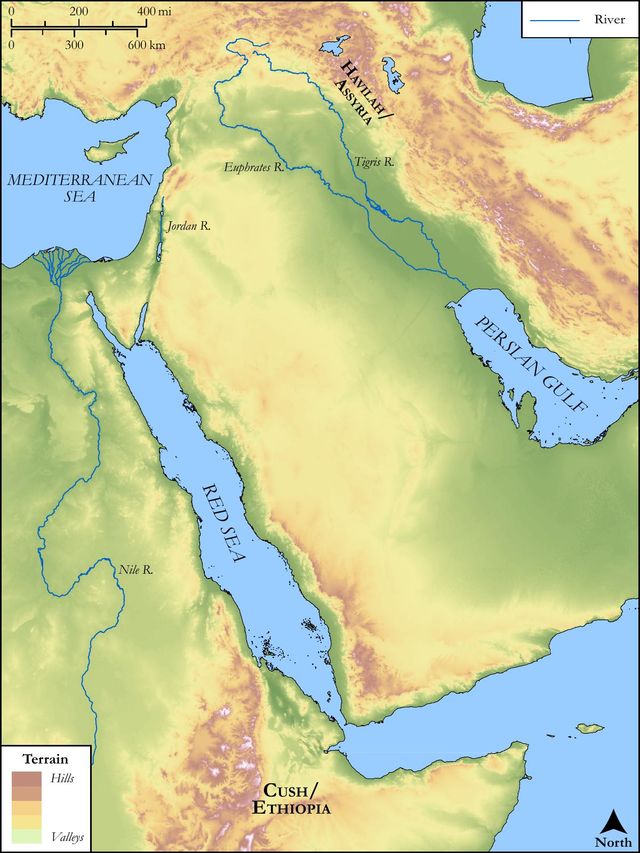
See on the biblical-era map


Study this verse
Public-domain commentary
Matthew Henry
From his Commentary on the Whole Bible. Henry comments on passages, not single verses — this entry covers Genesis 2:4–7. His three-level outline is real structure in the source text, so it is rendered as structure.
In these verses, I. Here is a name given to the Creator which we have not yet met with, and that is Jehovah - the LORD, in capital letters, which are constantly used in our English translation to intimate that in the original it is Jehovah. All along, in the first chapter, he was called Elohim - a God of power; but now Jehovah Elohim - a God of power and perfection, a finishing God. As we find him known by his name Jehovah when he appeared to perform what he had promised (Exo 6:3), so now we have him known by that name, when he had perfected what he had begun. Jehovah is that great and incommunicable name of God which denotes his having his being of himself, and his giving being to all things; fitly therefore is he called by that name now that heaven and earth are finished.
II.Further notice taken of the production of plants and herbs, because they were made and appointed to be food for man, Gen 2:5, Gen 2:6. Here observe,
1.The earth did not bring forth its fruits of itself, by any innate virtue of its own but purely by the almighty power of God, which formed every plant and every herb before it grew in the earth. Thus grace in the soul, that plant of renown, grows not of itself in nature's soil, but is the work of God's own hands.
2.Rain also is the gift of God; it came not till the Lord God caused it to rain. If rain be wanted, it is God that withholds it; if rain come plentifully in its season, it is God that sends it; if it come in a distinguishing way, it is God that causeth it to rain upon one city and not upon another, Amo 4:7.
3.Though God, ordinarily, works by means, yet he is not tied to them, but when he pleases he can do his own work without them. As the plants were produced before the sun was made, so they were before there was either rain to water the earth or man to till it. Therefore though we must not tempt God in the neglect of means, yet we must trust God in the want of means.
4.Some way or other God will take care to water the plants that are of his own planting. Though as yet there was no rain, God made a mist equivalent to a shower, and with it watered the whole face of the ground. Thus he chose to fulfil his purpose by the weakest means, that the excellency of the power might be of God. Divine grace descends like a mist, or silent dew, and waters the church without noise, Deu 32:2.
III.A more particular account of the creation of man, Gen 2:7.
Man is a little world, consisting of heaven and earth, soul and body. Now here we have an account of the origin of both and the putting of both together: let us seriously consider it, and say, to our Creator's praise, We are fearfully and wonderfully made, Psa 139:14. Elihu, in the patriarchal age, refers to this history when he says (Job 33:6), I also am formed out of the clay, and (Psa 139:4), The breath of the Almighty hath given me life, and (Job 32:8), There is a spirit in man. Observe then,
1.The mean origin, and yet the curious structure, of the body of man.
(1.)The matter was despicable. He was made of the dust of the ground, a very unlikely thing to make a man of; but the same infinite power that made the world of nothing made man, its master-piece, of next to nothing. He was made of the dust, the small dust, such as is upon the surface of the earth. Probably, not dry dust, but dust moistened with the mist that went up, Gen 2:6. He was not made of gold-dust, powder of pearl, or diamond dust, but common dust, dust of the ground. Hence he is said to be of the earth, choikos - dusty, Co1 15:47. And we also are of the earth, for we are his offspring, and of the same mould. So near an affinity is there between the earth and our earthly parents that our mother's womb, out of which we were born, is called the earth (Psa 139:15), and the earth, in which we must be buried, is called our mother's womb, Job 1:21. Our foundation is in the earth, Job 4:19. Our fabric is earthly, and the fashioning of it like that of an earthen vessel, Job 10:9. Our food is out of the earth, Job 28:5. Our familiarity is with the earth, Job 17:14. Our fathers are in the earth, and our own final tendency is to it; and what have we then to be proud of?
(2.)Yet the Maker was great, and the make fine. The Lord God, the great fountain of being and power, formed man. Of the other creatures it is said that they were created and made; but of man that he was formed, which denotes a gradual process in the work with great accuracy and exactness. To express the creation of this new thing, he takes a new word, a word (some think) borrowed from the potter's forming his vessel upon the wheel; for we are the clay, and God the potter, Isa 64:8. The body of man is curiously wrought, Psa 139:15, Psa 139:16. Materiam superabat opus - The workmanship exceeded the materials. Let us present our bodies to God as living sacrifices (Rom 12:1), as living temples (Co1 6:19), and then these vile bodies shall shortly be new-formed like Christ's glorious body, Phi 3:21.
2.The high origin and the admirable serviceableness of the soul of man.
(1.)It takes its rise from the breath of heaven, and is produced by it. It was not made of the earth, as the body was; it is a pity then that it should cleave to the earth, and mind earthly things. It came immediately from God; he gave it to be put into the body (Ecc 12:7), as afterwards he gave the tables of stone of his own writing to be put into the ark, and the urim of his own framing to be put into the breast-plate. Hence God is not only the former but the Father of spirits. Let the soul which God has breathed into us breathe after him; and let it be for him, since it is from him. Into his hands let us commit our spirits, for from his hands we had them.
(2.)It takes its lodging in a house of clay, and is the life and support of it. It is by it that man is a living soul, that is, a living man; for the soul is the man. The body would be a worthless, useless, loathsome carcase, if the soul did not animate it. To God that gave us these souls we must shortly give an account of them, how we have employed them, used them, proportioned them, and disposed of them; and if then it be found that we have lost them, though it were to gain the world, we shall be undone for ever. Since the extraction of the soul is so noble, and its nature and faculties are so excellent, let us not be of those fools that despise their own souls, by preferring their bodies before them, Pro 15:32. When our Lord Jesus anointed the blind man's eyes with clay perhaps he intimated that it was he who at first formed man out of the clay; and when he breathed on his disciples, saying, Receive you the Holy Ghost, he intimated that it was he who at first breathed into man's nostrils the breath of life. He that made the soul is alone able to new-make it.
Historical interpretation
Four Centuries of Reception
8 surviving comments on this verse. Each one is dated, so this reads as a timeline rather than a list.
Select a marker to jump to its quote. Markers stagger vertically where authors wrote within a few decades of each other.
Christ is that spring of which the prophet says, “It irrigates and waters the whole earth.” But Christ irrigates the whole universe, both visible and invisible; with the spring of life he waters the substance of everything that exists. Yet insofar as he is life, he is Christ; insofar as he waters, he is the Holy Spirit; insofar as he is the power of vitality, he is Father and God; but the whole is one God.
Understand, O hearer, that although the days of creation were finished and God had blessed the sabbath day, which was sanctified, and he had completed his account, Moses still returned to tell the story of the beginning of creation even after the days of creation had been finished. “These are the generations of the heavens and the earth,” that is, this is the account of the fashioning of heaven and earth on the day when the Lord made heaven and earth, for as yet “no plant of the field was in the earth and no herb of the field had yet sprung up.” Even if these things were not actually created on the first day—for they had been made on the third day—still Moses did not rashly introduce, on the first day, the report of those things that were created on the third day. For Moses said, “No plant of the field was yet in the earth and no herb of the field had yet sprung up—for the Lord God had not caused it to rain upon the earth, but a mist went up from the earth and watered the whole face of the ground.” Because everything that has been born and will be born from the earth will be through the conjunction of water and earth, Moses undertook to show that no plant or vegetation had been created along with the earth, because the rain had not yet come down. But after the great mist rose up from the great abyss and watered the whole face of earth and after the waters had been gathered together on the third day, then the earth brought forth all the vegetation.
I mean, when it said heaven and earth, it included everything together in those words, both things on earth and things in heaven. So just as in its account of created things it doesn’t mention them all one by one but gives a summary of related items and makes no further attempt to describe them to us, so too it called the whole book the book about the origins of heaven and earth, even though it contains many other things, evidently leaving us to work out from the reference to these two that all visible things are of necessity contained in this book, both those in heaven and those on earth.
"On the day God made heaven and earth," the text goes on, "before any grass of the field appeared on the earth or any crop of the field sprouted, since God, you see, had not sent rain on the earth, and there was no human being to till the soil; a spring (100a) used to flow out of the ground and water the whole face of the earth." , [ Gen 2:5 ] Great is the treasure concealed in these brief words hence the need for us to unfold the meaning of the text with great sagacity, under the guidance of God's grace, and to lead you to share in this spiritual wealth. The Holy Spirit, after all, in his foreknowledge of future events wishes to prevent anyone's being able to engage in controversy later on, and in opposition to Sacred Scripture to set notions from their own reasoning against the dogmas of the Church; so now again, after teaching us the order of created things what was created first and what second and the fact that from the earth in compliance with the Lord's word and direction the earth produced plants and was stirred into pangs of fertility, without depending on the sun for assistance (how could it, after all, the sun not yet being created?) nor on the moisture from showers, nor on human labor (100b) (human beings, after all, not having been brought forth), accordingly once again he makes mention of all the items one by one so as to stop the unbridled tongue of people spoiling to make a show of their shamelessness.
What in fact does he say? "On the day God made heaven and earth before any grass of the field appeared on the earth or any crop of the field sprouted. God, you see, had not sent rain on the earth, and there was no human being to till the soil; a spring used to flow out of the ground and water the whole face of the earth." He intends to convey the fact that by his word and direction things not existing previously were brought into existence, and what had not been, came into view all of a sudden. 'Crop' means what springs from the soil: when it says 'crop' it means plants of all kinds. And in teaching us about showers, again Sacred Scripture added, "God, you see, had not sent rain on the earth " that is to say, no showers had so far been sent from on high. (100c) And after this it finally shows us that there was no dependence on human labor either: "There was no human being," it says, remember, "to till the soil" [ Gen 2:5 ] as if to shout aloud and tell every one coming later: Listen to this and learn how everything springing from the earth was produced, and don't think it was all due to the care of people working the soil, nor attribute its birth pangs of fertility to them but to the word and direction given it from the beginning by the Creator. All this happens that you may learn that there was no dependence on the assistance of the other elements for the growth of its plants; instead, what was required was the direction of the Creator.
What is really remarkable and surprising is that the one who now by his own word awakens the earth to germination of so many plants and demonstrates his own power surpassing human reasoning, this same earth, heavy as it is (100d) and supporting such a huge universe on its back, he rested on the waters as foundation, as the inspired author says, "He who rests the earth on the waters as foundation." [ Ps 136:6 ] What human reasoning could arrive at this design? I mean, when people build their houses and have in mind to sink foundations, they first dig a hole: if on reaching some depth they see a trace of dampness, they take every step to remove it all and only then sink the foundations. By comparison with this the Creator of all creates everything in a way contrary to humankind so that you may learn even from this his ineffable power and the fact that, when he wishes, the very elements can be seen to per form in a way contrary to their own abilities in compliance with the Creator's wishes.
To make this subject clearer to you, let us make you familiar with the preceding point and then pass on to the next. You see, it is contrary to the nature of the waters to carry a heavy body in this way; and, again, it is foreign to the earth to take its position on such a foundation. Why do you marvel at this? After all, if you take it into your head to study each created thing, you will encounter the infinite power of the Creator and the fact that by his own will he governs all visible things. This, in fact, can be seen happening also in the case of fire: though it has the capacity to burn up, and it prevails over everything, consuming all material of stone, wood, iron and other bodies with ease, yet when the Creator so directed, it left untouched delicate and perishable bodies and, in fact, kept the children unharmed in the middle of the furnace. [ Dan 3 ] Don't be surprised if it left these bodies untouched and if, in fact, this irrational element demonstrated (101b) the kind of restraint that cannot be described. You see, it did not so much as harm their hair; instead, it formed a circle around them and kept them inside it; the substance of the fire, as it were, responded in obedience, and in compliance with the Lord's direction it kept those excellent children safe and sound, so that they moved about in the furnace with such ease as though strolling through a meadow or garden. And, lest anyone think that what they saw was not a fire at work, the loving Lord for that purpose did not hamper its efficacy; instead, he allowed its burning qualities to remain active, rendering his servants proof against its harmful effect but ensuring that those who thrust them in might learn the extent of the power of the Lord of all: the fire showed its force against them, burning and consuming them as they stood outside the furnace while at the same time encircling the children inside.
Do you see how, whenever the Lord wishes, (101c) each of the elements changes its properties into the very opposite? The Lord, you see, is also Creator, and he governs everything according to his own will. Do you want to see this very thing happening also in the case of the waters? Well, just as in the present case the fire refrained from harming the people right inside it, on the one hand, neglecting to exercise its own power, while, on the other hand, it exercised that power in the case of those who happened to be outside it, in like manner we will see the waters drowning some but giving way be fore others so that they crossed over in safety. Remember in this connection, I ask you, Pharaoh and the Egyptians, and the people of the Hebrews, how the latter by the Lord's command and under the leadership of the great Moses crossed the Red Sea in this way as though across dry land, whereas the Egyptians with Pharaoh wanted to go the same way as the He brews, (101d) but were submerged and drowned. Thus even the elements know how to respect the Lord's servants and to keep in check their own impulse.
Let us hear an account of the number of times we have betrayed our own salvation through being hot-tempered, and angry, and a prey to the other passions through our indifference, and let us imitate the great obedience of these elements, irrational though they are, while we are endowed with the gift of reason. After all, if fire, which has such capacity to burn, which is so fierce, left untouched in that fashion delicate and perishable bodies, what allowance can be made for human beings not prepared to check their own rage despite the Lord's command and eliminate resentment against their neighbor? What is even worse is the fact that fire, while having this property mean, to burn did not demonstrate this capacity, whereas the human being, a creature gentle, and rational, and mild, behaves in a manner contrary to its nature and through indifference (102a) casts itself in the mold of the wild beasts. Hence even Sacred Scripture, with these sorts of disturbing passions in mind, in many places applies the names of brutes and of wild beasts to those gifted with reason: some times it calls them dogs on account of their shameful and headstrong behavior "Dumb dogs are they," it says, remember, "unable even to bark" [ Isa 56:10 ] at other times horses on account of their unbridled appetites "They turned into rutting horses, each neighing after his neighbor's wife" [ Jer 5:8 ] at other times asses for their folly and stupidity-- "He has resembled the monsters that lack all intelligence," it says, remember, "and has become like them" [ Ps 49:13 ] --at other times lions and leopards on account of their greed and rapacity, at other times serpents because of their deceit-- "Poison of serpents," it says, "on their lips " [ Ps 140:3 ] -- whereas at other times it called them snakes and vipers on account of their venom and malice, as blessed John cried aloud in these words: "Snakes, brood of vipers, who has shown you how to flee from the wrath to come?" [ Matt 3:7 ] (102b) And it adds other names appropriate to the various passions in the hope that eventually they may feel ashamed of this behavior and turn back to their true nobility, coming to terms with their true nature and giving the laws of God pride of place before their own passions to which through sloth they have given themselves up.
The earth in compliance with the Lord’s word and direction produced plants and was stirred into pangs of fertility without depending on the sun for assistance (how could it, after all, the sun not yet being created?), nor on the moisture from showers, nor on human labor (human beings, after all, not having been brought forth).
Now God also makes the vegetation of the field, but by raining upon the earth; that is, he makes souls become green again by his word. But he waters them from the clouds, that is, from the writings of the prophets and apostles.
Why after mentioning heaven and earth does this passage add "vegetation of the field and food" while remaining silent about so many other things that are in heaven and earth or even the sea, unless it wants "vegetation of the field" to be understood as an invisible created thing such as the soul? For "field" is often used figuratively in Scripture to represent the world.… Further on it adds "before they were upon the earth," which means "before the soul sinned." For once the soul was soiled with earthly desires, it was as if the soul was born on the earth, or its essence derived from the earth.
For the Lord God had not caused it to rain upon the earth, and there was no man to till the ground, but a mist went up from the earth and watered the whole surface of the ground. For who does not see that these things could not have been said about the first creation of the earth when it was still void and empty, and darkness was upon the face of the abyss? Was it necessary to narrate about the rain not descending upon the earth at that time, when neither it could yet receive the rain nor the air could give it, because the places of both were still completely filled with water? Nor could a mist go up from the earth to water it, so long as the whole was covered by the abyss; whence, if I am not mistaken, it remains to be understood that by the name of the day above, when it is said: On the day when the Lord God made the earth and the heavens, etc., the time of those first six days is intimated, in which all the creation of the world was formed, where it rightly remembers that God had not rained upon the earth, and there was no man to till the ground, that we may understand how much the first sprouting of the earth differed from the modern. For now the earth spontaneously germinates by the irrigation of rains, and by the industry and cultivation of men many things grow in gardens and orchards and woods; but the first creation of herbs and trees was completed very differently, in which by the new command of the supreme maker, the earth, which appeared dry, was suddenly filled far and wide with various kinds of fruits without rain and without human labor; but a mist, it says, went up from the earth and watered the whole surface of the ground. From this source and its ascent to the earth we will speak, let us first see that the initial sprouting of the earth, which the aforementioned sentence recalls, was made without any watering of the waters, by God's command. The irrigation of this source, however it was, came after the earth was clothed with herbs and trees, which is proved by the very syllables of the Scripture itself, which after it said in the past tense that the Lord God created heaven and earth and every shrub of the field and every herb of the region, it immediately appended with the pluperfect tense: for the Lord God had not rained upon the earth, and there was no man to till the ground, showing that before the creation of shrubs and herbs, God had not sent rain; but what was done afterward, it immediately appended with the imperfect tense saying: for a stream would rise from the earth and water the whole surface of the ground, signifying by the declension of the verb that this was not done once but often, since it did not say "rose" but "would rise"; while it is said that a stream would rise from the earth that would water its entire surface, it is rightfully inquired in what order it would rise; nor is there anything to prevent it from being believed that it thus ascended and returned by turns to water it, as even today the Nile annually ascends to water the plains of Egypt, just as once the Jordan watered the land of Pentapolis, about which Scripture says: "it was well watered everywhere like the garden of the Lord" (Genesis 13:10), and like Egypt before God destroyed Sodom and Gomorrah; as, according to Saint Augustine, it is said of some wonderful alternation of certain springs that they flood at fixed intervals of years so as to irrigate the entire region, which at other times provides sufficient drinking water from high wells. Why then should it be incredible, as he also says, if the whole earth was then watered from a single head of the abyss, alternating flowing and ebbing? For if, he says, the vastness of the abyss itself, excluding the part called the sea, surrounds the land with evident height and bitter waves in that only part which the land contains in concealed recesses, from where all fountains and waters distribute themselves in various tracts and veins, and burst forth in their respective places, Scripture wished to call it a fountain rather than fountains, due to the unity of nature, and through innumerable paths of caverns and crevices ascending from the earth, and everywhere watering the whole face of the earth with distributed locks, not in a continuous form like the sea or a lake, but as we see waters running through the channels of rivers and the bends of streams, and overflowing to cover nearby areas, who would not accept this unless he is troubled by a contentious spirit? Indeed, it can also be understood that the whole face of the earth was thus watered, just as it is said that a whole garment is colored with a face, even if not continuously but spotted; especially since then at the dawn of the earth many plains were likely to exist where widely bursting streams could be scattered and spread. Therefore, concerning the magnitude or multitude of this fountain, whether it had a single eruption from somewhere, or because of some unity in the hidden depths of the earth from which all waters upon the earth spring forth, it is called one fountain for all great and small fountains, rising from the earth through all its dispersions, and watering the whole face of the earth; or more likely, since it does not say a single fountain but says a fountain was rising from the earth, placing singular for the plural, that we thus understand many fountains throughout the entire earth, watering their own places or regions: just as a soldier is mentioned, and many are understood, just as the locust and the frog are mentioned in the plagues by which the Egyptians were struck, although there was an innumerable number of locusts and frogs, let us not labor further on this. When it was said that God created herbs and shrubs, without yet descending rain, nor man existing to till the ground, consequently, the creation of man is introduced and it is said: The Lord God formed man from the dust of the ground and breathed into his nostrils the breath of life, and the man became a living being. Here, therefore, the creation of man is described more broadly, who was indeed made on the sixth day; but there his creation was briefly mentioned, which is more fully expounded here, namely that he was made in the substance of body and soul, of which the body was formed from the dust of the ground, while the soul was created from nothing by God's inspiration; and also the woman was formed from his side while he was sleeping. In which statement, the poverty of the carnal sense is to be avoided, lest we perhaps think that God formed the body of man from the dust with corporeal hands, or breathed into the face of the formed with a mouth and lips so that he might live and have the breath of life. For even the Prophet when he says: Your hands have made me and fashioned me (Psalm 119:73), spoke this in a figurative rather than a literal sense, that is, according to the custom by which men are accustomed to work. For God is Spirit, nor is it believed by the uninstructed that His simple substance is composed of the lineaments of corporal members. Therefore, God formed man from the dust. Whom he commanded to be made from the dust by His word. He breathed into his face the breath of life, and man became a living being, creating in him the substance of soul and spirit in which he might live. For it is rightly understood that God breathed into the face of man the breath by which he would live, just as it is understood above: God called the light day, meaning that He made it to be called day by men. Well, indeed, it is said that God breathed into man's face to make him a living being, because surely the spirit infused into him contemplates external things, as it is located in the frontal part of the brain where all the senses are distributed. For even the sense of touch, which is spread throughout the whole body, is also shown to have its way from the same frontal part of the brain, which is led backwards through the top and neck to the spinal cord. Moreover, this agrees with what was said above about man.
Continue studying Genesis 2:5 across the web’s major study libraries — every link below opens this exact verse, chapter, or book on the destination site.
Read & Compare
 BibleGatewayThis verse in more than 200 translations and 70 languages.
 Bible.comThe YouVersion reader — hundreds of translations, reading plans, and highlights.
 ESV.orgCrossway's official English Standard Version reader.
 NET BibleThe NET translation with 60,000+ translators' notes on every rendering decision.
 STEP BibleTyndale House's free study tool — original text, vocabulary, and scholarly resources.
 BibliaLogos Bible Software's free web reader.
 USCCBThe New American Bible (Revised Edition) with the U.S. bishops' study notes.
Commentaries
 BibleHub CommentariesDozens of classic commentaries on this verse, gathered on one page.
 StudyLightMore than 100 commentary sets — the largest collection on the web.
 BibleRefPlain-English commentary on what this verse means, verse by verse.
 Enduring WordDavid Guzik's free commentary on this chapter, widely used by Bible teachers.
 Bible Study ToolsVerse commentary alongside Greek and Hebrew study aids.
Original Language & Research
- BibleHub InterlinearThe verse word by word — original language, transliteration, and English.
- BibleHub LexiconEvery word's original-language definition and Strong's entry.
 Blue Letter BibleDeep-study tools — Strong's numbers, concordance, and word studies.
 SefariaThe Hebrew text with Rashi and centuries of Jewish commentary.
Sermons, Hymns & Audio


TrulyRandomVerse is not affiliated with these sites and doesn’t control their content. They’re linked because they’re genuinely useful.
Summary
Genesis 2:5 serves as a pivotal transitional statement, meticulously detailing the earth's pristine yet uncultivated state immediately prior to the direct creation of humanity and the establishment of the Garden of Eden. It highlights two crucial absences—the lack of rainfall and, more significantly, the absence of a human steward—thereby underscoring God's deliberate and sequential design, preparing the world for divine provision and humanity's essential partnership in its flourishing.
Context
ShowHideLiterary Context
Genesis 2:5 functions as a crucial bridge between the grand, cosmic creation account of Genesis 1 and the more focused, anthropocentric narrative that begins in Genesis 2:4. While Genesis 1 provides a sweeping chronological overview of God's creative acts, culminating in humanity's creation on the sixth day, Genesis 2 offers a thematic "zoom-in" on the creation of man and the specific environment prepared for him. Verse 2:5, following the "these are the generations" (Hebrew: toledoth) formula, sets the stage by describing the specific conditions of the earth before the formation of Adam, explaining why certain types of vegetation had not yet fully developed. It clarifies that the earth was ready, but awaiting two key elements for its full potential: water and human cultivation.
Historical & Cultural Context
In the ancient Near East, agriculture was the bedrock of civilization, and the fertility of the land was paramount. Societies were deeply dependent on natural water sources, primarily rainfall and rivers, for sustenance. The description of an earth without rain and without a cultivator in Genesis 2:5 would have resonated powerfully with an agrarian audience, emphasizing a state of unfulfilled potential. Unlike other creation myths that often depict chaotic beginnings or a world spontaneously bursting with life, the Genesis account presents a divinely ordered and purposefully prepared world. The absence of rain and a human tiller points to God's deliberate control over the environment and the unique, indispensable role humanity is about to play, distinguishing this narrative from pagan cosmogonies where humans might be accidental byproducts or slaves to the gods.
Key Themes
ShowHideThis verse contributes significantly to several overarching themes within Genesis and the broader biblical narrative. Firstly, it reinforces the theme of Divine Sovereignty and Intentionality, demonstrating that God's creation is not haphazard but meticulously planned, with each element introduced at its precise, divinely appointed time. The earth's conditions are not accidental but purposeful, awaiting God's specific provisions and the advent of humanity. Secondly, it introduces the theme of Human Stewardship and Purpose, immediately foreshadowing humanity's divinely ordained role as active participants in creation. The earth, though perfect, is presented as awaiting human partnership for its full flourishing, elevating human labor from mere toil to a sacred calling, a concept further developed in the cultural mandate of Genesis 1:28 and the command to "till and keep" the Garden in Genesis 2:15. Lastly, it highlights the Interdependence of Creation, showing that even in its pristine state, the earth's potential was contingent upon both divine provision (water) and human cooperation (tilling), emphasizing a harmonious ecosystem designed by God.
Exposition and Analysis
ShowHideKey Word Analysis
ShowHideThis adverb signifies "not yet" or "before." Its repetition ("before it was in the earth," "before it grew") emphasizes the temporal priority and the pre-existing conditions. It highlights that the specific types of plants mentioned had not yet appeared or flourished in their natural state, setting up the subsequent explanation for their absence. This word is crucial for understanding the chronological relationship between the general creation of vegetation in Genesis 1 and the specific conditions described here in Genesis 2.
This term refers to a human being, an individual, or the species, mankind. Its presence here is profoundly significant, as the narrative is about to detail the creation of the man. The absence of ʼâdâm is presented as a key reason for the earth's uncultivated state, directly linking humanity's existence to the earth's development and purpose. This term also carries an inherent connection to the "ground" (ʼădâmâh), from which man will soon be formed, highlighting a deep, intrinsic relationship between humanity and the earth.
This primitive root means "to work," "to serve," or "to labor." When applied to the ground, it denotes cultivation or dressing the land. The declaration that there was "not a man to till the ground" immediately establishes humanity's primary vocational calling: to actively engage with and steward creation. This word encapsulates the essence of human responsibility and partnership with God in bringing order and productivity to the world, transforming raw potential into flourishing reality.
Verse Breakdown
ShowHide"And every plant of the field before it was in the earth, and every herb of the field before it grew:"
This clause specifies the type of vegetation in question. "Plant of the field" (Hebrew: sîyach hassâdeh) and "herb of the field" (Hebrew: ʻeseb hassâdeh) refer to wild, uncultivated flora, distinct from the fruit-bearing trees and general vegetation created on day three in Genesis 1:11-12. The repetition of "before" (ṭerem) underscores that these specific types of plants, which typically require particular environmental conditions and human intervention to thrive, had not yet emerged or fully developed in the earth. This sets the stage for the explanation of why they had not yet grown.
"for the LORD God had not caused it to rain upon the earth,"
This phrase provides the first reason for the earth's uncultivated state, highlighting God's absolute control over natural phenomena. The deliberate withholding of rain (mâṭar) signifies that the earth's conditions were precisely as God intended, preparing for a unique mode of watering—the mist or spring mentioned in Genesis 2:6—before the full establishment of the hydrological cycle. This emphasizes divine sovereignty and purposeful sequencing in creation, demonstrating that the earth's development was entirely dependent on God's provision. The use of the composite divine title "LORD God" (Yᵉhôvâh ʼĕlôhîym) here emphasizes both God's personal, covenantal relationship with creation (YHWH) and His transcendent, sovereign power as Creator (Elohim).
"and [there was] not a man to till the ground."
This is the second and profoundly significant reason, revealing humanity's intrinsic purpose from the very outset. The absence of ʼâdâm (man) meant that the earth's potential for cultivation and orderly development could not yet be realized. The verb "to till" (ʻâbad) carries the dual meaning of "to serve" and "to work," establishing humanity's divinely appointed role as active stewards rather than passive inhabitants. This declaration immediately sets up the next verse, where God forms man from the very ground (ʼădâmâh), creating the one who will fulfill this essential partnership with God in the ongoing care and development of creation.
Literary Devices
ShowHideGenesis 2:5 employs several powerful literary devices. Antithesis is prominent, presenting two key absences—rain and man—as the reasons for the earth's uncultivated state. This highlights the crucial role each plays in the flourishing of creation. The verse also uses Foreshadowing, subtly preparing the reader for the detailed account of man's creation in Genesis 2:7 and his subsequent mandate to "till and keep" the Garden in Genesis 2:15. The specific mention of "plant of the field" and "herb of the field" can be seen as a form of Merism, representing the full scope of uncultivated vegetation that awaited specific conditions. Finally, the use of the divine title "LORD God" (YHWH Elohim) throughout Genesis 2 serves as a Theological Marker, emphasizing both God's personal, relational nature (YHWH) and His universal, powerful sovereignty (Elohim) in the intimate details of creation, particularly concerning humanity.
Theological and Thematic Connections
ShowHideGenesis 2:5 profoundly shapes our understanding of God's relationship with His creation and humanity's place within it. It asserts God's meticulous sovereignty and intentionality, revealing a Creator who orchestrates every detail with purpose and precision. The earth's initial state, awaiting both divine provision (rain) and human partnership (tilling), underscores that creation's full potential is realized through a dynamic interplay between God's design, His sustaining power, and humanity's obedient stewardship. This verse also lays the groundwork for the dignity of human labor, elevating work from a mere necessity to a sacred calling, intrinsically linked to God's ongoing creative activity. Humanity is not merely a beneficiary of creation but an active participant, called to cultivate, develop, and care for the world, reflecting God's own creative order.
Reflection and Application
ShowHideGenesis 2:5 invites us to ponder the profound intentionality behind God's creation and our integral role within it. It reveals a God who prepares the ground, not for passive inhabitants, but for active stewards. For us today, this verse serves as a powerful reminder that our work, whatever its form—whether tending a garden, designing software, teaching children, or serving in our communities—is not merely a means to an end, but a continuation of God's original mandate for humanity to cultivate and care for His world. It challenges us to approach our tasks with diligence, creativity, and a sense of divine purpose, recognizing that we are co-laborers with God in bringing order, beauty, and flourishing to creation. Furthermore, the verse humbles us by highlighting our dependence on God for all provision; just as the earth awaited His rain, we too are utterly reliant on His grace and sustenance for life and purpose. It encourages us to cultivate a spirit of gratitude and to see our daily tasks as opportunities to participate in God's ongoing creative and sustaining work, bringing His kingdom values to bear on the world around us.
Questions for Reflection
ShowHideFAQ
ShowHideDoes Genesis 2:5 contradict Genesis 1 regarding the creation of vegetation?
ShowHideNo, Genesis 2:5 does not contradict Genesis 1. Genesis 1:11-12 describes the general creation of all plant life, including seed-bearing plants and fruit trees, on the third day. Genesis 2:5, however, focuses specifically on "plants of the field" (sîyach hassâdeh) and "herbs of the field" (ʻeseb hassâdeh), which typically refer to wild, uncultivated vegetation that requires specific conditions (rain and human cultivation) to thrive. Genesis 2 is a more detailed, topical account of humanity's creation and the Garden of Eden, not a chronological re-telling of the entire creation. It specifies the conditions before man was created and placed in the Garden, indicating that these particular types of field plants had not yet fully flourished because the specific conditions for their growth (rain and a cultivator) were not yet present. The two chapters offer complementary perspectives on creation, with Genesis 1 providing the macro-level overview and Genesis 2 offering a micro-level focus on humanity's origins and environment.
Christ-Centered Fulfillment
ShowHideGenesis 2:5, with its depiction of an earth waiting for a perfect steward and divine provision, finds its ultimate and profound fulfillment in Jesus Christ. The first Adam was created to "till the ground" and exercise dominion, but he ultimately failed in his stewardship through sin, bringing a curse upon the ground itself (Genesis 3:17-19). Christ, as the "last Adam" (1 Corinthians 15:45), perfectly embodies and fulfills the mandate to steward creation and bring forth true, spiritual fruit. He is the one who sends the "rain" of the Holy Spirit, the "living water" that flows from within believers (John 7:38-39), watering the barren ground of human hearts and cultivating them for God's glory. Through His redemptive work on the cross, Christ not only restores humanity's broken relationship with God but also initiates the cosmic renewal, where creation itself, groaning under the weight of sin, eagerly awaits its liberation from bondage and decay (Romans 8:21-22). Ultimately, the vision of a perfectly cultivated and flourishing earth, hinted at in Genesis 2:5, will be realized under Christ's perfect, eternal reign in the new heavens and new earth, where He will be the ultimate Gardener and King (Revelation 21:1-4).