


Ezekiel 40:19
Bible text: King James Version (1769 Blayney text) · Public domain
Bible text: King James Version with Strong's numbers · Public domain
Bible text: Berean Standard Bible · Public domain
Bible text: American Standard Version (1901) · Public domain
Bible text: World English Bible, Messianic edition · Public domain
Bible text: Geneva Bible (1599) · Public domain
Bible text: Young's Literal Translation · Public domain
- וַיָּמָדvai·Ya·modand he measuredH4058Conj-w ¦ V-Qal-ConsecImperf-3msVerb Qal Consecutive Imperfect 3rd Singular Masculineוַandיָּמָדhe measured
- רֹחַבRo·chav[the] breadthH7341N-msNoun Singular Masculine Absolute
- מִלִּפְנֵיmi·lif·Neifrom to beforeH6440Prep-m ¦ Prep-l ¦ N-mpcNoun Plural Masculine Constructמִfromלִּtoפְנֵיbefore
- הַשַּׁעַרha·Sha·'arthe gateH8179Art ¦ N-msNoun Singular Masculine Absoluteהַtheשַּׁעַרgate
- הַתַּחְתּוֹנָהha·tach·To·nah<the> lowerH8481Art ¦ Adj-fsAdjective Singular Feminine Absoluteהַ<the>תַּחְתּוֹנָהlower
- לִפְנֵיlif·Neito [the] front ofH6440Prep-l ¦ N-mpcNoun Plural Masculine Constructלִtoפְנֵי[the] front of
- הֶחָצֵרhe·cha·Tzerthe courtyardH2691Art ¦ N-csNoun Singular common gender Absoluteהֶtheחָצֵרcourtyard
- הַפְּנִימִיha·pe·ni·Mi<the> innerH6442Art ¦ Adj-msAdjective Singular Masculine Absoluteהַ<the>פְּנִימִיinner
- מִחוּץmi·Chutzfrom outsideH2351Prep-m ¦ N-msNoun Singular Masculine Absoluteמִfromחוּץoutside
- מֵאָהme·'Aha hundredH3967Adj-fsAdjective Numerical Singular Feminine Absolute
- אַמָּה'a·Mahcubit[s]H520N-fsNoun Singular Feminine Absolute
- הַקָּדִיםha·ka·Dimthe eastH6921Art ¦ N-msNoun Singular Masculine Absoluteהַtheקָּדִיםeast
- וְהַצָּפוֹןve·ha·tza·Fonand the northH6828Conj-w ¦ Art ¦ N-fsNoun Singular Feminine Absoluteוְandהַtheצָּפוֹןnorth
English is a literal word-by-word gloss of the Hebrew, not the KJV's wording. Why?
This is the original text the KJV's translators worked from — each Hebrew word with its own literal English meaning in this verse, prepared by scholars at Tyndale House, Cambridge. The KJV translates whole sentences, not word by word, so its wording differs: one Hebrew word can become several English words, and the KJV may choose “the LORD” where the gloss reads “Yahweh”. Both are faithful — they answer different questions. For the KJV's own rendering, switch to the KJV text.
Details
See on the biblical-era map
Study this verse
Public-domain commentary
Matthew Henry
From his Commentary on the Whole Bible. Henry comments on passages, not single verses — this entry covers Ezekiel 40:5–26. His three-level outline is real structure in the source text, so it is rendered as structure.
The measuring-reed which was in the hand of the surveyor-general was mentioned before, Eze 40:3. Here we are told (Eze 40:5) what was the exact length of it, which must be observed, because the house was measured by it. It was six cubits long, reckoning, not by the common cubit, but the cubit of the sanctuary, the sacred cubit, by which it was fit that this holy house should be measured, and that was a hand-breadth (that it, four inches) longer than the common cubit: the common cubit was eighteen inches, this twenty-two, see Eze 43:13. Yet some of the critics contend that this measuring-reed was but six common cubits in length, and one handbreadth added to the whole. The former seems more probable. Here is an account,
I.Of the outer wall of the house, which encompassed it round, which was three yards thick and three yards high, which denotes the separation between the church and the world on every side and the divine protection which the church is under. If a wall of this vast thickness will not secure it, God himself will be a wall of fire round about it; whoever attack it will do so at their peril.
II.Of the several gates with the chambers adjoining to them.
Here is no mention of the outer court of all, which was called the court of the Gentiles, some think because in gospel-times there should be such a vast confluence of Gentiles to the church that their court should be left unmeasured, to signify that the worshippers in that court should be unnumbered, Rev 7:9, Rev 7:11, Rev 7:12.
1.He begins with the east gate, because that was the usual way of entering into the lower end of the temple, the holy of holies being at the west end, in opposition to the idolatrous heathen that worshipped towards the east. Now, in the account of this gate, observe,
(1.)That he went up to it by stairs (Eze 40:6), for the gospel-church was exalted above that of the Old Testament, and when we go to worship God we must ascend; so is the call, Rev 4:1. Come up hither. Sursum corda - Up with your hearts.
(2.)That the chambers adjoining to the gates were but little chambers, about ten feet square, Eze 40:7. These were for those to lodge in who attended the service of the house. And it becomes such as are made spiritual priests to God to content themselves with little chambers and not to seek great things to themselves; so that we may but have a place within the verge of God's court we have reason to be thankful though it be in a little chamber, a mean apartment, though we be but door-keepers there.
(3.)The chambers, as they were each of them four-square, denoting their stability and due proportion and their exact agreement with the rule (for they were each of them one reed long and one reed broad), so they were all of one measure, that there might be an equality among the attendants on the service of the house.
(4.)The chambers were very many; for in our Father's house there are many mansions (Joh 14:2), in his house above, and in that here on earth. In the secret of his tabernacle shall those be hid, and in a safe pavilion, whose desire is to dwell in the house of the Lord all the days of their life, Psa 27:4, Psa 27:5. Some make these chambers to represent the particular congregations of believers, which are parts of the great temple, the universal church, which are, and must be, framed by the scripture-line and rule, and which Jesus Christ takes the measure of, that is, takes cognizance of, for he walks in the midst of the seven golden candle-sticks.
(5.)It is said (Eze 40:14), He made also the posts. He that now measured them was the same that made them; for Christ is the builder of his church and therefore is best able to give us the knowledge of it. And his reducing them to the rule and standard is called his making them, for no account is made of them further than they agree with that. To the law and to the testimony.
(6.)Here are posts of sixty cubits, which, some think, was literally fulfilled when Cyrus, in his edict for rebuilding the temple at Jerusalem, ordered that the height thereof should be sixty cubits, that is, thirty yards and more, Ezr 6:3.
(7.)Here were windows to the little chambers, and windows to the posts and arches (that is, to the cloisters below), and windows round about (Eze 40:16), to signify the light from heaven with which the church is illuminated; divine revelation is let into it for instruction, direction, and comfort, to those that dwell in God's house, light to work by, light to walk by, light to see themselves and one another by. There were lights to the little chambers; even the least, and least considerable, parts and members of the church, shall have light afforded them. All thy children shall be taught of the Lord. But they are narrow windows, as those in the temple, Kg1 6:4. The discoveries made to the church on earth are but narrow and scanty compared with what shall be in the future state, when we shall no longer see through a glass darkly.
(8.)Divers courts are here spoken of, an outermost of all, then an outer court, then an inner, and then the innermost of all, into which the priests only entered, which (some think) may put us in mind "of the diversities of gifts, and graces, and offices, in the several members of Christ's mystical body here, as also of the several degrees of glory in the courts and mansions of heaven, as there are stars in several spheres and stars of several magnitudes in the fixed firmament." English Annotations. Some draw nearer to God than others and have a more intimate acquaintance with divine things; but to a child of God a day in any of his courts is better than a thousand elsewhere. These courts had porches, or piazzas, round them, for the shelter of those that attended in them from wind and weather; for when we are in the way of our duty to God we may believe ourselves to be under his special protection, that he will graciously provide for us, nay, that he will himself be to us a covert from the storm and tempest, Isa 4:5, Isa 4:6.
(9.)On the posts were palm-trees engraven (Eze 40:16), to signify that the righteous shall flourish like the palm-tree in the courts of God's house, Psa 92:12. The more they are depressed with the burden of affliction the more strongly do they grow, as they say of the palm-trees. It likewise intimates the saints' victory and triumph over their spiritual enemies; they have palms in their hands (Rev 7:9); but lest they should drop these, or have them snatched out of their hands, they are here engraven upon the posts of the temple as perpetual monuments of their honour. Thanks be to God, who always causes us to triumph. Nay, believers shall themselves be made pillars in the temple of our God, and shall go no more out, and shall have his name engraven on them, which will be their brightest ornament and honour, Rev 3:12.
(10.)Notice is here taken of the pavement of the court, Eze 40:17, Eze 40:18. The word intimates that the pavement was made of porphyry-stone, which was of the colour of burning coals; for the brightest and most sparkling glories of this world should be put and kept under our feet when we draw near to God and are attending upon him. The stars are, as it were, the burning coals, or stones of a fiery colour, with which the pavement of God's celestial temple is laid; and, if the pavement of the court be so bright and glittering, how glorious must we conclude the mansions of that house to be!
2.The gates that looked towards the north (Eze 40:20) and towards the south (Eze 40:24), with their appurtenances, are much the same with that towards the east, after the measure of the first gate, Eze 40:21. But the description is repeated very particularly. And thus largely was the structure of the tabernacle related in Exodus, and of the temple in the books of Kings and Chronicles, to signify the special notice God does take, and his ministers should take, of all that belong to his church. His delight is in them; his eye is upon them. He knows all that are his, all his living temples and all that belongs to them. Observe,
(1.)This temple had not only a gate towards the east, to let into it the children of the east, that were famous for their wealth and wisdom, but it had a gate to the north, and another to the south, for the admission of the poorer and less civilized nations. The new Jerusalem has twelve gates, three towards each quarter of the world (Rev 21:13); for many shall come from all parts to sit down there, Mat 8:11.
(2.)To those gates they went up by steps, seven steps (Eze 40:22-26), which, as some observe, may remind us of the necessity of advancing in grace and holiness, adding one grace to another, going from step to step, from strength to strength, still pressing forward towards perfection - upward, upward, towards heaven, the temple above.
Historical interpretation
Two Centuries of Reception
2 surviving comments on this verse. Each one is dated, so this reads as a timeline rather than a list.
Select a marker to jump to its quote. Markers stagger vertically where authors wrote within a few decades of each other.
(Verse 17 and onwards) 'And he led me to the outer court, and behold, treasuries, and a pavement laid with stone in the court all around: thirty treasuries around the pavement. And the pavement in front of the gateways, at the gateways, was lower. And he measured the width of the gateway from the front of the lower gate to the front of the inner court outside, one hundred cubits on the east side and on the north side. Seventy: And he brought me into the inner court, and behold, chambers, and the posts of the court all around, thirty chambers by the posts. And there was a porch in front of the gateways, and there were posts along the front of the gateways, below the columns.' And he measured the width of the atrium from the place that was under the outer gate to the inner gate: under the outer gate that faced the outside, one hundred cubits, and it turned towards the east. For the chambers, thirty, which were turned into seventy, or treasury rooms and cellars, as Aquila interpreted, Symmachus placed platforms. And for one hundred cubits of the outer space, which extended to the Eastern gate, the same number of cubits in Hebrew, and it is said to extend to the North: but in the Seventy, the name of the North has been removed. Therefore, that man who had in his hand a measuring line and a reed of measurement, and stood at the gate, among other things that the prophets showed to the sight, after the courtyard of sixty cubits, and another vestibule of the inner gate which measured fifty cubits, led the prophet to the outer courtyard, or as it is contained in the Septuagint, he brought him to the inner courtyard. And I marvel greatly, according to the literal and Septuagint text, how after the outer courts, which measure sixty and fifty cubits, there is an inner court which extends in width one hundred cubits: unless, of course, according to mystical understanding and the progress of those who enter, the inner things in teachings are broader. But upon entering the inner courtyard, or upon being led to the outer courtyard, as is stated in Hebrew, he immediately saw thirty chambers or treasuries, or as Symmachus interprets, exedras, which had been prepared for the dwelling of the Levites and priests, and a pavement adorned with living stones or intercolumnia, to show that the inner or outer courtyard had a row of columns in front of the entrance, and a pavement in front of the gates, or a portico behind the gates. In these colonnades, I believe that the columns were arranged in order, so that there were colonnades in front of the treasuries, and columns supporting the colonnades in front of the facades of the colonnades. The pavement, which was laid with stones, extended in front of the atrium’s colonnades, lower in elevation than the colonnades, and had the same length as the building of the chambers. And the same man, in whose hand there was a measuring line and a reed, measured from the face of the lower gate, or as the Seventy translate it, the outer gate, to the front of the atrium or the inner gate, one hundred cubits towards the east, and, as it is said in Hebrew, towards the north. From which we understand that Evangelical saying which is narrated by the Savior (Matthew 15), sowing in the field of the mind good seeds, which multiplies fruits according to the variety of virtues in thirtyfold, sixtyfold, and hundredfold, agree with the prophecy of this place. And here the thirtieth, sixtieth, and hundredth number are mentioned, so that by these steps we may be able to reach perfect knowledge; but only in such a way that the fiftieth number leads us to the inner parts of the Church, which, after the completion of the seven weeks of the Sabbath, broke forth into the day of the resurrection. But they are called gazophylacia, which are full of spiritual riches, of which it is written: The redemption of a man's soul, his own riches (Prov. XIII, 8). About which also the Apostle Paul congratulates his disciples, that they are full of every word and all knowledge (Philippians I). However, in the Persian language, gaza is the term for riches. Or certainly, the thalami, which in Greek are called παστοφόρια, show the prepared chambers for the arrival of the bridegroom, which were thirty in number, in order to demonstrate the perfect age of the inhabitants. And the pavement was laid with stone, so that the feet of the inhabitants, who were sinners, would not be polluted by mud, dirt, and the dust. But rather, the stones on which the temple of God is built, were walked upon. Whether the spaces between the columns were in front of the doors of the chambers, which supported the building placed on top. These are the columns, of which even the Apostle Paul writes: They gave me and Barnabas their right hands, Peter and John, who seemed to be columns (Gal. II, 9). And in another place: The pillar and foundation of truth (1 Timothy 3:15). And in the Book of Revelation we read: He who conquers, I will make him a pillar in the temple of my God, and he shall never go out of it (Revelation 3:12). Therefore, the pavement that was in front of the gates, which we have already mentioned, or the covered walkway behind the gates, which protected the inhabitants of the chambers from rain, was lower. For always those things which are lower are placed in higher places, so that we may be able to arrive at mystical and secret things, and those full of spiritual riches, through ascent and steps. And the number is full and perfect in the number of ten decades, which also multiplies the seed of Isaac by a hundred grains (Gen. XXVI). But because he was in the land, and still he could say: I am a stranger, and a sojourner like all my fathers (Psal. XXXVIII, 13), it is recounted that he sowed barley, and harvested a hundredth of the grain. For the grain of wheat had not yet died in the earth, which would make many grains (Matth. XIII, Joan. XII), and to satisfy the hunger of the Jewish people hearing the word of God, He fed them with the bread that descended from heaven (Amos VIII, Joan. VI). However, how one hundred cubits were not only towards the Eastern gate, but also towards the Northern gate, the following testimony will demonstrate.
In these words, if we understand the gate as the entrance by which we enter into the knowledge of the Lord, the lower gate is faith, while the inner court is contemplation. Moreover, the lower gate has width in its face, because clearly faith through the amplitude of its charity has that operation which is seen by neighbors. When we observe this being carried out strongly by those who are more perfect, we who are constrained in good actions receive through them examples of great operation. And each holy action becomes for us, as it were, a certain width of the journey, which previously was a narrowness of difficulty. The inner court also has a front, because the contemplative life through certain signs of desires and groans shows how much it sees within, which it loves so greatly. Moreover, the number ten multiplied by itself rises to one hundred. Hence rightly through one hundred great perfection is designated, just as the Truth says of the elect: Everyone who leaves house, or brothers, or sisters, or father, or mother, or wife, or children, or fields for my name's sake, shall receive a hundredfold, and shall possess eternal life. For no holy person abandons earthly things in order to be able to possess them more abundantly in this world, because whoever leaves earth with earthly eagerness does not leave earth but seeks it. Nor will one who abandons one wife receive a hundred; but through the number one hundred perfection is designated, after which eternal life is also promised, because whoever despises temporal and earthly things for God's name both receives here perfection of mind, so that he no longer desires what he despises, and in the age to come arrives at the glory of eternal life. Therefore he receives a hundredfold what he gave, who receiving the spirit of perfection, does not need earthly things, even if he does not have them. For he is poor who lacks what he does not have. For he who not having does not desire to have, is rich. For poverty is in the want of the mind, not in the quantity of possession. For one who gets along well with poverty is not poor. Therefore the man measured the width from the face of the lower gate to the front of the inner court on the outside, one hundred cubits, because our Redeemer daily through masters and teachers measures the life of the faithful in the measure of perfection, either in the appearance of good work through faith, or in holy desires through contemplation.
For many seem to be established in faith and to work great things, but they are not measured at a hundred cubits, because through the very things they do they seek earthly glory. And some seem to be afflicted through abstinence, to persist in groaning; but their measure is by no means extended to a hundred cubits, because in those things which they do they seek favors from human judgment. Who therefore is the one who is measured by a hundred cubits, except he whose good work employs a right intention, so that in what he does he is not turned back toward desiring earthly gains or toward transitory praises?
Behold, for to show mercy to neighbors, to give away possessions, to bestow upon the needy with swiftness, is breadth in the face of the lower gate. But if in giving your own things you do not covet what belongs to others, if you do not seek earthly glory from that good work itself, you are rightly measured in the number one hundred, that is, in perfection. For he who seems to give his own things mercifully, and yet perhaps seizes the things of others violently, still does not know what the way of perfection is, nor has he understood from where one reaches toward perfection, because he has not found even its beginning. For he ought first to have plucked out desire from his mind, and afterward to give away what he rightfully possesses. Hence it is written: Turn away from evil and do good. For what good can there be in what he does, who has not yet turned away from evil? And there are some who, as has been said, abstain from food, mortify the flesh, yet if they are struck, they are recognized as panting after worldly glory. These show the front of the inner court, but they are not measured at one hundred cubits.
These therefore are in the number of perfection, of whom it is said by Paul: "Who have crucified their flesh with its vices and concupiscences." And it should be noted that it is not said that these things are measured from within, but from without, because clearly our Redeemer, when through us He either approves or judges the deeds of men, measures not from within but from without. Hence He also says through the Gospel: "By their fruits you shall know them." For when through what we see we recognize the spirit of the worker which we do not see, we measure from without either the breadth which is in the face of the lower gate, or the front of the inner court. For when we observe others giving alms, hastening to the afflicted, coming to the aid of the oppressed, seeking nothing of glory in this world, gaping after no gains of this world, and we see others subduing the flesh, persisting in tears, occupied with heavenly words, desiring nothing of transitory honor, what else ought we to do but believe them to be perfect, esteem them holy? Therefore, because through what we behold we see them to be perfect, we measure their life from without by a hundred cubits.
And because many in Judea, and indeed most among the Gentiles, arrived at this summit of perfection, rightly it is added: "To the East and to the North." For the Jewish people is rightly called the East, from whose flesh He was born who is called the Sun of justice. Of whom it is said through the prophet: "But to you who fear the Lord, the Sun of justice shall rise." By the North, however, the Gentiles are figured, who long lay torpid in the cold of their unbelief, and in whose heart he reigned who, as the prophet attests, said within himself: "I will set my throne in the North." Therefore, since almighty God incarnate made some perfect ones from Judea and other perfect ones from the Gentiles within the holy Church, He measured a hundred cubits not only to the East, but also to the North.
But because under the name of the North a discourse about the Gentiles has arisen, it is pleasing to consider how greatly the tender mercies of our Creator have been poured out upon us. For we all came from the Gentiles. Our ancient ancestors served wood and stones, and, abandoning God by whom they were made, they venerated gods whom they themselves made. But we, through the grace of almighty God, have been led forth from darkness into light. Let us therefore recall from what darkness we came, that we may give thanks for the light we have received. For he does not understand divine mercy who is not mindful of his own misery. Hence also it is said to God through the Psalmist: "Make your mercies wonderful, O Lord, you who save those who hope in you." For then the mercies of God become wonderful to us, when our miseries are recalled to our memory, because, remembering what we were, we understand to whom we owe what we are. Let us therefore sing with joy to our Creator, because we have shaken off the yoke of servitude to creation from the neck of our mind. Let us rejoice that what was said through Isaiah has been fulfilled in us: "And the bridle of error that was in the jaws of the peoples shall be a song for you, like the voice of a sanctified solemnity." For the bridle of error had bound the jaws of the peoples, when the Gentiles, bound by the error of idols, knew not how to give the praise of confession to the true God. But this very bridle of error has now been turned into a song for us, since rejoicing we sing psalms and chant: "All the gods of the nations are demons, but the Lord made the heavens." And again: "The idols of the nations are silver and gold, the works of human hands: they have mouths, and shall not speak; they have eyes, and shall not see; they have ears, and shall not hear; they have nostrils, and shall not smell; they have hands, and shall not feel; they have feet, and shall not walk." We therefore who say these things in psalm to the almighty Lord have made the very bridle of our error, which had bound our mouths from the praise of God, a song to the true Lord. And well is it said: "Like the night of a sanctified solemnity," because while we render the praise of confession to God, we rejoice in a sanctified solemnity. Let us therefore respond in our conduct to the so great mercy of our Redeemer, and we who have known the light, let us turn away from the darkness of wicked works.
I ask, what is there now in this world that gives pleasure? Everywhere we see grief, from all sides we hear groans. Cities have been destroyed, fortifications have been overthrown, fields have been depopulated, the land has been reduced to solitude. No inhabitant remains in the fields, almost no dweller remains in the cities; and yet even these small remnants of the human race are still struck daily and without cease. And the scourges of heavenly justice have no end, because even amid the scourges the sins of conduct have not been corrected. We see some led into captivity, some mutilated, some killed. What is there, therefore, that gives pleasure in this life, my brothers? If we still love such a world, we love not joys but wounds. And we see what Rome herself has become, she who once seemed to be the mistress of the world. Worn down manifold by immense sorrows, by the desolation of citizens, by the assault of enemies, by the frequency of ruins; so that in her we see fulfilled what was said against the city of Samaria through this same prophet long before: Set on the pot, set it on, I say, and pour water into it, and gather its pieces into it. And a little later: Its cooking has boiled over, and its bones have been thoroughly cooked in its midst. And again: Heap up the bones, which I will burn with fire: the flesh will be consumed, and the whole composition will be cooked, and the bones will waste away. Also set it empty upon the coals, that it may grow hot and its bronze may melt. For the pot was set on for us when this city was established. Then water was poured into it and its pieces were gathered together, when peoples flowed together to her from all sides, who like boiling water would seethe with the activities of the world, and like pieces of flesh would melt in that very heat. Of which it is well said: Its cooking has boiled over, and its bones have been thoroughly cooked in its midst, because first indeed the pursuit of worldly glory burned intensely hot in her, but afterward that very glory failed along with its followers. For by the bones the powerful of the world are signified, while by the flesh the common people are designated, because just as flesh is supported by bones, so the weakness of the peoples is governed by the powerful of the world. But behold, now all the powerful of this age have been taken away from her; therefore the bones have been cooked out. Behold, the peoples have failed, her flesh has melted away. Let it be said therefore: Heap up the bones, which I will burn with fire; the flesh will be consumed, and her whole composition will be cooked, and the bones will waste away. For where is the senate? Where now is the people? The bones have wasted away, the flesh has been consumed, all the pride of worldly dignities in her has been extinguished. Her whole composition has been cooked out. And yet even we few who remain are still pressed daily by swords, still by innumerable tribulations daily. Let it be said therefore: Also set it empty upon the coals. For since the senate is gone, the people have perished, and yet in the few who remain sorrows and groans are multiplied daily, Rome now burns empty. But why do we say these things about people, when, as ruins multiply, we see even the buildings themselves being destroyed? Hence it is fittingly added concerning the city now empty: Let it grow hot and let its bronze melt. For now even the pot itself is being consumed, in which previously both flesh and bones were consumed, because after the people have failed, even the walls are falling. But where are those who once rejoiced in her glory? Where is their pomp? Where is their pride? Where is their frequent and immoderate joy?
In her was fulfilled what is said through the prophet against destroyed Nineveh: Where is the dwelling of the lions, and the feeding place of the young lions? Were not her leaders and princes lions, who, running through the various provinces of the world, seized plunder by raging and killing? Here the young lions found their feeding place, because boys, adolescents, worldly youths, and the sons of worldly men rushed together here from everywhere, when they wished to advance in this world. But now behold, she is desolated, behold, she is crushed, behold, she is oppressed with groans. Now no one runs to her in order to advance in this world; now no powerful and violent man remains who might seize plunder by oppressing. Let us therefore say: Where is the dwelling of the lions, and the feeding place of the young lions? What happened to her we know was said through the prophet concerning Judea: Enlarge your baldness like the eagle. For the baldness of a man usually occurs only on the head, but the baldness of an eagle occurs over the whole body, because when it has grown very old, its feathers and plumes fall from all its limbs. Therefore she enlarges her baldness like an eagle, because she has lost her feathers, she who has lost her people. The feathers of her wings also fell, with which she was accustomed to fly to prey, because all her powerful men have perished, through whom she seized the things of others.
But these things which we say concerning the destruction of the city of Rome, we know to have been done in all the cities of the world. For some places have been desolated by plague, others consumed by the sword, others tortured by famine, others swallowed up by gaping chasms of the earth. Let us therefore despise with our whole soul this present age, whether extinguished or not; let us end our desires for the world at least with the end of the world: let us imitate the deeds of the good as much as we can. For in the East and the North there are many who are measured at a hundred cubits for the perfection of their life. For from Judea and from the Gentiles, as has been said, they have grown to the summit of holiness. Although by the East and the North the just and sinners can also be understood. For the just are not undeservedly called the East, who, as they were born in the light of faith, have persisted in innocence. But by the North we rightly understand sinners, who, having fallen away through coldness of mind, have grown numb under the shadow of their sin. But because the mercy of almighty God recalls even such persons to repentance, washes them with compunction and tears, enriches them with virtues, and raises them up even to the glory of perfection, a hundred cubits are measured not only toward the East, but also toward the North, since together with the just, sinners also come to perfection through gifts and repentance, by the bounty of our Lord Jesus Christ, who with the Father and the Holy Spirit lives and reigns as God through all ages of ages. Amen.
Continue studying Ezekiel 40:19 across the web’s major study libraries — every link below opens this exact verse, chapter, or book on the destination site.
Read & Compare
 BibleGatewayThis verse in more than 200 translations and 70 languages.
 Bible.comThe YouVersion reader — hundreds of translations, reading plans, and highlights.
 ESV.orgCrossway's official English Standard Version reader.
 NET BibleThe NET translation with 60,000+ translators' notes on every rendering decision.
 STEP BibleTyndale House's free study tool — original text, vocabulary, and scholarly resources.
 BibliaLogos Bible Software's free web reader.
 USCCBThe New American Bible (Revised Edition) with the U.S. bishops' study notes.
Commentaries
 BibleHub CommentariesDozens of classic commentaries on this verse, gathered on one page.
 StudyLightMore than 100 commentary sets — the largest collection on the web.
 BibleRefPlain-English commentary on what this verse means, verse by verse.
 Enduring WordDavid Guzik's free commentary on this chapter, widely used by Bible teachers.
 Bible Study ToolsVerse commentary alongside Greek and Hebrew study aids.
Original Language & Research
- BibleHub InterlinearThe verse word by word — original language, transliteration, and English.
- BibleHub LexiconEvery word's original-language definition and Strong's entry.
 Blue Letter BibleDeep-study tools — Strong's numbers, concordance, and word studies.
 SefariaThe Hebrew text with Rashi and centuries of Jewish commentary.
Sermons, Hymns & Audio


TrulyRandomVerse is not affiliated with these sites and doesn’t control their content. They’re linked because they’re genuinely useful.
Summary
Ezekiel 40:19 offers a precise architectural detail within the prophet Ezekiel's comprehensive vision of a new temple, received during the profound spiritual and national crisis of the Babylonian exile. This verse meticulously records a specific measurement: the breadth from the outer edge of the lower (outer) gate to the outer edge of the inner court, stated as one hundred cubits, a dimension applicable to both the eastern and northern sides of the complex. This minute detail serves to underscore the divine precision, order, and tangible reality inherent in God's restorative plans, offering a concrete blueprint of hope and the unwavering promise of His glorious return to dwell among His people.
Context
ShowHideLiterary Context
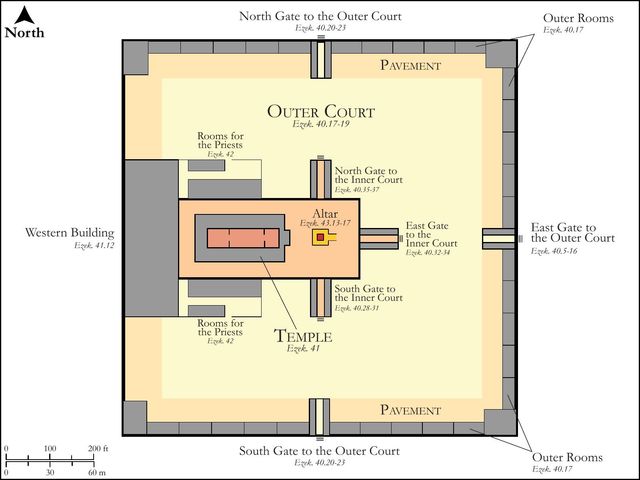
Ezekiel 40:19 is deeply embedded within the extensive and highly detailed temple vision that spans Ezekiel chapters 40-48. This monumental vision commences with Ezekiel being supernaturally transported by a divine hand to a very high mountain in the land of Israel, where he encounters a celestial figure, described as a man, holding a measuring reed and a line of flax (Ezekiel 40:1-3). The subsequent chapters unfold as a meticulous architectural tour, with this divine guide systematically measuring every component of the visionary temple complex—its formidable walls, imposing gates, expansive courts, numerous chambers, and the sacred holy places. Verse 19 specifically delineates a crucial measurement within the outer court, establishing the precise distance between the outer gate and the inner court. This detail is an essential component for understanding the overall layout and the progressive movement towards the sanctuary. The sheer volume and exacting nature of the architectural details throughout these chapters emphasize the divine origin and the tangible reality of this prophetic blueprint, setting the stage for the awe-inspiring return of God's glory in Ezekiel 43.
Historical & Cultural Context
The profound vision recorded in Ezekiel 40-48 was imparted to the prophet during the Babylonian exile, a period of immense national and spiritual devastation for the Jewish people. Jerusalem had been utterly destroyed, Solomon's magnificent Temple lay in ruins, and the people found themselves far from their cherished homeland, grappling with profound questions about God's faithfulness and their very future. In this context of deep despair, the detailed vision of a new, resplendent temple served as an extraordinarily potent message of hope, restoration, and divine continuity. Among the nations, temples were universally regarded as the dwelling places of their gods, and their destruction typically signified the defeat or departure of the god. For Israel, the obliteration of the Temple was not merely a physical catastrophe but a theological one, challenging their understanding of God's presence and covenant. Ezekiel's vision, therefore, directly confronted this pervasive despair by promising a future where God's glorious presence would return to a perfectly ordered, holy, and unblemished sanctuary. The meticulous measurements, including the "hundred cubits" detailed in this verse, were not merely architectural specifications but carried immense cultural and theological significance, assuring the exiles that God's plans were concrete, precise, and would be fulfilled with divine exactitude, in stark contrast to the human failures and disobedience that had led to their current predicament.
Key Themes
ShowHideThis verse, along with the entirety of the temple vision, contributes significantly to several foundational themes within the book of Ezekiel and the broader biblical narrative. Firstly, it powerfully highlights Divine Precision and Order. The exhaustive detail of every measurement, such as the "hundred cubits" specified here, profoundly underscores God's meticulous nature and His unwavering desire for perfect order in worship and in the very space of His dwelling. This divine order stands in sharp contrast to the chaos, idolatry, and moral disorder that had led to Israel's exile. Secondly, the vision powerfully conveys the Promise of Restoration. For a people steeped in despair and national ruin, the vision of a rebuilt, glorious temple served as a profound assurance of God's unwavering faithfulness to His covenant promises and His unyielding commitment to restore Israel, not merely physically but spiritually, re-establishing a vibrant and holy covenant relationship. This theme of spiritual renewal and national restoration is central to Ezekiel's prophetic message, vividly illustrated in the transformative vision of the dry bones in Ezekiel 37. Thirdly, the vision emphatically points to God's Imminent Presence. The ultimate purpose of any temple, whether ancient or visionary, is to serve as a sacred space where God's glory can dwell among His people. The climactic moment of this entire vision is the glorious return of the Lord's presence, which had tragically departed in Ezekiel 10, now majestically filling the new temple in Ezekiel 43:4, signifying that God would once again establish His dwelling place among His redeemed people, bringing forth holiness, life, and perfect communion.
Exposition and Analysis
ShowHideKey Word Analysis
ShowHideFrom a primitive root meaning "to stretch," this verb describes the precise act of taking dimensions, as if by stretching a measuring line. In the context of Ezekiel's vision, it emphasizes the exactness, divine authority, and unalterable nature behind every architectural specification. The repeated use of this verb throughout chapters 40-42 underscores the meticulous, intentional, and non-negotiable character of God's blueprint for His future dwelling, highlighting that every detail is divinely ordained.
Literally meaning "face" or "presence," this term, when used spatially, refers to the leading edge, front part, or surface of something. Its application here ("forefront of the lower gate" and "forefront of the inner court") signifies a specific, unambiguous starting and ending point for the measurement. This precision highlights the divine architect's meticulousness and the exactitude required in the temple's design, leaving no room for human estimation, approximation, or ambiguity.
This word denotes an enclosed yard or open space, often surrounded by a fence or walls. In the sacred context of the temple, it refers to the various courtyards that formed distinct, demarcated areas within the larger sacred complex. The distinction between the "lower gate" (leading to the outer court) and the "inner court" emphasizes the progressive levels of holiness, access, and proximity to the divine presence within the visionary structure, with each space having divinely ordained dimensions and boundaries.
Verse Breakdown
ShowHide"Then he measured the breadth"
This opening clause introduces the action, indicating that the divine guide—the man with the measuring reed, described earlier in Ezekiel 40:3—is taking a specific dimension. The term "breadth" (Hebrew rôchab) explicitly signifies a horizontal measurement, distinguishing it from length or height, and setting the scope for the subsequent details.
"from the forefront of the lower gate"
This specifies the precise starting point for the measurement. The "lower gate" refers to one of the outer gates of the temple complex, likely serving as the primary entry point into the outer court. The use of "forefront" emphasizes the exact, outermost leading edge or face of this structure, ensuring no ambiguity in the starting line of the measurement.
"unto the forefront of the inner court without"
This defines the precise ending point of the measurement. The "inner court" is a more sacred area situated within the temple complex, closer to the sanctuary itself. The addition of "without" (Hebrew chûwts) clarifies that the measurement extends to the outer edge or face of the inner court, not into its interior. This distinction is crucial for maintaining the precise boundaries and the hierarchical separation between the outer and inner sacred spaces.
"an hundred cubits eastward and northward"
This provides the exact distance of the measured breadth, specifying it as 100 cubits, and indicates the directions in which this precise measurement applies. This detail implies that the layout of the outer court, specifically the distance from the outer gate to the inner court, was consistent and symmetrical on both the eastern and northern sides, underscoring a divinely ordered and perfectly balanced design for the entire complex.
Literary Devices
ShowHideThe primary literary device powerfully at play in Ezekiel 40:19, and indeed pervading the entire temple vision, is Precision. The meticulous detailing of every measurement, down to the exact cubit and the specific points of "forefront," serves to underscore the divine origin, absolute reality, and unalterable nature of the vision. This extreme precision lends an undeniable air of authenticity and divine authority to the blueprint, assuring the exiles that God's promises are not vague hopes but concrete, tangible plans. Furthermore, the repeated numerical values and specific dimensions can be seen as a form of Symbolism. While the primary purpose is architectural, numbers in biblical contexts often carry profound symbolic weight. The "hundred cubits" (10 x 10) could subtly suggest completeness, divine order, or a perfect measure, reinforcing the idea of a divinely ordained and flawless structure. The entire vision also functions as Prophetic Architecture, where the highly detailed description of a physical structure serves as a tangible, albeit visionary, representation of future spiritual realities—God's renewed, intimate presence among His people, Israel's comprehensive restoration, and the establishment of a perfect system of worship.
Theological and Thematic Connections
ShowHideEzekiel 40:19, with its seemingly mundane emphasis on precise measurement within the visionary temple, powerfully communicates profound truths about God's character as a God of order, intentionality, and ultimate restoration. This divine blueprint for a future sanctuary speaks volumes about God's unwavering faithfulness to His covenant promises, even in the midst of national desolation and despair. It reveals that God's redemptive plans are not haphazard or improvised but are meticulously designed and executed, ensuring the re-establishment of a holy space where His glory can dwell among His people once more. The detailed dimensions underscore both the sacredness of the space and the structured, reverent approach to worship that God desires, pointing to a future era of perfect communion and unhindered divine presence.
Reflection and Application
ShowHideEzekiel 40:19, though appearing as a mere architectural detail, holds profound spiritual implications for believers today. It serves as a powerful reminder that God is a God of meticulous detail, sovereign plan, and unwavering purpose. Even when our lives feel like a period of exile, brokenness, or overwhelming chaos, this verse assures us that God possesses a perfect blueprint for restoration and a glorious future where His presence is central, accessible, and transformative. This verse challenges us to consider the "measurements" of our own spiritual lives: Are we living with intentionality, precision, and adherence to God's revealed will in our daily walk with Him? Do we recognize and honor the sacred spaces God has ordained for us, whether in moments of personal devotion, the sanctity of our homes, or the fellowship of corporate worship? Just as the temple's dimensions defined boundaries and pathways leading to holiness and God's presence, our lives are called to reflect God's divine order and purpose. As New Testament believers, we are now living temples, meticulously fashioned by God's Holy Spirit, called to reflect His glory and invite His transformative presence into every "court" and dimension of our being.
Questions for Reflection
ShowHideFAQ
ShowHideWhat is a "cubit" and why is it important in this context?
ShowHideA cubit (Hebrew ʼammâh) was an ancient unit of linear measurement, typically based on the length of a forearm from the elbow to the tip of the middle finger. While its exact length varied slightly by culture and period, it was generally around 18-21 inches (approximately 45-53 centimeters). In Ezekiel's vision, it's explicitly specified as a "long cubit," which was a common cubit plus a handbreadth (Ezekiel 40:5). The paramount importance of the cubit in this context lies in its role as the standard, divinely appointed unit for the entire temple blueprint. The precise use of this measurement, down to "an hundred cubits," emphasizes the absolute exactness, divine authority, and non-negotiable nature of the architectural plans, leaving no room for human estimation, approximation, or error. It powerfully underscores God's meticulousness and the tangible reality of the visionary temple.
What is the significance of the "lower gate" and the "inner court without"?
ShowHideThe "lower gate" (Hebrew shaʻar tachtôwn) refers to one of the outer gates of the temple complex, likely serving as the initial entry point for those approaching the sanctuary, leading into the outer court. It represents the outermost boundary of the sacred precinct. The "inner court without" (Hebrew châtsêr pᵉnîymîy chûwts) refers to the outer edge or boundary of the inner court, which is a more sacred area situated closer to the sanctuary itself. This distinction is crucial for understanding the hierarchical holiness and progressive access inherent in the temple layout. As one moved from the outer court, through the inner court, and eventually to the sanctuary and Most Holy Place, the level of sacredness and restricted access increased. The measurement in Ezekiel 40:19 precisely defines the breadth of the outer court, establishing the exact spatial relationship between these distinct sacred zones and highlighting the divinely ordered progression towards God's holy presence.
Christ-Centered Fulfillment
ShowHideWhile Ezekiel's temple vision describes a physical structure with meticulous measurements, its ultimate and profound fulfillment is found not in bricks and mortar, but in the person and redemptive work of Jesus Christ. The detailed dimensions and the promise of God's dwelling find their spiritual reality and ultimate purpose in Him. Jesus Himself declared, "Destroy this temple, and in three days I will raise it up," speaking not of the stone edifice, but of the temple of His own body (John 2:19-21). Christ is the ultimate dwelling place of God, the one in whom "all the fullness of the Godhead dwells bodily" (Colossians 2:9). He is the true and perfect temple, through whom humanity gains unhindered access to God, not through physical gates or courts, but by His perfect sacrifice on the cross. Furthermore, through Christ's atoning work, believers are miraculously incorporated into a spiritual temple, becoming the very "dwelling place for God by the Spirit" (Ephesians 2:21-22). The meticulous order, divine precision, and profound holiness foreshadowed in Ezekiel's measurements are perfectly realized and eternally fulfilled in Christ, who perfectly satisfies God's righteous requirements and establishes a new, living, and accessible way to the Father (Hebrews 10:19-20). Ultimately, the entire vision culminates in the glorious New Jerusalem, where there is no longer any need for a physical temple because "the Lord God Almighty and the Lamb are its temple" (Revelation 21:22), signifying the complete, unmediated, and eternal presence of God with His redeemed people through Christ for all eternity.