


Ezekiel 21:9
Bible text: King James Version (1769 Blayney text) · Public domain
Bible text: Berean Standard Bible · Public domain
Bible text: American Standard Version (1901) · Public domain
Bible text: World English Bible, Messianic edition · Public domain
Bible text: Geneva Bible (1599) · Public domain
Bible text: Young's Literal Translation · Public domain
- בֶּןbenO son ofH1121N-mscNoun Singular Masculine Construct
- אָדָם'a·DamhumankindH120N-msNoun Singular Masculine Absolute
- הִנָּבֵאhi·na·Ve'prophesyH5012V-Niphal-Imp-2msVerb Niphal Imperative 2nd Singular Masculine
- וְאָמַרְתָּve·'A·mar·taand you will sayH559Conj-w ¦ V-Qal-ConsecPerf-2msVerb Qal Consecutive Perfect 2nd Singular Masculineוְandאָמַרְתָּyou will say
- כֹּהkohthusH3541AdvAdverb
- אָמַר'a·Marhe saysH559V-Qal-Perf-3msVerb Qal Perfect 3rd Singular Masculine
- אֲדֹנָי'a·do·Nai[the] LordH136N-properNoun Proper Title
- אֱמֹר'e·MorsayH559V-Qal-Imp-2msVerb Qal Imperative 2nd Singular Masculine
- חֶרֶבChe·reva swordH2719N-fsNoun Singular Feminine Absolute
- חֶרֶבChe·reva swordH2719N-fsNoun Singular Feminine Absolute
- הוּחַדָּהhu·Cha·dahit has been sharpenedH2300V-Hophal-Perf-3fsVerb Hophal Perfect 3rd Singular Feminine
- וְגַםve·gamand alsoH1571Conj-w ¦ AdvAdverbוְandגַםalso
- מְרוּטָהme·ru·Tah[is] polishedH4803V-Qal-PassPrtcpl-fsVerb Qal Participle Passive Singular Feminine Absolute
English is a literal word-by-word gloss of the Hebrew, not the KJV's wording. Why?
This is the original text the KJV's translators worked from — each Hebrew word with its own literal English meaning in this verse, prepared by scholars at Tyndale House, Cambridge. The KJV translates whole sentences, not word by word, so its wording differs: one Hebrew word can become several English words, and the KJV may choose “the LORD” where the gloss reads “Yahweh”. Both are faithful — they answer different questions. For the KJV's own rendering, switch to the KJV text.
Details
See on the biblical-era map
Study this verse
Public-domain commentary
Matthew Henry
From his Commentary on the Whole Bible. Henry comments on passages, not single verses — this entry covers Ezekiel 21:8–17. His two-level outline is real structure in the source text, so it is rendered as structure.
Here is another prophecy of the sword, which is delivered in a very affecting manner; the expressions here used are somewhat intricate, and perplex interpreters. The sword was unsheathed in the foregoing verses; here it is fitted up to do execution, which the prophet is commanded to lament. Observe,
I.How the sword is here described.
1.It is sharpened, that it may cut and wound, and make a sore slaughter. The wrath of God will put an edge upon it; and, whatever instruments God shall please to make use of in executing his judgments, he will fill them with strength, courage, and fury, according to the service they are employed in. Out of the mouth of Christ goes a sharp sword, Rev 19:15.
2.It is furbished, that it may glitter, to the terror of those against whom it is drawn. It shall be a kind of flaming sword. If it have rusted in the scabbard for want of use, it shall be rubbed and brightened; for though the glory of God's justice may seem to have been eclipsed for a while, during the day of his patience and the delay of his judgments, yet it will shine out again and be made to glitter.
3.It is a victorious sword, nothing shall stand before it (Eze 21:10): It contemneth the rod of my son as every tree. Israel, said God once, is my son, my first-born. The government of that people was called a rod, a strong rod; we read (Eze 19:11) of the strong rods they had for sceptres. But when the sword of God's justice is drawn it contemns this rod, makes nothing of it; though it be a strong rod, and the rod of his son, it is no more than any other tree. When God's professing people have revolted from him, and are in rebellion against him, his sword despises them. What are they to him more than another people? The marginal reading gives another notion of this sword: It is the rod of my son; and we know of whom God has said (Psa 2:7), Thou art my Son, this day have I begotten thee, and (Eze 21:9) Thou shalt break them with a rod of iron. This sword is that rod of iron which contemns every tree and will bear it down. Or, This sword is the rod of my son, a correcting rod, for the chastening of the transgression of God's people (Sa2 7:14), not to cut them off from being a people. It is a sword to others, a rod to my son.
II.How the sword is here put into the hand of the executioners:
"It is the rod of my Son, and he has given it that it may be handled (Eze 21:11), that it may be made use of for the end for which it was drawn. It is given into the hand, not of the fencer to be played with, but of the slayer to do execution with. The sword of war my Son makes use of as a sword of justice, and to him all judgment is committed. It is made bright (Eze 21:15), it is wrapped up, that it may be kept safe, and clean, and sharp for the slaughter, not as Goliath's sword was wrapped up in a cloth only for a memorial," Sa1 21:9.
III.How the sword is directed, and against whom it is sent (Eze 21:12):
It shall be upon my people; they shall fall by this sword. It is repeated again, as that which is scarcely credible, that the sword of the heathen shall be upon God's own people; nay, it shall be upon all the princes of Israel; their dignity and power as princes shall be no more their security than their profession of religion as princes of Israel. But, if the sword be at any time upon God's people, have they not comfort within sufficient to arm them against every thing in it that is frightful? Yes, they have, while they conduct themselves as becomes his people; but these had not done so, and therefore terrors, by reason of the sword, shall be upon those that call themselves my people. Note, While good men are quiet, not only from evil, but from the fear of it, wicked men are disturbed not only with the sword, but with the terrors of it, arising from a consciousness of their own guilt. This sword is directed particularly against the great men, for they had been the greatest sinners among them; they had altogether broken the yoke and burst the bonds (Jer 5:5), and therefore with them in a special manner God's controversy is, who had been the ringleaders in sin. The sword of the slain is the sword of the great men that are slain, Eze 21:14. Though they have furnished themselves with places of retirement, places of concealment, where they flatter themselves with hopes that they shall be safe, they will find that the sword will enter into their privy chambers, and find them out there, as the frogs, when they were one of Egypt's plagues, found admission into the chambers of their kings. The sword, the point of this sword, is directed against their gates, against all their gates (Eze 21:15), against all those things with which they thought to keep it out and fortify themselves against it. Note, The strongest gates, though they be gates of brass, ever so well barred, ever so well guarded, are no fence against the point of the sword of God's judgments. But when that is pointed against sinners,
1.They are ready to fear the worst; their hearts faint, so that they are not able to make any resistance.
2.The worst comes; whatever resistance they make, it is to no purpose, but they are ruined, and their ruins are multiplied. But what need have we to observe the particular directions of this sword when it has a general commission, is sent with a running warrant? (Eze 21:16): "Go thee, one way or other, which way thou wilt, turn to the right hand or to the left, thou wilt find those that are obnoxious, for there are none free from guilt; and thou hast authority against them, for there are none exempt from punishment; and therefore, whithersoever thy face is set, that way do thou proceed, and, like Jonathan's sword, from the blood of the slain, from the fat of the mighty, thou shalt never return empty," Sa2 1:22. Note, So full is the world of wicked people that, which way soever God's judgments go forth, they will find work, will find matter to work upon. That fire will never go out on this earth for want of fuel. And such various methods God has of meeting with sinners that the sword of his justice is still as it was at first when it flamed in the hand of the cherubim: it turns every way, Gen 3:24.
IV.What is the nature of this sword, and what are the intentions and limitations of it as to the people of God, Eze 21:13.
It is a correction; it is designed to be so; the sword to others is a rod to them. This is a comfortable word which comes in in the midst of these terrible ones, though it be expressed somewhat obscurely.
1.The people of God begin to be afraid that the sword will contemn even the rod, that the sword will go on with such fury that it will despise its commission to be a rod only, will forget its bounds and become a sword indeed, even to God's own people. They fear lest the Chaldeans' sword, which is the rod of God's anger, contemn its being called a rod, and become as the axe that boasts itself against him that heweth therewith or the staff that lifts up itself as if it were no wood, Isa 10:15. Or, "What if the sword contemn even the rod? that is, what if this sword make the former rods, as that or Sennacherib, to be contemned as nothing to this? What if this should prove not a correcting rod, but a destroying sword, to make a full end of our church and nation?" This is that which the thinking, but timorous, few are apprehensive of. Note, When threatening judgments are abroad it is good to suppose the worst that may be the consequences of them, that we may provide accordingly. What if the sword contemn the tribe or sceptre? namely, that of Judah and the house of David (so some think Shebet here signifies); what if it should aim at the ruin of our government? If it do, the Lord is righteous and will be gracious notwithstanding. But,
2.These fears are silenced with an assurance that it is not so; the sword shall not forget itself, nor the errand on which it is sent: It is a trial, and it is no more than a trial. He that sends it makes what use of it, and sets what bounds to it, he pleases. Here shall its proud waves be stayed. Note, It is matter of comfort to the people of God, when his judgments are abroad, and they are ready to tremble for fear of them, that, whatever they are to others, to them they are but trials; and, when they are tried, they shall come forth as gold, and the proving of their faith shall be the improving of it.
V.Here the prophet and the people must show themselves affected with these judgments threatened.
1. The prophet must be very serious in denouncing these judgments. He must say, A sword! a sword! Eze 21:9. Let him not study for fine words, and a variety of quaint expressions; when the town is on fire people do not so give notice of it, but cry, with a frightful doleful voice, Fire! fire! So must the prophet cry, A sword! a sword! and (Eze 21:14), Let the sword be doubled the third time in thy preaching. God speaks once, yea, twice, yea, thrice; it were well if men, after all, would perceive and regard it. It shall be doubled the third time in God's providence; for it was Nebuchadnezzar's third descent upon Jerusalem that made a full end of it. Ruin comes gradually, but at last comes effectually, upon a provoking people. Yet this is not all: the prophet is not only as a herald at arms to proclaim war, and to cry, A sword! a sword! once and again, and a third time, but, as a person nearly concerned, he must cry and howl (Eze 21:12), must sadly lament the desolations that the sword would make, as one that did himself not only sympathize with the sufferers, but feel from the sufferings. Again (Eze 21:14), Prophesy, and smite thy hands together, wring thy hands, as lamenting the desolation, or clap thy hands, as by thy prophecy instigating and encouraging those that were to be the instruments of it, or as one standing amazed at the suddenness and severity of the judgment. The prophet must smite his hands together; for (says God) I will also smite my hands together, Eze 21:17. God is in earnest in pronouncing this sentence upon them, and therefore the prophet must show himself in earnest in publishing it. God's smiting his hands together, as well as the prophet's smiting, is in token of a holy indignation at their wickedness, which was really very astonishing. When Balak's anger was kindled against Balaam he smote his hands together, Num 24:10. Note, God and his ministers are justly angry at those who might be saved and yet will be ruined. Some make it an expression of triumph and exultation, agreeing with that (Isa 1:24), Ah! I will ease me of my adversaries; and that (Pro 1:26), I also will laugh at their calamity. And so it follows here, I will cause my fury to rest, not only it shall be perfected, but it shall be pleased. And observe with what solemnity, with what authority, this sentence is ratified: "I the Lord have said it, who can and will make good what I have said. I have said it, and will never unsay it. I have said it, and who can gainsay it?" 2. The people must be very serious in the prospect of these judgments. An intimation of this comes in in a parenthesis (Eze 21:10): Should we then make mirth? Seeing God has drawn the sword, and the prophet sighs and cries, Should we then make mirth? The prophet seems to give this as a reason why he sighs; as Neh 2:3, Why should not my countenance be sad, when Jerusalem lies waste? Note, Before we allow ourselves to be merry, we ought to consider whether we should be merry or no. Should we make mirth, we who are sentenced to the sword, who lie under the wrath and curse of God? Shall we make mirth as other people, who have gone a whoring from our God? Hos 9:1. Should we now make mirth, when the hand of God has gone out against us, when God's judgments are abroad in the land and he by them calls to weeping and mourning? Isa 22:11, Isa 22:13. Shall we now make mirth as the king and Haman, when the church is in perplexity (Est 3:15), when we should be grieving for the affliction of Joseph? Amo 6:6.
Historical interpretation
Historical reception
4 surviving comments on this verse. Each one is dated, so this reads as a timeline rather than a list.
(Verse 35, 36, and following) And I will bring you into a desert of peoples, and there I will judge you face to face. Just as I contended with your fathers in the desert of the land of Egypt, so I will judge you, says the Lord. And I will subject you to my scepter, and I will bring you into the bonds of the covenant, and I will choose from among you the transgressors and the wicked: from their place of residence I will bring them out, and they will not enter the land of Israel, and you will know that I am the Lord. Thus says the Lord: I will do for you who are in Babylon, and now serve idols, what I did for your ancestors in Egypt. I will lead you into the desert of the peoples, and there I will judge you face to face, just as I contended with them in judgment when they came out of Egypt. And after I have judged you, I will subject you to my scepter and rule, and I will make a covenant with you and bring you into your land with the bonds of love, so that bound by my love, you will never be able to depart from me. But I will choose from among you the transgressors and the wicked, who persist in the hardness of their hearts in evil deeds, not for possession, but for rejection. And I will indeed bring them out of the land of their dwelling, so that when they are brought out, they will not enter the land of Israel; but they will perish in various regions. And by the distinction between good and evil, you shall know that I am the Lord, who judges all things. The rest of the discourse hastens, and we briefly go through each point, in order to provide only the meaning to the readers.
(Ver. 23, 24 onwards) Again, I raised my hand against them in the wilderness, to scatter them among the nations and disperse them in the lands, because they had not performed my judgments, and had rejected my commandments, and had violated my Sabbaths, and their eyes had been after the idols (or thoughts) of their fathers. Therefore, I also gave them statutes that were not good, and judgments in which they would not live, and I defiled them in their offerings (or transgressions), as they offered (or led astray) everything that opens the womb because of their sins (for which the Septuagint translated, to destroy them and what they had overlooked): and they will know that I am the Lord. Where in the Old Testament, against their children, who fell in the wilderness, the Lord lifted up His hand to scatter them among the nations, Scripture does not say; but it is to be believed that this was done in accordance with what is reported here. Or he signifies by this, that after they entered the promised land, they were given over at various times, for many sins, to different nations and kings, and at that time the commandments of the Lord, which were good according to their nature, and the judgments by which believers could live, were made not good for them, since they were in no way able to keep the precepts of the law in captivity, and to do what the divine word commanded. He did not say, 'I gave them evil commandments,' but, 'not good commandments.' For it does not immediately follow that what is not good is evil, as the Apostle teaches, it is good for a man not to touch a woman; but because of incontinence, let each possess his own vessel in sanctification and honor (I Cor. VII). And if he does not do this, it is neither good nor evil. Therefore, God gave them, dispersed among the nations, not good commandments, that is, he allowed them to follow their own thoughts and desires, to do what is not appropriate. And he defiled them in his gifts: just as a Priest separates lepers from the people, and shows that they are defiled; while they offer to idols what they should offer to God. And they pass everything that opens the womb through the fire of Baal, that is, the firstborn; so that after they have deserted God and been handed over to the worship of idols, then they may understand that He is the Lord whom they have provoked to anger by their own fault. Symmachus interpreted this passage more explicitly, treating the future as past. Therefore, I will also give them bad precepts and judgments for which they will not live, and I will defile them because of their gifts, as they consecrate and offer everything that opens the womb, so that I may destroy them, and they will know that I am the Lord. And the meaning is this: because I have seen the sons of the fathers equaling the wickedness of their ancestors and doing the same things for which they offended God, I wanted to divide them into nations and disperse them throughout the whole world, and give them bad precepts and judgments in which they would not live, so that I may defile them with their gifts, for they consecrated everything that opens the womb to idols, and I may destroy them forever, and they will know that I am the Lord. Through which he showed that he had not given them good commandments who dwelt in the wilderness, but to those whom he wanted to scatter among the nations, and to make foreigners in the whole world, he gave them a desire for things that he did not give: so that there they would do good commandments of God, not good because of their own fault, while they exhibited to idols what God had commanded to be exhibited. This can also be said, that before the offense, they received only the Ten Commandments; but after idolatry and blasphemy, they received multiple ceremonies of the law, so that they would offer victims to God rather than to demons, and by comparison with sacrilege, what was not good in itself became lighter, and by no means evil, because it was offered to God, and yet not good, because they offended the author of good.
(Vers. 8 et seq.) And the word of the Lord came to me, saying: Son of man, prophesy and say: Thus says the Lord God, speak: A sword, a sharp sword, has been sharpened and polished, to slaughter victims; it has been sharpened, and polished, to shine: you who move the scepter of my son, you have cut down every tree. And I have given him to be polished, to be held in hand: this sword has been sharpened, and this sword has been polished, to be in the hand of the one who kills. Cry out and wail, son of man, for this has happened in my people, it has happened to all the leaders of Israel. Those who fled were delivered over to the sword along with my people. Therefore, strike your thigh and clap your hands in applause, for he has been tested and when he overturns the scepter, it will not be. This is what the Lord God says. As for you, son of man, be a prophet and strike hand against hand, and let the sword be doubled and tripled for the slayers. This is the sword of great slaughter that makes them astonished, causes their hearts to melt, and multiplies ruins. In all their gates I have given confusion of sharp and polished swords to flash: clothed for slaughter. Go to the right or to the left, wherever your desire leads your face. Indeed, I will applaud hand to hand, and I will fulfill my indignation, I, the Lord, have spoken. It is much if I present both editions, and the length of the books is extended, especially where there is either no distance or a small one. Therefore, I will present some things that differ. For this reason, what we said: 'Whoever moves the scepter of my son, cut down every tree,' they translated as: 'Kill, despise, reject every tree.' And again, where we said: 'Those who fled were handed over to the sword,' they translated as: 'My guests, or inhabitants.' And where we said: 'Applaud on the thigh,' they put: 'Strike with the hand.' And where we translated: 'And when he overturns this with the scepter, the edition belongs to them: Three are repelled.' However, he speaks to the sword of Nebuchadnezzar, that it may come against Jerusalem, to be sharpened and polished, for there are many to be slain; and he addresses Nebuchadnezzar himself. You are the one who moves and overturns the scepter of my son, the dominion of the people of Israel, and you cut down every tree, the entire multitude of the people. I have given, he says, this sword, that it may be held in the hand of Nebuchadnezzar; and let it be in the hand of a mighty man. Therefore, O prophet, cry out and wail, and with a voice filled with dire words, bear witness to the imminent calamity. This sword spared no one, nor left anyone untouched by the impending evils. It was made among the people, made among the leaders of Israel, made among my guests and priests who lived in my temple. Therefore, strike your thigh or your hand and put on the attire of one who mourns. For this sword has been tested by me, and it will overthrow my scepter and kingdom, which will no longer exist, and it will end with King Zedekiah. Again I command you, prophet, that you strike not only the thigh in astonishment and miracle, but also the hands, so that not only once, but a second and third time, the sword may come to kill. For first came Nebuchadnezzar, when he took Jehoiachin, and secondly, when Jehoiakim reigned, and thirdly, when Zedekiah. And this is the triple sword, when a great slaughter occurred and it multiplied ruins to such an extent that they were amazed in their minds and their hearts wasted away, and it caused disturbance in all their gates. Therefore it is ordered to him, that is, with a sharp and polished sword for flashing, and with a cloak and unburdened, and ready for slaughter, that he may go either to the right or to the left. Wherever, he says, it pleases your face, boldly enter, having me as your leader, me as your helper. I will applaud hand to hand, so that I may encourage you against my adversaries who rage against you, as if I were your supporter and instigator. Do not doubt, do not fear, and do not be afraid to suffer what Sennacherib has suffered: I am the Lord who has spoken, you are the minister of my will, fulfill my plan. We can, by way of anagoge, take up a sharp and ready sword for the slaughter of the devil, concerning whom the Apostle says: Deliver this kind of Satan unto the destruction of the flesh, that the spirit may be saved (I Cor. V, 5). And in another place: Hymenaeus and Alexander, whom I have delivered unto Satan, that they may learn not to blaspheme (I Tim. I, 20). And it is written in the Psalms: He sent forth his wrath and indignation and distress, a mission by the agency of wicked angels (Ps. LXXVII, 49). Some think that this sword was in the hand of an angel when Jerusalem was struck under David (2 Kings 24). Others suspect that it is said of the same sword in the Gospel: I did not come to bring peace on earth, but a sword (Matthew 10:34); and to divide among themselves every affection of kinship, so that the wicked may fall and the holy may rise. But it is impious to believe this of the sword of the Savior, and rather this should be believed of the devil, who overturns the scepters of the Lord in the Church, who kills all in the people, and the leaders, and the guests of God; and then is approved by the Lord, when he overthrows Judas the traitor and his like (John 13). After he had eaten the morsel, Satan entered into him. And the sword of those who were killed doubled and tripled, in order to forgive the sin of Jerusalem, because it had taken upon itself its own double sins from the hand of the Lord. But the Lord rejoices and exults, and encourages the raging sword to go either to the right or to the left, and wherever its desire takes it, so that the evil may be killed and the good may remain, and fulfill what is written: What are chaff to wheat? The Lord says (Jeremiah 23:32).
(Verse 27, 29 onwards) Therefore speak to the house of Israel, son of man, and tell them: Thus says the Lord God: Moreover, your fathers have blasphemed against me and have treated me with contempt, even as they spurned me. And I brought them into the land that I had lifted my hand to give them ((Vulgate adds: that land)): they saw every high hill and every leafy tree, and there they offered their sacrifices and presented there the irritation of their offerings, and they placed there the fragrance of their sweetness, and they poured out their ((Vulgate is silent on this)) libations there. And I said to them, 'What is the high place to which you are going?' And its name was called the High Place until this day. Therefore speak to the house of Israel, son of man, and say to them, 'Thus says the Lord God: As for your fathers, they have provoked Me to anger by their iniquities, by the fact that they have fallen away from Me. So I brought them into the land that I had lifted My hand in an oath to give them.' They saw every high hill and every leafy tree, and there they offered their sacrifices. They also presented there the provocation of their gifts, and they set there their pleasing aroma, and they poured out there their drink offerings. And I said to them: What is abbana, because you enter there? And they called its name abbana until this day. I wanted, he said, to scatter them in the wilderness, and to give them not good precepts, so that they would sacrifice to idols what they should have offered to me, and consecrate all their first-fruits to them by fire, so that I might kill them and destroy them. But when he says, I wanted, he shows that he did not do what he wanted. And that which follows: 'And they shall know that I am the Lord,' is not found in the Septuagint. For it did not seem fitting to them to know after their destruction that he himself is the Lord. But you, son of man, speak again to them, that is, to the elders of the house of Israel, who have come to inquire of you: Your fathers, from whom you have descended, have also blasphemed against me and held me in contempt; after I brought them into the land which I had given them to possess, they turned against me to provoke me. For when they saw every high hill and leafy tree, they would sacrifice on the mountains and in the groves and thickets, and offer victims to the idols, and pour out libations. And when I saw this, I said to them: What is this, Bama? for it is called high: or why do you enter into such a place which you have chosen for yourselves in all the hills, so that even today these places are called Bamoth, and the ancient error retains its original name? Regarding Bama, which we translate as excelsum, there is an error in the Septuagint edition, where it is written as ἀββανὰ, which does not resonate in the Hebrew language. Bama can mean 'in which' if the two syllables are divided into two words, but in the present context, that sense does not fit. However, wherever it is written in the Books of Kings and Chronicles: 'The people still sacrificed and offered incense on the high places,' Bama in the singular and Bamoth in the plural mean 'high places.'
Continue studying Ezekiel 21:9 across the web’s major study libraries — every link below opens this exact verse, chapter, or book on the destination site.
Read & Compare
 BibleGatewayThis verse in more than 200 translations and 70 languages.
 Bible.comThe YouVersion reader — hundreds of translations, reading plans, and highlights.
 ESV.orgCrossway's official English Standard Version reader.
 NET BibleThe NET translation with 60,000+ translators' notes on every rendering decision.
 STEP BibleTyndale House's free study tool — original text, vocabulary, and scholarly resources.
 BibliaLogos Bible Software's free web reader.
 USCCBThe New American Bible (Revised Edition) with the U.S. bishops' study notes.
Commentaries
 BibleHub CommentariesDozens of classic commentaries on this verse, gathered on one page.
 StudyLightMore than 100 commentary sets — the largest collection on the web.
 BibleRefPlain-English commentary on what this verse means, verse by verse.
 Enduring WordDavid Guzik's free commentary on this chapter, widely used by Bible teachers.
 Bible Study ToolsVerse commentary alongside Greek and Hebrew study aids.
Original Language & Research
- BibleHub InterlinearThe verse word by word — original language, transliteration, and English.
- BibleHub LexiconEvery word's original-language definition and Strong's entry.
 Blue Letter BibleDeep-study tools — Strong's numbers, concordance, and word studies.
 SefariaThe Hebrew text with Rashi and centuries of Jewish commentary.
Sermons, Hymns & Audio


TrulyRandomVerse is not affiliated with these sites and doesn’t control their content. They’re linked because they’re genuinely useful.
Summary
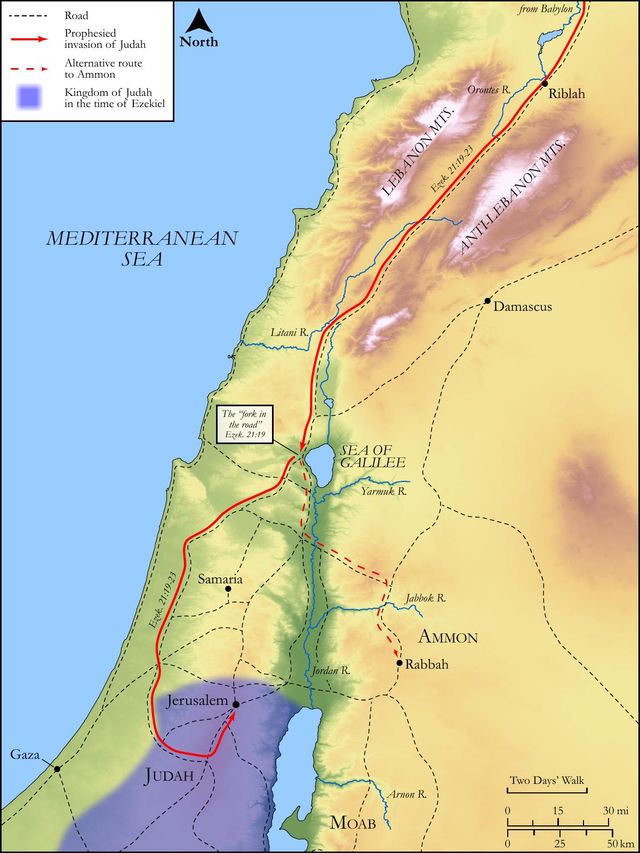
Ezekiel 21:9 delivers a stark and urgent divine pronouncement from the LORD, conveyed through the prophet Ezekiel. This verse serves as a chilling declaration of impending judgment, emphasizing its absolute certainty and meticulous preparation. The powerful, repeated imagery of a "sword," described as both "sharpened" and "furbished," vividly portrays God's unwavering resolve and readiness to execute His righteous wrath upon Judah, signifying an imminent and devastating military invasion.
Context
ShowHideLiterary Context
Ezekiel 21 is a pivotal chapter within a larger prophetic cycle (Ezekiel 20-24) where the prophet pronounces severe judgment against Jerusalem and the land of Israel. This condemnation stems from their persistent idolatry, rebellion, and profound covenant unfaithfulness. Verse 9 immediately follows a symbolic prophecy against the "forest of the South" in Ezekiel 20:45-49, which is widely understood as a veiled reference to Jerusalem. The "sword" imagery introduced here becomes the dominant and terrifying motif throughout the chapter, appearing repeatedly in verses such as Ezekiel 21:10, Ezekiel 21:14, and Ezekiel 21:28. This repetition underscores the pervasive, inescapable, and comprehensive nature of the coming destruction. The verse thus sets the stage for the detailed description of the sword's purpose, its path, and the devastating effects that unfold in the subsequent prophecies.
Historical & Cultural Context
Ezekiel prophesied during a profoundly tumultuous period in Judah's history, specifically the Babylonian exile in the early 6th century BCE. The first wave of exiles, including Ezekiel himself, had already been deported to Babylon in 597 BCE, and Jerusalem was under the looming, existential threat of final destruction, which tragically materialized in 586 BCE. In that day, the "sword" was the quintessential weapon of warfare, universally symbolizing military might, conquest, and the execution of judgment. The act of sharpening and furbishing a sword was not merely a ritual but a common and necessary preparation for battle, indicating a deliberate, meticulous, and imminent engagement. Culturally, the concept of a divine warrior wielding instruments of war to enact judgment was deeply embedded in Israelite theology, often understood as God's righteous response to covenant breaking, as explicitly outlined in passages like Deuteronomy 28. The Babylonian army, under the command of Nebuchadnezzar, was recognized by prophets like Jeremiah (e.g., Jeremiah 25:9) as God's chosen instrument for this divine judgment.
Key Themes
ShowHideEzekiel 21:9 powerfully contributes to several overarching themes prominent in the book of Ezekiel and broader prophetic literature. First, it vividly highlights the theme of Divine Judgment, emphasizing that the impending devastation is not a random act of war but a direct, deliberate, and righteous consequence of Israel's persistent sin, idolatry, and rebellion against the LORD. Second, the emphatic repetition and detailed description of the sword underscore the Imminence and Certainty of this judgment; it is not a distant, theoretical threat but an immediate, meticulously prepared reality. The "sharpened" and "furbished" nature of the sword conveys God's unwavering resolve and precision in executing His justice. Third, the opening command, "Son of man, prophesy," reinforces the theme of Prophetic Authority and Ezekiel's crucial role as God's faithful messenger. He is depicted as a watchman (as described in Ezekiel 3:17) tasked with delivering an unavoidable and often terrifying message, even when repentance seems unlikely or the people remain unresponsive.
Exposition and Analysis
ShowHideKey Word Analysis
ShowHideThis word (H2719) refers to a cutting instrument, specifically a knife, sword, or other sharp implement. In this profound prophetic context, it functions as a potent metonym for war, destruction, and death. Its immediate repetition in the verse, "A sword, a sword," serves to intensify the sense of its overwhelming presence and the absolute inevitability of the judgment it represents. It is presented as the primary and inescapable instrument of divine wrath.
Derived from a primitive root (H2300) meaning "to be (causatively, make) sharp" or "severe," this word emphatically highlights the keenness and lethal readiness of the sword. It implies that the weapon has been meticulously honed to an exceedingly effective edge, prepared for immediate, decisive, and devastating action. This is not a dull or neglected blade, but one precisely calibrated for its specific, deadly purpose, signifying God's precision in judgment.
This word (H4803) comes from a primitive root meaning "to polish" or "to make bright." When applied to a sword, it suggests that the blade has been thoroughly cleaned, polished, and made to gleam. This "furbishing" indicates not merely readiness, but a terrifying perfection and a chilling beauty in its destructive capacity. It implies that the sword is not only sharp but also aesthetically prepared for its terrifying task, reflecting the meticulous and deliberate nature of God's sovereign judgment.
Verse Breakdown
ShowHide"Son of man, prophesy, and say, Thus saith the LORD; Say,"
This opening clause unequivocally establishes the divine origin and supreme authority of the message. "Son of man" (H1121, H120) is God's consistent address to Ezekiel, emphasizing his human frailty and dependence on divine revelation, yet simultaneously affirming his unique and indispensable role as God's chosen messenger. The repeated command "prophesy, and say" underscores the profound urgency and absolute necessity of delivering this specific word from "the LORD" (H3068, YHWH), the covenant God of Israel, whose word carries ultimate authority, certainty, and performative power.
"A sword, a sword is sharpened,"
This declarative statement introduces the central, terrifying image of impending judgment. The immediate and emphatic repetition of "A sword, a sword" serves as a powerful rhetorical device, designed to convey the absolute certainty, overwhelming nature, and terrifying imminence of the coming destruction. The term "sharpened" (H2300) signifies that this instrument of judgment is not merely present but has been meticulously prepared, made exceedingly keen and ready for its devastating work. It conveys a chilling sense of precision and deadly effectiveness.
"and also furbished:"
This final phrase adds a crucial layer to the sword's state of readiness and its terrifying implications. "Furbished" (H4803) means polished or made bright. This suggests that the sword is not only lethally sharp but also gleaming, perhaps even radiating a terrifying perfection in its destructive purpose. It implies a state of absolute readiness and meticulous preparation for immediate and precise execution, profoundly highlighting God's deliberate, purposeful, and sovereign action in bringing about judgment.
Literary Devices
ShowHideEzekiel 21:9 is powerfully constructed with several literary devices that amplify its message of impending doom and divine resolve. The most prominent is Repetition, specifically a form of anadiplosis, evident in the immediate reiteration of "A sword, a sword." This powerful rhetorical technique intensifies the message, creating an overwhelming sense of urgency, certainty, and the inescapable presence of the destructive force. It hammers home the singular, all-consuming instrument of God's wrath. Furthermore, the passage employs vivid Imagery, painting a clear and chilling picture of a weapon meticulously prepared for battle. The terms "sharpened" and "furbished" are not merely descriptive; they evoke a sensory experience of a keen, gleaming blade, poised and ready to strike with deadly precision. This imagery contributes significantly to the overall tone of divine precision and terrifying inevitability. The "sword" itself functions as a potent Metaphor for divine judgment, war, and comprehensive destruction. It transcends its literal meaning to symbolize God's righteous retribution against a rebellious people, an instrument wielded by the Almighty Himself to execute His holy justice.
Theological and Thematic Connections
ShowHideEzekiel 21:9 profoundly reveals the unyielding holiness and perfect justice of God, demonstrating that His immutable character demands a response to persistent sin and rebellion. The "sharpened and furbished sword" is a vivid and terrifying manifestation of God's unwavering commitment to uphold His covenant and righteous standards. It underscores the profound truth that divine judgment is never arbitrary but is always a deliberate, precise, and inevitable consequence of persistent unfaithfulness. This passage serves as a stark and sobering reminder that God takes sin with ultimate seriousness and will act decisively to address it, even if it means sovereignly employing foreign nations as instruments of His wrath. The meticulous preparation of the "sword" powerfully reflects God's absolute sovereignty and His purposeful control over history and the destinies of nations, ensuring that His divine will is executed with absolute precision and without fail.
Reflection and Application
ShowHideEzekiel 21:9, while deeply rooted in an ancient context of divine judgment upon a rebellious Israel, offers timeless and profound principles for contemporary reflection and application. It stands as a solemn and powerful reminder of God's unwavering holiness and the serious, often devastating, consequences of persistent disobedience to His revealed will. The imagery of the "sharpened and furbished sword" compels us to confront the gravity of sin in our own lives and in the world, and to recognize that God's justice is as real, certain, and active as His boundless mercy. This passage should cultivate within us a healthy and reverent fear of the Lord, not as paralyzing terror, but as a profound awe and respect for His righteous character and His absolute authority. It calls us to engage in honest self-examination, to repent of any rebellion, and to proactively seek alignment with His divine standards in every area of our lives. Ultimately, a deep understanding of the severity and certainty of God's judgment, as depicted here, serves to immeasurably deepen our appreciation for the boundless grace and complete salvation offered through Jesus Christ, who bore the full, terrifying weight of God's wrath on the cross, thereby providing an eternal escape from the "sword" of judgment for all who believe and trust in Him.
Questions for Reflection
ShowHideFAQ
ShowHideWhat does "Son of man" mean in this context and how does it relate to Jesus?
ShowHideIn the book of Ezekiel, "Son of man" (Hebrew: ben 'adam - H1121, H120) is God's consistent and primary way of addressing the prophet Ezekiel, appearing over 90 times. This designation emphasizes Ezekiel's humanity, his mortality, and his humble status in stark contrast to the divine majesty and omnipotence of the LORD (H3068) who commissions him. It highlights that Ezekiel is a mere mortal delivering a divine message, thereby underscoring the absolute authority and divine origin of the message itself rather than the messenger. While this phrase in Ezekiel specifically refers to the prophet, it profoundly foreshadows the later, pivotal use of "Son of Man" in Daniel 7:13 to describe a messianic, divine-human figure who receives everlasting dominion and glory. Jesus frequently used "Son of Man" as His self-designation in the Gospels (e.g., Matthew 8:20), consciously connecting Himself to both the humble, suffering servant aspect and the glorious, authoritative figure who would come in judgment. Thus, while Ezekiel is a "son of man" delivering a message of judgment, Jesus is the ultimate "Son of Man" who will perfectly execute all judgment (e.g., John 5:27).
Why is the sword described as being "furbished" in addition to being "sharpened"?
ShowHideThe description of the sword as "furbished" (Hebrew: mâraṭ - H4803), meaning polished or made bright, adds a crucial and profound layer of meaning beyond mere sharpness. While "sharpened" emphasizes its readiness to cut and destroy, "furbished" suggests a meticulous, almost ritualistic preparation that makes the sword gleam. This powerful imagery conveys several profound theological points. First, it speaks to the deliberateness and perfection of God's judgment. This is not a hasty, impulsive, or emotional act, but one executed with precision, care, and divine intentionality, perfectly reflecting God's righteous and holy character. Second, the gleaming quality of a furbished sword can be terrifyingly beautiful in its destructive purpose, highlighting the awe-inspiring and fearful aspect of divine wrath. It implies that God's instrument of judgment is not only effective but also perfectly prepared for its task, leaving no doubt about its purpose or inevitable outcome. It underscores that God is absolutely sovereign over all events, even the most catastrophic, and that His judgments are executed with absolute control, purpose, and divine glory.
Christ-Centered Fulfillment
ShowHideEzekiel 21:9, with its terrifying imagery of a sharpened and furbished sword of divine judgment, finds its ultimate fulfillment and profound transformation in the person and work of Jesus Christ. While the immediate context points to God's imminent judgment upon rebellious Israel through the literal Babylonian sword, the New Testament reveals Christ as the one who both embodies and ultimately disarms this divine wrath for all who believe. Jesus is presented as the ultimate and righteous judge, the "Son of Man" who has been given all authority to execute judgment because He is the Son of Man (e.g., John 5:27). He is also powerfully depicted in the book of Revelation with a sharp, two-edged sword coming from His mouth, symbolizing the irresistible power and judgment of His divine word (e.g., Revelation 1:16 and Revelation 19:15). However, for those who place their faith in Him, Christ fully absorbed the "sharpened and furbished sword" of God's wrath on the cross. His sacrificial death was the perfect, meticulously prepared act of divine justice and boundless mercy, satisfying the holy demands of God's character so that all believers might be eternally spared from condemnation (e.g., Romans 8:1). The "sword" of judgment that was prepared for humanity's sin was instead plunged into Christ, the spotless Lamb of God, who bore our iniquities (e.g., Isaiah 53:5). Thus, while Ezekiel's sword brings death and destruction, Christ's self-sacrifice brings eternal life and reconciliation, transforming the instrument of judgment into the very means of salvation for all who trust in Him. For believers, the only "sword" they now face is the "sword of the Spirit, which is the word of God" (e.g., Ephesians 6:17), a powerful tool for spiritual warfare and truth, not condemnation.