


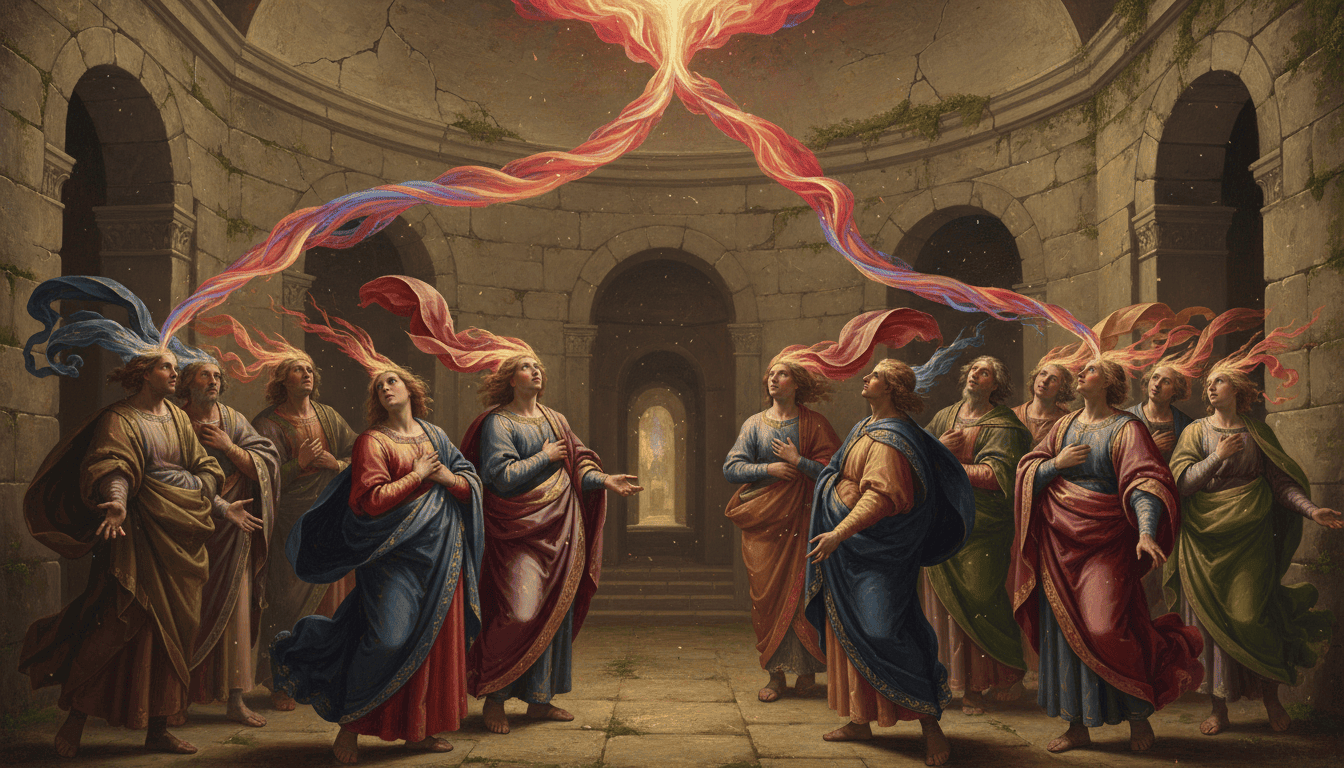
PentecostThe Coming of the Holy Spirit
Introduction
Pentecost marks the birth of the Christian church — the day the promised Holy Spirit descended on the disciples with power. Its very name is a number: the Greek Pentecost1 means "the fiftieth," the festival kept fifty days after Passover. The Jews already knew this day as Shavuot, the Feast of Weeks, when the firstfruits of the wheat harvest were brought to God. On this feast the Spirit came like a rushing wind and tongues of fire, and Peter's single sermon brought three thousand souls into the church in one day. This article follows the Acts account; for the Old Testament feast and the giving of the Law at Sinai that stand behind it, see Shavuot: The Feast of Weeks.
The Promise of the Father
Before his ascension, Jesus commanded the disciples not to leave Jerusalem but to wait for "the promise of the Father." John, he reminded them, had baptized2 with water; they would soon be immersed in the Holy Spirit himself.
And, being assembled together with them, commanded them that they should not depart from Jerusalem, but wait for the promise of the Father, which, saith he, ye have heard of me. For John truly baptized with water; but ye shall be baptized with the Holy Ghost not many days hence.
Acts 1:4-5
KJV
This baptism would not be an end in itself but an empowering for mission. They would receive power3 — the same word from which we get "dynamite" and "dynamic" — to be his witnesses from Jerusalem to the ends of the earth.
But ye shall receive power, after that the Holy Ghost is come upon you: and ye shall be witnesses unto me both in Jerusalem, and in all Judaea, and in Samaria, and unto the uttermost part of the earth.
Acts 1:8
KJV
The promise of the Spirit was not new. Joel had foreseen a day when God would pour out his Spirit on all flesh, so that sons and daughters would prophesy and old and young alike would receive him. Peter would stand up on Pentecost and declare that this very prophecy had now come true.
¶ And it shall come to pass afterward, that I will pour out my spirit upon all flesh; and your sons and your daughters shall prophesy, your old men shall dream dreams, your young men shall see visions: And also upon the servants and upon the handmaids in those days will I pour out my spirit.
Joel 2:28-29
KJV
Jesus himself had prepared the disciples for this gift. He called the Spirit the Comforter4 — the one called alongside to help — who would not merely visit them but abide with them and be in them forever.
And I will pray the Father, and he shall give you another Comforter, that he may abide with you for ever; Even the Spirit of truth; whom the world cannot receive, because it seeth him not, neither knoweth him: but ye know him; for he dwelleth with you, and shall be in you.
John 14:16-17
KJV
The Spirit's ministry, Jesus explained, would always be Christ-centered: he would guide the disciples into all truth and glorify the Son, taking what belongs to Christ and declaring it to his people. The Spirit does not draw attention to himself; he points to Jesus.
Howbeit when he, the Spirit of truth, is come, he will guide you into all truth: for he shall not speak of himself; but whatsoever he shall hear, that shall he speak: and he will shew you things to come. He shall glorify me: for he shall receive of mine, and shall shew it unto you.
John 16:13-14
KJV
The Spirit Promised Across the Prophets
Joel was not alone. Long before Pentecost, the prophets had spoken of a coming outpouring — God's Spirit poured out like water on a thirsty land, a new heart given, the spirit of grace bestowed. Isaiah set the promise beside the image of rain on dry ground.
For I will pour water upon him that is thirsty, and floods upon the dry ground: I will pour my spirit upon thy seed, and my blessing upon thine offspring:
Isaiah 44:3
KJV
When Peter quoted Joel on the day of Pentecost, he was not reaching for a single proof-text but naming the moment all these promises converged. The table below traces that prophetic spine — each line a verse the cross-reference record links directly to Peter's sermon.
| The prophet's promise | What was foretold | Fulfilled at Pentecost |
|---|---|---|
| Joel 2:28-29 | "I will pour out my spirit upon all flesh"; sons and daughters prophesy | "This is that which was spoken by the prophet Joel" (Acts 2:16-17) |
| Joel 2:32 | "Whosoever shall call on the name of the LORD shall be saved" | Peter's closing call; 3,000 call and are saved (Acts 2:21) |
| Isaiah 44:3 | "I will pour my spirit upon thy seed" — water on the thirsty | The Spirit poured on those near and "all that are afar off" (Acts 2:39) |
| Ezekiel 36:26-27 | "A new heart... and I will put my spirit within you" | The Spirit indwells the believer, given to all who repent (Acts 2:38) |
| Zechariah 12:10 | "The spirit of grace and of supplications," and they mourn for the pierced one | Hearts "pricked," they ask "what shall we do?" (Acts 2:37) |
The Day of Pentecost
When the day of Pentecost had fully come, the believers were together in one place. Suddenly a sound like a mighty rushing wind filled the house, divided tongues as of fire rested on each of them, and they were all filled with the Holy Spirit and began to speak in other tongues.
¶ And when the day of Pentecost was fully come, they were all with one accord in one place. And suddenly there came a sound from heaven as of a rushing mighty wind, and it filled all the house where they were sitting. And there appeared unto them cloven tongues like as of fire, and it sat upon each of them. And they were all filled with the Holy Ghost, and began to speak with other tongues, as the Spirit gave them utterance.
Acts 2:1-4
KJV
The signs were not arbitrary. The word for Spirit is also the word for wind and breath — ruach5 in Hebrew, pneuma6 in Greek — so the rushing wind announced the very breath of God, once breathed into Adam, now poured out on his people. Fire signified his purifying, empowering presence, as it had on Sinai. Hippolytus, writing early in the third century, gathered the whole sweep of the Spirit's work into one breath: "This is the Spirit that at the beginning moved upon the face of the waters... This is the Spirit that was given to the apostles in the form of fiery tongues" (Fragments). The Spirit who brooded over creation now brooded over the new creation, the church.
Jerusalem was crowded with devout Jews from every nation under heaven, and each of them heard the believers speaking in his own tongue7 — Parthians, Medes, Elamites, and the rest, all hearing the wonderful works of God in their native speech.
¶ And there were dwelling at Jerusalem Jews, devout men, out of every nation under heaven. Now when this was noised abroad, the multitude came together, and were confounded, because that every man heard them speak in his own language. And they were all amazed and marvelled, saying one to another, Behold, are not all these which speak Galilaeans? And how hear we every man in our own tongue, wherein we were born? Parthians, and Medes, and Elamites, and the dwellers in Mesopotamia, and in Judaea, and Cappadocia, in Pontus, and Asia, Phrygia, and Pamphylia, in Egypt, and in the parts of Libya about Cyrene, and strangers of Rome, Jews and proselytes, Cretes and Arabians, we do hear them speak in our tongues the wonderful works of God.
Acts 2:5-11
KJV
Babel Reversed
That detail — that every man heard in his own language8 — was the undoing of an ancient curse. At Babel, a united humanity had used one speech to exalt itself, and God scattered them by confounding their language.
Therefore is the name of it called Babel; because the LORD did there confound the language of all the earth: and from thence did the LORD scatter them abroad upon the face of all the earth.
Genesis 11:9
KJV
- one language, one proud ambition
- the LORD confounds their speech
- the nations scattered abroad
- many languages, one gospel
- each hears in his own tongue
- the nations gathered as one church
Cyril of Jerusalem saw the reversal plainly: at Pentecost "it was a second confusion, in contrast to the first evil confusion at Babylon. In that former confusion of tongues there was a division of purpose, for the intention was impious. Here there was a restoration and union of minds... Through what occasioned the fall came the recovery" (Catechetical Lecture 17). Where pride had once divided the nations, grace now gathered them — a foretaste of the multi-ethnic church drawn from every people and tongue.
Peter's Pentecost Sermon
When some mocked, suggesting the believers were drunk, Peter stood with the eleven and answered: this was not wine but the fulfillment of Joel. In the last days, God had promised to pour out his Spirit on all flesh, and that outpouring had now begun.
¶ But Peter, standing up with the eleven, lifted up his voice, and said unto them, Ye men of Judaea, and all ye that dwell at Jerusalem, be this known unto you, and hearken to my words: For these are not drunken, as ye suppose, seeing it is but the third hour of the day. But this is that which was spoken by the prophet Joel; And it shall come to pass in the last days, saith God, I will pour out of my Spirit upon all flesh: and your sons and your daughters shall prophesy, and your young men shall see visions, and your old men shall dream dreams:
Acts 2:14-17
KJV
Peter then preached Christ crucified and risen. Jesus of Nazareth, attested by God with mighty works, had been delivered up by God's set purpose and crucified by lawless hands — yet death could not hold him, for God raised him up.
Ye men of Israel, hear these words; Jesus of Nazareth, a man approved of God among you by miracles and wonders and signs, which God did by him in the midst of you, as ye yourselves also know: Him, being delivered by the determinate counsel and foreknowledge of God, ye have taken, and by wicked hands have crucified and slain: Whom God hath raised up, having loosed the pains of death: because it was not possible that he should be holden of it.
Acts 2:22-24
KJV
David, Peter argued, could not have spoken of himself, for his tomb was still among them. He spoke prophetically of the Christ whose flesh would not see corruption. God had raised this Jesus, and the apostles were witnesses of it.
Men and brethren, let me freely speak unto you of the patriarch David, that he is both dead and buried, and his sepulchre is with us unto this day. Therefore being a prophet, and knowing that God had sworn with an oath to him, that of the fruit of his loins, according to the flesh, he would raise up Christ to sit on his throne; He seeing this before spake of the resurrection of Christ, that his soul was not left in hell, neither his flesh did see corruption. This Jesus hath God raised up, whereof we all are witnesses.
Acts 2:29-32
KJV
The sermon's climax was direct and undeniable: God had made the crucified Jesus both Lord and Christ. Cut to the heart, the crowd cried out, "What shall we do?" Peter answered with the gospel call — repent, be baptized in the name of Jesus Christ for the remission of sins, and receive the gift of the Holy Spirit.
Therefore let all the house of Israel know assuredly, that God hath made that same Jesus, whom ye have crucified, both Lord and Christ. ¶ Now when they heard this, they were pricked in their heart, and said unto Peter and to the rest of the apostles, Men and brethren, what shall we do? Then Peter said unto them, Repent, and be baptized every one of you in the name of Jesus Christ for the remission of sins, and ye shall receive the gift of the Holy Ghost.
Acts 2:36-38
KJV
The promise, Peter assured them, was for them, for their children, and for all who are far off — everyone the Lord calls. About three thousand received his word and were baptized that day. The church was born in a single outpouring of Spirit-empowered preaching.
Then they that gladly received his word were baptized: and the same day there were added unto them about three thousand souls.
Acts 2:41
KJV
The Life of the Early Church
Luke's portrait of the newborn church is one of devotion and joy. They continued steadfastly in the apostles' teaching, in fellowship, in the breaking of bread, and in prayer. Awe fell on every soul, wonders were done through the apostles, believers shared their goods with any in need, and the Lord daily added to their number those who were being saved.
¶ And they continued stedfastly in the apostles' doctrine and fellowship, and in breaking of bread, and in prayers. And fear came upon every soul: and many wonders and signs were done by the apostles. And all that believed were together, and had all things common; And sold their possessions and goods, and parted them to all men, as every man had need. And they, continuing daily with one accord in the temple, and breaking bread from house to house, did eat their meat with gladness and singleness of heart, Praising God, and having favour with all the people. And the Lord added to the church daily such as should be saved.
Acts 2:42-47
KJV
These were not programs but the natural overflow of the Spirit's presence: devotion to Scripture, genuine community, the Lord's Supper, persistent prayer, supernatural power, sacrificial generosity, and effective witness. The Spirit who filled them on Pentecost shaped the church's whole common life.
The Spirit's Empowerment for Mission
The Spirit who came at Pentecost went on empowering the church for its mission. When Peter and John were hauled before the Jewish council, Peter — filled with the Holy Spirit — answered with such courage that the rulers marveled, recognizing that these unschooled men had been with Jesus.
Then Peter, filled with the Holy Ghost, said unto them, Ye rulers of the people, and elders of Israel,
Acts 4:8
KJV
Now when they saw the boldness of Peter and John, and perceived that they were unlearned and ignorant men, they marvelled; and they took knowledge of them, that they had been with Jesus.
Acts 4:13
KJV
Released and threatened, the believers prayed not for safety but for boldness. The place was shaken, they were filled afresh with the Spirit, and they kept on speaking God's word with courage. The Spirit's filling is not a single past event but a continual supply for the work of God.
And when they had prayed, the place was shaken where they were assembled together; and they were all filled with the Holy Ghost, and they spake the word of God with boldness.
Acts 4:31
KJV
The Spirit's power is the gift of God, never a commodity. When Simon the magician saw the Spirit given through the apostles' hands and offered money to buy the ability, Peter rebuked him sharply: the gift of God cannot be purchased.
And when Simon saw that through laying on of the apostles' hands the Holy Ghost was given, he offered them money, Saying, Give me also this power, that on whomsoever I lay hands, he may receive the Holy Ghost. But Peter said unto him, Thy money perish with thee, because thou hast thought that the gift of God may be purchased with money.
Acts 8:18-20
KJV
The Universal Gift of the Spirit
What came visibly upon the first disciples now comes to every believer. Paul makes the indwelling Spirit the very mark of belonging to Christ: "if any man have not the Spirit of Christ, he is none of his." Our bodies have become the temple of the Holy Spirit.
But ye are not in the flesh, but in the Spirit, if so be that the Spirit of God dwell in you. Now if any man have not the Spirit of Christ, he is none of his.
Romans 8:9
KJV
What? know ye not that your body is the temple of the Holy Ghost which is in you, which ye have of God, and ye are not your own?
The Spirit brings assurance, witnessing with our spirit that we are God's children and teaching us to cry "Abba, Father." He also helps us in our weakness, interceding for us when we do not know how to pray.
For ye have not received the spirit of bondage again to fear; but ye have received the Spirit of adoption, whereby we cry, Abba, Father. The Spirit itself beareth witness with our spirit, that we are the children of God:
Romans 8:15-16
KJV
¶ Likewise the Spirit also helpeth our infirmities: for we know not what we should pray for as we ought: but the Spirit itself maketh intercession for us with groanings which cannot be uttered.
Romans 8:26
KJV
This indwelling is itself a downpayment. Paul calls the Spirit we now have the firstfruits9 — the first installment of a harvest yet to come, pledging the redemption of our bodies. It is no accident that the Spirit was given on the feast of firstfruits: the gift is the down payment of glory.
And not only they, but ourselves also, which have the firstfruits of the Spirit, even we ourselves groan within ourselves, waiting for the adoption, to wit, the redemption of our body.
Romans 8:23
KJV
Paul therefore commands believers to be filled with the Spirit — not as a single ecstatic moment but as the ongoing yielding of life to his control, overflowing in worship, thanksgiving, and mutual submission, and bearing the Spirit's own fruit.
And be not drunk with wine, wherein is excess; but be filled with the Spirit; Speaking to yourselves in psalms and hymns and spiritual songs, singing and making melody in your heart to the Lord; Giving thanks always for all things unto God and the Father in the name of our Lord Jesus Christ; ¶ Submitting yourselves one to another in the fear of God.
But the fruit of the Spirit is love, joy, peace, longsuffering, gentleness, goodness, faith, Meekness, temperance: against such there is no law.
And the same Spirit who gathered the nations at Pentecost still gathers them into one body. By one Spirit we are all baptized into one body, Jew and Gentile alike, and all made to drink of one Spirit.
¶ For as the body is one, and hath many members, and all the members of that one body, being many, are one body: so also is Christ. For by one Spirit are we all baptized into one body, whether we be Jews or Gentiles, whether we be bond or free; and have been all made to drink into one Spirit.
Conclusion: Living in the Spirit's Power
Pentecost reminds us that the Christian life is supernatural from beginning to end. We are born again by the Spirit, indwelt by the Spirit, led by the Spirit, empowered by the Spirit, and sealed by the Spirit unto the day of redemption. The church is not a human organization running on natural ability but a Spirit-filled organism animated by divine power. As Leo the Great observed, fifty days after the Passover lamb God gave the Law at Sinai, and fifty days after the true Lamb's resurrection he sent the Spirit — "the same Spirit who instituted the first established the Second Covenant" (Sermon 75). Pentecost inaugurates the age of the Spirit, the age in which we still live. The promise stands undimmed: those who repent and believe receive the forgiveness of sins and the gift of the Holy Spirit.