


ShavuotThe Feast of Weeks
Introduction
Shavuot, also known as the Feast of Weeks1 or Pentecost2, celebrates both the wheat harvest and the giving of the Torah at Mount Sinai. Observed fifty days after Passover, this feast marked the culmination of the grain harvest and commemorated the covenant God made with Israel when he gave them his Law. For Christians, Shavuot holds significance, because it was on this very feast that the Holy Spirit descended upon the disciples in Jerusalem, birthing the New Testament church. The parallels are striking: just as God gave the Law written on stone tablets at Sinai, so he gave the Spirit to write his law on human hearts at Pentecost. Shavuot connects the old and new covenants, harvest and gospel, Law and Spirit.
Shavuot is the fourth of the seven feasts the LORD appointed in Leviticus 23 — the last of the spring feasts, which were fulfilled at Christ's first coming, and the hinge before the autumn feasts, which still await his return.
Biblical Foundation
God commanded Israel to count seven full weeks from the day after the Sabbath of Passover, making fifty days, and then to present an offering of new grain to the Lord. On this fiftieth day they were to hold a sacred assembly and do no regular work — a Sabbath, a holy convocation dedicated to the Lord.
¶ And ye shall count unto you from the morrow after the sabbath, from the day that ye brought the sheaf of the wave offering; seven sabbaths shall be complete: Even unto the morrow after the seventh sabbath shall ye number fifty days; and ye shall offer a new meat offering unto the LORD.
And ye shall proclaim on the selfsame day, that it may be an holy convocation unto you: ye shall do no servile work therein: it shall be a statute for ever in all your dwellings throughout your generations.
Leviticus 23:21
KJV
The offering consisted of two loaves made from fine flour, baked with leaven — representing the firstfruits of the wheat harvest. Along with the bread, Israel was to present seven lambs, one bull, and two rams as a burnt offering, plus a male goat for a sin offering and two lambs for a peace offering.
Ye shall bring out of your habitations two wave loaves of two tenth deals: they shall be of fine flour; they shall be baken with leaven; they are the firstfruits unto the LORD. And ye shall offer with the bread seven lambs without blemish of the first year, and one young bullock, and two rams: they shall be for a burnt offering unto the LORD, with their meat offering, and their drink offerings, even an offering made by fire, of sweet savour unto the LORD. Then ye shall sacrifice one kid of the goats for a sin offering, and two lambs of the first year for a sacrifice of peace offerings.
Deuteronomy calls this the Feast of Weeks and emphasizes its joyful, celebratory nature. Israel was to rejoice before the Lord with their sons and daughters, servants, Levites, foreigners, orphans, and widows — sharing the harvest with the vulnerable and remembering that they were once slaves in Egypt.
And thou shalt keep the feast of weeks unto the LORD thy God with a tribute of a freewill offering of thine hand, which thou shalt give unto the LORD thy God, according as the LORD thy God hath blessed thee: And thou shalt rejoice before the LORD thy God, thou, and thy son, and thy daughter, and thy manservant, and thy maidservant, and the Levite that is within thy gates, and the stranger, and the fatherless, and the widow, that are among you, in the place which the LORD thy God hath chosen to place his name there. And thou shalt remember that thou wast a bondman in Egypt: and thou shalt observe and do these statutes.
The Giving of the Torah at Sinai
Jewish tradition connects Shavuot with the giving of the Torah3 at Mount Sinai, which occurred approximately fifty days after the Exodus. When Israel arrived at Sinai, God descended on the mountain in fire, with thunder, lightning, and the sound of a loud trumpet. The people trembled with fear as Moses went up to receive the tablets of stone inscribed with God's commandments.
¶ And it came to pass on the third day in the morning, that there were thunders and lightnings, and a thick cloud upon the mount, and the voice of the trumpet exceeding loud; so that all the people that was in the camp trembled. And Moses brought forth the people out of the camp to meet with God; and they stood at the nether part of the mount. And mount Sinai was altogether on a smoke, because the LORD descended upon it in fire: and the smoke thereof ascended as the smoke of a furnace, and the whole mount quaked greatly. And when the voice of the trumpet sounded long, and waxed louder and louder, Moses spake, and God answered him by a voice.
Exodus 19:16-19
KJV
God proclaimed the Ten Commandments, establishing the covenant between himself and Israel. These laws defined how a redeemed people should live in relationship with God and one another. The Law was holy, righteous, and good — a revelation of God's own character and will.
¶ And God spake all these words, saying, I am the LORD thy God, which have brought thee out of the land of Egypt, out of the house of bondage. Thou shalt have no other gods before me. Thou shalt not make unto thee any graven image, or any likeness of any thing that is in heaven above, or that is in the earth beneath, or that is in the water under the earth: Thou shalt not bow down thyself to them, nor serve them: for I the LORD thy God am a jealous God, visiting the iniquity of the fathers upon the children unto the third and fourth generation of them that hate me; And shewing mercy unto thousands of them that love me, and keep my commandments. Thou shalt not take the name of the LORD thy God in vain; for the LORD will not hold him guiltless that taketh his name in vain. Remember the sabbath day, to keep it holy. Six days shalt thou labour, and do all thy work: But the seventh day is the sabbath of the LORD thy God: in it thou shalt not do any work, thou, nor thy son, nor thy daughter, thy manservant, nor thy maidservant, nor thy cattle, nor thy stranger that is within thy gates: For in six days the LORD made heaven and earth, the sea, and all that in them is, and rested the seventh day: wherefore the LORD blessed the sabbath day, and hallowed it. ¶ Honour thy father and thy mother: that thy days may be long upon the land which the LORD thy God giveth thee. Thou shalt not kill. Thou shalt not commit adultery. Thou shalt not steal. Thou shalt not bear false witness against thy neighbour. Thou shalt not covet thy neighbour's house, thou shalt not covet thy neighbour's wife, nor his manservant, nor his maidservant, nor his ox, nor his ass, nor any thing that is thy neighbour's.
Exodus 20:1-17
KJV
Wherefore the law is holy, and the commandment holy, and just, and good.
Romans 7:12
KJV
Moses received not only the Ten Commandments but the entirety of the Law — civil, ceremonial, and moral ordinances that would govern Israel's life as God's chosen nation. The Torah was God's gracious gift, teaching Israel how to walk in his ways and remain distinct from the surrounding nations.
The First Fruits of the Harvest
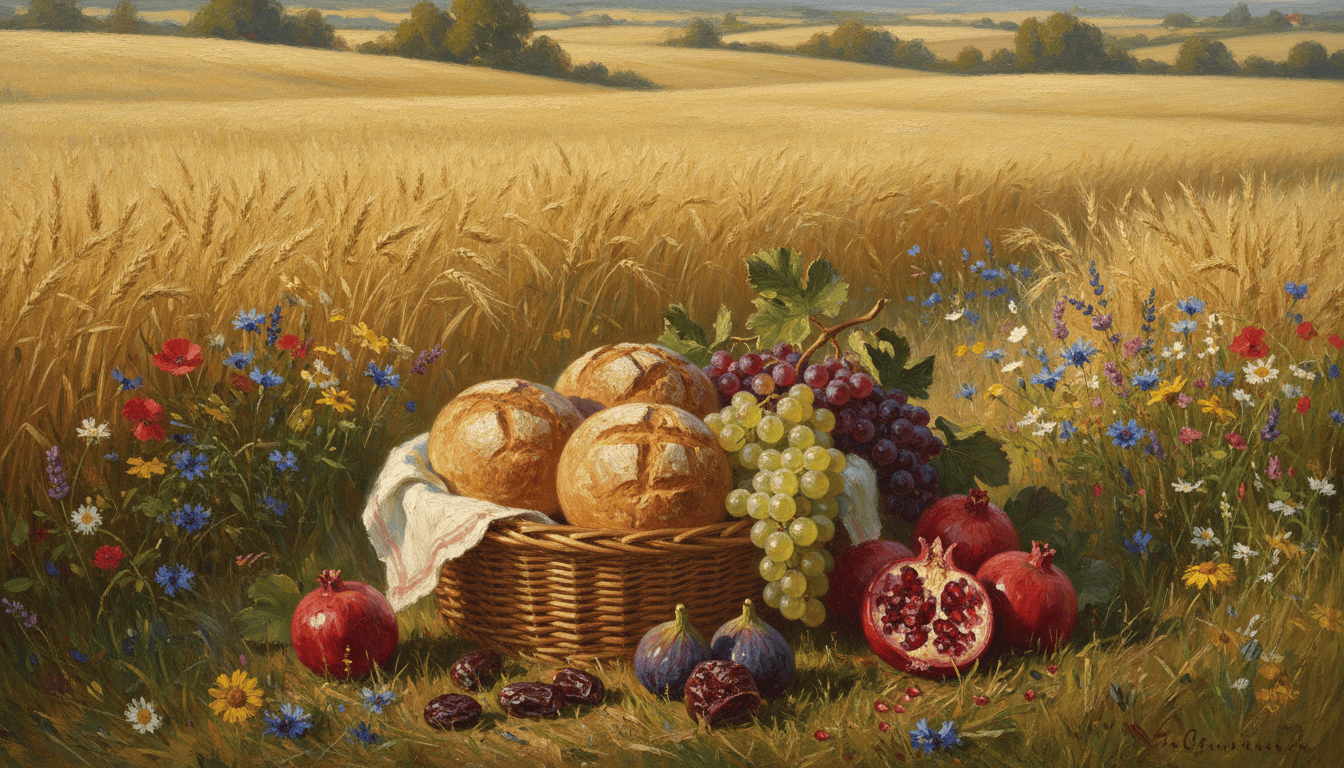
Shavuot celebrated the completion of the grain harvest that began with barley at Passover and concluded with wheat at Pentecost. The two loaves of bread offered were the firstfruits4 of this harvest, acknowledging that God provided the increase and deserved the first and the best of the crop.
The concept of firstfruits runs throughout Scripture. Israel was commanded to bring the first of their produce to the house of the Lord, not keeping it for themselves but offering it to God in gratitude. This practice cultivated generosity, faith, and the recognition that all blessings flow from God.
The first of the firstfruits of thy land thou shalt bring into the house of the LORD thy God. Thou shalt not seethe a kid in his mother's milk.
Exodus 23:19
KJV
Paul applies firstfruits imagery to Christ's resurrection. Christ is the firstfruits5 of those who have fallen asleep: as the firstfruits guarantee the full harvest, his resurrection guarantees the resurrection of all who belong to him.
¶ But now is Christ risen from the dead, and become the firstfruits of them that slept.
James calls believers "a kind of firstfruits of his creatures," indicating that redeemed humanity is the beginning of God's new creation. Just as the two loaves offered at Shavuot represented the harvest, believers are the first installment of a redemptive work that will ultimately encompass all creation.
Of his own will begat he us with the word of truth, that we should be a kind of firstfruits of his creatures.
James 1:18
KJV
Pentecost: The Spirit Poured Out
When the day of Pentecost arrived — the same day as Shavuot — the disciples were gathered in Jerusalem. Suddenly there came from heaven a sound like a mighty rushing wind, filling the house. Divided tongues as of fire appeared and rested on each of them, and they were all filled with the Holy Spirit, speaking in other tongues as the Spirit gave them utterance.
¶ And when the day of Pentecost was fully come, they were all with one accord in one place. And suddenly there came a sound from heaven as of a rushing mighty wind, and it filled all the house where they were sitting. And there appeared unto them cloven tongues like as of fire, and it sat upon each of them. And they were all filled with the Holy Ghost, and began to speak with other tongues, as the Spirit gave them utterance.
Acts 2:1-4
KJV
The sound of wind was no accident. The word for Spirit is also the word for wind and breath — ruach6 in Hebrew, pneuma7 in Greek — so that the breath of God once breathed into Adam was now poured out on his people. And they spoke in other tongues8, the Spirit reversing Babel: where pride had once scattered the nations into confusion, grace now gathered them to hear one gospel each in his own language.
The signs that accompanied the Spirit's coming deliberately echoed Sinai — fire, wind, and a powerful sound. The early church saw the connection plainly. "The Holy Spirit has frequently appeared in fire," wrote Cyprian, setting the smoking mountain of Exodus beside the upper room: "And the whole of Mount Sinai smoked, because God had come down upon it in fire... And there appeared to them cloven tongues as if of fire" (Testimonies). Cyril of Jerusalem dwelt on the mercy of it: the apostles "partook of fire, not of burning but of saving fire... As a fiery sword had barred of old the gates of paradise, a fiery tongue that brought salvation restored the gift" (Catechetical Lecture 17). But instead of inscribing law on stone, God was now writing his law on human hearts, fulfilling Jeremiah's promise of a new covenant.
But this shall be the covenant that I will make with the house of Israel; After those days, saith the LORD, I will put my law in their inward parts, and write it in their hearts; and will be their God, and they shall be my people.
Jeremiah 31:33
KJV
Peter explained that what the crowd witnessed was the fulfillment of Joel's prophecy — that God would pour out his Spirit on all flesh, and sons and daughters would prophesy.
But this is that which was spoken by the prophet Joel; And it shall come to pass in the last days, saith God, I will pour out of my Spirit upon all flesh: and your sons and your daughters shall prophesy, and your young men shall see visions, and your old men shall dream dreams:
Acts 2:16-17
KJV
The Spirit was poured out "upon all flesh" (Acts 2:17): sons and daughters, young men and old men, servants and handmaidens, and in time on the Gentiles also (Acts 10:45). The promise was for all whom the Lord would call. Pentecost inaugurated the age of the Spirit, when God's presence would dwell not in a temple made with hands but in the hearts of his people.
For the promise is unto you, and to your children, and to all that are afar off, even as many as the Lord our God shall call.
Acts 2:39
KJV
Sinai and Pentecost: One Pattern
The fiftieth day stands at both ends of redemptive history. About fifty days after the Exodus, God came down on Sinai to give the Law; fifty days after the resurrection, he sent the Spirit to give life. Augustine drew the correspondence with care: "There it was on tables of stone that the finger of God operated; here it was on the hearts of people. There the law was given outwardly, so that the unrighteous might be terrified; here it was given inwardly, so that they might be justified" (On the Spirit and the Letter). The same God acts in both; what was written on stone to condemn is now written on the heart to save.
| At Sinai | At Pentecost | |
|---|---|---|
| Timing | About fifty days after the Exodus | Fifty days after the resurrection |
| Place | Mount Sinai, in the wilderness | Jerusalem, in an upper room |
| Signs | Fire, thunder, trumpet, smoke, a quaking mountain (Ex 19:18) | Tongues of fire, rushing wind, languages spoken (Acts 2:3) |
| What was given | The Law, on tablets of stone (Ex 31:18) | The Spirit, writing the law on hearts (Jer 31:33) |
| Mediator | Moses ascends the mountain (Ex 19:20) | Christ ascends and sends the Spirit (Acts 2:33) |
| The three thousand | 3,000 fell for the golden calf (Ex 32:28) | 3,000 were saved through Peter's sermon (Acts 2:41) |
| Covenant | Old — external, written on stone | New — internal, written on the heart (2 Cor 3:3) |
| Outcome | Israel set apart as God's nation (Ex 19:6) | The church born from every nation (Acts 2:5) |
The Law of the Spirit
Paul contrasts the ministry of the Law with the ministry of the Spirit. The Law, though holy, brought death, because it revealed sin without supplying the power to overcome it. The Spirit gives life: the law of the Spirit of life in Christ Jesus has set us free from the law of sin and death.
For the law of the Spirit of life in Christ Jesus hath made me free from the law of sin and death.
Romans 8:2
KJV
What the Law could not do, weakened by the flesh, God did by sending his own Son and pouring out his Spirit. Now the righteous requirement of the Law is fulfilled in those who walk not according to the flesh but according to the Spirit. The Spirit produces from within what the Law commanded but could not create — genuine righteousness.
For what the law could not do, in that it was weak through the flesh, God sending his own Son in the likeness of sinful flesh, and for sin, condemned sin in the flesh: That the righteousness of the law might be fulfilled in us, who walk not after the flesh, but after the Spirit.
Romans 8:3-4
KJV
Paul draws the contrast vividly: the letter kills, but the Spirit gives life. The ministry of death, carved in letters on stone, came with glory; how much more glorious is the ministry of the Spirit. The old covenant brought condemnation; the new covenant brings righteousness.
¶ Who also hath made us able ministers of the new testament; not of the letter, but of the spirit: for the letter killeth, but the spirit giveth life. But if the ministration of death, written and engraven in stones, was glorious, so that the children of Israel could not stedfastly behold the face of Moses for the glory of his countenance; which glory was to be done away: How shall not the ministration of the spirit be rather glorious? For if the ministration of condemnation be glory, much more doth the ministration of righteousness exceed in glory.
The Birth of the Church
Pentecost marks the birth of the church, the new-covenant community indwelt by the Holy Spirit. Peter's sermon resulted in three thousand people repenting, believing, and being baptized. This diverse multitude, drawn from every nation, became the firstfruits of the gospel harvest.
Then they that gladly received his word were baptized: and the same day there were added unto them about three thousand souls.
Acts 2:41
KJV
The early church devoted themselves to the apostles' teaching, fellowship, the breaking of bread, and prayer. They shared possessions, cared for the needy, worshiped together, and saw the Lord adding daily to their number those being saved. This Spirit-filled community embodied the new humanity that Christ came to create.
¶ And they continued stedfastly in the apostles' doctrine and fellowship, and in breaking of bread, and in prayers. And fear came upon every soul: and many wonders and signs were done by the apostles. And all that believed were together, and had all things common; And sold their possessions and goods, and parted them to all men, as every man had need. And they, continuing daily with one accord in the temple, and breaking bread from house to house, did eat their meat with gladness and singleness of heart, Praising God, and having favour with all the people. And the Lord added to the church daily such as should be saved.
Acts 2:42-47
KJV
Paul teaches that the church is the body of Christ — many members, one Spirit. By one Spirit we were all baptized into one body, whether Jews or Greeks, slave or free, and all made to drink of one Spirit. Pentecost united diverse peoples into a single, Spirit-indwelt organism.
¶ For as the body is one, and hath many members, and all the members of that one body, being many, are one body: so also is Christ. For by one Spirit are we all baptized into one body, whether we be Jews or Gentiles, whether we be bond or free; and have been all made to drink into one Spirit.
The Covenant of Grace
Shavuot celebrated the covenant God made with Israel at Sinai. Pentecost inaugurated the new covenant9, superior to the old because it rests on better promises and is mediated by a better high priest. The old covenant required perfect obedience and pronounced curses for disobedience; the new covenant provides forgiveness and transforms the heart by the Spirit.
¶ But now hath he obtained a more excellent ministry, by how much also he is the mediator of a better covenant, which was established upon better promises.
Hebrews 8:6
KJV
God promised through Jeremiah that he would put his law within his people and write it on their hearts, be their God, and remember their sin no more. This covenant is better because it accomplishes what it promises — internal transformation and complete forgiveness.
But this shall be the covenant that I will make with the house of Israel; After those days, saith the LORD, I will put my law in their inward parts, and write it in their hearts; and will be their God, and they shall be my people. And they shall teach no more every man his neighbour, and every man his brother, saying, Know the LORD: for they shall all know me, from the least of them unto the greatest of them, saith the LORD: for I will forgive their iniquity, and I will remember their sin no more.
The writer of Hebrews quotes this prophecy at length, showing that the first covenant has been made obsolete. What is growing old and obsolete is ready to vanish away — for Christ has established a new and better covenant in his blood.
In that he saith, A new covenant, he hath made the first old. Now that which decayeth and waxeth old is ready to vanish away.
Hebrews 8:13
KJV
The Harvest of Souls
Just as Shavuot celebrated the completion of the physical harvest, Pentecost began the spiritual harvest of souls. Jesus told his disciples that the harvest is plentiful but the laborers are few, and urged them to pray to the Lord of the harvest.
Then saith he unto his disciples, The harvest truly is plenteous, but the labourers are few; Pray ye therefore the Lord of the harvest, that he will send forth labourers into his harvest.
Matthew 9:37-38
KJV
He spoke of fields already white for harvest, of grain ripening and ready to be gathered. The gospel would be proclaimed to every nation, reaping a harvest from every tribe and tongue, and Pentecost was the firstfruits of that worldwide ingathering.
Say not ye, There are yet four months, and then cometh harvest? behold, I say unto you, Lift up your eyes, and look on the fields; for they are white already to harvest.
John 4:35
KJV
Revelation depicts the final harvest at the end of the age, when the Son of man swings his sickle and the ripe harvest of the earth is gathered in.
And I looked, and behold a white cloud, and upon the cloud one sat like unto the Son of man, having on his head a golden crown, and in his hand a sharp sickle. And another angel came out of the temple, crying with a loud voice to him that sat on the cloud, Thrust in thy sickle, and reap: for the time is come for thee to reap; for the harvest of the earth is ripe.
Conclusion: From Law to Spirit
Shavuot beautifully illustrates the progression from the old covenant to the new. At Sinai, God gave the Law on stone tablets; at Pentecost, he wrote his law on human hearts by the Spirit. At Sinai, three thousand died for worshiping the golden calf; at Pentecost, three thousand were saved through the proclamation of Christ. Shavuot celebrated the firstfruits of the grain harvest; Pentecost inaugurated the firstfruits of the gospel harvest. The feast points us to the superiority of the new covenant, the indwelling presence of the Spirit, and the birth of the church. We live now in the age of the Spirit, when God dwells not in temples of stone but in temples of flesh — in us. As we remember Pentecost, we rejoice in the gift of the Spirit and the new covenant that transforms us from the inside out, writing God's law on our hearts and empowering us to walk in his ways.