


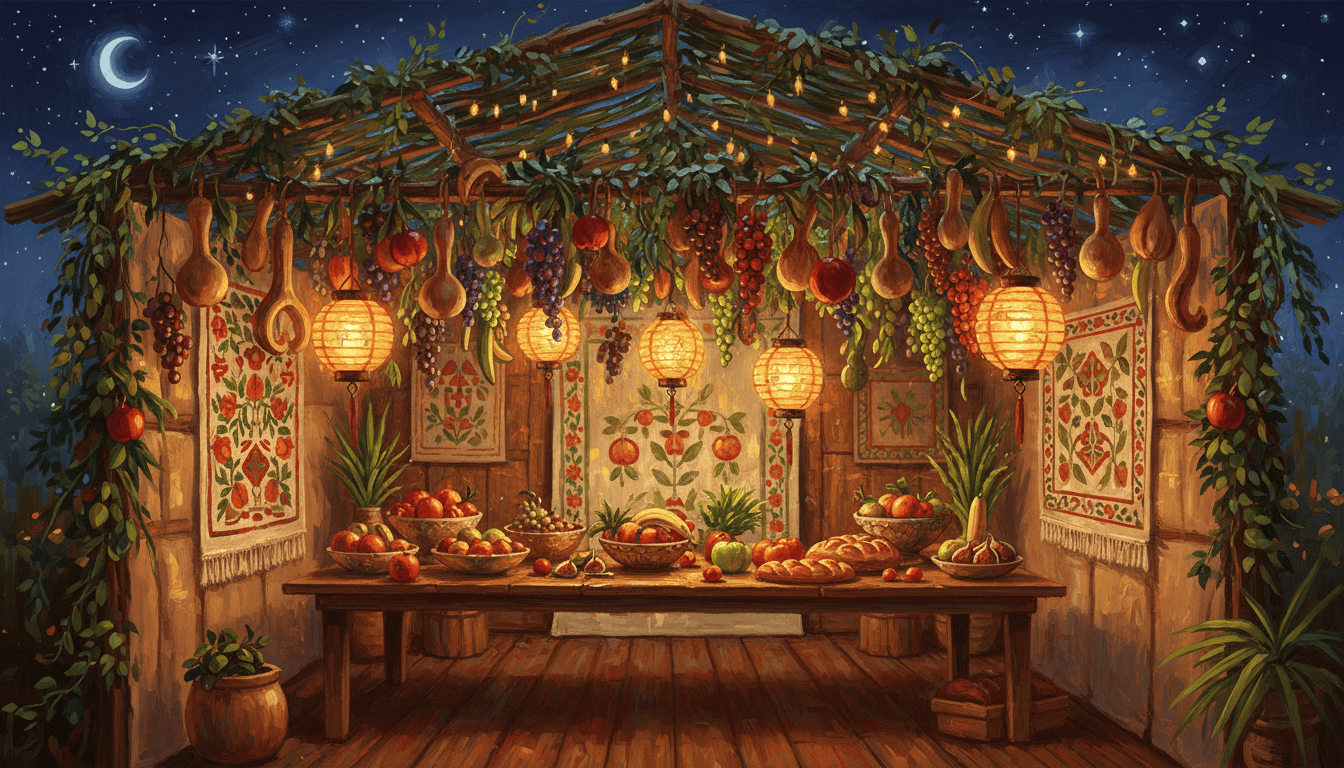
SukkotThe Feast of Tabernacles
Introduction
Sukkot, the Feast of Tabernacles (or Booths), celebrates God's provision for Israel during their wilderness wanderings. For seven days, Israelites lived in temporary shelters (sukkot), commemorating the forty years when God sheltered them in tents, provided manna from heaven, and led them with pillars of cloud and fire. This feast also marked the final harvest, a time of rejoicing over God's abundant provision. For Christians, Sukkot foreshadows God dwelling with his people—first in the incarnation, when "the Word was made flesh, and dwelt among us," and ultimately in the new creation when God will dwell with humanity forever. Sukkot reminds us that we are pilgrims in this world, sustained by God's grace, journeying toward our eternal home.
Biblical Foundation and Observance
God commanded Israel to observe the Feast of Tabernacles for seven days, beginning on the fifteenth day of the seventh month, and to dwell in booths, "that your generations may know that I made the children of Israel to dwell in booths, when I brought them out of the land of Egypt."
Also in the fifteenth day of the seventh month, when ye have gathered in the fruit of the land, ye shall keep a feast unto the LORD seven days: on the first day shall be a sabbath, and on the eighth day shall be a sabbath. And ye shall take you on the first day the boughs of goodly trees, branches of palm trees, and the boughs of thick trees, and willows of the brook; and ye shall rejoice before the LORD your God seven days. And ye shall keep it a feast unto the LORD seven days in the year. It shall be a statute for ever in your generations: ye shall celebrate it in the seventh month. Ye shall dwell in booths seven days; all that are Israelites born shall dwell in booths: That your generations may know that I made the children of Israel to dwell in booths, when I brought them out of the land of Egypt: I am the LORD your God.
During these seven days, Israel was to take branches from beautiful trees, palms, willows, and other leafy trees, and rejoice before the Lord. They were to build temporary shelters and live in them, remembering that their ancestors dwelt in tents, entirely dependent on God's provision and protection.
Deuteronomy emphasizes the joyful character of this feast, kept "after that thou hast gathered in thy corn and thy wine": "thou shalt rejoice in thy feast... therefore thou shalt surely rejoice." Sukkot was a time of celebration, gratitude, and worship.
Thou shalt observe the feast of tabernacles seven days, after that thou hast gathered in thy corn and thy wine: And thou shalt rejoice in thy feast, thou, and thy son, and thy daughter, and thy manservant, and thy maidservant, and the Levite, the stranger, and the fatherless, and the widow, that are within thy gates. Seven days shalt thou keep a solemn feast unto the LORD thy God in the place which the LORD shall choose: because the LORD thy God shall bless thee in all thine increase, and in all the works of thine hands, therefore thou shalt surely rejoice.
Remembering the Wilderness Journey
The Feast of Tabernacles called Israel to remember their forty years in the wilderness. During this time, God fed them with manna, gave them water from the rock, preserved their clothing and sandals, and led them by the pillar of cloud by day and fire by night. Despite their rebellions and complaints, God faithfully sustained his people.
And thou shalt remember all the way which the LORD thy God led thee these forty years in the wilderness, to humble thee, and to prove thee, to know what was in thine heart, whether thou wouldest keep his commandments, or no. And he humbled thee, and suffered thee to hunger, and fed thee with manna, which thou knewest not, neither did thy fathers know; that he might make thee know that man doth not live by bread only, but by every word that proceedeth out of the mouth of the LORD doth man live. Thy raiment waxed not old upon thee, neither did thy foot swell, these forty years.
Moses recounted God's provision: he "led thee through that great and terrible wilderness, wherein were fiery serpents, and scorpions, and drought, where there was no water," brought "water out of the rock of flint," and fed Israel with manna "that he might humble thee, and that he might prove thee, to do thee good at thy latter end."
Who led thee through that great and terrible wilderness, wherein were fiery serpents, and scorpions, and drought, where there was no water; who brought thee forth water out of the rock of flint; Who fed thee in the wilderness with manna, which thy fathers knew not, that he might humble thee, and that he might prove thee, to do thee good at thy latter end;
The wilderness experience taught Israel dependence on God. They could not survive by their own strength or provision; they needed God's daily sustenance. Jesus applied this lesson when he declared, "Man shall not live by bread alone, but by every word that proceedeth out of the mouth of God." Our deepest need is not physical but spiritual—we live by God's word.
But he answered and said, It is written, Man shall not live by bread alone, but by every word that proceedeth out of the mouth of God.
Matthew 4:4
KJV
The Harvest Celebration
Sukkot also celebrated the final harvest of the agricultural year. After gathering the produce from the threshing floor and winepress, Israel rejoiced in God's provision. The feast acknowledged that every good gift comes from the Lord, that he provides seed for the sower and bread for the eater.
The psalmist praises God for his abundant provision: "Thou visitest the earth, and waterest it: thou greatly enrichest it with the river of God, which is full of water... Thou crownest the year with thy goodness; and thy paths drop fatness."
Thou visitest the earth, and waterest it: thou greatly enrichest it with the river of God, which is full of water: thou preparest them corn, when thou hast so provided for it. Thou waterest the ridges thereof abundantly: thou settlest the furrows thereof: thou makest it soft with showers: thou blessest the springing thereof. Thou crownest the year with thy goodness; and thy paths drop fatness.
Psalms 65:9-11
KJV
Jesus taught his disciples to pray, "Give us this day our daily bread," acknowledging our dependence on God for every meal. Paul instructs believers, "In every thing give thanks," recognizing that God is the source of all blessings. Sukkot cultivates a spirit of gratitude, rejoicing in God's faithful provision.
Give us this day our daily bread.
Matthew 6:11
KJV
In every thing give thanks: for this is the will of God in Christ Jesus concerning you.
God Dwelling with His People
In English one word, tabernacle, covers two different Hebrew words. The booths of the feast are sukkot (singular sukkah), shelters of woven branches. The sacred tent where God dwelt among Israel in the wilderness is the mishkan, the "dwelling place." When it was finished, the glory of the LORD filled the tabernacle. Centuries later Solomon dedicated the temple at this very feast, "in the month Ethanim, which is the seventh month" (1 Kings 8:2), and the cloud filled the house of the LORD so that the priests could not stand to minister.
Then a cloud covered the tent of the congregation, and the glory of the LORD filled the tabernacle. And Moses was not able to enter into the tent of the congregation, because the cloud abode thereon, and the glory of the LORD filled the tabernacle.
Exodus 40:34-35
KJV
And it came to pass, when the priests were come out of the holy place, that the cloud filled the house of the LORD, So that the priests could not stand to minister because of the cloud: for the glory of the LORD had filled the house of the LORD.
1 Kings 8:10-11
KJV
John's Gospel uses tabernacle imagery to describe the incarnation: "And the Word was made flesh, and dwelt among us, and we beheld his glory, the glory as of the only begotten of the Father, full of grace and truth." The Greek word eskēnōsen means "tabernacled" or "pitched his tent." The Greek of the New Testament joins what English and Hebrew keep apart: the feast is the skēnopēgia, the "pitching of tents" (John 7:2), and the wilderness tabernacle is the skēnē (Hebrews 9:2). Jesus is Immanuel, God with us, the fulfillment of God's promise to dwell among his people.
And the Word was made flesh, and dwelt among us, (and we beheld his glory, the glory as of the only begotten of the Father,) full of grace and truth.
John 1:14
KJV
On the last day, that great day of the feast, Jesus stood and cried, "If any man thirst, let him come unto me, and drink." John explains the words himself: "this spake he of the Spirit, which they that believe on him should receive." In Jesus' day the temple service of the feast included a daily pouring out of water drawn from the Pool of Siloam, a custom kept by Jewish tradition rather than commanded in the Law, and Christians have long heard his cry against that background.
In the last day, that great day of the feast, Jesus stood and cried, saying, If any man thirst, let him come unto me, and drink. He that believeth on me, as the scripture hath said, out of his belly shall flow rivers of living water. (But this spake he of the Spirit, which they that believe on him should receive: for the Holy Ghost was not yet given; because that Jesus was not yet glorified.)
John 7:37-39
KJV
Teaching in the treasury of the temple (John 8:20), Jesus declared, "I am the light of the world: he that followeth me shall not walk in darkness, but shall have the light of life." Jewish tradition records great lamps lit in the temple courts during the feast; Jesus is "the true Light, which lighteth every man that cometh into the world" (John 1:9).
Then spake Jesus again unto them, saying, I am the light of the world: he that followeth me shall not walk in darkness, but shall have the light of life.
John 8:12
KJV
Eschatological Fulfillment
Zechariah prophesied that every one left of the nations which came against Jerusalem would go up from year to year to worship the King, the LORD of hosts, and to keep the feast of tabernacles. The feast of Israel's wilderness years becomes, in the prophet's vision, the worship of the nations.
And it shall come to pass, that every one that is left of all the nations which came against Jerusalem shall even go up from year to year to worship the King, the LORD of hosts, and to keep the feast of tabernacles.
Zechariah 14:16
KJV
John's vision in Revelation depicts a great multitude from every nation standing before the throne and the Lamb, holding palm branches—reminiscent of Sukkot's celebration. They cry out, "Salvation to our God which sitteth upon the throne, and unto the Lamb." This is the ultimate Feast of Tabernacles, the eternal celebration of God's salvation.
After this I beheld, and, lo, a great multitude, which no man could number, of all nations, and kindreds, and people, and tongues, stood before the throne, and before the Lamb, clothed with white robes, and palms in their hands; And cried with a loud voice, saying, Salvation to our God which sitteth upon the throne, and unto the Lamb.
The same vision uses the feast's own word a few verses later. In "he that sitteth on the throne shall dwell among them," the verb is skēnōsei: he will spread his tabernacle over them. The promise that follows is shelter from sun and heat, and "living fountains of waters." Isaiah had foreseen "a tabernacle for a shadow in the daytime from the heat" (Isaiah 4:6), and his word there is sukkah.
Therefore are they before the throne of God, and serve him day and night in his temple: and he that sitteth on the throne shall dwell among them. They shall hunger no more, neither thirst any more; neither shall the sun light on them, nor any heat. For the Lamb which is in the midst of the throne shall feed them, and shall lead them unto living fountains of waters: and God shall wipe away all tears from their eyes.
The ultimate fulfillment comes in the new creation: "Behold, the tabernacle of God is with men, and he will dwell with them, and they shall be his people, and God himself shall be with them, and be their God. And God shall wipe away all tears from their eyes; and there shall be no more death."
And I heard a great voice out of heaven saying, Behold, the tabernacle of God is with men, and he will dwell with them, and they shall be his people, and God himself shall be with them, and be their God. And God shall wipe away all tears from their eyes; and there shall be no more death, neither sorrow, nor crying, neither shall there be any more pain: for the former things are passed away.
This is what Sukkot anticipated—God dwelling permanently with his redeemed people. No longer in a temporary tent or earthly temple, but face to face, in unbroken fellowship forever. The feast looked forward to the eternal reality when God's tabernacle would be with humanity.
Pilgrims and Sojourners
Living in temporary booths reminded Israel that they were not yet home. They were pilgrims journeying to the Promised Land, living in tents until they received their inheritance. This symbolism applies to all believers. We are sojourners and exiles on earth, looking forward to our eternal home.
Dearly beloved, I beseech you as strangers and pilgrims, abstain from fleshly lusts, which war against the soul;
1 Peter 2:11
KJV
Abraham lived as a sojourner in the Promised Land, dwelling in tents with Isaac and Jacob, heirs with him of the same promise. He "looked for a city which hath foundations, whose builder and maker is God." By faith, he recognized that the earthly Canaan was not the final fulfillment but a pointer to the heavenly reality.
By faith he sojourned in the land of promise, as in a strange country, dwelling in tabernacles with Isaac and Jacob, the heirs with him of the same promise: For he looked for a city which hath foundations, whose builder and maker is God.
Hebrews 11:9-10
KJV
Paul reminds us that our citizenship is in heaven, from which we await a Savior, the Lord Jesus Christ. We live as temporary residents of earth, citizens of a better country, a heavenly one. Therefore, we do not set our hearts on earthly possessions or comforts but seek the things that are above.
For our conversation is in heaven; from whence also we look for the Saviour, the Lord Jesus Christ:
Philippians 3:20
KJV
If ye then be risen with Christ, seek those things which are above, where Christ sitteth on the right hand of God. Set your affection on things above, not on things on the earth.
Colossians 3:1-2
KJV
Joy in God's Provision
Sukkot was the most joyous of all Israel's feasts. After the solemn repentance of Yom Kippur came the celebration of God's forgiveness and provision. Israel rejoiced not only in the physical harvest but in the spiritual blessings God had given them—redemption, covenant relationship, and the promise of his continued presence.
The psalmist captures this joy: "Thou wilt shew me the path of life: in thy presence is fulness of joy; at thy right hand there are pleasures for evermore." True joy is found not in material prosperity but in God's presence. The Feast of Tabernacles celebrated this truth.
Thou wilt shew me the path of life: in thy presence is fulness of joy; at thy right hand there are pleasures for evermore.
Psalms 16:11
KJV
Paul commands believers, "Rejoice in the Lord alway: and again I say, Rejoice." This is not happiness dependent on circumstances but joy rooted in God's unchanging character and faithful promises. No matter our earthly conditions—whether living in palaces or booths—we can rejoice in the Lord.
Rejoice in the Lord alway: and again I say, Rejoice.
Philippians 4:4
KJV
Jesus told his disciples, "These things have I spoken unto you, that my joy might remain in you, and that your joy might be full." Joy flows from abiding in Christ, remaining connected to the vine. As we dwell in his love and keep his commandments, we experience the fullness of joy.
These things have I spoken unto you, that my joy might remain in you, and that your joy might be full.
John 15:11
KJV
Conclusion: Dwelling with God
The Feast of Tabernacles reminds us that God desires to dwell with his people. He dwelt with Israel in the wilderness, tabernacling among them. He took on flesh and tabernacled with us in the person of Jesus Christ. Through the Holy Spirit, he now dwells within believers, making our bodies his temple. And one day, he will dwell with us face to face in the new creation, where we will celebrate the eternal Feast of Tabernacles. Until that day, we live as pilgrims, dwelling in temporary tents, sustained by God's daily provision of grace. We rejoice not in earthly security but in the promise that God is with us, leading us home. The booths of Sukkot declare that this world is not our final destination; we are journeying toward the city whose builder and maker is God, where we will dwell in his presence forever.