


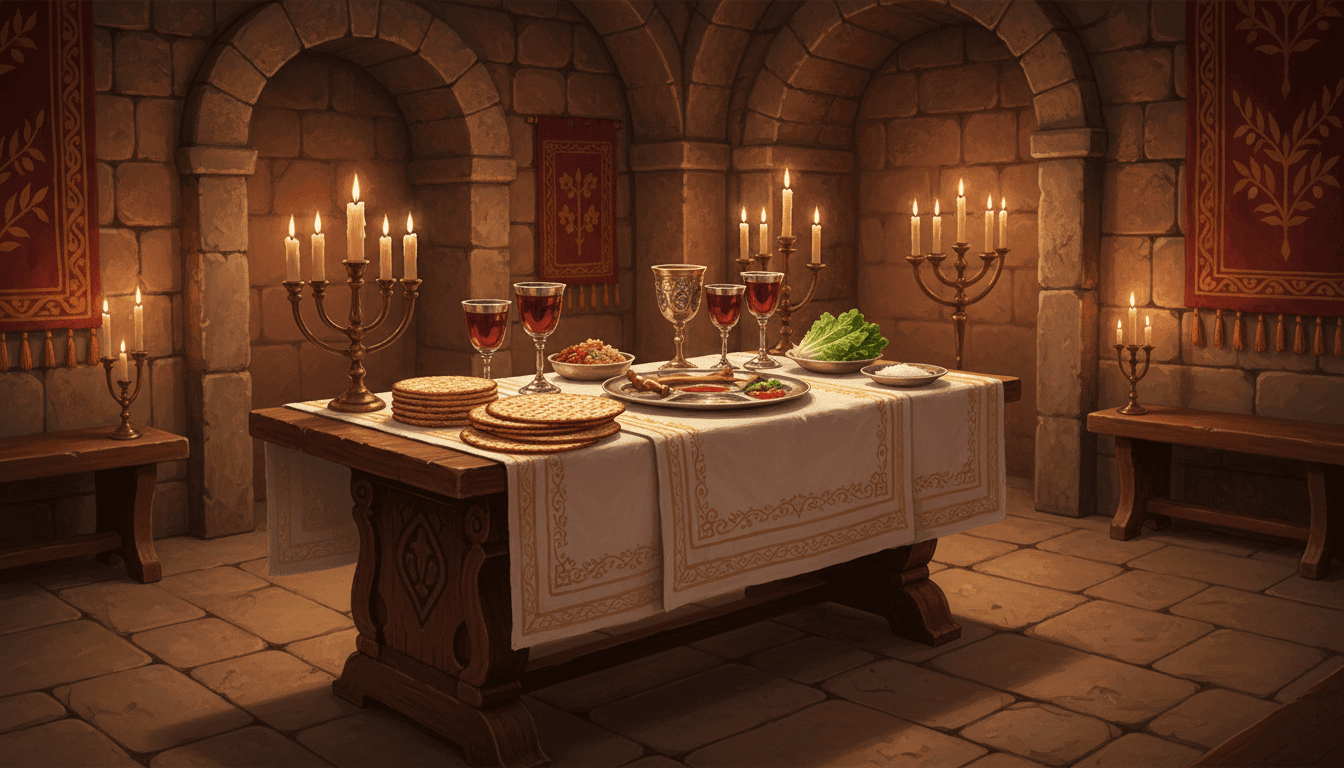
PassoverFrom Exodus to the Cross
Introduction
Passover is the foundational feast of Israel, commemorating God's deliverance of his people from Egyptian slavery. On the night before the Exodus, God commanded each Israelite household to slaughter a lamb and apply its blood to the doorposts of their homes. When the angel of death passed through Egypt, striking down every firstborn, the blood marked the homes where judgment would "pass over." This dramatic deliverance foreshadowed an even greater redemption—Christ's sacrifice on the cross. Jesus is the ultimate Passover Lamb, whose blood shields believers from divine wrath and liberates them from slavery to sin. Understanding Passover illuminates the meaning of the gospel and the depth of Christ's sacrifice.
The First Passover in Egypt
After nine plagues failed to persuade Pharaoh to release Israel, God announced a tenth and final plague: the death of every firstborn in Egypt. But he provided a way of escape for his people. Each household was to take a lamb without blemish, kill it at twilight, and apply its blood to the doorposts and lintel of their house. They were to roast the lamb and eat it with unleavened bread and bitter herbs, dressed and ready to depart.
Speak ye unto all the congregation of Israel, saying, In the tenth day of this month they shall take to them every man a lamb, according to the house of their fathers, a lamb for an house: And if the household be too little for the lamb, let him and his neighbour next unto his house take it according to the number of the souls; every man according to his eating shall make your count for the lamb. Your lamb shall be without blemish, a male of the first year: ye shall take it out from the sheep, or from the goats: And ye shall keep it up until the fourteenth day of the same month: and the whole assembly of the congregation of Israel shall kill it in the evening. And they shall take of the blood, and strike it on the two side posts and on the upper door post of the houses, wherein they shall eat it. And they shall eat the flesh in that night, roast with fire, and unleavened bread; and with bitter herbs they shall eat it.
Exodus 12:3-8
KJV
God declared, "When I see the blood, I will pass over you, and the plague shall not be upon you to destroy you, when I smite the land of Egypt." The blood of the lamb was the sign of protection. Not the worthiness of the household, not their ethnicity, not their spiritual maturity—only the blood stood between them and judgment.
And the blood shall be to you for a token upon the houses where ye are: and when I see the blood, I will pass over you, and the plague shall not be upon you to destroy you, when I smite the land of Egypt.
Exodus 12:13
KJV
At midnight, the Lord struck down all the firstborn in Egypt, from Pharaoh's son to the son of the prisoner in the dungeon, and all the firstborn of the livestock. There was a great cry in Egypt, for there was not a house where someone was not dead. But in every house marked with blood, the firstborn lived. The blood made all the difference.
And it came to pass, that at midnight the LORD smote all the firstborn in the land of Egypt, from the firstborn of Pharaoh that sat on his throne unto the firstborn of the captive that was in the dungeon; and all the firstborn of cattle. And Pharaoh rose up in the night, he, and all his servants, and all the Egyptians; and there was a great cry in Egypt; for there was not a house where there was not one dead.
Exodus 12:29-30
KJV
Pharaoh summoned Moses and Aaron in the night and told them to leave immediately, taking their flocks and herds. The Egyptians urged the people to hurry and leave, for they feared they would all die. Israel departed Egypt that very night, ending four hundred thirty years of dwelling in the land. The Passover marked their liberation from bondage.
Now the sojourning of the children of Israel, who dwelt in Egypt, was four hundred and thirty years. And it came to pass at the end of the four hundred and thirty years, even the selfsame day it came to pass, that all the hosts of the LORD went out from the land of Egypt.
Exodus 12:40-41
KJV
The Passover as Perpetual Memorial
God commanded Israel to observe Passover as a lasting ordinance. "This day shall be unto you for a memorial; and ye shall keep it a feast to the LORD throughout your generations; ye shall keep it a feast by an ordinance for ever." Each year, Israel was to remember and celebrate God's mighty act of deliverance.
And this day shall be unto you for a memorial; and ye shall keep it a feast to the LORD throughout your generations; ye shall keep it a feast by an ordinance for ever.
Exodus 12:14
KJV
When children asked the meaning of the ceremony, parents were to explain, "It is the sacrifice of the LORD'S passover, who passed over the houses of the children of Israel in Egypt, when he smote the Egyptians, and delivered our houses." The feast served as a teaching tool, passing down the story of redemption from generation to generation.
That ye shall say, It is the sacrifice of the LORD'S passover, who passed over the houses of the children of Israel in Egypt, when he smote the Egyptians, and delivered our houses. And the people bowed the head and worshipped.
Exodus 12:27
KJV
The Passover lamb had to meet specific requirements: a male without blemish, one year old, taken from the sheep or goats. No bone of it was to be broken. These details were not arbitrary but prophetically significant, pointing forward to Christ.
Your lamb shall be without blemish, a male of the first year: ye shall take it out from the sheep, or from the goats:
Exodus 12:5
KJV
In one house shall it be eaten; thou shalt not carry forth ought of the flesh abroad out of the house; neither shall ye break a bone thereof.
Exodus 12:46
KJV
Christ Our Passover Lamb
Paul explicitly identifies Jesus as our Passover Lamb: "Christ, our Passover lamb, has been sacrificed." Every detail of the Passover ceremony finds its fulfillment in Christ. He is the Lamb of God who takes away the sin of the world, the unblemished sacrifice offered for our redemption.
Purge out therefore the old leaven, that ye may be a new lump, as ye are unleavened. For even Christ our passover is sacrificed for us:
John the Baptist announced Jesus with these words: "Behold the Lamb of God, which taketh away the sin of the world." This declaration connected Jesus to both the Passover lamb and the suffering servant of Isaiah 53, who was "brought as a lamb to the slaughter." Jesus is the ultimate sacrificial lamb.
The next day John seeth Jesus coming unto him, and saith, Behold the Lamb of God, which taketh away the sin of the world.
John 1:29
KJV
He was oppressed, and he was afflicted, yet he opened not his mouth: he is brought as a lamb to the slaughter, and as a sheep before her shearers is dumb, so he openeth not his mouth.
Isaiah 53:7
KJV
Jesus was crucified during Passover season. John's Gospel emphasizes that Jesus died at the very hour when the Passover lambs were being slaughtered in the temple. This timing was not coincidental but divinely ordained. When soldiers came to break Jesus's legs to hasten death, they found him already dead and broke no bones—fulfilling the Passover requirement that no bone of the lamb be broken.
But when they came to Jesus, and saw that he was dead already, they brake not his legs: But one of the soldiers with a spear pierced his side, and forthwith came there out blood and water. And he that saw it bare record, and his record is true: and he knoweth that he saith true, that ye might believe. For these things were done, that the scripture should be fulfilled, A bone of him shall not be broken.
John 19:33-36
KJV
Peter writes that we were ransomed from the futile ways inherited from our forefathers, not with perishable things such as silver or gold, but with the precious blood of Christ, like that of a lamb without blemish or spot. Just as the Passover lamb had to be perfect, Christ was sinless, the only acceptable sacrifice for sin.
Forasmuch as ye know that ye were not redeemed with corruptible things, as silver and gold, from your vain conversation received by tradition from your fathers; But with the precious blood of Christ, as of a lamb without blemish and without spot:
1 Peter 1:18-19
KJV
Deliverance from Slavery
Passover commemorates liberation from Egyptian bondage. God heard Israel's groaning, remembered his covenant with Abraham, Isaac, and Jacob, and came down to deliver them. He brought them out with a mighty hand and outstretched arm, through signs and wonders. The Exodus became the paradigmatic act of salvation in the Old Testament.
And the LORD said, I have surely seen the affliction of my people which are in Egypt, and have heard their cry by reason of their taskmasters; for I know their sorrows; And I am come down to deliver them out of the hand of the Egyptians, and to bring them up out of that land unto a good land and a large, unto a land flowing with milk and honey; unto the place of the Canaanites, and the Hittites, and the Amorites, and the Perizzites, and the Hivites, and the Jebusites.
Exodus 3:7-8
KJV
Just as Israel was enslaved in Egypt, humanity is enslaved to sin. Jesus declared, "Verily, verily, I say unto you, Whosoever committeth sin is the servant of sin." But he promised, "If the Son therefore shall make you free, ye shall be free indeed." Christ's death and resurrection liberate us from sin's power, breaking the chains that bind us.
Jesus answered them, Verily, verily, I say unto you, Whosoever committeth sin is the servant of sin.
John 8:34
KJV
If the Son therefore shall make you free, ye shall be free indeed.
John 8:36
KJV
Paul teaches that we were once slaves to sin, but having been set free from sin, we have become slaves of righteousness. We have been delivered from the domain of darkness and transferred to the kingdom of God's beloved Son, in whom we have redemption, the forgiveness of sins.
But God be thanked, that ye were the servants of sin, but ye have obeyed from the heart that form of doctrine which was delivered you. Being then made free from sin, ye became the servants of righteousness.
Romans 6:17-18
KJV
Who hath delivered us from the power of darkness, and hath translated us into the kingdom of his dear Son: In whom we have redemption through his blood, even the forgiveness of sins:
The New Exodus
The prophets foretold a new exodus, a future deliverance even greater than the first. Isaiah prophesied that God would make a way in the wilderness and rivers in the desert, leading his people out of exile. This new exodus would surpass the first in glory.
Thus saith the LORD, which maketh a way in the sea, and a path in the mighty waters; Which bringeth forth the chariot and horse, the army and the power; they shall lie down together, they shall not rise: they are extinct, they are quenched as tow. Remember ye not the former things, neither consider the things of old. Behold, I will do a new thing; now it shall spring forth; shall ye not know it? I will even make a way in the wilderness, and rivers in the desert.
Isaiah 43:16-19
KJV
The New Testament presents Jesus's death and resurrection as this new exodus. Luke's Gospel describes Jesus's transfiguration as a discussion about his "exodus" (Greek exodos), which he was about to accomplish at Jerusalem. Jesus's redemptive work is the ultimate exodus, delivering God's people from sin and bringing them into the promised land of eternal life.
Who appeared in glory, and spake of his decease which he should accomplish at Jerusalem.
Luke 9:31
KJV
The Lord's Supper and the New Covenant
Jesus instituted the Lord's Supper during a Passover meal, transforming the old memorial into a new one. As they were eating, he took bread, blessed and broke it, and gave it to the disciples, saying, "Take, eat; this is my body." Then he took a cup, gave thanks, and gave it to them, saying, "Drink of it, all of you, for this is my blood of the covenant, which is poured out for many for the forgiveness of sins."
And as they were eating, Jesus took bread, and blessed it, and brake it, and gave it to the disciples, and said, Take, eat; this is my body. And he took the cup, and gave thanks, and gave it to them, saying, Drink ye all of it; For this is my blood of the new testament, which is shed for many for the remission of sins.
Matthew 26:26-28
KJV
Jesus established a new covenant in his blood, fulfilling Jeremiah's prophecy of a covenant superior to the one made at Sinai. This new covenant would be written on hearts, not tablets of stone. God would forgive iniquity and remember sin no more.
Behold, the days come, saith the LORD, that I will make a new covenant with the house of Israel, and with the house of Judah: Not according to the covenant that I made with their fathers in the day that I took them by the hand to bring them out of the land of Egypt; which my covenant they brake, although I was an husband unto them, saith the LORD: But this shall be the covenant that I will make with the house of Israel; After those days, saith the LORD, I will put my law in their inward parts, and write it in their hearts; and will be their God, and they shall be my people. And they shall teach no more every man his neighbour, and every man his brother, saying, Know the LORD: for they shall all know me, from the least of them unto the greatest of them, saith the LORD: for I will forgive their iniquity, and I will remember their sin no more.
The Lord's Supper replaces the Passover meal for Christians. We no longer sacrifice lambs or eat unleavened bread in remembrance of Egypt. Instead, we partake of bread and wine in remembrance of Christ. Paul writes, "For as often as ye eat this bread, and drink this cup, ye do shew the Lord's death till he come."
For as often as ye eat this bread, and drink this cup, ye do shew the Lord's death till he come.
Protection from Wrath
The blood applied to the doorposts protected Israelite homes from the angel of death. Similarly, Christ's blood shields believers from divine wrath. Paul declares that since we have now been justified by his blood, much more shall we be saved by him from the wrath of God. The blood that purchased our justification also secures our future deliverance.
Much more then, being now justified by his blood, we shall be saved from wrath through him.
Romans 5:9
KJV
God has not destined us for wrath, but to obtain salvation through our Lord Jesus Christ. Believers will not face the wrath that unbelievers will experience on the day of judgment. Christ bore that wrath in our place, satisfying God's justice and securing our peace.
For God hath not appointed us to wrath, but to obtain salvation by our Lord Jesus Christ,
John writes that the blood of Jesus cleanses us from all sin. There is no condemnation for those who are in Christ Jesus. The blood that marks us as God's people guarantees that judgment will pass over us, just as it passed over the homes marked with lamb's blood in Egypt.
But if we walk in the light, as he is in the light, we have fellowship one with another, and the blood of Jesus Christ his Son cleanseth us from all sin.
1 John 1:7
KJV
There is therefore now no condemnation to them which are in Christ Jesus, who walk not after the flesh, but after the Spirit.
Romans 8:1
KJV
Conclusion: Our Passover Lamb Has Been Sacrificed
Passover is a prophetic shadow pointing to Jesus Christ. Every element of the original Passover—the unblemished lamb, the shed blood, the protection from judgment, the liberation from slavery—finds its fulfillment in Jesus. He is the Lamb who was slain, whose blood redeems us from sin and shields us from wrath. As we celebrate the Lord's Supper, we remember that Christ our Passover has been sacrificed for us. We have been delivered from bondage to sin, brought out of darkness into marvelous light, and given an inheritance among the saints. Let us therefore celebrate the feast, not with the old leaven of malice and evil, but with the unleavened bread of sincerity and truth. Our exodus has been accomplished; our liberation is secure. We are a redeemed people, purchased by the blood of the Lamb, destined for the promised land of eternal life.