


Reformation DaySola Scriptura
Introduction
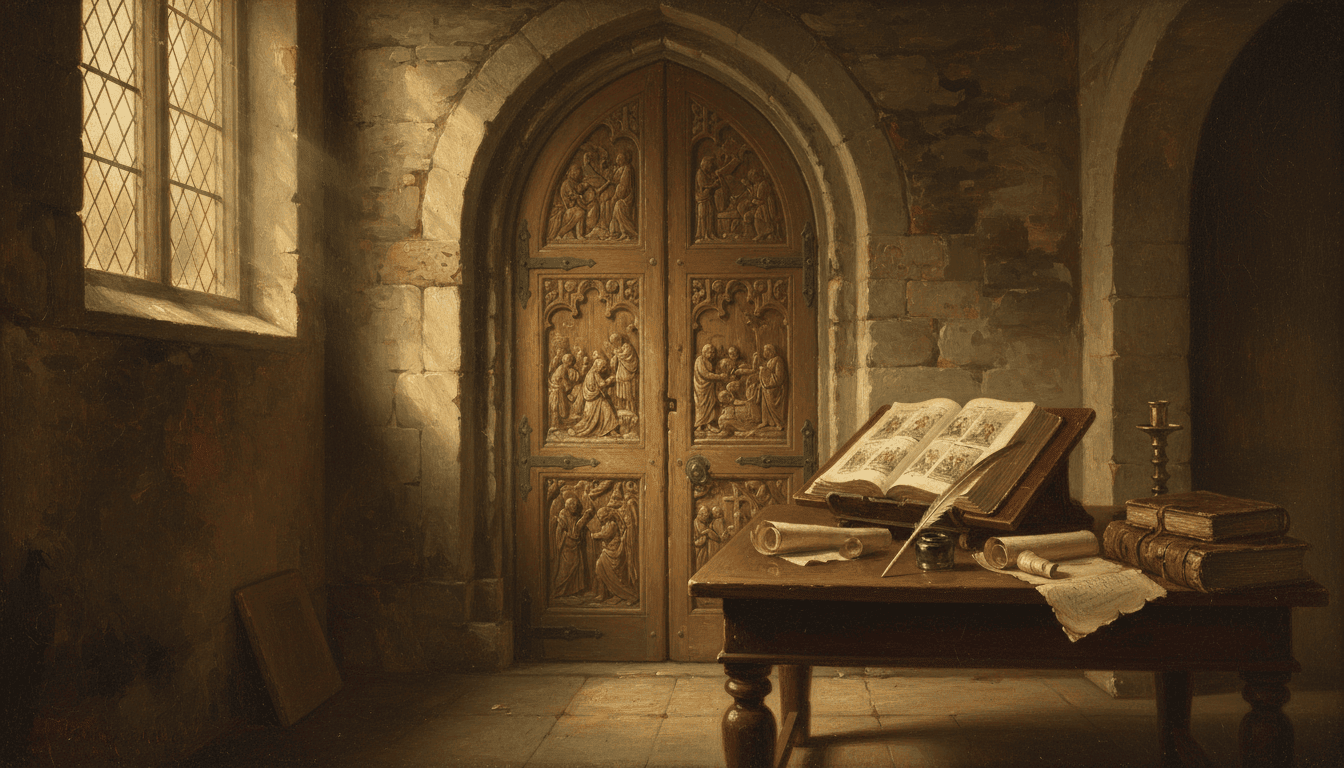
Reformation Day, celebrated on October 31st, commemorates Martin Luther nailing his Ninety-Five Theses to the door of the Wittenberg Castle Church in 1517. This act sparked the Protestant Reformation, a movement that called the church back to biblical authority and gospel truth. The Reformation was grounded in five fundamental principles known as the "Five Solas": Sola Scriptura (Scripture Alone), Sola Fide (Faith Alone), Sola Gratia (Grace Alone), Solus Christus (Christ Alone), and Soli Deo Gloria (Glory to God Alone). Together, these principles express the heart of evangelical Christianity. Reformation Day reminds us that the church must continually reform itself according to God's Word, rejecting human tradition when it contradicts Scripture and holding fast to the gospel of grace.
Sola Scriptura: Scripture Alone
The cornerstone of the Reformation was the principle of Sola Scriptura—Scripture alone is the final authority for faith and practice. The Reformers insisted that the Bible, as God's inspired Word, stands above church tradition, papal decrees, and human reason. When these conflict with Scripture, Scripture must prevail. This principle does not deny the value of tradition or reason but subordinates them to biblical authority.
All scripture is given by inspiration of God, and is profitable for doctrine, for reproof, for correction, for instruction in righteousness: That the man of God may be perfect, throughly furnished unto all good works.
All Scripture is breathed out by God and is profitable for teaching, reproof, correction, and training in righteousness, that the man of God may be complete, equipped for every good work. God's Word is sufficient—it contains everything necessary for salvation and godly living. We need not add to it or seek revelation beyond it.
The psalmist celebrates God's Word: "The law of the LORD is perfect, converting the soul: the testimony of the LORD is sure, making wise the simple. The statutes of the LORD are right, rejoicing the heart: the commandment of the LORD is pure, enlightening the eyes." Scripture is perfect, sure, right, and pure—fully trustworthy and completely sufficient.
The law of the LORD is perfect, converting the soul: the testimony of the LORD is sure, making wise the simple. The statutes of the LORD are right, rejoicing the heart: the commandment of the LORD is pure, enlightening the eyes.
Psalms 19:7-8
KJV
Jesus rebuked the Pharisees for elevating human tradition above God's commandment. "You leave the commandment of God and hold to the tradition of men." Whenever human tradition contradicts Scripture, it must be rejected. The Reformers applied this principle to medieval Catholicism, which had accumulated traditions that obscured the gospel.
For laying aside the commandment of God, ye hold the tradition of men, as the washing of pots and cups: and many other such like things ye do.
Mark 7:8
KJV
The Clarity and Sufficiency of Scripture
The Reformers taught that Scripture is not only authoritative but also clear (perspicuous) in its essential teachings. The ordinary believer, reading Scripture with the Spirit's illumination, can understand the gospel and the basic truths of the faith. Complex doctrines may require study, but the core message of salvation is accessible to all.
The psalmist declares, "Thy word is a lamp unto my feet, and a light unto my path." God's Word illuminates our way, guiding us through life's complexities. It is not obscure or incomprehensible but clear enough to direct our steps.
NUN. Thy word is a lamp unto my feet, and a light unto my path.
Psalms 119:105
KJV
Peter affirms that we have the prophetic word more fully confirmed, "to which you will do well to pay attention as to a lamp shining in a dark place, until the day dawns and the morning star rises in your hearts." Scripture shines light into darkness, making known God's will and revealing truth.
We have also a more sure word of prophecy; whereunto ye do well that ye take heed, as unto a light that shineth in a dark place, until the day dawn, and the day star arise in your hearts:
2 Peter 1:19
KJV
Sola Fide: Faith Alone
The second Reformation principle is Sola Fide—justification by faith alone, apart from works. This was the material cause of the Reformation, the doctrine over which the battle was fought. The medieval church taught that justification came through faith plus works, through a combination of God's grace and human merit. The Reformers rediscovered Paul's teaching that we are justified by faith apart from works of the law.
Therefore we conclude that a man is justified by faith without the deeds of the law.
Romans 3:28
KJV
Paul argues that if justification came through the law, then Christ died for nothing. But since all have sinned and fall short of God's glory, we are justified by his grace as a gift, through the redemption that is in Christ Jesus. Justification is a legal declaration, not a process of moral improvement. God declares the ungodly righteous based on Christ's righteousness credited to them by faith.
I do not frustrate the grace of God: for if righteousness come by the law, then Christ is dead in vain.
Galatians 2:21
KJV
For all have sinned, and come short of the glory of God; Being justified freely by his grace through the redemption that is in Christ Jesus:
Romans 3:23-24
KJV
Abraham believed God, and it was counted to him as righteousness. His faith, not his works, secured his right standing with God. David likewise speaks of the blessing of the one to whom God counts righteousness apart from works: "Blessed is he whose transgression is forgiven, whose sin is covered."
For what saith the scripture? Abraham believed God, and it was counted unto him for righteousness.
Romans 4:3
KJV
Even as David also describeth the blessedness of the man, unto whom God imputeth righteousness without works, Saying, Blessed are they whose iniquities are forgiven, and whose sins are covered.
Romans 4:6-7
KJV
Paul declares that by grace we have been saved through faith, and this is not our own doing; it is the gift of God, not a result of works, so that no one may boast. Salvation from beginning to end is God's gracious work. Faith itself is a gift, produced in us by the Holy Spirit.
For by grace are ye saved through faith; and that not of yourselves: it is the gift of God: Not of works, lest any man should boast.
Ephesians 2:8-9
KJV
Sola Gratia: Grace Alone
Closely related to justification by faith alone is the principle of Sola Gratia—salvation by grace alone. Salvation is entirely God's work, not a cooperative effort between God and humanity. We contribute nothing to our salvation except the sin that made it necessary. Grace is unmerited favor, God's kindness to those who deserve judgment.
Paul teaches that when we were dead in trespasses and sins, God made us alive together with Christ. It is by grace we have been saved. While we were still weak, at the right time Christ died for the ungodly. God shows his love for us in that while we were still sinners, Christ died for us.
And you hath he quickened, who were dead in trespasses and sins;
Ephesians 2:1
KJV
Even when we were dead in sins, hath quickened us together with Christ, (by grace ye are saved;)
Ephesians 2:5
KJV
For when we were yet without strength, in due time Christ died for the ungodly.
Romans 5:6
KJV
But God commendeth his love toward us, in that, while we were yet sinners, Christ died for us.
Romans 5:8
KJV
Salvation is not a reward for good works but a gift of pure grace. Titus declares that God saved us, not because of works done by us in righteousness, but according to his own mercy, by the washing of regeneration and renewal of the Holy Spirit. Our good works are the result, not the cause, of salvation.
Not by works of righteousness which we have done, but according to his mercy he saved us, by the washing of regeneration, and renewing of the Holy Ghost;
Titus 3:5
KJV
Solus Christus: Christ Alone
The fourth principle is Solus Christus—salvation is through Christ alone. There is no other mediator between God and humanity. Jesus is the only way to the Father. The medieval church had multiplied mediators—Mary, the saints, priests—but Scripture teaches that there is one mediator between God and men, the man Christ Jesus, who gave himself as a ransom for all.
For there is one God, and one mediator between God and men, the man Christ Jesus; Who gave himself a ransom for all, to be testified in due time.
1 Timothy 2:5-6
KJV
Jesus declared, "I am the way, and the truth, and the life. No one comes to the Father except through me." This exclusive claim is offensive to modern pluralism, but it is the consistent teaching of Scripture. Salvation is found in no one else, for there is no other name under heaven given among men by which we must be saved.
Jesus saith unto him, I am the way, the truth, and the life: no man cometh unto the Father, but by me.
John 14:6
KJV
Neither is there salvation in any other: for there is none other name under heaven given among men, whereby we must be saved.
Acts 4:12
KJV
Christ's work is complete and sufficient. He sat down at the right hand of God, having offered for all time a single sacrifice for sins. There is no need for repeated sacrifices, additional mediators, or supplementary merits. Christ's blood cleanses us from all sin. His righteousness covers all our unrighteousness.
But this man, after he had offered one sacrifice for sins for ever, sat down on the right hand of God;
Hebrews 10:12
KJV
But if we walk in the light, as he is in the light, we have fellowship one with another, and the blood of Jesus Christ his Son cleanseth us from all sin.
1 John 1:7
KJV
Soli Deo Gloria: Glory to God Alone
The fifth principle is Soli Deo Gloria—glory to God alone. Since salvation is entirely God's work, he alone deserves the glory. We cannot boast in our faith, our works, or our spiritual achievements. All glory belongs to the God who chose us, called us, justified us, and will glorify us.
For of him, and through him, and to him, are all things: to whom be glory for ever. Amen.
Romans 11:36
KJV
Paul writes, "For of him, and through him, and to him, are all things: to whom be glory for ever. Amen." Everything originates with God, proceeds through God, and returns to God. He is the beginning, middle, and end of all things. All glory, therefore, is his alone.
Our works should be done to God's glory. Whatever we do, whether we eat or drink, we are to do all to the glory of God. Our entire lives should be acts of worship, bringing honor to the One who saved us.
Whether therefore ye eat, or drink, or whatsoever ye do, do all to the glory of God.
In the final vision of Revelation, the redeemed fall before the throne, worshiping God and the Lamb. "Worthy are you, our Lord and God, to receive glory and honor and power, for you created all things, and by your will they existed and were created." All creation exists to glorify God.
Thou art worthy, O Lord, to receive glory and honour and power: for thou hast created all things, and for thy pleasure they are and were created.
Revelation 4:11
KJV
Martin Luther and the Gospel Rediscovery
Martin Luther, an Augustinian monk and theology professor, struggled under the burden of guilt and the impossibility of earning God's favor through works. While studying Paul's letter to the Romans, he discovered the truth that "the just shall live by faith." This revelation transformed him. Righteousness is not earned but received as a gift through faith in Christ.
For therein is the righteousness of God revealed from faith to faith: as it is written, The just shall live by faith.
Romans 1:17
KJV
Luther opposed the sale of indulgences, which promised remission of sin's punishment in exchange for money. This practice exploited people's fear and contradicted the gospel of free grace. Luther's Ninety-Five Theses challenged the theological foundation of indulgences, asserting that forgiveness comes through repentance and faith, not through payment to the church.
When summoned to recant his teachings, Luther refused. At the Diet of Worms in 1521, he declared, "Unless I am convinced by Scripture and plain reason... my conscience is captive to the Word of God. I cannot and I will not recant anything, for to go against conscience is neither right nor safe. Here I stand, I can do no other. God help me. Amen."
The Reformation's Legacy
The Reformation recovered the gospel of grace and returned the church to biblical authority. It translated the Bible into common languages, enabling ordinary believers to read God's Word. It emphasized preaching, teaching that the Word proclaimed is the primary means by which God builds his church. It restored the priesthood of all believers, affirming that every Christian has direct access to God through Christ.
Peter writes that believers are "a chosen race, a royal priesthood, a holy nation, a people for his own possession, that you may proclaim the excellencies of him who called you out of darkness into his marvelous light." Every believer is a priest, able to approach God directly and offer spiritual sacrifices.
But ye are a chosen generation, a royal priesthood, an holy nation, a peculiar people; that ye should shew forth the praises of him who hath called you out of darkness into his marvellous light:
1 Peter 2:9
KJV
Conclusion: Ecclesia Reformata, Semper Reformanda
The Reformation motto "Ecclesia Reformata, Semper Reformanda" means "The church reformed, always reforming." The Reformation was not a one-time event but an ongoing commitment to reform the church according to God's Word. Every generation must return to Scripture, test its traditions by biblical authority, and hold fast to the gospel of grace. Reformation Day calls us to examine whether we have drifted from biblical truth, whether we have added human requirements to the simple gospel, whether we have obscured grace with legalism. Let us stand with the Reformers on the foundation of Scripture alone, saved by grace alone through faith alone in Christ alone, to the glory of God alone. This is the gospel. This is our hope. This is worth defending.