

 TRV
TRV
- English
- King James KJV
- Complete Jewish CJB
- World English WEBM
- Berean Standard BSB
- American Standard ASV
- Geneva GNV
- Young's Literal YLT
- Douay-Rheims DRC
- International
- Shqip ALB
- العربية SVD
- বাংলা BN-IRV
- မြန်မာ Judson
- 简体文 CUV-S
- 繁體中文 CUV-T
- Čeština BKR
- Nederlands STVE
- Français LSG
- Deutsch SCH
- Ελληνικά Vamvas
- ગુજરાતી GU-IRV
- Hausa HCB
- עברית Hebrew
- हिन्दी HCV
- Magyar KAROLI
- Bahasa Indonesia INDO-TB
- Italiano Diodati
- 日本語 Kougo
- 한국어 Korean
- മലയാളം MAL
- मराठी MRCV
- Norsk DNB
- فارسی OPV
- Polski BG
- Português Almeida
- Română Cornilescu
- Русский Synodal
- Español RVG
- Kiswahili Neno
- Svenska SV1917
- Tagalog TAG-ADB
- தமிழ் TCV
- తెలుగు TSA
- ภาษาไทย THAI-KJV
- Українська Ohienko
- Tiếng Việt CADMAN
- Yorùbá YCB
The Molten Sea and Bronze Bases
The Molten Sea and Bronze Bases
In this passage
- Who
- Where
- When
- About
See also
Where else Scripture says this.
2 Chronicles 4:2
Also he made the molten sea of ten cubits from brim to brim, round in compass; and its height was five cubits; and a line of thirty cubits encircled it.from verse 232 Kings 25:13
The Kasdim broke up the pillars of brass that were in the LORD’s house and the bases and the bronze sea that were in the LORD’s house, and carried the brass pieces to Babylon.from verse 23Jeremiah 52:20
They took the two pillars, the one sea, and the twelve bronze bulls that were under the bases, which king Solomon had made for the LORD’s house. The brass of all these vessels was without weight.from verse 232 Chronicles 4:14
He made also the bases, and the basins made he on the bases;from verse 27Exodus 27:3
You shall make its pots to take away its ashes, its shovels, its basins, its flesh hooks, and its fire pans: all its vessels you shall make of brass.from verse 45Joshua 3:16
the waters which came down from above stood, and rose up in one heap, a great way off, at Adam, the city that is beside Zarethan; and those that went down toward the sea of the Arabah, even the Salt Sea, were wholly cut off. Then the people passed over right against Jericho.from verse 46Jeremiah 52:17
The Kasdim broke the pillars of brass that were in the LORD’s house, and the bases and the bronze sea that were in the LORD’s house in pieces, and carried all of their brass to Babylon.from verse 231 Kings 6:18
There was cedar on the house within, carved with buds and open flowers: all was cedar; there was no stone seen.from verse 242 Chronicles 4:4
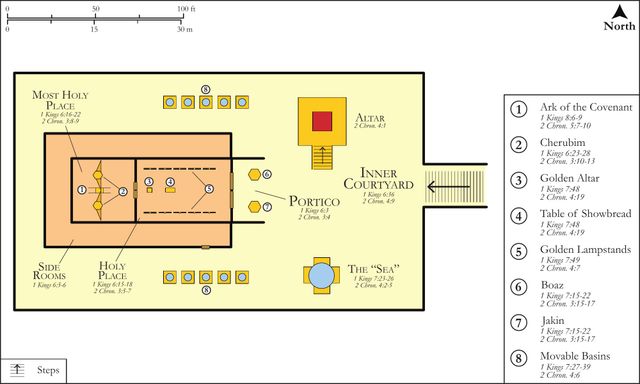
It stood on twelve oxen, three looking toward the north, and three looking toward the west, and three looking toward the south, and three looking toward the east: and the sea was set on them above, and all their hinder parts were inward.from verse 252 Chronicles 4:5
It was a hand breadth thick; and its brim was worked like the brim of a cup, like the flower of a lily: it received and held three thousand baths.from verse 252 Chronicles 4:17
The king cast them in the plain of the Jordan, in the clay ground between Succoth and Zeredah.from verse 46Genesis 33:17
Jacob traveled to Succoth, built himself a house, and made shelters for his livestock. Therefore the name of the place is called Succoth.from verse 46
Where this happens
Study this passage
Commentary written on this passage, not on a single verse.
Public-domain commentary
Matthew Henry
From his Commentary on the Whole Bible. Henry comments on passages, not single verses — this entry covers 1 Kings 7:13–47. His four-level outline is real structure in the source text, so it is rendered as structure.
We have here an account of the brass-work about the temple. There was no iron about the temple, though we find David preparing for the temple iron for things of iron, Ch1 29:2. What those things were we are not told, but some of the things of brass are here described and the rest mentioned.
I.The brasier whom Solomon employed to preside in this part of the work was Hiram, or Huram (Ch2 4:11), who was by his mother's side an Israelite, of the tribe of Naphtali, by his father's side a man of Tyre, Kg1 7:14. If he had the ingenuity of a Tyrian, and the affection of an Israelite to the house of God (the head of a Tyrian and the heart of an Israelite), it was happy that the blood of the two nations mixed in him, for thereby he was qualified for the work to which he was designed. As the tabernacle was built with the wealth of Egypt, so the temple with the wit of Tyre. God will serve himself by the common gifts of the children of men.
II.The brass he made use of was the best he could get.
All the brazen vessels were of bright brass (Kg1 7:45), good brass, so the Chaldee, that which was strongest and looked finest. God, who is the best, must be served and honoured with the best.
III.The place where all the brazen vessels were cast was the plain of Jordan, because the ground there was stiff and clayey, fit to make moulds of for the casting of the brass (Kg1 7:46), and Solomon would not have this dirty smoky work done in or near Jerusalem.
IV.The quantity was not accounted for.
The vessels were unnumbered (so it may be read, Kg1 7:47, as well as unweighed), because they were exceedingly numerous, and it would have been an endless thing to keep the account of them; neither was the weight of the brass, when it was delivered to the workmen, searched or enquired into; so honest were the workmen, and such great plenty of brass they had, that there was no danger of wanting. We must ascribe it to Solomon's care that he provided so much, not to his carelessness that he kept no account of it.
V.Some particulars of the brass-work are described.
1.Two brazen pillars, which were set up in the porch of the temple (Kg1 7:21), whether under the cover of the porch or in the open air is not certain; it was between the temple and the court of the priests. These pillars were neither to hang gates upon nor to rest any building upon, but purely for ornament and significancy.
(1.)What an ornament they were we may gather from the account here given of the curious work that was about them, chequer-work, chain-work, net-work, lily-work, and pomegranates in rows, and all of bright brass, and framed no doubt according to the best rules of proportion, to please the eye.
(2.)Their significancy is intimated in the names given them (Kg1 7:21): Jachin - he will establish; and Boaz - in him is strength. Some think they were intended for memorials of the pillar of cloud and fire which led Israel through the wilderness: I rather think them designed for memorandums to the priests and others that came to worship at God's door,
[1.]To depend upon God only, and not upon any sufficiency of their own, for strength and establishment in all their religious exercises. When we come to wait upon God, and find our hearts wandering and unfixed, then by faith let us fetch in help from heaven: Jachin - God will fix this roving mind. It is a good thing that the heart be established with grace. We find ourselves weak and unable for holy duties, but this is our encouragement: Boaz - in him is our strength, who works in us both to will and to do. I will go in the strength of the Lord God. Spiritual strength and stability are to be had at the door of God's temple, where we must wait for the gifts of grace in the use of the means of grace.
[2.]It was a memorandum to them of the strength and establishment of the temple of God among them. Let them keep close to God and duty, and they should never lose their dignities and privileges, but the grant should be confirmed and perpetuated to them. The gospel church is what God will establish, what he will strengthen, and what the gates of hell can never prevail against. But, with respect to this temple, when it was destroyed particular notice was taken of the destroying of these pillars (Kg2 25:13, Kg2 25:17), which had been the tokens of its establishment, and would have been so if they had not forsaken God.
2.A brazen sea, a very large vessel, above five yards in diameter, and which contained above 500 barrels of water for the priests' use, in washing themselves and the sacrifices, and keeping the courts of the temple clean, Kg1 7:23, etc. It stood raised upon the figures of twelve oxen in brass, so high that either they must have stairs to climb up to it or cocks at the bottom to draw water from it. The Gibeonites, or Nethinim, who were to draw water for the house of God, had the care of filling it. Some think Solomon made the images of oxen to support this great cistern in contempt of the golden calf which Israel had worshipped, that (as bishop Patrick expresses it) the people might see there was nothing worthy of adoration in those figures; they were fitter to make posts of than to make gods of. Yet this prevailed not to prevent Jerusalem's setting up the calves for deities. In the court of the tabernacle there was only a laver of brass provided to wash in, but in the court of the temple a sea of brass, intimating that by the gospel of Christ much fuller preparation is made for our cleansing than was by the law of Moses. That had a laver, this has a sea, a fountain opened, Zac 13:1.
3.Ten bases, or stands, or settles, of brass, on which were put ten lavers, to be filled with water for the service of the temple, because there would not be room at the molten sea for all that had occasion to wash there. The bases on which the lavers were fixed are very largely described here, Kg1 7:27, etc. They were curiously adorned and set upon wheels, that the lavers might be removed as there was occasion; but ordinarily they stood in two rows, five on one side of the court and five on the other, Kg1 7:39. Each laver contained forty baths, that is, about ten barrels, Kg1 7:38. Those must be very clean that bear the vessels of the Lord. Spiritual priests and spiritual sacrifices must be washed in the laver of Christ's blood and of regeneration. We must wash often, for we daily contract pollution, must cleanse our hands and purify our hearts. Plentiful provision is made for our cleansing; so that if we have our lot for ever among the unclean it will be our own fault.
4.Besides these, there was a vast number of brass pots made to boil the flesh of the peace-offerings in, which the priests and offerers were to feast upon before the Lord (see Sa1 2:14); also shovels, wherewith they took out the ashes of the altar. Some think the word signifies flesh-hooks, with which they took meat out of the pot. The basins also were made of brass, to receive the blood of the sacrifices. These are put for all the utensils of the brazen altar, Exo 38:3. While they were about it they made abundance of them, that they might have a good stock by them when those that were first in use wore out and went to decay. Thus Solomon, having wherewithal to do so, provided for posterity.
Historical interpretation
Twelve Centuries of Reception
13 surviving comments on this passage. Each one is dated, so this reads as a timeline rather than a list.
Select a marker to jump to its quote. Markers stagger vertically where authors wrote within a few decades of each other.
But amid these things we must understand that zeal for righteousness should be exercised against the wicked deeds of our neighbors in such a way that the virtue of gentleness is by no means abandoned in the fervor of severity. For the anger of a priest ought never to be hasty and disturbed, but rather tempered with the gravity of deliberation. And so we ought both to bear with those whom we correct and to correct those whom we bear with, lest if one of these two be lacking, the priestly action fail either in fervor or in gentleness. For this is why in the service of the temple, lions and oxen and cherubim were carved by sculptural work on the bases of the temple. For cherubim signifies fullness of knowledge. But what does it mean that on the bases lions are not made without oxen, nor oxen without lions? For what else do the bases in the temple represent but priests in the Church? Who, while they bear the burden of governance, carry, as it were in the manner of bases, a weight placed upon them. Therefore cherubim are depicted on the bases, because it is certainly fitting that the hearts of priests be filled with fullness of knowledge. By lions, moreover, the terror of severity is symbolized, while by oxen the patience of gentleness is represented. And so on the bases neither lions without oxen nor oxen without lions are depicted, because in the priestly heart the virtue of gentleness must always be preserved along with the terror of severity, so that gentleness may season anger, and that same gentleness, lest it perhaps become lax, may be kindled by zeal for severity.
It is appropriate that the vessels of the Lord’s house were cast in the region of the Jordan, namely, in the river in which our Lord deigned to be baptized and by his immersion in the waves of its waters changed the element for us into a bath for sins. For every baptism of the faithful in which they are consecrated to the Lord is celebrated on the model of his baptism whereby he himself sanctified the waters. It is proper that the vessels of the Lord’s house should have been made in the country of the Jordan, for there is no other way for us to become vessels of election and mercy than by looking to his baptism that he underwent in that river and making sure that we too are washed in that life-giving river. However, it must be noted that he says these vessels were made not only in the country around the Jordan but also in its plains to signify the multiplication of the faithful that was to take place not only in Judea but also in the wide world of all the nations in fulfillment of the prophecy that says, “The plains and everything in them will rejoice.”
Hence the surface of the bases was not level at any point, but whichever side one turned, it was carved with mystical figures because the minds of the saints, indeed their whole way of life, displays the charm of the virtues in everything, and not an empty or idle hour passes them by that they fail to have time for good works or words or, at all events, thoughts. They have little crowns carved on them when they yearn with untiring longing for entry into eternal life; they have ledges when, amid their longing for the life of heaven that is above, they never undo the bonds of fraternal intercourse that is at hand; they have lions between the little crowns and ledges when they so raise their minds to hope for heavenly things and so open them out to the love of their neighbor that they do not shirk the zealous exercise of stern denunciation on any sinners entrusted to their charge. In addition to lions, they have oxen when they employ even the invective of correction in a spirit of meekness, when, in the heat of rebuking, they never cease to have the cloven hoof of prudent action and word or to roll the words of divine reading around in the mouth as if ruminating on them. Finally, blessed Stephen, the one who was the pillar of excellence of the Lord’s temple, seemed to show the fierce teeth and claws of a lion when he said to his persecutors, “You stiff-necked people, uncircumcised in heart and ears, you always resist the Holy Spirit; which of the prophets did your fathers not persecute?” and so forth; but in saying this he showed how much of the compassion of bovine meekness he nurtured in his heart within, when, for these same persecutors raging to kill him, he knelt and said, “Lord, lay not this sin to their charge.” But because we can have neither hope of things eternal in heaven, nor love of neighbor on earth, nor the fervor of trenchant zeal nor the gentleness of compassionate restraint, without knowledge of the holy Scriptures, it is aptly remarked that after crown and ledges, after lions and oxen, cherubim too were carved. For it is generally accepted that cherubim are a type of sacred scripture, whether because the two cherubim on the propitiatory of the ark were fashioned as a figure of the two Testaments that sing in harmony of Christ or because the name itself means “much knowledge.”
The number forty conventionally typifies great perfection because, of course, four tens make forty; now there are ten precepts whereby our whole code of conduct is laid down in the divine law, but four books of the Gospels in which entry into our heavenly homeland was opened to us through the plan of the Lord’s incarnation. And because all who are involved in the ministry of sacred baptism must, together with the faith and mysteries of the gospel, show the fruits of upright conduct, it is fitting that each of the lavers in which the whole burnt offerings were washed should hold forty baths.
“And the sea he set on the right side of the temple facing the east southwards.” And this was placed in the same court to the east. His words, “on the right side of the temple,” he repeats when he says “southwards.” For those who entered the court from the east had first to turn southwards, where the sea stood in the very corner ready for the priests to wash; then, as they proceeded inside, they were met by lavers placed on either side for washing the victims; inside these was a bronze dais five cubits long and five cubits wide and three cubits high, on which Solomon stood when dedicating the temple; then as they proceeded further they came to the altar of burnt offering facing the south side of the court, then the temple porticoes or vestibule in which were bronze pillars around the door of the temple. Therefore, the fact that he placed the sea at the right side of the temple signifies that it is through the bath of baptism we must reach the kingdom of heaven, which is properly represented by the term “right hand.” For “he who believes and is baptized shall be saved.” For where right as well as left hand are taken in the positive sense, they indicate either Judea and the Gentiles, as we have said above in the explanation of the bases, or the present and future life of the church, or the happy and sad things of the world, or something of the sort, but where the right hand by itself is used in the positive sense, it more frequently stands for eternal joys. But the fact that he made the sea face eastwards has virtually the same significance, namely, that the splendor of eternal glory is revealed to us through the bath of the holy font; the fact that it was at the south side of the court signifies that the faithful are apt to be kindled into a blazing fire of genuine love through the reception of the Holy Spirit, for in the Scriptures the heat of the noonday sun customarily meant the ardor of love and the light of the Holy Spirit, through whom this love is poured forth in the hearts of the elect.
The four wheels are the four books of the Gospels, which are very aptly compared with wheels because, just as the wheel’s whirling motion can travel with the greatest rapidity wherever it is steered, so with the Lord’s help through the instrumentality of the apostles the word of the gospel filled all the regions of the world in a short space; as the wheel raises from the earth the chariot laid on it, and when raised carries it where the driver steers it, so the preaching of the gospel lifts up the minds of the elect from earthly cravings to heavenly desires and, having lifted them up, guides them to progress in good works or to the ministry of preaching, in whichever direction the helping grace of the Spirit wills. For since, in the text that follows, it says that “they were the kind of wheels usually designed for a chariot,” and moreover, we read of the saints, “The chariot of God is attended by ten thousands; thousands of them that rejoice,” why, then, is it that the wheels of the bases are compared with the wheels of chariots, unless it is that one and the same word of the gospel makes some of those whom it teaches chariots of God and others pillars of God’s temple?