


1 Kings 7:37
Bible text: King James Version (1769 Blayney text) · Public domain
Bible text: Berean Standard Bible · Public domain
Bible text: American Standard Version (1901) · Public domain
Bible text: World English Bible, Messianic edition · Public domain
Bible text: Geneva Bible (1599) · Public domain
Bible text: Young's Literal Translation · Public domain
- כָּזֹאתka·Zotlike thisH2063Prep-k ¦ PrtParticle Demonstrativeכָּlikeזֹאתthis
- עָשָׂה'a·Sahhe madeH6213V-Qal-Perf-3msVerb Qal Perfect 3rd Singular Masculine
- אֵת'et<obj.>H853DirObjMParticle Object Indicator
- עֶשֶׂר'E·ser[the] tenH6235N-mscNoun Singular Masculine Construct
- הַמְּכֹנוֹתha·me·kho·Notthe standsH4350Art ¦ N-fpNoun Plural Feminine Absoluteהַtheמְּכֹנוֹתstands
- מוּצָקmu·Tzaka castingH4165N-msNoun Singular Masculine Absolute
- אֶחָד'e·ChadoneH259N-fsNoun Singular Feminine Absolute
- מִדָּהmi·Daha measurementH4060N-fsNoun Singular Feminine Absolute
- אַחַת'a·ChatoneH259N-fscNoun Singular Feminine Construct
- קֶצֶבKe·tzeva shapeH7095N-msNoun Singular Masculine Absolute
- אֶחָד'e·ChadoneH259N-fsNoun Singular Feminine Absolute
- לְכֻלָּהְנָהle·khu·La·he·nahfor all of themH3605Prep-l ¦ N-msc ¦ 3fpNoun Singular Masculine Constructלְforכֻלָּall ofהְנָהthem
English is a literal word-by-word gloss of the Hebrew, not the KJV's wording. Why?
This is the original text the KJV's translators worked from — each Hebrew word with its own literal English meaning in this verse, prepared by scholars at Tyndale House, Cambridge. The KJV translates whole sentences, not word by word, so its wording differs: one Hebrew word can become several English words, and the KJV may choose “the LORD” where the gloss reads “Yahweh”. Both are faithful — they answer different questions. For the KJV's own rendering, switch to the KJV text.
Details
See on the biblical-era maps

Study this verse
Public-domain commentary
Matthew Henry
From his Commentary on the Whole Bible. Henry comments on passages, not single verses — this entry covers 1 Kings 7:13–47. His four-level outline is real structure in the source text, so it is rendered as structure.
We have here an account of the brass-work about the temple. There was no iron about the temple, though we find David preparing for the temple iron for things of iron, Ch1 29:2. What those things were we are not told, but some of the things of brass are here described and the rest mentioned.
I.The brasier whom Solomon employed to preside in this part of the work was Hiram, or Huram (Ch2 4:11), who was by his mother's side an Israelite, of the tribe of Naphtali, by his father's side a man of Tyre, Kg1 7:14. If he had the ingenuity of a Tyrian, and the affection of an Israelite to the house of God (the head of a Tyrian and the heart of an Israelite), it was happy that the blood of the two nations mixed in him, for thereby he was qualified for the work to which he was designed. As the tabernacle was built with the wealth of Egypt, so the temple with the wit of Tyre. God will serve himself by the common gifts of the children of men.
II.The brass he made use of was the best he could get.
All the brazen vessels were of bright brass (Kg1 7:45), good brass, so the Chaldee, that which was strongest and looked finest. God, who is the best, must be served and honoured with the best.
III.The place where all the brazen vessels were cast was the plain of Jordan, because the ground there was stiff and clayey, fit to make moulds of for the casting of the brass (Kg1 7:46), and Solomon would not have this dirty smoky work done in or near Jerusalem.
IV.The quantity was not accounted for.
The vessels were unnumbered (so it may be read, Kg1 7:47, as well as unweighed), because they were exceedingly numerous, and it would have been an endless thing to keep the account of them; neither was the weight of the brass, when it was delivered to the workmen, searched or enquired into; so honest were the workmen, and such great plenty of brass they had, that there was no danger of wanting. We must ascribe it to Solomon's care that he provided so much, not to his carelessness that he kept no account of it.
V.Some particulars of the brass-work are described.
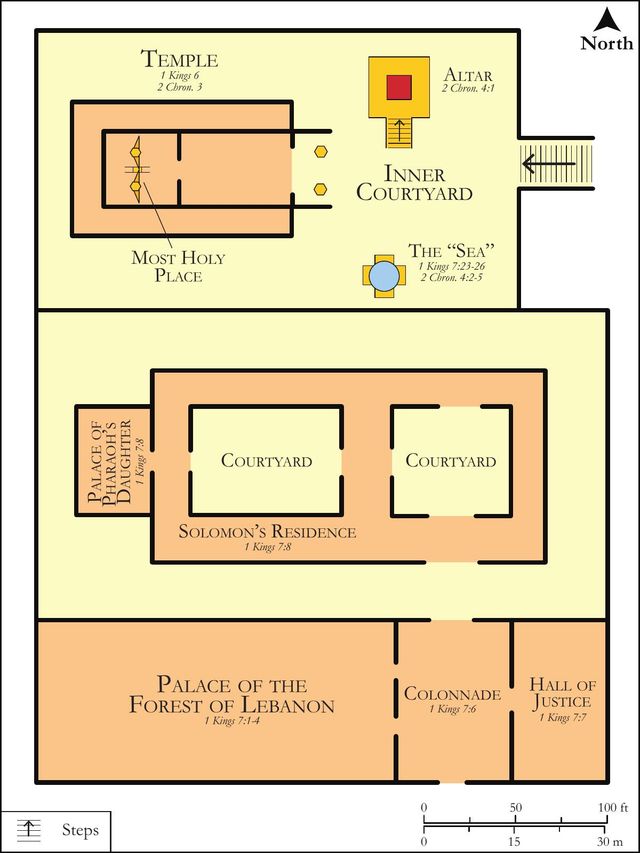
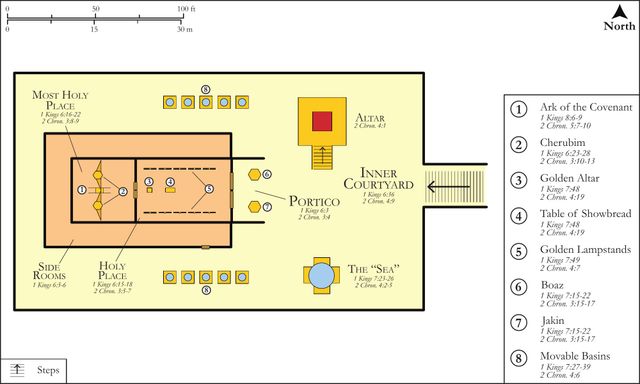
1.Two brazen pillars, which were set up in the porch of the temple (Kg1 7:21), whether under the cover of the porch or in the open air is not certain; it was between the temple and the court of the priests. These pillars were neither to hang gates upon nor to rest any building upon, but purely for ornament and significancy.
(1.)What an ornament they were we may gather from the account here given of the curious work that was about them, chequer-work, chain-work, net-work, lily-work, and pomegranates in rows, and all of bright brass, and framed no doubt according to the best rules of proportion, to please the eye.
(2.)Their significancy is intimated in the names given them (Kg1 7:21): Jachin - he will establish; and Boaz - in him is strength. Some think they were intended for memorials of the pillar of cloud and fire which led Israel through the wilderness: I rather think them designed for memorandums to the priests and others that came to worship at God's door,
[1.]To depend upon God only, and not upon any sufficiency of their own, for strength and establishment in all their religious exercises. When we come to wait upon God, and find our hearts wandering and unfixed, then by faith let us fetch in help from heaven: Jachin - God will fix this roving mind. It is a good thing that the heart be established with grace. We find ourselves weak and unable for holy duties, but this is our encouragement: Boaz - in him is our strength, who works in us both to will and to do. I will go in the strength of the Lord God. Spiritual strength and stability are to be had at the door of God's temple, where we must wait for the gifts of grace in the use of the means of grace.
[2.]It was a memorandum to them of the strength and establishment of the temple of God among them. Let them keep close to God and duty, and they should never lose their dignities and privileges, but the grant should be confirmed and perpetuated to them. The gospel church is what God will establish, what he will strengthen, and what the gates of hell can never prevail against. But, with respect to this temple, when it was destroyed particular notice was taken of the destroying of these pillars (Kg2 25:13, Kg2 25:17), which had been the tokens of its establishment, and would have been so if they had not forsaken God.
2.A brazen sea, a very large vessel, above five yards in diameter, and which contained above 500 barrels of water for the priests' use, in washing themselves and the sacrifices, and keeping the courts of the temple clean, Kg1 7:23, etc. It stood raised upon the figures of twelve oxen in brass, so high that either they must have stairs to climb up to it or cocks at the bottom to draw water from it. The Gibeonites, or Nethinim, who were to draw water for the house of God, had the care of filling it. Some think Solomon made the images of oxen to support this great cistern in contempt of the golden calf which Israel had worshipped, that (as bishop Patrick expresses it) the people might see there was nothing worthy of adoration in those figures; they were fitter to make posts of than to make gods of. Yet this prevailed not to prevent Jerusalem's setting up the calves for deities. In the court of the tabernacle there was only a laver of brass provided to wash in, but in the court of the temple a sea of brass, intimating that by the gospel of Christ much fuller preparation is made for our cleansing than was by the law of Moses. That had a laver, this has a sea, a fountain opened, Zac 13:1.
3.Ten bases, or stands, or settles, of brass, on which were put ten lavers, to be filled with water for the service of the temple, because there would not be room at the molten sea for all that had occasion to wash there. The bases on which the lavers were fixed are very largely described here, Kg1 7:27, etc. They were curiously adorned and set upon wheels, that the lavers might be removed as there was occasion; but ordinarily they stood in two rows, five on one side of the court and five on the other, Kg1 7:39. Each laver contained forty baths, that is, about ten barrels, Kg1 7:38. Those must be very clean that bear the vessels of the Lord. Spiritual priests and spiritual sacrifices must be washed in the laver of Christ's blood and of regeneration. We must wash often, for we daily contract pollution, must cleanse our hands and purify our hearts. Plentiful provision is made for our cleansing; so that if we have our lot for ever among the unclean it will be our own fault.
4.Besides these, there was a vast number of brass pots made to boil the flesh of the peace-offerings in, which the priests and offerers were to feast upon before the Lord (see Sa1 2:14); also shovels, wherewith they took out the ashes of the altar. Some think the word signifies flesh-hooks, with which they took meat out of the pot. The basins also were made of brass, to receive the blood of the sacrifices. These are put for all the utensils of the brazen altar, Exo 38:3. While they were about it they made abundance of them, that they might have a good stock by them when those that were first in use wore out and went to decay. Thus Solomon, having wherewithal to do so, provided for posterity.
Continue studying 1 Kings 7:37 across the web’s major study libraries — every link below opens this exact verse, chapter, or book on the destination site.
Read & Compare
 BibleGatewayThis verse in more than 200 translations and 70 languages.
 Bible.comThe YouVersion reader — hundreds of translations, reading plans, and highlights.
 ESV.orgCrossway's official English Standard Version reader.
 NET BibleThe NET translation with 60,000+ translators' notes on every rendering decision.
 STEP BibleTyndale House's free study tool — original text, vocabulary, and scholarly resources.
 BibliaLogos Bible Software's free web reader.
 USCCBThe New American Bible (Revised Edition) with the U.S. bishops' study notes.
Commentaries
 BibleHub CommentariesDozens of classic commentaries on this verse, gathered on one page.
 StudyLightMore than 100 commentary sets — the largest collection on the web.
 BibleRefPlain-English commentary on what this verse means, verse by verse.
 Enduring WordDavid Guzik's free commentary on this chapter, widely used by Bible teachers.
 Bible Study ToolsVerse commentary alongside Greek and Hebrew study aids.
Original Language & Research
- BibleHub InterlinearThe verse word by word — original language, transliteration, and English.
- BibleHub LexiconEvery word's original-language definition and Strong's entry.
 Blue Letter BibleDeep-study tools — Strong's numbers, concordance, and word studies.
 SefariaThe Hebrew text with Rashi and centuries of Jewish commentary.
Sermons, Hymns & Audio


TrulyRandomVerse is not affiliated with these sites and doesn’t control their content. They’re linked because they’re genuinely useful.
Summary
1 Kings 7:37 concludes the intricate description of the ten bronze bases crafted for the lavers in Solomon's Temple, emphasizing the astonishing precision and uniformity achieved in their construction. Despite their complex and ornate designs, each of these massive structures was cast, measured, and sized identically, showcasing an unparalleled level of craftsmanship and adherence to a singular, divine standard. This verse highlights the meticulous excellence dedicated to every detail of God's dwelling place, reflecting the divine expectation for order, perfection, and the highest quality in all matters pertaining to sacred worship.
Context
ShowHideLiterary Context
This verse serves as the culminating summary of an extensive and highly detailed architectural description found in 1 Kings 7:27-36. The preceding verses meticulously outline the dimensions, materials, and elaborate ornamentation of the ten movable bronze stands, each designed to hold a laver for ritual washing. The narrative provides specific details about their panels, frames, wheels, and the decorative motifs of lions, oxen, and cherubim, demonstrating the sheer complexity and artistry involved. Following this exhaustive technical account, verse 37 functions as a concise concluding statement, underscoring the remarkable consistency and identical nature of all ten bases. This emphasis on uniformity sets the stage for the subsequent description of the lavers themselves in 1 Kings 7:38-39, reinforcing the overall theme of ordered magnificence and functional beauty within the Temple complex.
Historical & Cultural Context
The construction of Solomon's Temple was a monumental undertaking, symbolizing the establishment of God's permanent dwelling among His people and the centralization of Israelite worship. This project, detailed extensively in 1 Kings 6-8, involved immense resources, skilled labor, and international cooperation, particularly with Hiram, King of Tyre, who supplied timber and master craftsmen like Hiram of Tyre (mentioned in 1 Kings 7:13-14). The Temple's grand construction reflected the wealth and might of the king, yet Israel's Temple distinguished itself by its dedication to Yahweh, the one true God, and the meticulous adherence to divinely revealed plans (echoing the Tabernacle's construction in Exodus 25-31). The emphasis on precision in 1 Kings 7:37 reflects not just advanced metallurgy and engineering for the time, but also the cultural value placed on perfection and beauty in offerings to the gods, here elevated to a divine standard for the God of Israel.
Key Themes
ShowHideThe meticulous description of the Temple furnishings, culminating in the uniformity highlighted in 1 Kings 7:37, contributes to several key themes within the book of 1 Kings and the broader biblical narrative. Firstly, it underscores the theme of Divine Majesty and Worthiness, emphasizing that God deserves the absolute best and most perfect offerings from humanity. The unparalleled craftsmanship and identical nature of the bases reflect a dedication to excellence befitting the Creator of the universe. Secondly, it speaks to Divine Order and Perfection. The consistency across all ten bases is a tangible representation of God's character as a God of order, not chaos, and His desire for harmony and precision in all things related to His worship and kingdom (as seen in 1 Corinthians 14:33). Thirdly, it subtly points to the Holiness of God and the Purity Required for Worship. The lavers, which these bases supported, were for ritual cleansing, and their perfectly uniform stands symbolize the consistent and unblemished standard of holiness required to approach God, a principle echoed in the call for spiritual purity in Psalm 24:3-4.
Exposition and Analysis
ShowHideKey Word Analysis
ShowHideThis term refers to the movable stands or carriages upon which the bronze lavers (basins for water) rested. The Hebrew word, derived from a root meaning "to establish" or "to prepare," implies a "pedestal" or "spot" specifically designed to support and transport. The detailed description in 1 Kings 7:27-36 reveals these were not mere pedestals but complex, wheeled structures adorned with intricate carvings, showcasing both artistic beauty and functional engineering. Their substantial nature (implied by "one casting, one measure, and one size") indicates they were a significant component of the Temple's movable furnishings, essential for the ritual cleansing processes.
Derived from a verb meaning "to pour" or "to cast," this word specifically refers to something that has been formed by melting and pouring metal, particularly bronze. The use of "one casting" emphasizes that each of the ten bases was produced through a single, unified mold or process, indicating a remarkable feat of ancient metallurgy. Given the size and complexity of these bases, achieving such uniformity in casting ten separate, large bronze objects would have required exceptional skill, precise temperature control, and advanced knowledge of material properties, highlighting the master craftsmanship of Hiram and his workers.
This numeral, properly meaning "united," signifies singularity, unity, and identicality. Its repetition three times in the verse ("one casting, one measure, and one size") powerfully emphasizes the absolute uniformity of the ten bases. It denotes that each base was alike, of the same standard, and precisely matched in every significant aspect, from its foundational formation to its final dimensions and appearance. This repetition underscores the extraordinary precision and consistency achieved in their construction.
Verse Breakdown
ShowHide"After this [manner] he made the ten bases:"
This introductory clause serves as a concluding summary to the preceding detailed description of the bases (from 1 Kings 7:27 onward). The phrase "[manner]" is supplied by the KJV translators for clarity, indicating that the construction followed the exact specifications previously outlined. "He" refers to Hiram, the master craftsman from Tyre, who was specifically brought by Solomon for the bronze work of the Temple (as noted in 1 Kings 7:13-14). The mention of "the ten bases" reiterates the quantity, emphasizing the scale of the project and the consistency required across multiple identical items.
"all of them had one casting,"
This clause highlights a remarkable achievement in ancient manufacturing. It means that each of the ten large, complex bronze bases was produced with such precision that they appeared to have come from the exact same mold or process. This uniformity in their initial formation speaks to the advanced metallurgical techniques and the meticulous attention to detail employed in their creation, ensuring that every base was fundamentally identical in its core structure.
"one measure,"
This phrase indicates that all ten bases conformed to identical dimensions and proportions. Despite their intricate designs and various components (panels, borders, wheels, figures), their overall measurements—length, width, height—were precisely the same. This speaks to an extraordinary level of accuracy in their construction and assembly, ensuring perfect symmetry and consistency across the entire set.
"[and] one size."
This final phrase, often seen as synonymous with "one measure" but adding emphasis, reinforces the absolute identical nature of the bases. It implies not just precise dimensions but also uniform weight, volume, and overall appearance. The repetition of "one" three times ("one casting, one measure, one size") serves as a powerful rhetorical device, underscoring the absolute perfection and indistinguishable quality of these ten massive bronze structures.
Literary Devices
ShowHideThe primary literary device employed in 1 Kings 7:37 is Repetition, specifically of the numeral "one" (Hebrew: ʼechâd). The phrase "one casting, one measure, and one size" is a powerful example of anaphora or parallel structure, where the repeated word emphasizes the absolute uniformity and identical nature of the ten bronze bases. This repetition serves to underscore the meticulous precision and unparalleled craftsmanship involved in their creation. It highlights the divine standard of excellence demanded for the Temple furnishings, conveying a sense of perfection, order, and harmony. The cumulative effect of this triple repetition is to leave the reader with an overwhelming impression of the flawless and indistinguishable quality of these massive structures, reinforcing the idea that everything dedicated to God's house was to be of the highest, most consistent standard.
Theological and Thematic Connections
ShowHide1 Kings 7:37, in its emphasis on the uniform perfection of the Temple bases, speaks volumes about the nature of God and the quality of worship He expects. The identical "casting, measure, and size" of these intricate structures reflects God's character as a God of order, precision, and beauty, who delights in excellence. This meticulousness in the physical construction of His dwelling place serves as a tangible metaphor for the spiritual order and integrity He desires in the lives of His people and in their corporate worship. It teaches that our service and offerings to God should not be haphazard or half-hearted, but marked by diligence, attention to detail, and a commitment to presenting our very best, as an act of reverence and love. The uniformity also subtly points to the unity and consistency required in a community dedicated to God, where every part, like every base, contributes equally and perfectly to the whole, reflecting the harmony of the body of Christ.
Reflection and Application
ShowHideThe astonishing precision and uniformity of the Temple bases, as highlighted in 1 Kings 7:37, offer a profound lesson for contemporary believers. In a world often characterized by mass production and compromise on quality, this verse calls us back to a divine standard of excellence. It reminds us that our service to God, whether in our vocations, our relationships, or our spiritual disciplines, should be marked by intentionality, diligence, and a commitment to offering our very best. Just as every part of the Temple was crafted with exactness for God's glory, so too should our lives be lived with integrity and purpose, reflecting the order and beauty of our Creator. This isn't about legalism or striving for human perfection, but about cultivating a heart of reverence that desires to honor God in every detail, understanding that He sees and values the effort and heart behind our actions. It challenges us to consider if our "casting, measure, and size" in spiritual matters are consistent, or if we allow for sloppiness where God desires excellence.
Questions for Reflection
ShowHideFAQ
ShowHideWhy is such a detailed description of the Temple furnishings, including the bases, included in the Bible?
ShowHideThe meticulous detail in describing the Temple furnishings, including the bases in 1 Kings 7, serves several crucial purposes. Firstly, it underscores the immense significance of the Temple as the dwelling place of God's presence among His people. Every component, no matter how functional, was sacred and designed according to divine principles. Secondly, it highlights the unparalleled craftsmanship and resources dedicated to God's glory, demonstrating the Israelites' commitment and the king's devotion. Thirdly, the precision and uniformity (as seen in 1 Kings 7:37) symbolize God's own character of order, perfection, and holiness. It sets a standard for excellence in worship and service, emphasizing that God is worthy of the very best. Finally, these detailed descriptions often contain symbolic meaning, foreshadowing aspects of God's redemptive plan and the ultimate reality found in Christ, who is the true and perfect Temple (John 2:19-21).
Christ-Centered Fulfillment
ShowHideWhile 1 Kings 7:37 meticulously details the physical perfection of the Temple bases, its deeper theological resonance finds profound fulfillment in Jesus Christ. The "one casting, one measure, and one size" of these bases, designed to support the cleansing lavers, foreshadows the singular, perfect, and unblemished sacrifice of Christ, who provides ultimate spiritual cleansing. Just as these bases were uniformly perfect to bear the instruments of purification, so Christ, the Lamb of God without blemish or spot, perfectly bore the sins of humanity. His sacrifice was a "one casting" in the sense that it was a unique, complete, and eternally effective act, requiring no repetition (as affirmed in Hebrews 10:10-14). Furthermore, the uniformity speaks to the consistency and reliability of God's plan of salvation, perfectly executed in Christ, who is the same yesterday, today, and forever. The meticulousness in the Temple's construction points to the divine precision in God's redemptive work, culminating in Christ, who is the true and perfect Temple, the ultimate meeting place between God and humanity, in whom all things hold together and find their ultimate "measure" and "size" (Colossians 1:17). He is the foundation upon which the spiritual temple, the Church, is built, with every believer perfectly fitted into His divine design (Ephesians 2:20-22).