


Numbers 11:10
Bible text: King James Version (1769 Blayney text) · Public domain
Bible text: King James Version with Strong's numbers · Public domain
Bible text: Berean Standard Bible · Public domain
Bible text: American Standard Version (1901) · Public domain
Bible text: World English Bible, Messianic edition · Public domain
Bible text: Geneva Bible (1599) · Public domain
Bible text: Young's Literal Translation · Public domain
- וַיִּשְׁמַעvai·yish·Ma'and he heardH8085Conj-w ¦ V-Qal-ConsecImperf-3msVerb Qal Consecutive Imperfect 3rd Singular Masculineוַandיִּשְׁמַעhe heard
- מֹשֶׁהmo·ShehMosesH4872N-proper-mNoun Proper Masculine
- אֶת'et<obj.>H853DirObjMParticle Object Indicator
- הָעָםha·'Amthe peopleH5971Art ¦ N-msNoun Singular Masculine Absoluteהָtheעָםpeople
- בֹּכֶהbo·KhehweepingH1058V-Qal-Prtcpl-msVerb Qal Participle Singular Masculine Absolute
- לְמִשְׁפְּחֹתָיוle·mish·pe·cho·Tavto its clansH4940Prep-l ¦ N-fpc ¦ 3msNoun Plural Feminine Constructלְtoמִשְׁפְּחֹתָיclansוits
- אִישׁ'isheveryoneH376N-msNoun Singular Masculine Absolute
- לְפֶתַחle·Fe·tachto [the] entrance ofH6607Prep-l ¦ N-mscNoun Singular Masculine Constructלְtoפֶתַח[the] entrance of
- אָהֳלוֹ'o·ho·Lohis tentH168N-msc ¦ 3msNoun Singular Masculine Constructאָהֳלtentוֹhis
- וַיִּחַרvai·yi·charand it burnedH2734Conj-w ¦ V-Qal-ConsecImperf-3msVerb Qal Consecutive Imperfect 3rd Singular Masculineוַandיִּחַרit burned
- אַף'af[the] anger ofH639N-mscNoun Singular Masculine Construct
- יְהוָהYah·wehYahwehH3068N-properNoun Proper Title
- מְאֹדme·'OdexceedinglyH3966Adj-msAdjective Numerical Singular Masculine Absolute
- וּבְעֵינֵיu·ve·'ei·Neiand in [the] eyes ofH5869Conj-w ¦ Prep-b ¦ N-fdcNoun Dual Feminine Constructוּandבְinעֵינֵי[the] eyes of
- מֹשֶׁהmo·ShehMosesH4872N-proper-mNoun Proper Masculine
- רָעRa'[it was] displeasingH7489V-Qal-Perf-3msVerb Qal Perfect 3rd Singular Masculine
English is a literal word-by-word gloss of the Hebrew, not the KJV's wording. Why?
This is the original text the KJV's translators worked from — each Hebrew word with its own literal English meaning in this verse, prepared by scholars at Tyndale House, Cambridge. The KJV translates whole sentences, not word by word, so its wording differs: one Hebrew word can become several English words, and the KJV may choose “the LORD” where the gloss reads “Yahweh”. Both are faithful — they answer different questions. For the KJV's own rendering, switch to the KJV text.
Details
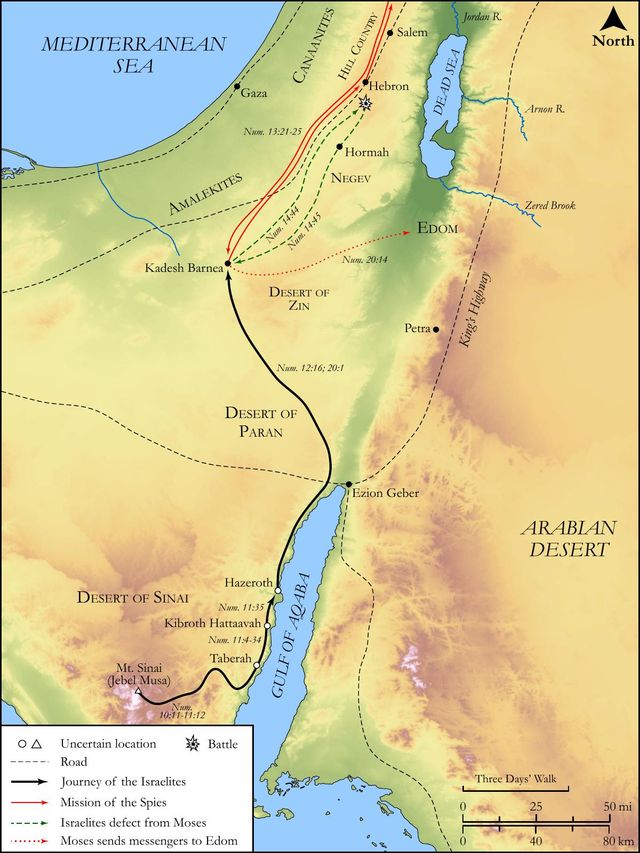
See on the biblical-era map
Study this verse
Public-domain commentary
Matthew Henry
From his Commentary on the Whole Bible. Henry comments on passages, not single verses — this entry covers Numbers 11:4–15. His three-level outline is real structure in the source text, so it is rendered as structure.
These verses represent things sadly unhinged and out of order in Israel, both the people and the prince uneasy.
I.Here is the people fretting, and speaking against God himself (as it is interpreted, Psa 78:19), notwithstanding his glorious appearances both to them and for them. Observe,
1.Who were the criminals.
(1.)The mixed multitude began, they fell a lusting, Num 11:4. The rabble that came with them out of Egypt, expecting only the land of promise, but not a state of probation in the way to it. They were hangers on, who took hold of the skirts of the Jews, and would go with them only because they knew not how to live at home, and were disposed to seek their fortunes (as we say) abroad. These were the scabbed sheep that infected the flock, the leaven that leavened the whole lump. Note, A few factious, discontented, ill-natured people, may do a great deal of mischief in the best societies, if great care be not taken to discountenance them. Such as these are an untoward generation, from which it is our wisdom to save ourselves, Act 2:40.
(2.)Even the children of Israel took the infection, as we are informed, Num 11:4. The holy seed joined themselves to the people of these abominations. The mixed multitude here spoken of were not numbered with the children of Israel, but were set aside as a people God made no account of; and yet the children of Israel, forgetting their own character and distinction, herded themselves with them and learned their way, as if the scum and outcasts of the camp were to be the privy-counsellors of it. The children of Israel, a people near to God and highly privileged, yet drawn into rebellion against him! O how little honour has God in the world, when even the people which he formed for himself, to show forth his praise, were so much a dishonour to him! Therefore let none think that their external professions and privileges will be their security either against Satan's temptations to sin or God's judgments for sin. See Co1 10:1, Co1 10:2, Co1 10:12.
2.What was the crime: they lusted and murmured. Though they had been lately corrected for this sin, and many of them overthrown for it, as God overthrew Sodom and Gomorrah, and the smell of the fire was still in their nostrils, yet they returned to it. See Pro 27:22.
(1.)They magnified the plenty and dainties they had had in Egypt (Num 11:5), as if God had done them a great deal of wrong in taking them thence. While they were in Egypt they sighed by reason of their burdens, for their lives were made bitter to them with hard bondage; and yet now they talk of Egypt as if they had all lived like princes there, when this serves as a colour for their present discontent. But with what face can they talk of eating fish in Egypt freely, or for nought, as if it cost them nothing, when they paid so dearly for it with their hard service? They remember the cucumbers, and the melons, and the leeks, and the onions, and the garlick (precious stuff indeed to be fond of!), but they do not remember the brick-kilns and the task-masters, the voice of the oppressor and the smart of the whip. No, these are forgotten by these ungrateful people.
(2.)They were sick of the good provision God had made for them, Num 11:6. It was bread from heaven, angels' food. To show how unreasonable their complaint was, it is here described, Num 11:7-9. It was good for food, and pleasant to the eye, every grain like an orient pearl; it was wholesome food and nourishing; it was not to be called dry bread, for it tasted like fresh oil; it was agreeable (the Jews say, Wisd. 16:20) to every man's palate, and tasted as he would have it; and, though it was still the same, yet, by the different ways of dressing it, it yielded them a grateful variety; it cost them no money, nor care, for it fell in the night, while they slept; and the labour of gathering it was not worth speaking of; they lived upon free quarter, and yet could talk of Egypt's cheapness and the fish they ate there freely. Nay, which was much more valuable than all this, the manna came from the immediate power and bounty of God, not from common providence, but from special favour. It was, as God's compassion, new every morning, always fresh, not as their food who live on shipboard. While they lived on manna, they seemed to be exempted from the curse which sin has brought on man, that in the sweat of his face should he eat bread. And yet they speak of manna with such scorn, as if it were not good enough to be meat for swine: Our soul is dried away. They speak as if God dealt hardly with them in allowing them no better food. At first they admired it (Exo 16:15): What is this? "What a curious precious thing is this!" But now they despised it. Note, Peevish discontented minds will find fault with that which has no fault in it but that it is too good for them. It is very provoking to God to undervalue his favours, and to put a but upon our common mercies. Nothing but manna! Those that might be very happy often make themselves very miserable by their discontents.
(3.)They could not be satisfied unless they had flesh to eat. They brought flocks and herds with them in great abundance out of Egypt; but either they were covetous, and could not find in their hearts to kill them, lest they should lessen their flocks (they must have flesh as cheap as they had bread, or they would not be pleased), or else they were curious, beef and mutton would not please them; they must have something more nice and delicate, like the fish they did eat in Egypt. Food would not serve; they must be feasted. They had feasted with God upon the peace-offerings which they had their share of; but it seems God did not keep a table good enough for them, they must have daintier bits than any that came to his altar. Note, It is an evidence of the dominion of the carnal mind when we are solicitous to have all the delights and satisfactions of sense wound up to the height of pleasurableness. Be not desirous of dainties, Pro 23:1-3. If God gives us food convenient, we ought to be thankful, though we do not eat the fat and drink the sweet.
(4.)They distrusted the power and goodness of God as insufficient for their supply: Who will give us flesh to eat? taking it for granted that God could not. Thus this question is commented upon, Psa 78:19, Psa 78:20, Can he provide flesh also? though he had given them flesh with their bread once, when he saw fit (Exo 16:13), and they might have expected that he would do it again, and in mercy, if, instead of murmuring, they had prayed. Note, It is an offence to God to let our desires go beyond our faith.
(5.)They were eager and importunate in their desires; they lusted a lust, so the word is, lusted greatly and greedily, till they wept again for vexation. So childish were the children of Israel, and so humoursome, that they cried because they had not what they would have and when they would have it. They did not offer up this desire to God, but would rather be beholden to any one else than to him. We should not indulge ourselves in any desire which we cannot in faith turn into prayer, as we cannot when we ask meat for our lust, Psa 78:18. For this sin the anger of the Lord was kindled greatly against them, which is written for our admonition, that we should not lust after evil things as they lusted, Co1 10:6.
(6.)Flesh is good food, and may lawfully be eaten; yet they are said to lust after evil things. What is lawful of itself becomes evil to us when it is what God does not allot to us and yet we eagerly desire it.
II.Moses himself, though so meek and good a man, is uneasy upon this occasion: Moses also was displeased. Now,
1.It must be confessed that the provocation was very great. These murmurings of theirs reflected great dishonour upon God, and Moses laid to heart the reproaches cast on himself; they knew that he did his utmost for their good, and that he neither did nor could do any thing without a divine appointment; and yet to be thus continually teased and clamoured against by an unreasonable ungrateful people would break in upon the temper even of Moses himself. God considered this, and therefore we do not find that he chided him for his uneasiness.
2.Yet Moses expressed himself otherwise than became him upon this provocation, and came short of his duty both to God and Israel in these expostulations.
(1.)He undervalues the honour God had put upon him, in making him the illustrious minister of his power and grace, in the deliverance and guidance of that peculiar people, which might have been sufficient to balance the burden.
(2.)He complains too much of a sensible grievance, and lays too near his heart a little noise and fatigue. If he could not bear the toil of government, which was but running with the footman, how would he bear the terrors of war, which was contending with horses? He might easily have furnished himself with considerations enough to enable him to slight their clamours, and make nothing of them.
(3.)He magnifies his own performances, that all the burden of the people lay upon him; whereas God himself did in effect ease him of all the burden. Moses needed not to be in care to provide quarters for them, or victuals; God did all. And, if any difficult case happened, he needed not to be in any perplexity, while he had the oracle to consult, and in it the divine wisdom to direct him, the divine authority to back him and bear him out, and almighty power itself to dispense rewards and punishments.
(4.)He is not so sensible as he ought to be of the obligation he lay under, by virtue of the divine commission and command, to do the utmost he could for his people, when he suggests that because they were not the children of his body therefore he was not concerned to take a fatherly care of them, though God himself, who might employ him as he pleased, had appointed him to be a father to them.
(5.)He takes too much to himself when he asks, Whence should I have flesh to give them (Num 11:13), as if he were the housekeeper, and not God. Moses gave them not the bread, Joh 6:32. Nor was it expected that he should give them the flesh, but as an instrument in God's hand; and if he meant, "Whence should God have it for them?" he too much limited the power of the Holy One of Israel.
(6.)He speaks distrustfully of the divine grace when he despairs of being able to bear all this people, Num 11:14. Had the work been much less, he could not have gone through it in his own strength; but had it been much greater, through God strengthening him, he might have done it.
(7.)It was worst of all passionately to wish for death, and desire to be killed out of hand, because just at this time his life was made a little uneasy to him, Num 11:15. Is this Moses? Is this the meekest of all the men on the earth? The best have their infirmities, and fail sometimes in the exercise of that grace for which they are most eminent. But God graciously overlooked Moses's passion at this time, and therefore we must not be severe in our animadversions upon it, but pray, Lord, lead us not into temptation.
Continue studying Numbers 11:10 across the web’s major study libraries — every link below opens this exact verse, chapter, or book on the destination site.
Read & Compare
 BibleGatewayThis verse in more than 200 translations and 70 languages.
 Bible.comThe YouVersion reader — hundreds of translations, reading plans, and highlights.
 ESV.orgCrossway's official English Standard Version reader.
 NET BibleThe NET translation with 60,000+ translators' notes on every rendering decision.
 STEP BibleTyndale House's free study tool — original text, vocabulary, and scholarly resources.
 BibliaLogos Bible Software's free web reader.
 USCCBThe New American Bible (Revised Edition) with the U.S. bishops' study notes.
Commentaries
 BibleHub CommentariesDozens of classic commentaries on this verse, gathered on one page.
 StudyLightMore than 100 commentary sets — the largest collection on the web.
 BibleRefPlain-English commentary on what this verse means, verse by verse.
 Enduring WordDavid Guzik's free commentary on this chapter, widely used by Bible teachers.
 Bible Study ToolsVerse commentary alongside Greek and Hebrew study aids.
Original Language & Research
- BibleHub InterlinearThe verse word by word — original language, transliteration, and English.
- BibleHub LexiconEvery word's original-language definition and Strong's entry.
 Blue Letter BibleDeep-study tools — Strong's numbers, concordance, and word studies.
 SefariaThe Hebrew text with Rashi and centuries of Jewish commentary.
Sermons, Hymns & Audio


TrulyRandomVerse is not affiliated with these sites and doesn’t control their content. They’re linked because they’re genuinely useful.
Summary
Numbers 11:10 powerfully encapsulates a moment of profound spiritual and relational crisis in Israel's wilderness journey. It vividly portrays the widespread, deeply personal, and ungrateful lament of the Israelites, whose insatiable craving for the foods of Egypt led to a collective outpouring of discontent permeating every family and tent. This pervasive rebellion ignited the fierce, righteous anger of the LORD, demonstrating His holy indignation against their persistent ingratitude and unbelief, while simultaneously inflicting a heavy burden and deep displeasure upon Moses, their faithful, yet exasperated, leader.
Context
ShowHideLiterary Context
Numbers 11:10 is a pivotal verse situated within the broader narrative of Israel's wilderness wanderings, specifically following their departure from Mount Sinai and the initial stages of their journey towards the Promised Land. The chapter opens with a general complaint that provokes God's fiery judgment at Taberah (Numbers 11:1). This is quickly followed by the specific "craving" (Numbers 11:4) that originates with the "rabble" or "mixed multitude" among them, a desire that rapidly infects the entire Israelite community. This craving manifests as a profound dissatisfaction with the divinely provided manna, leading to a nostalgic, yet deeply distorted, longing for the "fish, cucumbers, melons, leeks, onions, and garlic" of Egypt (Numbers 11:5). Verse 10 serves as the dramatic climax of this widespread lament, setting the immediate stage for Moses' profound despair and his subsequent, desperate plea to God (Numbers 11:11-15). It precedes God's complex response of providing quail and then judgment (Numbers 11:31-34), underscoring a recurring theme of rebellion and divine patience, often contrasted with Moses' intercession, which is notably absent in this specific verse, highlighting the depth of his own exasperation.
Historical & Cultural Context
The Israelites had experienced miraculous deliverance from centuries of slavery in Egypt and were now sustained by God's daily, supernatural provision of manna in the harsh, desolate wilderness. Their journey was not merely a physical relocation but a profound period of spiritual formation, designed to test their faith, teach them obedience, and forge them into a holy nation. Culturally, communal lament was a recognized and legitimate expression of distress in Israel, often directed towards God in supplication or repentance. However, here, the lament is directed against God's provision and leadership, signaling a profound spiritual rebellion rather than humble petition. The phrase "door of his tent" signifies a private yet pervasive weeping, indicating that this was not merely a public outburst but a deep, personal dissatisfaction that had infiltrated the very fabric of family life. The imagery evokes a sense of utter despair and rejection of their current circumstances, despite the clear and undeniable evidence of God's miraculous care and covenant faithfulness. This widespread murmuring was a direct challenge to the authority of both God and His chosen leader, Moses, echoing earlier incidents of complaint in the wilderness, such as at Marah (Exodus 15:24) and Rephidim (Exodus 17:3).
Key Themes
ShowHideThis verse powerfully contributes to several key themes prevalent throughout the book of Numbers and the Pentateuch. Firstly, it highlights the persistent nature of human rebellion and ungratefulness against divine provision, even in the face of undeniable miracles. The people's weeping demonstrates a profound lack of faith, a spiritual amnesia regarding God's mighty acts of deliverance, and a preference for perceived earthly comforts over divine freedom. Secondly, it underscores God's righteous anger and holy intolerance for sin, particularly for murmuring and unbelief that directly challenges His sovereignty, goodness, and covenant faithfulness. The declaration that "the anger of the LORD was kindled greatly" reveals that God takes their complaints personally, viewing them as a profound rejection of Him and His gracious care. Thirdly, the verse portrays the immense burden and psychological toll of spiritual leadership, as Moses is deeply "displeased" and overwhelmed by the people's constant ingratitude and defiance. This foreshadows his later struggles and even his own momentary failure to fully trust God at Meribah (Numbers 20:12), demonstrating the profound toll that leading a rebellious and ungrateful people can take on even the most faithful servant. Finally, it reinforces the theme of divine judgment and consequence, setting the stage for the devastating plague at Kibroth-Hattaavah (Numbers 11:33), where their craving is met with devastating results, illustrating God's justice in response to sin.
Exposition and Analysis
ShowHideKey Word Analysis
ShowHideThis primitive root signifies a deep, often audible, expression of sorrow, grief, or lamentation. It implies more than just shedding tears; it conveys a profound emotional distress, wailing, or bemoaning. In this context, it highlights the intensity and widespread nature of the Israelites' discontent, suggesting a collective outpouring of misery and regret, not over their sin, but over their perceived lack of desirable food. It underscores the depth of their spiritual malaise and ungratefulness, as they lamented their present blessings in favor of a romanticized past of bondage.
This primitive root literally means "to glow or grow warm" or "to burn," and is frequently used to describe the onset or intensification of anger, wrath, zeal, or jealousy. When applied to the LORD, as here, it denotes a fierce, intense, and consuming divine indignation. The addition of "greatly" (מְאֹד, mᵉʼôd) amplifies the intensity, indicating that God's anger was not a fleeting emotion but a profound, righteous, and consuming response to their persistent rebellion and direct challenge to His authority and provision.
The phrase "Moses also was displeased" uses the Hebrew root רָעַע (râʻaʻ), which properly means "to spoil (literally, by breaking to pieces)" or figuratively "to make (or be) good for nothing, i.e., bad." In this construction, particularly with the accompanying Hebrew word for "eye" (H5869, ʻayin), it signifies that the situation was "evil" or "bad" in Moses' eyes, conveying his deep frustration, disappointment, and exasperation. It reflects the immense emotional and spiritual toll the people's ungratefulness took on their leader, mirroring, in a human way, God's own sentiment. Moses, who had repeatedly interceded for them, was now himself overwhelmed by their persistent lack of faith.
Verse Breakdown
ShowHide"Then Moses heard the people weep throughout their families,"
This clause emphasizes the pervasive and communal nature of the lament. It was not an isolated incident or a few individuals complaining, but a widespread phenomenon that had infiltrated every household. Moses, as the primary leader and mediator, was acutely aware of this collective sorrow, which was directed at their circumstances and, implicitly, at God's provision. The weeping signifies a deep-seated dissatisfaction and a profound lack of contentment, revealing a spiritual malady that had infected the entire community.
"every man in the door of his tent:"
This phrase further underscores the personal and intimate nature of their discontent, even while it was publicly displayed. While weeping "throughout their families" suggests a communal aspect, "every man in the door of his tent" implies a private, yet universal, expression of grief or lament. The tent door was a common place for family life and social interaction, making this a public display of private misery, indicating that the discontent was not hidden but openly expressed, even if within the confines of the family unit, creating an atmosphere of pervasive gloom.
"and the anger of the LORD was kindled greatly;"
This marks the divine response to the people's widespread and ungrateful complaining. God's anger is described as "kindled greatly," signifying a fierce, intense, and righteous indignation. This was not a minor irritation but a profound displeasure rooted in their ungratefulness, their rejection of His miraculous provision, and their direct challenge to His authority and covenant faithfulness. Their weeping was not an act of repentance but of self-pity and rebellion, provoking a just and consuming divine wrath.
"Moses also was displeased."
This final clause highlights the parallel and shared sentiment between God and Moses, albeit from different perspectives. Just as God was greatly angered by their rebellion, Moses too was deeply frustrated, disappointed, and overwhelmed. This reveals the immense burden of spiritual leadership and the emotional toll taken by the people's persistent ingratitude and lack of faith. Moses, who had faithfully led and repeatedly interceded for them, was now himself at his breaking point, reflecting a profound weariness and exasperation with their spiritual immaturity.
Literary Devices
ShowHideNumbers 11:10 employs several potent literary devices to convey its message with vivid intensity. The phrase "weep throughout their families, every man in the door of his tent" utilizes Hyperbole and Synecdoche to emphasize the absolute pervasiveness and depth of the people's discontent. It suggests an almost universal lament, where the spirit of complaint had infected every individual and household, leaving no one untouched. The description of God's reaction, "the anger of the LORD was kindled greatly," is a clear example of Anthropomorphism, attributing human emotion (anger) and a physical action (kindling a fire) to God. This vivid imagery makes His righteous indignation relatable and impactful, conveying the intensity of His displeasure in a way that human understanding can grasp. Furthermore, the verse employs striking Juxtaposition by placing the anger of the LORD directly alongside Moses' displeasure, creating a powerful parallel that highlights the shared burden and profound frustration experienced by both divine and human leadership in response to the people's rebellion. This dual displeasure serves as a form of Emphasis, underscoring the extreme gravity of the Israelites' sin of murmuring and ungratefulness.
Theological and Thematic Connections
ShowHideNumbers 11:10 stands as a stark theological statement on the nature of human sin, divine sovereignty, and the severe consequences of ungratefulness and unbelief. The people's weeping is not a lament of repentance or a cry for mercy, but a self-pitying expression of discontent, revealing a deep-seated unbelief and a profound rejection of God's faithful and miraculous provision. This act of murmuring, often perceived as a minor transgression, is here treated with the utmost seriousness by God, demonstrating that true faith involves contentment and trust in His goodness, even when circumstances are challenging or when desires are not immediately met. Their desire for the "fleshpots of Egypt" over God's miraculous manna reveals a heart that prefers the illusion of past comfort, even in bondage, to the freedom, dignity, and divine sustenance offered by God in the wilderness. This spiritual blindness and rebellious spirit provoke God's righteous anger, underscoring His holiness and His intolerance for a defiant attitude that despises His grace and challenges His authority.
Reflection and Application
ShowHideNumbers 11:10 serves as a powerful and timeless warning against the insidious nature of discontent, ungratefulness, and the spiritual dangers of craving what God has not provided. In an age of abundant provision and constant stimulation, it challenges us to deeply examine our own hearts: do we truly appreciate God's daily blessings, or do we, like the Israelites, constantly crave something more, something different, something we imagine is better, even if it means looking back to a "slavery" of worldly desires? The people's weeping was not just a complaint about food; it was a symptom of a deeper spiritual malady—a profound lack of trust in God's wisdom, goodness, and sovereign care. This verse calls us to cultivate a spirit of profound and consistent gratitude, recognizing that all good gifts come from above and that true contentment and satisfaction are ultimately found in Christ, not in fleeting desires or material possessions. It also invites empathy for those in spiritual leadership, reminding us of the immense emotional and spiritual toll that faithfully guiding a flock can take, and prompting us to support and pray for our spiritual leaders rather than adding to their burdens through our own complaints and criticisms. Ultimately, it reminds us that our attitudes and the state of our hearts matter deeply to God, and persistent murmuring can indeed kindle divine displeasure, hindering our spiritual growth and relationship with Him.
Questions for Reflection
ShowHideFAQ
ShowHideWhy was God's anger "kindled greatly" over what seems like just complaining about food?
ShowHideThe Israelites' complaining was far more than a simple grumble about their diet; it represented a profound spiritual rebellion and a direct challenge to God's authority, faithfulness, and very character. God had miraculously delivered them from centuries of slavery in Egypt (Exodus 12), parted the Red Sea for their escape (Exodus 14), and was sustaining them daily with miraculous manna in the harsh wilderness (Exodus 16). Their lament for the "fish, cucumbers, melons, leeks, onions, and garlic" of Egypt (Numbers 11:5) was a blatant rejection of His divine provision and a romanticization of their past bondage, implying that slavery was preferable to God's care and freedom. This persistent murmuring, a recurring pattern throughout the wilderness narrative (e.g., Exodus 16:2), demonstrated a deep lack of faith, profound ungratefulness, and a questioning of God's love, power, and covenant promises. For God, it was not merely about the food, but about the rebellious heart attitude of unbelief, defiance, and contempt for His grace and sovereign leading. His anger was a righteous and just response to their spiritual infidelity and the profound dishonor they showed Him.
Christ-Centered Fulfillment
ShowHideNumbers 11:10, with its stark depiction of Israel's pervasive discontent and God's righteous anger, finds its ultimate fulfillment and resolution in the person and work of Jesus Christ. The Israelites craved the "fleshpots of Egypt," longing for physical sustenance that, in their spiritual blindness, led to further spiritual death and divine judgment. In profound contrast, Jesus declared Himself to be the "bread of life" (John 6:35), the true manna from heaven, offering eternal sustenance that truly satisfies the deepest longings of the human soul, a satisfaction that the world cannot give. While Israel murmured and rebelled against God's provision and authority, Jesus perfectly submitted to the Father's will, even unto death on the cross, becoming the ultimate, perfect sacrifice that appeases divine wrath against human sin. Moses, burdened and deeply displeased by the people's persistent rebellion and ungratefulness, foreshadows Christ, who, though tempted in every way, remained without sin (Hebrews 4:15), and who, unlike Moses, does not grow weary of His people's failings but continually intercedes for them as our great High Priest (Hebrews 7:25). The anger of the LORD, kindled greatly against Israel's ungratefulness and unbelief, was fully poured out on Christ at Calvary, so that all who believe in Him might receive grace, mercy, and reconciliation instead of judgment (Romans 5:8). Thus, Jesus is the divine answer to humanity's deep-seated discontent and rebellion, offering true satisfaction, perfect obedience, and ultimate reconciliation with a holy God, transforming hearts of murmuring into hearts of profound gratitude and worship.