


Mark 10:14
Bible text: King James Version (1769 Blayney text) · Public domain
Bible text: King James Version with Strong's numbers · Public domain
Bible text: Berean Standard Bible · Public domain
Bible text: American Standard Version (1901) · Public domain
Bible text: World English Bible, Messianic edition · Public domain
Bible text: Geneva Bible (1599) · Public domain
Bible text: Young's Literal Translation · Public domain
- ἰδὼνidōnHaving seenG1492V-2AAP-NSMVerb 2nd Aorist Active Participle Nominative Singular Masculine
- δὲdenowG1161CONJConjunction
- ὁho<the>G3588T-NSMDefinite article Nominative Singular Masculine
- ἸησοῦςIēsousJesusG2424N-NSM-PNoun Nominative Singular Masculine Individual
- ἠγανάκτησενēganaktēsenwas indignantG23V-AAI-3SVerb Aorist Active Indicative 3rd Singular
- καὶkaiandG2532CONJConjunction
- εἶπενeipenHe saidG2036V-2AAI-3SVerb 2nd Aorist Active Indicative 3rd Singular
- αὐτοῖς·autoisto themG846P-DPMPersonal pronoun Dative Plural Masculine
- ἄφετεaphetedo permitG863V-2AAM-2PVerb 2nd Aorist Active Imperative 2nd Plural
- τὰtatheG3588T-APNDefinite article Accusative Plural Neuter
- παιδίαpaidialittle childrenG3813N-APNNoun Accusative Plural Neuter
- ἔρχεσθαιerchesthaito comeG2064V-PNNVerb Present Middle Or Passive Deponent Infinitive
- πρόςprostoG4314PREPPreposition
- μεmeMeG3165P-1ASPersonal pronoun Accusative 1st Singular
- καὶkaiandG2532CONJConjunction
- μὴmēnotG3361PRT-NNegative Particle Negative
- κωλύετεkōluetedo hinderG2967V-PAM-2PVerb Present Active Imperative 2nd Plural
- αὐτάautathem!G846P-APNPersonal pronoun Accusative Plural Neuter
- τῶνtōnTo theG3588T-GPNDefinite article Genitive Plural Neuter
- γὰρgarforG1063CONJConjunction
- τοιούτωνtoioutōnsof uchG5108D-GPNDemonstrative pronoun Genitive Plural Neuter
- ἐστὶνestinbelongsG1510V-PAI-3SVerb Present Active Indicative 3rd Singular
- ἡhētheG3588T-NSFDefinite article Nominative Singular Feminine
- βασιλείαbasileiakingdomG932N-NSFNoun Nominative Singular Feminine
- τοῦtou<the>G3588T-GSMDefinite article Genitive Singular Masculine
- θεοῦtheouof GodG2316N-GSM-TNoun Genitive Singular Masculine Title
English is a literal word-by-word gloss of the Greek, not the KJV's wording. Why?
This is the original text the KJV's translators worked from — each Greek word with its own literal English meaning in this verse, prepared by scholars at Tyndale House, Cambridge. The KJV translates whole sentences, not word by word, so its wording differs: one Greek word can become several English words, and the KJV may choose “charity” where the gloss reads “love”. Both are faithful — they answer different questions. For the KJV's own rendering, switch to the KJV text.
Details
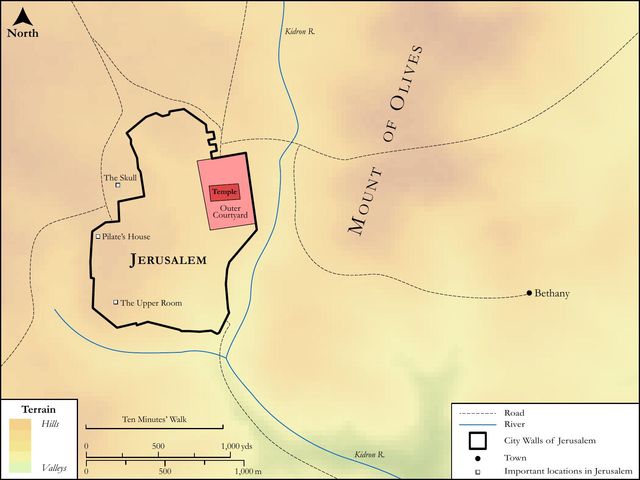
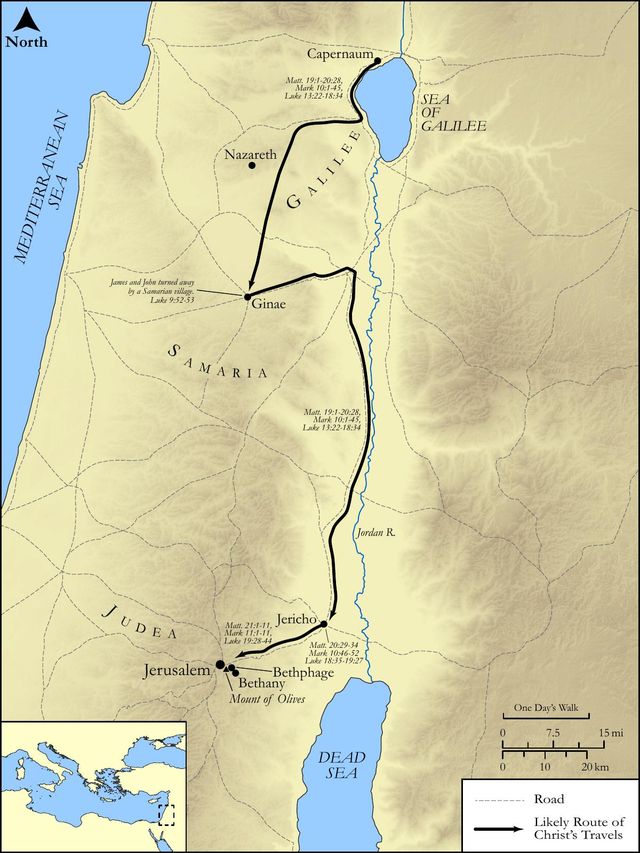
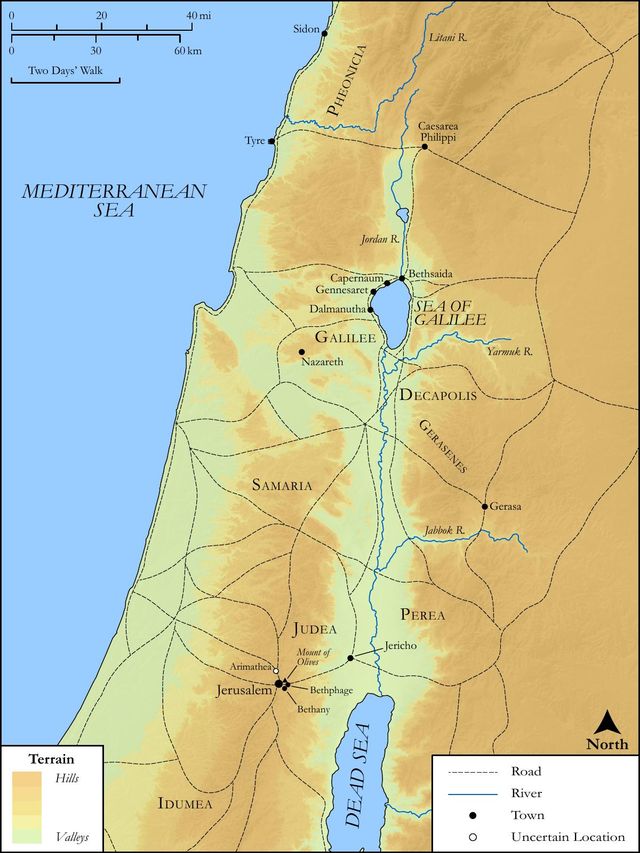
See on the biblical-era maps
Study this verse
Public-domain commentary
Matthew Henry
From his Commentary on the Whole Bible. Henry comments on passages, not single verses — this entry covers Mark 10:13–16. His three-level outline is real structure in the source text, so it is rendered as structure.
It is looked upon as the indication of a kind and tender disposition to take notice of little children, and this was remarkable in our Lord Jesus, which is an encouragement not only to little children to apply themselves to Christ when they are very young, but to grown people, who are conscious to themselves of weakness and childishness, and of being, through manifold infirmities, helpless and useless, like little children. Here we have,
I.Little children brought to Christ, Mar 10:13.
Their parents, or whoever they were that had the nursing of them, brought them to him, that he should touch them, in token of his commanding and conferring a blessing on them. It doth not appear that they needed any bodily cure, nor were they capable of being taught: but it seems,
1.That they had the care of them were mostly concerned about their souls, their better part, which ought to be the principal care of all parents for their children; for that is the principal part, and it is well with them, it if be well with their souls.
2.They believed that Christ's blessing would do their souls good; and therefore to him they brought them, that he might touch them, knowing that he could reach their hearts, when nothing their parents could say to them, or do for them, would reach them. We may present our children to Christ, now that he is in heaven, for from thence he can reach them with his blessing, and therein we may act faith upon the fulness and extent of his grace, the kind intimations he hath always given of favour to the seed of the faithful, the tenour of the covenant with Abraham, and the promise to us and to our children, especially that great promise of pouring his Spirit upon our seed, and his blessing upon our offspring, Isa 44:3.
II.The discouragement which the disciples gave to the bringing of children to Christ; They rebuked them that brought them; as if they had been sure that they knew their Master's mind in this matter, whereas he had lately cautioned them not to despise the little ones.
III.The encouragement Christ gave to it.
1.He took it very ill that his disciples should keep them off; When he saw it, he was much displeased, Mar 10:14. "What do you mean? Will you hinder me from doing good, from doing good to the rising generation, to the lambs of the flock?" Christ is very angry with his own disciples, if they discountenance any in coming to him themselves, or in bringing their children to him.
2.He ordered that they should be brought to him, and nothing said or done to hinder them; suffer little children, as soon as they are capable, to come to me, to offer up their supplications to me, and to receive instructions from me. Little children are welcome betimes to the throne of grace with their Hosannas.
3.He owned them as members of his church, as they had been of the Jewish church. He came to set up the kingdom of God among men, and took this occasion to declare that that kingdom admitted little children to be the subjects of it, and gave them a title to the privileges of subjects. Nay, the kingdom of God is to be kept up by such: they must be taken in when they are little children, that they may be secured for hereafter, to bear up the name of Christ.
4.That there must be something of the temper and disposition of little children found in all that Christ will own and bless. We must receive the kingdom of God as little children (Mar 10:15); that is, we must stand affected to Christ and his grace as little children do to their parents, nurses, and teachers. We must be inquisitive, as children, must learn as children (that is the learning age), and in learning must believe, Oportet discentem credere - A learner must believe. The mind of a child is white paper (tabula rose - a mere blank), you may write upon it what you will; such must our minds be to the pen of the blessed Spirit. Children are under government; so must we be. Lord, what wilt thou have me to do? We must receive the kingdom of God as the child Samuel did, Speak, Lord, for thy servant heareth. Little children depend upon their parents' wisdom and care, are carried in their arms, go where they send them, and take what they provide for them; and thus must we receive the kingdom of God, with a humble resignation of ourselves to Jesus Christ, and an easy dependence upon him, both for strength and righteousness, for tuition, provision, and a portion.
5.He received the children, and gave them what was desired (Mar 10:16); He took them up in his arms, in token of his affectionate concern for them; put his hands upon them, as was desired, and blessed them. She how he out-did the desires of these parents; they begged he would touch them, but he did more.
(1.)He took them in his arms. Now the scripture was fulfilled (Isa 40:11), He shall gather the lambs in his arms, and carry them in his bosom. Time was, when Christ himself was taken up in old Simeon's arms, Luk 2:28. And now he took up these children, not complaining of the burthen (as Moses did, when he was bid to carry Israel, that peevish child, in his bosom, as a nursing father bears the sucking child, Num 11:12), but pleased with it. If we in a right manner bring our children to Christ, he will take them up, not only in the arms of his power and providence, but in the arms of his pity and grace (as Eze 16:8); underneath them are the everlasting arms.
(2.)He put his hands upon them, denoting the bestowing of his Spirit upon them (for that is the hand of the Lord), and his setting them apart for himself.
(3.)He blessed them with the spiritual blessings he came to give. Our children are happy, if they have but the Mediator's blessing for their portion. It is true, we do not read that he baptized these children, baptism was not fully settled as the door of admission into the church until after Christ's resurrection; but he asserted their visible church-membership, and by another sign bestowed those blessings upon them, which are now appointed to be conveyed and conferred by baptism, the seal of the promise, which is to us and to our children.
Historical interpretation
Nine Centuries of Reception
9 surviving comments on this verse. Each one is dated, so this reads as a timeline rather than a list.
Select a marker to jump to its quote. Markers stagger vertically where authors wrote within a few decades of each other.
For why is it necessary-if (baptism itself) is not so necessary -that the sponsors likewise should be thrust into danger? Who both themselves, by reason of mortality, may fail to fulfil their promises, and may be disappointed by the development of an evil disposition, in those for whom they stood? The Lord does indeed say, "Forbid them not to come unto me." Let them "come," then, while they are growing up; let them "come" while they are learning, while they are learning whither to come; let them become Christians when they have become able to know Christ.
(Matt. tom. xv. 7) If any of those who profess to hold the office of teaching in the Church should see a person bringing to them some of the foolish of this world, and low born, and weak, who for this reason are called children and infants, let him not forbid the man who offers such an one to the Saviour, as though he were acting without judgment. After this He exhorts those of His disciples who are already grown to full stature to condescend to be useful to children, that they may become to children as children, that they may gain children; for He Himself, when He was in the form of God, humbled Himself, and became a child. On which He adds: For of such is the kingdom of heaven. (1 Cor. 9:22)
For which reason we think that no one is to be hindered from obtaining grace by that law which was already ordained, and that spiritual circumcision ought not to be hindered by carnal circumcision, but that absolutely every man is to be admitted to the grace of Christ, since Peter also in the Acts of the Apostles speaks, and says, "The Lord hath said to me that I should call no man common or unclean."8 But if anything could hinder men from obtaining grace, their more heinous sins might rather hinder those who are mature and grown up and older. But again, if even to the greatest sinners, and to those who had sinned much against God, when they subsequently believed, remission of sins is granted-and nobody is hindered from baptism and from grace-how much rather ought we to shrink from hindering an infant, who, being lately born, has not sinned, except in that, being born after the flesh according to Adam,9 he has contracted the contagion of the ancient death at its earliest birth, who approaches the more easily on this very account to the reception of the forgiveness of sins-that to him are remitted, not his own sins, but the sins of another.
The apostle praised one [Timothy] who had known the holy Scripture from infancy. He also instructed that children be reared “in the discipline and correction of the Lord.” So we consider every time of life, even the very earliest, suitable for receiving persons into the community of faith.
(ubi sup.) But the disciples, out of regard for the dignity of Christ, forbade those who brought them. And this is what is added: And his disciples rebuked those who brought them. But our Saviour, in order to teach His disciples to be modest in their ideas, and to tread under foot worldly pride, takes the children to Him, and assigns to them the kingdom of God: wherefore it goes on: And he said unto them, Suffer little children to come unto me, and forbid them not.
(ubi sup.) For indeed the mind of a child is pure from all passions, for which reason, we ought by free choice to do those works, which children have by nature.
(Vict. Ant. e Cat. in Marc.) There is no contrariety in Matthew's relating that He spoke these words to the Pharisees, though Mark says that they were spoken to the disciples; for it is possible that He may have spoken them to both.
(Vict. Ant. e Cat. in Marc.) Fitly does He take them up into His arms to bless them, as it were, lifting into His own bosom, and reconciling Himself to His creation, which in the beginning fell from Him, and was separated from Him. Again, He puts His hands upon the children, to teach us the working of His divine power; and indeed, He puts His hands upon them, as others are wont to do, though His operation is not as that of others, for though He was God, He kept to human ways of acting, as being very man.
(ubi sup.) That is, if ye have not innocence and purity of mind like that of children, ye cannot enter into the kingdom of heaven. Or else, we are ordered to receive the kingdom of God, that is, the doctrine of the Gospel, as a little child, because as a child, when he is taught, does not contradict his teachers, nor put together reasonings and words against them, but receives with faith what they teach, and obeys them with awe, so we also are to receive the word of the Lord with simple obedience, and without any gainsaying. It goes on: And he took them up in his arms, put his hands upon them, and blessed them.
(ubi sup.) Having embraced the children, He also blessed them, implying that the lowly in spirit are worthy of His blessing, grace, and love.
When Jesus saw them, He was indignant and said to them, "Let the little children come to Me, and do not hinder them, for the kingdom of God belongs to such as these." He said significantly, "to such as these," not "to these," to show that it is not age that reigns, but character; and that the reward is promised to those who have similar innocence and simplicity. The Apostle also agrees with this sentiment: "Brothers, do not be children in understanding, but in malice be children, and in understanding be perfect."
The wickedness of the Pharisees in tempting Christ, has been related above, and now is shown the great faith of the multitude, who believed that Christ conferred a blessing on the children whom they brought to Him, by the mere laying on of His hands. Wherefore it is said: And they brought young children to him, that he might touch them.
Wherefore He says not, for of these, but of such is the kingdom of God, that is, of persons who have both in their intention and their work the harmlessness and simplicity which children have by nature. For a child does not hate, does nothing of evil intent, nor though beaten does he quit his mother; and though she clothe him in vile garments, prefers them to kingly apparel; in like manner he, who lives according to the good ways of his mother the Church, honours nothing before her, nay, not pleasure, which is the queen of many; wherefore also the Lord subjoins, Verily I say unto you, Whosoever shall not receive the kingdom of God as a little child, he shall not enter therein.
Continue studying Mark 10:14 across the web’s major study libraries — every link below opens this exact verse, chapter, or book on the destination site.
Read & Compare
 BibleGatewayThis verse in more than 200 translations and 70 languages.
 Bible.comThe YouVersion reader — hundreds of translations, reading plans, and highlights.
 ESV.orgCrossway's official English Standard Version reader.
 NET BibleThe NET translation with 60,000+ translators' notes on every rendering decision.
 STEP BibleTyndale House's free study tool — original text, vocabulary, and scholarly resources.
 BibliaLogos Bible Software's free web reader.
 USCCBThe New American Bible (Revised Edition) with the U.S. bishops' study notes.
Commentaries
 BibleHub CommentariesDozens of classic commentaries on this verse, gathered on one page.
 StudyLightMore than 100 commentary sets — the largest collection on the web.
 BibleRefPlain-English commentary on what this verse means, verse by verse.
 Enduring WordDavid Guzik's free commentary on this chapter, widely used by Bible teachers.
 Bible Study ToolsVerse commentary alongside Greek and Hebrew study aids.
Original Language & Research
- BibleHub InterlinearThe verse word by word — original language, transliteration, and English.
- BibleHub LexiconEvery word's original-language definition and Strong's entry.
 Blue Letter BibleDeep-study tools — Strong's numbers, concordance, and word studies.
 CNTR CollationThe earliest Greek manuscripts of this verse, collated letter by letter.
Sermons, Hymns & Audio


TrulyRandomVerse is not affiliated with these sites and doesn’t control their content. They’re linked because they’re genuinely useful.
Summary
In Mark 10:14, Jesus sternly rebukes his disciples for hindering children from approaching him, unequivocally declaring that the Kingdom of God belongs to those who embody the qualities of such little ones. This pivotal moment reveals Jesus' universal reach, his deep displeasure with those who obstruct access to him, and his profound redefinition of who is truly valued in God's eyes, setting a foundational principle for kingdom membership.
Context
ShowHideLiterary Context
This verse is a direct and forceful reaction by Jesus to the preceding event described in Mark 10:13. There, people were bringing young children to Jesus for him to touch them, a common practice seeking blessing or healing. However, the disciples, likely operating under prevailing social norms or perhaps attempting to "protect" Jesus' time and dignity from what they perceived as trivial interruptions, "rebuked them." Jesus' response in verse 14 is not merely a mild correction but a strong expression of indignation, immediately overturning his disciples' misguided actions and articulating a foundational truth about the nature of God's Kingdom and who is welcome within it. This incident is part of a larger section in Mark (chapters 8-10) where Jesus repeatedly challenges his disciples' worldly understanding of power, greatness, and discipleship, often contrasting their ambition with the humility and servanthood required for true kingdom living, as seen in their arguments about who is greatest in Mark 9:33-37.
Historical & Cultural Context
In the first-century Roman and Jewish societies, children held a significantly lower status than adults. They possessed few, if any, legal rights, were often regarded as property, and were not considered important members of the community in a public or religious sense. Their opinions were not sought, and their presence was often overlooked or dismissed. It was highly unusual for an esteemed rabbi or teacher to dedicate time specifically to children, let alone to use them as a paradigm for spiritual truth. The disciples' actions in Mark 10:13 would have been entirely consistent with the prevailing cultural attitudes of the time. Jesus' reaction, therefore, was counter-cultural and revolutionary, elevating the status of children and challenging the established social hierarchy by placing them at the very center of his teaching on the Kingdom of God.
Key Themes
ShowHideMark 10:14 contributes significantly to several key themes within the Gospel of Mark and broader biblical theology. Firstly, it powerfully illustrates Jesus' universal reach and compassion, demonstrating his welcoming nature towards the lowly and overlooked, contrasting sharply with the exclusive tendencies of his disciples. Secondly, it profoundly redefines the nature of the Kingdom of God, asserting that its entry requirements are not based on social status, intellectual prowess, or religious achievements, but on qualities akin to those found in children—humility, dependence, trust, and lack of pretense. This theme is further developed in other teachings, such as the call to humble oneself like a child in Matthew 18:3-4. Lastly, the incident serves as another crucial lesson in discipleship, highlighting the disciples' persistent misunderstanding of Jesus' mission and values. It underscores the ongoing need for followers to shed worldly perspectives and adopt the counter-cultural values of God's Kingdom, emphasizing that true greatness in the Kingdom is found in servanthood and humility, as Jesus teaches elsewhere in Mark 9:35.
Exposition and Analysis
ShowHideKey Word Analysis
ShowHideMeaning "to be greatly afflicted, i.e. (figuratively) indignant." This word conveys a strong emotion, indicating Jesus was not merely annoyed but genuinely vexed or indignant. His displeasure was profound, signaling a deep offense at his disciples' actions and their failure to grasp a fundamental aspect of his ministry and God's heart.
Meaning "to send forth, in various applications... to allow, permit, let." In this context, Jesus issues a clear command to "allow" or "permit" the children to come to him without hindrance. It is an authoritative directive to cease their obstruction and facilitate access.
A neuter diminutive of país, meaning "a childling (of either sex), i.e. (properly), an infant, or (by extension) a half-grown boy or girl." The term emphasizes the tender age and vulnerability of those being brought to Jesus, making his welcome even more poignant and his disciples' rebuke more egregious.
Verse Breakdown
ShowHide"But when Jesus saw [it], he was much displeased"
This clause highlights Jesus' immediate and strong emotional reaction. The disciples' attempt to keep the children away provoked a deep indignation in Jesus, indicating that their actions were not merely a minor misstep but a significant affront to his mission and the nature of God's Kingdom. His displeasure underscores the importance he places on welcoming the vulnerable and accessible.
"and said unto them, "Suffer the little children to come unto me, and forbid them not":"
Jesus directly addresses his disciples, issuing a clear, authoritative command. "Suffer" (allow/permit) is an imperative, directly countermanding their previous actions. The double negative "forbid them not" emphasizes the absolute nature of his instruction, leaving no room for misunderstanding or further obstruction. He desires direct, unhindered access for the children to himself.
"for of such is the kingdom of God."
This is the theological grounding for Jesus' command, providing the profound reason for his indignation and his welcome. The phrase "of such" (Greek, toioûtos, G5108) refers to those who possess the qualities characteristic of children—humility, dependence, trust, lack of pretense, and openness. Jesus declares that the Kingdom of God is not built upon power, status, or self-sufficiency, but on these childlike attributes. These are the qualities necessary for entry into and participation in God's reign.
Literary Devices
ShowHideThe passage powerfully employs Contrast to highlight Jesus' radical values against the conventional wisdom of his disciples and society. The disciples' attempt to exclude the children stands in stark opposition to Jesus' indignant welcome, emphasizing the chasm between worldly and kingdom perspectives. Furthermore, Jesus uses Simile (or a form of Metaphor) when he declares, "for of such is the kingdom of God." He is not saying the kingdom is literally made up only of children, but that it belongs to those who possess childlike qualities, making children a living parable for kingdom entry. This also functions as a form of Inversion, as Jesus reverses the societal hierarchy by elevating the lowly and vulnerable (children) as models for the most profound spiritual truth (the Kingdom of God), challenging his followers' understanding of true greatness and spiritual status.
Theological and Thematic Connections
ShowHideMark 10:14 is a profound theological statement that redefines the nature of spiritual access and kingdom membership. It reveals God's heart for the humble, the dependent, and the lowly, contrasting sharply with human tendencies to value power, status, or self-sufficiency. Jesus' indignation underscores that hindering access to him, especially for the vulnerable, is a serious offense against the divine will. The "childlike" qualities he extols—humility, trust, and simple faith—are presented as the essential prerequisites for entering God's Kingdom, challenging any notion that spiritual maturity or religious achievement are the primary gateways. This passage calls believers to cultivate a radical dependence on God and to actively welcome all who seek Jesus, regardless of their perceived status or worth.
Reflection and Application
ShowHideJesus' passionate defense of children in Mark 10:14 serves as a timeless challenge to our own attitudes and practices. In a world that often values independence, strength, and achievement, Jesus elevates humility, dependence, and simple trust as the hallmarks of kingdom citizens. This passage compels us to examine our own hearts: do we, like the disciples, sometimes inadvertently create barriers for others to come to Jesus, perhaps through our judgments, our busyness, or our focus on outward appearances? It calls the church to be a place where children are not merely tolerated but celebrated, valued, and seen as vital participants in the community of faith, not just future members. Furthermore, it reminds us that true spiritual growth involves embracing a childlike posture before God—a willingness to trust completely, to admit our need, and to receive grace with open hands, free from the pretense and self-reliance that often hinder our relationship with God.
Questions for Reflection
ShowHideFAQ
ShowHideWhy were the disciples rebuking those bringing children to Jesus?
ShowHideThe disciples were likely operating under common cultural norms of the time, where children held little social status and were not typically considered important enough to warrant a rabbi's attention. They may have thought they were protecting Jesus' time, dignity, or energy from what they perceived as trivial interruptions, or perhaps they believed that only adults, particularly those with a certain level of religious understanding or social standing, were worthy of Jesus' direct engagement. Their actions stemmed from a misunderstanding of Jesus' mission and the true nature of God's Kingdom, which Jesus consistently sought to correct, as seen in his teaching on servanthood in Mark 9:33-37.
What does Jesus mean by "of such is the kingdom of God"?
ShowHideWhen Jesus says, "of such is the kingdom of God," he is not implying that only literal children can enter the Kingdom. Instead, he is using children as a powerful illustration of the qualities required for kingdom membership. The "such" refers to those who possess childlike attributes: humility, dependence, trust, openness, and a lack of pretense or self-sufficiency. Unlike adults who often rely on their own wisdom, achievements, or status, children naturally depend on others, are open to learning, and approach life with simple trust. Jesus teaches that these are the essential spiritual postures for receiving God's reign, as he further explains in Matthew 18:3-4.
Christ-Centered Fulfillment
ShowHideMark 10:14 finds its ultimate fulfillment in the person and work of Jesus Christ, who not only preached the Kingdom of God but embodied it perfectly. His indignant welcome of the children underscores his identity as the compassionate Shepherd who gathers the vulnerable and the Lamb of God who humbles himself for the sake of humanity. Jesus himself is the ultimate example of the childlike humility he commends, as seen in his willingness to empty himself and take on the form of a servant, even to death on a cross, as described in Philippians 2:5-8. Through his life, death, and resurrection, Jesus inaugurated the Kingdom of God, making access possible for all who come to him with childlike faith, dependence, and trust. He is the one who invites all who are weary and burdened to come to him for rest, promising that his yoke is easy and his burden is light, a call that resonates deeply with the simple trust of a child (Matthew 11:28-30). Thus, the Kingdom of God is "of such" because it is founded upon and accessed through the one who perfectly demonstrated and graciously provides the very humility and dependence he calls us to.